
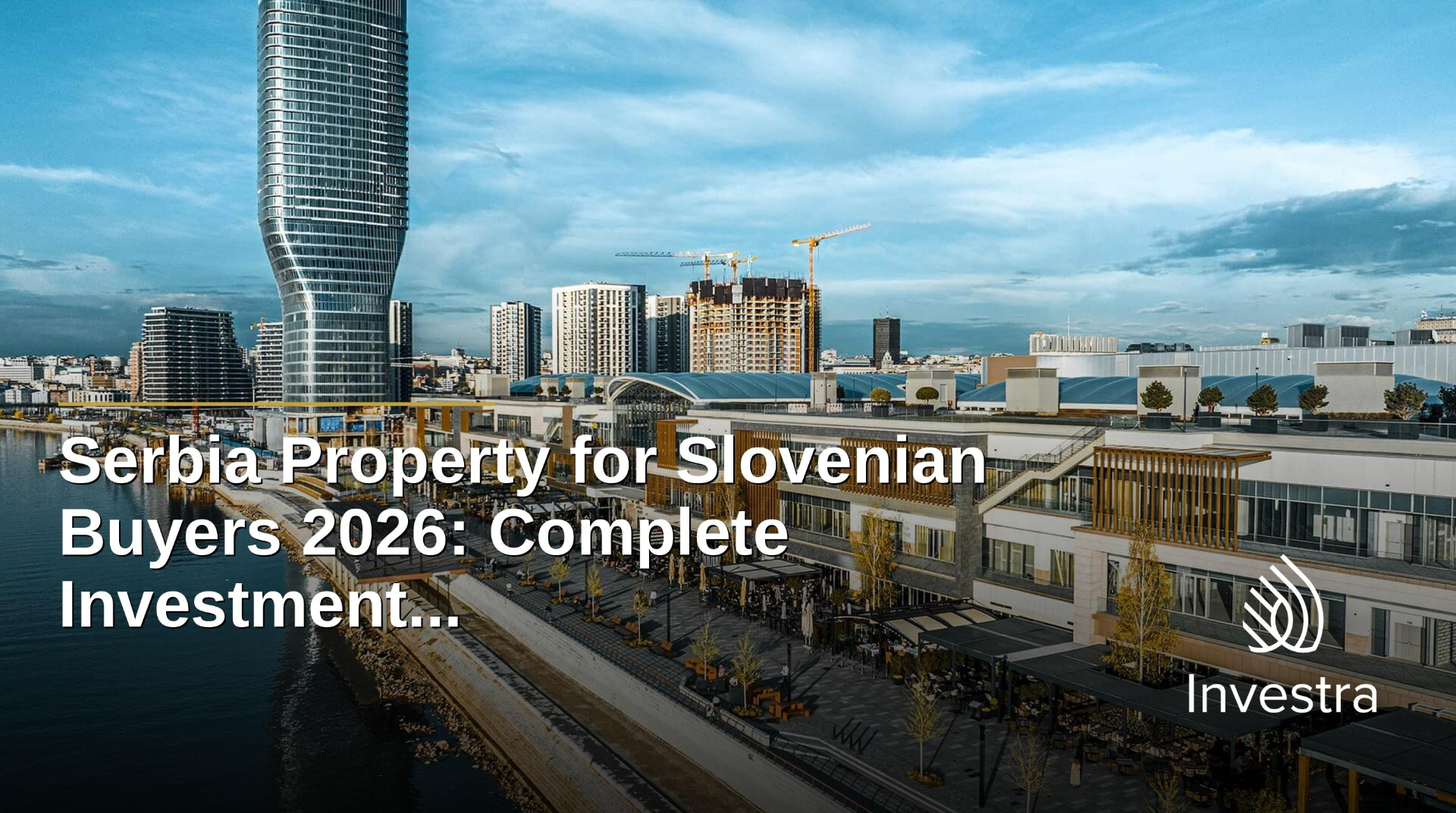
Serbia Property for Slovenian Buyers 2026: Complete Investment...
Serbia Property for Slovenian Buyers 2026: Complete Investment Guide from Slovenia
Slovenian buyers can purchase residential and commercial property in Serbia without major restrictions, with Belgrade and Novi Sad offering the strongest rental yields and capital growth prospects through 2026. Average prices range from €2,100 per square metre in secondary cities to €3,800 in prime Belgrade districts, supported by strong demand from both locals and regional investors. Cross-border purchases remain straightforward for EU citizens, though professional legal and tax advice is essential before committing capital.
Introduction
Slovenian interest in Serbian real estate has grown steadily since the early 2020s, driven by proximity, cultural familiarity, and significantly lower entry prices compared with Ljubljana or the Slovenian coast. In 2026, this trend shows no signs of slowing. Many Slovenian investors now view Serbia as a natural extension of their domestic portfolio, especially as Ljubljana apartment prices have climbed above €4,500 per square metre while comparable quality stock in Belgrade still trades well below that threshold.
The appeal goes beyond simple price arbitrage. Serbia’s economy continues to expand at a faster pace than Slovenia’s, supported by foreign direct investment in manufacturing, IT, and logistics. This growth translates directly into housing demand from young professionals and expatriate workers. Slovenian buyers, who already speak a closely related language and face minimal bureaucratic hurdles, are well positioned to capitalise on these dynamics.
At the same time, the regulatory environment for foreign purchasers has remained stable and transparent. EU citizens enjoy the same property rights as Serbian nationals when buying residential units, and the process is further eased by the absence of reciprocity requirements that still apply to some non-EU nationalities. For Slovenians considering their first cross-border purchase, 2026 represents a window of relative stability before potential EU accession talks introduce new variables.
Throughout this guide we reference data and listings available on Investra.io, the platform many Slovenian investors use to compare Serbian opportunities alongside domestic options.
Market Overview
Belgrade remains the clear focal point for Slovenian capital. In the first quarter of 2026, average asking prices in the capital reached €3,250 per square metre, up 6.8 percent year-on-year. Novi Sad, the second-largest city and a university hub, recorded €2,450 per square metre with stronger rental demand from students and young professionals. Secondary cities such as Niš and Kragujevac continue to lag at €1,650–1,900 per square metre, offering higher yields but thinner liquidity.
Transaction volumes between Slovenian buyers and Serbian sellers have increased by roughly 22 percent since 2023, according to notarial records. Most purchases involve one- and two-bedroom apartments in established residential districts rather than new-build developments. Cash transactions still dominate, although several Serbian banks now offer mortgage products to EU residents at rates between 4.1 and 5.3 percent.
Further context on current pricing and forecasts can be found in the Belgrade Real Estate Market 2026 report and the broader Serbia Property Investment Guide 2026.
Key Investment Factors
Legal Framework for Slovenian Citizens
EU nationals face no ownership caps on residential property in Serbia. The purchase is registered at the local cadastre office after the sales contract is notarised. Slovenian buyers benefit from simplified apostille procedures under the Hague Convention, which both countries have ratified. The entire legal transfer typically takes between six and ten weeks when documents are prepared correctly. Investors should still engage a Serbian-licensed attorney to verify title and resolve any historical ownership disputes common in older buildings.
Tax Considerations
Property tax rates in Serbia remain among the lowest in the region. Annual property tax averages 0.4 percent of cadastral value, while capital gains tax on sale stands at 15 percent if the asset is held less than five years. Rental income is taxed at a flat 10 percent after allowable deductions. Slovenian residents must also declare foreign income under Slovenian tax rules, creating a need for coordinated cross-border advice. Detailed breakdowns appear in the dedicated Serbia Property Taxes 2026 guide.
Financing and Currency Issues
Most Slovenian buyers continue to finance acquisitions through equity or Slovenian bank loans secured against domestic assets. Serbian mortgages for non-residents are available but require proof of stable income and usually a 30–40 percent down payment. The Serbian dinar remains the transactional currency, introducing modest FX risk that many investors hedge through euro-denominated rental contracts.
Market Accessibility and Local Partnerships
Language proximity reduces friction. Many Serbian real estate agents and lawyers already work regularly with Slovenian clients, and several agencies maintain offices in Ljubljana. Platforms such as Investra.io allow Slovenian users to shortlist verified listings, request video viewings, and connect directly with bilingual legal teams before travelling to Serbia.
Price Analysis Table
| Area | Avg. Price €/m² (Q1 2026) | Expected Rental Yield | 5-Year Price Forecast |
|---|---|---|---|
| Belgrade – Vračar / Savski Venac | €3,750 | 5.1% | +18–22% |
| Belgrade – New Belgrade | €3,150 | 5.8% | +15–19% |
| Novi Sad – City Centre | €2,650 | 6.4% | +14–17% |
| Niš – Medijana | €1,850 | 7.2% | +11–14% |
| Kragujevac – Centar | €1,680 | 7.6% | +9–12% |
Why Invest in 2026
Three structural drivers support continued price growth and rental demand through the remainder of the decade. First, Serbia’s ongoing infrastructure programme, including the completion of the Belgrade bypass and additional high-speed rail links to Novi Sad, continues to improve connectivity and unlock new residential catchments. Second, the country’s IT and shared-services sectors keep expanding, attracting young professionals who prefer renting over buying in the short term. Third, Slovenia’s own housing shortage and elevated prices are pushing more domestic investors to look southward for diversification.
Timing also matters. Several large-scale residential projects in Belgrade are scheduled for completion in late 2026 and early 2027, which could temporarily increase supply and create selective entry points for buyers willing to purchase off-plan. At the same time, the Serbia Buying Process 2026 remains predictable, giving Slovenian investors a clear runway to complete due diligence before any potential policy shifts linked to EU accession negotiations.
As with any investment, property in Serbia carries risks. Only invest capital you can afford to lose.
Practical Buying Guide
Slovenian buyers benefit from a relatively open market in Serbia, but success depends on careful preparation and the right local support. The process typically takes between six and twelve weeks once a property is chosen.
Step 1: Research and Shortlist Properties
Begin by identifying your goals—whether for rental income, personal use, or long-term capital growth. Belgrade districts such as Vračar and Savski Venac, along with central Novi Sad, consistently deliver stronger yields. Use local portals and cross-check prices against recent sales data from the Serbian Real Estate Cadastre to avoid overpaying.
Step 2: Assemble Your Team
Engage a Serbian-licensed real estate agent and an independent lawyer before making any offer. Your Slovenian notary can review documents, yet local counsel is essential for land-registry checks and contract drafting. Many Slovenian buyers also open a temporary bank account in Serbia for smoother fund transfers.
Step 3: Due Diligence and Preliminary Contract
Verify ownership, confirm no outstanding debts or disputes, and check zoning plans. Once satisfied, sign a preliminary contract and pay a 10 percent deposit held in escrow. This step protects both parties while final approvals are obtained.
Step 4: Notary, Payment and Registration
The purchase contract is signed before a Serbian notary. Full payment follows, usually via bank transfer. The notary then submits documents to the Real Estate Cadastre, where title transfer normally completes within 30 days. Slovenian buyers receive the same ownership rights as locals once registered.
Costs & Fees Breakdown
| Item | Example (EUR 150,000 apartment) | Notes |
|---|---|---|
| Purchase price | 150,000 | Negotiated amount |
| Notary fees | 450–650 | Fixed scale plus VAT |
| Transfer tax | 750–4,500 | 0.5–3 % of value |
| Agent commission | 3,000–4,500 | 2–3 % split between parties |
| Legal fees | 800–1,200 | Due diligence and contract review |
| Cadastre registration | 150–250 | Official filing fees |
| Total additional costs | 5,150–11,100 | 3.4–7.4 % of purchase price |
Risks & Challenges
Currency fluctuation between the euro and Serbian dinar can affect net returns for Slovenian buyers. While the dinar has remained relatively stable, larger swings remain possible. Legal differences also matter: Serbia’s cadastre system is still digitising older records, occasionally creating title gaps that require extra verification.
Market liquidity varies. Properties outside Belgrade and Novi Sad can take longer to sell or rent, and rental demand concentrates in university and business districts. Finally, construction quality in new-build projects differs widely; some developments suffer from delays or substandard finishes, underscoring the need for independent inspections.
Expert Tips
- Always commission an independent building survey even on new builds—Serbian developers rarely provide detailed technical reports.
- Budget an extra 5 percent above the purchase price for unexpected legal or renovation costs.
- Consider properties near planned infrastructure, such as the Belgrade metro extensions, for stronger future appreciation.
- Use escrow accounts for deposits rather than paying sellers directly.
- Register your property purchase with Slovenian tax authorities to avoid double-taxation issues under the bilateral agreement.
- Study seasonal rental patterns; Belgrade sees peak demand from September to June due to student influx.
- Maintain relationships with local property managers who handle tenant screening and maintenance for absentee owners.
Find Your Serbia Property on Investra.io
Investra.io aggregates verified listings across Belgrade, Novi Sad and emerging secondary cities, complete with yield estimates and legal checklists tailored for Slovenian buyers. The platform connects users directly with licensed agents and bilingual lawyers, reducing coordination time.
Beyond listings, Investra.io provides downloadable contract templates, cost calculators and regular market updates so Slovenian investors can track price movements and regulatory changes without leaving Ljubljana or Maribor.
Recommended Reading
Continue your research with these related articles: Serbia Legal Guide for Foreigners, Serbia Rental Market 2026, Serbia Property Price Forecast and Novi Sad Real Estate 2026. Additional resources include Sinisa Dagary Real Estate Blog and Findes.si Property Portal.
Follow Us
Stay updated on Serbia opportunities and Slovenian buyer experiences: Facebook, Instagram and LinkedIn.
Odkrijte globalne investicijske priložnosti na Unifyr.space — vaš portal za pametne investicije.
Frequently Asked Questions
Q: Can Slovenian citizens buy property in Serbia without restrictions?
A: Yes. Slovenians enjoy the same rights as Serbian citizens when purchasing residential or commercial real estate.
Q: How long does the full purchase process usually take?
A: From offer acceptance to title registration, most transactions complete in six to twelve weeks.
Q: What is the typical transfer tax rate in Serbia?
A: Transfer tax ranges from 0.5 to 3 percent of the property value, depending on the municipality and property type.
Q: Do I need a Serbian bank account to complete the purchase?
A: It is not mandatory but strongly recommended for smoother transfers and future rental income collection.
Q: Are there any annual property taxes for foreign owners?
A: Yes. Property tax is levied annually and is generally modest, calculated on the assessed value of the asset.
Q: Can I finance a Serbian purchase with a Slovenian mortgage?
A: Most Slovenian banks do not lend against Serbian collateral; local Serbian financing or cash purchase is more common.
Q: What happens if the cadastre records are incomplete?
A: Your lawyer will request additional documentation or court confirmation to clear the title before signing.
Q: Is rental income from Serbia taxable in Slovenia?
A: Under the double-taxation treaty, income is declared in Slovenia, with credit given for any Serbian tax paid.
Q: Are there restrictions on renting out the property to third parties?
A: No restrictions apply; short-term and long-term rentals are permitted once the property is registered in your name.
Q: How do I find reliable property management in Belgrade or Novi Sad?
A: Reputable agencies and platforms such as Investra.io maintain networks of licensed managers who handle tenant screening and maintenance.
Related Posts
No related posts available.
