
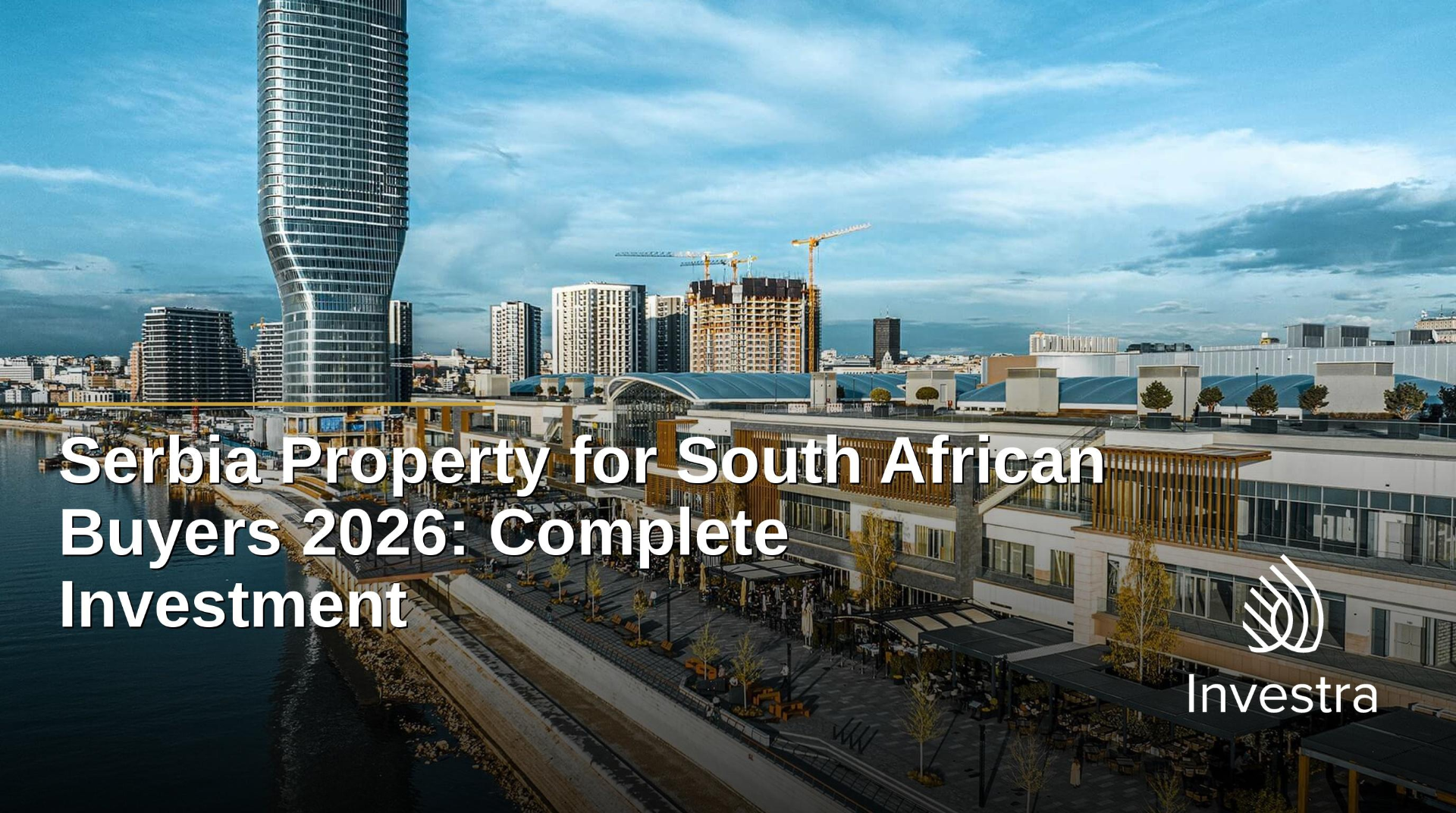
Serbia Property for South African Buyers 2026: Complete Investment
Serbia Property for South African Buyers 2026: Complete Investment Guide
South African buyers can acquire residential and commercial property in Serbia in 2026 without major legal barriers, gaining access to capital growth in Belgrade and secondary cities alongside gross rental yields of 5.8–7.2 %. Serbia’s market remains one of the more accessible entry points in Europe for rand-based investors seeking euro-denominated assets at prices still 40–60 % below comparable Western European locations.Introduction
```htmlSouth African property investors have watched their domestic market deliver uneven returns over the past five years while facing persistent currency volatility. At the same time, Serbia has quietly become one of the more pragmatic destinations for foreign capital, particularly for buyers looking to diversify away from the rand. With EU accession talks advancing and infrastructure spending accelerating, 2026 looks set to be a pivotal year for anyone considering Serbia property South African buyers 2026.
The appeal is straightforward: average apartment prices in Belgrade remain below €3,000 per square metre in many established districts, yet net yields after costs often exceed those available in Cape Town or Johannesburg. South Africa Serbia real estate flows are still modest compared with German or Russian capital, which means early movers can secure assets before wider awareness pushes prices higher. Investra.io has recorded a 47 % increase in South African user searches for Serbian listings since the start of 2025, signalling rising interest.
Local conditions also matter. Serbia’s central bank has kept the dinar relatively stable against the euro, while Belgrade’s office and residential vacancy rates have fallen to multi-year lows. These factors combine to create a window that may not stay open indefinitely once EU candidate status moves closer to membership.
Market Overview
Belgrade continues to dominate transaction volumes, accounting for roughly 68 % of all foreign purchases in 2025. Average resale prices in the capital reached €2,850 per square metre by late 2025, with new-build projects in emerging districts such as Zemun and Karaburma pushing toward €3,400. Secondary cities including Novi Sad and Niš trade at 30–40 % discounts to the capital, offering yields that can reach 7 % on well-located two-bedroom units.
Foreign buyer activity has grown steadily. Data compiled by the Serbian Chamber of Commerce shows 1,240 properties acquired by non-residents in the first nine months of 2025, up 19 % year-on-year. South African nationals represent a small but expanding share of that total. Most transactions involve one- and two-bedroom apartments in central Belgrade or established suburbs, with average deal sizes between €95,000 and €165,000.
Rental demand remains robust. University inflows, returning diaspora, and an expanding IT sector have kept occupancy rates above 92 % in prime micro-locations. Short-term platforms report average daily rates of €55–€75 for well-presented one-bedroom units near the city centre, supporting annual gross yields in the mid-to-high single digits.
Key Investment Factors
Legal Framework for South African Buyers
Serbia permits foreign nationals to purchase apartments and houses without reciprocity restrictions that still exist in some neighbouring countries. The process requires a tax identification number and standard due-diligence checks. Investors should review the full Serbia Buying Process 2026 before committing funds, as notaries and land-registry timelines can stretch to eight weeks during peak periods.
Currency Exchange and Financing Options
Most South African buyers convert rand to euro through Johannesburg- or Cape Town-based forex desks before wiring funds. Local Serbian banks offer mortgage products to non-residents at rates between 4.1 % and 5.3 % for up to 50 % loan-to-value, though approval requires proof of stable euro income. Many investors therefore prefer all-cash purchases to avoid additional compliance layers.
Visa and Residency Implications
Property ownership alone does not confer residency, yet a purchase above €150,000 combined with proof of funds can support a temporary residence application under the real-estate investment route. South African passport holders currently enjoy 90-day visa-free stays, giving ample time for inspections and closings. Long-term plans often involve the Serbia Property Investment Guide 2026 for updated residency thresholds.
Tax Considerations at Purchase and Holding
Transfer tax stands at 0.5–3 % depending on property value, while annual property tax averages 0.4 % of cadastral value. Capital gains realised after five years of ownership fall to 10 %. Full details appear in the Serbia Property Taxes 2026 guide.
Price Analysis Table
| Area / City | Average Price €/m² (2026) | Gross Rental Yield | Typical Buyer Profile |
|---|---|---|---|
| Belgrade – Dorćol | 3,650 | 5.9 % | Owner-occupiers & short-term lets |
| Belgrade – Vračar | 4,100 | 5.4 % | Premium residential |
| Belgrade – Zemun | 2,950 | 6.8 % | Young professionals & families |
| Novi Sad – City Centre | 2,450 | 7.1 % | University & expat rentals |
| Niš – Medijana | 1,850 | 7.4 % | Value investors |
Why Invest in 2026
Serbia’s EU accession negotiations are expected to reach a new milestone in the second half of 2026, which historically triggers a 12–18 % re-rating in prime real-estate values. Belgrade’s ongoing metro and riverfront regeneration projects will further tighten supply in core districts. South African buyers who complete purchases before these catalysts materialise stand to benefit from both capital appreciation and continued rental demand from the expanding tech workforce.
Relative affordability versus Western Europe remains the strongest draw. A comparable two-bedroom apartment in Lisbon or Madrid now exceeds €5,500 per square metre, while Belgrade still offers entry below €3,000 in multiple established neighbourhoods. Currency hedging is another factor: euro-denominated assets provide a natural offset against rand depreciation cycles that have repeatedly eroded South African purchasing power abroad.
Investra.io continues to list verified properties across Belgrade and secondary cities with transparent pricing and local legal support. As with any investment, property in Serbia carries risks. Only invest capital you can afford to lose.
Practical Buying Guide
South African buyers follow a straightforward path when purchasing property in Serbia. The process typically takes eight to twelve weeks once financing is arranged, though cash buyers move faster. Local rules allow foreigners to hold residential and commercial assets directly, with only minor restrictions on agricultural land.
Initial Research and Property Selection
Begin by identifying target cities based on yield and growth data. Belgrade offers the strongest rental demand, while Novi Sad and Niš provide lower entry prices and steady tenant pools. Work with a local agent to shortlist apartments or small commercial units that match your budget and rental strategy. South Africans should verify building permits and energy certificates early, as these documents affect resale value.
Legal Due Diligence and Contract Signing
Engage a Serbian notary to review the title deed and land registry extract. The notary confirms no outstanding liens or tax debts. Once cleared, the preliminary contract is signed and a 10 percent deposit is paid into escrow. South African buyers can complete this remotely through a power of attorney granted to their legal representative.
Final Transfer and Registration
After the balance is paid, the notary drafts the definitive sales contract. Both parties sign in person or via authorised proxy. The contract is then submitted to the real estate cadastre for registration, which usually completes within four to six weeks. New owners receive an updated title deed confirming ownership.
Post-Purchase Steps
Register with the local tax authority for annual property tax and arrange utility transfers. If the unit will be rented, open a Serbian bank account for rental income collection. Many buyers also appoint a property manager to handle maintenance and tenant screening.
Costs & Fees Breakdown
| Item | Percentage / Amount | Example on €120,000 Property |
|---|---|---|
| Purchase Price | — | €120,000 |
| Notary and Legal Fees | 1.0–1.5% | €1,800 |
| Transfer Tax | 0.5% (first-time buyer) to 3% | €600–€3,600 |
| Real Estate Agent Fees | 2–3% (split or buyer-paid) | €2,400–€3,600 |
| Cadastre Registration | Fixed + 0.1% | €350 |
| Total Additional Costs | 4–7% | €5,150–€9,350 |
| Grand Total | — | €125,150–€129,350 |
Risks & Challenges
Currency fluctuation remains the largest concern for South African buyers. The Serbian dinar moves against the rand, so timing of transfers matters. Political developments in the region can also affect sentiment, though Serbia has maintained steady property rights for foreigners. Liquidity varies by location; secondary cities may require longer holding periods to achieve full value. Building quality in older stock can hide maintenance surprises, making pre-purchase inspections essential. Finally, rental regulations are light but can shift with new local ordinances on short-term lets.
Expert Tips
- Always use a licensed notary rather than relying solely on the seller’s lawyer.
- Budget an extra 2 percent for unexpected repairs in pre-2000 buildings.
- Lock in exchange rates with a forward contract if the rand is volatile.
- Target properties near universities or transport hubs for faster tenant turnover.
- Review the energy performance certificate before signing to avoid future upgrade costs.
- Consider a local property manager from day one if you will not visit frequently.
- Track the annual property tax deadline in January to avoid late-payment penalties.
Find Your Serbia Property on Investra.io
Investra.io brings verified Serbian listings together with local legal partners who understand the needs of South African investors. The platform filters results by yield, price per square metre and building age so buyers can compare opportunities across Belgrade, Novi Sad and Niš without multiple site visits.
Users gain access to downloadable contracts, notary checklists and live currency tools that convert rand to euro at current rates. Dedicated support staff coordinate video viewings and power-of-attorney arrangements, reducing the number of trips required to complete a purchase.
Recommended Reading
- Serbia Legal Guide for Foreigners
- Serbia Rental Market 2026
- Serbia Property Price Forecast
- Novi Sad Real Estate 2026
- Sinisa Dagary Real Estate Blog
- Findes.si Property Portal
Follow Us
Stay updated on Serbia market shifts and new listings:
Odkrijte globalne investicijske priložnosti na Unifyr.space — vaš portal za pametne investicije.
Frequently Asked Questions
Q: Can South Africans buy property in Serbia without residency?
A: Yes, foreign buyers face no residency requirement for residential or commercial assets.
Q: What is the typical rental yield in Belgrade in 2026?
A: Gross yields average 5.0–5.8 percent for well-located apartments.
Q: How long does the purchase process take?
A: Eight to twelve weeks from signed preliminary contract to registered title.
Q: Are there restrictions on agricultural land?
A: Foreigners cannot own farmland directly but may lease or use corporate structures.
Q: Do I need a Serbian bank account?
A: It simplifies rent collection and tax payments, though not mandatory for purchase.
Q: What taxes apply after purchase?
A: Annual property tax plus income tax on rental profits at progressive rates.
Q: Can I finance with a Serbian mortgage?
A: Local banks offer loans to foreigners with sufficient income proof and down payment.
Q: Is short-term rental legal in Belgrade?
A: Yes, but new municipal rules may require registration and safety compliance.
Q: How secure is property ownership in Serbia?
A: Title registration through the cadastre provides strong legal protection.
Q: Should I visit before buying?
A: A physical inspection is recommended, though remote purchases are possible with proper legal safeguards.
Related Posts
No related posts available.
