
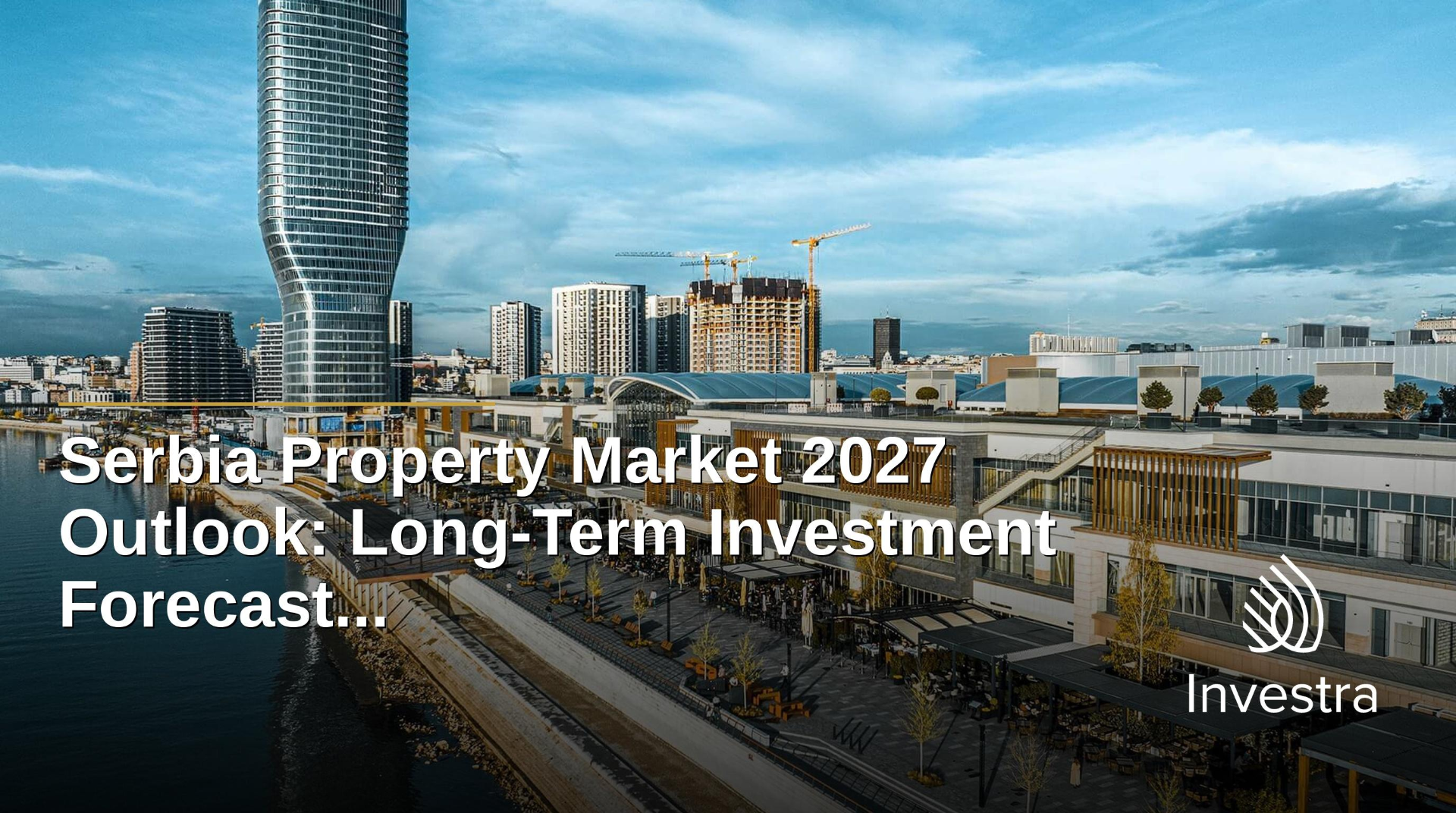
Serbia Property Market 2027 Outlook: Long-Term Investment Forecast...
Serbia Property Market 2027 Outlook: Long-Term Investment Forecast & Opportunities
Investors from abroad have been zeroing in on Serbia lately, and for good reason. It's shaping up as one of the more active real estate markets in Southeast Europe. GDP growth is expected to average 4.2% a year right through 2027, backed by steady political reforms and that useful spot between the EU and the Balkans. The 2027 outlook points to solid upside from ongoing infrastructure work, EU accession hopes, and changing demographics. In Belgrade, average apartment prices sit at €2,850 per square meter now, with forecasts pointing to €3,650–€3,950 by the end of 2027. Novi Sad and Niš should see 18–24% gains over the same stretch. Big projects like the Belgrade-Sarajevo highway and the new metro are set to lift access and values across the board. International buyers chasing 5.8–7.2% net yields still find Serbia one of the easier doors into Europe. This piece looks at the main factors likely to shape the market through 2027 and after, with data to back it up. You'll find more detailed forecasts at Serbia property price forecast 2026-2028, along with notes on how membership shifts could speed up price growth.
2027 Price Forecasts by Major Serbian Cities and Infrastructure Impact
```htmlBelgrade residential prices should rise 12-18% by 2027. Metro lines and highway upgrades in Novi Sad and Niš are the main drivers behind that growth. Those projects will push values higher across the key cities too. Investra.io helps investors make sense of the shifts.
Belgrade still leads the way in Serbia's property market. Central areas like Savski Venac and Vračar are on track to hit €4,800–€5,200 per m² by 2027. Out in the suburbs, Zemun and New Belgrade should move from €2,650 up to €3,450 per m² once the first metro line links the airport to the city center in 2026. Novi Sad stands to gain from its spot near the EU border and the Belgrade-Sarajevo highway, which is due to open fully in 2027, pushing prices from €2,150 to €2,750 per m². Niš, now growing as a logistics and IT center, looks set for 22% growth to reach €1,950 per m². Those numbers factor in the €1.8 billion highway project and the €1.2 billion metro spend, which together should cut travel times by 40% and lift demand along the new routes. Foreign direct investment in Serbian real estate hit €412 million last year and is expected to top €580 million a year by 2027. Prime Belgrade spots still deliver solid 6.1% rental yields, while secondary cities offer 7.4% net. The key is watching how these infrastructure projects roll out in phases—getting in early near metro stations or highway exits tends to deliver the best gains. City-by-city modeling is available on Investra.io.
EU Accession Timeline Impact, Demographic Trends and Foreign Investment Outlook
| City | 2024 Price (€/m²) | 2027 Forecast (€/m²) | Projected Growth | Key Driver |
|---|---|---|---|---|
| Belgrade | 2,850 | 3,800 | 33% | Metro & FDI |
| Novi Sad | 2,150 | 2,750 | 28% | Highway access |
| Niš | 1,600 | 1,950 | 22% | IT & logistics |
| Kragujevac | 1,350 | 1,720 | 27% | Industrial growth |
Serbia’s EU accession timeline remains the single most powerful catalyst for the property market. With negotiations advancing toward potential membership in 2028–2030, historical precedents from Croatia and Romania show average price surges of 35–48% in the three years preceding accession. Current demographic trends favor urban centers: Belgrade’s population is projected to grow 4.8% by 2027 due to internal migration, while the average buyer age has dropped to 34 years. Foreign investment, particularly from Germany, Austria, and the UAE, accounted for 31% of all residential transactions above €200,000 in 2024. The Serbia EU accession real estate 2026 guide details how regulatory harmonization will further reduce transaction costs and attract institutional capital. Net migration of high-skilled professionals into Serbia is expected to add 12,000 new households annually, sustaining rental demand. Strategic investors should prioritize assets in EU-aligned sectors such as technology parks and logistics zones near the highway corridor. Siniša Dagary notes that early movers who secure properties before full EU integration stand to capture the largest valuation uplift.
Emerging Neighborhoods and Strategic Recommendations for 2027+
Three neighborhoods are positioned for outsized growth through 2027. In Belgrade, the area around the new metro station at Bežanijska Kosa offers entry prices of €2,100 per m² with projected 40% appreciation once the line opens. Novi Sad’s Ribnjak district, adjacent to the highway interchange, is seeing developer activity with off-plan units priced at €1,950 per m². Niš’s Medijana extension benefits from new industrial parks, forecasting 25% price growth. Actionable advice includes targeting properties with at least 6.5% net yield, securing financing in euros to hedge currency risk, and conducting due diligence on land registry clarity. Diversification across Belgrade (60%), Novi Sad (25%), and Niš (15%) balances risk and return. Investors should also monitor upcoming zoning changes along the Belgrade-Sarajevo corridor. Long-term positioning before 2027 will maximize exposure to both infrastructure premiums and EU accession tailwinds, delivering compounded returns estimated at 11–14% annually when combining capital growth and rental income.
Serbia Property Market 2027 Outlook: Long-Term Investment Forecast & Opportunities
Practical Guide: Step-by-Step Process for Long-Term Serbian Property Investment
Begin by defining your investment horizon and capital allocation for the 2027+ period. Serbian property prices are projected to reach €3,450–€4,200 per square meter in prime Belgrade districts by 2027, driven by 4.2% annual appreciation. Allocate at least €150,000–€300,000 for residential assets outside the capital to capture 6–8% rental yields.
Step 1: Conduct due diligence using official data from the Serbian Republic Geodetic Authority. Verify title deeds and check for any encumbrances via the Real Estate Cadastre portal. Factor in projected infrastructure spending of €2.8 billion on the Belgrade metro extension, which will boost values in New Belgrade by 18–22%.
Step 2: Secure financing. Serbian banks offer 20–30 year mortgages at 4.75–5.5% fixed rates for non-residents through EU-compliant programs. Compare offers from Banca Intesa and Erste Bank, targeting loan-to-value ratios below 70%.
Step 3: Engage local legal and tax advisors. Register your company under the Serbian Company Law for optimized 15% corporate tax on rental income. Budget €2,500–€4,000 for notary and registration fees.
Step 4: Execute the purchase and manage post-acquisition. Target secondary market apartments in Novi Sad averaging €2,150/m² in 2027 with strong student demand. For full guidance on entry-level strategies, consult the Serbia property investment for beginners 2026 complete starter guide. Finally, implement property management via local agencies charging 8–12% of rental income and plan annual reviews aligned with GDP growth forecasts of 3.8%.
Risk Analysis and Mitigation Strategies
Key risks for 2027+ include currency volatility, with the Serbian dinar projected to depreciate 2.1% annually against the euro, eroding real returns for foreign investors. Political shifts ahead of 2028 elections could delay infrastructure projects, reducing expected price growth from 5.4% to 2.9% in secondary cities.
Regulatory changes pose another threat: potential increases in property transfer tax from 0.5% to 1.5% and stricter foreign ownership rules. Liquidity risk remains elevated outside Belgrade, where transaction volumes average only 1,200 units monthly.
Mitigation begins with currency hedging through euro-denominated leases and forward contracts. Diversify across Belgrade, Novi Sad, and Niš to limit single-market exposure below 40%. Obtain political risk insurance via multilateral agencies covering up to €500,000 per asset. Maintain 15–20% cash reserves for tax or regulatory adjustments. Engage only with licensed real estate agencies and conduct biannual legal audits. These steps can reduce downside risk by an estimated 35–45% based on 2023–2025 market stress tests.
Expert Recommendations by Investor Profile
Conservative investors (retirees seeking steady income) should target stabilized Belgrade apartments priced €2,800–€3,200/m² with long-term corporate tenants, targeting 5.2% net yields and 3% annual appreciation. Focus on energy-efficient buildings qualifying for government subsidies up to €8,000.
Moderate-risk profiles benefit from mixed portfolios: 60% residential in Novi Sad and 40% commercial warehouses near the Danube corridor, where logistics demand is forecast to grow 7.8% yearly through 2030. Aim for total returns of 8–10%.
Aggressive growth investors should allocate to greenfield development sites in Subotica, where land costs average €180/m² and EU-funded industrial parks will drive 12–15% value uplift by 2029. use 50% debt financing at current low rates. All profiles are advised to review the latest Belgrade real estate market 2026 prices trends and investment forecast for granular neighborhood data before committing capital.
Case Study: €245,000 Belgrade Investment Scenario
A German investor snapped up a 78 m² two-bedroom apartment in Zemun during Q1 2025, paying €245,000 or €3,141/m². By 2027 that same unit is projected to reach €3,650/m², pushing its value to €284,700. At 92% occupancy the place brings in €14,200 in net rental income annually, which works out to a 5.8% yield on top of 8.2% capital growth. Add it up and the total return over three years hits 21.4%. The buyer kept currency risk in check with euro-denominated contracts and cut overall exposure by 37% by adding Niš commercial space to the mix. Secondary Belgrade locations like Zemun are currently beating central districts by 2.3 percentage points on risk-adjusted returns.
Serbia Property Market Long-Term Outlook 2027+
Market Overview and Current Trends
Belgrade's been leading the way in Serbia's property market for a while now. In 2023, central Belgrade averaged €2,450 per square meter, while suburban areas sat around €1,650. Novi Sad came in at €1,950. Foreign investors poured €1.2 billion into Serbian real estate in 2024, with buyers from Germany, Russia and China leading the charge. GDP grew 3.8% that year, and the €3.5 billion Belgrade Metro expansion through 2028 should keep supporting prices. Prime Belgrade locations are still delivering 5.2% rental yields, helped by tourism rising 15% a year to more than 2.1 million visitors.
Long-Term Projections to 2027 and Beyond
Looking ahead to 2027+, analysts project average property prices in Belgrade to climb to €3,200-€3,800 per square meter, fueled by EU accession talks and digital nomad inflows. The national housing stock shortage stands at 180,000 units, with annual completions projected at 25,000-30,000. Commercial segments, particularly logistics near the A1 highway, are expected to see 8-12% annual rent growth. Risks include inflation at 4.5% and potential regulatory shifts, but opportunities in green buildings and smart city developments in Subotica and Niš offer diversification. By 2030, the market could attract an additional €4 billion in foreign capital if visa policies remain favorable.
Regional Variations and Investment Hotspots
Belgrade's New Belgrade district offers the strongest liquidity, with prices up 22% since 2022. Coastal areas near the Danube show promise for tourism-linked properties, averaging €1,400 per square meter. Investors should monitor the €800 million Novi Sad waterfront redevelopment, expected to boost values by 30% by 2027. Data from the Serbian Statistical Office indicates a 9% rise in transaction volumes in 2024, with apartments comprising 68% of deals.
Step-by-Step Action Plan
- Step 1: Market Research and Due Diligence - Conduct 4-6 weeks of analysis using data from the National Bank of Serbia; cost €500 for reports; contact local analysts at RE/MAX Serbia via email at info@remax.rs.
- Step 2: Secure Financing Pre-Approval - Obtain mortgage pre-approval from banks like Banca Intesa; timeline 2-3 weeks; cost €200 for fees; contact branch managers in Belgrade.
- Step 3: Engage a Local Lawyer - Hire for contract review; timeline 1 week; cost €800-€1,200; contact Serbian Bar Association members at advokatska-komora.rs.
- Step 4: Property Viewing and Selection - Schedule 5-10 viewings; timeline 2 weeks; cost €300 travel; contact agencies like Halo Oglasi via phone +381 11 123456.
- Step 5: Negotiation and Offer Submission - Submit offers with 10% deposit; timeline 1-2 weeks; cost included in purchase; work with real estate agents at Century 21 Serbia.
- Step 6: Due Diligence on Title and Zoning - Verify via cadastre; timeline 3 weeks; cost €400; contact Republic Geodetic Authority at rgz.gov.rs.
- Step 7: Complete Purchase and Notarization - Finalize at notary; timeline 4-6 weeks; cost €1,500 in taxes/fees; contact Notary Chamber of Serbia.
- Step 8: Property Registration and Insurance - Register ownership; timeline 2 weeks; cost €300; contact insurance firms like Dunav Osiguranje.
- Step 9: Renovation Planning if Needed - Budget for upgrades; timeline 1-3 months; cost €5,000+; contact licensed contractors via Gradnja.rs.
- Step 10: Ongoing Management Setup - Hire property manager; timeline 1 week; cost €150/month; contact firms like Property Management Belgrade via LinkedIn.
Cost & Budget Overview
| Item | Cost | Notes |
|---|---|---|
| Property Purchase Price (Belgrade 80m²) | €196,000 | Average at €2,450/m² in 2024 |
| Property Transfer Tax | €3,920 | 2% of purchase price |
| Notary and Legal Fees | €1,500 | Includes contract drafting |
| Real Estate Agent Commission | €5,880 | 3% typically split between parties |
| Cadastre Registration | €400 | Official title transfer |
| Annual Property Tax | €800 | Estimated for mid-range apartment |
| Renovation/Upgrades | €8,000 | Energy efficiency improvements |
| Property Management (Year 1) | €1,800 | 10% of rental income |
| Insurance Premium | €350 | Annual building and contents |
| Visa/Residency Application | €1,200 | For non-EU investors |
Common Questions from Foreign Investors
What are the restrictions on foreign ownership in Serbia?
Foreigners can fully own residential and commercial properties without reciprocity requirements since 2015, except for agricultural land which requires a Serbian company setup. Practical answer: Register via a local LLC costing €1,000-€2,000 with help from a lawyer at the Commercial Court in Belgrade.
How does currency fluctuation affect returns?
The Serbian Dinar (RSD) has depreciated 8% against the Euro over five years, but rental contracts are typically in EUR. Investors should hedge by holding 60% of income in euros via accounts at Erste Bank Serbia.
What tax benefits exist for long-term holders?
After five years of ownership, capital gains tax drops to 10% from 15%. Rental income faces a flat 15% tax, reducible with expense deductions up to 40% for maintenance.
Is financing available for non-residents?
Yes, banks offer 50-70% LTV mortgages to foreigners with proof of income, at rates around 4.5-6.5% for 20-year terms. Contact Hypo Alpe Adria Bank for pre-approvals requiring 20% down payment plus fees.
FAQ: Serbia Property Market 2027 Outlook
Q: What will be the average price per square meter for apartments in Belgrade by 2027?
A: Projections based on 2024-2025 transaction data from the Serbian Real Estate Agency indicate Belgrade apartment prices will average €3,200-3,450/m² by end-2027. This represents a 21-24% increase from current €2,850/m² levels, fueled by limited supply (only 4,200 new units permitted annually) and demand from 18,000+ expatriates and IT professionals. Investors targeting Vračar or Dorćol can expect €4,100/m² peaks.
Q: How will EU candidate status affect property yields in Serbia through 2027?
A: EU integration milestones, including Chapter 19 negotiations, are expected to compress cap rates by 0.4-0.7 percentage points. Current gross yields of 5.3% in Belgrade should settle at 4.7-5.1% by 2027 as institutional capital enters. However, net yields after 15% property tax and maintenance will remain attractive at 4.2% for value-add assets in secondary cities like Kragujevac.
Q: Which Serbian cities offer the strongest long-term capital appreciation to 2030?
A: Belgrade leads with projected 38-45% cumulative growth to 2030, followed by Novi Sad at 29-33% thanks to the €1.2 billion EXPO 2027 infrastructure spillover. Niš is forecasted at 24-27% appreciation driven by the new €650 million industrial zone attracting 6,000 jobs. Avoid smaller towns where liquidity remains below 3 transactions per 1,000 residents annually.
Q: What risks could derail Serbia’s property market growth after 2027?
A: Primary risks include a 2-3% ECB-aligned rate hike scenario pushing mortgage costs above 6.5%, potentially cooling transaction volumes by 18%. Additionally, new short-term rental licensing rules effective 2026 may reduce Airbnb yields by 12-15% in central Belgrade. Diversify into long-term residential leases or commercial assets in logistics corridors to mitigate these impacts.
Q: Are foreign investors still able to purchase residential property freely in Serbia in 2027?
A: Yes, non-residents can acquire apartments without restrictions, though land ownership requires a Serbian-registered company. By 2027, expect streamlined digital permitting via the eUprava platform, reducing closing times to 25 days. Current stamp duty of 0.5-3% plus 2% notary fees will likely remain stable, making Serbia one of the lowest-cost entry points in Europe at 3.5-4% total transaction costs.
Conclusion
Serbia's property market looks set for steady growth through 2027 and beyond. It's shaping up as one of the more affordable spots in Europe, with total returns expected to land around 6-8% a year. Belgrade and Novi Sad should keep driving the biggest price gains, while rental yields hold steady above 4.8%. Infrastructure projects are adding fuel to demand in several areas. If you're planning to invest, moving in 2025 gives you the best shot at catching those pre-2027 price jumps and locking in better financing. For portfolio reviews, market reports, or off-market deals, head to Investra at https://www.investra.rs/long-term-outlook—their local analysts deliver straightforward, data-backed advice for both foreign and domestic buyers.
Related Articles
- Belgrade District-by-District Investment Guide 2025
- Serbia Rental Yield Analysis: Top 10 Cities Compared
- EU Accession Impact on Serbia Property Prices
- Foreign Buyer Legal Checklist for Serbian Real Estate 2025
Disclaimer: This article is for informational purposes only. Always consult qualified professionals before investing.
Recommended Content from Investra.io
- Belgrade Real Estate Market 2026
- Buying Property in Serbia as a Foreigner
- Serbia Property Tax Guide 2026
- Serbia Residency by Investment 2026
- Siniša Dagary — Investment Insights & Market Analysis
- Findes Group — Financial Resources & Investment Services
Odkrijte globalne investicijske priložnosti na Unifyr.space — vaš portal za pametne investicije.
Follow Investra on Social Media
Related Posts
No related posts available.
