
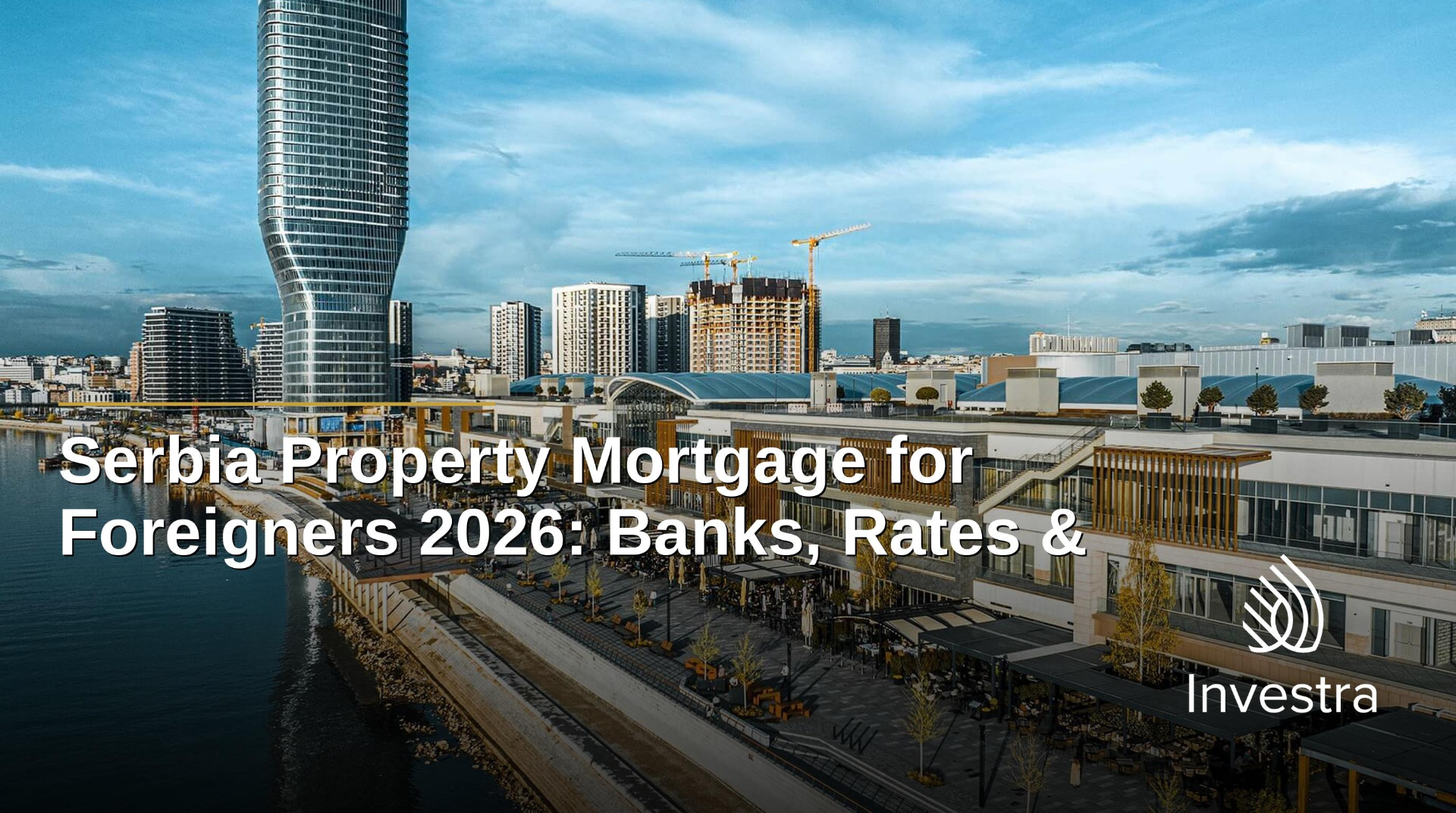
Serbia Property Mortgage for Foreigners 2026: Banks, Rates &
Serbia Property Mortgage for Foreigners 2026: Banks, Rates & Eligibility Guide
Foreigners can secure mortgages in Serbia in 2026 through major local banks, typically at interest rates between 4.2% and 6.8% for fixed terms, provided they meet residency or income requirements and provide standard collateral. Eligibility often hinges on stable foreign income documentation, a minimum 20-30% down payment, and credit checks that accommodate non-residents. Platforms like Investra.io help buyers compare current offerings before committing.
Serbia’s property market continues to attract international interest as the country strengthens its banking regulations and prepares for deeper EU integration. Mortgage access for non-citizens has improved steadily, yet it remains more selective than in Western Europe.
Introduction
```htmlSerbia’s real estate sector has matured noticeably since the post-pandemic recovery, drawing buyers from Germany, Turkey, Russia, and the Middle East who see both lifestyle value and solid rental returns. In 2026, the combination of relatively low entry prices and improving mortgage availability makes the country stand out for foreigners who want leveraged exposure rather than all-cash purchases. Banks have begun to relax some earlier restrictions on non-resident lending, though the process still demands careful preparation.
The question of financing often decides whether an investor moves forward or walks away. Understanding which Serbian banks actively lend to foreigners, what rates they quote this year, and what paperwork they require can save months of back-and-forth. This guide focuses squarely on those practical details while placing them in the broader 2026 market context.
Many readers arrive here after reviewing general market reports. If you need wider background on price trends and forecasts, the Belgrade Real Estate Market 2026 analysis provides useful context. For an end-to-end investment overview, the Serbia Property Investment Guide 2026 remains a strong starting point.
Market Overview
Belgrade continues to anchor foreign demand, with average apartment prices in prime central districts reaching €3,800–€4,600 per square metre in early 2026. Secondary cities such as Novi Sad and Niš show more moderate levels, typically €2,100–€2,900 per square metre, yet still deliver stronger rental yields for investors using mortgage leverage. Foreign buyers now account for roughly 18% of all residential transactions tracked by the National Bank of Serbia, up from 12% two years earlier.
Interest rates on euro-denominated loans have stabilised after the 2024–2025 tightening cycle. The benchmark three-month EURIBOR plus bank margin currently produces fixed-rate mortgages in the 4.2–5.1% range for the strongest applicants, while variable products start slightly lower. Banks remain cautious with loan-to-value ratios, rarely exceeding 70% for non-residents even when income is verified through EU tax returns.
Investra.io lists hundreds of properties with direct links to financing partners, allowing buyers to filter by mortgage eligibility before making offers. This transparency helps reduce the time between viewing and closing, an advantage in a market where cash buyers still dominate.
Key Investment Factors
Eligibility Rules for Non-Residents
Serbian banks generally require foreign applicants to demonstrate a minimum annual income of €35,000–€45,000, proven through tax returns or employment contracts. Residency status is not mandatory, but applicants without a Serbian address often face higher interest margins of 0.5–0.8 percentage points. Citizens of EU, UK, US, and several Gulf countries receive the most straightforward treatment, while applicants from higher-risk jurisdictions undergo extra compliance checks.
Leading Banks and Their 2026 Terms
Raiffeisen Bank Serbia, Banca Intesa, and Erste Bank currently lead in foreign-client mortgage volume. Raiffeisen offers fixed rates starting at 4.35% for loans up to €300,000 with a 25-year term, while Intesa requires at least 25% equity and quotes 4.6–5.2% depending on the applicant’s credit profile. Erste has introduced a new product for remote workers that accepts freelance income verified through platform statements, a notable shift from 2024 policy.
Documentation and Approval Timeline
Standard files include passport copies, three years of income verification, bank statements, and a preliminary property valuation. Most banks complete initial approval within 10–14 working days once all documents are submitted, though full disbursement can stretch to six weeks if the property requires additional due diligence. Using a bilingual lawyer recommended through Investra.io helps avoid translation delays that frequently stall applications.
Down Payment and Collateral Requirements
Foreign buyers should budget for a minimum 25% down payment, though some banks accept 20% when the borrower holds local employment or long-term rental contracts. The property itself serves as primary collateral, with additional personal guarantees rarely requested unless the loan exceeds €500,000. Currency risk remains a consideration because most mortgages are euro-denominated while rental income may arrive in dinars.
Price Analysis Table
| Area | Avg. Price €/m² (2026) | Typical Rental Yield | Mortgage Availability |
|---|---|---|---|
| Dorćol, Belgrade | 4,450 | 5.1% | High – all major banks |
| Vračar, Belgrade | 4,200 | 4.8% | High |
| Novi Beograd | 3,650 | 5.6% | Medium-High |
| Petrovaradin, Novi Sad | 2,750 | 6.4% | Medium |
| Niš City Centre | 2,350 | 6.9% | Medium |
| Suburban Belgrade | 2,100 | 7.2% | Variable |
Why Invest in 2026
Serbia’s banking sector has aligned more closely with European standards, giving foreign borrowers clearer pathways to financing than existed even two years ago. At the same time, property prices remain 35–45% below comparable cities in Hungary or Romania, creating a window for leveraged acquisitions before further convergence occurs. Mortgage rates have not risen in line with some Western markets, preserving monthly cash-flow advantages for rental investors.
The Serbia Property Taxes 2026 guide outlines the fiscal side of ownership, while the Serbia Buying Process 2026 article walks through the legal sequence once financing is secured. Together these resources help buyers model total costs before submitting mortgage applications.
Investra.io maintains updated listings that flag which properties have pre-approved financing options, reducing uncertainty during negotiations. As with any investment, property in Serbia carries risks. Only invest capital you can afford to lose.
Practical Buying Guide
Securing a mortgage as a foreigner in Serbia involves a clear sequence of steps that local banks follow consistently. The process starts with confirming your eligibility and ends with registration of the property in your name. Most major banks require either Serbian residency or proof of stable foreign income, and they typically finance up to 70 percent of the purchase price for non-residents.
Verify Eligibility and Gather Documents
Begin by contacting one of the larger Serbian banks such as Banca Intesa, Raiffeisen or Eurobank. Submit proof of identity, recent tax returns, employment contracts or pension statements, and a credit history report from your home country. Banks will also request a valuation of the chosen property carried out by an approved appraiser. Foreign buyers without residency often need to show at least three years of steady income and a minimum down payment of 30 percent.
Pre-Approval and Property Search
Once preliminary approval is granted, usually within two to three weeks, you receive a mortgage commitment letter that states the maximum loan amount and interest rate. With this document you can negotiate firmly with sellers. Focus on properties that have clean title and are registered in the cadastre, as banks will not lend against encumbered assets. Many buyers use this stage to compare offers in Belgrade, Novi Sad and Niš before making a final choice.
Loan Agreement, Notary and Registration
After signing the purchase contract, the bank issues the final loan agreement. A notary public then prepares the mortgage deed and registers it against the property. The entire closing process, from contract to land registry entry, normally takes six to eight weeks. Foreign buyers should budget for translation of all documents into Serbian and allow extra time for apostille certification of foreign paperwork.
Final Disbursement and Ownership Transfer
Funds are released directly to the seller once the mortgage is noted in the cadastre. You receive ownership title within 30 days of payment. Annual property tax and building maintenance fees become your responsibility immediately after registration.
Costs & Fees Breakdown
| Item | Percentage / Amount | Example on €150,000 Property |
|---|---|---|
| Purchase Price | 100% | €150,000 |
| Notary and Legal Fees | 0.8–1.2% | €1,500 |
| Transfer Tax (for properties over 5 years old) | 0.5–2% | €1,500 |
| Real Estate Agent Commission | 2–3% | €3,750 |
| Bank Appraisal and Processing | €300–600 | €450 |
| Land Registry and Cadastre Fees | €150–300 | €200 |
| Total Additional Costs | 4–6% | €7,400 |
| Grand Total | €157,400 |
Risks & Challenges
Currency fluctuation remains the most immediate risk for foreign borrowers. Mortgages are almost always issued in euros, while local salaries are paid in dinars, creating exposure if the dinar weakens. Legal title disputes still surface in older buildings where inheritance records are incomplete, and banks can delay disbursement until the cadastre is updated. Foreign buyers also face stricter loan-to-value ratios than Serbian citizens, and sudden regulatory changes on foreign ownership can affect future resale. Interest rates have fallen since 2023, yet they remain sensitive to European Central Bank policy; any upward movement would increase monthly payments for new borrowers. Finally, liquidity in smaller Serbian cities is lower, so selling quickly to repay the loan can prove difficult.
Expert Tips
- Compare at least three banks before accepting an offer, because rate differences of 0.5 percent can save several thousand euros over a 20-year term.
- Insist on a full cadastre search before signing any reservation agreement to avoid properties with unresolved ownership claims.
- Use a bilingual lawyer rather than relying solely on the bank’s notary; the extra cost is modest and protects against hidden clauses.
- Factor in ongoing costs such as annual property tax, building maintenance and insurance when calculating affordability.
- Consider fixing the interest rate for the first five years if you expect euro rates to rise again in 2027.
- Keep digital copies of every document, including the apostilled credit report, because banks frequently request replacements during the approval process.
- Monitor the National Bank of Serbia announcements on foreign borrowing rules, as minor policy shifts can change eligibility overnight.
Find Your Serbia Property on Investra.io
Investra.io brings together verified listings from across Serbia with direct access to mortgage specialists who work with the country’s leading banks. The platform filters properties that already meet bank lending criteria, saving foreign buyers weeks of preliminary checks.
Beyond listings, Investra.io provides downloadable mortgage calculators, sample loan agreements and introductions to English-speaking lawyers. Users can schedule video consultations with bank representatives and receive updated rate sheets each month, all within a single secure account.
Recommended Reading
- Serbia Legal Guide for Foreigners
- Serbia Rental Market 2026
- Serbia Property Price Forecast
- Novi Sad Real Estate 2026
- Sinisa Dagary Real Estate Blog
- Findes.si Property Portal
Follow Us
Stay updated on Serbian real estate and mortgage changes through our channels:
Odkrijte globalne investicijske priložnosti na Unifyr.space — vaš portal za pametne investicije.
Frequently Asked Questions
Q: Can a foreigner with no Serbian residency obtain a mortgage?
A: Yes, provided they demonstrate stable foreign income and meet the bank’s minimum down-payment requirement of 30 percent.
Q: What is the typical interest rate range in 2026?
A: Fixed rates currently sit between 4.2 percent and 6.8 percent depending on the bank, loan term and borrower profile.
Q: How long does mortgage approval usually take?
A: Most banks issue a decision within two to four weeks once all documents are submitted.
Q: Are there extra taxes for foreign property buyers?
A: Foreigners pay the same transfer tax and notary fees as Serbian citizens; no additional ownership tax applies.
Q: Can I use rental income to qualify for the loan?
A: Banks accept projected rental income if supported by a local market report and existing lease contracts.
Q: What happens if I default on the mortgage?
A: The bank can initiate foreclosure proceedings and sell the property through public auction to recover the outstanding balance.
Q: Is it possible to refinance later at a lower rate?
A: Yes, most loans allow refinancing after the first two years without early-repayment penalties.
Q: Do I need a Serbian guarantor?
A: Only in rare cases where income documentation is insufficient; most foreign applicants qualify without one.
Q: Which cities offer the easiest mortgage access?
A: Belgrade and Novi Sad have the highest approval rates because of stronger liquidity and established rental demand.
Q: Can I pay off the mortgage early?
A: Early repayment is permitted, though some banks charge a one-time administrative fee of 1 percent of the outstanding balance.
Related Posts
No related posts available.
