
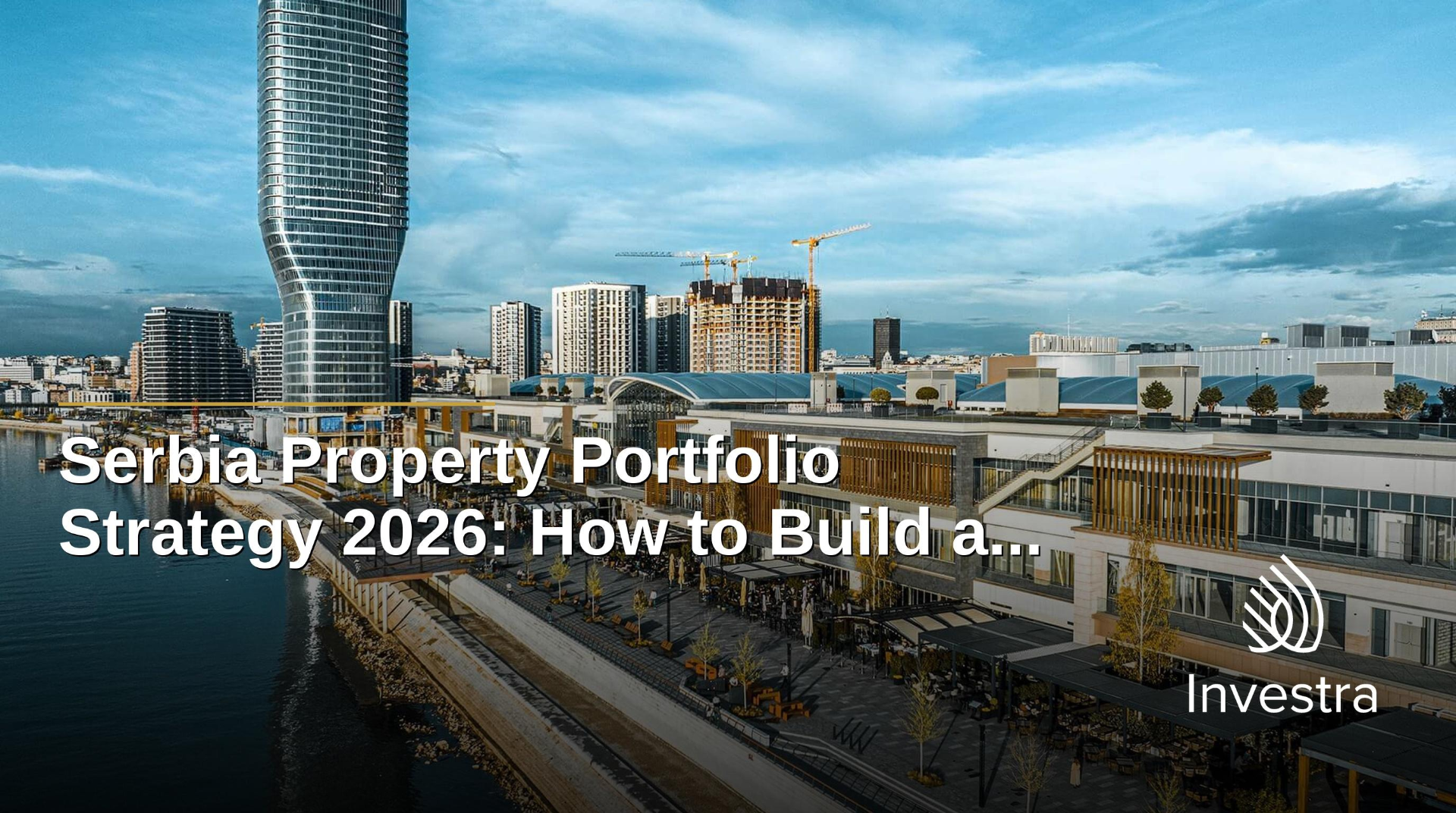
Serbia Property Portfolio Strategy 2026: How to Build a...
Serbia Property Portfolio Strategy 2026: How to Build a Multi-Property Investment
Answer Capsule: Building a Serbia property portfolio in 2026 requires a deliberate multi-property approach that combines Belgrade’s high-yield urban assets with secondary cities offering lower entry prices and stronger rental demand from domestic migrants. Investors typically allocate €150,000–€400,000 across three to five units, targeting blended gross yields of 5.8–7.2 % while using Serbia’s simple foreign-ownership rules and 2026 tax reforms to optimise after-tax returns. Platforms such as Investra.io provide the verified listings and local due-diligence tools needed to execute this strategy efficiently.
Introduction
```htmlSerbia’s real-estate market has moved from post-pandemic recovery into a more structured growth phase. Foreign buyers, particularly from Western Europe and the Gulf, are no longer chasing single apartments for personal use; instead they are constructing diversified portfolios that balance capital appreciation in the capital with cash-flow stability in regional cities. This shift is driven by predictable macroeconomic tailwinds and a regulatory environment that remains one of the most accessible in the Balkans for non-residents.
The 2026 outlook is shaped by two parallel trends: continued EU-accession-related infrastructure spending and a maturing short-term rental market that rewards owners who hold multiple units rather than one flagship property. Investors who entered the market between 2022 and 2024 are now looking to scale, while first-time portfolio builders are entering with clearer data on yields and exit liquidity. The question is no longer whether Serbia offers opportunity, but how to structure a multi-property strategy that survives interest-rate cycles and local supply increases.
At Investra.io we see daily evidence of this portfolio mindset. Clients are requesting bundled searches across Belgrade, Novi Sad and Niš, asking for comparative cash-flow models and tax-efficient ownership structures before they commit. This article sets out the practical framework for building such a portfolio in 2026, starting with current market conditions and moving through location selection, financing and risk management.
Market Overview
Prime residential prices in central Belgrade have stabilised at €3,450–€3,950 per square metre in 2026, up 6.4 % year-on-year, while new-build stock in emerging districts such as Zvezdara and Čukarica trades between €2,650 and €2,950. Secondary cities continue to offer a significant discount: Novi Sad averages €2,150 per square metre and Niš €1,650, creating natural diversification opportunities for portfolio investors.
Rental demand remains robust. Long-term residential yields in Belgrade average 6.1 % gross, with short-term tourist lets in the city centre pushing effective yields above 8 % for well-managed units. Regional cities deliver lower headline yields of 5.2–5.7 % but benefit from lower vacancy rates and slower but steadier price growth tied to university and industrial employment. Transaction volumes are expected to reach 48,000 residential deals nationally in 2026, with foreign buyers accounting for roughly 18 % of total value.
Supply-side pressures are emerging. Belgrade’s new-build pipeline will add approximately 9,200 units in 2026, concentrated in New Belgrade and along the future metro corridor. This increase is already moderating price growth in the most expensive micro-locations, reinforcing the case for a spread across multiple neighbourhoods and cities rather than concentration in a single postcode.
Key Investment Factors
Location Selection for Portfolio Balance
The single most important decision is the mix of locations. A resilient Serbia property portfolio 2026 typically contains one Belgrade asset for capital growth, one Novi Sad or Subotica unit for university-driven rental demand, and one Niš or Kragujevac property for lower entry costs and industrial tenant stability. This geographic spread reduces exposure to any single municipal planning decision or infrastructure delay.
Within Belgrade, pairing a central short-term rental unit with a suburban long-term let creates internal cash-flow smoothing. Investors can review current stock and comparable yields directly on Investra.io before shortlisting.
Financing Structures and Currency Risk
Foreign buyers continue to rely predominantly on cash or offshore mortgages, yet 2026 has seen Serbian banks offering euro-denominated loans to non-residents at rates between 4.1 % and 4.7 % for portfolios above €300,000. Matching euro income with euro liabilities removes the dinar fluctuation risk that previously deterred leveraged strategies. Investors should model both all-cash and 60 % LTV scenarios when building their multi-property investment strategy Serbia.
Legal and Tax Framework Updates
The 2026 tax amendments lowered the property transfer tax threshold for second and subsequent purchases, making portfolio scaling more efficient. Full details are available in our dedicated [Serbia Property Taxes 2026](https://investra.io/en/media/blogs/serbia-property-taxes-2026-complete-guide-for-foreign-investors) guide. Ownership remains straightforward for foreigners, with the same rights as citizens once the purchase contract is notarised, as outlined in the [Serbia Buying Process 2026](https://investra.io/en/media/blogs/serbia-property-buying-process-2026-step-by-step-guide-for-foreigners) article.
Operational Management at Scale
Managing three or more units requires systems. Professional property managers in Belgrade charge 8–10 % of gross rent, while regional cities often operate on 6–7 %. Investors using Investra.io’s vetted manager network report average vacancy below 4 % across portfolios when units are professionally furnished and priced dynamically.
Price Analysis Table
| Area / City | Avg. Price €/m² (2026) | Long-term Gross Yield | Short-term Gross Yield | 5-Year Price Growth Forecast |
|---|---|---|---|---|
| Belgrade – Savski Venac | 3,850 | 5.4 % | 8.1 % | +28 % |
| Belgrade – Zvezdara | 2,780 | 6.3 % | 7.2 % | +31 % |
| Novi Sad – Liman | 2,320 | 5.8 % | 6.4 % | +24 % |
| Niš – Centar | 1,720 | 6.7 % | 5.9 % | +22 % |
| Kragujevac – Centar | 1,480 | 7.1 % | 4.8 % | +19 % |
Why Invest in 2026
Three structural factors converge this year. First, EU accession negotiations are unlocking €2.1 billion in transport and digital infrastructure spending, directly supporting property values along new corridors. Second, Serbia’s 2026 personal income tax reform has reduced the effective rate on rental income for foreign owners who structure holdings through local companies, improving net yields by approximately 70 basis points. Third, the continued shortage of institutional-grade rental stock means small-scale portfolio owners still capture the majority of professional tenant demand.
Early movers who assembled three-property portfolios in 2023–2024 are already reporting internal rates of return above 11 % when both income and modest appreciation are combined. The window for similar entry pricing will narrow once the next wave of foreign funds arrives in late 2026.
Readers seeking current listings and comparative portfolio models can explore opportunities on Investra.io and cross-reference deeper city analysis in the [Belgrade Real Estate Market 2026](https://investra.io/en/media/blogs/belgrade-real-estate-market-2026-prices-trends-investment-forecast) and [Serbia Property Investment Guide 2026](https://investra.io/en/media/blogs/serbia-real-estate-2026-the-ultimate-investment-guide-for-foreign-buyers) resources.
As with any investment, property in Serbia carries risks. Only invest capital you can afford to lose.
Practical Buying Guide
Foreign buyers who approach the Serbian market methodically tend to avoid the most common pitfalls. The process is straightforward once the sequence of checks and paperwork is understood.
Step 1: Define your target cities and property types
Start by matching your goals to locations. Belgrade’s central districts deliver the strongest rental demand, while Novi Sad and Niš offer lower entry prices and growing student and professional tenant pools. Decide early whether you want cash-flow apartments, new-builds with developer guarantees, or older stock that can be renovated for higher yields.
Step 2: Secure local representation
Engage a lawyer registered with the Serbian Bar Association before signing anything. The same lawyer can review the title deed (list nepokretnosti) and confirm there are no encumbrances. Pair this with a licensed real-estate agent who works on both buyer and seller mandates so you see off-market opportunities early.
Step 3: Arrange financing or proof of funds
Serbian banks currently offer mortgage rates between 4.8 % and 6.2 % for non-residents who can provide 30–40 % equity. If you prefer an all-cash purchase, prepare a recent bank statement or investment portfolio summary. Currency conversion costs are lowest when you transfer euros directly to a Serbian account rather than exchanging cash on arrival.
Step 4: Execute the purchase and registration
Once an offer is accepted, the preliminary contract is signed at a notary public. The buyer pays a 10 % deposit, which is held in escrow. The final contract follows within 30–60 days, after which the transfer tax is paid and the property is registered at the real-estate cadastre. Full ownership is recorded within four to eight weeks.
Costs & Fees Breakdown
| Item | Typical Rate | Example on €150,000 purchase |
|---|---|---|
| Purchase price | — | €150,000 |
| Notary and contract fees | 0.5–0.8 % | €900 |
| Transfer tax (property tax) | 0.5–3 % (usually 2 % for used stock) | €3,000 |
| Real-estate agent commission | 2–3 % (split or buyer-paid) | €3,750 |
| Cadastre registration | Flat fee + 0.1 % | €250 |
| Legal representation | €600–1,200 | €900 |
| Total additional costs | 4–7 % | €8,800 |
Risks & Challenges
Like any emerging market, Serbia presents both opportunity and friction. Currency risk exists because the dinar fluctuates against the euro; most landlords therefore quote rents in euros to tenants who can pay in hard currency. Liquidity varies sharply between prime Belgrade locations and smaller towns—selling a property in Zemun can take three months, while a unit in a secondary city may require six to nine months. Regulatory changes around foreign ownership remain rare but should be monitored through your lawyer. Finally, older buildings can carry hidden renovation costs; always commission a technical inspection before committing.
Expert Tips
- Buy where new infrastructure is planned—Belgrade’s metro lines and Novi Sad’s bypass road are already lifting values in adjacent districts.
- Target properties under 60 m²; they rent faster and suffer fewer vacancy periods than larger family apartments.
- Insist on an energy-performance certificate; tenants increasingly compare running costs.
- Keep 5 % of the purchase price in reserve for unexpected repairs or tax adjustments.
- Use a property-management company from day one if you live outside Serbia—local teams handle everything from tenant screening to minor fixes.
- Review the land-registry extract yourself; never rely solely on the seller’s word that the title is clean.
- Reinvest rental income rather than repatriating it immediately; compounding across multiple properties accelerates portfolio growth.
Find Your Serbia Property on Investra.io
Investra.io aggregates verified listings across Belgrade, Novi Sad, Niš and emerging secondary cities, filtering by yield, price per square metre and building age. The platform’s due-diligence module surfaces encumbrance checks and comparable sales data so investors can shortlist without flying in for every viewing.
Users also gain access to downloadable cash-flow models and direct introductions to local lawyers and property managers who have already been vetted by the Investra team. Whether you are assembling your first two-unit portfolio or scaling toward five or six assets, the platform keeps the entire workflow—from initial search to post-purchase reporting—in one place.
Recommended Reading
- Serbia Legal Guide for Foreigners
- Serbia Rental Market 2026
- Serbia Property Price Forecast
- Novi Sad Real Estate 2026
- Sinisa Dagary Real Estate Blog
- Findes.si Property Portal
Follow Us
Stay updated on new listings, regulatory changes and yield data:
Odkrijte globalne investicijske priložnosti na Unifyr.space — vaš portal za pametne investicije.
Frequently Asked Questions
Q: Can foreigners own property outright in Serbia?
A: Yes. Non-residents may purchase residential and commercial real estate with the same rights as Serbian citizens, provided the transaction passes through a notary and the cadastre.
Q: What is the typical gross yield in Belgrade right now?
A: Central and semi-central districts currently deliver 6.8–8.2 % gross yields when properties are priced correctly and managed professionally.
Q: Do I need a Serbian bank account to receive rent?
A: It simplifies matters, but many owners use euro accounts at international banks that operate in Serbia; rent can be paid directly into those accounts.
Q: How long does the purchase process take from offer to title transfer?
A: Expect six to ten weeks once financing or proof of funds is confirmed.
Q: Are there restrictions on short-term lets such as Airbnb?
A: Municipal rules vary; Belgrade requires registration and payment of tourist tax, while Novi Sad is more permissive. Check local ordinances before committing.
Q: What taxes apply to rental income for non-residents?
A: Non-residents pay 15 % on net rental income after allowable deductions; many owners offset this with depreciation and management fees.
Q: Is it better to buy new-build or older stock?
A: New-builds offer lower maintenance and developer warranties, while older apartments in good locations often provide higher yields after modest renovation.
Q: Can I get a mortgage as a foreigner?
A: Several Serbian banks extend mortgages to non-residents with 30–40 % down payment and proof of stable income from abroad.
Q: How do I verify that a property has clear title?
A: Your lawyer orders an official extract from the real-estate cadastre; this document lists all owners and any liens or easements.
Q: What happens if the seller tries to back out after the preliminary contract?
A: The 10 % deposit is usually forfeited to the buyer, and the preliminary contract can be enforced through the courts if necessary.
Related Posts
No related posts available.
