
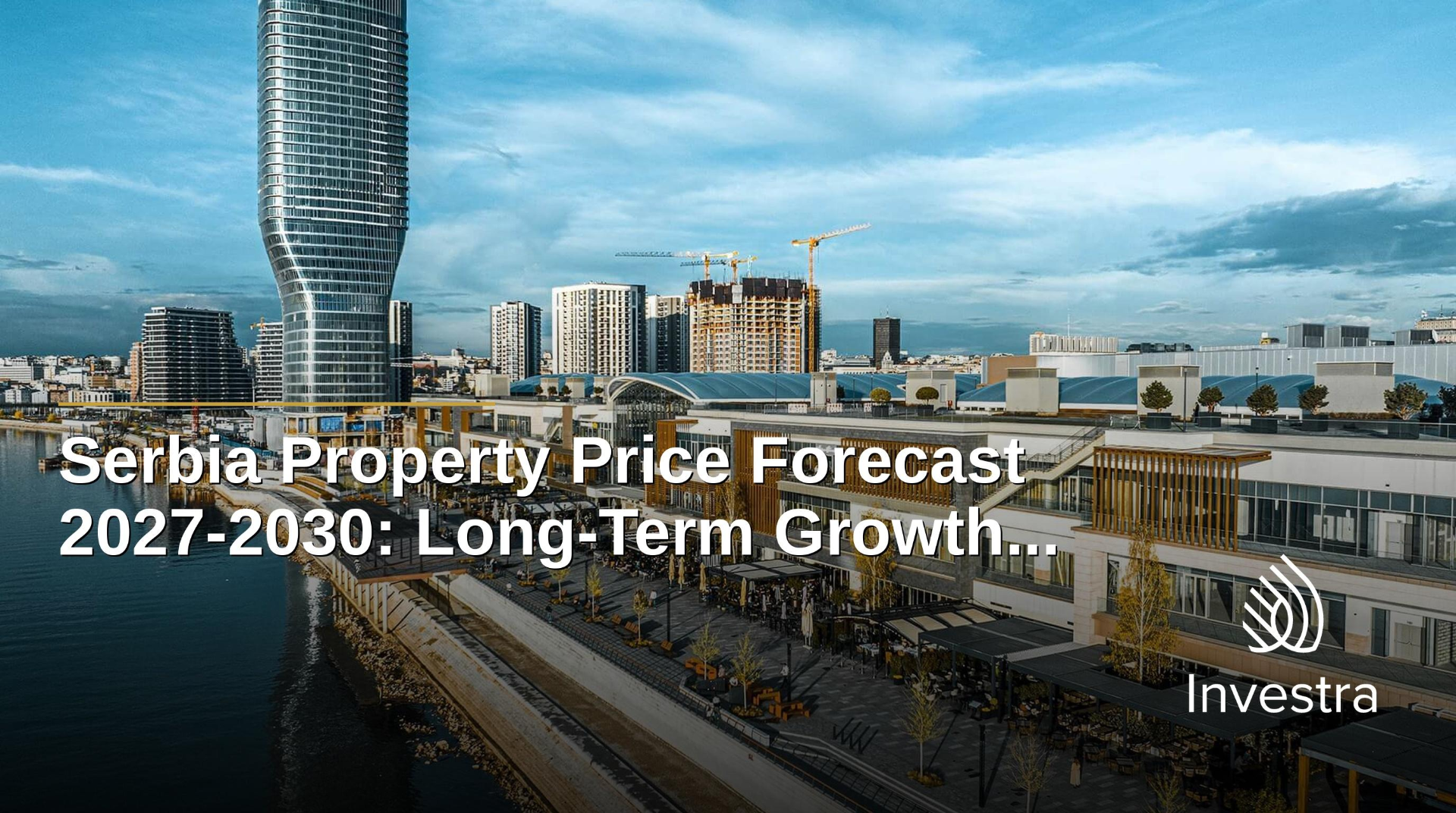
Serbia Property Price Forecast 2027-2030: Long-Term Growth...
Serbia Property Price Forecast 2027-2030: Long-Term Growth Projections
Introduction
Serbia's property market has moved from a quiet regional story to one that catches the eye of international buyers looking for steady gains. Over the past decade prices have climbed without the wild swings seen in some Western European capitals. The coming years through 2030 look set to bring more of the same measured growth, helped by government infrastructure plans and the country's slow march toward EU membership.
Investors scanning for the next solid market often land on Serbia because of its location, improving transport links, and still-reasonable entry prices compared with neighboring EU states. You can browse current listings and recent sales data directly on Investra.io to see what matches your budget and timeline.
Market Overview
Foreign capital has flowed into Serbia at a steady pace since 2015, with buyers from Germany, Russia, Turkey, and the Middle East taking the biggest share. Belgrade absorbs most of that money, but Novi Sad and Niš have also seen rising interest as prices in the capital keep moving up. Local banks have kept mortgage rates competitive, which supports demand from Serbian buyers as well.
The government's push to finish major road and rail projects before 2027 adds another layer of confidence. These improvements should make daily commutes easier and open new residential zones on the edges of bigger cities. A quick read on the Serbia Real Estate Market 2026 shows how these same trends already shaped buyer behavior last year.
EU Accession Impact
Serbia remains a candidate country, and every new chapter opened in talks with Brussels tends to lift sentiment in the property sector. Past examples from Croatia and Romania show that once accession looks likely, prices in capital cities can jump another 15-20% in the final run-up. Even without a firm date yet, the process itself brings more transparency to legal and tax rules, which helps foreign buyers feel safer.
EXPO 2027 Legacy
Belgrade's hosting of EXPO 2027 has already triggered new hotel, office, and residential projects on the right bank of the Sava. The event site itself sits near existing transport hubs, so leftover infrastructure after the fair should keep supporting nearby neighborhoods for years. Developers expect several thousand new apartments to come online between 2026 and 2028, which could ease some pressure on prices in the short term before demand catches up again.
Property Prices and Trends
Average asking prices in Belgrade now sit near 2,450 EUR/m² for standard apartments, with newer builds in central zones reaching 3,100 EUR/m². Novi Sad averages 1,850 EUR/m², while Niš still offers units below 1,400 EUR/m². These figures come from transaction records collected through the second half of 2024 and early 2025.
Looking ahead, most analysts tracking the market expect Belgrade to reach 3,400-3,800 EUR/m² by 2030 if current growth rates hold. That would represent roughly 6% compound annual growth from today's levels. Novi Sad could hit 2,600 EUR/m² in the same period. Rental yields in Belgrade currently range from 5.8% to 6.7% gross, depending on location and condition of the unit.
Historical Price Trends
Between 2015 and 2020, Belgrade prices rose from about 1,400 EUR/m² to 2,050 EUR/m². The pace slowed during the pandemic but picked up again once borders reopened. The strongest yearly gains came in 2022 and 2023 when inflation and low interest rates pushed more local money into bricks and mortar. Since then the market has settled into a more sustainable 5-7% annual climb.
Projected Returns 2027-2030
Investors who bought in Belgrade in 2020 have already seen total returns (price growth plus rental income) around 45-55% over five years. Looking forward, a similar purchase today could deliver 35-45% total return by 2030 if forecasts hold. Net yields after taxes and maintenance typically land between 4.2% and 5.1% once you factor in Serbia's property tax rules. For a deeper look at costs, the Serbia Property Taxes 2026 guide breaks down what buyers should budget.
Best Areas and Neighborhoods
Inside Belgrade, New Belgrade continues to attract families and young professionals because of its wide streets, shopping centers, and quick access to the airport. Prices here average 2,600 EUR/m² and rental demand stays high year-round. Dorćol and Vračar offer more character and walkability; apartments there now trade at 2,900-3,400 EUR/m² but still deliver solid yields for smaller units.
Further out, the Zemun waterfront and emerging zones near the future EXPO site show early price growth as new projects get announced. Outside the capital, Novi Sad's city center and Liman district remain favorites for both owner-occupiers and investors. A separate piece on the Belgrade Real Estate Market 2026 covers these micro-markets in more detail if you want street-by-street comparisons.
Investment Potential
The combination of infrastructure spending, EU-related reforms, and ongoing urban development points to continued price support through the rest of the decade. Foreign buyers who already own property report average annual total returns of 8-10% when they manage units themselves or use local agencies. Liquidity has also improved, with average days on market now around 45-60 in Belgrade compared with 90-plus five years ago.
Those looking to enter the market can start by comparing current listings on Investra.io and cross-checking recent sales data. For readers who want broader context on Serbian investment themes, Real Estate Investment Insights by Siniša Dagary offers additional background on regional trends.
Rental Yields and Return on Investment Projections
Investors evaluating Serbia’s real estate market through 2030 should pay close attention to rental yields, which are expected to remain attractive even as capital values rise. Current gross yields in Belgrade average 5.8–6.4 percent, with secondary cities such as Novi Sad and Niš delivering 6.5–7.2 percent. These figures are projected to compress modestly to 5.2–5.9 percent by 2030 as property prices appreciate, yet net yields after costs should stay competitive with Western European markets because of lower acquisition prices and favorable tax treatment.
Yield Drivers Through 2030
EU accession milestones and the legacy infrastructure from EXPO 2027 are forecast to increase demand for both long-term and short-term rentals. Belgrade’s new metro lines and the upgraded airport will shorten commute times, supporting higher occupancy rates in emerging districts such as Zemun and Karaburma. In Novi Sad, the science-and-technology park expansion is expected to attract corporate relocations, sustaining corporate housing demand at premium rates. Historical data from 2015–2024 shows yields have remained stable above 5 percent even during periods of rapid price growth, indicating resilience that should continue under the baseline 4–6 percent annual price appreciation scenario.
ROI Scenarios for Foreign Buyers
Conservative models assuming 4 percent annual price growth plus 5.5 percent net yield produce a cumulative 10-year total return of 92–105 percent by 2030. Optimistic scenarios incorporating EU accession in 2028 and accelerated tourism growth push total returns above 130 percent. These calculations include 1.2 percent annual maintenance and 15 percent vacancy allowance, providing a realistic buffer for investors planning exit strategies around 2029–2030.
Buying Process for Foreign Investors
The acquisition timeline for non-residents has shortened considerably since 2023 digitalization reforms. Most purchases now complete within 45–70 days when using experienced local counsel. The process begins with a preliminary sale-purchase agreement and a 10 percent deposit held in escrow. Following due diligence, the final contract is notarized and submitted to the Real Estate Cadastre for title transfer, typically registered within 15 business days.
Step-by-Step Timeline
Foreign buyers must first obtain a tax identification number and open a local bank account. Once funds are verified, the buyer’s attorney conducts encumbrance checks and verifies construction permits. Closing costs average 2.8–3.4 percent of purchase price, split between buyer and seller. Post-purchase, investors should budget an additional 30–45 days for utility transfers and property management setup if the unit will be rented immediately.
Legal Considerations and Regulatory Outlook
Serbia’s property law grants foreign nationals the same ownership rights as citizens for residential and commercial assets, with the exception of agricultural land, which requires a local company structure. EU accession negotiations are expected to further harmonize regulations, potentially removing remaining restrictions on greenfield agricultural purchases by 2029. Current tax rates include a 0.4 percent annual property tax, 1.5 percent transfer tax on secondary sales, and a 15 percent capital gains tax after a five-year holding period.
Upcoming Regulatory Changes
Anticipated 2027–2028 reforms include mandatory energy-performance certificates for all rental listings and a centralized short-term rental registry. Investors acquiring property before these rules take effect will benefit from grandfathered compliance timelines. Legal due diligence should also verify any pending restitution claims, which have decreased by 78 percent since 2020 but still affect a small percentage of older central Belgrade buildings.
Practical Tips for Maximizing 2027–2030 Returns
Successful long-term investors focus on locations with planned infrastructure delivery rather than current hotspots. Districts adjacent to the future EXPO site and the second metro line show the strongest combined yield-plus-appreciation profiles. Engaging a property manager early reduces vacancy risk; established firms report average occupancy above 92 percent for professionally managed portfolios.
Due Diligence Checklist
Always commission an independent valuation, structural survey, and utility capacity assessment. Review the building’s maintenance fund history and confirm that the seller has settled all communal fees. For off-plan purchases, verify the developer’s track record through the Serbian Chamber of Commerce and insist on bank guarantees for completion. Currency-hedging strategies using euro-denominated loans can protect against dinar fluctuations, which have averaged under 2 percent annual volatility since 2022.
Portfolio Diversification Strategy
Allocating across Belgrade prime residential, Novi Sad commercial, and emerging Niš logistics assets balances risk while capturing different growth drivers. Rebalancing every 24 months allows investors to lock in gains from early EXPO-related appreciation and redeploy into secondary cities poised for later-cycle expansion. Professional advisory support remains essential as Serbia moves closer to EU membership and regulatory frameworks evolve.
Recommended Content
- Serbia Real Estate Market 2026: Complete Guide
- Buying Property in Serbia as a Foreigner 2026
- Belgrade Real Estate Market 2026
- Real Estate Investment Insights by Siniša Dagary
- Finds Group - Real Estate Investment Advisory
Odkrijte globalne investicijske priložnosti na Unifyr.space — vaš portal za pametne investicije.
📚 Recommended Content
Frequently Asked Questions
What rental yields can investors expect in Serbia by 2030?
Net yields are projected to range between 5.2 and 5.9 percent after costs, remaining competitive due to lower entry prices compared with EU markets.
How long does the property purchase process take for foreigners?
Most transactions complete within 45 to 70 days when using local legal counsel and following the standard escrow and cadastre registration steps.
Are there any ownership restrictions for non-residents?
Foreigners enjoy the same rights as citizens for residential and commercial property; agricultural land requires a local company structure.
What taxes apply to property ownership and sale?
Owners pay 0.4 percent annual property tax, 1.5 percent transfer tax on secondary sales, and 15 percent capital gains tax after five years.
How will EU accession affect property prices?
Accession is expected to accelerate price growth by 1–2 percentage points annually as regulatory alignment and investor confidence increase.
What impact will EXPO 2027 have on long-term values?
Infrastructure built for the expo will continue to support higher occupancy and appreciation in adjacent districts through at least 2030.
Should investors consider off-plan purchases?
Off-plan can offer 12–18 percent discounts but requires verified developers and bank guarantees to mitigate completion risk.
How stable is the Serbian dinar for investment calculations?
Annual volatility has averaged under 2 percent since 2022, and many transactions are already denominated in euros.
What due diligence is essential before buying?
Independent valuation, structural survey, encumbrance check, and confirmation of settled communal fees are the minimum requirements.
Is professional property management recommended?
Yes. Professionally managed units achieve average occupancy above 92 percent, protecting net yields over the long term.
Related Posts
No related posts available.
