
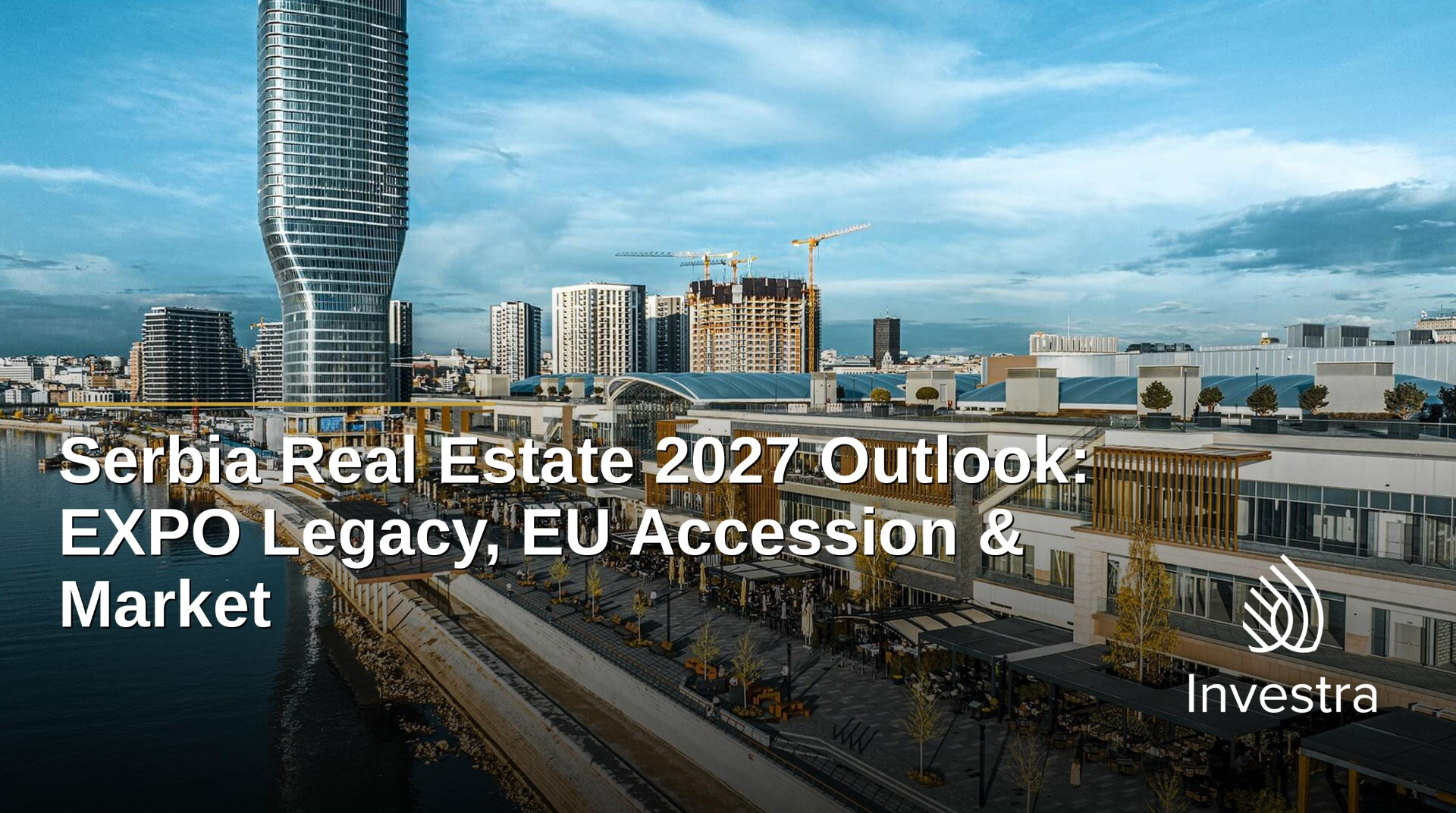
Serbia Real Estate 2027 Outlook: EXPO Legacy, EU Accession & Market
Serbia Real Estate 2027 Outlook: EXPO Legacy, EU Accession & Market Predictions
Serbia’s property market is expected to deliver moderate but consistent gains through 2027, supported by the lasting effects of the Belgrade EXPO 2027 infrastructure push and the ongoing EU accession process. Average residential prices in prime Belgrade locations are projected to reach €3,600–€4,200 per square metre by the end of 2027, while secondary cities such as Novi Sad and Niš should see more modest annual growth of 6–9 %. Foreign buyers who focus on well-connected districts and new developments tied to the EXPO site stand to capture the strongest rental yields and capital appreciation.
The outlook remains tied to Serbia’s political timeline and construction pipeline rather than any single speculative boom.
Introduction
```htmlBy mid-2026 the Serbian capital already shows the physical imprint of preparations for the specialised EXPO 2027. New metro lines, road links and a 40-hectare exhibition district are moving from blueprint to concrete, reshaping neighbourhoods that were previously overlooked by international capital. At the same time, the European Commission’s latest progress report on Serbia’s EU accession talks has kept the door open for candidate status advancement, a factor that has historically lifted property values across Central and Eastern Europe.
Investors scanning the region notice that Serbia still offers lower entry prices than neighbouring EU members while sharing many of the same long-term tailwinds: improving rule of law, rising disposable incomes and steady foreign direct investment. The combination makes the market attractive for both yield-focused buyers and those seeking medium-term capital growth ahead of potential EU membership milestones.
Yet the story is not uniform across the country. Belgrade continues to absorb the bulk of new supply and foreign demand, while regional cities rely more on domestic migration and university-driven rental markets. Understanding these differences is essential before committing capital in 2026.
Market Overview
Belgrade finished 2025 with an average residential transaction price of €2,950 per square metre, up 11 % year-on-year according to the latest data from the Serbian Statistical Office. New-build apartments in New Belgrade and the emerging EXPO-adjacent zone of Surčin traded between €3,400 and €4,100 per square metre, while older stock in Vračar and Dorćol commanded premiums of €4,500–€5,200 in the best buildings. Outside the capital, Novi Sad recorded €2,150 per square metre and Niš €1,650, both with single-digit annual gains.
Rental yields remain attractive by European standards. A well-located one-bedroom apartment in New Belgrade currently returns 6.4–7.1 % gross when let to corporate tenants or long-stay expats, while student-oriented studios near the University of Novi Sad deliver 7.8–8.3 %. Transaction volumes rose 14 % in 2025, driven largely by cash purchases from Serbian diaspora buyers and a growing number of Western European investors seeking diversification.
Supply is responding. Roughly 18,000 new residential units are scheduled for completion across Serbia in 2026, with more than half located in the Belgrade metropolitan area. This measured increase should prevent the overheating seen in earlier cycles, provided construction costs remain stable and mortgage rates do not spike above 5.5 %.
Key Investment Factors
EXPO 2027 Legacy and Infrastructure Delivery
The specialised exhibition grounds and supporting transport links are scheduled for completion by late 2026. Areas within a 15-minute metro ride of the site, such as New Belgrade’s Blocks 41–45 and the western edge of Zemun, have already recorded 18–22 % price growth since ground-breaking. Once the event concludes, the repurposed exhibition halls and adjacent parks are expected to become permanent commercial and residential anchors, supporting long-term demand similar to the post-Expo trajectories observed in Milan and Dubai.
EU Accession Timeline and Regulatory Convergence
Progress on chapters 23 and 24 of the EU acquis has accelerated in 2025, raising market expectations that Serbia could open accession negotiations in 2027 or 2028. Historical evidence from Croatia and Romania shows that property prices typically re-rate 25–40 % in the three years following the opening of talks. Serbia’s current price-to-income ratio remains below the level recorded in those markets at the equivalent stage, leaving room for catch-up appreciation.
Demographic and Migration Trends
Belgrade’s population grew by 1.8 % in 2025, the fastest pace in a decade, fuelled by returning diaspora and IT-sector inflows. Net migration into Novi Sad and Niš also turned positive for the first time since 2019. These trends underpin structural rental demand rather than one-off speculative surges.
Financing and Foreign Buyer Access
Mortgage rates for non-residents averaged 4.7 % in early 2026 when secured against Serbian properties, down from 6.1 % two years earlier. The process remains straightforward for EU and US citizens, though due diligence on title and planning permission is still required. Detailed guidance is available in the Serbia Buying Process 2026 guide on Investra.io.
Price Analysis Table
| Area | Avg. Price €/m² (mid-2026) | Projected 2027 Price €/m² | Gross Rental Yield | Primary Driver |
|---|---|---|---|---|
| New Belgrade – EXPO Zone | 3,650 | 4,100 | 6.8 % | Infrastructure & event legacy |
| Vračar | 4,850 | 5,200 | 5.4 % | Established residential prestige |
| Dorćol Waterfront | 4,200 | 4,650 | 5.9 % | Regeneration & river views |
| Novi Sad – Liman | 2,350 | 2,550 | 7.5 % | University & tech employment |
| Niš – City Centre | 1,720 | 1,870 | 8.1 % | Domestic migration & affordability |
Why Invest in 2026
Timing in 2026 captures two overlapping catalysts: the final wave of EXPO-related infrastructure spending and the market’s reaction to any positive signals on EU accession talks. Prices have already risen from 2023–2025 lows, yet they remain below the levels implied by comparable regional cities at similar stages of integration. Early positioning allows buyers to secure assets before the next re-rating cycle.
Investra.io currently lists more than 1,200 verified residential and mixed-use properties across Serbia, with detailed due-diligence packs and local legal support for non-resident purchasers. Cross-reference current Belgrade pricing and forecasts in the Belgrade Real Estate Market 2026 report, and review the full tax framework in the Serbia Property Taxes 2026 guide before making offers.
Foreign buyers who combine careful location selection with professional local advice continue to achieve double-digit total returns over three-to-five-year horizons. The window for advantageous entry remains open, but it is narrowing as construction milestones are reached and political clarity improves.
As with any investment, property in Serbia carries risks. Only invest capital you can afford to lose.
Practical Buying Guide
Foreign buyers who approach the Serbian market methodically tend to complete transactions with fewer surprises. The process is straightforward once the key legal and practical steps are understood, though it still requires patience with local administrative rhythms.
Clarify Ownership Rules and Residency Status
Serbia allows foreign individuals and companies to acquire residential and commercial real estate under the same conditions as citizens, with the exception of agricultural land. Before any viewing, confirm your eligibility through a short consultation with a Serbian notary or lawyer. EU citizens benefit from the ongoing accession talks, but current rules already permit direct purchase. Non-EU buyers usually register the property in a Serbian-registered company if they plan larger commercial holdings. This initial check prevents wasted time on properties that fall outside permitted categories.
Source Properties and Conduct On-Site Verification
Most buyers start with established portals and local agencies that list both new-build and resale stock in Belgrade, Novi Sad and Niš. Once a shortlist is prepared, schedule physical inspections rather than relying solely on virtual tours. Engage an independent building surveyor to examine structural integrity, especially in older buildings in central zones. Cross-check the land-registry extract (list nepokretnosti) at the cadastre office to confirm the seller’s title and any existing encumbrances. This step typically takes two to three weeks and is inexpensive relative to the purchase price.
Negotiate, Sign and Register
After inspection, a preliminary contract is signed and a 10 % deposit is lodged with a notary. The notary then prepares the final purchase agreement, verifies tax clearance and arranges the transfer of funds through a blocked account. The entire registration at the cadastre usually concludes within 30 to 60 days. Buyers should budget for possible delays during summer holidays or around major public infrastructure deadlines linked to the EXPO 2027 works.
Post-Purchase Obligations
Once registered, arrange utility transfers and, if renting the property, register the lease contract to protect both parties. Annual property tax declarations are filed each February; failure to do so triggers modest penalties rather than dramatic consequences. Keeping digital copies of all notarised documents simplifies future sales or inheritance procedures.
Costs & Fees Breakdown
| Purchase Price | Notary & Legal | Transfer Tax | Agent Fees | Other (cadastre, translations) | Total Additional Cost |
|---|---|---|---|---|---|
| €80,000 | €650 | €400 | €2,400 | €350 | €3,800 (4.75 %) |
| €150,000 | €950 | €750 | €4,500 | €450 | €6,650 (4.43 %) |
| €250,000 | €1,300 | €1,250 | €7,500 | €600 | €10,650 (4.26 %) |
| €400,000 | €1,800 | €2,000 | €12,000 | €750 | €16,550 (4.14 %) |
Figures are indicative for 2025–2026 and exclude VAT on new-build purchases, which adds 10 % to the price but is usually already included in developer quotes.
Risks & Challenges
The market remains exposed to several structural and external factors. Currency risk is modest because most transactions are euro-denominated, yet local financing, when used, is still largely in dinars and subject to occasional central-bank interventions. Bureaucratic delays at the cadastre can stretch beyond the advertised 30 days, particularly in districts affected by EXPO-related rezoning. Liquidity is lower outside Belgrade and Novi Sad; selling a secondary-city apartment within three months is still uncommon. Political uncertainty around the pace of EU accession occasionally surfaces in media narratives, though actual legislative changes affecting property ownership have been minimal. Finally, construction quality in some new-build projects varies; buyers who skip independent inspections have reported issues with sound insulation and finishing details.
Expert Tips
- Always route the purchase through a notary rather than attempting direct agreements; the small extra cost removes most title risks.
- Focus on micro-locations within walking distance of planned EXPO transport links rather than chasing the lowest advertised price.
- Request a full five-year utility and tax payment history before signing; unpaid bills transfer with the property.
- Budget an extra 2 % contingency for minor renovation works that almost every older apartment requires after purchase.
- If the plan includes rental, study seasonal demand patterns—Belgrade sees stronger summer corporate lets while Novi Sad benefits from university cycles.
- Keep copies of every document in both Serbian and English; future resale or inheritance cases move faster with bilingual records.
- Monitor the quarterly cadastre statistics published by the Republic Geodetic Authority to spot emerging price corrections early.
Find Your Serbia Property on Investra.io
Investra.io aggregates verified listings from licensed agencies across Serbia and adds a layer of legal pre-checks that many portals omit. Users can filter by distance to future EXPO infrastructure, projected rental yield and ownership structure, then connect directly with local notaries through the platform’s workflow tools.
The site also maintains an updated cost calculator and document checklist that reflects the latest cadastre fees and tax rulings. Foreign buyers report that the combination of mapped listings and downloadable legal templates reduces the usual back-and-forth with multiple agencies.
Recommended Reading
- Serbia Legal Guide for Foreigners
- Serbia Rental Market 2026
- Serbia Property Price Forecast
- Novi Sad Real Estate 2026
- Sinisa Dagary Real Estate Blog
- Findes.si Property Portal
Follow Us
Stay updated on regulatory changes and new listings through our channels:
Odkrijte globalne investicijske priložnosti na Unifyr.space — vaš portal za pametne investicije.
Frequently Asked Questions
Q: Can foreigners buy property in Serbia without a local company?
A: Yes. Individuals from any country may purchase apartments, houses and commercial premises directly, provided the asset is not classified as agricultural land.
Q: How long does the full purchase process usually take?
A: From signed preliminary contract to cadastre registration, most transactions close in 45–75 days, although EXPO-adjacent districts can experience longer waits.
Q: What is the current property transfer tax rate?
A: The rate is 0.5 % of the purchase price for residential property, collected at the notary stage.
Q: Are there restrictions on renting out a purchased apartment?
A: No restrictions apply to short- or long-term rentals once the property is registered in your name.
Q: Do I need a Serbian bank account to complete the purchase?
A: A temporary non-resident account is sufficient; many notaries accept international wire transfers into a blocked escrow account.
Q: What happens if the seller has unpaid utility bills?
A: Outstanding debts remain attached to the property and become the buyer’s responsibility unless cleared before registration.
Q: Is title insurance commonly used in Serbia?
A: It is still rare; most buyers rely on the notary’s verification of the cadastre extract instead.
Q: Can I finance the purchase with a local mortgage?
A: Banks offer euro-denominated loans to foreigners who can demonstrate stable income, though loan-to-value ratios are typically capped at 70 %.
Q: How are capital gains taxed on resale?
A: Residents pay 15 % on gains after a three-year holding period; non-residents are subject to the same rate unless a double-taxation treaty applies.
Q: What documents should I keep after purchase?
A: The notarised purchase contract, cadastre decision, tax receipt and proof of payment should all be retained in both digital and paper form.
Related Posts
No related posts available.
