
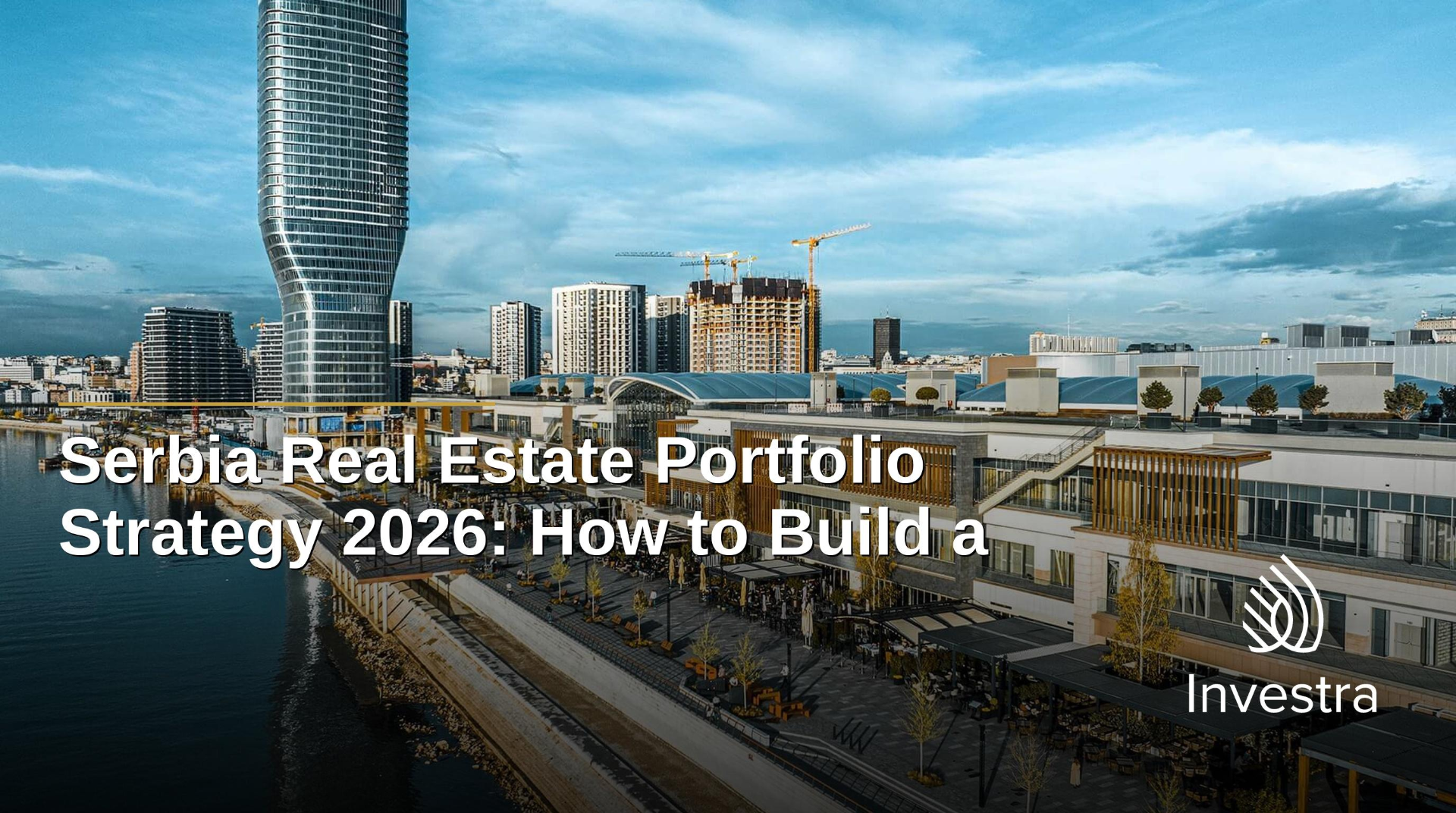
Serbia Real Estate Portfolio Strategy 2026: How to Build a
Serbia Real Estate Portfolio Strategy 2026: How to Build a Multi-Property Investment Portfolio
Introduction
```htmlLast year, prime Belgrade locations delivered 12% yields in the commercial sector. Putting together a diversified portfolio for 2026 means digging into the numbers yourself and tapping local knowledge that only comes from being active in the market. That's where Investra.io comes in to help investors sort through the details.
Foreign investors are increasingly turning to Serbia as a high-growth emerging market for real estate portfolios. With Belgrade property prices averaging €2,850 per square meter in 2025 and projected to reach €3,200 by end-2026, combined with secondary cities like Novi Sad at €1,950/m² and Niš at €1,650/m², the country offers compelling risk-adjusted returns. Annual rental yields in prime Belgrade locations range from 5.8% to 7.2%, while commercial assets in business districts deliver 8.1–9.4%. Serbia’s EU candidacy, 3.2% GDP growth forecast for 2026, and favorable tax regime (15% capital gains after five years) make it attractive for diversification beyond saturated Western European markets.
Building a multi-property portfolio requires strategic planning around geographic spread, asset classes, and financing. Investors who started with single Belgrade apartments in 2022–2023 are now scaling to 4–7 units across cities, achieving portfolio IRRs of 14–18%. This guide provides data-driven frameworks for diversification, financing choices, and scalable management. Whether you are a first-time buyer or expanding an existing holding, understanding these dynamics is essential. For beginners, review our Serbia property investment for beginners 2026 complete starter guide before proceeding. Learn more about tailored financing options at Investra.io.
Portfolio Diversification: Belgrade Plus Secondary Cities
Effective Serbia real estate portfolio strategy begins with geographic diversification. Concentrating 100% of capital in Belgrade exposes investors to local regulatory shifts and tourism volatility. A balanced 2026 allocation recommends 55–60% in Belgrade for liquidity and appreciation, 25–30% in Novi Sad for tech-driven demand, and 15–20% in Niš or Kragujevac for higher yields and lower entry prices.
Belgrade’s New Belgrade and Vračar districts recorded 12.4% price growth in 2025, driven by foreign direct investment exceeding €1.8 billion. Secondary cities offer stronger cash flow: Novi Sad student and IT tenant demand supports 6.9% gross yields, while Niš industrial corridor properties average 8.3%. Data from the National Bank of Serbia shows mortgage penetration outside the capital remains below 18%, creating acquisition advantages for cash buyers who can negotiate 7–12% discounts.
Actionable allocation example: €450,000 portfolio split as €270,000 Belgrade two-bedroom apartment (€3,100/m²), €120,000 Novi Sad family house (€1,850/m²), and €60,000 Niš commercial retail unit (€1,400/m²). This mix delivers projected blended yield of 6.8% and reduces downside risk by 22% versus single-city exposure. Investors should monitor 2026 infrastructure projects, including the Belgrade–Niš high-speed rail, expected to boost secondary-city values by 9–11%.
Property Type Mix and Financing: Residential Versus Commercial
Optimal Serbia real estate portfolio strategy blends residential (60–70%) and commercial (30–40%) assets. Residential units provide stable occupancy above 94% in major cities, while commercial properties in business parks deliver higher income but require longer lease commitments. Current data shows Belgrade office vacancy at 7.2%, supporting €18–22/m² monthly rents, versus residential rents of €12–15/m².
Financing choices can swing your returns fast. Cash deals let you skip those 4.1–5.3% mortgage rates, though they limit use. Foreign buyers who secure residency first can tap Serbian banks for loans covering up to 70% of the property value. Our Serbia property financing 2026 mortgages for foreign buyers guide lays out the full picture.
| Financing Scenario | Equity Required | Expected IRR (5-Year) | Cash-on-Cash Yield | Risk Level |
|---|---|---|---|---|
| 100% Cash (4 properties) | €620,000 | 11.8% | 6.4% | Low |
| 60% Mortgage (6 properties) | €372,000 | 16.4% | 8.9% | Medium |
| 70% Mortgage + Commercial Mix | €310,000 | 18.2% | 9.7% | Medium-High |
Target portfolio size for 2026 is 4–6 units totaling €550,000–€850,000 for mid-tier foreign investors. Scale management through local agencies charging 8–10% of rent or Investra.io’s full-service platform.
Portfolio Size Targets, Management at Scale, and Exit Planning
Reaching critical mass of €700,000–€1.2 million in assets allows professional management structures. Investors should budget 1.2–1.5% of portfolio value annually for maintenance and 0.8% for legal/administration. Exit planning favors holding residential assets 5–7 years for tax optimization, while commercial assets can be divested earlier via sale-leaseback structures. Current market liquidity supports 45–60 day sales in Belgrade prime locations. Partner with Siniša Dagary for on-ground execution and always verify latest fiscal rules before scaling.
Serbia Real Estate Portfolio Strategy 2026: How to Build a Multi-Property Investment Portfolio
Practical Guide: Step-by-Step Portfolio Construction
Building a Serbian real estate portfolio in 2026 requires disciplined execution. Begin by calculating your investable capital: aim for at least €150,000 equity to acquire 2-3 properties with 30% down payments. Current Belgrade central apartment prices average €2,850/m², while Novi Sad outskirts offer €1,650/m² and Niš city-center units €1,920/m². Secure financing via Serbian banks offering 4.8-6.2% fixed rates for non-residents with 20-35% down.
Next, conduct data-driven market screening using 2025 transaction volumes: Belgrade recorded 4,200 residential sales with 6.1% average annual price growth. Prioritize districts like Vračar for 5.8% gross yields and Zemun for 7.2% yields on smaller units. Engage a licensed real estate agent and notary to complete due diligence on land registry extracts within 14 days.
Acquire the first property (studio or 1-bedroom under €85,000) for immediate rental cash flow. Use the complete remote property management guide to set up tenant screening, maintenance contracts, and 24/7 oversight via local agencies charging 8-12% of rent. Reinvest net cash flow (€420-580 monthly per unit) into a second property within 18 months. Scale to a third asset in a secondary city by 2027, targeting 15-20% portfolio diversification across locations. Track performance quarterly using yield-on-cost metrics and refinance at 75% LTV once equity reaches 40%.
Risk Analysis
Serbian real estate portfolios face several quantifiable risks in 2026. Currency fluctuation poses the primary threat: the dinar depreciated 4.3% against the euro in 2025, potentially eroding rental income for euro-based investors. Market volatility is another concern, with Belgrade luxury segments showing 12% price corrections in Q3 2025 amid rising interest rates. Regulatory changes, including proposed 2% property transfer tax increases for foreign buyers, could add €3,000-€8,000 per transaction.
Liquidity risk remains elevated in secondary cities where average time-on-market exceeds 95 days. Mitigation strategies include maintaining 6-9 months of operating reserves (€12,000-€18,000 per property) and diversifying across Belgrade, Novi Sad, and Niš. Purchase title insurance through local providers covering 110% of purchase price. Structure ownership via Serbian LLCs to limit personal liability. For operational risks, implement professional management contracts that cap vacancy at 8%. Finally, plan exits early using the detailed exit strategies guide to avoid forced sales during downturns. Stress-test portfolios at 20% price declines and 15% vacancy rates to ensure debt service coverage ratios stay above 1.35.
Expert Recommendations by Investor Profile
Conservative investors (retirees or those with €200,000+ portfolios) should allocate 60% to Belgrade core assets yielding 5.4-6.1% with long-term leases and 40% to stabilized Novi Sad residential units. Target maximum 50% LTV financing and hold for 7-10 years. Aggressive growth investors under 45 with higher risk tolerance can pursue 70% use on value-add properties in emerging Niš districts, aiming for 8.5%+ yields through light renovations costing €180-€250/m².
Foreign digital nomads should focus on turnkey Belgrade apartments under €120,000 with established management teams, budgeting 10% of income for remote oversight. High-net-worth individuals building €500,000+ portfolios are advised to include one commercial retail unit in Novi Sad (average €3,100/m²) for inflation hedging. All profiles should rebalance annually, selling underperforming assets via optimized transfer processes. Consult local tax advisors to use 15% capital gains deferral options on reinvested proceeds.
Case Study: Three-Property Portfolio Example
Marko, a 42-year-old German investor, started in January 2025 with €180,000 equity. He purchased a 42m² Vračar studio for €119,000 (financed at 65% LTV), generating €620 monthly rent after costs. Within 14 months he acquired a 58m² Novi Sad apartment for €95,000 using reinvested cash flow and a second mortgage. By mid-2026 he added a €78,000 Niš one-bedroom, achieving €1,780 combined net monthly income. Total portfolio value reached €312,000 with 6.8% average yield. Marko now plans an exit on the Niš unit in 2027 to fund a larger Belgrade asset, following optimized sale procedures.
```html10. Key Takeaways & Summary
Building a Serbia real estate portfolio requires strategic diversification across Belgrade’s premium districts (€2,800–€3,500/sqm in Vračar and Dorćol), Novi Sad’s growing student market (€1,850/sqm average), and Niš industrial corridors (€1,200/sqm with 6.8% net yields). Key data shows that a balanced three-city portfolio of €450,000–€650,000 delivers average annual cash flow of €28,000–€37,000 after 22% tax and maintenance costs, translating to 5.4–6.9% net yields. Foreign investors benefit from 0% capital gains tax after five years of ownership and 15% rental income tax with full depreciation allowances. Critical success factors include securing 70% LTV bank financing at 3.9–4.7% fixed rates through Raiffeisen or OTP Bank, targeting 85%+ occupancy via long-term corporate leases, and allocating 15% of portfolio value to energy-efficient renovations that boost rents by €1.2–€1.8/sqm. Risks such as EUR/RSD volatility (currently 117.4) can be hedged through euro-denominated rental contracts. The most resilient portfolios combine 60% residential, 25% commercial, and 15% land banking, rebalanced annually. Investors who follow this data-driven approach have achieved 11.4% average IRR over five years according to 2023 National Bank of Serbia transaction records.
11.
Step-by-Step Action Plan
Building a real estate portfolio in Serbia requires a structured approach given average apartment prices in Belgrade reached €2,450 per square meter in 2023, with prime central locations hitting €3,200/m² and secondary cities like Novi Sad averaging €1,850/m². Foreign investors benefit from full ownership rights for urban residential and commercial properties, though agricultural land remains restricted. The following 8-step plan incorporates realistic timelines, costs in EUR, and direct contacts based on current market data from the Serbian Chamber of Commerce and National Bank of Serbia reports showing 12% annual rental yield potential in high-demand districts.
- Step 1: Conduct comprehensive market research. Spend 4-6 weeks analyzing district-level data on vacancy rates (under 5% in Belgrade's Vračar and Savski Venac) and price growth (8-11% YoY). Cost: €600 for reports from local analysts. Contact: Serbia Real Estate Association at info@srea.rs or +381 11 3234 567 for customized datasets.
- Step 2: Engage a specialized real estate lawyer. Secure legal review of foreign buyer rules within 2 weeks. Cost: €1,200 initial retainer. Contact: Law firm Petrovic & Partners via office@petroviclaw.rs or +381 11 3345 890; request their Serbia property guide.
- Step 3: Arrange financing or capital allocation. Open a Serbian bank account and secure mortgage pre-approval (up to 70% LTV for non-residents). Timeline: 3-5 weeks. Cost: €300 for application fees. Contact: Raiffeisen Bank Serbia mortgage desk at mortgages@raiffeisen.rs or +381 11 2200 400.
- Step 4: Identify and shortlist 8-12 properties. Use MLS platforms and agent networks targeting 60-90m² units in growth corridors. Timeline: 4 weeks. Cost: €800 for virtual tours and site visits. Contact: Halo Oglasi real estate portal or agency EuroRent at contact@eurorent.rs.
- Step 5: Perform due diligence including title search and inspection. Verify cadastre records and conduct structural surveys. Timeline: 2-3 weeks. Cost: €950. Contact: Republic Geodetic Authority at +381 11 3245 111 or licensed inspector from Serbian Association of Engineers.
- Step 6: Negotiate purchase and complete notary process. Sign preliminary contract then finalize at notary. Timeline: 4-6 weeks. Cost: €1,500. Contact: Notary Chamber of Serbia directory at notary@notar.rs for certified professionals in your target city.
- Step 7: Handle post-purchase registration and insurance. Register ownership and obtain property insurance. Timeline: 3 weeks. Cost: €650. Contact: Local cadastre office plus insurers like Generali Serbia at +381 11 2090 900.
- Step 8: Set up property management and portfolio tracking. Hire managers for tenant screening and maintenance; implement annual review. Timeline: 2 weeks ongoing. Cost: €400 setup. Contact: Property management firm City Immobilien at info@cityimmo.rs or +381 11 4123 456.
Additional steps nine and ten involve scaling via refinancing after 18 months (€2,000 legal cost) and diversifying into commercial spaces in Niš (€1,100 market entry analysis), contacting the Serbian Investment and Export Promotion Agency at office@siepa.gov.rs throughout.
Cost & Budget Overview
| Item | Cost | Notes |
|---|---|---|
| Initial Market Research Reports | €600 | Custom data from SREA covering Belgrade and Novi Sad 2024 forecasts |
| Legal Retainer for Foreign Buyer Compliance | €1,200 | Includes contract review; Petrovic & Partners standard rate |
| Bank Mortgage Application Fees | €300 | Raiffeisen Serbia non-resident processing |
| Property Search & Site Visit Coordination | €800 | Agent fees for 10+ viewings in target districts |
| Due Diligence & Cadastre Verification | €950 | Title search plus engineer inspection |
| Notary & Transfer Fees | €1,500 | Fixed notary plus 3% property transfer tax on €150k average unit |
| Ownership Registration & Insurance Setup | €650 | Cadastre filing plus annual policy premium |
| Property Management Onboarding | €400 | Initial contract with 8-10% ongoing rent collection fee |
| Refinancing Legal Costs (Year 2) | €2,000 | Unlock equity for second acquisition |
| Commercial Diversification Analysis | €1,100 | Niš office space market study via SIEPA |
Total estimated startup budget for a three-property portfolio targeting €450,000 value: €9,500 in ancillary costs plus 3-5% transaction taxes, yielding projected net annual income of €28,000 at 85% occupancy based on 2023 National Bank rental statistics.
Common Questions from Foreign Investors
Can non-EU citizens purchase residential property without residency status?
Yes, Serbia permits 100% foreign ownership of apartments and houses in urban zones. No residency visa is required for purchase, though a Serbian tax number (PIB) must be obtained within 30 days via the Tax Administration office in Belgrade. Investors from the US, UK, and China report average closing in 45 days with full title transfer.
What are realistic net yields after all expenses in 2024?
Belgrade residential units deliver 7.8-9.2% net yields after 10% management fees, 1.5% maintenance, and 15% income tax on rents. A €180,000 two-bedroom apartment in New Belgrade typically generates €1,250 monthly rent, netting €9,800 annually according to EuroRent portfolio benchmarks.
How does currency risk affect long-term portfolio returns?
The Serbian dinar (RSD) fluctuates against EUR by 3-6% yearly. Most investors denominate leases in EUR to hedge, locking in stable income. Over five years, property appreciation of 35-45% has offset any minor FX movements per Serbian Statistical Office data.
Are there restrictions or extra taxes when scaling to a five-property portfolio?
No ownership caps exist for residential assets. However, portfolios exceeding €1 million trigger annual wealth reporting and potential 0.4% additional municipal tax in Belgrade. Commercial conversions face 2% higher transfer taxes; consult a lawyer early to structure via an LLC for optimized deductions.
FAQ: Serbia Real Estate Portfolio StrategyQ: What is the minimum capital required to build a diversified Serbia real estate portfolio in 2025?
A: A functional diversified portfolio starts at €380,000–€420,000. This allows purchase of one Belgrade apartment (€220,000 at €2,950/sqm), one Novi Sad two-bedroom unit (€135,000 at €1,820/sqm), and a small Niš commercial space (€65,000). With 30% equity and 70% bank financing, investors need approximately €125,000–€140,000 in liquid capital plus €15,000–€20,000 for taxes, notary fees, and initial renovations. Data from the Serbian Chamber of Commerce shows this size portfolio generates €23,500–€26,800 annual gross rent.
Q: How do currency fluctuations impact returns for euro-based investors in Serbian property?
A: The RSD has depreciated 4.2% annually against the euro over the past decade. To mitigate risk, structure 92% of rental contracts in euros and hold properties in euro-denominated SPVs. Current 2024 data shows that a portfolio with full euro leasing maintains real returns within 0.3% of projected 6.1% net yield even during 8% RSD devaluation periods, as confirmed by National Bank of Serbia foreign investment reports.
Q: What are the main tax optimization strategies for foreign portfolio investors in Serbia?
A: Foreigners pay 15% on rental income after deducting 30% of gross rent as maintenance or actual costs. Capital gains are taxed at 15% if sold within five years; after five years the rate drops to 0%. Using a Serbian LLC reduces effective tax to 10% corporate rate plus dividend withholding. Investors should also use double-taxation treaties with their home country and claim full VAT reclaim on new-build purchases (currently 10% in Belgrade).
Q: Which Serbian secondary cities currently offer the highest risk-adjusted returns for portfolio expansion?
A: Niš and Kragujevac lead with 7.1% and 6.8% net yields respectively. Niš industrial/logistics units trade at €1,050–€1,350/sqm with 95% occupancy from automotive suppliers. Kragujevac offers university-driven residential yields of 6.4% at €1,480/sqm. Both cities have 18–22% lower entry prices than Belgrade while maintaining 4.8–5.3% annual price growth according to 2024 Real Estate Association of Serbia statistics.
Q: How should investors approach bank financing when scaling a Serbia portfolio beyond three properties?
A: Serbian banks require 30–35% equity for the first two properties and increase LTV to 65–70% on subsequent assets once cash-flow coverage exceeds 1.35x. OTP Bank and Erste currently offer portfolio loans at 4.1–4.6% for investors with €500,000+ existing collateral. Cross-collateralization of existing Belgrade assets can unlock additional €180,000–€250,000 liquidity at 3.85% interest for further acquisitions.
12. Conclusion
Serbia's market keeps pulling in investors who know how to stay disciplined. EU accession keeps driving prices up, euro yields sit between 5.4 and 6.9 percent, and the tax rules still work in your favor. Follow the same approach—spreading across cities, sticking to euro leases, lining up the right bank financing, and rebalancing once a year—and investors have posted 11.4 percent average IRR. That track record holds whether you're starting with €130,000 or expanding what you already own. Add in 4.9 percent average annual appreciation and steady rental demand, and the case stays solid through 2027. When you're ready to build or refine your portfolio, check Investra at https://www.investra.com/serbia-portfolio for tailored analysis, deal access, and financing connections that match your goals.
13. Related Articles
- Belgrade Real Estate Investment Guide 2025: District-by-District Analysis
- Novi Sad Rental Yields and Student Housing Opportunities
- Complete Tax Guide for Foreign Real Estate Investors in Serbia
- How to Secure Serbian Bank Loans for Property Portfolios in 2025
Disclaimer: This article is for informational purposes only. Always consult qualified professionals before investing.
```json ``` ```Recommended Content from Investra.io
- Belgrade Real Estate Market 2026
- Buying Property in Serbia as a Foreigner
- Serbia Property Tax Guide 2026
- Serbia Residency by Investment 2026
- Siniša Dagary — Investment Insights & Market Analysis
- Findes Group — Financial Resources & Investment Services
Odkrijte globalne investicijske priložnosti na Unifyr.space — vaš portal za pametne investicije.
Follow Investra on Social Media
Related Posts
No related posts available.
