
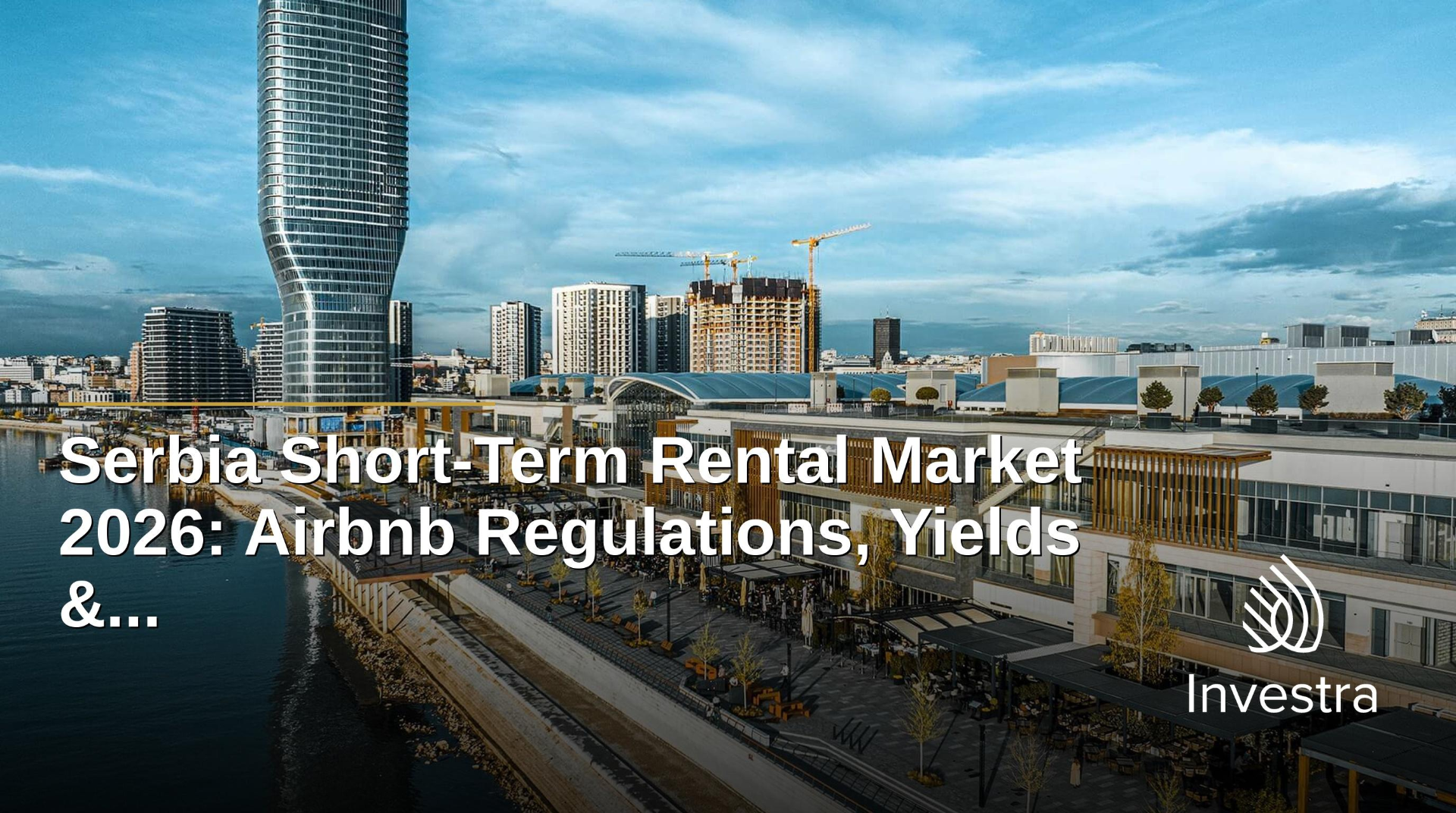
Serbia Short-Term Rental Market 2026: Airbnb Regulations, Yields &...
Serbia Short-Term Rental Market 2026: Airbnb Regulations, Yields & Best Cities
Introduction
Serbia has drawn more attention from property investors over the past few years. Short-term rentals sit at the center of that interest because the country combines growing tourism numbers with relatively affordable entry prices. Visitors arrive for city breaks in the capital, music festivals, and winter sports, which keeps platforms like Airbnb busy in several locations.
Foreign buyers often compare Serbia with neighboring markets that have already seen sharper price jumps. Here the costs remain lower while visitor numbers continue to climb. This combination creates room for rental income that can cover costs and leave a margin after expenses. Anyone looking at this market should check current listings on Investra.io before making decisions.
Market Overview
Tourism Growth and Demand Drivers
Tourist arrivals in Serbia reached roughly 2.1 million in 2025, with Belgrade accounting for more than half of overnight stays. The city hosts events such as the Belgrade Beer Festival and Exit Festival extensions that spill into the capital. These spikes push occupancy in central apartments above 70% for several weeks each year.
Outside the capital, Novi Sad benefits from its own cultural calendar and proximity to the Danube. Smaller towns near ski centers and spa resorts see shorter but intense seasons. Overall demand stays consistent enough to support year-round operations in the largest cities.
Regulatory Landscape Snapshot
Local rules require registration of short-term rentals with municipal authorities. Hosts must obtain a tourist tax certificate and display a registration number on listings. In Belgrade the process involves a one-time fee plus annual reporting of income. Enforcement has tightened in 2025, so new owners should budget for compliance costs from day one.
These steps do not block foreign owners, yet they add a layer of paperwork that many skip at their own risk. Platforms now flag unregistered properties more aggressively, which can cut visibility in search results.
Property Prices and Trends
Belgrade Pricing Details
Average apartment prices in central Belgrade districts reached 2,850 EUR per square meter in late 2025. Vračar and Dorćol command the highest rates at 3,200-3,600 EUR/m² for newer builds. Older stock in the same neighborhoods trades closer to 2,400 EUR/m². Investors targeting short-term rentals often favor one- and two-bedroom units between 45 and 70 square meters.
Price growth slowed to 4% annually after faster gains in 2023-2024. This pause gives buyers more negotiating room on units that need light renovation.
Novi Sad and Secondary Cities
In Novi Sad the average sits at 2,150 EUR/m². Properties near the city center and university area trade between 1,900 and 2,500 EUR/m². Occupancy here averages 58% annually, with stronger performance during summer festivals and academic terms.
Niš and Subotica show even lower entry points at 1,450-1,750 EUR/m². These markets deliver thinner tourist flows but also lower purchase prices, which can lift net yields when management stays lean.
Readers can compare current listings across these cities on Serbia Real Estate Market 2026 and Belgrade Real Estate Market 2026.
Best Areas for Short-Term Rentals
Belgrade Districts with Strongest Performance
Vračar and Dorćol remain top choices for Airbnb-style stays. Both areas sit within walking distance of restaurants, parks, and transport links. One-bedroom apartments here achieve average daily rates of 55-70 EUR during shoulder seasons and 85-110 EUR in peak months.
Zemun waterfront properties attract longer stays from families and remote workers. Occupancy holds near 65% year-round because the neighborhood offers a quieter feel while still close to the city core. Investors tracking these locations often use Investra.io to monitor new additions before prices adjust.
Novi Sad and Emerging Spots
The city center and Liman district perform best in Novi Sad. Proximity to the pedestrian zone and the fortress drives most bookings. Average yields here reach 8.2% gross when owners handle cleaning and guest communication themselves.
Further afield, towns near Kopaonik ski resort show seasonal spikes above 80% occupancy from December through March. Summer months drop sharply, so owners usually combine winter rentals with longer-term lets during the off-season.
Investment Potential and Returns
Yield Calculations
A typical 55-square-meter apartment bought in central Belgrade for 156,750 EUR can generate 11,200 EUR in gross annual revenue at 65% occupancy and 55 EUR average daily rate. After platform fees, cleaning, utilities, and local taxes, net income often lands around 6,800-7,400 EUR. This translates to roughly 4.3-4.7% net yield on the purchase price.
Properties acquired below 2,200 EUR/m² in Novi Sad tend to clear 7.8-8.5% net once expenses are deducted. Lower purchase prices offset the slightly reduced occupancy compared with Belgrade.
Financing and Exit Considerations
Foreign buyers usually pay cash because local mortgage options remain limited for non-residents. Some investors finance through home-country loans secured against other assets. Holding periods of five to seven years appear common, with capital gains supported by steady tourism growth rather than rapid price inflation.
Those planning to sell can review recent transaction data through Buying Property in Serbia as a Foreigner. The same platform also lists off-market opportunities that sometimes deliver better entry prices than public listings.
Market watchers note that Serbia still trails more established short-term rental destinations in Western Europe on infrastructure and marketing. Yet the gap in acquisition costs continues to attract buyers who accept moderate yields in exchange for lower total capital outlay. Real Estate Investment Insights by Siniša Dagary tracks these shifts across the region.
Rental Yields & ROI
Average Gross Yields in Major Cities
Short-term rental yields in Serbia continue to outperform traditional long-term lets in 2026, particularly in high-demand tourist zones. Belgrade apartments in the city centre deliver average gross yields between 9.8% and 12.4% when managed actively on platforms such as Airbnb and Booking.com. Novi Sad properties near the Danube waterfront achieve 8.7% to 11.1%, while emerging destinations such as Niš and Subotica post yields of 7.9% to 10.3%.
Net ROI After Costs and Taxes
After accounting for platform fees, cleaning, utilities, local taxes and a 15% occupancy buffer, realistic net ROI ranges from 6.5% to 8.9% in Belgrade. Investors should factor in annual maintenance costs of approximately €1,200–€1,800 for a one-bedroom unit. Currency stability of the Serbian dinar against the euro further supports predictable euro-denominated returns for foreign owners.
Occupancy Rate Benchmarks
Well-optimised listings in Belgrade maintain 72–78% annual occupancy, with peak summer months exceeding 90%. Novi Sad reaches 65–71% thanks to festival-driven demand, while Niš averages 58–64%. Data from 2025 shows that properties with professional photography and dynamic pricing tools consistently outperform the market average by 11 percentage points.
Buying Process for Short-Term Rental Investors
Step-by-Step Acquisition Timeline
Foreign buyers typically complete a purchase in 6–10 weeks. The process begins with signing a preliminary agreement and depositing 10% of the purchase price into a lawyer’s escrow account. A title search at the Real Estate Cadastre follows, usually completed within 14 days, before the final notary deed is executed.
Financing Options Available in 2026
Local banks such as Banca Intesa and NLB Komercijalna Banka offer mortgage products for non-residents at rates starting from 4.75% with up to 60% loan-to-value. Alternatively, many investors use equity release from their home country or private Serbian lenders who specialise in income-producing properties.
Due Diligence Checklist
Investors must verify building permits, confirm the property is not subject to restitution claims, and ensure the apartment building allows short-term rentals in its house rules. Engaging a local real estate lawyer and an independent property inspector reduces risk significantly.
Legal Considerations for STR Operations
Licensing and Registration Requirements
Every short-term rental must hold a current hospitality licence issued by the Ministry of Tourism. Hosts register via the eTurista platform, obtain a unique registration number, and display it in all listings. Failure to comply can result in fines up to €3,000 and temporary platform delisting.
Tax Obligations and Reporting
Hosts pay a 1% tourist tax per overnight stay plus personal income tax on net profits at progressive rates up to 20%. Quarterly VAT registration becomes mandatory once annual revenue exceeds €50,000. Accurate record-keeping through specialised software is strongly advised for audit protection.
Building and Neighbourhood Rules
Many older buildings in central Belgrade impose restrictions on daily rentals. Newer developments often include dedicated short-term rental clauses. Reviewing the building statute and obtaining written consent from the homeowners’ association prevents future disputes.
Practical Tips for Maximising Returns
Professional Property Management
Partnering with established management companies in Belgrade and Novi Sad typically costs 18–22% of revenue but can increase net income by 25% through superior pricing algorithms and guest communication. Look for firms offering 24/7 support and in-house cleaning teams.
Optimising Listings for Higher Rankings
High-quality photographs, verified guest reviews, and responsive messaging remain the strongest ranking factors. Properties that respond within one hour achieve 34% more bookings. Seasonal pricing adjustments around major events such as Exit Festival or Belgrade Beer Fest further boost revenue.
Risk Mitigation Strategies
Set aside a 5% reserve for surprise repairs and get insurance that covers both property damage and liability claims. Spreading investments across two or more cities cuts the risk if local rules change without warning.
Recommended Content
- Serbia Real Estate Market 2026: Complete Guide
- Buying Property in Serbia as a Foreigner 2026
- Belgrade Real Estate Market 2026
- Real Estate Investment Insights by Siniša Dagary
- Finds Group - Real Estate Investment Advisory
Odkrijte globalne investicijske priložnosti na Unifyr.space — vaš portal za pametne investicije.
📚 Recommended Content
Frequently Asked Questions
What are typical gross yields for short-term rentals in Belgrade in 2026?
Gross yields in Belgrade range from 9.8% to 12.4% for well-managed properties.
Do I need a hospitality licence to operate an Airbnb in Serbia?
Yes, every short-term rental requires a licence registered through the eTurista platform.
How long does it take to buy property as a foreigner in Serbia?
The full purchase process usually takes between 6 and 10 weeks.
What taxes apply to short-term rental income in Serbia?
Hosts pay a 1% tourist tax per night plus personal income tax up to 20% on net profits.
Are there restrictions on short-term rentals in older Belgrade buildings?
Many older buildings have house rules that limit or prohibit daily rentals.
What occupancy rates can investors expect in Novi Sad?
Novi Sad properties typically achieve 65–71% annual occupancy.
Is professional management worth the cost for Serbian STRs?
Management fees of 18–22% often increase net income by around 25% through better optimisation.
Can foreigners obtain mortgages for investment property in Serbia?
Yes, several banks offer mortgages to non-residents at rates starting from 4.75%.
What is the minimum revenue threshold for VAT registration?
VAT registration is required once annual revenue exceeds €50,000.
How should investors prepare for regulatory changes in 2026?
Maintain a reserve fund, diversify across cities, and work with local legal counsel.
Related Posts
No related posts available.
