
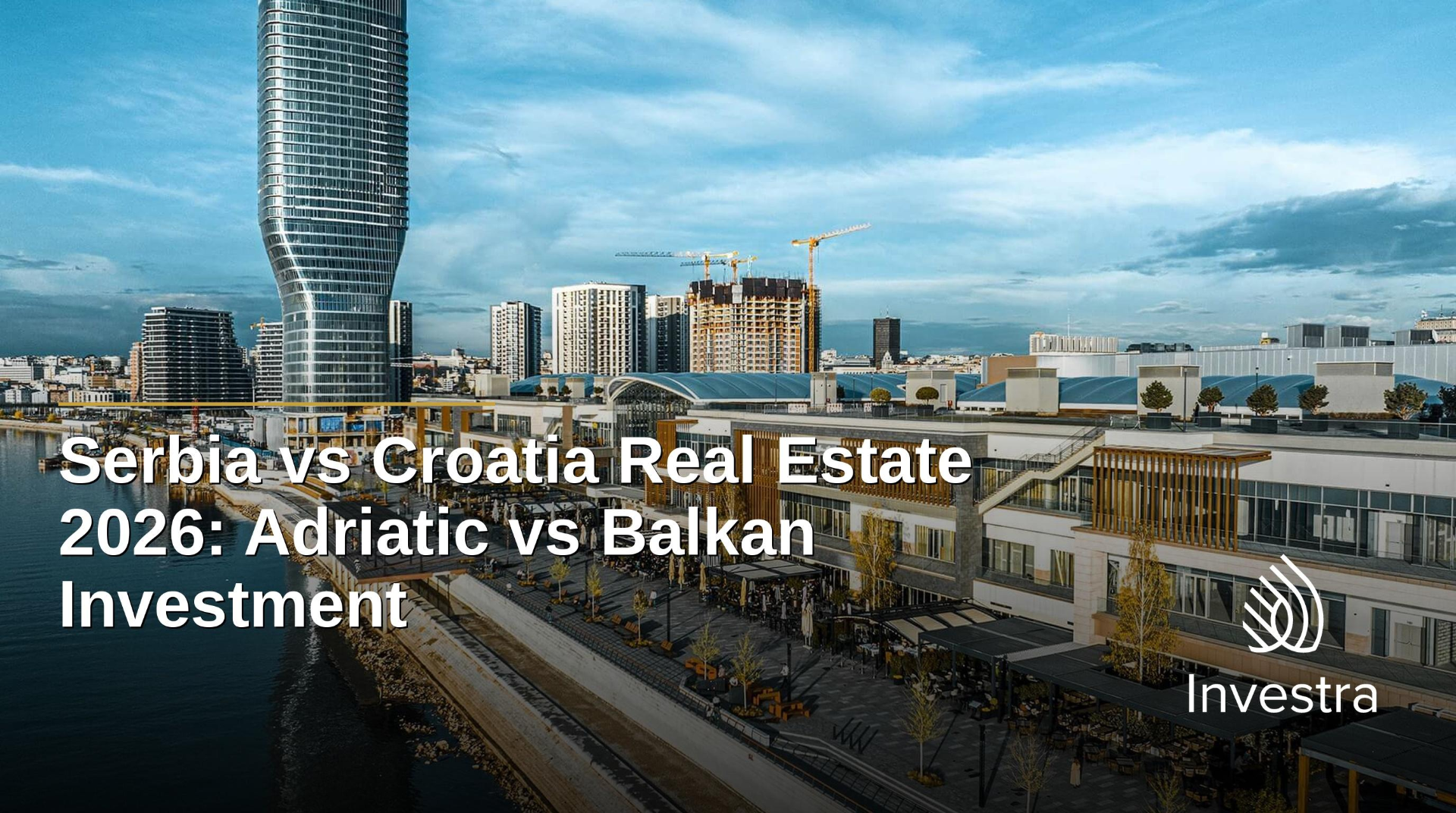
Serbia vs Croatia Real Estate 2026: Adriatic vs Balkan Investment
Serbia vs Croatia Real Estate 2026: Adriatic vs Balkan Investment Comparison
Answer Capsule: Serbia continues to deliver stronger rental yields and lower entry prices in 2026, with Belgrade apartments averaging €3,200 per square metre and gross yields often exceeding 6.5 percent. Croatia’s Adriatic locations command premium pricing between €5,500 and €9,000 per square metre, supported by tourism but offering thinner yields around 4 percent. Investors seeking cash-flow focus lean toward Serbia, while those prioritising lifestyle and long-term capital appreciation from EU integration favour Croatia’s coast.
Introduction
```htmlThe Balkan property story has shifted noticeably by 2026. Foreign buyers who once defaulted to Croatia’s coastline now routinely compare it with Serbia’s inland markets, driven by price gaps, yield differences and changing access rules. Both countries sit at the edge of the EU, yet their real-estate cycles have diverged sharply since the post-pandemic recovery.
Serbia’s capital, Belgrade, has absorbed steady inflows of remote workers and regional companies relocating back-office functions. At the same time, Croatia’s second-home market along the Adriatic has matured, with many coastal towns seeing renewed interest from German, Austrian and Scandinavian buyers. The result is a clear two-speed market that rewards careful location selection.
Investra.io has tracked transaction data across both countries for the past three years, revealing that average prices in prime Serbian cities remain roughly 40 percent below comparable Croatian coastal towns. This differential continues to shape allocation decisions among private investors looking for a mix of income and growth.
Market Overview
Belgrade’s central districts finished 2025 with average resale prices of €3,150–€3,450 per square metre, while Novi Sad hovered around €2,600. New-build supply has increased modestly, yet absorption rates remain high thanks to limited mortgage availability and strong cash purchases from domestic and regional buyers. Rental demand from students and young professionals keeps occupancy above 92 percent in well-located buildings.
On the Croatian side, Split’s historic core averaged €6,800 per square metre at the end of 2025, with Dubrovnik exceeding €8,500 in prime positions. Inland cities such as Zagreb recorded €3,900, still above Belgrade but below most Adriatic resorts. Tourism statistics published by the Croatian National Tourist Board showed a 7 percent rise in overnight stays, supporting short-term rental performance yet also increasing regulatory scrutiny on unlicensed listings.
Overall transaction volumes across both markets grew modestly in 2025, with Serbia recording a larger percentage increase from a smaller base. Investors monitoring these trends can compare live listings and verified transaction data directly on Investra.io.
Key Investment Factors
Economic and Demographic Drivers
Serbia’s GDP growth averaged 3.8 percent in 2025, supported by manufacturing and IT services. Net migration into Belgrade has added roughly 25,000 residents annually, sustaining rental demand. Croatia posted steadier but slower growth of 2.9 percent, with population decline outside tourist zones continuing to limit domestic buyer pools.
Regulatory Environment and Foreign Ownership
Foreign nationals can purchase property in Serbia without restriction, although agricultural land still requires a local company structure. Croatia maintains similar rules for apartments and houses but imposes tighter controls on coastal development permits. Both countries simplified notarial procedures in 2024, shortening average closing times to 45–60 days. Detailed tax implications are covered in the Serbia Property Taxes 2026 guide on Investra.io.
Infrastructure and Connectivity
Serbia completed additional motorway sections linking Belgrade to the Hungarian border in late 2025, cutting journey times for logistics tenants. Croatia’s ongoing Pelješac bridge improvements and airport expansions have improved access to southern resorts. Rail upgrades in both countries remain gradual, with high-speed connections still several years away.
Tourism Versus Residential Demand
Croatia’s rental market splits between seasonal tourist lets and longer-term residential contracts. Serbia relies almost entirely on local and regional tenants, producing more stable year-round income but lower peak nightly rates. Investors weighing these patterns often cross-reference the Serbia Property Investment Guide 2026 available on Investra.io.
Price Analysis Table
| Area / Neighbourhood | Country | Avg. Price per m² (€) | Gross Rental Yield (%) | Typical Buyer Profile |
|---|---|---|---|---|
| Belgrade – Vračar / Savski Venac | Serbia | 3,450 | 6.8 | Local professionals, remote workers |
| Novi Sad – City Centre | Serbia | 2,650 | 7.1 | Students, young families |
| Zagreb – Donji Grad | Croatia | 4,100 | 4.9 | Domestic middle class, expats |
| Split – Bačvice / Centre | Croatia | 6,900 | 4.2 | International second-home buyers |
| Dubrovnik – Old Town vicinity | Croatia | 8,700 | 3.8 | High-net-worth seasonal investors |
| Niš – City Centre | Serbia | 1,950 | 7.4 | Regional buyers, small landlords |
Why Invest in 2026
Price differentials between the two markets have widened rather than narrowed over the past 18 months, creating a window for investors who can tolerate slightly higher perceived political risk in Serbia in exchange for stronger cash flow. At the same time, Croatia’s continued progress toward full Schengen integration and euro-zone stability supports long-term capital preservation for lifestyle buyers.
Foreign purchasers who complete purchases before anticipated regulatory tightening in Croatia’s short-term rental sector may lock in more favourable operating conditions. Serbia, meanwhile, is expected to maintain its relatively open stance toward non-EU capital, with further improvements to the Serbia Buying Process 2026 outlined on Investra.io.
Both markets remain accessible through conventional bank financing for residents, while cash buyers continue to dominate foreign transactions. As with any investment, property in Serbia carries risks. Only invest capital you can afford to lose.
Practical Buying Guide
Foreign buyers looking at Serbia in 2026 follow a straightforward sequence that has remained consistent for the past few years. The process begins with due diligence on the specific property and ends with registration at the land registry. Most investors complete the steps in eight to twelve weeks when they work with a local notary and a registered agent.
Step 1: Secure financing and open a local account
Non-residents can purchase residential property without restrictions. Banks in Serbia require a Serbian tax number and a local current account for any mortgage drawdown. EU citizens often use their home-country bank for cash purchases and open a Unicredit or Raiffeisen account in Belgrade solely for ongoing expenses and rental income collection.
Step 2: Sign the preliminary contract and deposit funds
Once a property is selected, the buyer and seller sign a preliminary agreement that includes a 10 percent deposit held in a notary escrow account. This document must be verified by a licensed notary public. The deposit is released to the seller only after the final contract is signed and the transfer tax is paid.
Step 3: Complete the final contract and tax payment
The final purchase contract is executed before the same notary. Transfer tax of 0.5 percent is due within 15 days. The notary submits the documents to the cadastre for title registration, which normally takes 30 to 45 days. Foreign buyers receive the same ownership certificate as Serbian citizens.
Step 4: Register the property and arrange utilities
After the cadastre issues the new title deed, the owner registers for property tax at the local municipality. Utility transfers for electricity, water and heating are handled at the respective public companies with a copy of the title deed. Most investors appoint a local property manager for the first year to handle these administrative tasks.
Costs & Fees Breakdown
| Item | Belgrade (€) | Novi Sad (€) | Notes |
|---|---|---|---|
| Purchase price (100 m²) | 320,000 | 210,000 | Average 2026 asking prices |
| Notary fees | 1,600 | 1,050 | Fixed scale up to 0.5% |
| Transfer tax (0.5%) | 1,600 | 1,050 | Paid within 15 days |
| Agent commission | 6,400 | 4,200 | Usually split 50/50 |
| Cadastre registration | 450 | 450 | Flat government fee |
| Total additional costs | 10,050 | 6,750 | 3.1–3.2% of purchase price |
Risks & Challenges
Serbia’s real-estate market offers attractive yields, yet several practical risks remain. Currency fluctuation between the euro and the Serbian dinar can affect rental income when converted back to euros. While the dinar has been stable, a sudden depreciation would reduce net returns for foreign landlords.
Bureaucratic delays at the cadastre still occur in smaller towns, sometimes stretching registration beyond the advertised 45 days. Investors who buy off-plan developments face construction delays and occasional quality shortfalls if the developer lacks a proven track record. Property tax rates have risen modestly each year, and owners should budget for a further increase in 2027.
Political risk is low but not zero. Any future change in foreign-ownership rules would likely apply only to new purchases, leaving existing owners unaffected. Liquidity is thinner outside Belgrade and Novi Sad, so exit timelines can stretch to six months if the property is located in a secondary city.
Expert Tips
- Always use a notary who has handled at least 50 foreign-buyer transactions in the past two years; their experience prevents common paperwork errors.
- Request a full cadastre extract and proof of paid utility bills before signing the preliminary contract to avoid hidden debts.
- Budget an additional 1 percent of the purchase price annually for maintenance, vacancy periods and unexpected repairs.
- Choose properties within 500 metres of a metro or tram line in Belgrade; these locations have shown the strongest rental demand and price resilience.
- Consider a local property-management company from day one rather than managing remotely; the 8–10 percent fee is usually offset by higher occupancy and faster rent collection.
- Monitor the National Bank of Serbia’s monthly mortgage statistics; rising loan approvals often precede a short-term price surge in new-build segments.
- Register for electronic tax filing immediately after purchase; it simplifies annual property-tax payments and avoids late-payment penalties.
Find Your Serbia Property on Investra.io
Investra.io aggregates verified listings from licensed Serbian agencies and presents them with full price history, rental-yield estimates and neighbourhood data. The platform’s search filters allow investors to compare Belgrade, Novi Sad and Niš apartments by net yield, distance to public transport and building age in a single view.
Users can request video viewings, download notary-checked ownership documents and connect directly with English-speaking agents. The site also provides live updates on new-build projects that have received construction permits, helping buyers identify opportunities before prices rise after completion.
Recommended Reading
- Serbia Legal Guide for Foreigners
- Serbia Rental Market 2026
- Serbia Property Price Forecast
- Novi Sad Real Estate 2026
- Sinisa Dagary Real Estate Blog
- Findes.si Property Portal
Follow Us
Stay updated on Serbia and regional real-estate trends:
Odkrijte globalne investicijske priložnosti na Unifyr.space — vaš portal za pametne investicije.
Frequently Asked Questions
Q: Can EU citizens buy property in Serbia without restrictions?
A: Yes. EU citizens face the same rules as Serbian residents when purchasing apartments or houses.
Q: What is the average gross rental yield in Belgrade in 2026?
A: Central Belgrade apartments currently deliver gross yields between 6.1 and 6.8 percent depending on the neighbourhood.
Q: How long does the cadastre registration usually take?
A: In Belgrade and Novi Sad the process averages 30–45 days; smaller municipalities may require up to 90 days.
Q: Are there any annual property taxes for foreign owners?
A: Yes. Property tax is levied at municipal rates and typically equals 0.3–0.4 percent of the assessed value each year.
Q: Can I obtain a mortgage as a non-resident?
A: Several Serbian banks offer mortgages to foreigners with a local income or collateral; loan-to-value ratios usually reach 60–70 percent.
Q: Is off-plan purchase common and safe?
A: Off-plan sales are widespread in new Belgrade developments. Risk is reduced by checking the developer’s track record and using notary escrow for staged payments.
Q: What documents does a foreign buyer need?
A: A valid passport, Serbian tax number (PIB) and proof of address are sufficient for most transactions.
Q: How is rental income taxed for non-residents?
A: Non-residents pay 15 percent on rental income after allowable deductions; many investors offset this with depreciation and maintenance costs.
Q: Can I sell the property and repatriate funds easily?
A: Yes. Proceeds can be transferred abroad after capital-gains tax, if applicable, is settled.
Q: Are there any upcoming infrastructure projects that could affect prices?
A: The ongoing Belgrade metro construction and Novi Sad ring-road works are expected to lift values in adjacent districts through 2028.
Related Posts
No related posts available.
