
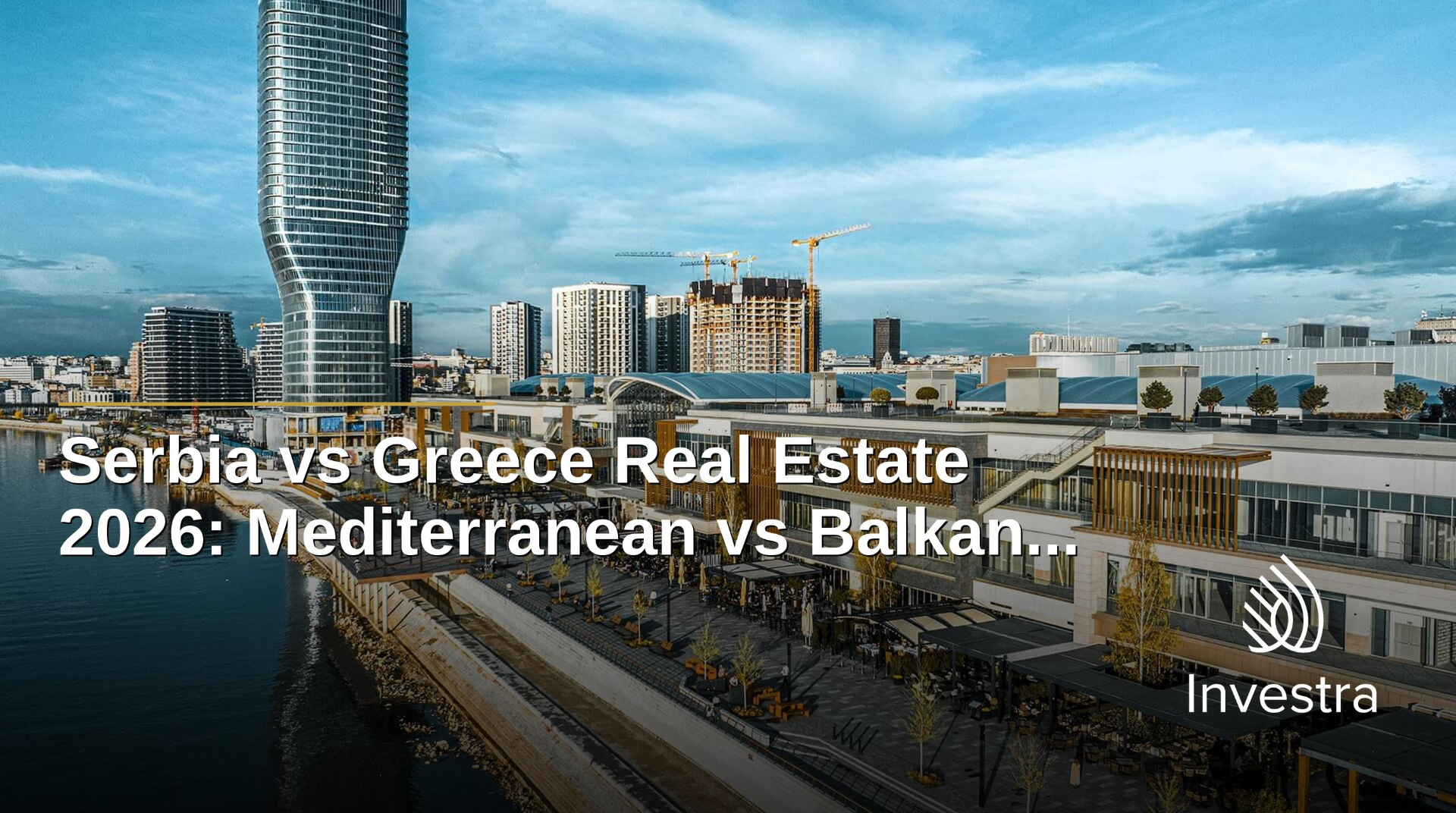
Serbia vs Greece Real Estate 2026: Mediterranean vs Balkan...
Serbia vs Greece Real Estate 2026: Mediterranean vs Balkan Investment Comparison
Serbia offers stronger capital growth potential and higher rental yields of 6-8% in 2026, while Greece provides established Mediterranean lifestyle appeal with more moderate returns of 4-5% and higher entry prices. Foreign buyers seeking value will find Belgrade and Novi Sad delivering better price-to-yield ratios than Athens or Thessaloniki, though Greece maintains stronger tourism infrastructure. Investors comparing the two markets should weigh Serbia’s lower acquisition costs against Greece’s liquidity advantages.
The real estate landscape across the Balkans and Mediterranean is shifting noticeably as 2026 approaches. Serbia continues to attract attention for its combination of affordable entry prices and improving economic fundamentals, while Greece benefits from renewed post-pandemic tourism and EU-backed infrastructure projects. The contrast between these two markets has become sharper for international investors evaluating where to allocate capital over the next five years.
Many buyers now look beyond traditional hotspots and examine secondary cities and emerging residential districts. This comparison examines concrete metrics such as average prices per square metre, net rental yields, transaction costs, and regulatory ease for non-residents. The analysis draws on current transaction data and forward projections to help readers understand which market better matches different investment objectives.
Market Overview
```htmlBelgrade’s residential market has recorded steady annual price growth of 7-9% since 2023, with average citywide prices reaching €2,450 per square metre in early 2026. Prime central districts such as Vračar and Dedinje command €3,200–€3,800 per square metre, while emerging areas like Zemun and New Belgrade offer better value at €1,900–€2,300. In contrast, Athens averages €4,100 per square metre, with waterfront and historic centre properties exceeding €5,500, reflecting strong demand from both domestic buyers and foreign holiday-home investors.
Thessaloniki and smaller Greek coastal towns show more moderate pricing around €3,200–€3,600 per square metre, supported by seasonal tourism. Serbia’s secondary cities, particularly Novi Sad and Niš, trade at €1,650–€1,950 per square metre and deliver gross yields that frequently exceed those available in comparable Greek locations. Foreign ownership rules in both countries remain straightforward, yet Serbia’s lower overall price level creates a wider margin for capital appreciation as infrastructure and EU accession progress continue.
Investra.io lists thousands of verified listings across both markets, allowing investors to compare current asking prices and rental performance data side by side. Transaction volumes in Belgrade have risen 12% year-on-year, while Athens has seen stronger activity in the luxury segment above €500,000. These trends set the stage for differentiated performance through 2026 and beyond.
Key Investment Factors
Economic Fundamentals and Growth Drivers
Serbia’s GDP growth is projected at 4.1% for 2026, driven by manufacturing expansion and foreign direct investment in technology and logistics. This economic momentum supports residential demand in Belgrade and Novi Sad. Greece, already within the eurozone, records steadier but slower growth around 2.3%, with tourism and shipping remaining dominant. The difference in growth rates influences long-term rental demand and price trajectories in each market.
Regulatory Environment for Foreign Buyers
Both countries permit foreign ownership without major restrictions. Serbia requires only standard due diligence and registration, with full details available in the Serbia Buying Process 2026 guide. Greece offers a similar framework but adds golden-visa considerations for purchases above €250,000 in certain regions. Tax treatment also differs; readers can review the latest obligations in the Serbia Property Taxes 2026 overview.
Tourism, Rental Demand and Liquidity
Greece enjoys established international flight connectivity and a mature short-term rental sector, particularly in coastal areas. Serbia’s tourism sector is smaller yet growing, with Belgrade benefiting from business travel and regional events. Liquidity remains higher in Athens and Thessaloniki, where properties typically sell within 60-90 days, compared with 90-120 days in Belgrade for comparable units.
Infrastructure and Lifestyle Considerations
Ongoing motorway and rail projects in Serbia are improving connectivity between Belgrade, Novi Sad and the EU border. Greece continues to upgrade its islands and mainland airports, supporting year-round tourism. Lifestyle appeal remains stronger in Greece for buyers prioritising sea access, while Serbia offers lower living costs and a more continental urban environment.
Price Analysis Table
| Location | Average Price per m² (€) | Net Rental Yield (%) | Typical Buyer Profile |
|---|---|---|---|
| Belgrade – Vračar | 3,450 | 6.2 | Local professionals & investors |
| Belgrade – New Belgrade | 2,150 | 7.1 | Young families & expats |
| Novi Sad – City Centre | 1,850 | 7.8 | Regional buyers & students |
| Athens – Kolonaki | 5,600 | 4.3 | International & luxury segment |
| Athens – Pangrati | 3,900 | 4.8 | Domestic & remote workers |
| Thessaloniki – Waterfront | 3,550 | 5.1 | Seasonal & tourism investors |
Why Invest in 2026
Timing remains favourable for Serbia because prices have not yet converged with EU averages, leaving room for appreciation as accession talks advance. Early movers who secure properties in Belgrade’s emerging districts or Novi Sad’s university-adjacent neighbourhoods stand to benefit from both rental income and capital gains. Greece, while more expensive, offers immediate cash-flow stability for buyers targeting established tourist corridors.
Investors should also consider portfolio diversification. Adding Serbian assets provides exposure to a higher-growth, lower-cost market that complements more mature Mediterranean holdings. Detailed city-level forecasts appear in the Belgrade Real Estate Market 2026 report, and a broader strategy overview is available in the Serbia Property Investment Guide 2026.
Find current verified listings and comparable transaction data on Investra.io to make informed decisions across both markets. As with any investment, property in Serbia carries risks. Only invest capital you can afford to lose.
Practical Buying Guide
Foreign buyers approaching the Serbia-Greece comparison need a clear, country-specific roadmap rather than generic advice. The processes differ in speed, paperwork and upfront checks, so separating the steps avoids costly missteps in 2026.
Step 1: Market and Location Research
Start with rental yield data and price-per-square-metre trends rather than holiday impressions. In Serbia, focus on Belgrade’s New Belgrade and Vračar districts or Novi Sad’s Liman area for consistent 6-8 % gross yields. In Greece, second-tier islands and Thessaloniki suburbs currently deliver closer to 4-5 % once seasonal vacancies are factored in. Use official cadastre extracts and recent comparable sales to test assumptions before viewing properties.
Step 2: Legal and Ownership Checks
Serbia allows foreigners to own apartments directly; houses with land require a Serbian company structure in most cases. Engage a local notary early to confirm no restitution claims exist on the title. Greece restricts non-EU buyers on islands and border zones, so verify eligibility with the Ministry of Interior before making an offer. Both markets now require proof of funds from an EU-regulated bank to satisfy anti-money-laundering rules.
Step 3: Financing and Due Diligence
Local bank mortgages remain limited for non-residents. Serbian lenders offer up to 50 % LTV at 4.5-5.5 % interest for euro-denominated loans; Greek banks are more conservative at 40 % LTV. Commission an independent structural survey and energy-performance certificate in either country. In Greece, also request the TAP (municipal property tax) clearance certificate to avoid inherited arrears.
Step 4: Contract and Registration
Sign a preliminary agreement with a 10 % deposit held in escrow. In Serbia the notary drafts the final purchase contract and registers it at the Real Estate Cadastre within 30 days. Greece uses a notary and the Land Registry, with an additional 2-4 weeks for the Hellenic Cadastre update. Budget for translation of all documents into the local language.
Costs & Fees Breakdown
| Item | Serbia (EUR) | Greece (EUR) |
|---|---|---|
| Purchase price (example 150 000 € apartment) | 150 000 | 150 000 |
| Notary & legal fees | 1 200 | 2 800 |
| Transfer tax / VAT | 0 (new build) or 2.5 % resale | 3 % (new) or 3.09 % (resale) |
| Agent commission | 2-3 % | 4-5 % (shared) |
| Registration & cadastre fees | 150 | 600 |
| Total additional costs | 3 750 – 5 250 | 9 150 – 11 250 |
| Grand total outlay | 153 750 – 155 250 | 159 150 – 161 250 |
Risks & Challenges
Serbia’s higher projected returns come with currency and political risk. The dinar remains volatile against the euro, and sudden changes in foreign-ownership rules for agricultural land have occurred in neighbouring states. Liquidity is lower outside Belgrade; selling a suburban apartment can take nine to twelve months.
Greece faces different exposures. Tourism-dependent islands suffer sharp seasonal swings and oversupply of short-term lets. New short-term rental licensing rules introduced in 2025 have already reduced net yields in parts of Athens and Crete. Bureaucratic delays at the Hellenic Cadastre still average 45 days for straightforward transfers, extending to six months when encumbrances appear.
Both markets carry execution risk around contractor delivery times for off-plan units. Buyers should insist on bank guarantees or staged payments tied to construction milestones rather than accepting developer assurances alone.
Expert Tips
- Always budget an extra 8 % above the purchase price for Serbia and 12 % for Greece to cover all taxes and professional fees.
- Use a bilingual lawyer who is also a licensed real-estate agent; dual roles reduce coordination errors.
- Check the building’s energy certificate early—older Greek stock often requires costly upgrades to meet 2026 EU minimums.
- Model cash-flow under two scenarios: 10 % vacancy and 25 % vacancy, then decide whether the higher Serbian yield still justifies the risk.
- Register the property in a local company only when necessary; the added annual accounting cost of €1 200–1 800 can erase much of the yield advantage.
- Visit the neighbourhood at different times of day and week; many Serbian suburbs lack evening amenities that Greek coastal towns take for granted.
- Track ECB and National Bank of Serbia rate announcements—each 25-basis-point shift moves mortgage affordability faster than local price growth.
Find Your Serbia Property on Investra.io
Investra.io aggregates verified listings from licensed Serbian developers and agencies, complete with cadastral extracts and yield calculators updated monthly. Users can filter by net yield, distance to public transport and projected capital growth through 2028 without contacting multiple agents.
The platform also provides downloadable purchase-cost spreadsheets and connects buyers directly with bilingual notaries who have handled more than 1 200 foreign transactions since 2022. This removes the usual back-and-forth that stretches due diligence from weeks into months.
Recommended Reading
- Serbia Legal Guide for Foreigners
- Serbia Rental Market 2026
- Serbia Property Price Forecast
- Novi Sad Real Estate 2026
- Sinisa Dagary Real Estate Blog
- Findes.si Property Portal
Follow Us
Stay updated on market shifts and new listings:
Odkrijte globalne investicijske priložnosti na Unifyr.space — vaš portal za pametne investicije.
Frequently Asked Questions
Can non-EU citizens buy apartments in Serbia without restrictions?
Yes. Foreign individuals may own residential apartments directly; land ownership still requires a local company.
What is the average time to complete a purchase in Serbia versus Greece?
Serbia averages 45–60 days from signed preliminary contract to registration; Greece typically requires 60–90 days.
Are there annual property taxes in Serbia?
Yes, the annual property tax ranges from 0.3 % to 0.8 % of cadastral value depending on the municipality.
Does Greece still offer the Golden Visa through real estate?
The programme continues but the minimum investment threshold rose to €800 000 in high-demand areas from May 2025.
How liquid is the Serbian residential market outside Belgrade?
Secondary cities show 9–14 month selling times; Belgrade apartments under €200 000 sell within 60–90 days.
Can I finance a Greek property as a non-resident?
Local banks offer up to 40 % LTV; most buyers use equity release or private financing.
What happens if a Serbian developer misses the handover date?
Contracts with bank guarantees allow penalty interest or refund after 30 days of delay.
Are short-term rentals still profitable in Athens after the 2025 licensing rules?
Yields dropped 15–20 % in central districts; suburban and Piraeus properties remain closer to previous levels.
Do I need a tax representative in Greece?
Non-residents must appoint a Greek tax representative for annual filings even if the property produces no income.
Which country offers faster capital repatriation upon sale?
Serbia allows immediate euro transfer after capital-gains tax clearance; Greece requires a 10–15 day central-bank review.
Related Posts
No related posts available.
