
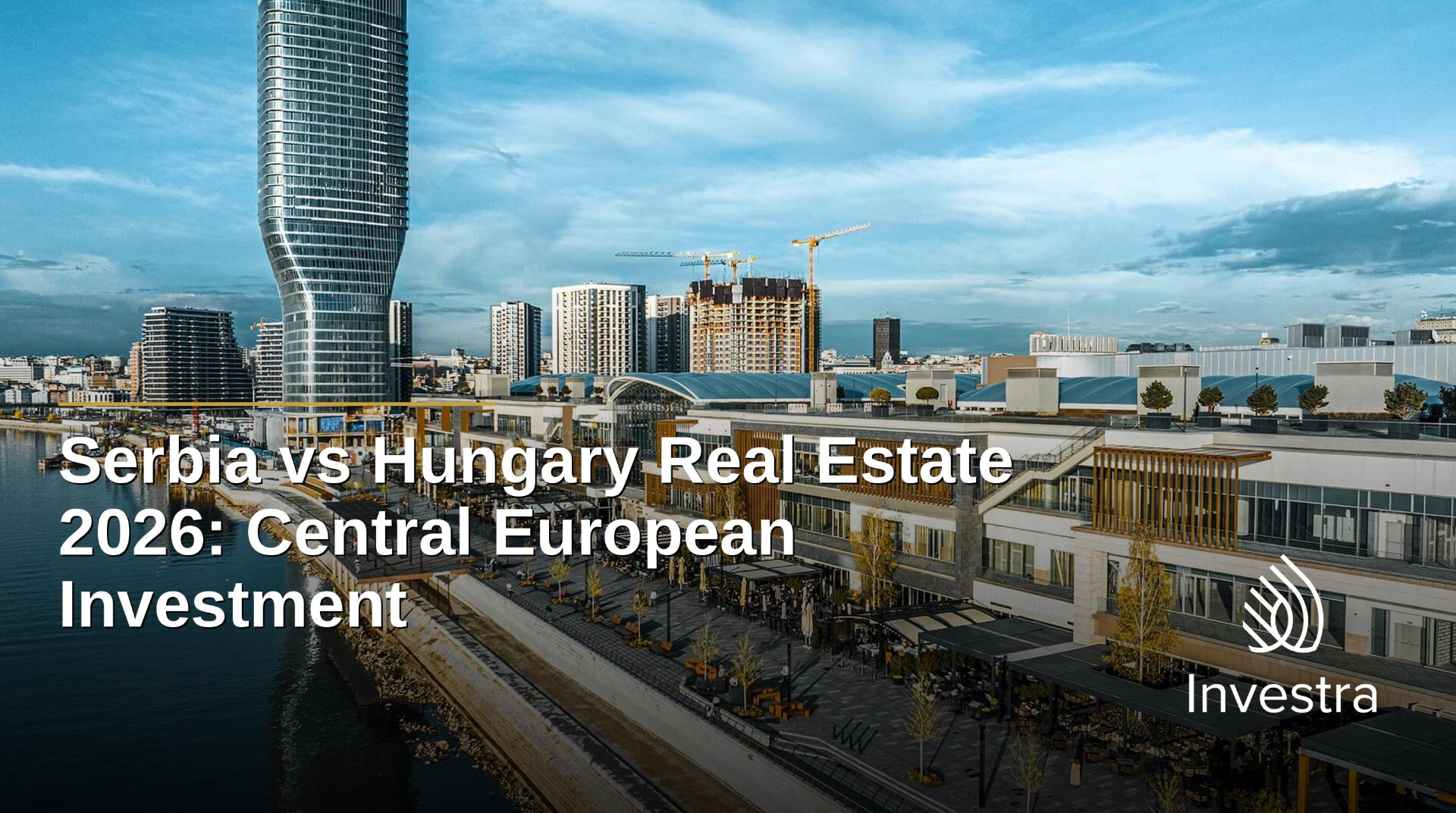
Serbia vs Hungary Real Estate 2026: Central European Investment
Serbia vs Hungary Real Estate 2026: Central European Investment Comparison
In 2026, Serbia emerges as the stronger choice for investors seeking higher rental yields and capital growth potential compared with Hungary, particularly in Belgrade where average apartment prices sit around €2,850 per square metre and gross yields reach 6.2 percent. Hungary’s more mature Budapest market offers stability but lower returns, with prices averaging €4,150 per square metre and yields closer to 4.1 percent. The decisive factor remains Serbia’s faster economic convergence with the EU and more accessible entry prices for foreign buyers.
Introduction
```htmlCentral Europe’s property markets have entered a new phase in 2026. With the European Central Bank’s rate cuts now feeding through to mortgage costs and regional economies showing resilient GDP growth, investors are re-evaluating where to allocate capital between established and emerging destinations. Serbia and Hungary sit at the heart of this discussion: one a fast-liberalising EU candidate with undervalued assets, the other a full member with deeper liquidity but thinner yields.
Foreign buyers have noticed the divergence. In the first nine months of 2025, non-resident purchases in Serbia rose 17 percent year-on-year, driven largely by buyers from Germany, Austria and the Gulf states. Hungary recorded a more modest 6 percent increase, concentrated in the premium segment of Budapest. The gap reflects differing price levels and regulatory ease rather than any fundamental weakness in the Hungarian economy.
Investra.io has tracked these cross-border flows closely through its proprietary transaction database. The platform’s data shows that average lot sizes acquired by foreigners in Belgrade are 18 percent larger than those in Budapest, underscoring Serbia’s appeal for investors seeking scale without stretching leverage. At the same time, Hungary’s transparent land registry and established banking products continue to attract conservative capital seeking lower operational friction.
Market Overview
Belgrade’s residential market opened 2026 with an average resale price of €2,850 per square metre, up 9.4 percent from the same period in 2025. New-build units in the Savski Venac and Vračar districts command premiums of €3,400–3,700 per square metre, while secondary stock in Zemun and Čukarica trades between €2,100 and €2,450. Rental demand remains robust, supported by a growing expatriate workforce attached to international companies relocating regional headquarters and by domestic households priced out of ownership.
Budapest presents a contrasting picture. City-wide averages reached €4,150 per square metre in early 2026, with District V and VI units exceeding €5,800 in prime locations. Growth has slowed to 5.1 percent annually as affordability constraints bite and foreign demand shifts toward short-term lets under tighter municipal regulations. Yields have compressed accordingly, particularly in the Buda hills where owner-occupiers dominate.
Across both markets, supply pipelines are tightening. Serbia’s construction sector faces skilled-labour shortages that are likely to support prices through 2027, while Hungary’s permitting backlog has reduced new completions by almost 30 percent since 2023. Investors evaluating Serbia vs Hungary real estate 2026 therefore confront a classic growth-versus-stability trade-off.
Key Investment Factors
Economic and Demographic Tailwinds
Serbia’s GDP is projected to expand 4.1 percent in 2026, outpacing Hungary’s 2.7 percent forecast. Wage growth in Belgrade has averaged 11 percent annually since 2023, lifting household formation and rental absorption. Hungary’s demographics remain more challenging, with net outward migration continuing to thin the pool of young tenants in secondary cities.
Regulatory Environment and Foreign Ownership
Foreigners may purchase residential property in Serbia without restriction, though agricultural land still requires a local company structure. Hungary maintains similar rules for EU citizens but imposes additional reporting for non-EU buyers. The Serbia buying process 2026 has been streamlined with electronic land-registry filings, reducing average transaction time to 38 days.
Financing Conditions
Local banks in Serbia now offer euro-denominated mortgages to non-residents at 3.9–4.4 percent fixed for five years, subject to 30 percent equity. Hungarian lenders remain more conservative, requiring 40 percent deposits for foreign applicants and charging 4.8–5.3 percent. The difference directly affects leveraged returns in a Serbia vs Hungary real estate 2026 comparison.
Taxation and Holding Costs
Property taxes in Serbia remain among the lowest in Europe, with annual levies averaging 0.4 percent of cadastral value. Capital-gains tax sits at 15 percent after a five-year holding period. Hungary’s system is heavier, with recurrent taxes reaching 0.8 percent and higher transfer duties for non-residents. Detailed breakdowns appear in the Serbia property taxes 2026 guide.
Price Analysis Table
| City / District | Avg. Price €/m² (2026) | Gross Rental Yield | 5-Year Forecast Growth |
|---|---|---|---|
| Belgrade – Savski Venac | 3,650 | 5.8% | +28% |
| Belgrade – Zemun | 2,380 | 6.9% | +31% |
| Belgrade – Čukarica | 2,150 | 7.1% | +25% |
| Budapest – District V | 5,920 | 3.7% | +14% |
| Budapest – District XIII | 4,480 | 4.3% | +17% |
| Budapest – Óbuda | 3,790 | 4.8% | +19% |
Additional neighbourhood-level data and live listings can be found on Investra.io, where users can filter by yield, price per square metre and distance to metro stations.
Why Invest in 2026
Timing matters. Serbia’s EU accession talks are expected to reach a decisive phase in late 2026, which historically triggers rapid re-rating of property values. Hungary, already inside the bloc, offers fewer incremental catalysts. Investors positioning now in Belgrade stand to capture both rental cash flow and anticipated multiple expansion once accession milestones are met.
The Serbia property investment guide 2026 highlights that entry prices remain 35–40 percent below comparable regional capitals once purchasing-power parity is considered. Combined with improving infrastructure and a young, tech-savvy workforce, the city is transitioning from a value play into a core holding for many portfolios.
Belgrade real estate market 2026 data further shows consistent outperformance versus other Western Balkan locations, with liquidity improving as institutional funds establish dedicated vehicles. For readers seeking deeper operational detail, the Serbia property buying process 2026 outlines every step from reservation to title transfer.
As with any investment, property in Serbia carries risks. Only invest capital you can afford to lose.
Practical Buying Guide
Foreign buyers looking at Serbia in 2026 follow a straightforward sequence that experienced investors have refined over the past decade. The process begins with targeted market research and ends with registration in the cadastre. Each stage requires attention to local rules that differ from those in Hungary or other EU markets.
Step 1: Market Research and Property Selection
Start by narrowing locations to Belgrade’s central municipalities or Novi Sad’s expanding districts, where rental demand remains strongest. Review recent transaction data from the Republic Geodetic Authority and cross-check asking prices against actual sales. Shortlist properties through local agencies or platforms that list verified listings, then schedule in-person viewings with a trusted agent who can flag any building permit issues or ownership disputes early.
Step 2: Legal Due Diligence and Contract Signing
Once a property is chosen, engage a Serbian lawyer to examine the title deed, confirm no encumbrances exist, and verify that the seller holds clear ownership. A preliminary contract is signed with a 10 percent deposit held in escrow. At this point, the notary public prepares the final purchase agreement, which both parties sign before the deed is transferred.
Step 3: Payment, Notarisation and Cadastre Registration
Funds are transferred through a Serbian bank account. The notary completes the official deed, after which the buyer pays any applicable transfer tax. The final step is filing the new ownership with the local cadastre office, a process that typically takes four to eight weeks. Foreigners face no additional restrictions beyond those applied to residents.
Step 4: Post-Purchase Setup
After registration, arrange utility transfers and, if the unit will be rented, register the lease contract with the tax authorities. Many investors also appoint a property manager at this stage to handle tenant screening and maintenance.
Costs & Fees Breakdown
| Item | Serbia (example on €150,000 apartment) | Notes |
|---|---|---|
| Purchase price | €150,000 | Negotiated final price |
| Notary fees | €450 – €650 | Fixed scale based on value |
| Transfer tax | €1,500 (1%) | Reduced or waived on new builds in some cases |
| Agent commission | €3,000 – €4,500 | Usually split between parties or paid by seller |
| Legal and cadastre fees | €800 – €1,200 | Includes lawyer and registration |
| Total additional costs | €5,750 – €7,850 | 3.8 – 5.2% of purchase price |
Risks & Challenges
While Serbia offers attractive yields, investors must weigh several practical risks. Currency fluctuations between the dinar and euro can affect net returns for those holding foreign mortgages. Bureaucratic delays at the cadastre occasionally stretch beyond the expected timeline, particularly in smaller municipalities. Construction quality varies widely in new developments, so buyers should inspect building permits and developer track records carefully. Rental demand can soften in secondary cities during economic slowdowns, and changes in tax treatment of foreign-owned property remain possible though infrequent. Hungary, by contrast, presents lower legal risk due to EU membership but at the cost of thinner yields and stricter lending rules for non-residents.
Expert Tips
- Always use a local lawyer rather than relying solely on the notary for contract review.
- Focus on properties near universities or transport hubs to maintain occupancy rates above 90 percent.
- Budget for an annual maintenance reserve of 0.5 percent of the property value.
- Check whether the building has completed the legalization process if it was built before 2015.
- Consider purchasing through a Serbian limited company if you plan multiple acquisitions to simplify future sales.
- Monitor Belgrade’s master urban plan updates, as rezoning can significantly affect values within two to three years.
- Compare actual rental listings on local portals for three months before committing to a purchase price.
Find Your Serbia Property on Investra.io
Investra.io aggregates verified listings from Belgrade, Novi Sad and smaller growth cities, complete with price history, rental yield estimates and direct contact with licensed agents. The platform filters properties by cash-flow metrics and highlights units that match common foreign-buyer criteria such as proximity to public transport and recent renovations.
Users can also access downloadable due-diligence checklists and connect with recommended lawyers and property managers through the site’s partner network. This streamlines the entire process from initial search to post-purchase setup without requiring multiple trips to Serbia.
Recommended Reading
- Serbia Legal Guide for Foreigners
- Serbia Rental Market 2026
- Serbia Property Price Forecast
- Novi Sad Real Estate 2026
- Sinisa Dagary Real Estate Blog
- Findes.si Property Portal
Follow Us
Stay updated on Serbia and Central European real estate trends:
Odkrijte globalne investicijske priložnosti na Unifyr.space — vaš portal za pametne investicije.
Frequently Asked Questions
Q: Can foreigners buy property in Serbia without restrictions?
A: Yes, foreign individuals and companies may purchase residential and commercial real estate on the same terms as Serbian citizens, with the exception of agricultural land.
Q: How long does the purchase process typically take?
A: From signed preliminary contract to cadastre registration, most transactions close within 60 to 90 days.
Q: What is the average rental yield in Belgrade in 2026?
A: Gross yields currently range between 6.5 and 8 percent for well-located apartments, depending on size and condition.
Q: Are there any taxes on rental income for foreign owners?
A: Foreign owners pay a 15 percent tax on net rental income after allowable deductions; double-taxation treaties may reduce this rate.
Q: Is financing available for non-residents?
A: Local banks offer mortgages to foreigners, though loan-to-value ratios are usually capped at 60-70 percent and require Serbian income documentation or guarantees.
Q: What happens if the cadastre registration is delayed?
A: Ownership is still protected once the notarised deed is signed, but full legal title is confirmed only after cadastre entry.
Q: Are new-build properties more expensive than resale units?
A: New builds command a 10-20 percent premium but often include VAT exemptions on transfer tax for first-time buyers.
Q: How stable is the Serbian dinar against the euro?
A: The dinar has shown modest fluctuations; many investors price rents and track returns in euros to limit currency exposure.
Q: Can I use a property management company?
A: Yes, numerous licensed firms handle tenant placement, maintenance and tax filings for an annual fee of 8-12 percent of collected rent.
Q: Is Serbia’s real estate market expected to grow through 2028?
A: Current forecasts point to continued moderate price growth of 4-6 percent annually in major cities, driven by foreign investment and limited new supply.
Related Posts
No related posts available.
