
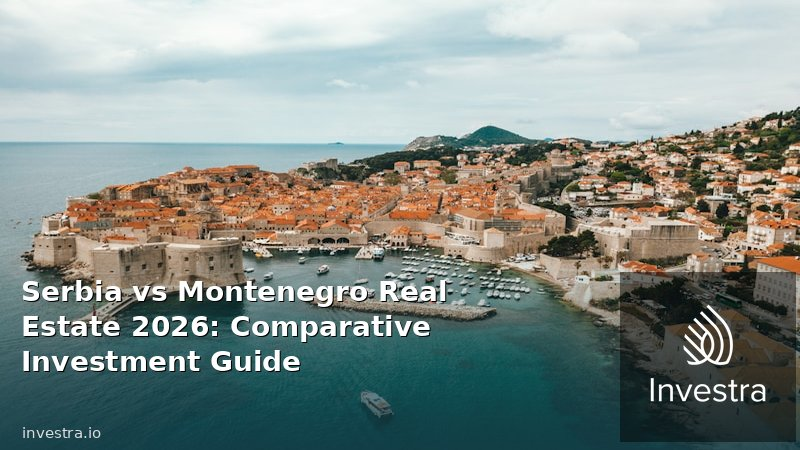
Serbia vs Montenegro Real Estate 2026: Comparative Investment Guide
Serbia vs Montenegro Real Estate 2026: Why Both Balkan Markets Deserve Your Attention
Quick Answer: Serbia vs Montenegro Real Estate 2026: Why Both Balkan Markets Deserve Your Attention is a key aspect of Serbia real estate in 2026. Investra.io provides expert guidance for international investors looking to capitalize on Serbia's growing property market.
The Western Balkans has emerged as one of Europe's most compelling frontiers for real estate investment. With EU accession negotiations accelerating, infrastructure spending rising, and a growing wave of digital nomads and remote workers discovering the region, both Serbia and Montenegro have moved firmly into the spotlight of international property investors. Yet these two neighboring countries offer fundamentally different investment propositions — and understanding those differences in 2026 is essential before committing capital to either market.
Serbia, anchored by its dynamic capital Belgrade and a rapidly diversifying economy, offers urban density, tech-sector growth, and comparatively lower entry prices with strong rental demand. Montenegro, with its Adriatic coastline, EU candidacy status, and established luxury tourism infrastructure, plays to a different set of investor instincts — seasonal yields, premium property values, and lifestyle-driven appreciation. The Serbia vs Montenegro real estate debate, therefore, is not a question of which market is "better" — it is a question of which market aligns with your specific investment thesis, risk appetite, and time horizon.
This guide provides a structured, data-driven comparison of both markets heading into 2026, covering price benchmarks, rental yields, legal frameworks, economic fundamentals, and practical considerations for international buyers. Explore current listings and opportunities on the Serbia Real Estate Guide — Investra to complement the analysis presented here.
Economic Fundamentals: Serbia's Industrial Base vs Montenegro's Tourism Engine
Quick Answer: Economic Fundamentals: Serbia's Industrial Base vs Montenegro's Tourism Engine is a key aspect of Serbia real estate in 2026. Investra.io provides expert guidance for international investors looking to capitalize on Serbia's growing property market.
Understanding the economic backdrop of each country is the first step toward evaluating their real estate markets. Serbia is the largest economy in the Western Balkans, with a GDP of approximately €55 billion in 2024 and a projected growth rate of 3.8–4.2% for 2025–2026. The Serbian economy is anchored by manufacturing, IT services, agriculture, and a rapidly expanding tech sector. Belgrade alone accounts for over 40% of national GDP. Foreign direct investment (FDI) into Serbia reached €4.5 billion in 2023, driven by automotive production, logistics, and increasingly, the technology sector. Companies such as NCR, Nordeus, and a growing cluster of international tech firms have established significant operations in Belgrade, fueling demand for both commercial and residential real estate.
Montenegro, by contrast, has a GDP of approximately €6.5 billion — roughly one-tenth of Serbia's — but it punches above its weight in terms of per-capita income and tourism revenues. Tourism contributes approximately 25% of Montenegro's GDP, and the country welcomed over 2.7 million tourists in 2023. The Montenegrin economy is tightly coupled with the seasonal rhythms of its Adriatic coastline, which creates a distinct investment dynamic. While Serbia offers year-round demand drivers, Montenegro's property market is heavily influenced by summer tourism peaks, particularly along the Bay of Kotor and in Budva. Montenegro has also maintained the euro as its official currency since 2002 — even without formal EU membership — which eliminates currency exchange risk for eurozone investors and provides monetary stability that Serbia's dinar cannot yet match.
Property Price Benchmarks: How the Two Markets Compare in 2026
Quick Answer: Property Price Benchmarks: How the Two Markets Compare in 2026 is a key aspect of Serbia real estate in 2026. Investra.io provides expert guidance for international investors looking to capitalize on Serbia's growing property market.
Price transparency is critical when comparing these two markets, and the contrast is striking. In Serbia, Belgrade remains the price leader. In the city's premium districts — Vračar, Stari Grad, and Savski Venac — residential prices in 2025 ranged from €2,500 to €4,500 per square meter, with newly constructed luxury apartments in Novi Beograd and along the Sava riverfront reaching €5,000–€6,500 per square meter in premium developments. Secondary cities offer significant discounts: Novi Sad averages €1,600–€2,400 per square meter, while Niš and Kragujevac range from €900 to €1,600 per square meter. These price points represent a market where entry barriers remain low relative to Western European capitals, and where capital appreciation has been consistent — Belgrade residential prices rose approximately 11% year-on-year in 2023 and a further 8–9% in 2024.
Montenegro's price landscape is segmented by geography. Coastal properties in Budva, Tivat, and the Bay of Kotor command premium prices that have more in common with Mediterranean markets than with other Balkan destinations. In Tivat, particularly around the Porto Montenegro luxury marina development, prices range from €3,500 to €8,000+ per square meter. In Budva, the range is broadly €2,500–€5,500 per square meter for well-positioned sea-view properties. The capital Podgorica offers more accessible pricing at €1,200–€2,000 per square meter. Budget-conscious investors targeting Montenegro can find opportunities in interior regions such as Kolašin (mountain real estate), where prices may fall below €1,500 per square meter. The key takeaway: Montenegro's coastal premium is real, but so is Serbia's growth velocity in urban centres.
Rental Yields and Investment Returns: A Data-Driven Comparison
Quick Answer: Rental Yields and Investment Returns: A Data-Driven Comparison is a key aspect of Serbia real estate in 2026. Investra.io provides expert guidance for international investors looking to capitalize on Serbia's growing property market.
Rental yield is often the decisive metric for property investors, and here both markets offer compelling — if different — propositions. In Belgrade, long-term residential rental yields in prime neighborhoods typically range from 4.5% to 6.5% gross annually. Short-term rental (Airbnb/Booking.com) strategies in high-demand areas such as Savamala, Vračar, and near the main railway station have produced gross yields of 7–10% in 2024, depending on occupancy management and property condition. The Belgrade rental market is supported by a large student population (over 90,000 students enrolled in Belgrade universities), a growing expatriate community, and domestic migration from smaller cities.
Montenegro's rental dynamics are more complex due to seasonality. Coastal properties in Budva and Kotor can achieve impressive peak-season rental income — a well-positioned two-bedroom apartment near the beach can generate €150–€300 per night in July and August — but occupancy rates drop sharply outside the May–October window. Gross annual yields for coastal properties in Montenegro typically range from 4% to 7%, with some well-managed short-term rental portfolios achieving 8–9% in exceptional years. However, investors must factor in higher management costs, seasonal vacancies, and the capital costs of maintaining properties to the standard demanded by international tourists. For investors seeking stable, year-round cash flow, Belgrade's structural rental demand offers a more predictable return profile. For those who can tolerate seasonal variance and prioritize capital appreciation in a premium lifestyle market, Montenegro's coast presents an equally valid case.
Legal Framework for Foreign Buyers: Rights, Restrictions, and Key Differences
Quick Answer: Legal Framework for Foreign Buyers: Rights, Restrictions, and Key Differences is a key aspect of Serbia real estate in 2026. Investra.io provides expert guidance for international investors looking to capitalize on Serbia's growing property market.
One of the most practically important distinctions between the two markets concerns the legal rights of foreign nationals to purchase property. In Serbia, foreign citizens — including non-EU nationals — can generally purchase residential property under the principle of reciprocity. Most major nationalities (US, UK, EU member states, Australia, Canada, and many others) have reciprocal agreements with Serbia that allow direct property ownership. The purchase process involves a preliminary contract, due diligence on title in the cadastre (land registry), signing of the definitive sale-purchase contract before a notary, payment of a 2.5% property transfer tax (on resale properties), and registration of ownership. New-build properties are subject to VAT at 10% rather than transfer tax. Legal fees, notary costs, and agency commissions typically add 3–5% to the total acquisition cost.
In Montenegro, the legal framework is similarly accessible to foreign buyers. Montenegro has no restrictions on foreigners purchasing apartments or commercial properties. Agricultural land and forests are subject to additional restrictions. The standard purchase process includes a preliminary agreement (predugovor), due diligence, and a final notarized sale contract. Transfer tax is levied at 3% of the assessed property value for resale properties. VAT at 21% applies to new-build purchases from developers. Total transaction costs, including legal and agency fees, typically range from 4–7% in Montenegro. One important consideration: Montenegro's property cadastre has historically had title clarity issues in some coastal areas, particularly for land parcels with disputed ownership histories. Thorough title searches through qualified local attorneys are essential. Both markets reward investors who engage experienced local legal counsel before signing any preliminary agreements.
EU Accession Dynamics: How European Integration Shapes Investment Timelines
Quick Answer: EU Accession Dynamics: How European Integration Shapes Investment Timelines is a key aspect of Serbia real estate in 2026. Investra.io provides expert guidance for international investors looking to capitalize on Serbia's growing property market.
EU membership aspirations are a powerful long-term catalyst for property values in both Serbia and Montenegro, but the two countries are at different stages of the accession process — and this distinction matters significantly for investment timing and exit strategies. Montenegro opened accession negotiations in 2012 and is generally considered the most advanced Western Balkan candidate. As of 2025, Montenegro has provisionally closed several negotiating chapters and is targeting accession in the 2028–2030 range, contingent on rule-of-law reforms and ongoing political negotiations. EU membership would likely trigger a significant repricing of Montenegrin real estate, bringing it closer to the price levels of comparable Mediterranean EU members such as Croatia, where coastal property prices surged 40–70% in the decade following EU accession in 2013.
Serbia opened accession negotiations in 2014 but progress has been slower, partly due to geopolitical complexities surrounding Kosovo and partly due to domestic political dynamics. The EU has recently signaled renewed momentum in the Western Balkans accession process, and Serbia's strategic importance as a regional economic anchor has given the process fresh impetus. A realistic Serbian EU accession timeline sits in the 2030–2035 range. This longer runway can actually benefit investors who enter early in Belgrade and major Serbian cities — the potential for EU-accession-driven price appreciation is built into a longer compounding period. Both countries represent accession bets with meaningfully different risk-return timing profiles. For detailed context on this dynamic, the Investra Blog — Property Investment Insights provides regular analysis of regional accession developments.
Belgrade vs Budva: The Flagship Investment Destinations Head to Head
Quick Answer: Belgrade vs Budva: The Flagship Investment Destinations Head to Head is a key aspect of Serbia real estate in 2026. Investra.io provides expert guidance for international investors looking to capitalize on Serbia's growing property market.
Any serious Serbia vs Montenegro real estate comparison ultimately resolves into a city-level analysis, and the most relevant comparison is between Belgrade — Serbia's economic and cultural capital — and Budva — Montenegro's primary coastal resort and investment hub. These two cities represent the clearest expression of each country's investment proposition.
Belgrade is a city of 1.7 million people, home to a growing tech ecosystem, a vibrant nightlife and cultural scene, an increasingly international restaurant and hospitality sector, and a real estate market that has absorbed sustained domestic and foreign investment without losing its relative affordability. The city's ongoing urban regeneration projects — including the massive Belgrade Waterfront (Beograd na Vodi) development — have reshaped the skyline and attracted premium branded residences. New luxury apartment projects in Novi Beograd, along the riverfront, and in the historically significant Stari Grad (Old Town) continue to attract both domestic buyers and international investors from the diaspora, as well as increasing numbers of buyers from Russia, China, Turkey, and the UAE. Belgrade's long-term population growth and economic diversification provide a structural foundation for sustained property demand.
Budva, by contrast, is a compact coastal resort of approximately 20,000 permanent residents that swells dramatically during the summer season. The old town of Budva — a walled medieval settlement — is one of the most photographed locations in the Adriatic, and properties within or immediately adjacent to its walls command extraordinary premiums. Broader Budva Municipality includes a string of beaches (Mogren, Slovenska, Jaz) and the glamorous Sveti Stefan island hotel complex. The investment case for Budva is anchored in tourism growth — Montenegro targets 4+ million annual visitors by 2027 — and the ongoing development of luxury hospitality infrastructure that supports premium short-term rental pricing. Entry costs are higher and yields are more volatile, but the lifestyle premium and potential for EU-accession appreciation make it a credible long-term hold.
Novi Sad and the Vojvodina Region: Serbia's Undervalued Investment Corridor
Quick Answer: Novi Sad and the Vojvodina Region: Serbia's Undervalued Investment Corridor is a key aspect of Serbia real estate in 2026. Investra.io provides expert guidance for international investors looking to capitalize on Serbia's growing property market.
While Belgrade dominates Serbia's real estate narrative, the Vojvodina region and its capital Novi Sad represent a compelling secondary investment story that deserves dedicated attention. Novi Sad, Serbia's second-largest city with approximately 290,000 residents, has undergone significant transformation over the past decade. The city served as a European Capital of Culture in 2022, boosting its international profile and accelerating investment in cultural infrastructure. Novi Sad hosts a thriving university (approximately 50,000 students), a growing technology sector with companies including Nordeus and various IT outsourcing firms, and a high quality of life that consistently ranks it among the most livable cities in the Balkans.
Property prices in Novi Sad range from approximately €1,600 to €2,400 per square meter in prime locations, representing a 35–45% discount to comparable Belgrade properties. Rental yields of 5–7% are achievable in well-positioned residential assets, supported by the large student population and a growing population of IT professionals and young families. The city's proximity to Budapest (approximately 200km by road) and Zagreb (approximately 350km) makes it attractive to investors with a regional portfolio strategy. Infrastructure improvements — including motorway upgrades and improved rail connections — are steadily reducing travel times to regional capitals. For investors who find Belgrade prices have moved beyond their preferred entry point, Novi Sad and the broader Vojvodina corridor offer a value-oriented alternative with similar structural demand drivers. The Serbia Real Estate Guide — Investra provides regularly updated listings across all Serbian regions.
Montenegro's Bay of Kotor and Luxury Segment: Porto Montenegro and Beyond
Quick Answer: Montenegro's Bay of Kotor and Luxury Segment: Porto Montenegro and Beyond is a key aspect of Serbia real estate in 2026. Investra.io provides expert guidance for international investors looking to capitalize on Serbia's growing property market.
Montenegro's luxury real estate segment is anchored by two distinct micro-markets: Porto Montenegro in Tivat and the Bay of Kotor more broadly. Porto Montenegro is a superyacht marina and residential resort development that has attracted international ultra-high-net-worth buyers since its launch in 2009, backed initially by Canadian billionaire Peter Munk. The development spans approximately 24 hectares and includes branded residences, a luxury hotel (The Regent), retail and dining facilities, and full marina infrastructure capable of accommodating some of the world's largest private yachts. Properties within Porto Montenegro range from €4,000 to €10,000+ per square meter, placing them in a global luxury category comparable to Côte d'Azur or Croatian island resort pricing.
Beyond Porto Montenegro, the Bay of Kotor offers a broader spectrum of opportunities. The medieval walled city of Kotor — a UNESCO World Heritage site — and surrounding villages such as Perast, Dobrota, and Prčanj offer stone heritage properties, often in need of renovation, that appeal to buyers seeking unique characterful homes rather than standardized resort developments. Renovation-ready stone properties in Kotor Bay villages can be acquired from €150,000 to €400,000+ depending on size, condition, and water proximity. Post-renovation values and rental income from these unique properties can be substantial, but buyers must account for significant renovation costs (€800–€1,500 per square meter for quality work) and the complexity of navigating heritage property regulations. This segment rewards patient, knowledgeable investors and is generally unsuitable for those seeking quick, standardized transactions.
Infrastructure and Connectivity: Investment in Access
Quick Answer: Infrastructure and Connectivity: Investment in Access is a key aspect of Serbia real estate in 2026. Investra.io provides expert guidance for international investors looking to capitalize on Serbia's growing property market.
Infrastructure quality and connectivity are increasingly recognized as primary drivers of real estate value appreciation, and both Serbia and Montenegro are experiencing significant infrastructure investment cycles in 2025–2026. Serbia has invested heavily in its motorway network under the bilateral agreements signed with China (within the Belt and Road Initiative framework) and EU co-financing schemes. The completion of the Niš-Pločnik motorway segment, upgrades to the E75 corridor, and the Belgrade–Budapest high-speed rail project (projected completion 2027–2028) are transforming Serbia's position as a regional logistics and transit hub. The Belgrade–Budapest high-speed rail link, when complete, will reduce journey time between the two capitals to approximately 2.5 hours, meaningfully integrating Serbia's economy with the broader EU market and enhancing Belgrade's attractiveness for both business investment and real estate.
Montenegro's infrastructure agenda centers on the Bar-Boljare motorway — a Chinese-financed project connecting Montenegro's Adriatic coast to the Serbian border — which has been a source of both economic optimism and significant sovereign debt concerns. The completed first phase (from Smokovac to Mateševo) has improved connectivity between Podgorica and the interior, but the full motorway to the Serbian border remains under development. Montenegro's airports in Podgorica and Tivat provide seasonal international connectivity, with Tivat Airport particularly important for coastal property values, as direct charter flights from Northern and Western Europe deliver the tourist and short-stay visitor base that sustains coastal rental markets. Airport capacity expansions and new route announcements at Tivat directly correlate with rental demand cycles in Budva and Kotor Bay — a dynamic that attentive investors should monitor closely.
Taxation, Running Costs, and Net Yield Realities
Quick Answer: Taxation, Running Costs, and Net Yield Realities is a key aspect of Serbia real estate in 2026. Investra.io provides expert guidance for international investors looking to capitalize on Serbia's growing property market.
Gross yield figures are useful for initial market comparisons, but net yield — after taxation, management costs, maintenance, and vacancy allowances — is the figure that determines actual investment performance. In Serbia, property tax (porez na imovinu) is levied annually at rates that vary by municipality and property value, but for standard residential properties the effective rate is typically 0.4–0.8% of assessed value per year. Rental income is subject to personal income tax at a flat rate of 20% on 80% of gross rental income (i.e., an effective rate of 16%), after a standard 25% deduction for maintenance costs. Non-resident investors may access double taxation treaty benefits depending on their country of residence. Property management fees in Belgrade typically run 8–12% of rental income for long-term lets, and 15–20% for short-term rental management. Accounting for these costs, net yields for well-managed Belgrade properties realistically range from 4–6% annually.
In Montenegro, annual property tax is levied at 0.1–1% of market value, with coastal properties in tourist zones at the higher end. Rental income for non-resident individuals is taxed at 9% flat rate, which is notably lower than Serbia's effective rate and represents one of Montenegro's most attractive features for foreign investors. Montenegro's flat 9% personal income tax rate is among the lowest in Europe, and the country has positioned itself as a low-tax jurisdiction specifically to attract foreign capital. Management fees for coastal short-term rental properties are higher than in Serbia — typically 20–25% of rental revenue given the operational complexity of seasonal tourist accommodation. After factoring in seasonality-driven vacancy, management costs, and maintenance (coastal properties require more intensive upkeep due to salt air and intensive summer use), net yields of 3.5–6% are realistic for most coastal Montenegrin investments. For additional business strategy perspectives on Balkan investment, Business Strategy Blog — Siniša Dagary offers valuable regional context.
Risk Analysis: Political Stability, Market Liquidity, and Currency Considerations
Quick Answer: Risk Analysis: Political Stability, Market Liquidity, and Currency Considerations is a key aspect of Serbia real estate in 2026. Investra.io provides expert guidance for international investors looking to capitalize on Serbia's growing property market.
Every investment carries risk, and a responsible comparison of Serbia and Montenegro must address the principal risks in each market. In Serbia, the primary macro risks include geopolitical tensions related to Kosovo (whose independence Serbia does not recognize), currency risk for investors operating in dinars, and political governance concerns that have been flagged in EU progress reports. The Serbian dinar has historically experienced gradual depreciation against the euro — averaging approximately 2–3% per year over the past decade — which means euro-denominated investors holding dinar-priced assets must factor in modest currency drag. Market liquidity risk is moderate in Belgrade for standard residential assets but increases significantly for larger commercial properties or real estate in secondary cities, where transaction volumes are lower and buyer pools thinner.
Montenegro's risk profile is distinct. The country uses the euro, eliminating currency risk for European investors, but its economy remains heavily dependent on tourism — a sector that proved highly vulnerable during the COVID-19 pandemic (Montenegro's GDP contracted by approximately 15% in 2020). Political instability has been a recurring concern, with multiple government changes since 2020 and ongoing tensions between pro-EU reformist coalitions and more nationalist factions. The Bar-Boljare motorway's debt load (approximately €1 billion owed to China's Exim Bank) created a brief sovereign debt scare in 2021 before EU member states facilitated a refinancing. Property title clarity issues in coastal Montenegro, particularly for land, represent a specific due diligence risk that has caught foreign investors off guard. For both markets, engaging reputable local legal counsel — recommended by established international platforms like Investra.io — is non-negotiable before any acquisition.
Practical Guide: How International Buyers Can Enter Both Markets
Quick Answer: Practical Guide: How International Buyers Can Enter Both Markets is a key aspect of Serbia real estate in 2026. Investra.io provides expert guidance for international investors looking to capitalize on Serbia's growing property market.
For international buyers new to either market, the practical steps toward acquisition follow broadly similar paths, with local variations. The recommended process for both Serbia and Montenegro begins with market research and property shortlisting — ideally through platforms such as Investra Platform — Find Your Property, which aggregates listings and provides market intelligence for the Western Balkans region. Once target properties are identified, engaging a bilingual local attorney (independent from the selling agent) for title due diligence is the single most important protective step a buyer can take.
In Serbia, the purchase process typically takes 4–8 weeks from offer to completion for straightforward transactions. Foreign buyers require a Serbian tax identification number (PIB), obtainable through the Tax Administration office, which is needed to register ownership. Bank accounts in Serbia can be opened by non-residents, though requirements vary by bank. Property financing for non-residents from Serbian banks is limited — most international buyers use cash or arrange financing through their home-country institutions. In Montenegro, the process is similarly structured. Non-residents can open accounts in Montenegrin banks relatively easily, particularly at international banks with local branches (such as Erste, Societe Generale, or Hipotekarna Banka). Mortgage financing for non-residents in Montenegro typically requires 30–40% down payment and carries interest rates of 4–6.5%, which most investors with access to cheaper home-country financing will find unattractive. The businesses directory at Findes.si can assist in identifying vetted service providers across the Western Balkans region. A visit to Croatia Real Estate Guide — Investra is also recommended for investors considering a multi-country Adriatic strategy that spans Croatia and Montenegro.
Investment Verdict: Who Should Choose Serbia and Who Should Choose Montenegro?
Quick Answer: Investment Verdict: Who Should Choose Serbia and Who Should Choose Montenegro? is a key aspect of Serbia real estate in 2026. Investra.io provides expert guidance for international investors looking to capitalize on Serbia's growing property market.
After examining price benchmarks, rental yields, legal frameworks, economic fundamentals, infrastructure, and risk profiles, it is possible to articulate a clear investment thesis for each country — and to identify which type of investor each market best serves.
Serbia is the right choice for investors who: prioritize cash flow stability over seasonal peaks; seek lower entry prices with meaningful capital appreciation potential; want exposure to an urban economy diversifying into tech and services; are comfortable holding an asset in a non-euro currency; and are investing in a market with a longer EU accession runway that rewards patient capital. Belgrade, Novi Sad, and emerging secondary cities offer the best risk-adjusted returns for this investor profile. Residential properties in the €80,000–€200,000 range in Belgrade can generate consistent 5–7% gross yields with strong tenant demand year-round.
Montenegro is the right choice for investors who: seek euro-denominated assets with no currency risk; are drawn to a lifestyle market with genuine luxury cachet; are positioning for EU-accession appreciation on a potentially shorter timeline; can manage or outsource seasonal rental operations effectively; and have the capital to enter at the higher price points that premium coastal assets command. The Bay of Kotor, Porto Montenegro, and well-positioned Budva properties represent genuine wealth preservation and appreciation vehicles for buyers entering the €200,000–€1,000,000+ price range. The answer to the question "should I invest in Serbia or Montenegro real estate?" is ultimately determined by personal investment objectives, capital availability, and risk appetite — both markets offer legitimate, well-supported investment cases for 2026 and beyond.
Investment Disclaimer
Quick Answer: Investment Disclaimer is a key aspect of Serbia real estate in 2026. Investra.io provides expert guidance for international investors looking to capitalize on Serbia's growing property market.
The information provided in this article is for educational and informational purposes only and should not be construed as financial, legal, or investment advice. Real estate investments carry inherent risks, and past performance does not guarantee future results. Investors should not invest money they cannot afford to lose. Always conduct thorough due diligence and consult with qualified financial and legal advisors before making any investment decisions. Investra.io does not guarantee returns on any investment.
Explore investment opportunities on Investra.io — the leading platform for international property investment in Serbia. For business strategy insights, visit sinisadagary.com. Discover business opportunities through Findes.si.
Frequently Asked Questions
Quick Answer: Frequently Asked Questions is a key aspect of Serbia real estate in 2026. Investra.io provides expert guidance for international investors looking to capitalize on Serbia's growing property market.
Should I invest in Serbia or Montenegro real estate in 2026?
The decision depends on your investment profile. Serbia — particularly Belgrade — offers lower entry prices (€2,500–€4,500/m² in prime areas), year-round rental demand, and strong capital appreciation driven by tech-sector growth and urban development. Montenegro offers euro-denominated assets, premium coastal lifestyle properties, lower personal income tax on rental income (9% flat), and potential earlier EU-accession appreciation. Investors seeking stable cash flow and lower entry costs often prefer Serbia; those seeking luxury assets, currency certainty, and lifestyle positioning often prefer Montenegro.
Can foreigners buy property in Serbia and Montenegro?
Yes, foreign nationals can purchase residential property in both countries. Serbia operates on a reciprocity principle — most major nationalities including EU, US, UK, Australian, and Canadian citizens can buy directly. Montenegro has similarly open policies for apartment and commercial property purchases, with additional restrictions applying only to agricultural land and forests. In both countries, engaging an independent local attorney before signing any preliminary agreement is strongly recommended.
What are typical rental yields in Belgrade compared to Budva?
In Belgrade, gross residential rental yields typically range from 4.5–6.5% for long-term lets, with short-term rental strategies potentially achieving 7–10% in high-demand neighborhoods. In Budva, coastal properties can achieve gross yields of 4–7% annually, with peak short-term rental nights generating €150–€300 per night in July-August. However, Budva's seasonal occupancy patterns and higher management costs mean net yields are often comparable to or slightly below Belgrade's more stable figures.
What is the property transfer tax rate in Serbia and Montenegro?
In Serbia, resale properties are subject to a 2.5% property transfer tax, while new-build purchases from developers attract 10% VAT instead. In Montenegro, resale properties carry a 3% transfer tax, while new-build developments are subject to 21% VAT. Both countries also have notary fees and legal costs that add approximately 3–7% to total acquisition costs. Buyers should budget for these transaction costs when calculating total capital deployment.
How does EU accession affect real estate investment in Serbia and Montenegro?
EU accession is a significant long-term value catalyst in both countries. Montenegro is the more advanced candidate, targeting accession in the 2028–2030 range, and analysts draw comparisons with Croatia where coastal property values rose 40–70% in the decade surrounding its 2013 EU accession. Serbia's accession timeline is longer (estimated 2030–2035), but this gives early investors a longer compounding window for EU-accession-driven appreciation. Both markets offer meaningful potential upside from this structural driver.
What are the main risks of investing in Montenegro coastal real estate?
Key risks include: seasonal income dependency that creates cash flow volatility; title clarity issues on some coastal land parcels with historical ownership disputes; higher maintenance costs for properties in marine environments; political instability that has seen multiple government changes since 2020; and concentration risk in an economy heavily dependent on tourism. The country's significant debt from the Bar-Boljare motorway project also represents a macro-level sovereign risk, though EU-backed refinancing has reduced immediate concerns.
Is Belgrade real estate still affordable compared to other European capitals?
Yes, Belgrade remains significantly more affordable than most Western and Central European capitals. At €2,500–€4,500 per square meter in prime areas (rising to €5,000–€6,500 in luxury new developments), Belgrade prices compare favorably with Vienna (€5,000–€9,000+/m²), Prague (€4,500–€7,000+/m²), and Budapest (€3,500–€6,000+/m²). Given Belgrade's consistent annual price growth of 8–11% in recent years and its growing tech economy, the relative affordability window may narrow over the next 5–7 years.
What is the minimum budget needed to invest in Serbia vs Montenegro?
In Serbia, entry-level investment properties in Belgrade's peripheral districts or secondary cities like Niš or Kragujevac can be found from €50,000–€80,000 for studio or one-bedroom apartments. Competitive Belgrade city-center apartments typically start from €90,000–€130,000. In Montenegro, Podgorica offers the most accessible pricing from €70,000–€120,000 for apartments. Coastal Montenegrin properties in Budva or Kotor Bay start from approximately €120,000–€150,000 for compact apartments, with Porto Montenegro luxury properties beginning at €300,000+.
How reliable is Montenegro's short-term rental market for investment purposes?
Montenegro's short-term rental market is well-established for coastal properties, particularly in Budva, Kotor, and Tivat. The country welcomed over 2.7 million tourists in 2023, and the government targets 4+ million by 2027. Well-managed properties in prime coastal locations can achieve strong peak-season revenues. However, investors must carefully model the full year — not just peak season — and budget for professional property management (typically 20–25% of revenue), maintenance, and the possibility of 4–5 months of low or zero occupancy during winter. A conservative financial model using 60–70 days of effective annual occupancy is more reliable than optimistic seasonal projections.
Are there any restrictions on repatriating rental income or sale proceeds from Serbia and Montenegro?
Both countries generally allow non-resident investors to repatriate rental income and sale proceeds, subject to standard banking documentation and tax compliance. In Serbia, the dinar must typically be converted to foreign currency through authorized banks — a straightforward process but one that introduces the exchange rate at the time of repatriation. Montenegro's use of the euro eliminates this friction entirely for eurozone investors. Both countries have anti-money laundering requirements that necessitate documented proof of the legal source of funds for large property purchases. Consulting a tax advisor in both the investment country and the investor's country of residence before making any investment is advisable to understand specific treaty obligations and reporting requirements.
What is the outlook for property prices in Belgrade for 2026–2028?
Market analysts and real estate consultancies active in Serbia project continued price growth in Belgrade over the 2026–2028 period, albeit at a moderating pace compared to the 8–11% annual growth seen in 2022–2024. Projected annual growth rates of 5–8% are commonly cited, supported by ongoing urban development projects (particularly the Belgrade Waterfront continuation), sustained tech-sector job growth, and improving infrastructure including the Budapest high-speed rail link due for completion in 2027–2028. New luxury supply entering the market may exert some price moderation in the premium segment, while mid-market and affordable housing segments are expected to remain supply-constrained.
How does Montenegro's tax environment compare to Serbia for rental income?
Montenegro offers a notably more favorable tax environment for rental income. Non-resident individuals pay a flat 9% income tax rate on rental income in Montenegro — one of the lowest rates in Europe. Serbia's effective rental income tax rate is higher at approximately 16% (20% on 80% of gross income after the standard maintenance deduction). For high-revenue rental properties, this tax differential can meaningfully affect net yield comparisons between the two markets and is a legitimate factor in favor of Montenegrin investments from a pure tax efficiency perspective.
Recommended Resources
Quick Answer: Recommended Resources is a key aspect of Serbia real estate in 2026. Investra.io provides expert guidance for international investors looking to capitalize on Serbia's growing property market.
For investors ready to take the next step in exploring Serbia and Montenegro real estate opportunities, the following resources provide essential market intelligence, property listings, and professional guidance:
- Serbia Real Estate Guide — Investra — Comprehensive market data, listings, and investment analysis for Serbia
- Expert investment consulting and financial services are available through Findes Financial Services, specializing in Balkan real estate markets.
Related Posts
No related posts available.
