
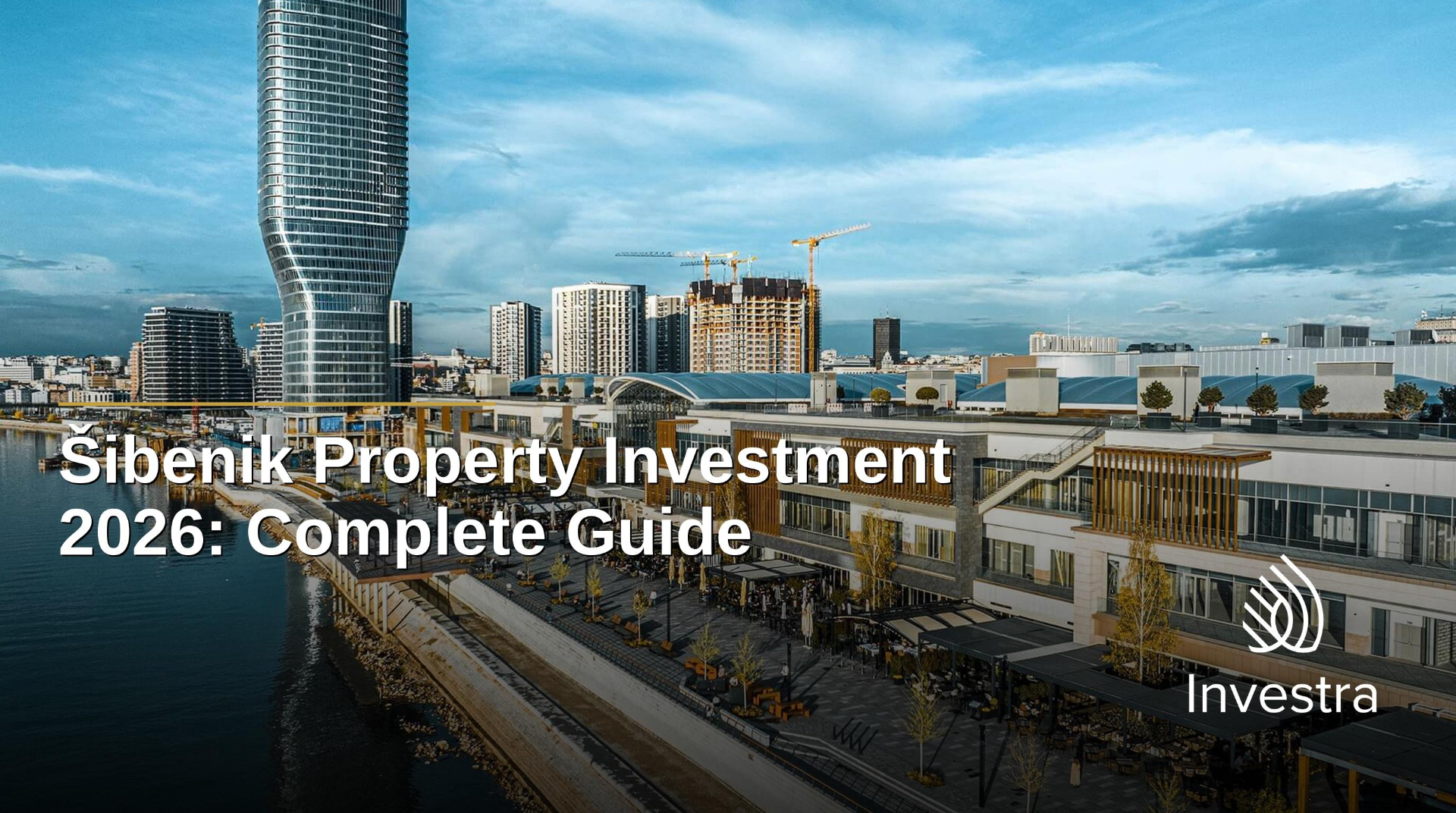
Šibenik Property Investment 2026: Complete Guide
Šibenik Property Investment 2026: Croatia's Hidden Gem — Yields, ROI & Market Analysis
Šibenik is one of Croatia's most compelling investment stories of 2026. While Dubrovnik and Split dominate international headlines, Šibenik quietly delivers some of Dalmatia's best investment fundamentals: rental yields of 6–9%, property prices 30–40% below Split, two UNESCO World Heritage Sites, and proximity to two of Croatia's most visited national parks. For investors seeking value in the Adriatic market, Šibenik deserves serious attention.
Quick Answer: Šibenik offers rental yields of 6–9% and property prices of €2,500–€5,500/m² — significantly better value than Split (€3,500–€8,000/m²) with comparable tourism appeal. The city's UNESCO heritage, national park proximity, and growing international recognition make it one of Dalmatia's top investment opportunities in 2026.
Why Šibenik Is Gaining Investment Attention
Šibenik's investment case rests on several converging factors that distinguish it from more established Dalmatian markets.
UNESCO Double Heritage: Šibenik is home to two UNESCO World Heritage Sites — the Cathedral of St. James (the world's first cathedral built entirely of stone, without brick or mortar) and the Venetian defensive works of Šibenik. This heritage status provides permanent protection against overdevelopment and ensures lasting tourist appeal.
National Park Gateway: Šibenik is the gateway to two of Croatia's most visited national parks — Krka National Park (1.6 million visitors annually) and Kornati National Park (the Mediterranean's densest archipelago). This dual national park access drives year-round tourism beyond the standard beach season.
Infrastructure Investment: The Croatian government and EU are investing heavily in Šibenik's infrastructure — new marina facilities, road improvements, and cultural tourism development. The Šibenik Fortress (St. Michael's) has been transformed into a major concert and events venue, attracting 200,000+ visitors annually.
Price Advantage: Šibenik's property prices remain 30–40% below Split despite comparable or superior tourism appeal in many respects. This price gap is narrowing as international investors discover the market.
Growing International Recognition: Šibenik appeared in Game of Thrones (filming location for Braavos), significantly boosting international name recognition. Tourism numbers have grown 15–20% annually since 2019.
Šibenik Property Market Overview 2026
Quick Answer: Šibenik's property market has grown 10–14% annually since 2022. Average prices range from €2,500/m² in outer neighborhoods to €5,500/m² in the Old Town. The market is characterized by limited supply, growing demand, and strong rental performance.
Price by Location
| Area | Price Range (€/m²) | Annual Growth | Character |
|---|---|---|---|
| Old Town (Stari Grad) | €4,000–€5,500 | 12–15% | UNESCO heritage, premium |
| Brodarica | €3,000–€4,500 | 10–13% | Waterfront, marina |
| Vodice (nearby) | €2,800–€4,000 | 10–12% | Beach resort, high tourism |
| Primošten (nearby) | €3,500–€5,000 | 11–14% | Luxury, exclusive |
| Outer Šibenik | €2,500–€3,500 | 8–11% | Residential, affordable |
Market Statistics 2026
| Metric | Value |
|---|---|
| Average price (city) | €3,200/m² |
| Annual price growth | 10–14% |
| Gross rental yield | 6–9% |
| Net rental yield | 4.5–6.5% |
| Average days to sell | 45–90 |
| Foreign buyer share | 35% |
| Short-term rental occupancy (peak) | 85–95% |
Investment Returns Analysis
Quick Answer: A typical Šibenik investment property (€180,000 for a 2-bedroom in the Old Town) generates €12,000–€18,000 annual rental income (7–10% gross yield) with 10–14% annual capital appreciation — total annual return of 17–24%.
Sample Investment Calculation
Property: 2-bedroom apartment, 55m², Old Town Šibenik
Purchase price: €198,000 (€3,600/m²)
Transaction costs (7%): €13,860
Renovation: €20,000
Total investment: €231,860
Short-Term Rental Income (Airbnb/Booking.com):
| Season | Months | Nightly Rate | Occupancy | Monthly Income |
|---|---|---|---|---|
| Peak (Jul–Aug) | 2 | €150–€220 | 90% | €2,700–€3,960 |
| High (Jun, Sep) | 2 | €100–€150 | 75% | €1,500–€2,250 |
| Shoulder (May, Oct) | 2 | €70–€100 | 55% | €770–€1,100 |
| Low (Nov–Apr) | 6 | €50–€70 | 35% | €525–€735 |
Annual Gross Income: €14,000–€20,000
Annual Expenses (management 25%, tax, maintenance): €5,000–€7,000
Annual Net Income: €9,000–€13,000
Net Yield: 3.9–5.6%
5-Year Projection (12% annual appreciation):
| Year | Property Value | Cumulative Net Income | Total Return |
|---|---|---|---|
| 1 | €221,760 | €11,000 | +€1,900 |
| 2 | €248,371 | €22,000 | +€38,511 |
| 3 | €278,175 | €33,000 | +€79,315 |
| 4 | €311,556 | €44,000 | +€123,696 |
| 5 | €348,943 | €55,000 | +€172,083 |
5-year total return: €172,083 on €231,860 investment = 74.2% total return (14.8% annually)
Šibenik's Tourism Infrastructure
Quick Answer: Šibenik receives 1.2 million tourists annually (2025) with 15–20% annual growth. The city's tourism is diversified across heritage, nature, and events — providing stronger year-round demand than pure beach destinations.
Tourism Breakdown
| Tourism Type | Share | Annual Visitors | Growth |
|---|---|---|---|
| Heritage/cultural | 35% | 420,000 | 12% |
| National parks (Krka/Kornati) | 30% | 360,000 | 15% |
| Beach/leisure | 25% | 300,000 | 10% |
| Events (Šibenik Fortress concerts) | 10% | 120,000 | 25% |
Key Attractions Driving Tourism
Cathedral of St. James: UNESCO World Heritage Site, built 1431–1536. One of the most important Renaissance monuments in Croatia. Attracts 300,000+ visitors annually.
Krka National Park: 73km² of waterfalls, lakes, and forests. 1.6 million visitors annually. Šibenik is the primary gateway city — most visitors stay in Šibenik before or after visiting the park.
Kornati National Park: 89 islands and islets in the Adriatic. Popular with sailors and divers. Šibenik marina is the main departure point for Kornati excursions.
Šibenik Fortress (St. Michael's): Transformed into an open-air concert venue. Hosts international artists and festivals from June to September. 200,000+ event visitors annually.
St. Nicholas' Fortress: UNESCO-listed Venetian sea fortress at the entrance to Šibenik Bay. Accessible by boat, increasingly popular with tourists.
Šibenik vs Competitors — Investment Comparison
Quick Answer: Šibenik offers the best risk-adjusted returns among Dalmatian cities — better yields than Split and Dubrovnik, lower prices, and stronger tourism diversification than pure beach destinations like Vodice or Primošten.
Comparative Analysis
| Factor | Šibenik | Split | Dubrovnik | Zadar | Vodice |
|---|---|---|---|---|---|
| Price (€/m²) | €2,500–€5,500 | €3,500–€8,000 | €5,000–€15,000 | €2,800–€5,000 | €2,500–€4,000 |
| Gross yield | 6–9% | 5–8% | 4–7% | 6–8% | 6–9% |
| Annual growth | 10–14% | 8–12% | 6–10% | 9–12% | 8–11% |
| UNESCO sites | 2 | 1 | 1 | 0 | 0 |
| National parks | 2 | 0 | 0 | 1 | 0 |
| Tourism diversification | High | High | Medium | Medium | Low |
| Liquidity | Medium | High | Medium | Medium | Low |
Practical Buying Guide for Šibenik
Quick Answer: Buying in Šibenik follows the standard Croatian process — 2–3 months, 6–8% transaction costs, OIB required, notary contract, land registry registration. Old Town properties require heritage authority approval for renovations.
Due Diligence Checklist
Heritage restrictions: Old Town properties are subject to conservation authority oversight. Exterior modifications require approval. Budget 20–30% extra for heritage-compliant renovations.
Access: Some Old Town properties are accessible only on foot (no vehicle access). This affects rental appeal and renovation logistics — verify access before purchasing.
Short-term rental license: Croatia requires a license (rješenje) for short-term rentals. Verify the property has or can obtain a license. New licenses are becoming harder to obtain in some areas.
Building condition: Many Old Town buildings are centuries old. Commission a structural survey before purchasing — hidden costs can be significant.
Flood risk: Šibenik Bay area has some flood risk during extreme weather. Check flood maps for waterfront properties.
Transaction Costs
| Cost | Amount |
|---|---|
| Real estate transfer tax | 3% |
| Notary fees | €400–€1,000 |
| Land registry | €80–€250 |
| Agent commission | 2–3% |
| Legal fees | €600–€1,500 |
| Total | ~6–8% |
Frequently Asked Questions About Šibenik Property Investment
Q: What is the minimum budget for investing in Šibenik?
A: The minimum practical budget for a Šibenik investment property is approximately €120,000–€150,000 for a small studio in outer neighborhoods. For the Old Town, budget €180,000+.
Q: Is Šibenik better than Split for investment?
A: Šibenik offers better yields (6–9% vs 5–8%) and lower entry prices. Split offers better liquidity and higher absolute rental income. For yield-focused investors with a medium budget, Šibenik is often the better choice.
Q: How do I get to Šibenik?
A: Šibenik is 80km from Split Airport (SPU) and 60km from Zadar Airport (ZAD). Both airports have excellent connections to European cities. Transfer time is approximately 1 hour by car or shuttle.
Q: What is the short-term rental season in Šibenik?
A: Peak season is July–August (85–95% occupancy). High season extends May–June and September–October (60–80% occupancy). The national park proximity extends the season compared to pure beach destinations.
Q: Are there any restrictions on foreign buyers in Šibenik?
A: EU citizens have the same rights as Croatian citizens. Non-EU citizens need to verify reciprocity with their lawyer. Agricultural land and properties in certain protected zones have additional restrictions.
Q: What property management options are available in Šibenik?
A: Several professional property management companies operate in Šibenik, offering full-service management for 20–30% of rental revenue. Ask Investra for verified local recommendations.
Q: Is Šibenik growing in popularity with international buyers?
A: Yes — Šibenik's international buyer share has grown from 20% to 35% between 2020 and 2026. UK, German, and Scandinavian buyers are the most active international segments.
Q: What are the best neighborhoods in Šibenik for investment?
A: The Old Town offers the highest yields and appreciation potential. Brodarica is excellent for marina-adjacent properties. Vodice (15km north) offers high tourism volume with lower prices.
Recommended Reading
- Šibenik Real Estate Buying Guide 2026
- Croatia Real Estate Investment Guide
- Zadar Property Investment 2026
- Split Real Estate Buying Guide 2026
Investment Disclaimer
This article is for informational purposes only and does not constitute financial, legal, or investment advice. Property investment involves risk, including potential loss of capital. Past performance is not indicative of future results. Always consult qualified legal and financial professionals before making investment decisions. Property values and rental income can decrease as well as increase.
Follow Investra
Stay updated with the latest Croatian real estate news and investment opportunities:
Šibenik's Airbnb Market Deep Dive
The short-term rental market in Šibenik has grown dramatically since 2019, driven by international platforms and the city's growing global recognition. Understanding the Airbnb dynamics is essential for investment planning.
Airbnb Performance Metrics 2026
| Metric | Šibenik Old Town | Šibenik Outskirts | Vodice (nearby) |
|---|---|---|---|
| Average daily rate (peak) | €95–€160 | €70–€110 | €65–€100 |
| Occupancy rate (Jul–Aug) | 88–95% | 78–88% | 82–92% |
| Annual revenue (1-bed) | €12,000–€18,000 | €8,000–€13,000 | €9,000–€14,000 |
| RevPAR (revenue per available room) | €62–€105 | €42–€72 | €45–€78 |
Top Performing Property Types
Old Town apartments: The highest-yielding properties in Šibenik are small apartments (30–60m²) in the Old Town with stone walls, exposed beams, and sea or fortress views. These command premium rates of €120–€200/night in peak season.
Waterfront properties: Properties with direct sea access or views in Brodarica and the marina area achieve 15–25% higher rates than comparable inland properties.
Family villas: 3–4 bedroom villas with pools near Vodice achieve €250–€500/night in peak season, with annual revenues of €30,000–€60,000.
Seasonality Management
Successful Šibenik investors use several strategies to extend the rental season:
National park packages: Partnering with Krka National Park tour operators to offer accommodation + park entry packages. This extends demand into May and October.
Event-based pricing: Šibenik Fortress concerts (June–September) create demand spikes. Dynamic pricing during events can increase revenue by 30–50%.
Long-term winter rentals: Some investors rent their properties to locals or digital nomads on monthly contracts during winter (November–April), providing stable income during the low season.
Legal Framework for Foreign Investors in Šibenik
Quick Answer: EU citizens have the same property rights as Croatian citizens in Šibenik. Non-EU citizens can purchase property but need to verify reciprocity agreements. The process is well-established and takes 2–3 months.
Step-by-Step Buying Process
Step 1: Property search and offer
Work with a local agent or use international platforms like Investra to find suitable properties. Make an offer and negotiate terms.
Step 2: Preliminary contract (Predugovor)
Sign a preliminary contract and pay a 10% deposit. The seller is legally bound to sell; if they withdraw, they must return double the deposit.
Step 3: Due diligence
Your lawyer checks the land registry (Zemljišna knjiga) for encumbrances, verifies building permits, and confirms the seller's ownership.
Step 4: Final contract (Kupoprodajni ugovor)
Sign the final contract before a notary. Pay the remaining purchase price.
Step 5: Land registry registration
Your lawyer registers the property in your name in the land registry. This takes 2–6 weeks.
Step 6: Tax payment
Pay the 3% real estate transfer tax within 30 days of signing.
OIB (Tax Number) Requirement
All property buyers in Croatia must obtain an OIB (Personal Identification Number) from the Croatian Tax Administration. This can be done in person at any Tax Administration office or through a lawyer with a power of attorney.
Šibenik's Future Development Plans
Šibenik's city government and Croatian national authorities have several major development projects planned that will enhance the city's investment appeal:
Marina expansion: The Šibenik marina is being expanded to accommodate larger vessels, including superyachts. This will attract higher-spending tourists and support premium property values.
Cultural tourism investment: EU funds are supporting restoration of additional historic buildings and development of new cultural attractions. The St. Nicholas' Fortress visitor center is under development.
Cycling infrastructure: A new coastal cycling route connecting Šibenik to Zadar and Split is under development. This will extend the tourist season and attract cycling tourism.
Digital nomad infrastructure: Šibenik is developing co-working spaces and digital infrastructure to attract remote workers, supporting year-round accommodation demand.
These development projects are expected to drive continued property price appreciation and rental demand growth through 2030 and beyond.
Connecting with Investra for Šibenik Investment
Investra is the leading international real estate platform for Croatian property investment. Our Šibenik specialists can help you:
- Find verified investment properties matching your budget and yield targets
- Connect with trusted local lawyers, notaries, and property managers
- Navigate the Croatian buying process as a foreign investor
- Optimize your rental strategy for maximum returns
- Manage your property remotely through our network of local partners
Visit investra.io to explore current Šibenik listings and connect with our Croatia investment team. For expert insights on Croatian real estate, follow Siniša Dagary — one of the region's leading real estate advisors. For real estate network connections across the Balkans, visit Findes.
Šibenik Property Investment Checklist
Before finalizing your Šibenik investment, use this comprehensive checklist to ensure you have covered all key aspects:
Financial preparation:
- [ ] Define investment budget (purchase + costs + renovation)
- [ ] Arrange financing if needed (Croatian mortgage or home country financing)
- [ ] Calculate expected yield and return scenarios
- [ ] Budget for ongoing costs (management, maintenance, tax, insurance)
Property selection:
- [ ] Choose target area (Old Town, Brodarica, Vodice)
- [ ] Verify short-term rental license status
- [ ] Commission structural survey for older properties
- [ ] Check heritage restrictions for Old Town properties
- [ ] Verify access (foot access only vs vehicle access)
- [ ] Check flood risk for waterfront properties
Legal due diligence:
- [ ] Engage Croatian lawyer with Šibenik experience
- [ ] Obtain OIB (Croatian tax number)
- [ ] Verify land registry (no encumbrances)
- [ ] Confirm building permits for all construction
- [ ] Review preliminary contract terms
Rental setup:
- [ ] Register with local tourist board
- [ ] Obtain short-term rental license (if not already licensed)
- [ ] Set up property management
- [ ] Create Airbnb/Booking.com listings
- [ ] Arrange professional photography
Ongoing management:
- [ ] Set up Croatian bank account for rental income
- [ ] Register for Croatian income tax
- [ ] Arrange property insurance
- [ ] Establish maintenance schedule
- [ ] Monitor market rates and adjust pricing seasonally
This checklist ensures you approach your Šibenik investment systematically, minimizing risks and maximizing returns. For personalized guidance through each step, contact Investra — Croatia's leading international real estate investment platform.
Summary: Why Šibenik Stands Out in 2026
Šibenik offers the rare combination of UNESCO heritage, national park proximity, strong rental yields, and significantly lower prices than Split or Dubrovnik. The city's growing international recognition, infrastructure investment, and tourism diversification create a compelling long-term investment case. For investors seeking value in the Dalmatian market with yields of 6–9% and appreciation potential of 10–14% annually, Šibenik is one of Croatia's top opportunities in 2026. The window for early-mover advantage is narrowing as international investors discover this hidden gem of the Adriatic coast.
Šibenik's strategic location between Split and Zadar, combined with its UNESCO heritage status, national park proximity, and growing international profile, makes it one of the most compelling investment opportunities on the Croatian coast. Investors who enter the market now — before the full international repricing — will benefit from both strong rental yields and significant capital appreciation over the next decade. The combination of Krka National Park day-trippers, sailing tourists, cultural visitors, and beach tourists creates a diversified demand base that reduces seasonality risk. With property prices still 30–40% below Split and 50–60% below Dubrovnik, Šibenik offers exceptional value for quality Dalmatian real estate.
Related Posts
No related posts available.
