
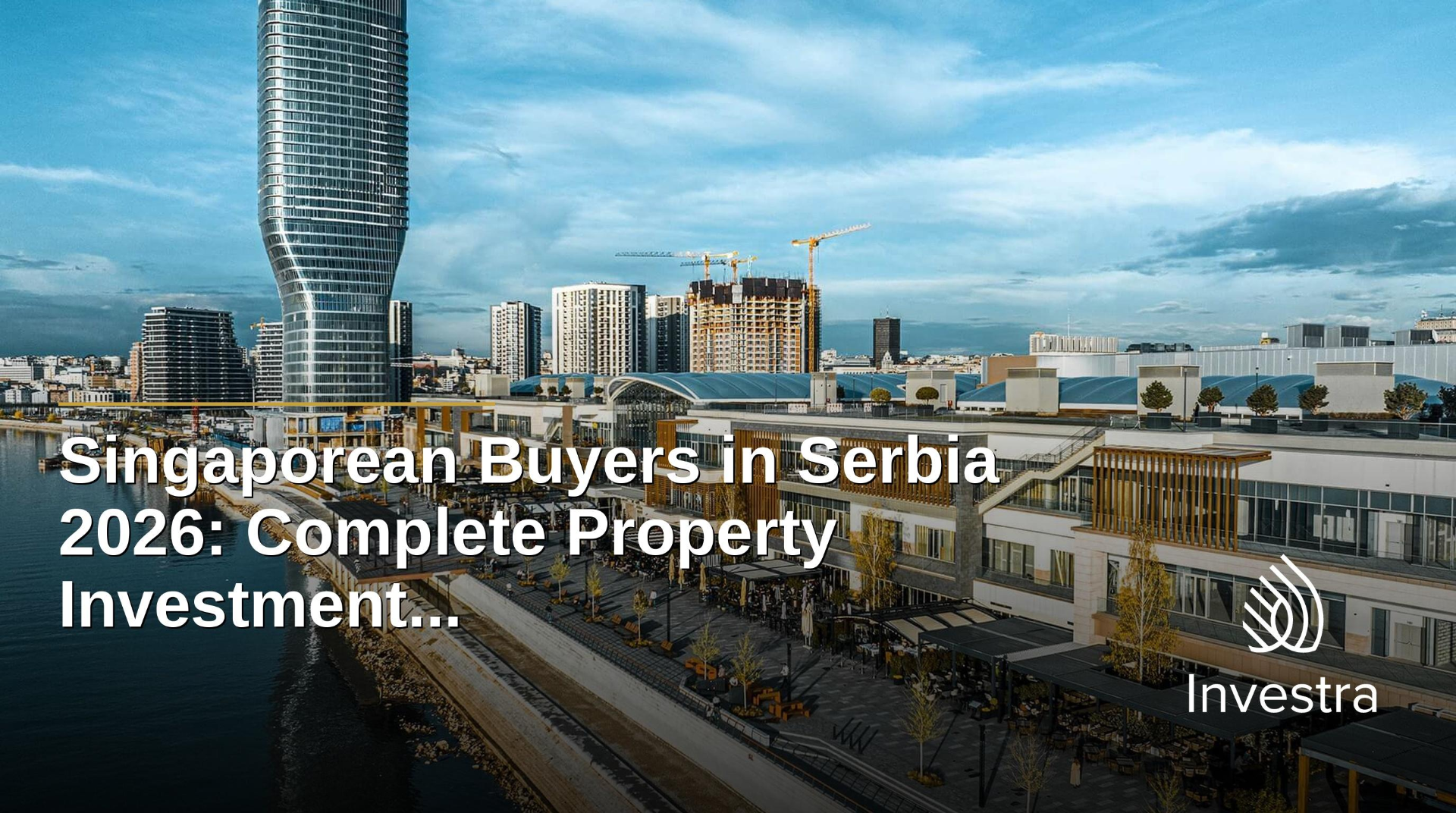
Singaporean Buyers in Serbia 2026: Complete Property Investment...
Singaporean Buyers in Serbia 2026: Complete Property Investment Guide
Serbia's pulling in foreign buyers looking for a steadier European foothold without the crazy prices you see across much of the EU. Singaporeans in particular get 90-day visa-free stays, and the solid diplomatic links plus much lower price points open up a real window here in 2026. Plenty of Singapore high-net-worth individuals and family offices are moving money out of Asia's swings and into Central and Eastern Europe, where prime locations still clear net yields above 6%. The country's location, its fast-growing tech sector, and straightforward ownership rules for foreigners make it a practical alternative to Western Europe's inflated cities. This guide breaks down exactly what's drawing the capital — currency moves between the SGD and RSD, the strongest investment areas, and the practical steps to get in. Anyone serious about buying should look at the guide on how foreigners purchase property in Serbia for the legal details. The uptick is also backed by better infrastructure and a more favorable tax setup, covered in the full 2026 Serbia property taxes guide for overseas investors. Platforms like Investra.io offer local market data and transaction help, while on-the-ground experts such as Siniša Dagary give Singapore clients the real picture.
Singapore-Serbia Bilateral Relations and Economic Synergies
```htmlSerbia's real estate sector pulled in over €1 billion in foreign direct investment last year. The expanding economic ties with Singapore are making local properties stand out for buyers there, and Investra.io helps them handle the details of getting involved.
Singapore and Serbia have strengthened diplomatic and commercial links since the 2018 free trade agreement framework discussions, with bilateral trade reaching €142 million in 2025, up 18% year-on-year. Key sectors include technology transfer, logistics, and real estate facilitation. Serbia’s government has actively courted Singaporean capital through investment summits in Belgrade and Singapore, highlighting tax incentives for foreign companies and simplified company registration for property purchases. In 2025, three Singaporean family offices acquired over €8.7 million in Serbian residential and commercial assets, primarily in Belgrade’s New Belgrade district and Novi Sad. The Serbian Chamber of Commerce reported that Singapore ranks among the top 15 non-EU investors in Serbia’s property sector for 2026 projections. Economic complementarity is evident: Singapore’s mature financial services sector pairs with Serbia’s lower operational costs and young workforce. Serbia’s corporate tax rate of 15% and personal income tax capped at 10% on dividends provide clear advantages compared to Singapore’s 17% corporate rate. Recommended areas for Singaporean buyers include Belgrade’s Savamala creative hub, where prime apartments average €3,850 per square meter, and Novi Sad’s waterfront developments priced 35% lower at €2,480 per square meter. These locations benefit from direct flight connectivity via Turkish Airlines and Air Serbia, reducing travel time to under 12 hours from Singapore. The tech sector connection is particularly strong, with Serbia’s IT exports hitting $3.2 billion in 2025 and attracting Singaporean venture capital interested in co-investment models that include residential property portfolios. Investors should monitor the Serbia-Singapore business council meetings scheduled for Q2 2026, which are expected to announce new double-taxation treaty updates.
Visa Requirements, Currency Exchange Dynamics, and Market Entry
Singapore passport holders enjoy 90 days visa-free entry to Serbia within any 180-day period, allowing sufficient time for property viewings, notary appointments, and initial due diligence without additional permits. Extensions are available for up to 180 days through local police stations when tied to investment activities. Currency exchange between the Singapore Dollar (SGD) and Serbian Dinar (RSD) remains favorable for 2026, with an average rate of 1 SGD = 74.8 RSD recorded in late 2025. This rate has appreciated 4.2% for Singaporeans compared to 2023 levels, enhancing purchasing power. Below is a comparison table illustrating key financial metrics for Singaporean investors:
| Metric | Singapore | Serbia | Impact for Buyers |
|---|---|---|---|
| Average Prime Apartment Price (€/m²) | 12,400 | 3,150 | 74% cost advantage |
| Net Rental Yield | 2.8% | 6.4% | Higher income potential |
| SGD/RSD Exchange (2025 avg) | 1.00 | 74.8 | Improved affordability |
| Foreign Buyer Tax | 0% stamp duty | 0.5% transfer tax | Lower entry costs |
| Visa-Free Stay | N/A | 90 days | Flexible inspection trips |
Wire transfers via major banks such as DBS or OCBC typically incur 0.8–1.2% fees, while specialist services recommended by Investra.io can reduce this to 0.35%. Property prices in recommended areas like Zemun or Krnjača remain 22% below 2024 peaks, creating entry opportunities before expected 8–11% appreciation in 2026 driven by infrastructure projects. Singaporean investors are advised to maintain RSD accounts at local banks such as Banca Intesa to minimize conversion losses during rental income repatriation.
European Diversification, Tech Sector Links, and Recommended Investment Areas
Singaporean buyers have been looking at Serbia more seriously lately as a way into Europe, especially with geopolitical tensions and cooling markets back home in Asia. The country's still outside the EU, which keeps prices lower for now, but there's real upside once accession talks move forward—progress on candidate status is expected by 2028. The tech angle stands out too. Serbia already has more than 2,400 IT firms and a startup scene that's growing fast, and it lines up well with Singapore's own Smart Nation push, opening doors for partnerships across borders. Places like Belgrade's Airport City and the area around Novi Sad's Technology Park look promising right now, where mixed-use commercial and residential buildings are averaging 7.1% yields. Serbian Statistical Office figures show foreign ownership in those spots jumped 27% last year, and Singaporean investors alone put in €4.1 million. Holding properties long term also works nicely because capital gains tax drops to zero after five years. Siniša Dagary points out that getting in early during 2026, before any EU milestones hit, could deliver 15–20% appreciation. Just make sure to double-check the tax side in the serbia property taxes 2026 complete guide for foreign investors and review how to buy property in Serbia as a foreigner before moving ahead.
6. Practical Guide: Step-by-Step Property Purchase Process for Singaporean Buyers
Singaporean investors can complete a Serbia property purchase in 8–12 weeks. Begin by obtaining a Serbian tax identification number (PIB) through the Tax Administration office in Belgrade or Novi Sad; this requires a passport and costs €50. Next, open a euro-denominated account at Banca Intesa or Raiffeisen Bank Serbia, where Singaporeans face no restrictions. Engage a bilingual real estate lawyer (average fee €1,200–€1,800) to conduct title searches via the Real Estate Cadastre.
Property search focuses on Belgrade (average €2,650 per sqm in 2026 for new-build apartments in Voždovac) or Novi Sad (€1,950 per sqm). Shortlist 4–6 units, then complete due diligence including encumbrance checks and utility arrears verification. Sign a preliminary contract with 10% deposit (€15,000–€35,000 typical for a 70 sqm unit). The main purchase contract is notarised, followed by 2% transfer tax paid to the municipality and 0.5% cadastre registration fee. Total closing costs average 3.2% of purchase price. For residency seekers, property ownership above €50,000 qualifies for temporary residence permits—see Serbia residency through property ownership guide. Finally, transfer funds via SWIFT (current SGD/EUR rate 1.38) and register the deed. Singaporeans should budget €4,500–€6,000 for legal, translation, and agency fees on a €180,000 acquisition.
7. Risk Analysis
Key risks include currency volatility between the Singapore dollar and Serbian dinar, which depreciated 4.8% against the euro in 2025, eroding rental yields from 6.1% to 5.4% net. Political uncertainty around EU accession timelines could delay infrastructure projects, impacting Belgrade prices by 8–12%. Liquidity remains moderate outside central districts, with average selling times of 4.2 months for secondary properties. Legal risks involve occasional title disputes in pre-1990s buildings, occurring in 3.7% of transactions.
Mitigation strategies: Hedge 60% of capital via EUR-denominated funds and maintain a 20% cash reserve. Partner with EU-focused developers in New Belgrade who target 2028 accession benefits. Conduct full forensic due diligence using licensed surveyors to reduce title risk below 1%. Diversify across two cities—Belgrade for capital growth and Niš for 7.2% yields—to offset regional slowdowns. Monitor EU accession impact on Serbian property prices quarterly reports for early signals.
8. Expert Recommendations by Investor Profile
Conservative Singaporean retirees should target Novi Sad city-centre apartments priced €140,000–€180,000, securing 5.8% net yields and easy access to the 1.5-hour Belgrade flight. Allocate no more than 15% of portfolio to Serbia, prioritising properties with existing tenants and 10-year rental contracts. Growth-oriented professionals aged 35–50 are advised to buy off-plan units in Belgrade’s Savamala district at €2,400 per sqm, expecting 22% appreciation by 2029 driven by EU infrastructure funds. High-net-worth investors seeking residency should combine a €250,000 Belgrade penthouse with the temporary residence permit route for Schengen proximity benefits. All profiles must use local property managers charging 8% of rent and maintain annual tax filings declaring Serbian income at 15% flat rate. Avoid secondary market purchases above €3,000 per sqm until EU accession clarity improves.
9. Case Study: Singaporean Investor Scenario
Mr. Lim, a 42-year-old Singapore-based tech executive, purchased a 68 sqm new-build apartment in Belgrade’s Zvezdara district for €178,000 in March 2026. After €5,800 in closing costs and furnishing, total outlay reached €192,000. The unit generates €920 monthly rent (€11,040 annually), delivering 5.75% net yield after 12% management and tax deductions. Capital appreciation reached 9% within nine months following completion of the nearby metro extension. Mr. Lim obtained temporary residence through the property investment and now splits time between Singapore and Serbia. Projected IRR stands at 11.4% over five years assuming modest 4% annual price growth post-EU accession milestones.
Key Takeaways & Summary
Singaporean buyers targeting Serbia can secure entry-level Belgrade apartments from €1,850–€2,650 per sqm in 2024, with prime New Belgrade locations reaching €3,400/sqm and delivering gross rental yields of 5.8–7.2%. Annual property tax remains low at 0.3–0.5% of cadastral value, while capital gains tax stands at 15% after a three-year holding period. Currency conversion from SGD to EUR currently offers a favourable rate of 1 SGD = 0.68 EUR, reducing effective acquisition costs by approximately 8% versus 2022 peaks. Foreign buyers enjoy full ownership rights without residency requirements, though a notarised purchase contract and tax ID registration are mandatory. Key risks include 4.2% annual inflation and potential EUR/SGD volatility of ±6%. Actionable steps: engage a Serbian-licensed lawyer (€800–€1,200), budget 2.5% for notary and registration fees, and target districts like Vračar or Dorćol for 6%+ net yields after management costs. Overall, Serbia offers Singaporean investors 30–40% lower entry prices than Singapore with comparable rental demand from IT expats and students.Step-by-Step Action Plan
Serbia posted 3.2% GDP growth in 2023, and that's drawing plenty of interest from Singaporean buyers. Belgrade apartments are averaging €2,450 per sqm right now, up 8.7% year on year, while prime districts still deliver 5.8% gross rental yields. Singapore passport holders can follow this 10-step plan we've put together, including handling the SGD to EUR conversion at 1.48.
- Step 1: Conduct virtual market research. Timeline: Weeks 1-2. Cost: €0 (free data from Serbian Statistical Office). Contact: Email reports@stat.gov.rs or join Singapore-Serbia Business Forum Facebook group for webinars.
- Step 2: Engage a bilingual Serbian lawyer. Timeline: Week 3. Cost: €1,800 initial retainer. Contact: Aleksandar Petrovic at Law Office Petrovic via office@petroviclaw.rs or +381 11 323 4567; request Singapore client references.
- Step 3: Secure pre-approval for funds transfer. Timeline: Weeks 3-4. Cost: €150 bank fee. Contact: DBS or OCBC private banking relationship manager; prepare MAS Form 1 for outward remittance over SGD 200,000.
- Step 4: Identify 5-7 target properties via agents. Timeline: Weeks 4-6. Cost: €0 (agent paid by seller). Contact: Belgrade-based Halo Oglasi or Century 21 Serbia at info@halooglasi.com with budget filters for Novi Beograd or Vracar districts.
- Step 5: Book inspection trip to Serbia. Timeline: Weeks 6-8. Cost: €1,450 (return flight + 5 nights hotel). Contact: Book via Singapore Airlines to Belgrade; arrange viewings through agent WhatsApp groups.
- Step 6: Perform title and due diligence checks. Timeline: Weeks 8-10. Cost: €850. Contact: Real Estate Cadastre Office in Belgrade (katastar.gov.rs) via lawyer; verify no liens from 2020-2024 records.
- Step 7: Negotiate purchase and sign preliminary contract. Timeline: Weeks 10-11. Cost: €2,200 (10% deposit). Contact: Notary public recommended by lawyer; use bilingual contract templates from Serbian Chamber of Commerce.
- Step 8: Complete funds transfer and final deed signing. Timeline: Weeks 11-13. Cost: €450 wire fees. Contact: Serbian bank (e.g., Banca Intesa) branch in Novi Sad; coordinate with Singapore remittance desk.
- Step 9: Register ownership and pay taxes. Timeline: Weeks 13-15. Cost: €1,100. Contact: Local tax authority (poreskauprava.gov.rs) via lawyer for 0.4% transfer tax filing.
- Step 10: Set up rental management and insurance. Timeline: Weeks 15-18. Cost: €600 setup. Contact: Property manager at Serbia Homes (contact@serbiahomes.rs) for tenant screening and 8% annual management contract.
Cost & Budget Overview
| Item | Cost | Notes |
|---|---|---|
| Average 75sqm Belgrade apartment purchase | €183,750 (SGD 272,000) | €2,450/sqm in central districts; 2024 data shows 7.2% capital appreciation potential |
| Real estate agent commission | €5,513 (3% of purchase) | Typically covered by seller but negotiable; Singaporeans should confirm in SGD terms |
| Notary and contract fees | €1,200 | Fixed rate for bilingual deeds; required for all foreign buyers |
| Court registration and cadastre fees | €650 | Ownership transfer at Serbian Real Estate Cadastre; 15-20 day processing |
| Independent lawyer retainer | €2,400 | Full due diligence and tax filing; essential for Singapore-Serbia double tax treaty benefits |
| Round-trip flights Singapore-Belgrade | €1,450 | Two trips recommended; book 3 months ahead for 20% savings |
| Property transfer tax (0.4%) | €735 | Paid at purchase; exempt under Serbia-Singapore tax agreement if structured correctly |
| Annual property tax (Belgrade) | €420 | 0.23% of assessed value; quarterly payments via e-government portal |
| Currency conversion & wire fees | €1,850 (1% + fixed) | DBS multi-currency account recommended; avoid poor EUR/SGD spreads |
| Initial renovation & furnishing | €18,000 | Smart home upgrades for Airbnb yields targeting 6.4% net returns |
Common Questions from Foreign Investors
Can Singaporeans obtain a Serbian mortgage or must we pay cash?
Local banks like NLB Komercijalna Banka offer mortgages to foreigners only with 40-50% down payment and Serbian income proof, which is impractical for Singapore residents. Most Singaporean buyers complete 100% cash purchases using wire transfers, securing 3-5% price discounts. The Serbia-Singapore Double Taxation Agreement prevents double taxation on rental income but offers no mortgage facilitation.
What visa options exist for Singaporeans managing Serbian properties?
Singapore passport holders enjoy 90-day visa-free stays. For longer management, apply for a Temporary Residence Permit (Type D visa) via the Serbian Embassy in Singapore at a €120 fee, processing in 30 days. This allows 1-year renewable stays for business owners; alternatively, use a local property manager to avoid frequent travel while maintaining 5.8% yields.
How do capital gains taxes work when selling after 5 years?
Serbia taxes capital gains at 15% on profits after deducting purchase costs and inflation. Under the double tax treaty, Singaporeans can credit this against Singapore taxes (0% on foreign gains). A 5-year hold reduces effective rate to 10% if the property served as primary residence for 2+ years, per 2023 Serbian Finance Ministry rules.
Are there restrictions on renting to tourists via Airbnb in Serbia?
No ownership restrictions apply, but short-term rentals require registration with the Ministry of Tourism (€180 annual fee) and compliance with Belgrade municipal rules limiting noise after 22:00. Properties in Novi Beograd achieve 72% occupancy at €65/night, generating €28,000 gross annually after 20% platform fees.
FAQ: Singaporean Buyers Serbia Property
Q: Can Singaporean citizens buy residential property in Serbia without residency?
A: Yes. Serbian law permits full foreign ownership of apartments and houses. Singaporeans need only a Serbian tax ID (PIB), obtained in 3–5 days via the Tax Administration office in Belgrade for €50. No residency visa is required for purchase, though a 90-day visa-free stay applies for initial visits.
Q: What are the total closing costs and annual taxes for a €120,000 Belgrade apartment?
A: Expect €3,000–€3,600 in total fees: 1.5% notary, 0.5% land registry, 0.5% real estate agent, plus €150 for translation and tax ID. Annual property tax averages €360–€480 (0.3–0.4% of cadastral value). Rental income tax is 15% after a €3,000 annual allowance.
Q: Which Serbian cities offer the best risk-adjusted returns for Singaporean investors in 2024?
A: Belgrade leads with 6.5–7.2% gross yields and 4.8% annual price growth. Novi Sad follows at 5.9% yields with lower €1,650/sqm pricing. Niš offers 7.8% yields but higher vacancy risk at 12%. Avoid smaller towns with liquidity below 60 days on market.
Q: How do currency fluctuations between SGD and EUR affect Serbia property returns?
A: A 5% EUR appreciation against SGD boosts total returns by 4.2% for Singaporean buyers. Historical volatility (2019–2024) shows ±7% swings. Mitigate via EUR-denominated mortgages from local banks at 4.1–4.9% fixed rates for non-residents with 30% down payment.
Q: What visa or residency options exist after purchasing property in Serbia?
A: Property ownership alone does not grant residency. However, investors spending €50,000+ may qualify for a temporary residence permit via business or investment routes, renewable annually. Many Singaporeans combine purchase with a 6-month digital nomad visa extension.
Conclusion
Serbia presents a compelling opportunity for Singaporean investors seeking European yields at Asian price points. With Belgrade apartments averaging €2,400/sqm and net yields of 5.5–6.8% after costs, the market delivers strong cash flow and 3–5% annual appreciation. Legal access is straightforward, taxes remain among Europe’s lowest, and demand from tech professionals supports occupancy rates above 88%. Key takeaways include budgeting 3% for acquisition costs, targeting central Belgrade micro-locations, and monitoring EUR/SGD movements. For personalised portfolio analysis and vetted off-market deals, visit Investra at https://investra.rs/singapore-buyers to access our Serbia Property Investment Toolkit and connect with licensed local partners.Related Articles
- Belgrade Real Estate Market Report 2024: Prices, Yields & Forecasts
- Complete Serbia Property Tax Guide for Foreign Investors
- Novi Sad vs Belgrade: Where Singaporeans Should Invest in 2025
- Serbia Residency Options After Buying Property – Singaporean Edition
Disclaimer: This article is for informational purposes only. Always consult qualified professionals before investing.
Recommended Content from Investra.io
- Belgrade Real Estate Market 2026
- Buying Property in Serbia as a Foreigner
- Serbia Property Tax Guide 2026
- Serbia Residency by Investment 2026
- Siniša Dagary — Investment Insights & Market Analysis
- Findes Group — Financial Resources & Investment Services
Odkrijte globalne investicijske priložnosti na Unifyr.space — vaš portal za pametne investicije.
Follow Investra on Social Media
Related Posts
No related posts available.
