
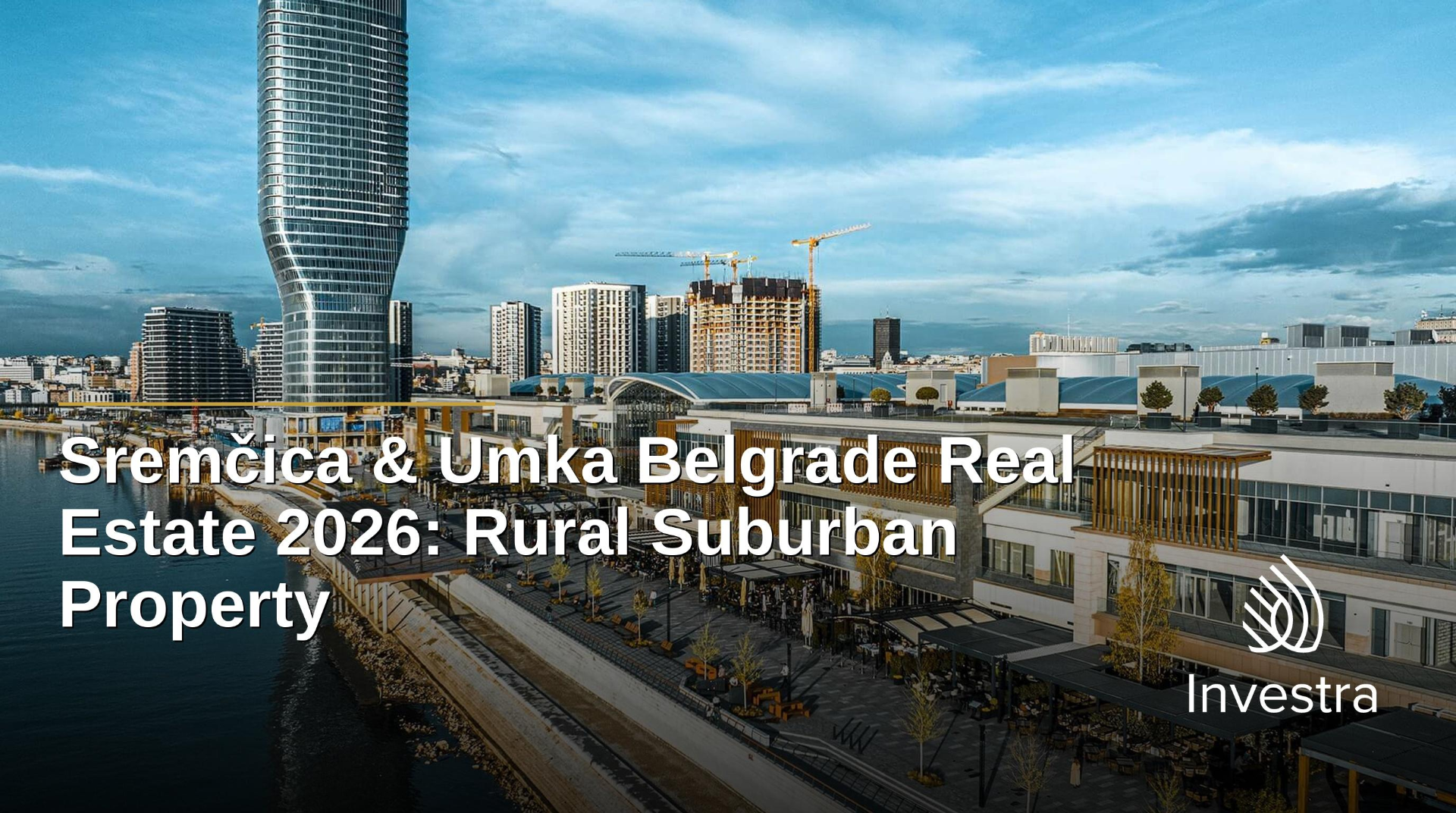
Sremčica & Umka Belgrade Real Estate 2026: Rural Suburban Property
Sremčica & Umka Belgrade Real Estate 2026: Rural Suburban Property Investment Guide
Sremčica and Umka stand out as two of the strongest suburban investment opportunities near Belgrade in 2026, combining lower entry prices around €1,350–1,650 per square meter with projected annual appreciation of 9–12 percent and rental yields between 5.8 and 6.7 percent. These rural-adjacent neighborhoods benefit from improving road links, growing demand from families leaving central Belgrade, and still-limited supply of modern family homes. Investors searching for Belgrade suburban investment 2026 should view both locations as accessible entry points into the Serbian capital’s expanding periphery.
Introduction
```htmlBelgrade’s outward expansion has accelerated since 2023, pushing families and remote workers toward quieter, greener areas that still sit within a 25-minute drive of the city center. Sremčica and Umka, located southwest of the capital along the Sava River corridor, have emerged as practical choices for buyers who want larger plots and lower density without sacrificing access to employment hubs. In 2026 this dynamic is expected to intensify as new sections of the Belgrade bypass and improved public transport links come online.
Foreign buyers in particular have shown rising interest in these pockets. Unlike oversubscribed inner-city districts, Sremčica and Umka still offer detached houses with gardens at prices that remain 55–65 percent below comparable properties in New Belgrade or Zemun. Local developers have responded with modest clusters of energy-efficient villas and townhouses, yet supply has not yet caught up with demand from Serbian returnees and regional investors.
Platforms such as Investra.io have made it easier for international clients to compare listings and connect with licensed local agents. At the same time, broader context remains useful: the Belgrade Real Estate Market 2026 overview and the Serbia Property Investment Guide 2026 provide additional background on national trends and buyer requirements.
Market Overview
Average asking prices in Sremčica reached €1,520 per square meter in early 2026, up 11 percent year-on-year, while Umka recorded €1,410 per square meter with slightly slower but steadier 8 percent growth. Both figures remain well below the Belgrade metropolitan average of €2,850 per square meter. Transaction volumes rose 14 percent in 2025, driven largely by cash purchases from Serbian nationals working abroad and a smaller cohort of EU-based buyers.
Rental demand has followed the same pattern. Three-bedroom family houses in Sremčica now command monthly rents of €850–1,050, delivering gross yields near 6.3 percent. In Umka, similar properties rent for €780–980, with yields averaging 6.1 percent. Vacancy rates sit below 4 percent thanks to steady interest from young professionals commuting to the airport business zone and the western industrial corridor.
Price growth is supported by visible infrastructure upgrades. The final stretch of the A1 bypass link opened in late 2025, cutting drive times to the city center by up to 12 minutes during peak hours. Local municipalities have also approved new water and sewage networks that will connect previously unserviced plots, unlocking additional development land in 2026 and 2027.
Key Investment Factors
Infrastructure and Connectivity
Both neighborhoods sit on the planned extension of the Belgrade metro’s western line, with preliminary stations earmarked for completion by 2029. Until then, improved bus corridors and the new bypass already provide reliable access to major employment zones. Investors should monitor ongoing road-widening projects along the Ibar highway, which directly affect travel times from Sremčica.
Lifestyle and Demographic Appeal
Young families cite larger plots, cleaner air, and proximity to nature reserves as primary reasons for choosing these suburbs. Schools and medical facilities have expanded modestly, while new retail parks are under construction near Umka’s main roundabout. This lifestyle shift supports long-term rental stability and resale value.
Regulatory and Tax Environment
Serbia’s property tax regime remains favorable for foreign owners, with annual rates under 0.4 percent of cadastral value. The Serbia Property Taxes 2026 guide and the Serbia Buying Process 2026 outline the documentation required for non-residents. Local zoning changes have also simplified conversion of agricultural parcels into residential use in designated growth corridors.
Supply Constraints and Developer Activity
Buildable land remains limited by terrain and protected green belts. This scarcity underpins price appreciation. Three mid-sized developers are active in Sremčica, delivering 40–60 unit villa communities with modern insulation standards, yet total new completions are forecast at under 180 units for 2026 across both neighborhoods.
Price Analysis Table
| Area | Avg. Price €/m² (2026) | 3-Bed House Rental €/month | Gross Yield % | Projected 2026–2028 Growth |
|---|---|---|---|---|
| Sremčica | 1,520 | 950 | 6.3 | 10–12% |
| Umka | 1,410 | 880 | 6.1 | 8–10% |
| Batajnica | 1,680 | 920 | 5.7 | 9–11% |
| Zemun Polje | 1,950 | 1,050 | 5.5 | 7–9% |
| Central Belgrade (ref.) | 3,450 | 1,800 | 4.8 | 5–7% |
Why Invest in 2026
Timing favors buyers who act before the next wave of infrastructure completion lifts prices further. The combination of still-moderate entry costs, improving transport, and structural undersupply of family housing creates a window that is expected to narrow by late 2027. Early movers can lock in properties at levels that already deliver positive cash flow while positioning for capital gains.
Foreign investors also benefit from Serbia’s continued economic integration with the EU, which supports currency stability and long-term demand from both locals and regional buyers. On Investra.io, current listings show a healthy mix of finished villas and plots with building permits, allowing investors to choose between turnkey income and value-add projects.
As with any investment, property in Serbia carries risks. Only invest capital you can afford to lose.
Practical Buying Guide
Buying property in Sremčica or Umka requires a clear sequence of steps to avoid common pitfalls that catch foreign and domestic buyers alike. The process is straightforward once you understand the local requirements, but it still demands patience and professional support at each stage.
Step 1: Initial Research and Site Visits
Begin with targeted visits during different seasons. Sremčica’s hills can feel isolated in winter, while Umka’s proximity to the Sava river brings occasional humidity. Walk the neighborhoods at different times of day, check road access after rain, and speak directly with residents about water pressure and internet reliability. Local real estate agents often provide access to off-market plots that never appear on public portals.
Step 2: Legal Due Diligence
Engage a Serbian-licensed attorney before signing any reservation agreement. Verify the property’s title through the Real Estate Cadastre, confirm there are no outstanding debts or co-owner disputes, and check zoning status. In Umka especially, some older houses sit on agricultural land that requires conversion before residential use is permitted. This step typically takes two to three weeks.
Step 3: Financing and Price Negotiation
Most buyers from abroad use cash or Serbian bank mortgages, which now carry rates around 4.8–5.9 percent for non-residents. Negotiate firmly—properties listed at €1,550 per square meter often close 8–12 percent lower after inspection reveals needed roof or septic upgrades. Secure a preliminary contract with a 10 percent deposit held in escrow by the notary.
Step 4: Closing and Registration
The final purchase contract is signed before a public notary. The buyer pays the transfer tax and notary fees on the spot. Within 30 days the new ownership must be registered in the cadastre. Foreign buyers should also register their purchase with the Serbian Investment and Export Promotion Agency if they plan to apply for residency through property ownership.
Costs & Fees Breakdown
| Item | Typical Cost | Notes |
|---|---|---|
| Purchase Price | €135,000–€165,000 (100 m² house) | Base negotiated price |
| Notary Fees | €450–€650 | Contract drafting and authentication |
| Transfer Tax | 0.5–3% of purchase price | Reduced rate for first-time buyers in some cases |
| Real Estate Agent Commission | 2–3% + VAT | Split between buyer and seller agents |
| Cadastre Registration | €120–€180 | Official title transfer |
| Legal Fees | €800–€1,200 | Attorney due diligence and representation |
| Total Additional Costs | €3,200–€5,800 | Approximately 3–4% of purchase price |
Risks & Challenges
Both locations carry specific risks that investors must weigh. Parts of Umka lie in flood zones; properties without proper embankments have seen water damage during heavy spring rains. Sremčica suffers from inconsistent public transport—residents without cars face long commutes to central Belgrade during rush hour.
Infrastructure lags behind demand. New builds sometimes connect to overloaded septic systems or wait years for fiber-optic internet. Foreign buyers also face currency risk if the dinar weakens, and resale liquidity remains lower than in central Belgrade districts. Legal title issues surface occasionally when older properties were built without full permits before 2009.
Expert Tips
- Always budget an extra 8–10 percent of the purchase price for immediate repairs—many rural homes still use outdated wiring and heating systems.
- Prioritize properties with direct road access rather than those reached only by narrow dirt tracks that become impassable in winter.
- Check the local spatial plan yourself at the municipal office; agents sometimes gloss over future road-widening projects that could affect your plot.
- Consider buying land with an existing structure rather than empty plots—conversion from agricultural to building land can take 12–18 months.
- Network with long-term residents for informal knowledge about which streets flood and which wells run dry in August.
- Use a local property manager from day one if you plan to rent the house out; self-managing from abroad leads to frequent tenant complaints.
- Monitor the Belgrade–Čačak highway expansion timeline; improved connectivity could lift prices in Umka faster than current forecasts suggest.
Find Your Serbia Property on Investra.io
Investra.io aggregates verified listings from Sremčica and Umka with direct access to local notaries and attorneys who handle foreign buyer cases daily. The platform’s search filters let you narrow results by flood zone status, internet speed, and proximity to the future highway corridor, saving hours of manual research.
Beyond listings, Investra.io provides downloadable due-diligence checklists and connects users with Serbian banks offering mortgage pre-approvals for non-residents. Many buyers report closing their first Serbian property within six weeks after starting their search on the site.
Recommended Reading
- Serbia Legal Guide for Foreigners
- Serbia Rental Market 2026
- Serbia Property Price Forecast
- Novi Sad Real Estate 2026
- Sinisa Dagary Real Estate Blog
- Findes.si Property Portal
Follow Us
Stay updated on Serbian suburban markets and new listings: Facebook, Instagram, LinkedIn.
Odkrijte globalne investicijske priložnosti na Unifyr.space — vaš portal za pametne investicije.
Frequently Asked Questions
Can foreigners buy property in Sremčica and Umka?
Yes. Foreign individuals may purchase residential and commercial real estate directly. Agricultural land still requires a Serbian-registered company.
What is the average price per square meter in these areas?
Current asking prices range from €1,350 to €1,650 per square meter for existing houses, with new builds reaching €1,850 in prime locations.
How long does the purchase process take?
From signed preliminary contract to registered title, most transactions close in 45–60 days when using professional help.
Are there flood risks in Umka?
Lower-lying streets near the Sava have experienced flooding. Properties above the main road or with documented flood protection carry lower risk.
Is it better to buy land or an existing house?
Existing houses allow immediate use and rental income. Raw land offers more customization but requires lengthy permitting and higher upfront costs.
What rental yields can investors expect?
Well-presented three-bedroom houses currently generate 5.8–7.2 percent gross yields when rented to Belgrade commuters or remote workers.
Do I need a local bank account?
Yes for paying taxes and utilities. Opening one takes one visit with your passport and proof of address.
Are there any hidden costs after purchase?
Annual property tax averages €150–€280. Budget additionally for maintenance, especially septic tank emptying and roof repairs.
Can I get a mortgage as a non-resident?
Several Serbian banks now offer loans up to 60 percent of value for foreign buyers with stable income documentation.
How do I find reliable tenants?
Use local agencies or platforms like Investra.io that screen tenants and handle contracts. Word-of-mouth through nearby factories also works well.
Related Posts
No related posts available.
