
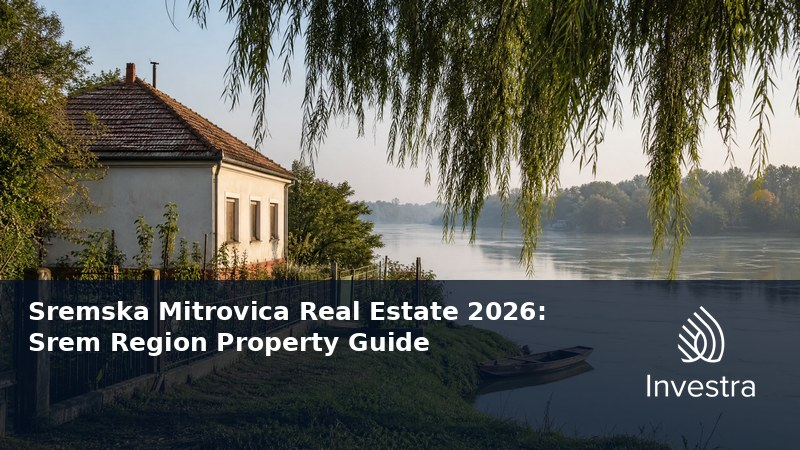
Sremska Mitrovica Real Estate 2026: Srem Region Property Guide
Sremska Mitrovica Real Estate 2026: Why This Ancient City Is Attracting Modern Investors
Quick Answer: Sremska Mitrovica's real estate market in 2026 offers some of the most competitive property prices in Serbia, ranging from €600 to €1,800 per square meter depending on location and property type, with growing investor interest driven by infrastructure investment, EU proximity, and strong rental demand. Investra.io's Belgrade Real Estate Market Report 2026 provides broader regional context for understanding Serbia's property landscape.
There's a certain irony about Sremska Mitrovica. This city of roughly 75,000 people sits on the Sava River in the heart of Vojvodina, built on the foundations of ancient Sirmium — once one of the four capitals of the Roman Empire, a city that rivaled Rome itself in importance. Yet in 2026, most international property investors have never heard of it. That invisibility is precisely what makes it interesting.
While Belgrade commands the headlines and Novi Sad attracts the digital nomad crowd, Sremska Mitrovica has been quietly developing. New residential complexes are rising along the riverfront. The Corridor 10 motorway connects the city directly to Belgrade in under an hour. Foreign companies are establishing operations in the Srem District's industrial zones. And property prices? They remain dramatically undervalued compared to virtually every comparable European city of similar historical and strategic significance.
The Srem Region — the fertile strip of land between the Sava and Danube rivers — has historically been one of the most contested and coveted territories in southeastern Europe. Today, that strategic geography translates into genuine investment potential. Road networks, agribusiness, proximity to Croatia (and thus the EU border), and a stable local economy are combining to create conditions that experienced property investors recognize as early-stage opportunity.
This guide covers everything international and domestic investors need to know about the Sremska Mitrovica property market in 2026: current prices, best neighborhoods, rental yields, the legal purchase process for foreigners, tax obligations, and the broader market trends shaping the next five years. Whether you're considering a buy-to-let apartment, a commercial investment, or a longer-term land play, the data and analysis here will give you a clear, honest picture of what this market offers — and what it doesn't.
Understanding the Srem Region: Geography, Economy, and Strategic Context
Quick Answer: The Srem Region is a historically significant territory in northern Serbia (Vojvodina province), bordered by Croatia to the west and connected to Belgrade by major road and rail infrastructure — making Sremska Mitrovica both an agricultural hub and an emerging industrial center with real investor appeal.
Before looking at property prices, it helps to understand what you're actually buying into. Geography matters in real estate, and the Srem Region has a geography that most investors would find compelling if they knew about it.
Sremska Mitrovica serves as the administrative center of the Srem District, which covers approximately 3,500 square kilometers of flat, extraordinarily fertile land between the Sava and Danube rivers. The district borders Croatia directly to the west — meaning it sits at the edge of EU territory. That proximity has economic consequences: logistics companies, agricultural exporters, and manufacturers all find the location strategically valuable for cross-border operations.
The city itself sits on the southern bank of the Sava River, about 85 kilometers west of Belgrade. The A1 motorway (part of European Corridor 10) runs through the region, providing fast, modern road connections to both the Serbian capital and the Croatian border crossing at Batrovci. Travel time to Belgrade Nikola Tesla International Airport runs approximately 60-75 minutes under normal traffic conditions — a commutable distance that significantly influences residential property demand.
Economically, Sremska Mitrovica has diversified beyond its traditional agricultural base. The city hosts several industrial zones that have attracted investments from companies across the automotive supply chain, food processing, and light manufacturing sectors. Unemployment in the Srem District has been trending downward, and average wages, while still below the Serbian national average for Belgrade, have been rising consistently. This wage growth directly supports the local rental market and property demand.
Tourism plays a smaller but growing role. The Sirmium archaeological site — one of the most significant Roman imperial sites in the Balkans — draws cultural tourism. The Sava riverfront has been partially redeveloped with promenades and recreational facilities. These aren't yet major economic drivers, but they contribute to the quality-of-life narrative that attracts residents and, increasingly, second-home buyers from Belgrade looking for weekend properties at a fraction of the capital's prices.
Population dynamics deserve attention too. Sremska Mitrovica has experienced the mild demographic pressures common to mid-sized Serbian cities — some outmigration of younger workers to Belgrade and Western Europe — but it has maintained a relatively stable population base compared to smaller Serbian towns that have seen sharper declines. The local university presence helps maintain a younger demographic mix and supports demand for smaller rental apartments.
Property Prices in Sremska Mitrovica 2026
Quick Answer: Property prices in Sremska Mitrovica range from approximately €600 to €1,800 per square meter in 2026, with city-center new-build apartments commanding the highest rates and peripheral or older socialist-era housing stock representing the most affordable entry points in the Serbian market.
Let's get specific about the numbers, because this is where Sremska Mitrovica truly separates itself from other markets international investors are familiar with.
New-build apartments in the most desirable central locations — typically within 500 meters of the main pedestrian zone or along the Sava riverfront — are currently priced between €1,400 and €1,800 per square meter. This puts a standard 50m² one-bedroom apartment in the €70,000–€90,000 range, and a 75m² two-bedroom unit between €105,000 and €135,000. By any Western European standard, these prices are remarkably low for a city of this size and connectivity.
Mid-range residential properties — which represent the bulk of market transactions — typically sell between €900 and €1,300 per square meter. These include apartments in well-maintained buildings from the 1990s-2010s period, renovated units in older blocks, and newly built properties in secondary neighborhoods. The sweet spot for most buy-to-let investors tends to fall in this segment, where the combination of reasonable acquisition cost and solid rental demand produces attractive yields.
Older residential stock — socialist-era apartment blocks built between the 1960s and 1980s, which represent a significant portion of the city's housing supply — trades at €600–€900 per square meter. These properties require varying levels of renovation investment but offer the lowest entry points. Investors comfortable with renovation projects can acquire, renovate, and still come out well below comparable Western European prices while creating a significantly improved rental asset.
What's been driving price movement? Year-on-year price growth in Sremska Mitrovica has run approximately 6–9% in nominal terms over the past two years, slightly below Belgrade's pace but impressive for a secondary city. Construction costs have risen sharply across Serbia (up roughly 30–40% from 2020 levels due to global materials inflation), and this cost pressure has pushed new-build pricing upward even as demand has remained healthy. The result is a market where quality properties are appreciating, but where prices still represent genuine value compared to regional alternatives.
For comparison: comparable new-build apartments in Novi Sad — just 55 kilometers to the north — now trade at €2,000–€2,800 per square meter in desirable locations. Belgrade's prime areas have crossed €3,500–€4,500 per square meter. The Sremska Mitrovica discount to these established markets reflects lower current demand and liquidity, but also represents the arbitrage opportunity that value-oriented investors are beginning to recognize.
For a broader understanding of how these prices fit into Serbia's national property market picture, the Belgrade Real Estate Market Report 2026: Prices, Trends & Forecasts provides essential comparative context.
Best Neighborhoods and Areas to Buy Property in Sremska Mitrovica
Quick Answer: The most desirable areas for property investment in Sremska Mitrovica include the historic city center (Stari Grad), the Sava riverfront zone, the Mačvanska Street corridor, and newer residential developments on the city's eastern expansion zone — each offering different risk/reward profiles for investors.
Not all neighborhoods are created equal in any property market, and Sremska Mitrovica is no exception. The city's layout is relatively compact, which means neighborhood distinctions aren't as dramatic as in a major metropolis, but they matter for both rental income potential and capital appreciation prospects.
Stari Grad (Old Town Center) is the premium address. The pedestrian zone, main square, and the area immediately surrounding the central market represent the heart of commercial and social life. Properties here command the top end of the price range (€1,400–€1,800/m² for quality units) but also attract the highest rental rates and the lowest vacancy periods. The Roman heritage sites and improved public spaces in this area have made central living genuinely appealing, and demand from young professionals working in the city consistently exceeds supply for well-finished smaller apartments.
The Sava Riverfront Zone deserves particular attention. Municipal investment in riverfront redevelopment has transformed parts of the waterfront into attractive public space with promenades, cycling paths, and gastronomy. Properties with river views or easy walkable access to the waterfront carry a premium — typically 15–20% above comparable inland properties — and this premium appears sustainable as the riverfront continues to develop. Several new residential projects have been specifically marketed around their proximity to the Sava, and occupancy rates in these buildings have been strong.
Mačvanska Street and surrounding blocks represent a solid mid-market residential zone that many local families and professionals prefer. Infrastructure is well-established, public transport connections are good, and the mix of older renovated apartments and newer builds creates options at multiple price points. Buy-to-let investors often find the best risk-adjusted yields in this area, where acquisition prices are moderate and tenant demand is consistent.
Eastern expansion zones are where more speculative but potentially high-upside investment opportunities exist. As the city grows and industrial zone employment expands, residential development has been pushing eastward. Land prices here are still modest, and some developers are building newer apartment complexes that attract young families priced out of the center. Values in these areas could appreciate significantly over a 5–10 year horizon if employment growth continues, but they require a longer investment timeframe and tolerance for slower short-term appreciation.
For investors interested in houses rather than apartments, the surrounding municipalities within the Srem District — Ruma, Šid, Inđija, and Stara Pazova — offer detached houses with gardens at even lower price points. Stara Pazova in particular has benefited from Belgrade commuter demand given its position directly on the motorway corridor toward the capital.
Rental Market and Yields: What Investors Can Realistically Expect
Quick Answer: Gross rental yields in Sremska Mitrovica currently range from 5.5% to 8.5% annually, with smaller centrally located apartments generating the strongest returns relative to purchase price — significantly outperforming yields available in Western European markets at comparable risk levels.
Yield figures are where Sremska Mitrovica starts to look genuinely compelling for income-focused investors. The reality of the rental market here is that supply of quality, well-finished rental accommodation remains relatively tight against consistent demand from several distinct tenant groups.
Let's run through realistic scenarios with actual numbers. A 45m² one-bedroom apartment in the city center, acquired for approximately €75,000 (at €1,667/m²), can command monthly rent of €350–€450 in the current market. At €400/month, that's €4,800 annually — a gross yield of 6.4%. After accounting for property tax (low in Serbia, typically €100–€250/year for an apartment this size), maintenance reserves, and occasional vacancy periods, net yields in the 5.0–5.8% range are achievable and realistic.
Smaller studio and one-bedroom units geared toward students and young professionals tend to generate the highest yields relative to cost. A 30m² studio acquired for €45,000–€55,000 can rent for €280–€350/month, producing gross yields in the 7–8.5% range. The trade-off is higher tenant turnover and more frequent minor maintenance requirements.
Larger family apartments (80–100m²) in quality locations trade at lower yield multiples — typically 5–6.5% gross — because acquisition costs are proportionally higher relative to achievable rents. However, they attract longer-tenancy professional families and embassy/company-assigned workers when those are present, resulting in more stable income and lower management burden.
What about short-term rental (Airbnb-style)? This is a more nuanced question in Sremska Mitrovica than in Belgrade or Novi Sad. The city doesn't yet generate the volume of tourist and business visitor traffic that would make pure short-term letting highly lucrative. Business travelers staying for industrial zone projects represent the most reliable short-stay segment. A blended strategy — longer-term tenancy during academic and standard business periods with short-term letting during peak seasonal windows — works for some investors, but most find the administrative overhead outweighs the yield premium given current tourism volumes. For a detailed look at how short-term rental strategies work in larger Serbian markets, the Airbnb Belgrade 2026: Rental Income, Best Areas & Legal Guide offers practical guidance that can inform your approach.
Demand drivers for the long-term rental market are solid: university students (the city has a branch of the University of Novi Sad), employees of expanding industrial zone companies, healthcare workers at the large regional hospital, and government/administrative workers all represent consistent rental demand segments. The combination of employment diversity and modest supply of quality rental stock creates favorable landlord conditions that experienced investors in more mature markets rarely encounter.
Can Foreigners Buy Property in Sremska Mitrovica?
Quick Answer: Yes, most foreign nationals can legally purchase apartments and commercial properties in Sremska Mitrovica under Serbia's reciprocity principle, with EU citizens having full property rights and non-EU nationals able to buy most urban real estate — though agricultural land purchases remain restricted for foreigners.
This is one of the first questions every international investor asks, and the answer for Serbia is generally positive. The legal framework isn't complicated once you understand the key distinctions.
Serbia operates a reciprocity-based system for foreign property ownership, meaning citizens of countries that allow Serbian nationals to purchase property can do the same in return. In practice, this covers virtually all EU member states, the United States, Canada, Australia, the United Kingdom, and most other nations from which international investors typically come. The Serbian Ministry of Justice maintains an official list of reciprocity agreements.
For EU citizens, the picture is even cleaner. Serbia's EU accession process has resulted in progressive alignment with European property ownership norms, and EU passport holders face minimal restrictions on purchasing urban residential and commercial real estate.
The main restriction worth knowing: agricultural land. Foreign nationals face significant restrictions on purchasing agricultural land in Serbia, a protection that's common throughout Eastern Europe and unlikely to change dramatically in the near term. This restriction affects land investment strategies in the fertile Srem region, though there are legal structures (such as establishing a Serbian company) that some investors use to access agricultural land opportunities — an approach that requires qualified legal counsel.
For standard apartment purchases — which represent the overwhelming majority of what international investors buy in Sremska Mitrovica — the process is straightforward. Foreign buyers need a valid passport, a Serbian tax identification number (PIB — obtainable in a single day at the Tax Administration), and the willingness to navigate a documentation process that, while functional, is still largely paper-based and benefits significantly from local legal assistance.
The full legal purchase process for foreign buyers in Serbia is covered comprehensively in the Buying Property in Belgrade 2026: Complete Guide for Foreign Investors — the process applies equally to purchases in Sremska Mitrovica and other Serbian cities.
The Property Purchase Process in Sremska Mitrovica: Step by Step
Quick Answer: Buying property in Sremska Mitrovica typically takes 4–8 weeks from agreement to completed ownership transfer, involving a preliminary contract, notarized sale agreement, payment of transfer tax (2.5%), and registration with the Republic Geodetic Authority — all manageable with proper local legal support.
The mechanics of buying property in Sremska Mitrovica follow the same general framework as all Serbian property transactions, but with some practical nuances specific to secondary cities that buyers should understand upfront.
The process typically begins with property search and due diligence. In Sremska Mitrovica, the market is smaller and less liquid than Belgrade, meaning the best properties often move through informal networks — local agents who know every building and landlord in town. Engaging a reputable local agent early is worthwhile; online listings exist (Halo Oglasi and Nekretnine.rs both cover the market) but frequently lag the actual available inventory.
Once a property is identified, title verification is the critical first step. Serbia's property registry (Katastar) is now largely digitized and publicly searchable, allowing verification of ownership, existence of mortgages or other encumbrances, and property boundaries. In older parts of Sremska Mitrovica, you'll occasionally encounter properties with legacy ownership complications from the post-Yugoslav privatization period — issues that aren't insurmountable but require careful legal review before committing.
A preliminary contract (predugovor) is typically signed once both parties agree on terms, accompanied by a deposit of 10% of the agreed purchase price. This binds both parties: if the seller withdraws, they return the deposit doubled; if the buyer withdraws, they forfeit the deposit. This is standard practice and legally enforceable.
The main sale and purchase agreement (kupoprodajni ugovor) must be notarized by a licensed Serbian notary (javni beležnik). Since 2014, Serbia has implemented a notary system that has significantly improved transaction security compared to the earlier system. The notary verifies identities, confirms the legal validity of the transaction, and handles the submission for property registration. Legal fees for the notary typically run 0.3–0.5% of the transaction value, with minimums and maximums that cap costs on both very small and very large transactions.
Following notarization, the buyer pays property transfer tax of 2.5% (applicable to existing properties — new-build properties from VAT-registered developers are typically covered by VAT instead). The title registration with the Republic Geodetic Authority (RGZ) follows, completing the ownership transfer. The entire process from signed preliminary contract to registered ownership typically runs 4–8 weeks in Sremska Mitrovica, though delays in the registration queue can occasionally extend this timeline.
For investors comparing the Serbian purchase process to other Balkan markets, consulting with specialists like Siniša Dagary — Investment Consultant can provide valuable cross-market perspective on navigating regional property transactions efficiently.
Property Taxes and Ongoing Costs for Owners in Sremska Mitrovica
Quick Answer: Serbia's annual property tax rates are among the lowest in Europe, typically running 0.1%–0.4% of the assessed (not market) property value — meaning annual tax bills for a typical Sremska Mitrovica apartment often fall between €80 and €300, representing a major cost advantage over Western European property ownership.
One of Serbia's most compelling features for property investors is its genuinely low ongoing tax burden. In markets like the UK, France, or even some other Balkan countries, annual holding costs can significantly erode rental yields. In Serbia, property taxes are structured in a way that keeps holding costs low and makes buy-to-let math work.
The annual property tax (porez na imovinu) in Serbia is levied by local municipalities on the assessed value of the property — not its market value. The assessed value is typically set well below actual market prices, particularly in secondary cities like Sremska Mitrovica where the municipal valuation methodology tends to lag market appreciation. Tax rates range from 0.1% to a maximum of 0.4% depending on property type and location, with the actual rate set by each municipality. For a well-located apartment with a market value of €100,000 in Sremska Mitrovica, annual property tax bills of €100–€250 are typical.
Beyond the annual property tax, investors in the rental market should be aware of income tax on rental earnings. Serbia levies a flat 20% tax on net rental income (gross rental income minus a 25% standardized expense deduction), which effectively produces a tax rate of approximately 15% on gross rental income. This is worth modeling into yield calculations — but even after this tax burden, net yields in Sremska Mitrovica remain competitive with pre-tax yields in many Western European markets.
For investors holding property in a Serbian company structure, corporate income tax applies at a flat rate of 15%, which remains one of the most competitive rates in Europe. Company ownership can also enable VAT recovery on new-build purchases in some circumstances, making the structure attractive for larger-scale investors.
The one-time costs at purchase include: transfer tax (2.5% for existing properties), notary fees (approximately 0.3–0.5%), real estate agent commission (typically 2–3%, negotiable), and legal fees for an independent attorney review (€500–€1,500 for standard residential transactions, higher for complex commercial deals). Total transaction costs typically land between 5–8% of the purchase price — reasonable by European standards.
For a complete breakdown of Serbia's property tax regime, the Serbia Property Tax Guide 2026: What Foreign Buyers Must Know is essential reading before you commit to any purchase.
Financing and Mortgages: What Are the Options for Buyers in Sremska Mitrovica?
Quick Answer: Serbian banks do offer mortgage products to both residents and some foreign nationals, with interest rates currently running 3.5%–6.5% for EUR-denominated loans, though foreign buyers without Serbian residency typically find domestic financing challenging and often rely on home-country financing or cash purchases.
Financing is one of the more complex areas for international investors in the Serbian market, and it's worth being realistic about the options and limitations.
For Serbian residents and citizens, mortgage financing is fully available through all major domestic banks. Key players include Banca Intesa, UniCredit Bank Serbia, Raiffeisen Banka, Erste Bank, and Komercijalna Banka. Loan-to-value ratios typically cap at 80% for residential properties, with many banks preferring 70–75% LTV. Loan terms extend to 30 years. Interest rates for EUR-denominated mortgages have been running in the 3.5–5.5% range for well-qualified borrowers in 2025-2026, having risen from historic lows but remaining manageable.
For non-resident foreign nationals, domestic mortgage access is more limited. Serbian banks generally require Serbian residency or at minimum a consistent income history documented through Serbian accounts for mortgage approval. Some banks will consider applications from foreign nationals with strong international financial profiles and Serbian tax residency, but this is handled case-by-case and often involves significant documentation requirements.
The practical reality for most international investors purchasing in Sremska Mitrovica is that they either purchase in cash (which the relatively low price points make feasible compared to Western European markets) or they refinance against equity in their home-country properties to fund Serbian purchases. Given that a quality Sremska Mitrovica apartment can be acquired for €70,000–€100,000, many investors find the cash purchase route entirely manageable — particularly when entering the market specifically because of these accessible price points.
Developer financing is occasionally available for new-build purchases. Some local and regional developers offer payment plans tied to construction stages — for instance, 30% on contract signing, 40% during construction, and 30% on completion. These arrangements can help manage cash flow timing, though they carry developer completion risk and require careful contract review.
The full picture of mortgage options for foreign buyers in Serbia is covered in detail by Serbia Mortgage Guide 2026: Can Foreigners Get a Loan? — an essential resource before approaching any bank or developer with a financing inquiry.
New Development Projects and Construction Activity in 2026
Quick Answer: Construction activity in Sremska Mitrovica has been rising steadily, with several new residential complexes in the central and riverfront zones completing in 2025-2026, driven by growing demand from Belgrade commuters, local professional upgraders, and the first wave of international investors discovering the market.
The construction landscape tells you a lot about a market's confidence in its own future. What's been happening in Sremska Mitrovica over the past 2–3 years is instructive.
New residential construction has been concentrated in several areas: the central zone (where land is scarce and premiums are highest), the Sava riverfront where municipal investment has made development commercially viable, and emerging residential clusters on the eastern and southern periphery where land is available and new industrial zone employment is creating demand. The quality of new builds has improved noticeably compared to the construction standards of even 5–10 years ago, with developers increasingly offering open-plan layouts, better insulation standards, underground parking, and modern common area design that meets the expectations of both domestic upgraders and international buyers.
Several mixed-use development projects combining retail ground floors with residential upper floors have been completed in the central area, mimicking a development model that has proven successful in Novi Sad and Belgrade. These projects typically sell out off-plan faster than pure residential buildings, as investors recognize the diversified income potential of ground-floor commercial units combined with residential apartments.
Commercial and industrial construction is arguably even more significant from a macro-economic standpoint. Expansion of industrial zone facilities, logistics warehousing (driven by the city's position on the Corridor 10 route), and retail infrastructure investment all contribute to employment growth that ultimately feeds residential property demand. When jobs arrive in a city this size, the effect on the housing market is proportionally larger than in a major metropolis where one employer's arrival barely registers in market data.
For investors evaluating off-plan purchases specifically, the standard caveats apply with heightened importance in a smaller market: developer track record matters enormously, escrow or bank guarantee arrangements for deposits are preferable to developer-held deposits, and timeline projections should always be stress-tested against historical performance. Local legal counsel familiar with Srem Region developer history is genuinely valuable here.
Infrastructure Investment and Connectivity: The Growth Catalyst
Quick Answer: Sremska Mitrovica benefits from some of Serbia's most significant infrastructure investment corridors — the A1/E75 motorway, the upgraded Corridor 10 rail line, and ongoing Sava River development — creating the transport connectivity that typically precedes sustained property value appreciation in regional cities.
Infrastructure investment is arguably the single most reliable predictor of regional property appreciation, and Sremska Mitrovica's infrastructure position is genuinely strong for a city of its size.
The Corridor 10 motorway (A1) is the backbone of Serbia's road network, running from the Hungarian border in the north to the North Macedonian border in the south, passing through Belgrade. Sremska Mitrovica sits directly on this corridor. The Batrovci border crossing — the main Serbia-Croatia (and thus Serbia-EU) road entry point — is approximately 80 kilometers west of the city. This positioning makes Sremska Mitrovica naturally attractive for logistics, cross-border trade, and companies wanting to locate near the EU border without paying EU real estate prices.
Rail connectivity has been the subject of significant ongoing investment. The Serbia-Hungary high-speed rail project (funded partly through Chinese investment) has been the major headline, but improvements to the Corridor 10 rail line more broadly have reduced travel times between Belgrade and Western Serbian/Vojvodina cities. The Sremska Mitrovica rail station connects to this network, giving both freight and passenger traffic options that reinforce the city's regional hub status.
River transport and the Sava River corridor represent a longer-term infrastructure opportunity. The Sava and Danube rivers form part of the EU's Trans-European Transport Network (TEN-T) inland waterways designation, and there are active discussions and some funded projects related to improving river navigation infrastructure along the Sava. If river freight capacity expands, the logistical value of riverside industrial and warehouse properties in the Srem region would increase substantially.
Municipal infrastructure investment — roads, utilities, digital connectivity, and public space — has also been improving. The Sremska Mitrovica municipality has been relatively effective in accessing EU pre-accession and IPA (Instrument for Pre-Accession Assistance) funds for urban improvement projects. Fiber optic internet coverage in the city is now extensive, supporting the remote working trends that are driving new categories of mobile residents to consider secondary Serbian cities as bases. For those exploring Serbia's digital nomad and remote worker ecosystem, Serbia Digital Nomad Visa 2026: Complete Guide for Remote Workers offers an excellent overview of the visa and residency options available.
Sremska Mitrovica vs. Belgrade and Novi Sad: A Comparative Investment Analysis
Quick Answer: Compared to Belgrade and Novi Sad, Sremska Mitrovica offers substantially lower entry prices (40–60% cheaper per square meter), higher potential rental yields (5.5–8.5% vs. 4–6% in Belgrade), and greater long-term appreciation upside from a lower base — at the cost of lower current market liquidity and a smaller tenant pool.
Serious investors always compare their options. So how does Sremska Mitrovica actually stack up against Serbia's two main investment markets?
In Belgrade, prime residential properties now trade at €3,500–€4,500/m² in top districts like Stari Grad, Vračar, and Savski Venac. Even secondary Belgrade neighborhoods trade at €2,000–€2,800/m². The capital offers unmatched tenant demand depth, liquidity, and a growing international visitor base that supports short-term rental strategies. But yields have compressed as prices have risen — gross yields of 4–5.5% are typical for quality Belgrade investments, and the days of buying cheap and renting well in Belgrade are largely past for small investors.
Novi Sad, Serbia's second city and European Capital of Culture 2022, sits at a middle point. New-build apartments in desirable Novi Sad neighborhoods now command €2,000–€2,800/m², and prices have risen sharply since the city's cultural capital boost. Yields are typically 4.5–6%, and the market is more liquid than Sremska Mitrovica but less so than Belgrade. Novi Sad's university and tech industry presence (it's Serbia's tech hub outside the capital) provides a strong rental demand foundation.
Sremska Mitrovica offers the trade-off characteristic of all secondary-city investments: lower entry costs and higher potential yields at the price of lower liquidity and a smaller immediate demand pool. For investors with a 7–15 year horizon who are comfortable with lower-liquidity assets, the math can actually favor the smaller city. If prices in Sremska Mitrovica appreciate from current levels of €1,200/m² average to €2,000/m² over a decade (a rate of appreciation that merely replicates what Novi Sad has achieved from a similar starting point), an investment made today would see 65%+ capital appreciation alongside 5–7% annual rental yields. Total returns in that scenario would substantially exceed what a Belgrade investment made at current prices would likely achieve.
For a full strategic comparison of Belgrade's investment neighborhoods and what they currently offer, Belgrade Investment Property: Best Neighborhoods for ROI in 2026 provides granular neighborhood-by-neighborhood analysis.
Risks and Challenges: What Investors Need to Understand
Quick Answer: The key risks in Sremska Mitrovica real estate include lower market liquidity (longer selling timelines than Belgrade), title/documentation complexity in older properties, demographic pressure from outmigration, and the general political and currency risk of investing in a pre-EU accession economy — all manageable with proper due diligence and realistic expectations.
No honest investment guide skips the risk section, and Sremska Mitrovica has real risks that deserve clear-eyed assessment rather than promotional glossing-over.
Market liquidity is the most significant operational risk. Sremska Mitrovica's property market is small. Transaction volumes are a fraction of Belgrade's. If you need to sell quickly, you may face a significantly longer time-to-sale than you'd experience in the capital, and you may need to accept a discount to achieve a faster exit. Investors should treat Sremska Mitrovica property as an illiquid asset with a minimum recommended holding period of 5 years; ideally 7–10 years to ensure the appreciation story has time to materialize and you can sell into a stronger market without time pressure.
Title and documentation risk requires emphasis. Serbian property registries have improved enormously, but older properties in secondary cities occasionally carry legacy complications from socialist-era tenure arrangements, inheritance disputes, or privatization-era anomalies. Thorough title searches, conducted by a qualified local attorney rather than left to agent assurances, are non-negotiable before signing any preliminary contract.
Demographic trends bear watching. Like many mid-sized Serbian cities, Sremska Mitrovica faces mild population outmigration pressure as younger workers seek opportunities in Belgrade or Western Europe. This is a real headwind to long-term demand. The counter-argument — industrial zone growth attracting new workers, Belgrade commuter demand, and remote work enabling returns — is valid but not guaranteed. Investors should stress-test their yield assumptions against moderate vacancy scenarios.
Currency and political risk are present at the macro level. The Serbian dinar is pegged informally to the euro, and property transactions are typically denominated in euros, which provides de facto currency protection for Euro-zone investors. But Serbia is still a pre-EU accession country with political dynamics that differ from EU member states. Serbia's EU candidacy process has been proceeding, albeit slowly, and the political trajectory matters for long-term investor confidence. Understanding the broader market outlook is aided by resources like the Serbia Real Estate Market Forecast 2026-2030: Prices & Trends, which analyzes these macro factors in depth.
Consulting experienced professionals is genuinely valuable in navigating these risks. The About Siniša Dagary page details the background of consultants who specialize in exactly this kind of market-entry risk assessment for the Balkan region.
Tourism, Heritage, and the Cultural Economy as Investment Drivers
Quick Answer: Sremska Mitrovica's Roman imperial heritage (ancient Sirmium), growing Sava River tourism, and cultural programming represent emerging but still underdeveloped demand drivers that are beginning to create short-stay accommodation demand — not yet transformative but directionally positive for property investors with multi-year horizons.
The cultural and heritage dimension of Sremska Mitrovica is both one of its most genuinely interesting features and one of the most misunderstood from an investment perspective. Let's separate the hype from the substance.
Ancient Sirmium was genuinely among the most important cities in the Roman world. Four emperors were born there. It served as a capital during critical periods of the late empire. The archaeological remains — a Roman palace complex, circus foundations, and extensive museum collections — represent a heritage asset that comparable European cities have turned into substantial tourism industries. The comparison often made is to sites like Diocletian's Palace in Split, Croatia, which has transformed that city's property market and economy through heritage tourism.
The honest assessment for 2026 is that Sremska Mitrovica is still in early stages of heritage tourism development. The archaeological site is not yet fully excavated or presented to international visitor standards. Infrastructure for cultural tourism — multilingual interpretation, international marketing, quality accommodation options oriented toward heritage visitors — is developing but not yet mature. This means tourism's contribution to short-stay accommodation demand is currently modest.
However, there are genuine reasons to expect this to change over the next decade. The municipality and the Republic of Serbia have both expressed commitment to developing the Sirmium heritage site as a major cultural tourism destination. EU pre-accession funds have been partially directed toward cultural heritage development across Serbia, and Sirmium is a nationally significant candidate for such investment. If even a portion of this potential is realized, the tourism demand base for Sremska Mitrovica accommodation would increase substantially.
The Sava River tourism dimension is more immediately real. Nautical tourism on the Sava — sailing, leisure boating, fishing tourism — generates seasonal visitor flows that support short-stay accommodation demand during summer months. The improved riverfront infrastructure has made this more accessible, and some property investors have specifically targeted properties suitable for weekend visitor rentals during the river tourism season.
The Digital Nomad and Remote Worker Market in Sremska Mitrovica
Quick Answer: While Belgrade and Novi Sad lead Serbia's digital nomad scene, Sremska Mitrovica is attracting a smaller but growing cohort of remote workers drawn by extremely low living costs, fast internet infrastructure, and quality of life — creating a new, stable demand segment for well-finished rental accommodation.
The remote work revolution has had genuinely transformative effects on property markets in Eastern Europe over the past several years, and Serbia has benefited disproportionately from this trend. Belgrade and Novi Sad have been the headline beneficiaries, but the ripple effects are reaching secondary cities like Sremska Mitrovica in ways that matter for investors.
The cost-of-living case for Sremska Mitrovica is compelling for remote workers. Monthly rental costs for a well-furnished one-bedroom apartment run €350–€500. Restaurant meals run €5–€12. Coffee
For comprehensive financial planning, mortgage advisory, and investment structuring services, consult Findes Financial Services — your trusted partner for Balkan real estate investments.
Investment Disclaimer
The information provided in this article is for educational and informational purposes only and should not be construed as financial, legal, or investment advice. Real estate investments carry inherent risks, and past performance does not guarantee future results. Investors should not invest money they cannot afford to lose. Always conduct thorough due diligence and consult with qualified financial and legal advisors before making any investment decisions. Investra.io does not guarantee returns on any investment.
Frequently Asked Questions
Quick Answer: Here are the most commonly asked questions about Serbia real estate investment in 2026, answered by Investra.io experts.
Is Serbia a good country for real estate investment in 2026?
Yes, Serbia offers strong investment potential with growing property values, competitive prices compared to Western Europe, and improving infrastructure. Investra.io provides comprehensive market data and investment guidance.
Can foreigners buy property in Serbia?
EU citizens can buy property freely in Serbia. Non-EU citizens may need to meet specific requirements. Investra.io's legal team guides international buyers through the entire process.
What is the average property price in Sremska Mitrovica?
Property prices in Sremska Mitrovica vary significantly by location and property type. Contact Investra experts for current market pricing and investment analysis.
What rental yields can I expect?
Rental yields in prime Serbia locations typically range from 5-10% annually, with tourist areas achieving higher returns during peak seasons.
What taxes apply to property purchases?
Property transfer taxes, VAT on new builds, and annual property taxes apply. Rates vary by property type and location. Consult Siniša Dagary for tax optimization strategies.
How long does the purchase process take?
Typically 30-60 days from offer to completion. Working with Investra.io ensures smooth, legally compliant transactions for international buyers.
What financing options are available?
Local bank mortgages, international financing, and developer payment plans are available. Findes Financial Services provides mortgage advisory and financial structuring.
Is property management available for rental properties?
Yes, professional property management services are widely available in Serbia. Investra.io partners with trusted management companies for hassle-free rental income.
What are the best areas to invest in Sremska Mitrovica?
Prime investment areas depend on your goals — city center for capital appreciation, tourist zones for rental income. Investra.io's market analysis identifies the best opportunities.
Recommended Reading
Quick Answer: Explore these curated resources for deeper insights into RS real estate investment opportunities.
- Buying Property in Belgrade 2026: Complete Guide for Foreign Investors
- Serbia Real Estate FAQ 2026: 50 Most Asked Questions Answered
- Belgrade Real Estate Market Report 2026: Prices, Trends & Forecasts
- Serbia Property Tax Guide 2026: What Foreign Buyers Must Know
- Serbia Digital Nomad Visa 2026: Complete Guide for Remote Workers
- Belgrade Investment Property: Best Neighborhoods for ROI in 2026
- Siniša Dagary — Investment Consultant
- Business Strategy Blog
Related Posts
No related posts available.
