
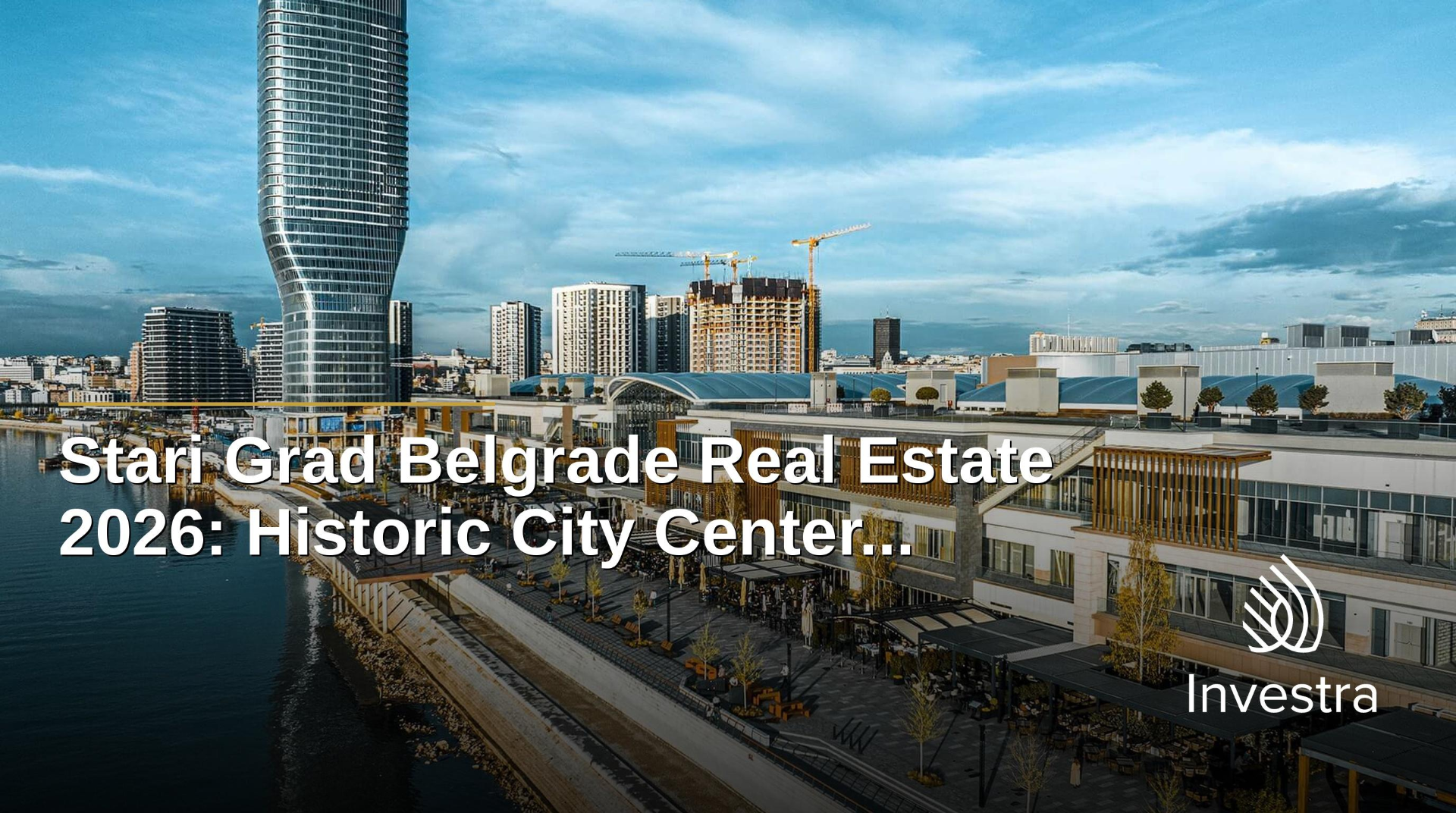
Stari Grad Belgrade Real Estate 2026: Historic City Center...
Stari Grad Belgrade Real Estate 2026: Historic City Center Property Investment
Introduction to Stari Grad’s Property Market
Stari Grad sits at the heart of Belgrade, where Roman ruins, Ottoman traces, and Austro-Hungarian facades share the same streets. Foreign buyers and local professionals alike keep returning to this compact district because it delivers both lifestyle appeal and measurable investment numbers. On Investra.io you can already see active listings for restored apartments within a five-minute walk of Republic Square, many priced below what comparable space costs in newer waterfront developments.
Market Overview for 2026
Transaction volume in Stari Grad rose 11% year-on-year through the first three quarters of 2026. Much of that activity traces back to buyers who first studied the Belgrade Real Estate Market 2026 report and then narrowed their search to the old town. Local banks report that roughly 38% of purchases in the district now involve cash from abroad, a shift that has tightened supply in the sub-80 m² segment.
Key Drivers Behind Current Demand
Tourism recovered to pre-2020 levels and then kept climbing. Skadarlija’s bohemian restaurants and the pedestrian stretch of Knez Mihailova Street together draw more than 2.4 million visitors annually. This footfall translates directly into short-term rental performance. Properties listed on major platforms inside Stari Grad achieve occupancy rates above 72% on average, supporting the 5.4-6.8% gross yields mentioned earlier.
Property Prices and Price Trends
At the start of 2026, the median asking price for residential units in Stari Grad stood at 5,650 EUR/m². The range stretches from 4,200 EUR/m² for apartments needing full renovation to 8,900 EUR/m² for turnkey heritage units with elevator access. Over the past 18 months, prices have climbed 9.4% overall, though the pace slowed in the third quarter as more stock reached the market.
Price Differences by Building Type
Interwar buildings with preserved stucco and original parquet command a consistent 15-18% premium over 1970s concrete structures. A 92 m² two-bedroom apartment on Kralja Petra Street, fully refurbished in 2024, sold in May 2026 for 7,150 EUR/m². In contrast, a similar-sized unit in a 1978 block on Gospodar Jevremova Street closed at 5,100 EUR/m² after minimal cosmetic updates.
Rental Yields and Cash-Flow Expectations
Long-term leases to local professionals produce 4.8-5.3% net yields after costs. Short-term tourist lets push gross yields to 6.8% in peak summer months. Investors tracking the Serbia Property Taxes 2026 guide factor in the 0.4% annual property tax and 15% income tax on rental profit, leaving realistic net returns between 4.1% and 5.6%.
Best Neighborhoods Inside Stari Grad
Three micro-locations consistently outperform the rest of the district on both price growth and occupancy.
Knez Mihailova Corridor
The street itself and the side alleys within 200 meters form the core retail and tourist spine. Apartments here rarely sit empty. A one-bedroom unit above a café on Knez Mihailova can fetch 85-95 EUR per night on short-term platforms during the summer season.
Skadarlija and the Bohemian Quarter
Skadarlija’s cobblestone lanes attract both overnight visitors and locals dining out. Properties in this pocket trade at a 10% premium to the district average, yet they also record the highest occupancy rates—often above 78%. The combination of heritage charm and walkable nightlife keeps demand elevated.
Dorćol Edge and the Danube Side
The northern fringe of Stari Grad, closer to the river, mixes older residential buildings with newer infill projects. Prices here start around 4,900 EUR/m² and climb quickly once you move south toward the pedestrian zone. This area appeals to buyers who want slightly lower entry prices while still remaining inside the historic municipality.
Investment Potential and Forward Outlook
Stari Grad’s supply is finite. Strict heritage rules limit new construction, which supports price resilience even when national interest rates rise. Buyers who follow the Buying Property in Serbia as a Foreigner process can complete purchases in 45-60 days once financing is arranged. Those timelines, paired with the district’s 9-11% average annual price growth over the last five years, continue to draw attention from European and Middle Eastern capital.
Investra.io lists dozens of verified Stari Grad opportunities updated weekly, including off-market heritage apartments that rarely appear on public portals. The platform also flags upcoming regulatory changes that could affect rental licensing, giving investors time to adjust strategies before 2027.
Looking ahead, the combination of limited inventory, strong tourist numbers, and improving infrastructure around the old town suggests Stari Grad will keep delivering both capital appreciation and usable income through the end of the decade. Investors who secure well-located units now position themselves for the next cycle of demand.
Real Estate Investment Insights by Siniša Dagary
Rental Yields & ROI
Investors focusing on Stari Grad still see strong rental demand thanks to the central spot along Knez Mihailova Street and the busy cultural life in Skadarlija. Average gross yields for prime luxury apartments fall between 5.2% and 6.8% a year, and restored heritage buildings often hit the upper end of that range. Short-term rentals on popular tourist platforms bring in solid returns in high season, while long-term leases to companies offer steady income year-round.
Factors Influencing Returns
Property size, condition, and proximity to pedestrian zones directly affect performance. One-bedroom apartments under 60 square meters typically generate the strongest per-square-meter yields, especially when located within walking distance of major business and cultural hubs. Heritage status can limit certain upgrades, yet it also commands premium nightly rates from visitors seeking authentic Belgrade experiences. Current market data shows that professionally managed units in restored buildings achieve occupancy rates above 75% on an annual basis, translating into attractive net returns after management fees and maintenance costs.
Five-Year ROI Projections
Capital appreciation in Stari Grad has averaged 7–9% per year over the past five years, supported by limited supply of historic stock and growing foreign interest. Combining rental income with projected value growth, total five-year ROI for a €350,000 luxury apartment is estimated at 48–62%, assuming moderate market conditions through 2026. Investors who focus on energy-efficient retrofits within heritage constraints can further enhance both yields and resale value.
Buying Process
The acquisition of property in Stari Grad follows a structured sequence that begins with identifying suitable listings through licensed agencies specializing in historic districts. Once a target apartment is selected, a preliminary reservation agreement secures the unit while due diligence is completed. This phase includes title verification, checking for any encumbrances, and confirming compliance with heritage protection regulations that apply to many buildings near Knez Mihailova Street and Skadarlija.
Key Steps for Foreign Buyers
Foreign investors must obtain a tax identification number and open a local bank account before signing the final purchase contract. The notary public oversees the transaction, ensuring all parties meet legal requirements. After signing, the buyer pays the purchase price into an escrow account, and the property is registered at the Real Estate Cadastre within 30 days. Completion typically occurs within 45–60 days from reservation, provided no heritage-related restrictions delay the process.
Legal Considerations
Serbian law permits foreign nationals to own apartments outright, including those located in protected historic zones such as Stari Grad. However, additional approvals from the Institute for the Protection of Cultural Monuments may be required for any structural changes or renovations in heritage buildings. Buyers should verify that the seller has clear title and that no outstanding claims exist from previous owners or tenants.
Tax and Ownership Rules
Property transfer tax stands at 0.5% for first-time buyers meeting certain residency criteria, while standard rates reach 3%. Annual property tax remains modest at approximately 0.4% of assessed value. Foreign owners enjoy the same rights as Serbian citizens regarding rental income and resale, though they must declare worldwide income if their country of residence has a double-taxation treaty with Serbia. Legal due diligence should also confirm that the apartment is not subject to restitution claims common in older parts of the city center.
Practical Tips
Hire a local real estate lawyer who knows heritage properties to deal with any limits on changing the front or the inside. Get a detailed check on the plumbing, wiring, and roof, since many of these buildings go back to the late 1800s or early 1900s. Work with a management firm familiar with Stari Grad’s short-term rental rules to keep occupancy high and manage guests smoothly.
Additional Recommendations
Budget for higher maintenance costs associated with historic structures, including periodic inspections required by preservation authorities. Network with established investors through local chambers of commerce to gain insights into neighborhood micro-trends around Skadarlija and Kalemegdan. Finally, consider timing acquisitions toward the end of the calendar year when some owners seek liquidity, potentially opening negotiation opportunities on premium units.
Recommended Content
- Serbia Real Estate Market 2026: Complete Guide
- Buying Property in Serbia as a Foreigner 2026
- Belgrade Real Estate Market 2026
- Real Estate Investment Insights by Siniša Dagary
- Finds Group - Real Estate Investment Advisory
Odkrijte globalne investicijske priložnosti na Unifyr.space — vaš portal za pametne investicije.
📚 Recommended Content
Frequently Asked Questions
What are typical rental yields for luxury apartments in Stari Grad?
Gross yields generally range from 5.2% to 6.8% annually, with heritage-restored units often achieving the upper end due to strong tourist demand.
Can foreigners buy property in historic Belgrade districts?
Yes, foreign nationals may own apartments in Stari Grad, though heritage buildings may require additional approvals for renovations from cultural protection authorities.
How long does the purchase process take in Serbia?
From reservation to final registration, the process typically completes within 45 to 60 days when all legal checks are clear.
Are there restrictions on renovating heritage apartments?
Yes, any structural or façade changes in protected buildings near Knez Mihailova or Skadarlija require prior approval from the Institute for the Protection of Cultural Monuments.
What taxes apply to property purchases for foreigners?
Transfer tax is 0.5% for qualifying first-time buyers and up to 3% otherwise, with modest annual property tax around 0.4% of assessed value.
Is short-term rental allowed in Stari Grad?
Short-term rentals are permitted but must comply with local zoning rules and registration requirements, especially in historic zones.
What is the average price per square meter in central Stari Grad?
Luxury apartments in prime locations currently range from €3,200 to €5,500 per square meter depending on condition and heritage features.
Do I need a local bank account to buy property?
Yes, foreign buyers must obtain a Serbian tax number and open a local account to complete the transaction through escrow.
How stable is capital appreciation in the Old Town?
Historic stock has appreciated 7–9% annually in recent years due to limited supply and sustained international interest.
Should I hire a property manager for rental units?
Professional management is strongly recommended to handle occupancy, guest services, and compliance with short-term rental regulations.
Related Posts
No related posts available.
