
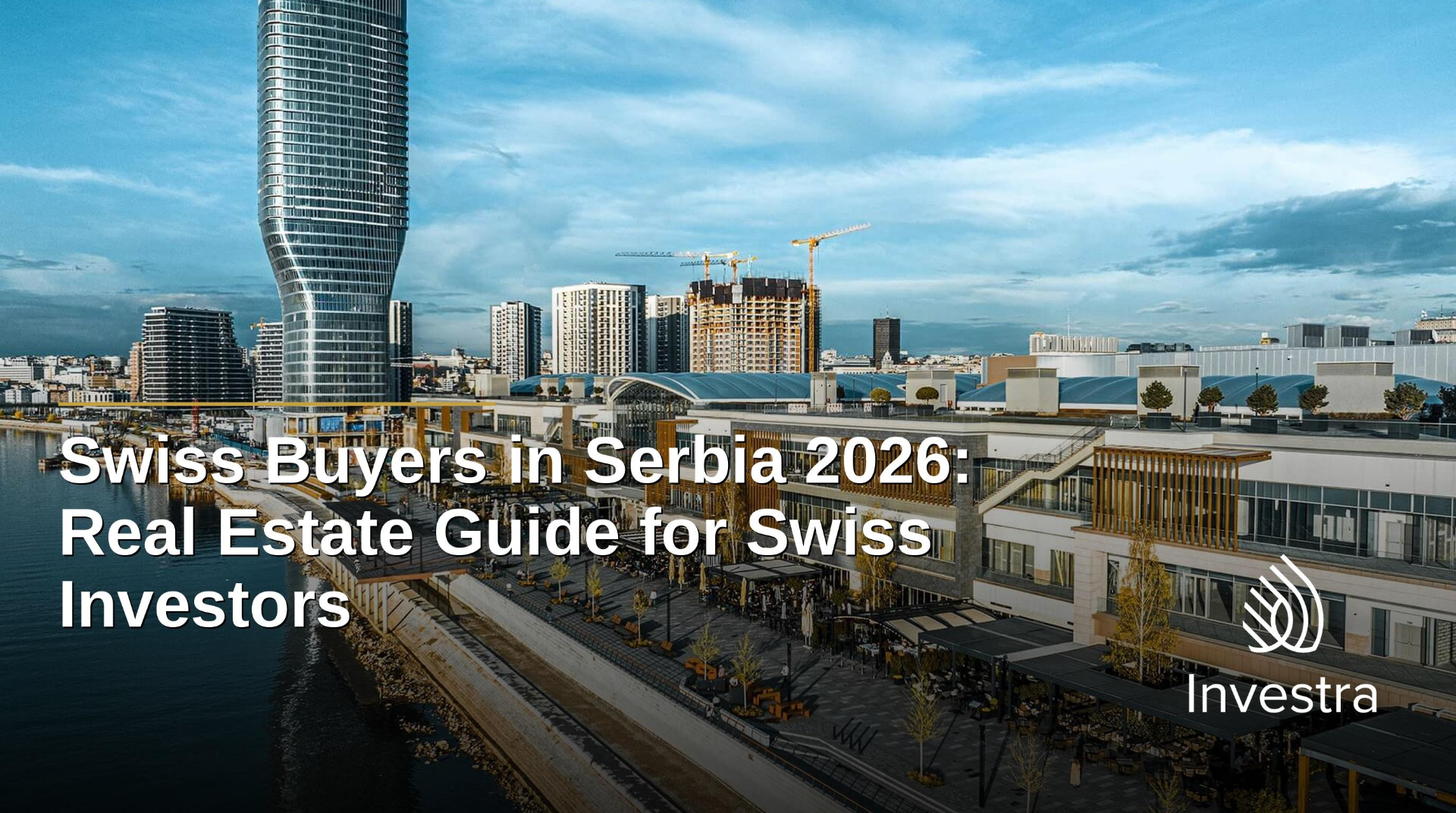
Swiss Buyers in Serbia 2026: Real Estate Guide for Swiss Investors
Swiss Buyers in Serbia 2026: Real Estate Guide for Swiss Investors
Why Swiss Investors Choose Serbia
Switzerland's high property prices and low yields have pushed many residents to look abroad for better returns without sacrificing stability. Serbia offers direct flights from Zurich and Geneva in under two hours, a stable currency pegged to the euro in practice, and full ownership rights for foreign buyers. Swiss nationals face no special restrictions on residential or commercial assets, unlike in some neighboring countries.
The cost difference stands out immediately. A comparable three-bedroom apartment in Zurich might exceed 1.2 million euros, while the same standard in central Belgrade runs between 450,000 and 650,000 euros. Currency strength gives Swiss buyers an edge in negotiations, often securing 5 to 8 percent discounts on cash deals.
Proximity and Lifestyle Factors
Many Swiss families already spend summers along the Danube or in the Fruška Gora hills. The Swiss expat community in Belgrade has grown to roughly 1,800 registered residents as of late 2025, supported by a Swiss Club that organizes monthly events and a weekend school. This network helps newcomers handle paperwork and find reliable contractors.
Serbia Real Estate Market Overview 2026
Transaction volumes rose 14 percent year-on-year through the first three quarters of 2025, driven by demand from EU and Swiss buyers. Average prices across Serbia reached 1,950 EUR per square meter, yet luxury segments in the largest cities trade at two to three times that level. New supply remains limited because construction permits take 18 to 24 months on average.
Rental demand stays firm. Belgrade occupancy rates for well-located apartments sit at 92 percent, with monthly rents for 90-square-meter units ranging from 1,100 to 1,600 euros. Net yields after management fees and local taxes average 6.2 percent, compared with 2.8 percent in Geneva or 3.1 percent in Zurich.
Serbia Real Estate Market 2026 tracks these figures monthly and includes data on secondary cities such as Novi Sad, where prices have climbed 11 percent in the past year.
Price Benchmarks by Segment
Luxury waterfront apartments in Belgrade's Savamala district now list between 4,100 and 5,200 EUR per square meter. In Novi Sad's city center the same category trades at 2,650 to 3,400 EUR per square meter. Villas with gardens in the Dedinje neighborhood start at 1.8 million euros and reach 3.5 million euros for properties above 400 square meters.
Best Areas for Swiss Buyers
Belgrade's Dedinje and Senjak districts attract Swiss families for their quiet streets, international schools, and green space. Properties here rarely appear on open portals, so direct owner contact through Investra.io often yields better results. Average transaction prices in these zones reached 4,800 EUR per square meter in 2025.
Belgrade Waterfront and Dorćol
The regenerated waterfront offers modern buildings with hotel-style services. Two-bedroom units of 85 square meters sell for 380,000 to 520,000 euros and produce gross rents of 2,200 euros monthly during peak seasons. Swiss owners report total annual returns of 11.4 percent when combining rental income and 5 percent price growth.
Belgrade Real Estate Market 2026 breaks down vacancy rates and comparable sales for these micro-locations.
Novi Sad and Fruška Gora
Buyers seeking weekend homes favor the hills outside Novi Sad. Stone villas with pools on one-hectare plots list from 650,000 euros upward. Rental yields reach 7.1 percent when marketed to Austrian and German tourists during summer festivals.
Investment Potential and Projected Returns
Over the past five years, prime Belgrade property appreciated 47 percent in euro terms. Forecasts for 2026 to 2030 point to continued 4 to 6 percent annual growth, supported by infrastructure projects such as the new airport terminal and metro line extensions. Total expected returns for Swiss investors, including 6 percent net yield plus appreciation, sit between 10 and 12 percent per year.
Exit liquidity has improved. Average days on market for luxury units dropped from 68 in 2023 to 41 in 2025. Swiss owners who bought in 2021 and sold in 2025 realized internal rates of return above 14 percent after all costs.
Investra.io allows users to filter listings by price per square meter, yield estimates, and distance to international schools, making it simpler to compare opportunities across Belgrade, Novi Sad, and smaller resort areas.
Tax Implications for Swiss Nationals
Serbia taxes rental income at a flat 15 percent after allowable deductions. Capital gains fall to 10 percent if the asset is held longer than five years. Switzerland and Serbia maintain a double-taxation treaty, so Swiss residents can credit Serbian tax paid against their Swiss liability. Property tax remains low at 0.4 percent of assessed value annually.
Buying Property in Serbia as a Foreigner outlines the exact sequence of notarized contracts, tax registration, and title transfer that Swiss buyers follow.
Legal Process in Brief
Foreign buyers sign a preliminary contract, pay a 10 percent deposit, and complete the sale at a notary within 60 days. The entire transfer registers with the cadastre in four to six weeks. No government approval is required for residential purchases under 5,000 square meters. Lawyers typically charge 1.2 percent of the purchase price for full due diligence and representation.
Many Swiss buyers use Investra.io to connect with bilingual legal teams that have handled over 200 transactions for Swiss clients since 2022.
Real Estate Investment Insights by Siniša Dagary provide additional case studies on cross-border financing structures that Swiss banks accept for Serbian assets.
Legal Process for Acquiring Property
Swiss nationals benefit from Serbia’s investor-friendly legislation that treats EU and EFTA citizens similarly to domestic buyers in most respects. The process begins with obtaining a personal identification number (PIB) from the Serbian Tax Authority, which can be completed remotely through a local representative. Once secured, the investor engages a licensed real estate attorney to conduct title searches at the Real Estate Cadastre. This step verifies ownership history, encumbrances, and zoning compliance, typically taking seven to ten business days.
Notarization and Purchase Agreement
All property transfers require notarization. The preliminary purchase agreement outlines payment schedules, contingencies, and penalty clauses. Swiss buyers often insert currency fluctuation protections given the CHF-RSD exchange rate. The notary verifies the seller’s capacity and ensures the contract complies with the Law on Obligations. After signing, a 10-15 percent deposit is held in escrow at a reputable Serbian bank.
Final Transfer and Registration
Upon payment of the full purchase price, the parties execute the final sales contract before the same notary. The deed is then submitted to the Cadastre for registration, which grants legal title. Processing times average 20-30 days, though expedited services are available for an additional fee. Swiss investors should also register the acquisition with the Swiss Embassy in Belgrade for consular protection records.
Tax Implications and Double Taxation Relief
Serbia and Switzerland maintain a double taxation treaty that prevents investors from being taxed twice on the same income. Property tax in Serbia is levied annually at rates between 0.4 and 2 percent of the cadastral value, significantly lower than Swiss cantonal rates. Capital gains realized after three years of ownership are taxed at 15 percent, with an exemption available if proceeds are reinvested in Serbian real estate within 12 months.
VAT and Transfer Taxes
New-build properties incur 10 percent VAT, while secondary market transactions are subject to a 3 percent transfer tax paid by the buyer. Swiss residents can credit Serbian taxes against their Swiss tax liability under the treaty. It is advisable to structure ownership through a Serbian limited liability company for larger portfolios to optimize corporate tax treatment at 15 percent on profits.
Reporting Obligations
Swiss investors must declare foreign real estate holdings to the Swiss Federal Tax Administration via Form 400. Serbia requires annual submission of tax returns even for non-residents, with penalties for late filing reaching 20 percent of the assessed amount. Consulting a cross-border tax advisor familiar with both jurisdictions is strongly recommended.
Practical Tips for Swiss Buyers
High purchasing power allows Swiss investors to target premium segments, yet local market knowledge remains essential. Engaging bilingual property managers who understand Swiss expectations regarding maintenance and tenant screening reduces operational friction. Currency conversion through Swissquote or local banks offering CHF accounts minimizes fees. Internet banking platforms such as Banca Intesa Serbia provide seamless transfers from Swiss accounts.
Navigating the Expat Community
Belgrade hosts an active Swiss-Serbian Chamber of Commerce that organizes quarterly networking events. These gatherings offer insights into regulatory updates and introduce reliable service providers. Many Swiss families choose the Dedinje and Senjak districts for their proximity to international schools and green spaces.
Step-by-Step Investment Guide
- Define investment objectives and budget, factoring in 8-12 percent ancillary costs.
- Obtain a Serbian PIB and open a local bank account.
- Shortlist properties with the assistance of a licensed agent and conduct virtual viewings.
- Commission an independent technical inspection and legal due diligence.
- Negotiate and sign the preliminary contract with escrow arrangements.
- Complete payment and execute the final notarized deed.
- Register title at the Cadastre and pay all transfer taxes.
- Arrange property insurance and appoint a local manager.
- Register the asset with Swiss tax authorities and file initial Serbian tax returns.
- Monitor performance and plan exit strategy under the double taxation treaty.
Recommended Content
- Serbia Real Estate Market 2026: Complete Guide
- Buying Property in Serbia as a Foreigner 2026
- Belgrade Real Estate Market 2026
- Real Estate Investment Insights by Siniša Dagary
- Finds Group - Real Estate Investment Advisory
Odkrijte globalne investicijske priložnosti na Unifyr.space — vaš portal za pametne investicije.
📚 Recommended Content
Frequently Asked Questions
Can Swiss citizens freely purchase residential property in Serbia?
Yes, Swiss nationals face no significant restrictions and enjoy the same rights as most foreign buyers under Serbian law.
How long does the entire purchase process typically take for Swiss investors?
From initial due diligence to final title registration, the process usually requires six to ten weeks when all parties act promptly.
What taxes apply to Swiss buyers acquiring property in Serbia?
Buyers pay a 3 percent transfer tax on secondary market properties and 10 percent VAT on new builds, plus annual property tax between 0.4 and 2 percent.
Does the Switzerland-Serbia double taxation treaty cover real estate investments?
The treaty prevents double taxation on income and capital gains arising from Serbian property for Swiss residents.
Are there any residency benefits linked to property purchase for Swiss nationals?
Property ownership alone does not grant residency, but it can support an application for temporary residence through investment or business setup.
Which Belgrade neighborhoods are most popular among Swiss expats?
Dedinje, Senjak, and Vračar attract Swiss buyers seeking luxury homes, international schools, and established expat communities.
What currency considerations should Swiss investors keep in mind?
While transactions occur in euros or dinars, many Swiss buyers maintain CHF accounts and use forward contracts to hedge exchange rate risk.
Is it advisable to set up a Serbian company for property ownership?
For portfolios exceeding two or three units, a Serbian LLC often provides tax optimization and simplified management.
How can Swiss buyers verify property titles effectively?
A licensed attorney conducts a full Cadastre search and obtains an extract confirming ownership and any registered liens.
What ongoing costs should Swiss owners budget for in Serbia?
Annual property tax, building maintenance fees, insurance, and occasional management fees typically total 1-2 percent of property value.
Related Posts
No related posts available.
