
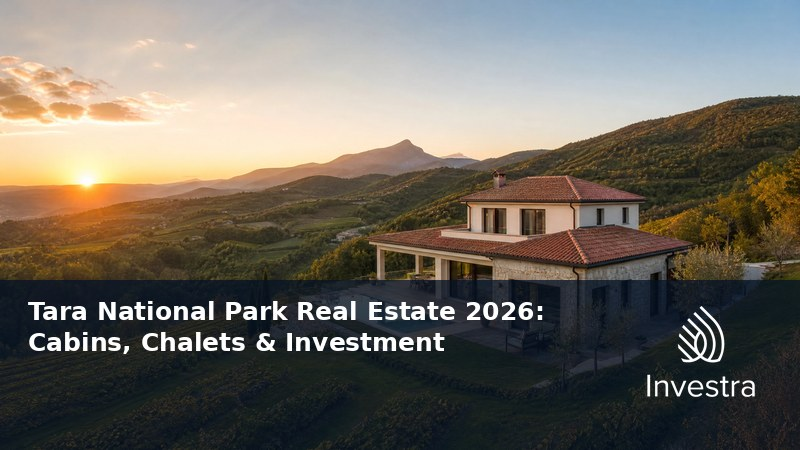
Tara National Park Real Estate 2026: Cabins, Chalets & Investment
Tara National Park: Serbia's Mountain Investment Frontier
Quick Answer: To buy property in Serbia: (1) Find a property through a licensed agent, (2) Conduct due diligence and title check, (3) Sign a preliminary contract with 10% deposit, (4) Complete notarized purchase contract, (5) Register at the land registry. The process typically takes 4–8 weeks.
Tara National Park stands as one of the Balkans' most compelling natural treasures — a vast expanse of ancient forests, dramatic canyon landscapes, and pristine mountain air that draws visitors from across Europe and beyond. Located in western Serbia along the Drina River canyon border with Bosnia and Herzegovina, Tara encompasses approximately 19,175 hectares of protected wilderness, yet the surrounding municipalities of Bajina Bašta, Kaludjerske Bare, and Zaovine offer legitimate, growing real estate markets where both domestic and international buyers are acquiring cabins, chalets, and holiday properties at prices that remain substantially below comparable Alpine or Adriatic destinations.
The Tara Serbia real estate market is undergoing a quiet transformation. What was once a domestic weekend-retreat market dominated by Serbian city dwellers from Belgrade and Novi Sad has increasingly attracted attention from Slovenian, Austrian, Croatian, and even British buyers seeking affordable mountain escapes with genuine investment potential. Property prices in the Tara region have risen by an estimated 15–25% since 2021, yet they remain remarkably accessible compared to mature European mountain markets. In 2026, the question is no longer whether Tara represents an opportunity — it is how to approach that opportunity intelligently.
Explore investment opportunities on Investra.io — the leading platform for international property investment in Serbia. For business strategy insights, visit sinisadagary.com. Discover business opportunities through Findes.si.
Understanding the Tara Region: Geography, Infrastructure & Accessibility
Quick Answer: This section covers key aspects of real estate in Serbia. For personalized guidance on property investment, consult with a licensed local agent and legal advisor. Investra.io connects you with verified professionals across all major Serbian cities.
Tara National Park sits within the municipality of Bajina Bašta in the Zlatibor District of western Serbia. The park is divided into distinct zones — the Zaovine Lake area, the Mitrovac resort settlement, the Kaludjerske Bare plateau, and the Perućac Lake shoreline — each offering different real estate typologies and investment profiles. Understanding these micro-locations is essential for any buyer assessing the market.
Accessibility has improved meaningfully in recent years. The drive from Belgrade to Bajina Bašta takes approximately 2.5 to 3 hours via the E-763 highway toward Požega, followed by a scenic regional road. The completion of the Moravian Corridor motorway sections has progressively reduced travel times, and ongoing infrastructure investment under Serbia's national road development plan is expected to shorten the Belgrade–Tara corridor further by 2027. Nikola Tesla Airport in Belgrade offers direct connections to over 40 European cities, making Tara genuinely accessible for weekend use by international property owners.
Local infrastructure within the park zone includes established resort settlements with electricity, water supply, and telecommunications. The Kaludjerske Bare plateau, situated at approximately 1,000 meters elevation, hosts the highest concentration of tourist accommodation and is the most developed sub-market. Zaovine, set around the stunningly scenic reservoir lake, represents a more secluded option with lower development density. Both areas have paved access roads and reliable utility connections, which is a non-trivial consideration in mountain real estate markets across the Western Balkans.
Current Property Prices: Cabins, Chalets & Land in 2026
Quick Answer: Property prices in this area vary by location and type. City center apartments typically range from €1,000 to €2,500/m², while suburban areas offer €700–€1,400/m². New developments command premium prices. Always verify current prices with a local agent.
The Tara Serbia real estate market in 2026 presents a spectrum of price points that reflect both property type and precise location. The following data synthesizes recent transaction records, local agency listings, and market intelligence gathered from active operators in the Bajina Bašta municipality.
Wooden Cabins and Bungalows (30–60 m²): The most numerous property type in the Tara market, these traditional-style log cabins typically trade between €25,000 and €65,000 depending on condition, proximity to ski or hiking infrastructure, and plot size. Older, unrenovated cabins at the lower end of this range frequently require €15,000–€25,000 in renovation investment to reach lettable condition.
Mid-Range Chalets (60–120 m²): Purpose-built wooden or mixed-construction chalets with modern interiors, functional kitchens, and multiple bedrooms command between €70,000 and €150,000. Properties in Kaludjerske Bare with direct mountain views and proximity to the Kaludjerske Bare hotel complex represent the premium end of this segment.
Larger Mountain Villas and Guest Houses (120–300 m²): Properties capable of operating as micro-hotels or licensed guest accommodation (pansion) range from €150,000 to €400,000+. These assets attract serious investors targeting the tourism rental yield market and have seen the most rapid price appreciation since 2020.
Undeveloped Land: Building plots within or adjacent to the national park buffer zone range from €5 to €30 per square meter depending on zone designation, utilities access, and proximity to resort centres. Agricultural land with potential rezoning upside is available at €1–€5 per square meter in more remote areas.
Can You Buy Property Near Tara National Park in Serbia?
Quick Answer: To buy property in Serbia: (1) Find a property through a licensed agent, (2) Conduct due diligence and title check, (3) Sign a preliminary contract with 10% deposit, (4) Complete notarized purchase contract, (5) Register at the land registry. The process typically takes 4–8 weeks.
Yes — international buyers can purchase real estate near Tara National Park in Serbia, subject to specific legal frameworks that govern both foreign ownership and development within nationally protected areas. This question sits at the core of every international buyer's due diligence process, and the answer is more nuanced than a simple yes or no.
Serbia operates a broadly open foreign ownership regime for real estate. Citizens of EU member states, as well as nationals of countries with reciprocal property ownership agreements with Serbia, can acquire real estate on the same terms as Serbian citizens. For nationals of countries without such agreements — the United States, Canada, and Australia, for example — ownership is typically structured through the incorporation of a Serbian company (d.o.o.), a straightforward process that costs approximately €500–€1,500 in legal and registration fees.
The critical complication at Tara relates to the National Park's zoning regulations. Properties within the core protection zones (Zone I and Zone II) face strict construction restrictions and are generally unavailable for new development. However, the majority of active real estate transactions occur in Zone III (transition zones) and outside the formal park boundary in the broader Bajina Bašta municipality — areas where standard construction permits apply and foreign ownership is unencumbered. Buyers must obtain a precise cadastral extract (izvod iz katastra) to confirm their target property's zoning classification before proceeding. Working with a locally experienced real estate lawyer is not optional in this market — it is fundamental.
For a full breakdown of Serbia's foreign ownership legal framework, consult the comprehensive Serbia Real Estate Guide on Investra, which covers legal requirements, tax obligations, and transaction processes in detail.
Investment Returns: Rental Yields and Tourism Revenue at Tara
Quick Answer: To buy property in Serbia: (1) Find a property through a licensed agent, (2) Conduct due diligence and title check, (3) Sign a preliminary contract with 10% deposit, (4) Complete notarized purchase contract, (5) Register at the land registry. The process typically takes 4–8 weeks.
The investment case for Tara real estate in 2026 is anchored in the mountain tourism sector's consistent growth trajectory. Serbia's national tourism statistics record approximately 1.2 million overnight stays in the Zlatibor District annually, with the Tara and Bajina Bašta area accounting for a meaningful and growing share. Domestic tourism has been the primary driver — Serbian urban households from Belgrade (population 1.7 million), Novi Sad, and Kragujevac represent a deep, reliable demand pool for weekend and holiday accommodation.
International visitor numbers at Tara have grown at approximately 8–12% annually since 2019, driven by regional visitors from Slovenia, Croatia, Bosnia, and Montenegro, as well as diaspora travelers returning from Western Europe. The Serbian National Tourism Organization's promotional campaigns targeting the mountain segment have amplified this trend.
For a well-positioned, well-managed rental cabin or chalet, realistic gross rental yields range from 6% to 10% annually on acquisition cost. Peak season (July–August summer, December–January winter) achieves nightly rates of €60–€120 for a two-bedroom cabin and €100–€200 for a larger chalet. Occupancy rates for actively marketed properties on platforms including Booking.com and Airbnb average 55–70% across the year, with clear seasonality peaks. Operational costs including platform fees (15–20%), utilities, and maintenance typically consume 30–40% of gross revenue, yielding net returns in the 4–7% range — figures that compare favorably against mature European mountain markets where acquisition costs are 3–5× higher.
Kaludjerske Bare: The Prime Investment Sub-Market
Quick Answer: Property prices in this area vary by location and type. City center apartments typically range from €1,000 to €2,500/m², while suburban areas offer €700–€1,400/m². New developments command premium prices. Always verify current prices with a local agent.
Among all micro-locations within the Tara real estate ecosystem, Kaludjerske Bare consistently demonstrates the strongest combination of price growth, rental demand, and liquidity. Situated on a high plateau at the heart of Tara National Park's buffer zone, this settlement has developed around the historic Kaludjerske Bare hotel — a Yugoslav-era property that retains strong brand recognition among Serbian tourists — and a cluster of private chalets, small hotels, and tourist apartments that have expanded substantially over the past decade.
Properties at Kaludjerske Bare benefit from proximity to both summer hiking trail networks and the Tara ski center, a modest but functional facility that extends winter appeal. The ski infrastructure, while not comparable to major Alpine resorts, reliably generates December through February demand that fundamentally changes the annual return profile for rental properties versus summer-only destinations.
Current pricing at Kaludjerske Bare for move-in-ready chalets ranges from €90,000 to €180,000 for two-to-three bedroom properties, representing a 20–30% premium over equivalent properties in less central Tara locations. This premium is justified by measurable rental income data from existing operators. Price appreciation at Kaludjerske Bare has averaged approximately 8–12% per annum since 2020, and local agents report significantly reduced days-on-market compared to five years ago — a reliable indicator of improving market liquidity.
Zaovine Lake Area: Seclusion, Scenery & Emerging Demand
Quick Answer: Each neighborhood offers distinct advantages. City centers provide walkability and high rental demand. Suburban areas offer larger spaces at lower prices. New developments in emerging districts often provide the best capital appreciation potential.
Zaovine Lake, an artificial reservoir created by the damming of the Zaovine River in 1989, has emerged as one of western Serbia's most photographed landscapes. The turquoise-green waters set against forested canyon walls create a visual drama that resonates powerfully on social media, a factor that has demonstrably driven tourism awareness and property interest among younger buyer demographics.
Real estate around Zaovine remains notably more affordable than Kaludjerske Bare, with comparable cabin properties trading at a 20–35% discount, reflecting lower infrastructure density and longer drive times from Bajina Bašta town. However, precisely this relative remoteness has become a selling point for a specific buyer segment — those seeking genuine seclusion, off-grid or semi-off-grid properties, and a more authentic wilderness experience than the more developed plateau areas provide.
Several smaller parcels of land with lake frontage or lake views traded in 2024–2025 at prices between €20,000 and €60,000, representing what market observers consider compelling value for properties with this level of scenic amenity. Development in this zone must navigate stricter environmental controls given the lake's role in the Drina River system, but purpose-built eco-cabins and low-impact timber structures are receiving planning approvals where environmental impact assessments are properly conducted. The long-term trajectory for Zaovine points toward significant appreciation as the area's visual appeal continues to drive organic awareness.
New Construction and Development Projects: What's Being Built in 2026
Quick Answer: Serbia's real estate market shows strong fundamentals: GDP growth of 3–4%, EU accession progress, and increasing foreign investment. Property values in major cities are expected to appreciate 5–8% annually through 2027, driven by infrastructure development and growing expat demand.
The Tara region is not static — a number of active development projects are reshaping the supply landscape in 2026 and will influence both property values and rental market dynamics through 2028 and beyond. Understanding the development pipeline is essential for buyers assessing entry timing.
Several private developers are actively constructing purpose-built chalet complexes in the Bajina Bašta municipality periphery, primarily targeting the tourist rental segment. These off-plan developments typically offer chalets of 50–90 m² on shared-infrastructure plots at prices between €80,000 and €140,000, often with managed rental programmes included as part of the purchase package. Such arrangements guarantee a rental management structure from day one, which simplifies the investment proposition for international buyers who cannot be present to manage operations personally.
The Serbian government's investment in road infrastructure, combined with ongoing discussions about expanding Tara's ski area and developing additional mountain sports facilities, is expected to catalyze further private development in the 2026–2028 window. A planned upgrade to the regional road connecting Bajina Bašta with the Mokra Gora railway tourism circuit — home to the famous Šargan Eight narrow-gauge railway — would create a combined tourism corridor with substantially increased visitor volumes.
Buyers entering the market through off-plan purchases should conduct thorough due diligence on developer credentials, planning permission status, and escrow arrangements. Working through established platforms and advisors significantly reduces execution risk. The Investra Blog regularly publishes analysis of Serbian development markets and off-plan investment considerations.
Legal Framework for Foreign Buyers: Step-by-Step Process
Quick Answer: To buy property in Serbia: (1) Find a property through a licensed agent, (2) Conduct due diligence and title check, (3) Sign a preliminary contract with 10% deposit, (4) Complete notarized purchase contract, (5) Register at the land registry. The process typically takes 4–8 weeks.
Purchasing real estate near Tara National Park as a foreign national requires adherence to a clearly defined legal process. While not inherently complicated, the process differs materially from Western European transaction norms and requires professional guidance to execute correctly.
Step 1 — Property Identification and Due Diligence: Prior to any commitment, obtain a current cadastral extract (list nepokretnosti) from the Republic Geodetic Authority (RGZ) confirming ownership title, encumbrances, and zoning classification. Verify the property's location relative to National Park protection zones.
Step 2 — Legal Representation: Engage a qualified Serbian real estate lawyer (advokat) independent of the seller or agency. Legal fees typically range from 0.5% to 1.5% of transaction value, representing essential transaction insurance.
Step 3 — Pre-Contract (Predugovor): A preliminary contract is typically signed with a deposit of 10% of the agreed purchase price. This creates binding obligations for both parties and should be drafted or reviewed by your lawyer.
Step 4 — Final Contract and Notarization: The final purchase contract (Ugovor o kupoprodaji) must be notarized by a Serbian notary (javni beležnik). Both parties or their authorized representatives must be present. Power of attorney arrangements are available for buyers who cannot attend in person.
Step 5 — Tax Payment: Property transfer tax (porez na prenos apsolutnih prava) is levied at 2.5% of the assessed transaction value and must be paid within 15 days of contract signing. This is the buyer's liability in Serbian law.
Step 6 — Cadastral Registration: The property is registered in the buyer's name at the Republic Geodetic Authority. This process typically takes 30–60 days and completes the transfer of legal ownership.
Comparing Tara to Other Serbian Mountain Destinations
Quick Answer: This section covers key aspects of real estate in Serbia. For personalized guidance on property investment, consult with a licensed local agent and legal advisor. Investra.io connects you with verified professionals across all major Serbian cities.
Tara does not operate in a vacuum — it competes and coexists with several other established Serbian mountain real estate markets, most notably Zlatibor, Kopaonik, and Divčibare. Understanding this competitive landscape helps buyers position their investment decisions and manage expectations appropriately.
Zlatibor is Serbia's most commercially developed mountain resort, approximately 40 kilometers south of Tara. Property prices at Zlatibor have escalated significantly — new apartments in resort complexes trade at €1,800–€2,500 per square meter, and resale market liquidity is higher. However, the intense development has resulted in an increasingly urbanized atmosphere that diverges from the wilderness experience that defines Tara's appeal.
Kopaonik, Serbia's premier ski mountain, commands the highest prices in the mountain segment — €2,000–€4,000 per square meter for ski-in/ski-out apartments — reflecting its superior ski infrastructure and strongest winter tourism brand. Kopaonik is a genuine alpine ski investment, while Tara offers a different, more nature-immersive proposition.
Divčibare near Valjevo is a smaller, predominantly domestic-market destination with lower prices and more limited tourism infrastructure. It lacks Tara's dramatic landscape advantage and international profile.
Tara's competitive position is defined by its spectacular scenery, relative affordability compared to Zlatibor and Kopaonik, and its authentic nature park identity. Buyers seeking early-stage appreciation potential rather than established market liquidity consistently rate Tara as the most compelling Serbian mountain investment for 2026. Comparative analysis of regional markets is available through the Croatia Real Estate Guide on Investra, which provides useful context for buyers comparing Balkan mountain destinations.
Short-Term Rental Market: Platforms, Performance & Management
Quick Answer: Property prices in this area vary by location and type. City center apartments typically range from €1,000 to €2,500/m², while suburban areas offer €700–€1,400/m². New developments command premium prices. Always verify current prices with a local agent.
The short-term rental market at Tara has matured considerably since 2019, driven by the broad adoption of Booking.com and Airbnb by Serbian property owners and the general normalization of platform-based accommodation booking among both domestic and international travelers. Understanding how this market operates is central to building a credible rental income projection for any Tara investment.
Booking.com dominates the Tara accommodation market, reflecting the platform's strength in the domestic Serbian market and its strong penetration among regional European travelers. Properties listed on Booking.com with high review scores (8.5+) typically achieve 60–75% occupancy across peak months. Airbnb has grown its Tara presence but remains secondary, making it best used as a complementary channel rather than a primary distribution strategy.
Nightly rate benchmarks for 2025–2026 peak periods: Basic two-bedroom cabin with heating and WiFi — €55–€80 per night; modern two-to-three bedroom chalet with fireplace and mountain view — €90–€150 per night; larger guest house suitable for families or groups (6–10 persons) — €150–€280 per night. Weekday rates outside peak periods typically run 30–40% below these figures.
Property management services are available in the Bajina Bašta area through local operators who handle check-in/check-out, cleaning, and maintenance for fees ranging from 15–25% of gross rental revenue. For international investors unable to manage operations remotely, these services are essential. Several new purpose-built chalet developments include centralized management structures that pool resources across multiple units, reducing per-unit management costs and improving booking visibility through consolidated marketing.
Practical Considerations: Currency, Banking & Taxes
Quick Answer: Key taxes when buying property in Serbia: 2.5% property transfer tax (resale), 10% VAT (new builds). Additional costs include notary fees (0.5–1%), legal fees, and registration. Budget 5–7% of purchase price for total transaction costs.
Serbia's currency is the Serbian Dinar (RSD), though real estate transactions are almost universally denominated in Euros in practice. Payments are formally made in Dinars at the current exchange rate, but agreed prices are stated and understood in Euros — a dual-currency convention deeply embedded in the Serbian property market.
Foreign buyers opening Serbian bank accounts will find the major banks — Raiffeisen, UniCredit, Erste, Intesa, and NLB — straightforward to work with and generally English-language capable at branch level in larger cities. A Serbian bank account is required to execute property transactions and to receive rental income domestically. Account opening requires a valid passport and proof of address; the process typically takes 1–3 business days.
Tax considerations for rental income are relevant and manageable. Rental income earned in Serbia by foreign nationals is subject to Serbian income tax at a flat rate of 20% on net income (after allowable deductions for operating costs, depreciation, and management fees). Serbia has double taxation treaties with over 50 countries including Germany, Austria, UK, France, and the Netherlands, preventing double taxation on the same income in most buyer origin countries. Property tax (porez na imovinu) is assessed locally and is minimal — typically €50–€200 per year for cabin-sized properties.
For broader strategic perspectives on property investment structures, the Business Strategy Blog by Siniša Dagary provides valuable context on structuring cross-border investments in the Western Balkans region.
Sustainable and Eco-Tourism Investment: The Growth Opportunity
Quick Answer: To buy property in Serbia: (1) Find a property through a licensed agent, (2) Conduct due diligence and title check, (3) Sign a preliminary contract with 10% deposit, (4) Complete notarized purchase contract, (5) Register at the land registry. The process typically takes 4–8 weeks.
Tara National Park's protected status is not merely a constraint — it is fundamentally a long-term value driver. The park's biodiversity credentials, which include hosting the last natural stands of Pančić's spruce (Picea omorika), a glacial relict species found nowhere else on earth, create a conservation narrative that resonates powerfully with the rapidly growing eco-tourism and sustainable travel segment.
Eco-lodge and sustainable cabin concepts are increasingly viable investment propositions at Tara. Properties that authentically integrate sustainable construction methods — timber-frame or log construction using local materials, passive solar design, rainwater harvesting, composting systems — command rental premiums of 20–40% over conventional equivalent properties when marketed to environmentally conscious traveler segments. The certification pathway for eco-tourism accommodation in Serbia, managed through the National Tourism Organization, provides a marketable credential that enhances booking visibility on specialist platforms.
Investment in this segment requires careful attention to construction method compliance with National Park environmental standards, but for buyers with genuine sustainable development convictions — or simply an eye for where premium travel markets are heading — the Tara eco-lodge concept represents a compelling long-term play. Initial investment for a purpose-built two-bedroom eco-cabin on a properly serviced plot runs approximately €80,000–€120,000 all-in, and rental income from well-marketed eco-properties has demonstrated both higher average rates and better off-season occupancy than conventional cabins.
Due Diligence Checklist for Tara Property Buyers
Quick Answer: To buy property in Serbia: (1) Find a property through a licensed agent, (2) Conduct due diligence and title check, (3) Sign a preliminary contract with 10% deposit, (4) Complete notarized purchase contract, (5) Register at the land registry. The process typically takes 4–8 weeks.
Executing a successful Tara real estate acquisition requires systematic due diligence that goes beyond standard property checks. The following checklist reflects the specific risk factors most commonly encountered in this market and the minimum verification steps that any professional advisor would recommend.
Title Verification: Confirm clean title through the RGZ cadastral database. Check for any outstanding mortgages (hipoteka), liens, or court judgments against the property. In older properties, confirm resolution of any pre-1990s socialist-era property restitution claims that may affect title clarity.
Zone Classification: Obtain official confirmation from the Bajina Bašta municipal urban planning department of the property's zone designation within the National Park regulatory framework. Zone I and Zone II restrictions can severely limit development and renovation rights.
Building Permits: Verify that all existing structures have valid building permits (građevinska dozvola) and use permits (upotrebna dozvola). Illegal construction is not uncommon in the Serbian mountain market and creates significant legal and financial exposure.
Utility Connections: Confirm physical connection to the electricity grid, water supply, and sewage or septic system. Request utility bills for the previous 12 months to verify active connections and identify any outstanding arrears.
Access Rights: Verify legal access to the property via public or private road. In rural mountain areas, landlocked properties or properties dependent on informal access arrangements over neighboring land represent a real risk category.
Environmental Restrictions: Check for any additional environmental protection designations — Natura 2000 equivalents, watershed protection zones, or forestry reserve classifications — that may restrict development or renovation beyond standard National Park zoning rules.
Buyers are strongly encouraged to engage with the Investra Platform to access vetted property listings, legal partner networks, and market intelligence tools that significantly reduce the due diligence burden for international buyers approaching the Serbian mountain market for the first time.
Investment Disclaimer
Quick Answer: To buy property in Serbia: (1) Find a property through a licensed agent, (2) Conduct due diligence and title check, (3) Sign a preliminary contract with 10% deposit, (4) Complete notarized purchase contract, (5) Register at the land registry. The process typically takes 4–8 weeks.
The information provided in this article is for educational and informational purposes only and should not be construed as financial, legal, or investment advice. Real estate investments carry inherent risks, and past performance does not guarantee future results. Investors should not invest money they cannot afford to lose. Always conduct thorough due diligence and consult with qualified financial and legal advisors before making any investment decisions. Investra.io does not guarantee returns on any investment.
Frequently Asked Questions
Quick Answer: This section covers key aspects of real estate in Serbia. For personalized guidance on property investment, consult with a licensed local agent and legal advisor. Investra.io connects you with verified professionals across all major Serbian cities.
Can foreigners buy property near Tara National Park in Serbia?
Yes, foreigners can buy property near Tara National Park in Serbia. Citizens of EU member states and countries with reciprocal property agreements can purchase on the same terms as Serbian nationals. Citizens of other countries — including the US, Canada, and Australia — typically acquire property through a Serbian-registered limited liability company (d.o.o.), which is a straightforward process costing €500–€1,500 in setup fees. The key consideration is ensuring the target property lies outside the strict protection zones of the National Park itself, which restrict development and resale liquidity.
What are average property prices near Tara National Park in 2026?
Property prices near Tara National Park in 2026 range widely by type and location. Small wooden cabins (30–60 m²) trade between €25,000 and €65,000. Mid-range chalets (60–120 m²) command €70,000–€150,000. Larger guest houses and properties suitable for commercial accommodation range from €150,000 to €400,000+. Building plots range from €5–€30 per square meter depending on zone and utility access. Prices at Kaludjerske Bare carry a 20–30% premium over equivalent properties in less central locations.
What rental yields can investors expect from Tara mountain properties?
Well-positioned, actively managed rental properties at Tara generate gross rental yields of 6–10% annually on acquisition cost. Net yields after operational costs (platform fees, utilities, maintenance, management) typically range from 4–7%. Peak season nightly rates range from €60–€120 for two-bedroom cabins and €100–€200 for larger chalets. Annual occupancy for well-marketed properties averages 55–70%, with clear peaks in July–August and December–January.
What are the restrictions on building or renovating near Tara National Park?
Tara National Park is divided into three protection zones. Zone I (strict protection) prohibits all construction and is generally unavailable for private acquisition. Zone II (guided protection) severely restricts construction. Zone III (transition zone) and areas outside the formal park boundary follow standard Serbian construction permit regulations. Buyers must obtain official zone classification from the Bajina Bašta municipal urban planning department before purchasing. All structures must have valid building and use permits — illegal construction is a significant risk category in this market.
How do I legally complete a property purchase in Serbia as a foreigner?
The Serbian property purchase process involves six key steps: (1) obtaining a cadastral extract to verify title and zoning; (2) engaging an independent Serbian real estate lawyer; (3) signing a preliminary contract with a 10% deposit; (4) executing and notarizing the final purchase contract; (5) paying property transfer tax at 2.5% within 15 days; and (6) registering ownership at the Republic Geodetic Authority. The entire process typically takes 45–90 days from agreement to registered ownership.
What taxes apply to property ownership and rental income in Serbia?
Property transfer tax is 2.5% of the assessed transaction value, paid by the buyer at the time of purchase. Annual property tax (porez na imovinu) is minimal — typically €50–€200 per year for standard cabin-sized properties. Rental income earned in Serbia is subject to income tax at 20% on net income after allowable deductions. Serbia has double taxation treaties with over 50 countries, preventing double taxation on the same rental income in most buyer home countries.
Which areas near Tara offer the best investment value in 2026?
Kaludjerske Bare is generally considered the prime investment sub-market — it offers the highest rental demand, best infrastructure, and strongest price appreciation history, with 8–12% annual price growth since 2020. Zaovine Lake area offers the most attractive scenery and compelling entry prices at a 20–35% discount to Kaludjerske Bare, making it attractive for buyers prioritizing long-term appreciation over immediate rental yield. The broader Bajina Bašta municipality periphery offers the widest selection of new construction and off-plan opportunities.
Is the Tara region accessible for international property owners?
Tara is reasonably accessible for international property owners. The drive from Belgrade's Nikola Tesla Airport takes 2.5–3 hours. The airport offers direct connections to over 40 European cities. Ongoing motorway development — including the Moravian Corridor — is progressively reducing Belgrade–Tara travel times, with further improvements expected by 2027. Local infrastructure at resort settlements including Kaludjerske Bare is well-developed, with electricity, water, and telecommunications reliably available.
Are there property management services available at Tara for absentee owners?
Yes, property management services are available in the Bajina Bašta area from local operators who handle bookings, guest communication, check-in/check-out, cleaning, and maintenance. Management fees typically range from 15–25% of gross rental revenue. Several new purpose-built chalet developments include centralized professional management structures. For international buyers who cannot manage properties remotely themselves, engaging a reputable local management company is essential to realizing the rental income potential of a Tara investment.
How does Tara compare to Zlatibor and Kopaonik as a real estate investment?
The three markets serve different investor profiles. Kopaonik offers the highest ski infrastructure quality and strongest winter season but commands the highest prices (€2,000–€4,000/m²) with limited early-stage appreciation potential. Zlatibor is Serbia's most commercially developed mountain resort with good liquidity but increasingly urbanized character and prices of €1,800–€2,500/m² for new resort apartments. Tara offers the most compelling combination of natural amenity, price accessibility (€800–€1,500/m² for quality chalets), and early-stage market growth potential — at the cost of lower market liquidity compared to the more established destinations.
What is the outlook for Tara real estate prices through 2028?
Market indicators suggest continued price appreciation at Tara through 2028, supported by road infrastructure investment reducing Belgrade travel times, growing international awareness of the region, expanding short-term rental demand, and a national tourism strategy that specifically targets mountain and nature tourism growth. Conservative projections from local market operators suggest 8–15% annual price appreciation in prime sub-markets over the 2026–2028 period, though buyers should treat these projections as indicative rather than guaranteed and conduct their own analysis.
Can I obtain a mortgage in Serbia to buy property at Tara as a foreigner?
Mortgage finance is available to foreign nationals in Serbia, but practical access varies by nationality and residency status. EU citizens with Serbian residency permits can access mortgage products from major Serbian banks (Raiffeisen, UniCredit, Erste) on terms broadly similar to Serbian nationals. Non-resident foreign nationals face more limited mortgage options and typically purchase with cash or through financing arranged in their home countries. Loan-to-value ratios for real estate in Serbia typically range from 60–75%, and interest rates for foreign borrowers are generally higher than for domestic borrowers. Most international buyers in the Tara market execute purchases in cash.
Recommended Resources
Quick Answer: This section covers key aspects of real estate in Serbia. For personalized guidance on property investment, consult with a licensed local agent and legal advisor. Investra.io connects you with verified professionals across all major Serbian cities.
- Serbia Real Estate Guide — Investra — Comprehensive legal, market, and investment information for buying property in Serbia.
- Croatia Real Estate Guide — Investra — Comparative Balkan market analysis useful for buyers considering regional investment diversification.
- Investra Blog — Property Investment Insights — Ongoing analysis of Serbian and regional property markets, investment strategies, and market developments.
- Business Strategy Blog — Siniša Dagary — Strategic perspectives on Western Balkans business and investment opportunities.
- Investra Platform — Find Your Property
Related Posts
No related posts available.
