
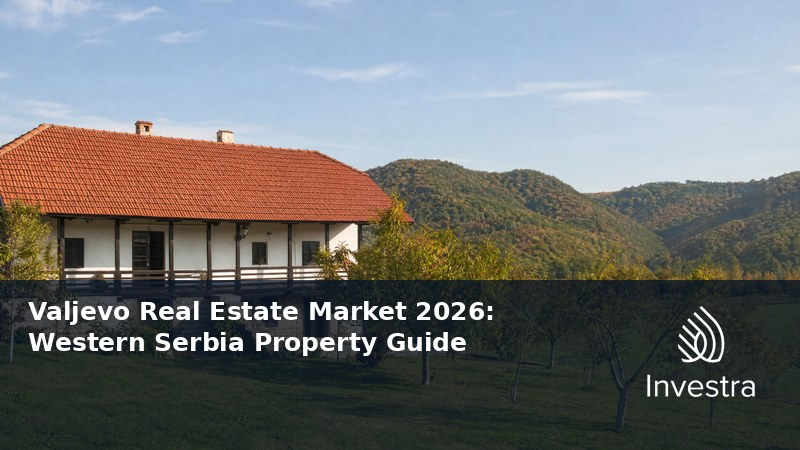
Valjevo Real Estate Market 2026: Western Serbia Property Guide
Valjevo Real Estate Market Overview: Western Serbia's Emerging Property Hub
Quick Answer: Property prices in this area vary by location and type. City center apartments typically range from €1,000 to €2,500/m², while suburban areas offer €700–€1,400/m². New developments command premium prices. Always verify current prices with a local agent.
Valjevo, a mid-sized city nestled in the Kolubara District of western Serbia, is rapidly gaining recognition among savvy property investors and lifestyle buyers seeking value beyond Belgrade's saturated market. With a population of approximately 90,000 residents and a rich industrial and cultural heritage, Valjevo represents one of the most compelling emerging real estate markets in the Western Balkans heading into 2026.
The Valjevo real estate 2026 landscape is shaped by a confluence of factors: sustained domestic demand from local professionals, improving infrastructure connectivity to Belgrade (roughly 100 km to the northeast), and growing interest from the Serbian diaspora returning to invest in hometown properties. Unlike the coastal markets of Montenegro or the capital's increasingly expensive neighborhoods, Valjevo offers genuine affordability without sacrificing quality of life.
The city sits at the confluence of the Kolubara and Jablanica rivers, surrounded by forested hills and positioned as a gateway to some of western Serbia's most scenic natural terrain. This combination of urban amenities and natural proximity is drawing a new generation of remote workers, retirees, and investors who recognize the city's untapped potential.
This comprehensive guide examines every dimension of the Valjevo property market — from current price benchmarks and neighborhood analysis to legal frameworks for foreign buyers and projected growth trajectories through 2026 and beyond.
Explore investment opportunities on Investra.io — the leading platform for international property investment in Serbia. For business strategy insights, visit sinisadagary.com. Discover business opportunities through Findes.si.
Valjevo at a Glance: City Profile and Strategic Location
Quick Answer: Each neighborhood offers distinct advantages. City centers provide walkability and high rental demand. Suburban areas offer larger spaces at lower prices. New developments in emerging districts often provide the best capital appreciation potential.
Understanding the Valjevo real estate market requires first understanding the city itself. Valjevo is the administrative center of the Kolubara District and one of the more significant urban centers in western Serbia. It functions as a regional economic hub for surrounding municipalities, hosting administrative offices, healthcare facilities, secondary and tertiary educational institutions, and a diversified industrial base.
The city's geography is characterized by its position in a river valley surrounded by the Valjevo Mountains — a range that includes popular recreational areas such as Divčibare mountain resort, located just 30 kilometers away. This proximity to nature has increasingly become a selling point for urban residents seeking weekend retreats and for developers targeting tourism-adjacent residential projects.
In terms of connectivity, Valjevo is accessible via the Ibarska magistrala (E-763 motorway corridor), and infrastructure upgrades planned under Serbia's national development programs are expected to further reduce travel time to Belgrade by 2026–2027. The city also maintains rail connections, though road transport remains the dominant mode of intercity movement.
Demographically, Valjevo has experienced moderate population stability compared to many Serbian cities that have seen dramatic urban-to-rural exodus patterns. The city benefits from a relatively young working-age population supported by local manufacturing plants, services, and the public sector. Major employers include industrial firms in metalworking and food processing, contributing to stable household incomes and consistent demand for residential property.
For investors considering Serbian regional markets, Valjevo's profile — established urban infrastructure, natural amenities, reasonable income levels, and proximity to the capital — creates a fundamentally sound environment for property investment with manageable risk profiles.
Current Property Prices in Valjevo: 2024–2026 Benchmarks
Quick Answer: Property prices in this area vary by location and type. City center apartments typically range from €1,000 to €2,500/m², while suburban areas offer €700–€1,400/m². New developments command premium prices. Always verify current prices with a local agent.
One of the most compelling aspects of the Valjevo real estate 2026 picture is the significant price differential compared to Serbian urban benchmarks. While Belgrade's prime neighborhoods regularly see prices exceeding €3,000–€4,500 per square meter for new construction, Valjevo's market operates at a fraction of that level — presenting exceptional entry-point opportunities for both domestic and international buyers.
Based on aggregated market data from Serbian property portals and local real estate agencies, the following price ranges characterize Valjevo's residential market as of late 2024 and projected into 2026:
- New construction apartments (city center): €1,100–€1,500/m²
- New construction apartments (outer districts): €850–€1,100/m²
- Resale apartments (city center): €700–€1,050/m²
- Resale apartments (suburban areas): €550–€800/m²
- Family houses (urban plots): €50,000–€120,000 total
- Family houses (semi-rural periphery): €30,000–€70,000 total
- Commercial retail space (center): €800–€1,400/m²
- Land plots (urban, per are): €3,000–€8,000/are
These price points reflect a market that has seen moderate but consistent annual appreciation of 5–9% in recent years, mirroring broader Serbian property trends driven by inflation hedging, mortgage availability, and growing domestic investor demand. Analysts monitoring regional Serbian markets anticipate continued appreciation in the 6–10% annual range through 2026, supported by national housing demand and limited quality supply in mid-tier cities like Valjevo.
Rental yields in Valjevo tend to range from 4.5% to 7.5% gross, depending on property type, location, and tenant profile — competitive figures relative to Western European markets where yields have compressed significantly.
Neighborhood Analysis: Where to Buy in Valjevo
Quick Answer: To buy property in Serbia: (1) Find a property through a licensed agent, (2) Conduct due diligence and title check, (3) Sign a preliminary contract with 10% deposit, (4) Complete notarized purchase contract, (5) Register at the land registry. The process typically takes 4–8 weeks.
Valjevo's urban fabric is organized around a historic core with expanding residential zones radiating outward. Each area presents a distinct investment profile, price point, and demand driver. Understanding these micro-market differences is essential for making informed acquisition decisions.
City Center (Centar): The downtown area around Tešnjar, Valjevo's protected pedestrian cultural quarter, commands the highest prices in the market. Properties here benefit from proximity to commercial activity, cultural institutions, restaurants, and services. Apartments in this zone are primarily pre-war stock and Yugoslav-era blocks with some new infill developments. Demand is strong from young professionals and small families seeking walkable urban living.
Beogradska / Vojvode Mišića Street Corridor: The main arterial streets connecting the center to surrounding districts host a mix of commercial ground floors with residential upper floors. These properties attract mixed-use investors and see solid foot traffic, supporting retail and service businesses.
Petnica and Northern Residential Zones: These established residential neighborhoods feature predominantly Yugoslav-era apartment blocks alongside newer residential developments. Prices are slightly below center rates, and rental demand from university-affiliated residents and mid-income families is consistent.
Brđanska and Eastern Periphery: Expanding zones with newer construction, larger apartment formats, and more parking availability. These areas cater to families seeking more space and are particularly popular with buyers coming from the diaspora or relocating from Belgrade seeking more affordable ownership.
Pećina and River Valley Districts: Areas closer to the Kolubara and Jablanica rivers offer a more tranquil setting with potential for renovation and eco-oriented development. Prices in these zones remain significantly below city averages, creating bottom-of-market entry opportunities.
The Investment Case for Valjevo Real Estate in 2026
Quick Answer: To buy property in Serbia: (1) Find a property through a licensed agent, (2) Conduct due diligence and title check, (3) Sign a preliminary contract with 10% deposit, (4) Complete notarized purchase contract, (5) Register at the land registry. The process typically takes 4–8 weeks.
Constructing a compelling investment thesis for Valjevo real estate in 2026 requires examining both macroeconomic context and city-specific dynamics. Serbia's overall economic trajectory is favorable: GDP growth has averaged 3–4% annually, inflation has moderated from post-pandemic peaks, and the country continues advancing toward EU candidate status — a structural factor that consistently supports real estate demand and investor confidence.
At the city level, several catalysts are converging to support Valjevo property values. The Serbian government's continued investment in road and rail infrastructure improvements in the western corridor will meaningfully improve accessibility. Planned upgrades to the Belgrade–Valjevo highway connection are expected to reduce peak-hour travel time toward 60–70 minutes by the mid-2020s, fundamentally repositioning Valjevo as a viable commuter zone for Belgrade-employed professionals.
The remote work revolution, accelerated by the pandemic and now structurally embedded in many Serbian industries and multinational companies operating in the country, creates sustained demand for quality housing outside the capital. Valjevo's combination of lower cost of living (estimated 25–35% below Belgrade), natural surroundings, and improving digital infrastructure makes it attractive to location-flexible professionals.
Industrial investment in the Valjevo region, including a free trade zone that has attracted international manufacturers, continues to generate stable employment and household income growth. This industrial base creates organic, income-backed rental demand — a fundamentally healthier market driver than speculative capital flows.
Investors seeking diversified Serbian property exposure beyond Belgrade should carefully evaluate Valjevo alongside other regional centers. For a comparative perspective on Adriatic alternatives, the Croatia Real Estate Guide on Investra provides useful benchmarking for regional portfolio construction.
Rental Market Dynamics and Yield Analysis
Quick Answer: Property prices in this area vary by location and type. City center apartments typically range from €1,000 to €2,500/m², while suburban areas offer €700–€1,400/m². New developments command premium prices. Always verify current prices with a local agent.
The Valjevo rental market operates across several distinct demand segments, each offering different yield profiles and risk characteristics. Understanding these segments is critical for investors targeting income-generating assets rather than purely capital appreciation plays.
Long-term residential rentals form the backbone of Valjevo's rental market. A typical 1-bedroom apartment (40–55 m²) in a well-located central building commands monthly rents of €200–€320. Two-bedroom units (55–75 m²) typically rent for €280–€420 per month. These figures represent attractive yields given purchase prices in the €55,000–€90,000 range for equivalent properties, translating to gross yields of approximately 5.0–6.5%.
Student and young professional rentals generate consistent demand, particularly in areas surrounding the Valjevo Gymnasium and vocational institutions. Smaller studio and one-bedroom formats are in particularly high demand in this segment, with near-zero vacancy in well-maintained properties.
Corporate and professional rentals from employees of multinational manufacturers operating in the free zone create a premium rental segment. These tenants typically seek furnished properties with reliable utilities and modern finishes, paying premiums of 15–25% above standard market rates.
Short-term and vacation rentals represent a smaller but growing niche, driven by Valjevo's position as a gateway to Divčibare and other western Serbian outdoor destinations. Properties marketed through international platforms can achieve significantly higher per-night rates during peak weekends and holiday periods, though this segment requires more active management.
Net yield calculations should account for property management fees (typically 8–12% of gross rent in the Serbian market), maintenance provisions, and potential vacancy periods. Conservative net yield estimates of 4.0–5.5% remain competitive by European standards, particularly given the capital appreciation upside at current price levels.
Legal Framework for Foreign Property Buyers in Serbia
Quick Answer: To buy property in Serbia: (1) Find a property through a licensed agent, (2) Conduct due diligence and title check, (3) Sign a preliminary contract with 10% deposit, (4) Complete notarized purchase contract, (5) Register at the land registry. The process typically takes 4–8 weeks.
Serbia maintains a relatively open legal environment for foreign real estate investment, though the framework carries important nuances that buyers must understand before transacting. The country operates under the principle of reciprocity for most EU and Western countries — meaning citizens of nations that allow Serbian citizens to purchase property are generally permitted to acquire real estate in Serbia.
For EU citizens, the process is largely straightforward. Non-EU foreigners, including citizens of the United States, United Kingdom, Canada, Australia, and many others, can purchase property through the establishment of a Serbian company (d.o.o.), which is a common and legally sound approach that also carries tax planning advantages.
The standard property acquisition process in Serbia involves:
- Preliminary agreement (predugovor): A deposit contract (typically 10% of purchase price) that binds both parties and establishes transaction terms
- Due diligence: Title search through Serbia's Real Estate Cadastre (Republički Geodetski Zavod), verification of encumbrances, utility connections, and building permits
- Main purchase agreement (kupoprodajni ugovor): Executed before a Serbian notary public (notar)
- Transfer tax: 2.5% absolute rights transfer tax payable by the buyer (VAT of 10% applies to new construction instead of transfer tax)
- Registration: Transfer of ownership registered in the Real Estate Cadastre, typically completed within 5–15 working days
Legal fees typically range from €500 to €1,500 depending on transaction complexity, and notary fees are regulated by statute relative to transaction value. Total transaction costs (excluding agent commissions) generally fall in the 3–5% range of purchase price.
Foreign buyers are strongly advised to engage a local Serbian lawyer with real estate specialization. The Investra Serbia Real Estate Guide provides vetted professional referral resources and detailed legal guidance for international buyers.
Infrastructure Developments Driving Valjevo's Property Market
Quick Answer: Property prices in this area vary by location and type. City center apartments typically range from €1,000 to €2,500/m², while suburban areas offer €700–€1,400/m². New developments command premium prices. Always verify current prices with a local agent.
Infrastructure investment is among the most reliable leading indicators of real estate value appreciation, and Valjevo is positioned to benefit substantially from multiple concurrent infrastructure programs under Serbia's national development agenda through 2027.
The most significant project for Valjevo's long-term property outlook is the planned modernization and capacity upgrade of the Belgrade–Valjevo road corridor. Current journey times can reach 90–120 minutes in peak conditions; the planned improvements are designed to establish a consistent sub-75-minute connection, fundamentally expanding Valjevo's commuter catchment area relative to the capital's labor market.
The Valjevo Free Trade Zone has received sustained public and private investment, hosting companies from Germany, Austria, Turkey, China, and domestic Serbian manufacturers. The zone's continued expansion — with additional parcels being developed for new tenants — signals durable employment growth that supports housing demand from working populations and management-level employees seeking quality accommodation.
Municipal investments in Valjevo's urban environment have included pedestrian zone expansions, riverbank revitalization along the Kolubara, upgrades to public parks and recreational infrastructure, and improvements to the city's cultural facilities. These quality-of-life investments enhance residential desirability and support property values in adjacent neighborhoods.
Fiber optic internet infrastructure expansion, a component of Serbia's digital transformation agenda, has reached substantial coverage in Valjevo, enabling the remote work use case that drives migration demand from Belgrade. This digital infrastructure investment, while less visible than road projects, directly enables the demographic trends most favorable to the city's property market.
Regional tourism infrastructure linking Valjevo to Divčibare, Brankovina village, and the wider western Serbia nature tourism circuit is receiving both public funding and private hospitality investment, creating secondary demand for both residential and commercial properties along these corridors.
Divčibare and Mountain Real Estate: The Nature Premium
Quick Answer: This section covers key aspects of real estate in Serbia. For personalized guidance on property investment, consult with a licensed local agent and legal advisor. Investra.io connects you with verified professionals across all major Serbian cities.
Any comprehensive analysis of Valjevo real estate must include the mountain resort of Divčibare, located approximately 30 kilometers from the city center at an elevation of around 1,000 meters above sea level. Divčibare functions as the primary winter and summer recreation destination for the Valjevo region and draws visitors from across Serbia and neighboring countries.
The Divčibare property market occupies a distinct niche characterized by vacation home demand, weekend retreat purchases, and small-scale hospitality investment. Weekend and holiday apartments at Divčibare typically range from €40,000 to €85,000 for established units, while newer purpose-built vacation developments can reach €100,000–€150,000 for premium furnished units with resort amenities.
The short-term rental opportunity at Divčibare is meaningful: well-positioned units can achieve occupancy rates of 40–60% annually, with peak season (winter ski weekends, summer hiking months) generating daily rates of €50–€120 per unit. This translates to gross annual revenues of €8,000–€18,000 on appropriately positioned properties — potentially exceeding the yields available in urban Valjevo for active rental operators.
Investors should note that Divčibare's development potential is partially constrained by environmental protections and construction regulations designed to preserve the mountain environment. This regulatory protection, while limiting supply expansion, provides downside price support for existing inventory and adds a scarcity premium to quality properties.
The combination of urban Valjevo investment (stable long-term yields) and Divčibare vacation property (higher-yield short-term rental potential) creates a diversified dual-market strategy that experienced Serbian property investors increasingly pursue. For additional strategic frameworks applicable to this approach, the Business Strategy Blog at Siniša Dagary's platform offers relevant analytical frameworks for regional property investment decisions.
Comparing Valjevo to Other Serbian Regional Markets
Quick Answer: Property prices in this area vary by location and type. City center apartments typically range from €1,000 to €2,500/m², while suburban areas offer €700–€1,400/m². New developments command premium prices. Always verify current prices with a local agent.
Positioning Valjevo within the broader Serbian regional real estate landscape helps investors calibrate expectations and identify comparative advantages and disadvantages. Serbia's significant regional cities — Novi Sad, Niš, Kragujevac, Čačak, and Subotica — each present distinct market profiles, and Valjevo compares favorably on several key dimensions.
vs. Novi Sad: Serbia's second city has seen dramatic price appreciation, with new construction regularly exceeding €2,000–€2,800/m². Valjevo offers entry points 40–60% below Novi Sad, with lower competition among buyers. Novi Sad carries higher liquidity but also higher risk of price correction from elevated levels.
vs. Niš: Serbia's third-largest city shares Valjevo's value positioning, with prices in the €900–€1,400/m² range for quality properties. Niš benefits from a larger population base (~250,000) and more diversified economy, but is significantly further from Belgrade. Valjevo's western corridor location gives it distinct connectivity advantages.
vs. Kragujevac: The Šumadija capital shares industrial characteristics with Valjevo and operates in similar price ranges. Kragujevac's larger size (~150,000) provides more market depth, but Valjevo's natural amenity position (Divčibare) creates an additional investment dimension absent from the Kragujevac market.
vs. Čačak: Valjevo's nearest comparable on the western corridor, Čačak shows similar price dynamics and market drivers. Both cities benefit from highway-adjacent industrial development and rural hinterland tourism, making them broadly comparable investment cases with minor differentials in specific asset classes.
The consensus among regional market analysts is that mid-tier Serbian cities offering the combination of economic stability, natural amenity access, and infrastructure improvement timelines represent the highest risk-adjusted return opportunities in the country's 2024–2027 property cycle. Valjevo sits squarely within this opportunity set.
Practical Buying Guide for International Investors
Quick Answer: To buy property in Serbia: (1) Find a property through a licensed agent, (2) Conduct due diligence and title check, (3) Sign a preliminary contract with 10% deposit, (4) Complete notarized purchase contract, (5) Register at the land registry. The process typically takes 4–8 weeks.
International investors approaching the Valjevo market for the first time benefit from a structured process that accounts for local market conventions, language barriers, and the specific requirements of cross-border transactions. The following framework reflects best practices for non-resident buyers in the Serbian market.
Step 1 — Market research and platform engagement: Begin with comprehensive research using Serbian property portals (Halo Oglasi, Nekretnine.rs, 4zida.rs) and international platforms that cover Serbian regional markets. Register on platforms like Investra.io that specialize in international property investment in Serbia and provide curated listings with professional due diligence support.
Step 2 — Establish legal and financial structure: Determine whether direct purchase (EU citizens and reciprocity-covered nationals) or company acquisition (non-EU buyers seeking full legal flexibility) is appropriate for your circumstances. Engage a Serbian real estate lawyer before viewing properties.
Step 3 — Property viewing trip: Plan a minimum 3–5 day visit to Valjevo, scheduling viewings with 2–3 local agencies. Include time to understand different neighborhoods, visit Divčibare if relevant, and assess practical factors like parking, building condition, and utility infrastructure.
Step 4 — Due diligence: Conduct a comprehensive cadastre search to verify ownership title, identify any mortgages or encumbrances, confirm building legalization status (a critical issue in Serbia where informal construction is common), and verify utility account status.
Step 5 — Negotiation and contracting: Price negotiation norms in Valjevo typically allow for 5–10% reduction from listed price in a buyer's negotiation. Structure the preliminary agreement carefully with appropriate penalty clauses for breach by either party.
Step 6 — Closing and registration: Complete the notarized purchase agreement, pay transfer tax or VAT as applicable, and track the cadastre registration through to completion. Ensure all utility transfers are completed and documented.
The entire process from offer to keys typically requires 30–60 days for straightforward transactions. Complex situations involving inheritance chains, informal construction legalization, or company acquisitions may require additional time. Building a local professional team — lawyer, accountant, and property manager — before completing the first purchase significantly reduces execution risk and establishes infrastructure for ongoing portfolio management.
Tourism, Culture, and Quality of Life in Valjevo
Quick Answer: This section covers key aspects of real estate in Serbia. For personalized guidance on property investment, consult with a licensed local agent and legal advisor. Investra.io connects you with verified professionals across all major Serbian cities.
The investment case for Valjevo real estate extends well beyond financial metrics — the city offers genuine quality of life advantages that support both owner-occupier demand and the attractiveness of the location for the residential tenants and vacation renters who underpin investment returns.
Valjevo's cultural heritage is centered on Tešnjar, a beautifully restored craftsmen's quarter dating to the 18th century that functions as the city's most distinctive public space. The quarter hosts artisan workshops, traditional restaurants serving western Serbian cuisine, cultural events, and festivals throughout the year. This authentic urban heritage represents a significant quality-of-life differentiator compared to many Serbian cities that lost historic urban fabric during the Yugoslav-era development period.
The broader cultural infrastructure includes the National Museum of Valjevo, multiple cinemas, theaters, and a lively café culture that belies the city's modest size. Healthcare is anchored by the General Hospital of Valjevo, which provides specialist services covering the broader Kolubara District catchment area.
Educational infrastructure includes Valjevo's renowned Gymnasium (one of the oldest secondary schools in Serbia), multiple vocational schools, and access to university programs — creating conditions for a relatively educated local workforce and sustained family-formation demand for housing.
Outdoor lifestyle amenities are exceptional relative to Valjevo's urban size. The Kolubara River offers kayaking and fishing; Divčibare provides skiing (limited but present), hiking, mountain biking, and paragliding; and the surrounding hills host marked trail networks increasingly popular with trail running and cycling communities. Brankovina village and monastery, approximately 20 kilometers from Valjevo, is a significant cultural and religious destination that draws both Serbian and international visitors.
For international buyers considering relocating or establishing a long-term base in western Serbia, Valjevo presents a compelling package: historical character, natural access, urban services, and a cost of living substantially below Western European equivalents without sacrificing the fundamentals of comfortable modern life.
Market Risks and Due Diligence Considerations
Quick Answer: Property prices in this area vary by location and type. City center apartments typically range from €1,000 to €2,500/m², while suburban areas offer €700–€1,400/m². New developments command premium prices. Always verify current prices with a local agent.
A comprehensive property investment analysis demands honest assessment of risks alongside opportunities. The Valjevo real estate market carries several specific risk factors that international buyers should incorporate into their decision-making frameworks.
Market liquidity risk: Valjevo is a secondary Serbian market with lower transaction volumes than Belgrade or Novi Sad. This means that selling a property quickly at market value may require more time and price flexibility than in larger markets. Investors should plan for holding periods of 5–10 years and avoid positions that require near-term liquidity.
Legalization and construction permit issues: A significant proportion of Serbian residential buildings — particularly older family homes and extended structures — contain additions or modifications built without proper permits. Purchasing illegally extended properties creates title and resale complications. Thorough legalization status verification is essential and non-negotiable in due diligence.
Currency risk: While Serbian property prices are commonly quoted in euros, the official currency remains the Serbian Dinar (RSD). Exchange rate fluctuations can affect the effective cost basis for non-euro investors. The National Bank of Serbia maintains a managed float policy that has provided relative stability, but currency risk remains relevant for non-eurozone investors.
Infrastructure timeline uncertainty: The property appreciation case for Valjevo is partly predicated on infrastructure improvements to the Belgrade corridor. Infrastructure projects in Serbia (as elsewhere in the region) have historically experienced delays. Investors pricing in specific connectivity improvements should apply conservative timelines.
Local market knowledge gap: In a smaller market like Valjevo, accurate price information is less systematically available than in major metropolitan markets. Overpriced listings exist alongside genuine value opportunities, and the absence of a robust comparative transaction database means investors rely more heavily on local agent expertise — with attendant agency conflict risks. Engaging independent legal and valuation professionals is particularly important in this context.
For broader perspectives on Serbian property market trends and risk management, the Investra Property Investment Insights Blog offers regularly updated analysis covering both macro market trends and transaction-level considerations.
2026 Outlook: Price Forecasts and Emerging Opportunities
Quick Answer: Property prices in this area vary by location and type. City center apartments typically range from €1,000 to €2,500/m², while suburban areas offer €700–€1,400/m². New developments command premium prices. Always verify current prices with a local agent.
Synthesizing the market dynamics, infrastructure catalysts, demographic trends, and risk factors discussed throughout this guide, a forward-looking view of the Valjevo real estate market through 2026 supports the following projections and emerging opportunity identification.
Price appreciation forecast: Mainstream residential property in Valjevo's city center and established residential zones is projected to appreciate at 6–9% annually through 2026, in line with or slightly exceeding broader Serbian regional market trends. Properties in strategic locations (near the planned road improvement corridor access points, within walking distance of Tešnjar, in new-build developments with quality specifications) may outperform this baseline.
Emerging opportunity 1 — New build pre-sales: Several Valjevo developers are bringing quality new residential projects to market through 2025–2026, offering pre-sale pricing that typically sits 10–20% below projected completion values. Early-stage buyers with 18–24 month construction timelines can potentially achieve built-in equity at completion — a strategy widely used by experienced Serbian property investors.
Emerging opportunity 2 — Commercial to residential conversion: Valjevo's city center contains aging commercial buildings that are candidates for conversion to residential use as retail consumption patterns shift. Creative investors with renovation capital can acquire commercial assets at below-residential values and convert to high-specification apartments that command center premiums.
Emerging opportunity 3 — Tourism-linked short-term rental: The growth of Serbian domestic tourism and the increasing international visitor profile for western Serbia's outdoor destinations (Tara, Zlatar, Divčibare) creates structural demand for quality short-term accommodation managed through platforms like Airbnb and Booking.com. Purpose-positioned apartments in Valjevo and Divčibare with professional management are positioned to capture growing platform-driven bookings.
Emerging opportunity 4 — Land acquisition in growth corridors: As road improvements bring Valjevo closer to Belgrade functionally, demand for residential development land in well-positioned peripheral locations will increase ahead of construction activity. Land acquisition at current agricultural-adjacent prices in designated development zones carries asymmetric upside potential for patient investors with 5–10 year time horizons.
The 2026 market will also be shaped by Serbia's continued EU accession process trajectory. Each milestone in EU candidate status negotiations historically generates a positive market sentiment effect for Serbian real estate, as it signals regulatory convergence, rule-of-law improvements, and potential eventual single-market access — all factors valued by international property buyers and institutional investors. For additional reading on regional investment strategy and market analysis, the Findes.si platform offers business intelligence resources relevant to Western Balkans market participants.
Investment Disclaimer
Quick Answer: To buy property in Serbia: (1) Find a property through a licensed agent, (2) Conduct due diligence and title check, (3) Sign a preliminary contract with 10% deposit, (4) Complete notarized purchase contract, (5) Register at the land registry. The process typically takes 4–8 weeks.
The information provided in this article is for educational and informational purposes only and should not be construed as financial, legal, or investment advice. Real estate investments carry inherent risks, and past performance does not guarantee future results. Investors should not invest money they cannot afford to lose. Always conduct thorough due diligence and consult with qualified financial and legal advisors before making any investment decisions. Investra.io does not guarantee returns on any investment.
Frequently Asked Questions
Quick Answer: This section covers key aspects of real estate in Serbia. For personalized guidance on property investment, consult with a licensed local agent and legal advisor. Investra.io connects you with verified professionals across all major Serbian cities.
What is the property market like in Valjevo Serbia?
The Valjevo property market is a stable, moderately appreciating secondary Serbian market characterized by significantly lower prices than the national capital Belgrade. Residential apartment prices range from approximately €550 to €1,500 per square meter depending on property type, age, and location within the city. The market is driven by genuine end-user demand from local professionals and families, growing interest from the Serbian diaspora, and increasing attention from Belgrade-based investors seeking value. Annual price appreciation of 5–9% has been observed in recent years, with the trajectory supported by infrastructure improvements, industrial zone expansion, and remote work migration trends.
How do Valjevo property prices compare to Belgrade?
Valjevo property prices are typically 50–70% lower than equivalent properties in Belgrade. While Belgrade's prime and mid-market new construction ranges from €2,500 to €4,500 per square meter, Valjevo new builds in central locations are priced at €1,100–€1,500 per square meter. This discount creates compelling relative value for investors and lifestyle buyers, particularly as infrastructure improvements gradually reduce the commute time between the two cities toward the 60–75 minute range.
Can foreigners buy property in Valjevo, Serbia?
Yes, foreigners can purchase property in Valjevo and throughout Serbia, subject to the principle of reciprocity. Citizens of most EU countries, the United States, United Kingdom, Canada, Australia, and many other nations can buy property directly or through a Serbian registered company (d.o.o.). Non-EU buyers often establish a Serbian company for acquisition, which provides full legal standing and additional tax planning flexibility. The transaction process involves a notarized purchase agreement, a 2.5% property transfer tax (or 10% VAT for new construction), and registration with Serbia's Real Estate Cadastre.
What rental yields can investors expect in Valjevo?
Gross rental yields in Valjevo typically range from 4.5% to 7.5% for residential properties, depending on property type, location, and target tenant segment. Long-term residential rentals generate more stable but typically lower yields (4.5–6.5% gross), while furnished apartments targeting corporate tenants or short-term vacation rentals can achieve higher gross returns. After deducting property management fees (8–12%), maintenance provisions, and vacancy allowances, conservative net yields of 4.0–5.5% are achievable on well-positioned assets — competitive by European standards.
What are the best neighborhoods to buy property in Valjevo?
The city center area around Tešnjar quarter offers the highest prices and strongest demand from young professionals. Established residential neighborhoods to the north (including Petnica area) provide solid rental demand at slightly lower price points. Newer suburban zones to the east offer larger apartment formats popular with families and diaspora buyers. For value-oriented investors, areas along the Kolubara river valley offer the lowest entry prices with renovation potential. Each zone has distinct demand drivers and yield profiles; the optimal choice depends on individual investment objectives and budget parameters.
Is Divčibare a good location for vacation property investment?
Divčibare presents an attractive vacation property investment case for active rental operators. Located 30 kilometers from Valjevo at approximately 1,000
Related Posts
No related posts available.
