
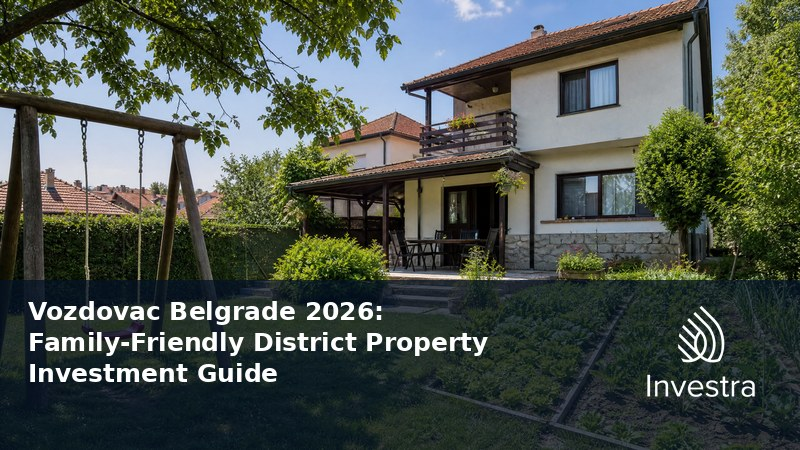
Vozdovac Belgrade 2026: Family-Friendly District Property Investment Guide
Vozdovac Belgrade 2026: Why This District Is Capturing Investor Attention
Quick Answer: Vozdovac is one of Belgrade's most established residential districts, offering property prices between €1,800 and €3,200 per m² in 2026, strong rental yields of 5–7%, and a family-oriented environment that attracts both long-term tenants and international buyers seeking value outside the city core. Investra.io tracks this district closely as part of its broader Belgrade investment coverage.
There's a particular kind of neighbourhood that seasoned investors learn to recognise — the kind that doesn't make headlines, doesn't have a glitzy new waterfront development attached to its name, but quietly delivers year after year. Vozdovac is that neighbourhood in Belgrade.
Stretching south from the city centre toward the forested slopes of Avala Mountain, Vozdovac is Belgrade's third-largest municipality by population, home to roughly 160,000 residents. It's not a district that shouts for attention. What it does instead is offer something arguably more valuable in real estate terms: consistency. Solid infrastructure, a strong local community, good schools, green spaces, and a property market that has demonstrated steady appreciation even during periods when other parts of Belgrade experienced more volatile swings.
In 2024 and 2025, Belgrade's overall residential market posted average price increases of 8–12% annually, driven by persistent demand, limited supply of quality stock, and a significant influx of foreign residents — particularly from Russia, Ukraine, and Western Europe. Vozdovac benefited from this trend, but it also attracted a distinct buyer profile: families seeking quality of life, expats wanting suburban calm with urban connectivity, and investors who've done their homework and know that areas adjacent to established premium zones tend to be where the next wave of appreciation lands.
This guide covers everything you need to know about buying property in Vozdovac in 2026 — from price data broken down by micro-zone, to rental market dynamics, the legal buying process for foreigners, tax obligations, and the kinds of returns that are realistically achievable here.
Understanding Vozdovac: Geography, Character, and Demographics
Quick Answer: Vozdovac is a large, predominantly residential municipality in southern Belgrade covering approximately 148 km², blending urban apartment districts near the city centre with quieter, greener sub-neighbourhoods further south, and home to a stable middle-class population that drives consistent rental demand.
Geography shapes real estate in ways that price data alone can't fully capture. Vozdovac runs from the edge of Vračar and Savski venac in the north — practically the city's geographic centre — all the way south to the wooded hills flanking Avala. That's a significant span, and it means the district contains genuinely distinct micro-environments that appeal to very different buyer profiles.
The northern parts of Vozdovac — areas like Medaković, Karaburma's southern fringes, and the zones immediately around Autokomanda — feel distinctly urban. High-density apartment blocks, excellent public transport connections, proximity to major commercial arteries. This is where you'll find the densest investor activity and the strongest short-term rental numbers.
Move further south into sub-municipalities like Beli Potok, Zuce, Pinosava, and the areas around the Kaljemegdan road corridor, and the character shifts entirely. Detached houses with gardens, quieter streets, local schools within walking distance, a pace of life that genuinely earns the description "family-friendly." These areas attract a different buyer — typically someone thinking in decades rather than months.
Demographically, Vozdovac skews toward established Belgrade families. The median resident here is educated, employed in a professional capacity, and puts significant weight on school quality and neighbourhood safety when choosing where to live. That demographic profile is important for investors because it correlates with rental reliability — tenants in this district tend to stay longer, pay on time, and treat properties with care.
The district also has a growing expat presence, particularly around the international schools in adjacent municipalities. Families relocating to Belgrade for work increasingly look at Vozdovac as a practical base — it's close enough to the centre for professional life while offering the kind of residential environment that makes the relocation genuinely liveable rather than merely functional.
Vozdovac Property Price Analysis 2026: What the Numbers Actually Show
Quick Answer: In 2026, Vozdovac property prices range from approximately €1,800/m² for older socialist-era apartments in less central sub-zones to €3,200/m² for new-build premium units in the northern parts of the district, with the most active transaction segment sitting between €2,200 and €2,700/m².
Price data in Serbian real estate requires careful interpretation. The official transaction prices recorded at the Republic Geodetic Authority (RGA) have historically understated actual values due to the widespread practice of declaring lower prices in purchase contracts — though this practice has diminished significantly since the tax authorities tightened enforcement in 2022 and 2023. What we know from current market data is that Vozdovac represents genuine value relative to adjacent premium districts.
For context: in Vračar, Belgrade's most sought-after residential district and immediately to the north, new-build apartments regularly transact at €3,800–€4,800/m². Dedinje commands €4,000–€7,000/m² for premium villas and upscale apartments. Vozdovac, sitting adjacent to both, offers comparable quality of life at a meaningful discount.
Here's how prices break down by property type and location within Vozdovac in 2026:
Northern Vozdovac (Medaković, Autokomanda area): New-build apartments: €2,700–€3,200/m². Quality resale apartments: €2,200–€2,600/m². Older socialist-era units requiring renovation: €1,800–€2,100/m².
Central Vozdovac (Banjica, Voždovac village area): New developments: €2,400–€2,900/m². Resale market: €1,950–€2,400/m². Renovation projects: €1,600–€1,900/m².
Southern Vozdovac (Beli Potok, Pinosava, Zuce): Family houses: €1,200–€2,200/m² (depending heavily on condition and plot size). Apartments where available: €1,700–€2,200/m².
The average transaction price across the district hovers around €2,350/m² — making it one of the better value propositions in inner Belgrade for investors who want capital appreciation potential without paying peak-market prices. For the detailed Belgrade-wide context that helps frame these numbers, the Belgrade Real Estate Market Report 2026: Prices, Trends & Forecasts is essential reading.
The Investment Case for Vozdovac: Yields, Returns, and Capital Growth
Quick Answer: Vozdovac delivers gross rental yields of 5–7% on well-selected properties in 2026, with capital appreciation averaging 8–11% annually over the past three years, creating total annual returns in the 13–18% range for investors who buy correctly and manage actively.
Let's talk about what actually matters when you're deploying capital: the return. And the honest picture for Vozdovac in 2026 is genuinely compelling — not in a promotional way, but in a data-supported way that stands up to scrutiny.
Rental yields depend enormously on property type, location within the district, and management approach. A well-positioned 60m² two-bedroom apartment in northern Vozdovac purchased at €148,000 (approximately €2,467/m²) can generate €700–€800 per month in long-term rental income, producing a gross yield of around 5.7–6.5%. Deduct Serbian property tax (0.4% of assessed value annually, which for a property like this typically means €400–€600/year), management fees if applicable (8–12% of rent), and maintenance provisions (typically 1–2% of property value annually), and net yields settle in the 4–5.5% range.
Short-term rental through platforms like Airbnb tells a different story. A quality apartment in the more northern, accessible parts of Vozdovac — close to transport and within reasonable distance of the city's main attractions — can generate €1,200–€1,600/month in peak season (June–September) and €700–€900 during quieter winter months. Average annual income for a well-managed short-term rental in this district runs approximately €10,000–€13,000, pushing gross yields toward 7–9% on appropriately priced properties. For a thorough breakdown of the Belgrade short-term rental market, Airbnb Belgrade 2026: Rental Income, Best Areas & Legal Guide covers the legal requirements and income expectations in detail.
Capital appreciation is where Vozdovac's story becomes particularly interesting. The district has benefited from what property analysts call the "spillover effect" — as premium central districts like Vračar and Stari Grad become unaffordable for middle-class buyers and typical investors, demand spills into adjacent areas. Vozdovac, sitting directly below Vračar geographically, has been one of the primary beneficiaries. Annual price appreciation has averaged 9.4% between 2022 and 2025, significantly outpacing inflation and most conventional investment alternatives available in the Serbian market.
The total return calculation — combining net rental yield with capital appreciation — places well-selected Vozdovac properties in the 13–18% annual return range. That's a strong number by any European standard, and it reflects the fundamental reality that Serbia remains an emerging market with considerable room to run before property prices approach Western European norms. Investors interested in where this trajectory might lead should review the Serbia Real Estate Market Forecast 2026-2030: Prices & Trends for the longer-term picture.
Best Sub-Neighbourhoods in Vozdovac for Property Investment
Quick Answer: The highest investment returns in Vozdovac currently come from northern areas like Medaković and the Autokomanda corridor for rental yield, while southern sub-zones like Beli Potok and Pinosava offer superior capital growth potential and quality of life for family-oriented buyers.
Vozdovac isn't a monolith, and treating it as such would mean missing the real estate story. Each sub-neighbourhood has its own investment thesis, its own risk-return profile, and its own buyer/tenant profile. Here's what we know about the most significant ones.
Medaković is arguably the district's most active investment sub-zone. Three distinct residential blocks — Medaković 1, 2, and 3 — house tens of thousands of residents in a mix of socialist-era and more recent apartment construction. It's well-connected by bus and trolleybus to the city centre, has good local retail infrastructure, and generates consistent rental demand from young professionals and small families. Prices here typically range €2,100–€2,600/m² for quality resale units, with yields strong enough to make it a clear choice for income-focused investors.
Banjica sits in the central section of Vozdovac and has a character that feels distinctly residential and established. Tree-lined streets, proximity to Banjica Forest (a genuine green lung in the city), and good local schools make it popular with families. New developments here have been more limited than in Medaković, which has kept supply tight and supported prices. Expect to pay €2,300–€2,900/m² for quality stock.
Voždovac village — the area around the old village core — is experiencing quiet but meaningful gentrification. Old village houses are being renovated into desirable residential properties, and younger Belgrade residents are discovering its charm. This is a medium-term bet: the transformation is real but gradual.
Beli Potok and Pinosava are the district's southern stars for family buyers. These sub-municipalities, nestled against forested hillsides near the Avala road, offer detached homes with gardens, genuine quiet, clean air, and a quality of life that apartment-dense central Belgrade simply can't replicate. Properties here are predominantly houses rather than apartments, and the price per m² of built area is lower — but the lifestyle premium is significant. This is where international families with children who are planning a multi-year stay in Belgrade typically end up.
For a city-wide comparison of neighbourhood investment performance, Belgrade Investment Property: Best Neighborhoods for ROI in 2026 provides the context needed to understand where Vozdovac sits in the broader picture.
New Developments vs. Resale Market in Vozdovac
Quick Answer: New-build developments in Vozdovac command a 15–25% premium over comparable resale properties but offer modern specifications, energy efficiency, and warranty protections that significantly reduce near-term maintenance costs; the resale market, meanwhile, offers better entry prices and immediate availability that can produce superior yields when renovated correctly.
This is one of those decisions where the "right answer" depends entirely on your investment goals, and where generic advice does more harm than good. So let's be specific.
New-build developments have proliferated in Vozdovac over the past five years, driven by demand that Belgrade's older housing stock simply couldn't satisfy. Modern constructions typically offer underground parking, lift access, energy-efficient construction (meeting B or A+ energy classifications), and specifications — fitted kitchens, quality bathroom finishes, smart-home infrastructure — that make them immediately tenantable at premium rental rates. The catch is price: new builds in Vozdovac's better locations start around €2,600/m² and can reach €3,200/m² for the most impressive units.
The resale market is where value hunters operate. Socialist-era apartment blocks from the 1970s and 1980s — common throughout the district — often sell at €1,800–€2,200/m² in their existing condition. A renovation budget of €200–€400/m² (depending on scope) transforms these properties into competitive rental units. An investor buying a 55m² apartment for €110,000 and spending €15,000 on renovation has an all-in cost of €125,000 — potentially €30,000–€50,000 less than a comparable new-build. At similar rental rates, the yield arithmetic strongly favours the renovation approach.
The risk with older buildings is structural — not all socialist-era construction is equal. Some buildings have been well-maintained by residential communities (stambene zajednice), others have been neglected. Due diligence on building condition, communal maintenance records, and the status of any required major works (roof, facade, lift) is essential before committing to a resale purchase in these buildings.
Off-plan purchases from reputable developers represent a middle ground that can work well — buying at pre-completion prices (typically 15–20% below finished market value) in exchange for construction risk during the build period. Serbia's legal framework has improved significantly for off-plan purchases since regulatory changes in 2021, but developer reputation and financial backing remain critical factors to assess.
How Foreign Nationals Can Buy Property in Vozdovac
Quick Answer: Most foreign nationals can legally purchase property in Vozdovac and throughout Serbia, with EU citizens having essentially identical rights to Serbian citizens; non-EU nationals can purchase based on reciprocity agreements or through a Serbian-registered company, and the process typically takes 4–8 weeks from offer acceptance to registration.
Serbia is one of the more accessible European property markets for international buyers, and that accessibility is a genuine competitive advantage relative to markets with significant foreign ownership restrictions. The legal framework is clear, the process is documented, and thousands of foreign buyers have successfully navigated it in recent years.
EU/EEA citizens can buy property in Serbia on the same terms as Serbian nationals — no restrictions, no special permissions required. This covers buyers from Germany, France, Netherlands, Austria, and every other EU member state.
For non-EU nationals, the picture is slightly more complex. Serbia has reciprocity agreements with many countries — essentially meaning that if Serbian nationals can buy property in your country, you can buy property in Serbia. This covers nationals of the US, UK, Switzerland, Russia, UAE, China, and many others. The complete list is maintained by the Ministry of Justice and should be verified for your specific nationality before proceeding.
Where direct purchase isn't possible due to reciprocity limitations, establishing a Serbian d.o.o. (limited liability company) and purchasing through that entity is a straightforward alternative. A Serbian d.o.o. can be established in 5–10 working days, with minimum capital requirements as low as 100 RSD (essentially nothing), and provides additional tax planning flexibility regardless.
The purchase process itself involves: property identification and offer, preliminary contract (predugovor) with deposit typically 10%, due diligence period including title search at the Republic Geodetic Authority, finalisation of the main purchase contract (ugovor o kupoprodaji) — this must be certified by a public notary (javni beležnik), payment of purchase price, and registration of ownership at the RGA. Total timeline: 4–8 weeks for standard transactions. The comprehensive step-by-step guide at Buying Property in Belgrade 2026: Complete Guide for Foreign Investors covers every stage in detail.
One practical note: having a trusted local lawyer who speaks your language is not optional, it's essential. Contract law nuances, title history issues, and urban planning status questions (particularly relevant for houses in southern Vozdovac) require professional legal guidance. Budget €800–€2,000 for quality legal representation on a typical transaction.
Property Taxes and Ownership Costs in Vozdovac
Quick Answer: Property transaction tax in Serbia is 2.5% of the assessed purchase price (not always the contracted price), annual property holding tax runs 0.4% of assessed value, and rental income is taxed at an effective rate of approximately 10.5–14% after allowable deductions — making Serbia's tax burden among the lightest in Europe for property investors.
Serbia's tax environment for property investors is genuinely competitive — and that's not marketing language, it's a factual comparison against most European markets where stamp duty alone can exceed 5% and annual property taxes consume a meaningful share of rental income.
The main taxes to understand are these:
Property Transfer Tax (Porez na prenos apsolutnih prava): 2.5% of the higher of the contracted price or the tax authority's assessed value. The tax authority maintains its own valuation database (the "market value" database), and if your contracted price is lower than their assessed value, you'll pay 2.5% on their number. This matters particularly for undervalued resale transactions. For new-builds purchased from developers with VAT already applied, transfer tax is not payable — instead, VAT at 10% is embedded in the purchase price.
Annual Property Tax (Porez na imovinu): 0.4% of the municipal assessed value for residential property owned by individuals. Municipal assessments are typically below market value — often 40–60% of actual market prices — so on a property purchased at €150,000, the annual tax bill might be €240–€360. Genuinely negligible by European standards.
Rental Income Tax: Rental income is taxed at the corporate/individual income tax rate after a 25% deduction for expenses (for unfurnished properties; higher for furnished). The effective tax rate on gross rental income typically works out to approximately 10.5–14%, depending on income level and deductions. This compares very favourably with France (up to 45%), Germany (up to 42%), or the UK (up to 40%).
Capital Gains Tax: Property sold within 10 years of purchase is subject to 15% capital gains tax on the profit (sale price minus purchase price minus eligible costs). Hold for more than 10 years and capital gains are exempt. There are also partial exemptions available if you've used the property as your primary residence.
The full breakdown, including specific strategies for structuring ownership to optimise your tax position, is covered in the Serbia Property Tax Guide 2026: What Foreign Buyers Must Know. Expert input from Siniša Dagary — Investment Consultant is also worth engaging for personalised tax structuring advice, particularly for investors building larger portfolios in Belgrade.
Financing Your Vozdovac Property: Mortgage Options for Foreign Buyers
Quick Answer: Serbian banks offer mortgages to non-residents, but with significantly more stringent conditions than for residents — typically requiring 30–40% down payment, proof of stable foreign income, and interest rates of 3.5–5.5% on EUR-denominated loans; most foreign investors currently purchase with cash or finance through home country lending.
Financing is often the decisive variable in international property investment, and Serbia's mortgage landscape for foreigners is improving but still carries notable friction compared to purchasing in your home country.
Serbian banks — the major ones including Banca Intesa, UniCredit, Raiffeisen, and Komercijalna banka — do offer mortgage products to non-resident foreigners. The conditions as of 2026 typically look like this: loan-to-value (LTV) ratio of 60–70% (meaning 30–40% deposit), loan term of 20–30 years, interest rates of 3.5–5.5% per annum on EUR-indexed loans, proof of regular income from foreign employment or business, and credit assessment based on documentation from your home country.
The documentation requirements can be demanding. Banks typically want six months of bank statements, an employment contract or two to three years of tax returns for self-employed buyers, proof of current address, and often a Serbian tax identification number (PIB). The process takes 4–8 weeks and isn't guaranteed — banks exercise conservative judgment on foreign applications.
Given these complexities, a significant proportion of foreign buyers in Vozdovac and Belgrade more broadly purchase with cash. Serbia's entry prices remain low enough in absolute terms that €100,000–€250,000 cash transactions are feasible for buyers who have accumulated capital in stronger-currency markets. The ROI calculation on an all-cash purchase in Vozdovac — annual returns of 13–18% as outlined earlier — makes the case for deploying available capital here even without leverage.
Alternatives worth exploring include refinancing existing property in your home country to release equity, private lenders who operate in the Serbian market, or developer financing on new-build projects (some developers offer staged payment plans that effectively function as interest-free financing during construction). For a comprehensive analysis of all available financing routes, the Serbia Mortgage Guide 2026: Can Foreigners Get a Loan? covers all current options in detail.
Vozdovac as a Family Destination: Schools, Amenities, and Quality of Life
Quick Answer: Vozdovac is widely considered one of Belgrade's best districts for families with children, offering multiple highly-rated primary and secondary schools, extensive green spaces including Banjica Forest and proximity to Avala Mountain, good local retail and healthcare infrastructure, and significantly lower noise and pollution levels than central Belgrade districts.
The "family-friendly" label gets thrown around a lot in real estate marketing. In Vozdovac's case, it actually means something specific and verifiable.
Education infrastructure is genuinely strong. The district contains multiple highly regarded primary schools (osnovna škola) including OŠ Miodrag Mitrović, OŠ Vuk Stefanović Karadžić, and OŠ Vlada Obradović Kameni, several of which consistently rank among Belgrade's top performers. Secondary school options within or adjacent to the district cover both general gymnasium programmes and technical/vocational tracks. For international families, the proximity to Belgrade's international schools — several located in adjacent municipalities accessible within 15–20 minutes — makes Vozdovac a practical base.
Green space provision in Vozdovac is exceptional by Belgrade standards. Banjica Forest occupies several hundred hectares of the district, offering proper woodland walking, cycling, and recreational space in an otherwise urban context. Further south, the Avala Mountain corridor provides hiking, nature reserves, and weekend outdoor recreation within 30 minutes of the northern district areas. This green access is a major driver of long-term rental demand from families — it's difficult to put a price on it, but experienced agents know it commands a consistent premium.
Healthcare access is solid. The Banjica Clinical Centre for Orthopaedic Surgery and Traumatology is one of Serbia's leading medical facilities, located within the district. General practitioner access through the Serbian public health system is available at multiple polyclinic locations, and private healthcare providers have expanded their presence in the district significantly over the past five years.
Daily life practicalities — supermarkets, retail, restaurants, cafés — are well-served throughout the northern and central parts of the district. TC Plaza shopping centre on the district's edge provides comprehensive retail access. The southern sub-zones are quieter in terms of commercial amenity, which is part of their appeal rather than a drawback for residents who want the peaceful lifestyle they offer.
The Digital Nomad and Expat Angle: Vozdovac for Remote Workers
Quick Answer: Vozdovac is attracting a growing number of digital nomads and remote-working expats drawn by Belgrade's internet infrastructure, relatively low cost of living, Serbia's visa-free access for many nationalities, and the district's combination of residential quality and urban accessibility — all of which drives above-average rental demand from this internationally mobile demographic.
Something has shifted in Belgrade's residential property market since 2022, and it's not subtle. The city has become a genuine hub for internationally mobile workers — people running location-independent businesses, tech employees working remotely for European and American companies, and freelancers seeking an excellent quality of life at a cost that makes Western European capitals feel absurd by comparison.
This demographic matters to Vozdovac property investors because they make excellent tenants. Digital nomads and expat remote workers typically earn in hard currencies (EUR, USD, GBP), pay rent reliably, are accustomed to market-rate pricing, and prioritise quality of the living environment over location centrality per se — making Vozdovac's combination of residential quality and reasonable transport access to the city centre genuinely appealing to them.
Serbia's visa framework is notably accessible. Most Western passport holders can stay up to 90 days visa-free and then easily extend through a visa run or by applying for a temporary residence permit. Serbia's digital nomad visa, formalised and updated for 2026, provides a structured legal framework for longer-term stays. The full details of this visa mechanism — and how it affects the tenant pool available to Belgrade landlords — are outlined in the Serbia Digital Nomad Visa 2026: Complete Guide for Remote Workers.
Internet connectivity in Vozdovac is excellent — Serbia consistently ranks among Europe's best performers for broadband speed and reliability, and the district is fully covered by multiple fibre providers. For anyone whose income depends on stable connectivity, this is a non-trivial practical consideration.
The cost of living angle is worth quantifying. A comfortable two-bedroom apartment in Vozdovac rents for €600–€850/month. Restaurant meals average €8–€15 for a quality lunch, €15–€30 for dinner. Monthly transport pass: approximately €30. By the standards of Amsterdam, Zürich, or London — the cities many of these nomads are fleeing — the arithmetic is almost embarrassingly favourable. That cost advantage sustains demand from the expat rental segment even as property prices rise, which is exactly what investors want to see in their target market.
Practical Due Diligence: What to Check Before Buying in Vozdovac
Quick Answer: Essential due diligence for Vozdovac property purchases includes title verification at the Republic Geodetic Authority, checking for mortgages or encumbrances on the property, verifying urban planning status (particularly important for houses in southern Vozdovac), confirming building construction legality, and assessing the financial health and maintenance history of the residential community (stambena zajednica).
Due diligence in Serbian real estate isn't optional, and there are specific issues that are particularly relevant in Vozdovac that don't apply equally across all Belgrade districts.
Title verification is the starting point everywhere. The Republic Geodetic Authority maintains the land registry (katastar), and a search will reveal who actually owns the property, whether there are mortgages registered against it, whether there are easements or other encumbrances, and what the exact registered surface area is. Discrepancies between listed and actual areas are more common than you'd expect in older buildings and should always be investigated.
For houses in the southern parts of Vozdovac — Beli Potok, Pinosava, Zuce, and similar sub-zones — the urban planning status is critical. Serbia has a significant stock of "legal grey area" constructions — buildings built without proper permits or with permits that don't match what was actually built. The legalization process (ozakonjenje) has progressed substantially since the 2018 legislation, but not all properties have been successfully legalized. An unlegalised building cannot be mortgaged, may face restrictions on sale, and can incur penalties. Your lawyer must verify construction legality through the municipal administration before any purchase in these areas.
Building condition assessment matters enormously for older apartment blocks. Request the maintenance records from the stambena zajednica (residential community), check when the roof was last replaced, whether the facade has been renovated, and whether the lift is functioning and recently serviced. Membership fees for building maintenance vary widely — from €20 to €80+ per month depending on building age and standards — and should be factored into your running cost calculations.
For new-builds, verify the developer's track record and financial standing. Check that the building permit is in order, that the pre-sale contract gives you appropriate protections including a bank guarantee or escrow arrangement for your deposit, and that the anticipated completion date comes with contractual penalties for delays. Serbia's Findes Financial Services and equivalent financial advisory firms can assist with escrow arrangements and financial risk assessment on developer transactions.
Environmental considerations are increasingly relevant in southern Vozdovac. The proximity to Avala Mountain means some sub-zones are within designated protected natural areas, which carries both restrictions on development and significant amenity value. Confirm the planning zone status of any property before assuming development or extension potential.
Vozdovac Rental Market Dynamics: Who Rents Here and What They Pay
Quick Answer: Vozdovac's rental market is dominated by Belgrade-based families and professionals in the long-term segment, with growing short-term demand in northern sub-zones; typical long-term rents range from €450–€600 for one-bedroom apartments to €700–€950 for two-bedroom units, representing yields that outperform comparable Western European residential markets.
Understanding who rents — not just what the rent is — tells you a great deal about the stability and trajectory of a rental market. In Vozdovac, the long-term rental tenant base is predominantly Belgrade families and young professionals who want residential quality at prices somewhat below the premium that Vračar and Stari Grad command.
One-bedroom apartments (30–50m²) in Vozdovac rent for €450–€600 per month in long-term lease arrangements. Two-bedroom units (55–75m²) command €700–€950. Three-bedroom apartments and houses pull €950–€1,400 depending on specification and location. Premium properties — new-build, fully furnished, with parking, in the better northern sub-zones — can achieve €1,100–€1,500 for a well-sized two or three-bedroom unit.
Vacancy rates in this market are low. Well-priced, quality properties in Vozdovac typically rent within 2–3 weeks of listing. The tenant quality in this district is generally strong — established Belgrade professionals and families who prioritise stability, not transient occupants. Average tenancy length for long-term leases here runs 18–36 months, which reduces turnover costs and vacancy periods significantly.
The short-term rental segment is concentrated in the district's northern areas. Proximity to the city centre, access to public transport, and competitive pricing relative to central Belgrade makes northern Vozdovac a reasonable alternative to more expensive city-centre accommodation for visitors. Airbnb occupancy rates of 65–80% are achievable for well-located, quality-presented units during peak months, with the full-year average typically around 55–65% for well-managed properties. The additional management burden of short-term rental (more frequent cleaning, guest communication, maintenance response) is the trade-off for the higher gross income these properties generate.
What surprised many investors when they first looked at this market is how resilient rents proved during the 2020–2021 pandemic period. While tourist-dependent central areas saw significant rental income drops, Vozdovac's long-term residential tenant base held largely stable, underscoring the defensive characteristics of this district's rental market compared to more tourist-dependent alternatives.
Infrastructure Development and Future Value Drivers in Vozdovac
Quick Answer: Several significant infrastructure investments are either planned or underway in and around Vozdovac for the 2025–2028 period, including public transport upgrades, road improvements along key arterial routes, and proximity to Belgrade's continued urban development southward — all of which are expected to exert upward pressure on property values in the district.
Infrastructure investment is one of the clearest forward-looking indicators in urban property markets. Areas that are receiving public investment in transport, roads, and public amenity consistently outperform those that aren't. Vozdovac's infrastructure outlook is meaningfully positive.
Belgrade's public transport upgrade programme — which involves both modernisation of the existing bus and trolleybus network and planned metro/BRT expansion — includes routes that directly serve Vozdovac. The Belgrade Metro project, while subject to the timeline uncertainties that characterise large infrastructure programmes in emerging markets, has planned corridors that include southern Belgrade. When completed — optimistic projections suggest initial segments operational by 2028–2030 — metro access will substantially revalue areas currently served only by surface transport.
Road infrastructure in and around Vozdovac has received ongoing investment. The Avala road corridor has been upgraded, improving connectivity between southern sub-zones and the city centre. The bypass connections that reduce transit traffic through residential streets improve livability in the affected neighbourhoods, which in turn supports property values.
The broader southward development trajectory of Belgrade is perhaps the most significant structural factor. As Belgrade Waterfront (on the Sava river) has successfully established itself as a premium address and driven up values in adjacent Savski venac, the ripple effects of Belgrade's urban regeneration continue to move south. Vozdovac sits directly in the path of this wave — adjacent to Vračar, which has already been transformed, and benefiting from the same forces of demand spillover that have driven property markets in comparable European cities.
Commercial development in the district also adds to its investment case. New retail and service infrastructure reduces residents' need to travel to central areas for daily needs, which improves quality of life scores and makes the district more attractive to a broader tenant and buyer pool. The pipeline of new commercial projects — supermarkets, gyms, private healthcare clinics — reflects developers' confidence in the district's demographic trajectory.
Common Mistakes Foreign Buyers Make in Vozdovac (And How to Avoid Them)
Quick Answer: The most costly mistakes foreign buyers make in Vozdovac include failing to verify construction legality for houses in southern sub-zones, paying above market on properties dressed up with cosmetic renovations, choosing short-term rental over long-term without properly accounting for management overhead, and skipping independent legal advice to save money on a relatively small purchase.
After observing hundreds of foreign buyer transactions in Belgrade, the patterns of error are depressingly predictable — and mostly avoidable with the right preparation. Here are the most significant ones.
Skipping independent legal due diligence: Some buyers, particularly those purchasing through developer sales offices or agents who offer to handle "everything," skip hiring their own lawyer to save €1,000–€2,000. On a €150,000 transaction, this is a false economy of spectacular magnitude. Your lawyer works for you, not for the developer or agent. Get one.
Ignoring construction legality for houses: This is the single most common serious problem encountered by foreign buyers in southern Vozdovac. A house that looks attractive, is priced reasonably, and has a motivated seller may have significant legal complications if it — or parts of it — were built without proper permits. The ozakonjenje (legalization) process resolves many such cases, but not all, and an unlegalised property can be a genuine liability. Verification is essential and non-negotiable.
Overestimating short-term rental income: Properties look very different on paper when you assume 85% occupancy and peak-season rates year-round. The reality of managing an Airbnb property — or paying someone to manage it for you — is more demanding and the income more seasonal than projections often suggest. Model conservatively: 55% average occupancy, middle-range nightly rates, and deduct 15% for platform fees plus 10–12% for management if you're not doing it yourself.
Not understanding what you're actually buying: In Serbia, apartment listings sometimes quote usable area, sometimes total area including common-area shares, and the difference matters. Verify the registered surface area at the RGA against what's being advertised. A 10% discrepancy in area can mean a 10% error in your price-per-m² calculation.
The comprehensive FAQ resource at Serbia Real Estate FAQ 2026: 50 Most Asked Questions Answered addresses these and many other practical questions in detail. The About Siniša Dagary page outlines the kind of expert investment consultancy that helps international buyers avoid these pitfalls through experienced local guidance.
Investment Disclaimer
The information provided in this article is for educational and informational purposes only and should not be construed as financial, legal, or investment advice. Real estate investments carry inherent risks, and past performance does not guarantee future results. Investors should not invest money they cannot afford to lose. Always conduct thorough due diligence and consult with qualified financial and legal advisors before making any investment decisions. Investra.io does not guarantee returns on any investment.
Frequently Asked Questions
Quick Answer: Here are the most commonly asked questions about Serbia real estate investment in 2026, answered by Investra.io experts.
Is Serbia a good country for real estate investment in 2026?
Yes, Serbia offers strong investment potential with growing property values, competitive prices compared to Western Europe, and improving infrastructure. Investra.io provides comprehensive market data and investment guidance.
Can foreigners buy property in Serbia?
EU citizens can buy property freely in Serbia. Non-EU citizens may need to meet specific requirements. Investra.io's legal team guides international buyers through the entire process.
What is the average property price in Beograd?
Property prices in Beograd vary significantly by location and property type. Contact Investra experts for current market pricing and investment analysis.
What rental yields can I expect?
Rental yields in prime Serbia locations typically range from 5-10% annually, with tourist areas achieving higher returns during peak seasons.
What taxes apply to property purchases?
Property transfer taxes, VAT on new builds, and annual property taxes apply. Rates vary by property type and location. Consult Siniša Dagary for tax optimization strategies.
How long does the purchase process take?
Typically 30-60 days from offer to completion. Working with Investra.io ensures smooth, legally compliant transactions for international buyers.
What financing options are available?
Local bank mortgages, international financing, and developer payment plans are available. Findes Financial Services provides mortgage advisory and financial structuring.
Is property management available for rental properties?
Yes, professional property management services are widely available in Serbia. Investra.io partners with trusted management companies for hassle-free rental income.
What are the best areas to invest in Beograd?
Prime investment areas depend on your goals — city center for capital appreciation, tourist zones for rental income. Investra.io's market analysis identifies the best opportunities.
Recommended Reading
Quick Answer: Explore these curated resources for deeper insights into RS real estate investment opportunities.
- Buying Property in Belgrade 2026: Complete Guide for Foreign Investors
- Serbia Real Estate FAQ 2026: 50 Most Asked Questions Answered
- Belgrade Real Estate Market Report 2026: Prices, Trends & Forecasts
- Serbia Property Tax Guide 2026: What Foreign Buyers Must Know
- Serbia Digital Nomad Visa 2026: Complete Guide for Remote Workers
- Belgrade Investment Property: Best Neighborhoods for ROI in 2026
- Siniša Dagary — Investment Consultant
- Business Strategy Blog
Related Posts
No related posts available.
