
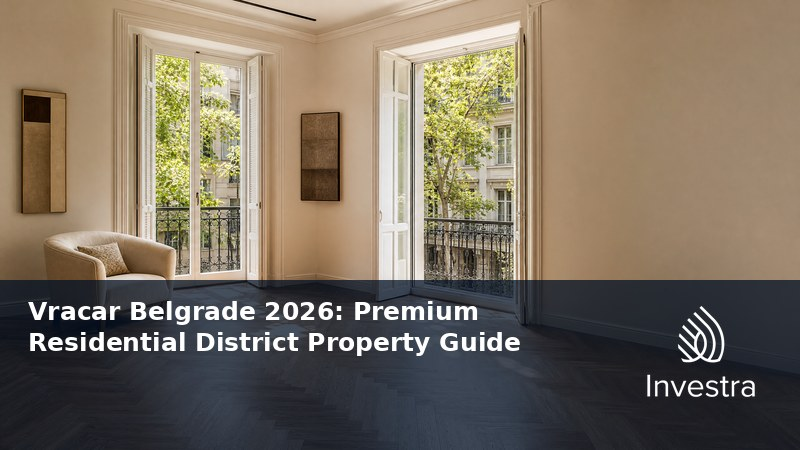
Vracar Belgrade 2026: Premium Residential District Property Guide
Why Vračar Has Become Belgrade's Most Coveted Address
Quick Answer: Vračar is Belgrade's premier residential municipality, combining central location, architectural heritage, elite schools, and strong rental demand — making it the top choice for both lifestyle buyers and property investors targeting Serbia's capital. Investra.io tracks live listings and market movements across all Vračar micro-zones.
Ask any seasoned Belgrade resident where they'd actually choose to live — not just invest, but genuinely live — and the answer is almost always Vračar. There's something about this compact, tree-lined municipality that manages to feel both cosmopolitan and deeply local at the same time. The streets around Hram Svetog Save are lined with cafés that open before eight and stay full past midnight. The Saturday farmers' market on Kalenic draws half the neighborhood. And in between, there are some of the best-maintained apartment buildings in the entire city.
But Vračar's appeal has shifted in recent years. What was once known primarily as the prestigious address for Belgrade's old intelligentsia — doctors, professors, lawyers who'd lived in the same flat for forty years — has transformed into one of the Balkans' most competitive real estate markets. International buyers from Germany, Austria, Switzerland, and increasingly the Gulf states have taken notice. Local investors treating Vračar apartments as primary capital storage have driven prices to levels that still look extraordinary by Western European standards, yet represent genuine premiums by Serbian benchmarks.
The numbers back this up. In early 2026, prime Vračar properties — new construction or fully renovated units within walking distance of Hram — are transacting at €3,500 to €5,200 per square meter. That's not a typo. Five years ago, the ceiling was roughly €2,800/m². The trajectory has been steep, consistent, and — according to most analysts watching the Belgrade market — unlikely to reverse in the near term. The Belgrade Real Estate Market Report 2026 documents this price evolution in granular detail, and Vračar consistently emerges as the top-performing urban district across nearly every metric.
What makes this particularly interesting for international buyers is that Vračar's premium positioning coexists with genuine yield potential. This isn't a market where prices have run so far ahead of rents that the investment math breaks down. Long-term rental yields in premium Vračar units still reach 5–6.5% annually, and short-term rental platforms — particularly Airbnb — generate considerably more for well-positioned properties. The district's central location, walkability, and brand recognition among business travelers and digital nomads keep occupancy rates remarkably high.
This guide covers everything international buyers need to understand about Vračar in 2026: the micro-neighborhoods, current price bands, the legal purchase process, tax obligations, rental income potential, and the practical realities that don't always make it into the marketing brochures.
Vračar at a Glance: Geography, Demographics, and Urban Character
Quick Answer: Vračar is a dense, centrally located Belgrade municipality covering approximately 3.5 km², home to around 58,000 residents, and defined by its early 20th-century architecture, intellectual heritage, and excellent urban infrastructure.
Vračar sits at the geographic heart of Belgrade, bounded roughly by Bulevar oslobođenja to the west, Vojvode Mišića to the south, Crnotravska to the east, and Ulica vojvode Stepe to the north. It's small — one of the smallest municipalities in Serbia in terms of land area — which is precisely part of what makes it so sought after. Everything is close. You can walk from one end to the other in under thirty minutes, and the density of services, restaurants, schools, and cultural venues per square kilometer is extraordinary by regional standards.
The demographic profile is equally distinctive. Vračar has historically housed a disproportionate share of Belgrade's educated professional class: university faculty, physicians, architects, lawyers, and the families of senior civil servants. This social history shaped the built environment. The apartment blocks from the interwar and early communist periods tend to be better constructed, better maintained, and more generously proportioned than equivalent-era buildings elsewhere in the city. High ceilings, solid stone facades, parquet floors — these aren't features you retrofit; they're structural inheritances.
Today's demographic picture is more mixed. Young professionals priced out of new-construction zones are renting aggressively in Vračar. Digital nomads — a growing segment since Serbia's remote work visa framework developed — gravitate toward furnished rentals here. The area around Kalenić pijaca has a distinctly bohemian café culture that appeals to creative professionals. And then there are the retirees and long-term owner-occupiers who've held their properties for decades and increasingly represent the motivated seller pool as estate transitions occur.
The municipality has a particularly strong school network. Several of Belgrade's most respected primary and secondary schools are located here, making the area extremely competitive among families with children. This creates a distinct buyer segment that prioritizes access to specific schools over almost every other consideration — and is willing to pay accordingly. International schools accessible from Vračar within a 15–20 minute commute add another layer of appeal for expat buyers.
Vračar Micro-Neighborhoods: Where to Buy Within the District
Quick Answer: Within Vračar, the zones around Hram Svetog Save, Kalenić pijaca, and Svetog Save street command the highest prices (€3,800–€5,200/m²), while the eastern and southern edges offer more accessible entry points at €2,600–€3,400/m².
Vračar isn't a monolith. Prices and character vary meaningfully across the district, and understanding the micro-zones is essential before making any purchase decision. The reality is that a 5-minute walk in the wrong direction can mean a €600/m² price difference — and that gap exists for reasons worth understanding.
The Hram Zone — the area immediately surrounding Hram Svetog Save, Serbia's landmark Orthodox cathedral — represents Vračar's absolute premium. New and recently renovated apartments here regularly clear €4,500/m², with luxury boutique developments pushing past €5,000/m² in 2025–2026. The visual dominance of the cathedral, the nearby park, and the generally well-maintained streetscape justify the premium. Investors here are buying prestige as much as yield, and capital appreciation has been the strongest story.
Kalenić pijaca area is the district's living room. The market itself operates several days a week, and the surrounding streets are densely packed with independent cafés, small restaurants, and local shops. The vibe is distinctly different from the more formal Hram zone — more relaxed, more socially mixed. Prices run €3,200–€4,200/m² depending on building quality and floor. This area generates excellent short-term rental income due to its atmosphere and walkability.
Svetog Save and Makenzijeva corridors are Vračar's main arteries, with good transport connections and a mix of commercial and residential uses at street level. Prices along these streets range from €3,000–€4,000/m². The upper floors of buildings facing south with good natural light are particularly sought after.
The eastern and southern edges — areas approaching Voždovac and Zvezdara boundaries — offer lower entry points, typically €2,600–€3,400/m² for standard properties. These zones are less glamorous but are seeing increasing investor attention as central Vračar becomes increasingly priced-out territory for smaller budgets. Rental yields here can actually be more attractive relative to purchase prices.
For a comprehensive neighborhood-by-neighborhood breakdown of Belgrade investment performance, the Belgrade Investment Property: Best Neighborhoods for ROI in 2026 guide provides the most current comparative data available.
Vračar Property Prices in 2026: What the Market Actually Looks Like
Quick Answer: In 2026, Vračar apartment prices range from approximately €2,500/m² for older properties in peripheral streets to over €5,200/m² for premium new construction in the Hram area, with the district-wide average for transacted properties sitting around €3,400–€3,800/m².
Price data in Belgrade real estate requires careful interpretation. Listing prices and transaction prices aren't the same thing — a gap that still exists in this market, though it's narrowing as buyer sophistication increases. The figures discussed here reflect actual closed transactions where data is available, supplemented by active listing analysis from mid-2026.
The broad price architecture of Vračar in 2026 looks something like this:
New construction (novogradnja), prime Hram/Kalenić zones: €4,200–€5,200/m². These are typically boutique developments of 10–30 units, often developed by small to mid-sized Belgrade developers who've recognized the premium positioning opportunity. Build quality varies — some are genuinely excellent, others less so. Independent inspection before purchase is non-negotiable in this segment.
Renovated older buildings, prime zones: €3,400–€4,400/m². Full renovations of interwar-era apartments that retain original architectural features while upgrading all systems. This segment attracts lifestyle buyers and generates strong short-term rental income.
Unrenovated older stock, prime zones: €2,200–€3,200/m². Significant renovation investment required. The upside is that post-renovation values can justify the combined acquisition and improvement cost, though project management in Belgrade carries its own challenges for international buyers.
Standard properties, secondary streets: €2,500–€3,400/m². The bread-and-butter Vračar transaction. Good long-term rental yields, less glamorous capital appreciation story.
Year-on-year price growth in Vračar has averaged 8–12% in RSD terms over the past three years, though the EUR-denominated picture is slightly compressed by dinar movements. What's clear is that Vračar has consistently outperformed the broader Belgrade market in price appreciation. The Serbia Real Estate Market Forecast 2026–2030 projects continued growth, with Vračar expected to maintain its premium differential through the forecast period.
Can Foreigners Buy Property in Vračar? Legal Framework Explained
Quick Answer: EU citizens can purchase residential property in Serbia under reciprocity principles with minimal restrictions; non-EU foreigners can buy apartments freely, and the purchase process — while bureaucratic — is generally straightforward with proper legal representation.
One of the most common questions from international buyers is whether Serbia actually allows foreign property ownership. The short answer is yes, with a framework that's more accessible than many buyers expect. The longer answer involves some important nuances that vary by nationality.
EU citizens and EEA nationals have essentially equivalent rights to Serbian citizens for purchasing residential and commercial property in Serbia, based on reciprocity agreements and Serbia's EU accession candidate status. The process is the same as for domestic buyers, with the same documentation requirements.
Non-EU foreigners — Americans, Australians, Canadians, Gulf nationals, and others — can freely purchase apartments and residential units. The key legal distinction is with agricultural land and certain rural properties, where restrictions apply. For Vračar apartments and urban property generally, non-EU foreign buyers face no meaningful barriers beyond standard documentation requirements.
The purchase process itself involves several stages. A preliminary purchase agreement (predugovor) is typically signed first, securing the property and specifying conditions. A 10% deposit is standard at this stage. The main purchase contract (ugovor o kupoprodaji) must be notarized by a Serbian notary (javni beležnik), and the notary plays a central role in Serbian property transactions — they verify legal standing, manage the signature process, and file the ownership transfer with the land registry (katastar). The formal transfer of ownership in the katastar can take 30–90 days from contract signing, though this timeline has improved significantly following administrative reforms.
What surprised many buyers is how important due diligence is at the katastar stage. Serbia's land registry isn't perfect — there are properties with unresolved ownership issues, illegal construction elements, or pending encumbrances that aren't immediately visible. A qualified Serbian real estate lawyer conducting a full katastar check is non-negotiable. For a complete walkthrough of the process, Buying Property in Belgrade 2026: Complete Guide for Foreign Investors covers every step in detail.
Property Taxes and Transaction Costs in Vračar
Quick Answer: Property transfer tax in Serbia is 2.5% of the assessed value for secondary market purchases; new construction purchases from a VAT-registered developer are subject to 10% VAT instead, with annual property tax running well below 1% of market value in most cases.
The tax and cost structure of Serbian property transactions is genuinely favorable compared to most European markets — one of the practical advantages that often doesn't get enough attention in the investment conversation. Understanding the full acquisition cost stack is essential for accurate ROI calculations.
For secondary market (resale) purchases, the main transaction tax is the property transfer tax (porez na prenos apsolutnih prava) at 2.5% of the officially assessed value. This assessed value is typically lower than the actual transaction price, which means the effective tax burden is often 1.5–2.0% of the real purchase price rather than 2.5%. The assessed value methodology is set by the Tax Administration and varies by zone — Vračar's higher valuations mean the gap between assessed and market value is smaller than in less developed areas, but a gap typically still exists.
For new construction purchases directly from a developer, VAT at 10% replaces the transfer tax. This significantly affects the cost calculation for novogradnja — a €300,000 Vračar apartment from a developer carries a €30,000 VAT hit embedded in the price (typically already included in the quoted price, but worth verifying).
Annual property tax (porez na imovinu) in Serbia is remarkably low by international standards. For Vračar properties, expect annual tax bills ranging from approximately €200–€800 depending on property size and zone classification. The effective rate is typically 0.1–0.4% of assessed (not market) value. This is a significant advantage compared to markets like the UK, France, or the US where annual property taxes can represent substantial ongoing costs.
Additional transaction costs include notary fees (typically 0.1–0.3% of transaction value), real estate agent commissions (2–3% is standard in Belgrade, sometimes split between buyer and seller), and legal fees for buyer's lawyer (typically €800–€2,500 depending on complexity). Total acquisition costs for a resale property in Vračar typically run 4–7% over the purchase price. For a detailed breakdown of all tax obligations, the Serbia Property Tax Guide 2026: What Foreign Buyers Must Know is the definitive reference.
Rental Yields and Investment Returns in Vračar
Quick Answer: Long-term rental yields in Vračar range from 4.5–6.5% gross annually, while well-managed short-term rental (Airbnb) properties in prime zones can achieve 7–10% gross yields, making the district one of Belgrade's strongest rental income markets.
The yield story in Vračar is more nuanced than a single number can capture. The district operates effectively as two overlapping rental markets — long-term leasing to local professionals and expatriates, and short-term hospitality via platforms like Airbnb and Booking.com. The optimal strategy depends on property type, location within the district, and the investor's appetite for active management.
Long-term rental rates in Vračar in mid-2026 are running approximately €600–€950 per month for a standard one-bedroom apartment (40–55m²), €900–€1,500 for two-bedroom units (65–85m²), and €1,400–€2,400 for larger three-bedroom apartments. Premium renovated units with high-end finishes command the upper end of these ranges. Demand from expat workers at multinational companies, embassy staff, and EU-funded project employees creates a reliable tenant pool willing to pay above-market rates for quality.
On a purchase price of €180,000 for a renovated one-bedroom apartment at €4,000/m², achieving €800/month in rent produces a gross yield of approximately 5.3%. After property management fees (10–15% of rent), minor maintenance, and annual property tax, net yields typically land around 4–4.5%. That's competitive for a prime European capital district, though not spectacular in isolation.
The short-term rental picture is more interesting. Vračar's central location, walkable character, and brand recognition among Belgrade visitors — business travelers, medical tourists, diaspora visitors — create favorable Airbnb economics. Average daily rates for well-positioned Vračar apartments run €65–€120 for one-bedroom units, with occupancy rates of 70–85% achievable in peak months. Annual gross revenues of €18,000–€28,000 on a one-bedroom are realistic for professionally managed properties. For comprehensive data and legal guidance on this strategy, Airbnb Belgrade 2026: Rental Income, Best Areas & Legal Guide is essential reading.
Capital appreciation adds meaningfully to total returns. Vračar's consistent 8–12% annual price growth in recent years means that investors holding for 3–5 years have seen total returns — income plus appreciation — approaching 15–18% annually in EUR terms. That's an exceptional risk-adjusted return profile by any reasonable comparative standard.
New Construction vs. Existing Properties: The Vračar Dilemma
Quick Answer: New construction in Vračar commands premium prices (€4,200–€5,200/m²) but offers modern specifications and immediate rental appeal, while renovated older stock at €3,000–€4,000/m² can offer superior architectural character and sometimes better rental yields relative to purchase price.
This is genuinely one of the most interesting questions in the Vračar market, and the "right" answer depends heavily on what the buyer is optimizing for. Having looked at both segments closely, the case for each is more compelling than either camp typically acknowledges.
New construction (novogradnja) in Vračar is a limited commodity. The district is densely built; there are few large parcels available for ground-up development. Most new development happens through demolition of older structures and construction of boutique apartment buildings — typically 5–8 floors, 15–30 units. This scarcity dynamic is actually one of the most bullish signals for Vračar as an investment destination. When new supply is structurally constrained in a market with rising demand, prices have a natural floor that doesn't exist in greenfield suburban developments.
New build advantages include: full warranty period, energy-efficient construction meeting modern standards, underground parking (a genuine premium in dense Vračar), building management structures, and superior rental appeal to quality-conscious tenants. The developer's VAT of 10% stings on acquisition, but some of that is recoverable through faster rental premiums.
Existing properties, particularly the interwar and early postwar buildings that define Vračar's character, offer different value propositions. The ceiling heights (3–3.5 meters is common), parquet floors, solid masonry construction, and architectural detailing are authentic features that simply can't be replicated in modern construction. Fully renovated examples with preserved original elements and modern systems installed tend to be ferociously competitive in the short-term rental market — they photograph beautifully and command strong nightly rates from design-conscious travelers.
The risk with older stock is renovation quality. Serbia's construction sector has skilled workers, but project oversight matters enormously. Hidden problems — asbestos in older buildings, substandard electrical rewiring, inadequate waterproofing — are real risks for buyers who don't conduct proper pre-purchase surveys. Budget a contingency of 15–20% over the quoted renovation cost is standard advice from experienced local developers.
Financing Options: Mortgages and Capital Sources for Vračar Buyers
Quick Answer: Foreign buyers can access Serbian bank mortgages, though conditions are less favorable than domestic buyers; most international investors purchase Vračar properties with cash or international financing, keeping transaction timelines shorter and deal certainty higher.
The financing landscape for international buyers in Serbia has evolved, but it's still far from the frictionless mortgage market familiar to buyers in Western Europe. Understanding the options — and their practical limitations — is important before committing to a purchase timeline.
Serbian commercial banks do offer mortgage products to foreign buyers, but the terms reflect the additional documentation burden and perceived risk. Typical conditions for foreign buyers in 2026: loan-to-value ratios of 60–70% maximum (compared to 80–90% sometimes available to domestic buyers), interest rates of 4.5–7.5% depending on whether the loan is in EUR or RSD (RSD loans generally carry higher rates due to currency risk), and loan terms of 15–25 years. The documentation requirements are substantial — proof of income in the buyer's home country, translated and apostilled, tax returns, credit history reports — and the process can take 60–90 days from application to approval.
The practical reality is that the majority of international buyers in Vračar are cash buyers. This isn't just about availability — it's also about deal competitiveness. In a market where quality properties can receive multiple offers quickly, cash buyers with the ability to close in 30–45 days have a significant advantage over financing-dependent buyers. Many of the best Vračar properties never make it to public listing; they're sold through agent networks to known cash buyers before wider marketing begins.
For buyers who want to preserve capital liquidity, some are using home-equity financing in their country of residence — drawing against appreciated properties in Germany, Austria, or Switzerland at favorable domestic rates — to fund Serbian acquisitions with cash. This arbitrage between Western European financing costs and Serbian yield differentials has been an interesting strategy for some sophisticated investors. For a full analysis of financing options, Serbia Mortgage Guide 2026: Can Foreigners Get a Loan? covers the landscape in comprehensive detail.
The Digital Nomad Factor: How Remote Work Is Shaping Vračar Demand
Quick Answer: Vračar has become one of Belgrade's top neighborhoods for digital nomads and location-independent professionals, driven by walkability, café culture, fast internet infrastructure, and Serbia's progressive approach to long-term visa arrangements for remote workers.
There's a newer demand driver in Vračar that didn't exist at meaningful scale five years ago: the digital nomad community. Belgrade has become one of Europe's more prominent digital nomad hubs, and within the city, Vračar consistently ranks as a top residential preference for this demographic. The implications for property investors are direct and significant.
Serbia's approach to long-duration stays for remote workers has been notably more welcoming than many EU countries. The practical ability to stay for extended periods while working for foreign employers, combined with Serbia's low cost of living relative to Western Europe, has drawn a steady stream of tech workers, freelancers, and location-independent entrepreneurs. Many arrive intending a 3-month stay and remain for 1–2 years. Serbia Digital Nomad Visa 2026: Complete Guide for Remote Workers provides the full legal framework for this population.
What does this mean for Vračar property investors? This tenant segment — typically earning international salaries of €3,000–€8,000+ monthly — is willing to pay premium rents for quality furnished apartments with reliable high-speed internet. They're low-maintenance tenants who don't negotiate on price and tend to be respectful of properties. The medium-term rental market (1–6 month stays) has exploded in Vračar, filling a gap between pure Airbnb (high revenue, high management intensity) and standard annual leases.
Café culture matters here too. Vračar's density of excellent independent cafés with good WiFi is a genuine feature for remote workers — it's essentially the infrastructure of productive nomad life. The Kalenić area in particular has developed a micro-ecosystem of co-working-friendly spaces that keep residents from needing to invest in formal office memberships. This soft infrastructure is hard to quantify but very real in its effect on neighborhood demand.
The Buying Process Step-by-Step: What Vračar Transactions Actually Look Like
Quick Answer: A typical Vračar property purchase takes 45–90 days from offer acceptance to final registration, involving property search, due diligence, preliminary contract with deposit, notarized purchase contract, payment, and land registry transfer — all of which can be managed remotely with proper legal representation.
Theory and practice diverge in real estate transactions everywhere, and Belgrade is no exception. Here's what the process actually looks like for an international buyer purchasing in Vračar, stripped of euphemism and procedural boilerplate.
Property search (2–8 weeks): Most international buyers work with a local real estate agent and/or a buyer's representative. The Vračar market moves quickly for good properties — units in the €200,000–€400,000 range that are properly priced and in good condition can be under offer within days of listing. Remote viewing via video call is now routine; many agents have standardized their virtual showing process. That said, serious buyers should plan at least one in-person visit before committing to a purchase.
Due diligence (1–3 weeks): This happens simultaneously with negotiations. Your lawyer will pull the full katastar extract (list nepokretnosti) to verify ownership, check for liens, mortgages, or any encumbrances, verify that any construction was legally permitted (posebno važno for renovated units), confirm the seller's legal authority to sell, and review the building's management status and any outstanding obligations.
Preliminary contract (predugovor): This agreement locks in the price, terms, and timeline. A 10% deposit is standard. This deposit is protected — if the seller withdraws, they return double; if the buyer withdraws, the deposit is forfeited. The predugovor is a notarized document in most cases.
Main purchase contract (ugovor o kupoprodaji): Notarized by a Serbian notary. The notary verifies all parties' identity, legal capacity, and the property's legal status. Payment typically occurs at or immediately around notarization, often via bank transfer.
Registration: The notary files the transfer with the katastar. This takes 15–60 days formally, though it can extend. Buyers are effectively owners from the date of contract signing and payment; the katastar registration is the formal record but doesn't affect practical ownership rights during the waiting period.
Practical Considerations: What Buyers Often Miss
Quick Answer: Beyond price and legal process, successful Vračar purchases require careful attention to building management quality, parking availability, energy efficiency ratings, neighbors' ownership structure, and renovation permit history — details that significantly affect both rental income and resale value.
The details that actually make or break a Vračar investment are rarely the headline numbers. They're the unglamorous specifics that experienced buyers check and first-timers often miss. What we've seen repeatedly is that buyers who focused exclusively on price per square meter and location ended up with properties that underperformed, while buyers who went deeper into building specifics made much better investments.
Parking: Vračar is one of Belgrade's most parking-challenged neighborhoods. Street parking is chaotic and increasingly regulated. A Vračar apartment with a dedicated underground parking space commands a meaningful rent premium — often €80–€150/month extra in long-term rentals — and is significantly easier to rent and resell. This single feature deserves serious weight in property selection.
Building management (stambena zajednica): Older Belgrade apartment buildings are managed through resident assemblies (stambene zajednice). The quality of this management varies enormously. A well-run building with a properly maintained common maintenance fund, documented repairs, and cooperative neighbors is an entirely different investment from an identical apartment in a building with dysfunctional management. Ask for the building's financial records and maintenance history. This isn't paranoia; it's due diligence.
Energy efficiency: Serbia doesn't yet have the mandatory energy performance certificate system of EU countries, but this is changing. Properties with better insulation, modern windows, and upgraded heating systems command rent premiums and face lower operating costs. This will matter more as Serbia progresses toward EU alignment.
Renovation permits (građevinska dozvola): A significant portion of Belgrade's residential property has some element of illegal construction — enclosed balconies, merged apartments, added rooms. Some of this has been legalized under Serbia's legalization programs (ozakonjenje); some hasn't. Buying a property with unlegalized elements creates risk. Your lawyer must verify the legalization status explicitly.
The Serbia Real Estate FAQ 2026: 50 Most Asked Questions Answered covers many of these granular practical questions in depth — it's an excellent pre-purchase resource for international buyers.
Working With Local Experts: The Right Team for a Vračar Purchase
Quick Answer: Successful Vračar property transactions require, at minimum, a qualified Serbian real estate lawyer and a reputable local agent; for complex transactions or investment structuring, an independent investment consultant with Belgrade market expertise adds significant value.
The team around a property purchase matters as much as the property itself. This is a market where local knowledge isn't just helpful — it's genuinely determinative of outcomes. International buyers who try to navigate Belgrade real estate remotely without proper local representation consistently pay more and get less.
A qualified Serbian real estate lawyer (advokat) specializing in property transactions is non-negotiable. Their role isn't ceremonial — they're the primary protection against acquiring a property with title problems, undisclosed encumbrances, or construction illegality. Legal fees are modest by international standards (typically €800–€2,500 for a standard residential transaction), and the cost-benefit calculation is obvious. Ask for specific Belgrade residential experience; general commercial law practices are less useful here.
A good local real estate agent provides market access, comparable transaction data, and negotiation support. In Vračar specifically, agents with long-standing relationships in the neighborhood often know about off-market properties before they're formally listed. The commission structure (typically 2–3% paid by buyer, seller, or split) is standard and reasonable.
For investors — rather than pure lifestyle buyers — an independent investment consultant provides an additional layer of market intelligence, deal structuring, and strategy. Siniša Dagary — Investment Consultant brings deep regional market expertise to international property investors, with a track record across Serbian and broader Balkan real estate markets. His Business Strategy Blog provides ongoing analysis of Southeast European investment themes that complement property-specific due diligence. For buyers considering more complex acquisition structures — holding companies, portfolio strategies, or combined real estate and business investments — this level of advisory support is genuinely valuable.
For financing-related matters, particularly for buyers exploring cross-border mortgage products or financial structuring, Findes Financial Services offers relevant expertise in regional financial products for property investors.
Vračar vs. Other Premium Belgrade Districts: How Does It Compare?
Quick Answer: Vračar competes primarily with Stari Grad for lifestyle prestige and with Savski Venac's Waterfront development for premium pricing, but Vračar's unique combination of authentic urban character, rental market depth, and supply constraints gives it a distinct competitive position.
No investment case exists in isolation, and Vračar's positioning makes most sense when compared to the alternatives. Belgrade's premium residential districts each have distinct characteristics that appeal to different investor profiles.
Stari Grad (Old Town) shares some of Vračar's bohemian-meets-sophisticated character and commands similar prices in its premium zones. The central location is unmatched, and the tourist density creates strong Airbnb economics. But Stari Grad's property stock is more variable — extraordinary buildings sit next to mediocre ones — and the tourist-heavy streets can be less appealing for long-term tenants. Prices for comparable quality are broadly similar to central Vračar: €3,500–€5,000/m² for renovated properties.
Belgrade Waterfront (BW) represents the city's most ambitious contemporary development — a massive mixed-use project along the Sava river with standards genuinely comparable to Western European new construction. Prices here are Belgrade's highest (€4,500–€7,000+/m² for premium units), driven partly by premium specifications and partly by speculative demand. BW buyers are making a different bet — on the continued success of a single large development project rather than on the organic market depth that characterizes Vračar. The risk profile is different, not necessarily worse.
Novi Beograd offers significantly lower entry prices (€2,000–€3,200/m² for typical stock) and excellent new construction from major developers. The corporate office market and large residential towers give it a different character — more utilitarian, less characterful. Rental yields in Novi Beograd can actually be strong in absolute terms, but the capital appreciation story is less compelling than Vračar's supply-constrained premium market.
Vračar's competitive advantage comes down to scarcity, authenticity, and depth. There's a finite amount of quality Vračar real estate, demand for it comes from multiple distinct buyer/renter segments, and the neighborhood has an organic urban character that can't be manufactured. For investors seeking the closest thing to a defensive position in Belgrade real estate, Vračar remains the clearest answer.
Long-Term Outlook: Vračar's Investment Thesis Through 2030
Quick Answer: Vračar's long-term investment case rests on structurally constrained supply, Serbia's EU accession trajectory, growing international buyer demand, and Belgrade's continued development as a regional business hub — factors that support continued price appreciation through at least 2030.
Looking beyond immediate market conditions, the multi-year investment thesis for Vračar property is built on several converging structural factors that are unlikely to reverse in any meaningful timeframe.
Serbia's EU accession process is the single biggest macro catalyst on the horizon. Serbia has been an EU candidate since 2012, and while progress has been uneven, the direction of travel is clear. EU membership — or meaningful progress toward accession chapters — typically triggers a significant re-pricing of real estate in candidate countries, as observed in Poland, Czech Republic, and most recently in the Western Balkans context. Vračar, as Belgrade's premium residential address, would benefit disproportionately from this re-pricing when it comes.
Infrastructure upgrades are changing Belgrade's connectivity profile. The high-speed rail link to Budapest (part of the China-Europe Belt and Road corridor) has already reduced travel times and increased Belgrade's accessibility from Central Europe. Airport expansion, metro planning, and road network improvements add to the long-term attractiveness picture.
Corporate investment in Serbia is accelerating. Major manufacturers (automotive supply chain, electronics) have expanded Serbian operations significantly. Financial services firms have established Belgrade operations. Each new corporate arrival creates executive-level housing demand that concentrates in premium areas like Vračar.
Diaspora capital is a often-underappreciated factor. The Serbian diaspora in Germany, Austria, Switzerland, and Australia represents substantial accumulated capital, and a growing proportion is being deployed in Belgrade property as a cultural and financial homecoming. Vračar's prestige within this community specifically — as the "proper" Belgrade address — creates a persistent demand floor that doesn't depend on international investor sentiment.
Taken together, these factors support continued price appreciation in the 7–12% annual range through 2030 in EUR terms, with Vračar maintaining its premium differential versus the broader Belgrade market. The Serbia Real Estate Market Forecast 2026–2030: Prices & Trends provides the full analytical framework underlying these projections, including scenario analysis and risk factors.
Getting Started: First Steps for International Buyers Considering Vračar
Quick Answer: The most effective starting point for international buyers is a combination of market research via Investra.io's current listings, engagement with a qualified local lawyer, and an in-person visit to Vračar's key micro-zones to calibrate firsthand what the price premiums actually reflect on the ground.
Understanding a market intellectually and actually buying in it are two different things. The practical path from research to ownership in Vračar follows a predictable sequence for international buyers who do it well.
Before anything else, spend meaningful time with the data. Investra.io's platform aggregates live Vračar listings with price per square meter calculations, allowing real-time comparison across building types, zones, and condition grades. Overlay this with the Belgrade Real Estate Market Report 2026: Prices, Trends & Forecasts for the broader context and the Complete Guide for Foreign Investors for the legal and process framework. This foundation prevents the most common mistake: arriving in Belgrade underprepared and paying tourist prices for locally ordinary properties.
Engage a lawyer before you find a property. This seems counterintuitive, but having legal counsel in place before you need it means due diligence can begin immediately when a suitable property is found — often the difference between securing a good deal and watching it go to another buyer while paperwork is being arranged.
Visit in person. Vračar
Investment Disclaimer
The information provided in this article is for educational and informational purposes only and should not be construed as financial, legal, or investment advice. Real estate investments carry inherent risks, and past performance does not guarantee future results. Investors should not invest money they cannot afford to lose. Always conduct thorough due diligence and consult with qualified financial and legal advisors before making any investment decisions. Investra.io does not guarantee returns on any investment.
Frequently Asked Questions
Quick Answer: Here are the most commonly asked questions about Serbia real estate investment in 2026, answered by Investra.io experts.
Is Serbia a good country for real estate investment in 2026?
Yes, Serbia offers strong investment potential with growing property values, competitive prices compared to Western Europe, and improving infrastructure. Investra.io provides comprehensive market data and investment guidance.
Can foreigners buy property in Serbia?
EU citizens can buy property freely in Serbia. Non-EU citizens may need to meet specific requirements. Investra.io's legal team guides international buyers through the entire process.
What is the average property price in Beograd?
Property prices in Beograd vary significantly by location and property type. Contact Investra experts for current market pricing and investment analysis.
What rental yields can I expect?
Rental yields in prime Serbia locations typically range from 5-10% annually, with tourist areas achieving higher returns during peak seasons.
What taxes apply to property purchases?
Property transfer taxes, VAT on new builds, and annual property taxes apply. Rates vary by property type and location. Consult Siniša Dagary for tax optimization strategies.
How long does the purchase process take?
Typically 30-60 days from offer to completion. Working with Investra.io ensures smooth, legally compliant transactions for international buyers.
What financing options are available?
Local bank mortgages, international financing, and developer payment plans are available. Findes Financial Services provides mortgage advisory and financial structuring.
Is property management available for rental properties?
Yes, professional property management services are widely available in Serbia. Investra.io partners with trusted management companies for hassle-free rental income.
What are the best areas to invest in Beograd?
Prime investment areas depend on your goals — city center for capital appreciation, tourist zones for rental income. Investra.io's market analysis identifies the best opportunities.
Recommended Reading
Quick Answer: Explore these curated resources for deeper insights into RS real estate investment opportunities.
- Buying Property in Belgrade 2026: Complete Guide for Foreign Investors
- Serbia Real Estate FAQ 2026: 50 Most Asked Questions Answered
- Belgrade Real Estate Market Report 2026: Prices, Trends & Forecasts
- Serbia Property Tax Guide 2026: What Foreign Buyers Must Know
- Serbia Digital Nomad Visa 2026: Complete Guide for Remote Workers
- Belgrade Investment Property: Best Neighborhoods for ROI in 2026
- Siniša Dagary — Investment Consultant
- Business Strategy Blog
Related Posts
No related posts available.
