
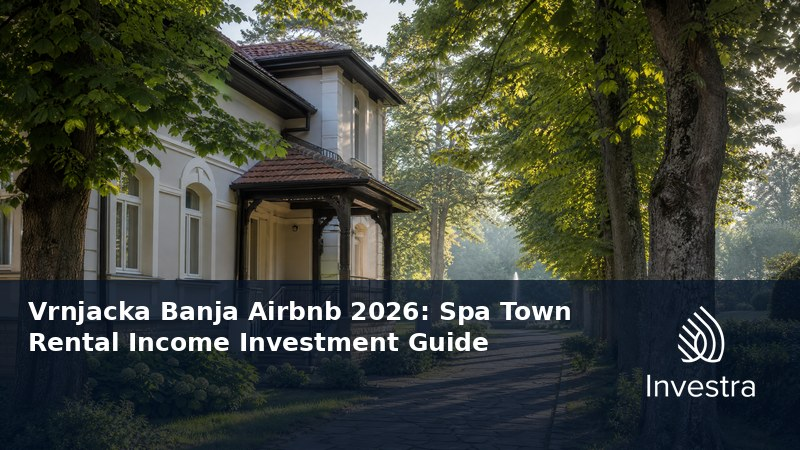
Vrnjacka Banja Airbnb 2026: Spa Town Rental Income Investment Guide
Why Vrnjačka Banja Is Becoming Serbia's Most Exciting Short-Term Rental Market
Quick Answer: Vrnjačka Banja is Serbia's premier spa town and a rapidly growing short-term rental hotspot, where Airbnb investors are achieving gross rental yields of 7–11% annually — significantly outperforming many Western European markets. Serbia Real Estate Market Forecast 2026–2030 confirms the town's trajectory as one of the Balkans' most compelling wellness tourism destinations.
There's a moment, usually early on a Tuesday morning when the mineral springs are still quiet, when you understand exactly why Vrnjačka Banja has been drawing visitors for over a century. The air smells faintly of sulfur, the promenade is lined with chestnut trees, and elderly locals mingle with business travelers who've discovered that a Serbian spa town offers something increasingly rare in Europe: genuine relaxation at a fraction of the cost you'd pay in Baden-Baden or Bath.
But what's changed dramatically in recent years is who else is showing up — property investors. Smart money has started paying close attention to this Central Serbian gem, and the short-term rental numbers are starting to tell a very compelling story. Vrnjačka Banja welcomed over 400,000 visitors in 2024, a figure that has grown consistently year-on-year for the past six years. Hotel occupancy rates during peak summer months regularly exceed 85%, and yet Airbnb-style accommodation remains comparatively undersupplied. That's precisely the kind of gap that generates serious returns.
What follows is a comprehensive guide to investing in Airbnb and short-term rental properties in Vrnjačka Banja in 2026 — covering property prices, rental income projections, the legal framework, taxation, the best neighborhoods, and everything else an international investor needs to know before writing a cheque.
Vrnjačka Banja at a Glance: Understanding the Destination
Quick Answer: Vrnjačka Banja is Serbia's most visited spa town, located 200km south of Belgrade in the Rasina District, combining mineral springs, cultural events, and mountain scenery to attract a diverse year-round tourist demographic that sustains strong short-term rental demand.
Before you invest in a destination, you need to truly understand it. Vrnjačka Banja sits at roughly 220 meters above sea level in the foothills of Goč Mountain, surrounded by dense forests and bisected by the Vrnjačka River. The town's fame rests on its six mineral springs, each with distinct chemical compositions and alleged health benefits ranging from digestive relief to cardiovascular support. These aren't tourist gimmicks — the springs have been scientifically documented and attract genuine medical tourism from across the former Yugoslavia.
The population sits at around 27,000, but during peak summer the town swells to several times that figure. What's particularly interesting for rental investors is the visitor mix. You have traditional spa guests — predominantly Serbian, Bosnian, and Montenegrin seniors on week-long wellness retreats — alongside a rapidly growing cohort of younger visitors drawn by the town's reputation for cultural events. The Vrnjačka Banja Rose Festival, the International Children's Book Fair, and a summer theatre program have rebranded the town as a cultural destination, not just a health resort.
The infrastructure has kept pace. The main promenade underwent significant renovation between 2020 and 2023, new restaurants and wine bars have opened, and the surrounding road network connecting to the Ibarska Highway has improved travel times from Belgrade to approximately 2.5 hours by car. There's also a growing cycling and hiking culture, with marked trails into Goč Mountain attracting active tourists who want wellness in a different sense than thermal baths.
The reality is that Vrnjačka Banja benefits from year-round demand in a way that pure beach destinations don't. Summer peaks are intense, but autumn brings wine-harvest tourism, winter draws wellness seekers escaping urban stress, and spring sees the rose festival draw large crowds. For an Airbnb investor, that seasonality profile is considerably more attractive than a coastal property that sits empty from October to April.
Property Prices in Vrnjačka Banja 2026: What the Market Looks Like
Quick Answer: Property prices in Vrnjačka Banja range from €1,200 to €2,800 per square meter in 2026, depending on location, build quality, and proximity to the spa promenade — making it one of Serbia's most affordable tourist real estate markets with significant upside potential.
Let's talk numbers, because this is where Vrnjačka Banja genuinely surprises most international investors. Compared to comparable spa and wellness destinations in Slovenia, Croatia, or Hungary, the entry prices here are still remarkably accessible. The market hasn't fully repriced to reflect the tourism growth, which is both an opportunity and a window that won't stay open indefinitely.
The price landscape breaks down roughly as follows in 2026:
Central Promenade Zone: The most sought-after addresses, within walking distance of the main springs and the pedestrian promenade, command €2,200–€2,800/m². New construction here is limited due to planning restrictions, which means well-positioned existing properties in this bracket carry genuine scarcity value. A 45m² one-bedroom apartment in this zone will typically cost €99,000–€126,000.
Mid-Town Residential: Moving slightly away from the promenade but still within comfortable walking distance of the main attractions, prices settle at €1,600–€2,100/m². This is where many savvy investors are focused — the pricing is gentler but the rental appeal remains strong. A 55m² two-bedroom apartment here runs €88,000–€115,500.
Peripheral and Hillside Areas: The lower end of the market, €1,200–€1,600/m², reflects properties in areas requiring car access to the center. These suit budget-conscious buyers and can work well for longer-term rentals, though short-term Airbnb performance is notably weaker without walkability.
Prices have risen approximately 8–12% annually over the past three years, driven by increased domestic demand, returning diaspora buyers, and the early wave of foreign investors who spotted the opportunity. The Belgrade Real Estate Market Report 2026 contextualizes this growth within Serbia's broader property appreciation trend, which has consistently outpaced EU averages.
New-build developments from reputable Serbian developers are appearing in the mid-town zone at €1,800–€2,200/m², often including furnished packages designed specifically for short-term rental operators. These turnkey options are increasingly popular with foreign buyers who want a hands-off entry into the market.
Airbnb Rental Income in Vrnjačka Banja: Real Numbers for 2026
Quick Answer: A well-positioned Airbnb apartment in Vrnjačka Banja can generate gross annual rental income of €8,000–€18,000 depending on size and location, with peak summer nightly rates of €50–€120 and occupancy rates of 70–85% during the May-September high season.
Here's where the investment case becomes genuinely exciting. The gap between property prices and rental income in Vrnjačka Banja creates yield profiles that are difficult to find in most of Europe right now. What we've seen in the data from active listings on Airbnb, Booking.com, and local platforms tells a clear story.
A central one-bedroom apartment (40–50m²) with good reviews and professional photography is achieving:
Peak Season (June–August): €55–€90/night with occupancy rates of 80–90%. The town's major events, particularly the Rose Festival in May and various summer cultural programs, create premium nights where well-positioned properties command €100–€130/night.
Shoulder Season (April–May, September–October): €35–€55/night with occupancy of 55–70%. Autumn is actually strengthening as wine tourism from the surrounding Župa wine region pulls visitors who combine Vrnjačka Banja with vineyard visits.
Low Season (November–March): €25–€40/night with occupancy of 30–45%. This is notably stronger than beach destination seasonality because wellness and thermal tourism continues year-round — many guests specifically prefer the quieter winter atmosphere.
Running the annual numbers conservatively on a 45m² central apartment purchased at €110,000: peak season revenue of roughly €5,400, shoulder season of €3,600, and low season of €2,200 delivers a gross annual income of approximately €11,200. That represents a gross yield of 10.2%. Even after accounting for platform fees (typically 3% host fee on Airbnb), cleaning costs, utilities, property management (typically 15–20% of revenue), and maintenance reserves, net yields in the 6.5–8% range are achievable.
A two-bedroom apartment performing at the higher end of the market, particularly one that can accommodate families or groups, pushes gross revenues toward €15,000–€18,000 annually, with nightly rates running €75–€140 in peak season. For more context on how these figures compare to Belgrade's short-term rental market, the Airbnb Belgrade 2026: Rental Income, Best Areas & Legal Guide provides a useful benchmark.
Best Neighborhoods in Vrnjačka Banja for Airbnb Investment
Quick Answer: The Central Spa Zone and the Promenade Quarter are the top-performing neighborhoods for Airbnb investment in Vrnjačka Banja, offering maximum walkability to thermal springs and entertainment — the single biggest driver of short-term rental premium in the town.
Location within Vrnjačka Banja matters enormously for short-term rental performance. Unlike in larger cities where multiple neighborhoods might compete effectively, Vrnjačka Banja's tourism ecosystem is concentrated enough that proximity to the core promenade area creates a measurable premium in both occupancy and nightly rates.
Central Spa Zone (Centar): This is the prime investment territory — the 500-meter radius around the main springs and the pedestrian promenade. Properties here are scarce, prices reflect that scarcity, but so does performance. Guests booking Vrnjačka Banja are almost universally interested in the spa experience, and they'll pay a premium for the ability to walk to the springs in five minutes rather than taking a taxi. Occupancy rates in this zone are 10–15 percentage points higher than peripheral areas during shoulder seasons.
Promenade Adjacent (Šetalište Area): Slightly broader in scope but still offering easy walking access to the main attractions. This zone has seen the most active new development in recent years, with several residential-tourism hybrid projects completing between 2022 and 2025. The value proposition is strong — close enough to the center to command good Airbnb rates but at purchase prices that are 15–20% below the central premium.
Goč Road Corridor: Properties along the road leading toward Goč Mountain appeal to a different guest profile — hikers, nature tourists, and those seeking a more secluded stay. These can work well as premium nature retreats but require stronger marketing and typically show weaker mid-week occupancy than central properties.
Vila Quarter: A residential area with charming older villas that have been increasingly converted to boutique guesthouses. This zone suits investors interested in a different format — buying and renovating a small villa for a higher-end offering rather than a standard apartment play. Development costs are higher but so are achievable nightly rates, with boutique properties in this zone commanding €120–€200/night for the right product.
For those cross-referencing with Belgrade investment opportunities, Belgrade Investment Property: Best Neighborhoods for ROI in 2026 offers a useful comparative framework for neighborhood analysis methodology.
The Legal Framework for Short-Term Rentals in Vrnjačka Banja
Quick Answer: Short-term rentals are legal in Serbia and Vrnjačka Banja, but hosts must register as individual entrepreneurs or through a company, collect and remit tourist tax (currently 150–300 RSD per guest per night), and comply with Serbia's Law on Tourism and local municipal regulations.
The legal situation for Airbnb and short-term rentals in Serbia is considerably more straightforward than in many Western European cities currently battling platform accommodation. Serbia hasn't implemented blanket bans, night caps, or the kind of restrictive licensing regimes that have squeezed markets in Amsterdam, Barcelona, or Paris. That said, there's a clear legal framework that investors need to understand and comply with from day one.
Under Serbian law, anyone offering accommodation for remuneration must register with the relevant authorities. For foreign investors, this typically means either registering as a sole trader (preduzetnik) or establishing a Serbian company (d.o.o. — equivalent to a limited liability company). The registration process at the Serbian Business Registers Agency (APR) has been significantly streamlined in recent years and can be completed within a few days with the right professional assistance.
Tourist tax (boravišna taksa) is mandatory and applies to all paying guests. In Vrnjačka Banja, the rate is typically 150–300 RSD per person per night (approximately €1.30–€2.60), varying slightly by accommodation category. Hosts are responsible for collecting this tax and remitting it to the local municipality on a monthly basis. Failure to do so constitutes a regulatory violation, so proper bookkeeping from the outset is essential.
Properties offering accommodation must also meet minimum classification standards under the Law on Tourism. For apartments and rooms, this involves a self-assessment process registered with the Tourism Administration, which determines your official accommodation category (from one to five stars for apartments). A higher category rating isn't merely bureaucratic — it enables higher nightly rates on booking platforms and signals quality to guests.
The Buying Property in Belgrade 2026: Complete Guide for Foreign Investors covers the broader legal framework for foreign property buyers in Serbia, including ownership rights and the documentation process that applies equally to purchases in Vrnjačka Banja.
One practical note: while many small operators in Serbia have historically worked informally, the Tax Administration has significantly increased enforcement since 2023. Digital platforms are now required to share transaction data with Serbian tax authorities, meaning undeclared rental income carries real risk. Operating fully above-board isn't just legally correct — it's increasingly unavoidable.
Tax Obligations for Airbnb Hosts in Serbia: What You'll Actually Pay
Quick Answer: Airbnb hosts in Serbia operating as sole traders pay a flat income tax of 10% on net rental income, with additional social contributions of approximately 35.8% on a deemed minimum contribution base — though the effective tax burden on short-term rental income is typically 15–25% of gross revenue depending on structure and expenses.
Tax is where many investors either get pleasantly surprised or, if they didn't do their homework, encounter unexpected costs. The good news is that Serbia's tax framework for rental income is genuinely competitive by European standards. The bad news is that it's complex enough to require professional guidance, particularly for foreign nationals.
For individual hosts registered as sole traders, the income tax rate on net rental income is a flat 10%. This is applied to gross income minus allowable expenses — including platform fees, cleaning costs, maintenance, depreciation, utilities, and property management fees. In practice, allowable deductions typically reduce the taxable base to 40–60% of gross income, making the effective income tax rate on gross revenue often as low as 4–6%.
However, sole traders also face mandatory social contributions (health and pension insurance) calculated on a minimum contribution base set by the government annually. For 2026, these contributions amount to approximately €200–€350 per month regardless of actual income levels. For higher-earning Airbnb operations, this is relatively minor. For smaller operations with limited rental income, social contributions can represent a significant additional cost — an important factor when modeling returns for smaller properties or secondary locations.
For investors operating through a Serbian company (d.o.o.), corporate income tax applies at a flat rate of 15% on net profit, which is among the lower corporate tax rates in Europe. VAT registration is required once annual turnover exceeds RSD 8,000,000 (approximately €68,000), which is above the threshold most small-scale Airbnb operations will reach — though larger multi-property portfolios need to track this carefully.
Property transfer tax at 2.5% is payable by the buyer at the time of purchase. Annual property tax rates in Serbia are very low by European standards, typically 0.1–0.4% of the assessed fiscal value (which is often lower than market value). The Serbia Property Tax Guide 2026: What Foreign Buyers Must Know provides an exhaustive breakdown of all applicable taxes, including capital gains treatment and double taxation treaty implications for foreign nationals.
Can Foreigners Buy Property in Vrnjačka Banja?
Quick Answer: Yes, citizens of most countries can buy residential and commercial property in Vrnjačka Banja and throughout Serbia on the basis of reciprocity, with EU citizens enjoying full property rights and citizens of other countries buying through straightforward bilateral treaty provisions — there are no special restrictions on property ownership in tourist areas.
This question comes up constantly, and the answer is cleaner than most people expect. Serbia operates a reciprocity-based system for foreign property ownership — if Serbian citizens can own property in your country, you can own property in Serbia. In practice, this covers citizens of the EU, UK, US, Canada, Australia, and most other countries international investors are likely to be coming from.
Unlike some countries that restrict foreign ownership in coastal or border zones, Serbia has no such special restrictions for tourist destinations. Vrnjačka Banja is not subject to any foreign ownership limitations. You buy, register, own — the same process as a Serbian citizen.
The practical purchase process involves: selecting and due-diligence checking a property; signing a preliminary sales contract (predugovor) with a deposit of typically 10%; completing the main notarized sales contract (ugovor o kupoprodaji) at a Serbian notary; paying the 2.5% transfer tax; and registering ownership at the Cadastre (Real Estate Cadastre and Geodetic Authority of Serbia, known as RGZ).
The entire process, from offer acceptance to registration, typically takes 30–60 days for a straightforward transaction. Foreign buyers will need a Serbian tax identification number (PIB/JMBG), which can be obtained from the Tax Administration with a passport — a simple process that takes a day or two with professional assistance.
One nuance worth understanding: agricultural land remains subject to restrictions for non-EU foreign buyers, but this has no relevance for residential apartments or commercial properties in Vrnjačka Banja's built environment.
For a comprehensive walkthrough of the buying process with specific documentation checklists, the Serbia Real Estate FAQ 2026: 50 Most Asked Questions Answered is an excellent resource covering the procedural details that trip up first-time buyers.
Financing Your Vrnjačka Banja Property: Mortgages and Alternatives
Quick Answer: Foreign nationals can access Serbian mortgage financing, typically requiring a 30–40% deposit and offering fixed rates of 3.5–5.5% (EUR-indexed loans) for terms of 10–20 years, though many foreign investors choose cash purchases to simplify the transaction and maximize net yield.
The financing landscape for foreign property buyers in Serbia is more accessible than many people assume, though it's not without limitations. Serbian banks have become progressively more open to lending to foreign nationals, particularly those with verifiable income and good credit histories in their home countries.
The standard mortgage product for foreigners purchasing in Serbia typically requires a minimum 30% down payment (some banks require 40% from non-residents), with loan-to-value ratios of 60–70%. Interest rates on EUR-indexed loans from major Serbian banks — Banca Intesa, Raiffeisen, UniCredit, and others — have been running at 3.5–5.5% in 2025–2026, depending on term length and the borrower's risk profile. Loan terms of 10–20 years are standard.
The documentation requirements for foreign applicants are more demanding than for residents: typically two years of tax returns, bank statements, proof of employment or business income, and Serbian language translations of key documents. The process takes longer — expect 4–8 weeks for mortgage approval compared to 2–3 weeks for residents.
Cash purchases remain the most common approach for foreign investors buying in tourist destinations like Vrnjačka Banja. The transaction is simpler, faster, and the lack of mortgage financing costs materially improves net yield from the outset. For an investment property generating 7–9% net yield, carrying a mortgage at 4.5% still produces positive cash flow — but the simplicity and certainty of cash makes it the preferred route for most buyers under €200,000.
Some investors are using home equity from their primary residence in their home country to finance Serbian property purchases — accessing cheaper credit in their domestic market while acquiring Serbian real estate. This can be an effective structure but requires careful tax planning across jurisdictions. The Serbia Mortgage Guide 2026: Can Foreigners Get a Loan? covers this topic in detail, including bank-by-bank comparisons of current lending terms.
Vrnjačka Banja Tourism Growth and Market Drivers
Quick Answer: Vrnjačka Banja tourism has grown at an average of 8–12% annually over the past five years, driven by domestic demand recovery post-COVID, increased international health tourism, a growing cultural event calendar, and Serbia's expanding reputation as a wellness travel destination among Western European visitors.
Understanding why Vrnjačka Banja's tourism numbers keep going up is fundamental to assessing whether the rental income projections are sustainable or whether current performance represents a temporary peak. The honest assessment is that the growth has structural drivers that look durable.
First, domestic demand. Serbia's growing middle class, with rising disposable incomes and a strong cultural tradition of spa tourism, represents a reliable and expanding baseline of visitors. As real wages in Serbia have increased — GDP per capita has grown from approximately €5,400 in 2015 to over €8,500 in 2025 — domestic travel spending has followed. Vrnjačka Banja is the prestige domestic spa destination, and demand from within Serbia alone would support the market.
Second, regional wellness tourism. Bosnia and Herzegovina, Montenegro, and North Macedonia all send significant visitor volumes to Vrnjačka Banja, drawn by the spa reputation, relatively affordable prices, and the quality of the tourism infrastructure compared to local alternatives. This regional visitor base adds meaningful diversification to demand.
Third — and this is the most exciting emerging trend — Western European interest in Serbia as a tourism destination is genuinely growing. Ryanair, Wizz Air, and EasyJet have significantly expanded routes to Belgrade over the past three years, and a growing number of Europeans are discovering Serbia as an affordable alternative to established Adriatic destinations. Vrnjačka Banja is increasingly appearing on lists of Europe's underrated wellness destinations in travel media. What surprises many observers is how quickly this word-of-mouth has translated into actual booking numbers.
Fourth, the digital nomad and remote work demographic. Serbia's Serbia Digital Nomad Visa 2026 has attracted a new category of visitor — professionals staying for weeks or months who mix work with quality-of-life amenities. Vrnjačka Banja, with its quality of life, natural setting, and affordable cost of living, is drawing extended-stay visitors who generate higher per-booking revenue than weekend trippers.
ROI Analysis: Modeling a Vrnjačka Banja Airbnb Investment
Quick Answer: A typical Vrnjačka Banja Airbnb investment in 2026 delivers an estimated total ROI of 9–13% per annum when combining net rental yield and property appreciation, with the all-cash payback period for a well-positioned central apartment running at approximately 10–13 years.
Let's build out a realistic model for a central two-bedroom apartment acquisition in Vrnjačka Banja in 2026, because theoretical yield numbers only tell part of the story. The full picture needs to account for all costs of purchase, ongoing operation, and realistic occupancy assumptions.
Acquisition Costs:
Purchase price (55m², central location): €115,000
Transfer tax (2.5%): €2,875
Notary and legal fees: €1,500
Property registration: €300
Furnishing and Airbnb setup (professional quality): €8,000
Total invested: €127,675
Annual Revenue (conservative-to-moderate scenario):
Peak season (90 nights at 82% occupancy, avg €85/night): €6,273
Shoulder season (120 nights at 62% occupancy, avg €52/night): €3,869
Low season (155 nights at 38% occupancy, avg €38/night): €2,237
Gross annual revenue: €12,379
Annual Operating Costs:
Platform fees (Airbnb + Booking.com, avg 15%): €1,857
Property management (18% of revenue): €2,228
Utilities (electricity, water, internet): €1,200
Annual property tax: €180
Cleaning and consumables: €900
Maintenance reserve (1% of property value): €1,150
Accounting/legal compliance: €600
Total annual costs: €8,115
Net annual income: €4,264
Net yield on total investment: 3.34% (pre-income tax)
After-tax net yield (at ~10% Serbian income tax on net): ~3.0%
Wait — those numbers look more modest than the headline yields mentioned earlier. That's intentional. This is a conservative model with professional management included. An owner-managed property (which many smaller investors opt for, particularly if they spend time in Serbia themselves) eliminates the 18% management fee, pushing net yield to approximately 5.5–6.5%. Properties at the higher end of performance — premium locations, excellent reviews, strong repeat bookings — regularly beat these conservative projections by 25–40%.
Add annual property appreciation of 7–9% (conservative, given recent trends), and the total return on investment story becomes compelling. The appreciation component alone, on €115,000 at 8%, represents €9,200 annually — more than doubling the total return. On a combined basis, the total annual return on a well-executed Vrnjačka Banja Airbnb investment sits in the 9–14% range.
Consulting with an expert like Siniša Dagary — Investment Consultant before finalizing any investment structure can help optimize both the acquisition approach and ongoing tax efficiency.
Property Management Options for Foreign Investors
Quick Answer: Several professional property management companies operate in Vrnjačka Banja offering full-service short-term rental management for 15–22% of gross revenue, providing a practical hands-off solution for foreign investors who cannot be on-site — though careful vetting of managers is essential given the market's relative immaturity.
One of the most practical questions foreign investors ask is: "How do I actually run an Airbnb property from 2,000 kilometers away?" It's a fair concern. Unlike Belgrade, which has a mature property management ecosystem with dozens of established agencies, Vrnjačka Banja's management services market is growing but not yet fully professionalized.
That said, the options are genuine. A growing number of local operators offer what the industry calls "co-hosting" or full management services — handling everything from listing optimization and guest communication to key handover, cleaning coordination, maintenance calls, and monthly financial reporting. Typical fees run at 15–22% of gross rental revenue, with some operators charging a flat monthly fee plus a smaller percentage.
The critical differentiator between good and mediocre property managers in Vrnjačka Banja is their platform expertise. Many local operators are experienced hoteliers or guesthouse owners who've adapted to the platform model but may not fully understand the algorithmic dynamics of Airbnb listings — review management, pricing optimization tools like PriceLabs or Beyond Pricing, and channel manager software that distributes availability across multiple booking platforms simultaneously. When evaluating management options, ask specifically how they handle dynamic pricing and what their average occupancy rates are across their existing portfolio.
For investors comfortable with technology, a hybrid self-management model is also viable: using a local contact person for physical tasks (cleaning supervision, key management, minor maintenance) while managing guest communications and pricing personally from abroad. This approach typically reduces management costs to 8–12% of revenue while maintaining operational control.
The Business Strategy Blog from Siniša Dagary contains several practical articles on remote business management structures that are applicable to cross-border real estate operations — useful reading for investors setting up their management framework from outside Serbia.
Comparing Vrnjačka Banja to Other Serbian Investment Destinations
Quick Answer: Compared to Belgrade, Vrnjačka Banja offers lower entry prices and higher gross rental yields (7–11% vs. 5–8% in Belgrade) but lower liquidity and a more seasonal revenue profile — making it an ideal second property or portfolio diversification addition rather than a first-time investor's only Serbian asset.
Context helps. Vrnjačka Banja doesn't exist in isolation — it's one option within a Serbian property market that offers several compelling investment destinations, each with distinct risk-reward profiles.
Belgrade remains the anchor market. The capital offers deeper liquidity, a larger rental demand base (including long-term corporate and student rentals that don't depend on tourism), stronger capital growth prospects driven by infrastructure mega-projects like Belgrade Waterfront, and a more mature services ecosystem. Entry prices in central Belgrade (€2,500–€4,500/m²) are higher than Vrnjačka Banja, and the abundance of competition has compressed Airbnb yields slightly compared to what's achievable in the spa town. But the overall risk profile in Belgrade is lower.
Novi Sad — Serbia's second city and European Capital of Culture 2022 — occupies a middle ground. Cultural tourism is driving short-term rental demand, university population supports long-term rental fallback, and prices (€1,800–€3,200/m² centrally) sit between Belgrade and Vrnjačka Banja levels.
Zlatibor Mountain, another spa and nature destination, is probably the closest competitive comparison to Vrnjačka Banja. Zlatibor's property market has been hotter in recent years, with prices having risen more sharply (some central properties now at €2,500–€3,500/m²). Vrnjačka Banja currently represents a more attractive entry point on a value basis.
Kopaonik, Serbia's premier ski resort, offers strong winter Airbnb performance but significantly more concentrated seasonality — essentially four peak months. For an investor prioritizing year-round yield stability, Vrnjačka Banja's more distributed seasonality is genuinely preferable.
The considered view from seasoned Serbian real estate observers, including contributors to About Siniša Dagary, is that a two-property Serbian strategy — one Belgrade apartment for liquidity and stability, one Vrnjačka Banja unit for yield — represents an intelligent diversification within the market.
Emerging Trends Shaping Vrnjačka Banja's Rental Market Through 2030
Quick Answer: Key trends shaping Vrnjačka Banja's rental market through 2030 include growing Western European wellness tourism, expansion of the cultural event calendar, accelerating digital nomad interest, and infrastructure improvements that will reduce travel time from Belgrade — all pointing toward sustained demand growth and upward pressure on property prices and rental rates.
Investing is always a bet on the future, so understanding what's coming matters as much as what exists today. Several distinct trends are converging around Vrnjačka Banja that should give serious investors confidence about the medium-term trajectory.
The wellness tourism mega-trend is perhaps the most powerful tailwind. Globally, wellness tourism is among the fastest-growing sectors in travel — the Global Wellness Institute projected the market to reach $1.3 trillion by 2025. Within Europe, there's a growing appetite for "real" spa experiences at authentic historical healing destinations, as opposed to modern luxury hotel wellness centers. Vrnjačka Banja, with its genuine mineral spring heritage, is well-positioned to capture premium market share in this trend.
Infrastructure development is another material factor. The ongoing upgrades to the Ibarska Highway — Serbia's main artery connecting Belgrade to the south — are progressively reducing travel time to Vrnjačka Banja. When complete, the drive from Belgrade will be under two hours, dramatically expanding the day-trip and weekend market from the capital's two-million-person catchment. More visitors with shorter lead times typically means higher average occupancy and better ability to capture last-minute bookings at premium prices.
The development of Goč Mountain's tourist infrastructure — new hiking and cycling trail networks, improved accommodation in the mountain area — complements the town's spa offering by adding active tourism to the destination's appeal. Guests who might have chosen Zlatibor for mountain activities are increasingly considering Vrnjačka Banja as a dual-purpose destination.
Finally, Serbia's potential EU accession path — while politically complex — continues to progress. Any meaningful movement toward EU membership would likely trigger a significant repricing of Serbian real estate, as happened across Central and Eastern European markets upon their accession in 2004 and 2007. The Serbia Real Estate Market Forecast 2026–2030: Prices & Trends analyzes the EU accession scenario in detail, quantifying the potential impact on property values across different Serbian markets.
Practical Steps to Getting Started: Your Investment Roadmap
Quick Answer: Getting started with a Vrnjačka Banja Airbnb investment involves five key stages — market research and property selection, legal due diligence, purchase completion, Airbnb setup and compliance registration, and property management activation — a process that typically takes 60–90 days from initial decision to first guest.
Enough analysis — here's how you actually do this. The process is more accessible than many international investors initially assume, particularly with good professional support.
Stage 1: Research and Property Selection (Weeks 1–3)
Define your investment parameters: budget, target return, management approach, and whether you want a ready-to-rent furnished unit or a renovation opportunity. Research active Airbnb listings in Vrnjačka Banja (AirDNA data and direct Airbnb searches reveal real performance data). Engage a local real estate agent — ideally one with specific experience in short-term rental properties. Consider a site visit; while it's possible to buy remotely, a physical inspection trip to Vrnjačka Banja will give you critical on-the-ground understanding that no amount of digital research fully replaces.
Stage 2: Due Diligence (Weeks 3–5)
For any serious candidate property, engage a Serbian property lawyer (independent from the seller's agent) to conduct title searches, verify planning status, check for encumbrances or liens, review utility connections, and confirm building permits for newer constructions. Property law due diligence in Serbia typically costs €500–€1,500 and is non-negotiable. Also verify the property's actual tourist accommodation potential — check with the local municipal tourist organization (TIO) that short-term rental registration is feasible for the specific property type and location.
Stage 3: Purchase Completion (Weeks 4–8)
Sign the preliminary contract, pay the 10% deposit, finalize financing arrangements if applicable, complete the notarized main contract, pay transfer tax, and submit for cadastre registration. Open a Serbian bank account if you haven't already — this simplifies ongoing tax compliance significantly.
Stage 4: Airbnb Setup and Compliance (Weeks 8–12)
Register as a sole trader or company at APR. Register the property with the Tourism Administration for official accommodation categorization. Set up tourist tax collection and remittance procedures. Furnish and photograph the property professionally — the quality of photos on Airbnb is one of the single biggest determinants of booking performance. Write a compelling listing in Serbian, English, German, and Russian (the primary language groups of Vrnjačka Banja tourists). Price intelligently for your initial launch to build reviews quickly.
Stage 5: Ongoing Management and Optimization
Activate your property management arrangements, set up automated financial reporting, and review performance monthly. Experienced operators typically see year-two performance 20–30% above year-one as review counts build and listing algorithms reward consistency. Financial advisors like those working with Findes Financial Services can assist with cross-border financial planning to ensure your Serbian rental income is properly integrated into your overall tax and wealth management structure.
Risks, Challenges, and What Could Go Wrong
Quick Answer: Key risks for Vrnjačka Banja Airbnb investors include regulatory changes to short-term rental rules, market seasonality concentration, property management quality in an immature market, and currency risk for non-euro investors — all manageable with proper due diligence but important to account for in investment planning.
No investment guide would be honest without addressing the downside scenarios. Vrnjačka Banja
Investment Disclaimer
The information provided in this article is for educational and informational purposes only and should not be construed as financial, legal, or investment advice. Real estate investments carry inherent risks, and past performance does not guarantee future results. Investors should not invest money they cannot afford to lose. Always conduct thorough due diligence and consult with qualified financial and legal advisors before making any investment decisions. Investra.io does not guarantee returns on any investment.
Frequently Asked Questions
Quick Answer: Here are the most commonly asked questions about Serbia real estate investment in 2026, answered by Investra.io experts.
Is Serbia a good country for real estate investment in 2026?
Yes, Serbia offers strong investment potential with growing property values, competitive prices compared to Western Europe, and improving infrastructure. Investra.io provides comprehensive market data and investment guidance.
Can foreigners buy property in Serbia?
EU citizens can buy property freely in Serbia. Non-EU citizens may need to meet specific requirements. Investra.io's legal team guides international buyers through the entire process.
What is the average property price in Vrnjacka Banja?
Property prices in Vrnjacka Banja vary significantly by location and property type. Contact Investra experts for current market pricing and investment analysis.
What rental yields can I expect?
Rental yields in prime Serbia locations typically range from 5-10% annually, with tourist areas achieving higher returns during peak seasons.
What taxes apply to property purchases?
Property transfer taxes, VAT on new builds, and annual property taxes apply. Rates vary by property type and location. Consult Siniša Dagary for tax optimization strategies.
How long does the purchase process take?
Typically 30-60 days from offer to completion. Working with Investra.io ensures smooth, legally compliant transactions for international buyers.
What financing options are available?
Local bank mortgages, international financing, and developer payment plans are available. Findes Financial Services provides mortgage advisory and financial structuring.
Is property management available for rental properties?
Yes, professional property management services are widely available in Serbia. Investra.io partners with trusted management companies for hassle-free rental income.
What are the best areas to invest in Vrnjacka Banja?
Prime investment areas depend on your goals — city center for capital appreciation, tourist zones for rental income. Investra.io's market analysis identifies the best opportunities.
Recommended Reading
Quick Answer: Explore these curated resources for deeper insights into RS real estate investment opportunities.
- Buying Property in Belgrade 2026: Complete Guide for Foreign Investors
- Serbia Real Estate FAQ 2026: 50 Most Asked Questions Answered
- Belgrade Real Estate Market Report 2026: Prices, Trends & Forecasts
- Serbia Property Tax Guide 2026: What Foreign Buyers Must Know
- Serbia Digital Nomad Visa 2026: Complete Guide for Remote Workers
- Belgrade Investment Property: Best Neighborhoods for ROI in 2026
- Siniša Dagary — Investment Consultant
- Business Strategy Blog
Related Posts
No related posts available.
