
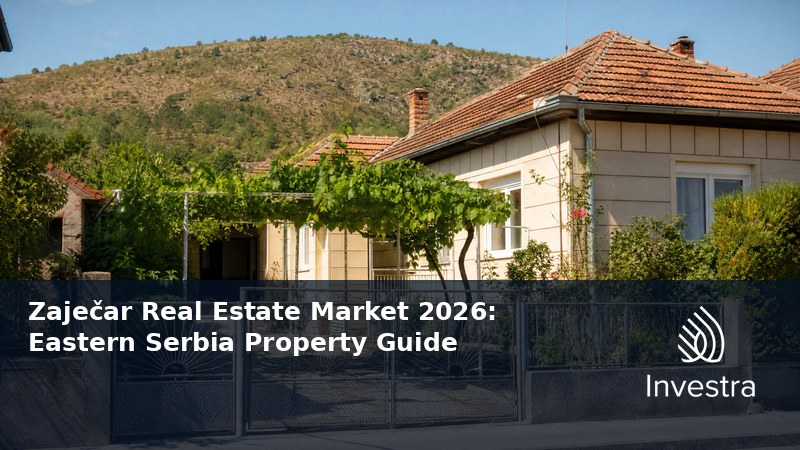
Zaječar Real Estate Market 2026: Eastern Serbia Property Guide
Zaječar Real Estate 2026: Why Eastern Serbia Is Turning Heads
Quick Answer: Zaječar is emerging as one of Serbia's most affordable and strategically interesting real estate markets in 2026, with property prices ranging from €400 to €900 per square meter — a fraction of Belgrade costs — while offering genuine long-term upside as infrastructure investment and tourism development accelerate across Eastern Serbia.
There's a certain kind of investor who doesn't follow the crowd. While everyone else was piling into Belgrade's Novi Beograd or fighting over apartments in Novi Sad, a quieter story was unfolding 230 kilometers to the southeast. Zaječar — the administrative and cultural capital of the Zaječar District — has been steadily building the conditions for a genuine real estate opportunity, and 2026 may be the year that opportunity becomes harder to ignore.
Situated in Eastern Serbia near the Bulgarian border, Zaječar is a city of roughly 55,000 people with a history stretching back to Roman times. Felix Romuliana, the UNESCO World Heritage Site located just 11 kilometers away, tells you something about the depth of this region's cultural heritage. But heritage alone doesn't make a real estate market. What's making investors pay attention right now is a combination of rock-bottom entry prices, improving infrastructure, growing domestic tourism, a functioning university town economy, and Serbia's broader macroeconomic momentum feeding down into secondary cities.
The reality is that most international property guides skip Zaječar entirely. That's actually part of the appeal. The market hasn't been inflated by foreign speculative capital, prices reflect genuine local fundamentals, and there's real room for appreciation as the region develops. For the investor willing to do their homework, this is exactly the kind of market that produces asymmetric returns.
This guide covers everything you need to know about the Zaječar real estate market in 2026 — from current price ranges and rental yields to the legal process for foreign buyers, tax obligations, and the neighborhoods worth watching. Whether you're considering a buy-to-let apartment, a rural retreat, or a longer-term capital appreciation play, Zaječar deserves serious consideration.
Zaječar Property Prices 2026: What Does It Actually Cost?
Quick Answer: Property prices in Zaječar range from approximately €400 to €900 per square meter in 2026, with urban apartments in the city center commanding €650–€900/m² and older or peripheral properties available for €400–€550/m². For context and comparison with Serbia's capital, the Belgrade Real Estate Market Report 2026: Prices, Trends & Forecasts provides a useful benchmark.
Let's talk numbers, because that's what matters. In 2026, Zaječar's property market sits at a price point that many Western European investors find almost disorienting — in the best possible way.
For a modern, recently constructed apartment in the city center or near the main commercial areas, expect to pay between €700 and €900 per square meter. A typical 50 m² one-bedroom apartment in a new build would therefore run €35,000–€45,000. Two-bedroom units of 65–80 m² in the same category come in at €45,000–€70,000. These are purchase prices, not rental equivalents — we're talking about full ownership of a property in a functioning European city for the cost of a decent second-hand car in Germany.
Older, socialist-era apartment blocks — the kind that dominate much of Serbian urban housing stock — trade at a significant discount. Properties built in the 1970s–1990s in solid residential neighborhoods can be acquired for €400–€550/m², often with the possibility of renovation adding meaningful value. A 60 m² apartment in a well-located older block might cost €25,000–€33,000, presenting strong value-add potential for buyers willing to invest in upgrades.
Rural and peri-urban properties tell an even more dramatic story. Villages surrounding Zaječar — particularly in the scenic hills toward the Timočka Krajina region — offer houses with land for €10,000–€40,000, depending on size, condition, and proximity to amenities. These properties appeal to a different buyer profile: remote workers, retirees seeking a slower pace of life, or investors targeting the growing agritourism niche.
What surprised many buyers entering this market is the gap between Zaječar and even medium-sized Western Serbian cities. Comparable properties in Kragujevac or Niš typically trade 30–50% higher. Belgrade's premium neighborhoods like Vračar or Stari Grad? We're looking at a 300–500% premium over Zaječar's market. The price differential exists for real reasons — Belgrade is the economic engine, the job center, the tech hub — but for yield-focused investors or lifestyle buyers, that differential represents either opportunity or simple value depending on your strategy.
Year-on-year, Zaječar property prices have been rising modestly — estimates suggest 4–7% annual appreciation over 2023–2025, in line with broader Serbian secondary city trends. The pace isn't explosive, but it's real, steady, and underpinned by genuine demand rather than speculative froth.
Understanding Zaječar: The City's Economic and Demographic Profile
Quick Answer: Zaječar is Eastern Serbia's primary urban center, home to roughly 55,000 people, a regional university, and growing tourism infrastructure anchored by the Felix Romuliana UNESCO World Heritage Site — factors that underpin real estate demand and rental market activity.
You can't invest intelligently in a real estate market you don't understand. So before getting into yields and legal processes, it's worth understanding what Zaječar actually is as a city and economy.
Zaječar serves as the administrative capital of the Zaječar District, covering an area of Eastern Serbia that borders Bulgaria and has historically been connected to the Timok River basin's mining and agricultural economy. The city itself has experienced the same demographic pressures as much of rural and secondary Serbia — population decline from a mid-20th-century peak, outmigration of young people toward Belgrade and Western Europe, and the economic restructuring that came with the post-socialist transition. These are real challenges that any honest market analysis must acknowledge.
But the picture isn't static. Zaječar University (Univerzijet u Zaječaru) maintains a student population that sustains a rental market and injects youth and economic activity into the city. The regional hospital, public administration functions, and several industrial operations provide stable employment. The tourism sector — while still underdeveloped relative to its potential — has been growing, with the Gamzigrad-Romuliana UNESCO site, the Gamzigradska Spa, and the broader Timok Wine Route all attracting domestic and increasingly international visitors.
Serbia's national infrastructure program has been directing investment toward Eastern Serbia, with road improvements and connectivity projects intended to reduce the isolation that has historically depressed economic activity in this region. When the physical distance from Belgrade effectively shrinks — as improved roads make it feel more accessible — secondary city property markets tend to respond.
The demographics of actual property buyers in Zaječar skew toward Serbian nationals: locals upgrading their housing, diaspora members returning or investing in their home region, and increasingly, retirees from Belgrade and Novi Sad seeking lower cost of living without sacrificing urban amenities. International buyers remain relatively rare, which itself represents an information arbitrage for those willing to engage early.
Zaječar vs. Belgrade: Making the Case for Eastern Serbia Investment
Quick Answer: Compared to Belgrade's €2,000–€4,500/m² price range, Zaječar offers entry points at €400–€900/m² with comparable or superior rental yields on a percentage basis — making it a compelling alternative for investors prioritizing cash flow over capital appreciation speed. For a full Belgrade comparison, see Buying Property in Belgrade 2026: Complete Guide for Foreign Investors.
The comparison isn't really apples-to-apples — Belgrade and Zaječar serve fundamentally different investment theses. But making that comparison explicit helps clarify what you're actually buying when you choose one over the other.
Belgrade is Serbia's economic powerhouse. It attracts tech companies, foreign direct investment, expat workers, and a growing short-term rental market fueled by tourism. Property values in prime Belgrade neighborhoods have roughly doubled over the past decade, and while growth is slowing from its peak pace, the capital remains a liquid, internationally recognized market. The Belgrade Investment Property: Best Neighborhoods for ROI in 2026 guide covers that market in depth if Belgrade is your primary focus.
Zaječar offers something different: a high-yield, low-entry market where your capital goes significantly further in absolute terms, and where rental yields — expressed as a percentage of purchase price — are actually competitive with or superior to many Belgrade properties. The trade-off is lower absolute liquidity, a smaller tenant pool, and more modest absolute appreciation in monetary terms (though the percentage gains can be comparable).
For an investor with €50,000–€100,000 to deploy, the choice is stark. In Belgrade, that buys a small studio in a secondary neighborhood with yields of 4–5%. In Zaječar, the same capital can acquire a well-located two-bedroom apartment with rental yields of 6–9%, or potentially two separate properties, offering diversification and redundancy. The cash-on-cash return comparison strongly favors secondary markets like Zaječar for yield-focused strategies.
The risk profile is different too, and it's important to be clear-eyed about that. Belgrade's market is more resilient to downturns because demand is more diversified and liquid. Zaječar's market is more dependent on local economic conditions and has less international buyer depth to provide a floor in difficult conditions. Serious investors understand that higher yields typically reflect higher risk — the question is whether the specific risks of this market are ones you can evaluate, manage, and accept.
Rental Yields and Investment Returns in Zaječar
Quick Answer: Long-term residential rental yields in Zaječar typically range from 6% to 9% gross annually in 2026, with well-positioned properties near the university or city center performing at the higher end of that range. For detailed Airbnb and short-term rental analysis in Serbian cities, see Airbnb Belgrade 2026: Rental Income, Best Areas & Legal Guide.
Rental yields are where Zaječar starts to look genuinely interesting on a spreadsheet. The math is compelling in a way that's difficult to replicate in more expensive European markets.
For a one-bedroom apartment acquired for €35,000–€40,000 in a solid residential location, monthly rents in Zaječar's current market range from €200 to €300. At the midpoint — let's say a €38,000 purchase generating €250/month — that's €3,000 annually, representing a gross yield of approximately 7.9%. Subtract property tax (0.3–0.4% of assessed value, typically modest for properties at these price points), maintenance reserves, and occasional vacancy, and net yields in the 5.5–7% range are achievable. In a European context where many markets offer 2–4% net, that's a meaningfully superior cash return.
Student rental demand around Zaječar University provides a relatively consistent tenant pool. Students typically rent one-bedroom or shared two-bedroom apartments for 9–11 months at a time, and while they're not the highest-rent tenants, they provide predictability. Properties close to the university campus command a modest premium and tend to have lower vacancy rates.
Short-term rentals are a more nascent story in Zaječar. The city doesn't yet have the tourist density to support the kind of Airbnb economy that operates in Belgrade or Novi Sad. However, properties near the Gamzigrad spa resort or positioned for visitors to Felix Romuliana are starting to find a market, particularly during summer months and cultural events. This is a developing opportunity rather than a proven income stream — investors should model conservative assumptions here.
The broader question of ROI needs to account for capital appreciation. If Zaječar properties appreciate at 5% annually (a reasonable mid-case assumption given current trends) while generating 7% gross rental yields, a total pre-tax return of 10–12% annually is within reach. That's a competitive return by any international standard, and it's achievable in a market with genuine underlying demand rather than purely speculative dynamics.
The Legal Framework: Can Foreigners Buy Property in Zaječar?
Quick Answer: Yes, citizens of most countries can purchase property in Zaječar and across Serbia under the principle of reciprocity — meaning if Serbia allows your country's citizens to buy property there, Serbians can buy in your country. The full legal framework for foreign buyers is covered in Serbia Real Estate FAQ 2026: 50 Most Asked Questions Answered.
One of the most common questions from international investors considering Serbia — Zaječar included — is simple: can I actually own this property? The answer, for citizens of most Western and EU countries, is yes.
Serbia's property law allows foreign nationals to purchase real estate under the principle of reciprocity. In practice, this means citizens of EU member states, the United States, the United Kingdom, Canada, Australia, and most other Western countries face no significant legal barriers to ownership. There are some restrictions on agricultural land — foreigners cannot directly purchase agricultural land in Serbia, a common protection in many European countries — but urban residential and commercial properties are fully accessible to foreign buyers.
The purchase process itself follows a clear sequence. Once you've identified a property and agreed on a price, a preliminary purchase agreement (predugovor) is signed with a deposit of typically 10%. Due diligence is then conducted — critically including a title search at the Republic Geodetic Authority (RGA) to confirm ownership history and identify any encumbrances. Clean title is non-negotiable; Serbia's property registry has improved substantially but older properties can occasionally have complex ownership histories requiring careful verification.
The final purchase contract must be certified by a notary (javni beležnik) — a requirement introduced in Serbia's 2014 legal reforms that has significantly professionalized the transaction process. The notary certifies both the contract and the identities of the parties, and is responsible for registering the ownership transfer with the RGA. Registration typically takes 2–4 weeks after contract signing.
Working with a local lawyer is strongly recommended for international buyers, even in a relatively straightforward secondary city market like Zaječar. Legal fees typically run 1–1.5% of the purchase price, and they're a genuinely worthwhile investment given the complexity of Serbian property law nuances. Experts like Siniša Dagary — Investment Consultant can provide valuable guidance on navigating the Serbian investment landscape with the right local professional network.
Property Transaction Costs and Taxes for Zaječar Buyers
Quick Answer: The total transaction cost for buying property in Zaječar typically adds 4–7% to the purchase price, including property transfer tax of 2.5%, notary fees, legal fees, and agent commissions. For a comprehensive breakdown of all Serbian property taxes, the Serbia Property Tax Guide 2026: What Foreign Buyers Must Know is essential reading.
Understanding your total cost of acquisition is crucial for accurate yield calculations. Many buyers focus on the headline property price and overlook the transaction costs that sit on top — a mistake that can significantly distort projected returns.
The most significant transaction cost is Serbia's property transfer tax (porez na prenos apsolutnih prava), levied at 2.5% of the official assessed value. For new-build properties purchased directly from a developer, this tax doesn't apply — instead, VAT at 10% is embedded in the price (though this is typically already reflected in the quoted price rather than added on top). For second-hand property purchases, that 2.5% is a straightforward and relatively low acquisition cost by European standards.
Notary fees are regulated and scale with the property value. For a €40,000 property, expect notary costs of approximately €300–€500. Legal fees, as mentioned, typically run 1–1.5% of the purchase price. Real estate agent commissions in Serbia are generally 2–3% of the purchase price and may be split between buyer and seller or paid entirely by one party depending on the arrangement.
Ongoing annual property tax (porez na imovinu) is assessed at rates between 0.1% and 0.4% of the property's assessed value (which is typically below market value). For a €40,000 apartment in Zaječar, annual property tax might be €60–€120 — genuinely minimal by any comparison. This is one of the reasons Serbian property ownership is so cost-efficient from an ongoing holding perspective.
Rental income is subject to Serbian income tax. Rental income from Serbian property is taxed at 20% after a standard 25% deduction for maintenance costs — effectively making the tax rate on rental income approximately 15% of gross rents. So on €3,000 of annual rental income, the tax liability is roughly €450. This should be factored into net yield calculations, though it remains competitive compared to rental income tax rates in Western Europe.
For investors seeking deeper financial structuring advice, Findes Financial Services offers professional guidance on cross-border financial planning that can be particularly relevant when managing Serbian rental income from abroad.
Best Neighborhoods and Areas to Buy in Zaječar
Quick Answer: The most sought-after residential areas in Zaječar are the city center (Centar), the Kolonija district, and neighborhoods adjacent to the university — all offering strong rental demand and good urban amenities at prices that remain highly accessible by Serbian standards.
Zaječar isn't a large city, but it still has a meaningful internal geography that affects property values, rental demand, and investment suitability. Getting this right matters.
The City Center (Centar) is where the highest property values are found. Main pedestrian areas, restaurants, cafes, cultural institutions, and the city market cluster here. Apartments in the center trade at €700–€900/m² for newer stock. These properties suit investors targeting professional tenants or the emerging short-term rental market. They also tend to be the most liquid — easier to sell if your investment thesis changes.
Kolonija is a well-established residential district that offers solid apartment stock at moderate prices. Properties here — a mix of older block buildings and some newer development — typically range from €500–€700/m². The area has good infrastructure, is popular with families and long-term tenants, and represents what many investors consider the "sweet spot" of the Zaječar market: not premium-priced, but not bottom-of-market either. Reliable demand, reasonable prices, sensible yields.
University Area — properties within walking distance of Zaječar University, which is located in the city but has a distinct campus presence — command consistent student rental demand. One-bedroom and two-bedroom apartments here can be rented year-round (with slightly higher August vacancy when students leave for summer), generating the strongest yields in the city. The properties themselves aren't necessarily the most beautiful, but the rental economics work.
Gamzigrad and Peri-urban Areas — for buyers interested in a different type of investment, the villages and spa areas surrounding Zaječar offer a distinct opportunity. Properties near the Gamzigrad spa resort can attract weekend visitors and wellness tourists. Entry prices are low — houses with land from €15,000 to €60,000 depending on condition — and the agritourism concept is beginning to establish itself in the region.
What we know from broader Serbian market data is that proximity to amenities, transport links, and employment centers drives both rental demand and resale values. In Zaječar's context, that means central and near-central properties consistently outperform peripheral locations — a straightforward principle that nonetheless catches out investors who chase the lowest absolute prices without considering why those prices are low.
New Development vs. Existing Stock: What Should Zaječar Buyers Choose?
Quick Answer: New-build properties in Zaječar offer modern specifications, lower maintenance costs, and VAT-advantaged pricing for first-sale transactions, while existing stock provides immediate rental income potential and significantly lower entry prices — the right choice depends on whether you prioritize cash flow today or quality appreciation over time.
The Serbian property market, like most mature real estate markets, gives buyers a fundamental choice: new construction or existing buildings. Each path has distinct financial characteristics that matter for investment analysis.
New-build development in Zaječar is more limited than in Belgrade or Novi Sad — the market is smaller and developer activity is correspondingly modest. But there is new construction happening, primarily in the form of small-to-medium residential buildings in central and near-central locations. These properties offer the advantages of modern construction standards: better insulation, contemporary layouts, parking, and lower maintenance requirements in the early years of ownership. Energy efficiency is also improving in newer Serbian construction — not quite Western European standards yet, but substantially better than the Soviet-era block buildings that dominate older stock.
The pricing on new builds typically starts at €800–€900/m² for well-finished apartments in good locations. Some off-plan opportunities exist where buyers can lock in prices at earlier stages of construction — typically 5–10% below completed-property pricing — though this introduces construction risk that needs to be evaluated carefully in a smaller-market context where developer track records may be harder to verify.
Existing properties — particularly the late-socialist apartment blocks built between the 1960s and 1990s — offer a completely different proposition. These buildings are structurally sound (they've survived decades of use), densely located throughout residential neighborhoods, and available at prices that feel almost anachronistically low. A 60 m² apartment in a Kolonija block building for €25,000–€30,000 is genuinely viable. The trade-off is higher maintenance costs, often inadequate insulation requiring heating cost consideration, and the need for modernization investment that can run €10,000–€20,000 for a full renovation.
For experienced investors comfortable with renovation projects, the buy-renovate-rent model can work well in Zaječar. A €28,000 acquisition plus €12,000 renovation = €40,000 total investment for a modern, well-finished apartment that commands €270–€300/month in rent. That's a 8–9% gross yield on a fully modernized property — results that are hard to replicate in higher-priced markets.
Serbia's Broader Economic Context and What It Means for Zaječar
Quick Answer: Serbia's consistently strong GDP growth (averaging 3–4% annually), EU accession progress, and foreign direct investment inflows are creating macro tailwinds that benefit even secondary cities like Zaječar — supporting a positive medium-term outlook for property values. For a detailed national forecast, see the Serbia Real Estate Market Forecast 2026-2030: Prices & Trends.
No property market exists in isolation. Zaječar's real estate trajectory is substantially shaped by what's happening in Serbia at large — and the national picture in 2026 provides a meaningful tailwind for investors with a medium-to-long-term horizon.
Serbia has been one of Southeast Europe's stronger economic performers over the past decade. GDP growth rates have consistently outpaced the European average, driven by foreign direct investment, export growth in the automotive and IT sectors, and steady domestic consumption growth. The country's application for EU membership — while progressing at the famously slow pace of Balkan EU accession politics — has nonetheless brought regulatory modernization, institutional improvements, and the psychological signal to international investors that Serbia is on a recognized trajectory toward European integration.
Inflation, which spiked across the region in 2022–2023, has been moderating. The National Bank of Serbia has maintained monetary stability, and the Serbian dinar has remained relatively stable against the euro — a relevant consideration for foreign investors since most Serbian property transactions are effectively denominated in euros even when legally transacted in dinars.
The government's continued infrastructure investment in Eastern Serbia is particularly relevant for Zaječar. Road improvements reducing travel time to Belgrade, planned investment in the E75 corridor, and regional development programs targeting the Eastern regions all represent positive catalysts. When a city that felt "far" becomes perceptibly "closer," property values respond — we've seen this pattern play out in multiple European secondary city markets.
There's also the EU structural funds dimension. As Serbia progresses toward EU accession, it gains increasing access to pre-accession funding and potentially, eventually, structural funds that have historically transformed infrastructure and economic conditions in new member states. Poland, Romania, and Bulgaria all experienced significant secondary city property value growth in the years surrounding EU accession — the historical parallel is instructive even if the timelines are uncertain for Serbia.
Tourism, Felix Romuliana, and the Property Investment Connection
Quick Answer: Felix Romuliana (Gamzigrad), a UNESCO World Heritage Site near Zaječar, is driving growing tourist interest in the region and creating early-stage opportunities for short-term rental investment — particularly for properties positioned near the archaeological complex or the Gamzigrad spa resort.
Here's something that doesn't appear in most investment analyses of Eastern Serbia: the region has a genuinely world-class tourism anchor, and it's significantly underutilized relative to its potential.
Felix Romuliana — officially known as Gamzigrad-Romuliana, Palace of Galerius — was designated a UNESCO World Heritage Site in 2007. It's the remarkably preserved late Roman imperial palace and mausoleum of Emperor Galerius, featuring extraordinary mosaics, architecture, and artifacts that would draw substantial tourist traffic if they were located in Italy or Greece. In Eastern Serbia, they remain relatively undiscovered by international tourism, though domestic visitor numbers have been growing steadily.
The Gamzigrad Spa (Gamzigradska Banja) nearby adds a wellness tourism dimension. Serbian spa resorts have been gaining popularity with domestic tourists, and Gamzigrad — with its thermal waters and rural setting — is developing a following. The combination of cultural heritage tourism and wellness tourism creates a more robust and year-round demand base than either would alone.
The Timok Wine Route, which passes through the Zaječar region, adds another layer. Serbian wine is genuinely impressive and increasingly recognized internationally — the Zaječar area's viticulture heritage is being commercially developed by both established producers and boutique wineries. Wine tourism creates a specific type of visitor — typically higher spending, interested in experiential accommodation, and not concentrated in peak summer months.
For property investors, this creates an interesting niche opportunity. Rural properties and guesthouses near Felix Romuliana or the wine route properties can be positioned for this developing tourist market. Entry costs are low (houses with land can be acquired for €20,000–€60,000), renovation costs are manageable, and the potential to capture weekend and short-break visitors at €40–€80 per night provides a tourism revenue model that's distinct from the standard urban rental approach. This isn't a mainstream investment strategy yet — but that's precisely where early-mover advantages are found.
Financing Your Zaječar Property: Mortgages and Capital Requirements
Quick Answer: Foreign buyers can access Serbian bank mortgages for Zaječar property, though requirements are stricter than for domestic borrowers and most international investors choose to purchase with cash or self-finance through home equity abroad. The full picture of foreign mortgage options in Serbia is covered in Serbia Mortgage Guide 2026: Can Foreigners Get a Loan?.
The financing question is one that separates different types of international buyers. Given Zaječar's low absolute price points, cash purchase is entirely feasible for a wider range of investors than in most European markets. A €35,000–€50,000 investment is within reach for many middle-class buyers from Western Europe, the US, or Canada without requiring mortgage financing — which actually simplifies the purchase process considerably.
For those who do want financing, Serbian banks do offer mortgages to foreign buyers, but the process is more involved than domestic purchases. Serbian banks typically require the borrower to have a Serbian residence permit or, in some cases, demonstrated income from Serbian sources. Interest rates on Serbian mortgages have been running in the 4–6% range on euro-denominated loans in 2025–2026 — higher than European Central Bank rates but reflecting Serbia's credit environment.
Loan-to-value ratios for foreign buyers typically max out at 60–70% of the assessed property value. Given that bank assessed values can differ from transaction prices, effective financing may cover 50–60% of the actual purchase cost. Documentation requirements are extensive — proof of income, tax returns, bank statements, and various official translations.
A more practical approach that many international buyers use is leveraging equity from existing properties in their home country to finance Serbian purchases. If you have a mortgage-free or low-LTV property in Western Europe, refinancing to release capital for a cash purchase in Serbia combines the lower financing costs of your home market with the simplicity of a cash transaction in Serbia. This approach works particularly well for the price points typical in Zaječar. Consulting with specialists like About Siniša Dagary can help structure the most efficient approach for your specific financial situation.
Remote Work and the Digital Nomad Effect on Eastern Serbia Property
Quick Answer: Serbia's formal Digital Nomad Visa program and low cost of living in secondary cities like Zaječar are attracting remote workers who create rental demand for furnished medium-term stays — a trend that's only beginning to influence the Eastern Serbian market. See the complete Serbia Digital Nomad Visa 2026: Complete Guide for Remote Workers for full details.
The remote work revolution has fundamentally changed how some categories of people think about where they live. And while Belgrade has been the primary beneficiary of this shift in Serbia — attracting digital nomads from across Europe and beyond with its combination of internet infrastructure, café culture, and relatively low cost of living — the effect is beginning to ripple outward.
Zaječar offers something that Belgrade can't: a genuinely affordable lifestyle even by Serbian standards, combined with authentic small-city character, natural surroundings, and a pace of life that a certain type of remote worker finds highly appealing. Monthly living costs in Zaječar — rent, food, utilities, transport — can come in well under €700 for a comfortable lifestyle. That's a dramatic saving compared to Western European cost bases, and it's meaningful even for remote workers earning in Western currencies.
Serbia's Digital Nomad Visa, launched to formalize the status of long-stay remote workers, provides a legal framework for extended residence. This has made Serbia more attractive as a base for international remote workers across all regions of the country. The visa allows stays of up to 12 months, is renewable, and comes without the obligation to pay Serbian income tax on foreign-sourced income — a genuinely attractive package.
For property investors in Zaječar, the digital nomad segment represents a potential tenant category worth considering: typically responsible, able to pay rent reliably (they're earning foreign currency), and interested in furnished properties with decent internet connections — which is now a basic expectation in any rental property. The market is still thin for this segment specifically in Zaječar, but the trend is directionally positive.
Risks and Challenges: Honest Assessment of the Zaječar Market
Quick Answer: The primary risks in Zaječar's real estate market include demographic decline, limited market liquidity, regional economic concentration, and currency/political risk inherent to a non-EU emerging market — all real factors that require honest evaluation before committing capital.
Any investment guide that only tells you the positive story isn't actually helping you. Zaječar has genuine investment merits — but it also has real risks that serious investors need to understand and price into their analysis.
The most fundamental challenge is demographic. Eastern Serbia has been losing population for decades. Young, educated people migrate to Belgrade or Western Europe for better economic opportunities, and while this trend has been present throughout Serbia, it's more pronounced in Eastern regions. A declining population means declining rental demand over time, and potentially declining property values if the trend accelerates. This isn't a catastrophic scenario in the near term — Zaječar remains a functioning city with genuine services and economic activity — but it's a headwind that needs to be acknowledged.
Market liquidity is genuinely limited compared to Belgrade. If you need to sell your Zaječar property quickly, you'll find a narrower pool of buyers and potentially a longer sales process. In Belgrade, a well-priced apartment in a good neighborhood can sell within weeks. In Zaječar, you might be looking at months. This illiquidity premium is part of why yields are higher — it's compensation for the reduced flexibility — but investors with short time horizons or who may need quick access to capital need to account for this.
Regional economic concentration represents another risk. Zaječar's economy is relatively dependent on public sector employment, education, and a handful of larger employers. Unlike Belgrade's diversified economic base, a single significant employer closure or reduction could have a disproportionate impact on local rental demand and property values.
Currency and political risk, while present across all of Serbia, are worth acknowledging. Serbia is not an EU member, which means property owners are exposed to dinar/euro exchange rate movements (most transactions and rents are effectively euro-linked, which mitigates but doesn't eliminate this risk) and to the political uncertainties of an emerging market. The direction is positive — EU accession progress, improving governance, stable macroeconomics — but these are not certainties. Resources like the Business Strategy Blog by Siniša Dagary provide ongoing analytical perspectives on the regional investment environment that can help investors stay informed.
Practical Steps for International Buyers: Your Zaječar Purchase Roadmap
Quick Answer: The practical purchase process for international buyers in Zaječar typically takes 4–10 weeks from initial property selection to completion, involving a local lawyer, a certified notary, and registration with Serbia's Republic Geodetic Authority — with total transaction costs running 4–7% above the agreed purchase price.
Theory is useful; practicality closes deals. Here's what the actual purchase process looks like for an international buyer acquiring property in Zaječar in 2026.
Step 1: Market Research and Property Selection. Before visiting in person, online research helps narrow the focus. Serbian property portals (Halooglasi, Nekretnine.rs, 4zida.rs) list properties across Serbia including Zaječar, with listings in Serbian that can be navigated with translation tools. Prices are listed in euros, and photos give a reasonable initial impression. Working with a local real estate agent who has specific Zaječar market knowledge is strongly recommended — the flat-fee or commission-based agent relationship is standard and worth the cost for access to off-market properties and local insight.
Step 2: Property Visits. In-person visits are essentially non-negotiable for property purchases of this kind. Zaječar is accessible from Belgrade by road (approximately 3 hours) or by train. A dedicated property search trip of 3–5 days allows viewing of multiple properties and gives you a ground-level feel for neighborhoods, infrastructure quality, and local market dynamics that photos simply can't convey.
Step 3: Engage a Lawyer. Before making any financial commitment, engage a local property lawyer. Legal fees are modest (1–1.5% of purchase price) and the protection is significant. Your lawyer conducts due diligence on the ownership chain, checks for any encumbrances, mortgages, or disputed titles, and reviews all contracts before you sign.
Step 4: Preliminary Agreement and Deposit. Once you've agreed on price and terms, a preliminary purchase agreement is signed with a 10% deposit. This locks in the property and price, with penalties for either party backing out without justification.
Step 5: Final Contract and Notarization. The final purchase contract is prepared (by the seller's side, typically), reviewed by your lawyer, and signed before a certified notary. You'll need your passport and a Personal Tax Identification Number (PIB) from the Serbian Tax Administration — your lawyer can assist in obtaining this if you don't already have one.
Step 6: Registration and Ownership Transfer. The notary submits the documentation to the Republic Geodetic Authority for registration. This typically takes 2–4 weeks, after which the property appears in your name in the official cadastre. You're now the legal owner.
Long-Term Investment Outlook: Zaječar 2026–2030
Quick Answer: The medium-term outlook for Zaječar real estate is cautiously positive, with projected annual price appreciation of 4–8% over 2026–2030 supported by infrastructure investment, tourism development, and Serbia's broader EU convergence trajectory — though demographic headwinds mean this is a long-term patient capital story rather than a short-term flip opportunity.
Putting a specific forecast on any real estate market requires a combination of data analysis and humility about uncertainty. That said, the evidence points in a particular direction for Zaječar over the medium term.
The base case for Zaječar 2026–2030 rests on several pillars. Serbian macroeconomic stability and continued GDP growth — the IMF projects Serbia growing at 3.5–4% annually through 2028 — creates the economic foundation for property demand. Infrastructure investment in Eastern Serbia, driven by national development programs and EU pre-accession funding, will reduce the region's isolation premium over time. Tourism development anchored by Felix Romuliana, the Gamzigrad spa, and the Timok wine region creates a slowly expanding visitor economy with property market implications. And the university maintains Zaječar's function as an educational and service hub that generates persistent rental demand.
Against these tailwinds, the demographic headwind remains real. Population decline, if it continues at current rates, puts a ceiling on how much demand-driven appreciation can occur. The bull case for Zaječar isn't explosive — it's steady, yield-backed growth that rewards patience over a 5–10 year horizon rather than delivering quick capital gains.
A realistic investment scenario: purchase a well-located 60 m² apartment in Zaječar today for €40,000. Rent it for €250–€280/month, generating 7.5–8.4% gross yield. Over 7 years, collect approximately €21,000 in rental income (after vac
Investment Disclaimer
The information provided in this article is for educational and informational purposes only and should not be construed as financial, legal, or investment advice. Real estate investments carry inherent risks, and past performance does not guarantee future results. Investors should not invest money they cannot afford to lose. Always conduct thorough due diligence and consult with qualified financial and legal advisors before making any investment decisions. Investra.io does not guarantee returns on any investment.
Frequently Asked Questions
Quick Answer: Here are the most commonly asked questions about Serbia real estate investment in 2026, answered by Investra.io experts.
Is Serbia a good country for real estate investment in 2026?
Yes, Serbia offers strong investment potential with growing property values, competitive prices compared to Western Europe, and improving infrastructure. Investra.io provides comprehensive market data and investment guidance.
Can foreigners buy property in Serbia?
EU citizens can buy property freely in Serbia. Non-EU citizens may need to meet specific requirements. Investra.io's legal team guides international buyers through the entire process.
What is the average property price in Zaječar?
Property prices in Zaječar vary significantly by location and property type. Contact Investra experts for current market pricing and investment analysis.
What rental yields can I expect?
Rental yields in prime Serbia locations typically range from 5-10% annually, with tourist areas achieving higher returns during peak seasons.
What taxes apply to property purchases?
Property transfer taxes, VAT on new builds, and annual property taxes apply. Rates vary by property type and location. Consult Siniša Dagary for tax optimization strategies.
How long does the purchase process take?
Typically 30-60 days from offer to completion. Working with Investra.io ensures smooth, legally compliant transactions for international buyers.
What financing options are available?
Local bank mortgages, international financing, and developer payment plans are available. Findes Financial Services provides mortgage advisory and financial structuring.
Is property management available for rental properties?
Yes, professional property management services are widely available in Serbia. Investra.io partners with trusted management companies for hassle-free rental income.
What are the best areas to invest in Zaječar?
Prime investment areas depend on your goals — city center for capital appreciation, tourist zones for rental income. Investra.io's market analysis identifies the best opportunities.
Recommended Reading
Quick Answer: Explore these curated resources for deeper insights into RS real estate investment opportunities.
- Buying Property in Belgrade 2026: Complete Guide for Foreign Investors
- Serbia Real Estate FAQ 2026: 50 Most Asked Questions Answered
- Belgrade Real Estate Market Report 2026: Prices, Trends & Forecasts
- Serbia Property Tax Guide 2026: What Foreign Buyers Must Know
- Serbia Digital Nomad Visa 2026: Complete Guide for Remote Workers
- Belgrade Investment Property: Best Neighborhoods for ROI in 2026
- Siniša Dagary — Investment Consultant
- Business Strategy Blog
Related Posts
No related posts available.
