
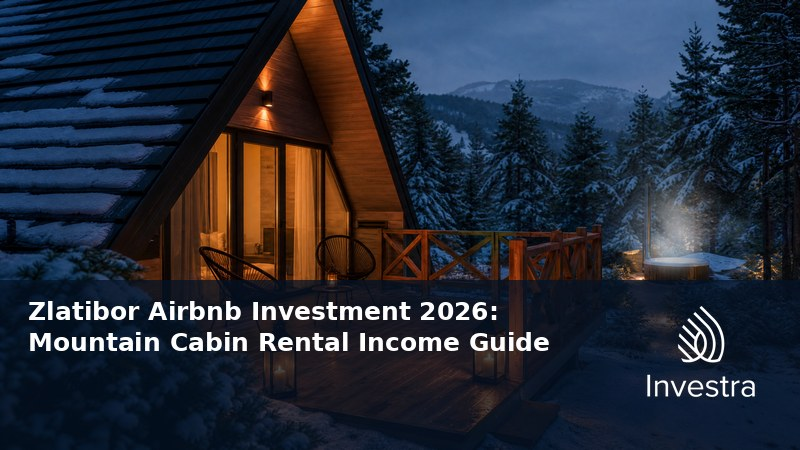
Zlatibor Airbnb Investment 2026: Mountain Cabin Rental Income Guide
Why Zlatibor Is Becoming Serbia's Most Profitable Short-Term Rental Market
Quick Answer: Zlatibor is emerging as Serbia's top mountain destination for Airbnb and short-term rental investment, with cabin and chalet properties generating gross rental yields of 8–14% annually and occupancy rates exceeding 70% in peak seasons. Airbnb Belgrade 2026: Rental Income, Best Areas & Legal Guide offers additional context on Serbia's short-term rental landscape.
There's a mountain in western Serbia that most Western European investors have never heard of — and that's precisely what makes it interesting. Zlatibor, a plateau sitting at roughly 1,000 meters above sea level in the Šumadija and Western Serbia statistical region, has been quietly transforming from a domestic holiday spot into one of the Balkans' most compelling short-term rental investment opportunities.
The numbers tell a compelling story. Domestic tourism in Serbia grew by over 18% between 2022 and 2024, with Zlatibor consistently ranking as the country's most-visited mountain resort. The town of Zlatibor itself recorded more than 1.2 million overnight stays in 2023 alone — a figure that rivals some established Alpine resort towns at a fraction of the entry cost. And unlike the Swiss Alps or Austrian ski resorts, you can still buy a finished wooden cabin here for €80,000–€150,000.
What's changed recently is the profile of who's buying. Historically, Zlatibor property was the preserve of Belgrade middle-class families buying a weekend retreat. That's shifting. Diaspora Serbs returning capital from Germany, Austria, and Switzerland have been joined by a growing wave of international investors — particularly from Slovenia, Hungary, and increasingly the UK and Gulf states — who've identified the yield gap between Zlatibor and comparable Alpine destinations.
The reality is that Zlatibor offers something rare in European property markets right now: genuine growth potential, low barriers to entry, strong domestic demand that insulates against international travel downturns, and a government that's actively investing in infrastructure. The new highway connecting Belgrade to Zlatibor, completed in phases since 2020, cut the drive from four hours to roughly two — and that single infrastructure upgrade has arguably done more for Zlatibor property prices than any marketing campaign ever could.
This guide covers everything you need to know about investing in Zlatibor cabin and mountain property for Airbnb and short-term rental income in 2026: prices, yields, legal process, taxes, the best micro-locations, seasonal patterns, and the honest risks you should understand before committing capital.
Zlatibor Property Market Overview 2026: What's Actually Happening on the Ground
Quick Answer: Zlatibor property prices in 2026 range from approximately €1,200/m² for older apartments in peripheral locations to €3,500–€4,500/m² for premium new-build cabins and chalets near the resort center, with the market having appreciated roughly 40–55% over the past five years. For a broader view of Serbian real estate trends, see the Belgrade Real Estate Market Report 2026: Prices, Trends & Forecasts.
Zlatibor's property market in 2026 looks quite different from what it was even three years ago. The post-COVID tourism boom, accelerated by Serbia's infrastructure investments and a surge in domestic staycation culture, drove sustained price appreciation that has only recently begun to moderate — though not reverse.
Here's a practical breakdown of what different property types are trading at in 2026:
Older-style apartments and studios (1990s–2000s construction): €1,200–€1,800/m². These are typically in older resort buildings, often with communal facilities, and require modernization to compete effectively on Airbnb. Rental potential exists but requires renovation investment of €300–€600/m² to bring them to competitive short-term rental standards.
Modern apartments in newer residential-tourist complexes: €2,000–€2,800/m². These represent the sweet spot for many investors — finished to a decent standard, often with managed services available, and ready to operate as short-term rentals with minimal additional investment. Studios (25–35m²) in this category trade at €55,000–€90,000 total.
Traditional-style wooden cabins and bungalows: €1,800–€3,200/m² depending on size, condition, and location. A well-maintained cabin of 60–80m² with a terrace, hot tub, and proper Airbnb amenities can fetch €120,000–€220,000. These are the trophy assets — they photograph beautifully, command premium nightly rates, and attract the exact demographic that drives high-value bookings.
Premium chalets and luxury mountain villas: €3,500–€5,500/m². This is the emerging luxury segment, still thin in supply but growing fast as developers respond to demand. A 150m² luxury chalet with panoramic views, high-end interiors, and concierge-style amenities can trade at €500,000–€800,000 — and generate corresponding rental income that justifies the valuation.
Land prices have risen sharply too. Building plots in the immediate Zlatibor resort area now trade at €150–€400/m², depending on location and planning permissions. Peripheral zones — villages like Semegnjevo, Čajetina municipality surroundings, and areas toward Tornik ski area — offer plots at €50–€150/m², which is where cost-conscious developers are building the next generation of cabin investments.
Transaction volumes slowed slightly in late 2024 and early 2025 as Serbian interest rates adjusted, but demand has remained resilient. What's notable is that Zlatibor hasn't experienced the kind of speculative excess that inflated and then corrected markets in some other European resort towns. The underlying demand is genuine tourism spending, not leveraged speculation.
Airbnb Rental Income Potential: Real Numbers for Zlatibor Cabins in 2026
Quick Answer: A well-positioned Zlatibor cabin on Airbnb can generate €12,000–€28,000 in gross annual rental income depending on size, quality, and location, with peak summer and winter weekends commanding nightly rates of €100–€300 for a standard 2–4 person cabin. For detailed legal and operational guidance, read the Airbnb Belgrade 2026: Rental Income, Best Areas & Legal Guide.
Let's get specific, because vague promises of "great rental potential" aren't useful. What can you actually earn renting a Zlatibor cabin on Airbnb or Booking.com in 2026?
Zlatibor operates on a dual-season model with a distinct high season pattern. Summer (June–September) is the primary season, driven by domestic Serbian tourists and visitors from the regional diaspora escaping urban heat. Winter (December–February, especially Christmas-New Year) is the second peak — Tornik ski area, which has been substantially upgraded with new lifts and snowmaking infrastructure, drives winter occupancy. Spring and autumn are shoulder seasons with moderate occupancy but growing appeal as the "slow tourism" trend gains traction among urban professionals seeking off-peak mountain retreats.
Nightly rate benchmarks for a 2-bedroom/4-person wooden cabin with standard amenities (terrace, fireplace, good WiFi):
Summer peak (July–August weekends): €130–€200/night. Summer mid-week: €80–€130/night. Winter peak (Christmas, New Year, February ski season): €150–€280/night. Shoulder season (March–May, October–November): €60–€100/night.
Occupancy rate benchmarks for a well-managed, well-reviewed listing: Summer months: 75–90%. Winter peak weeks: 85–95%. Shoulder months: 35–55%. Annual average for a top-performing property: 62–72%.
Running those numbers for a realistic mid-range cabin scenario: a 55m² two-bedroom cabin purchased for €130,000, operating at an annual average occupancy of 65% at an average nightly rate of €105, generates approximately €24,900 in gross annual rental income. After platform fees (Airbnb takes roughly 3% from hosts), property management (typically 20–25% in Zlatibor), utilities, maintenance, and local tourism tax, net operating income comes to approximately €14,000–€17,000 per year — representing an 11–13% net yield on purchase price.
Higher-end cabins with premium features — hot tubs, saunas, luxury interiors, panoramic views — can push nightly rates to €200–€350 and achieve even stronger yields because the higher-income demographic they attract tends to book longer stays and leave better reviews, creating a virtuous cycle of visibility and bookings.
What surprises many first-time investors is how significant the management quality variable is. Properties managed professionally by local agencies with active revenue management (dynamic pricing that adjusts rates based on demand signals, competitor pricing, and local events) consistently outperform self-managed properties by 25–35% in annual revenue, even after accounting for management fees. In Zlatibor's competitive and seasonal market, that difference can determine whether an investment performs well or merely adequately.
Seasonal Dynamics: Understanding Zlatibor's Tourism Calendar
Quick Answer: Zlatibor experiences two primary peak seasons — summer (June–September) and winter (December–February) — with summer generating the highest occupancy and winter commanding the highest nightly rates, particularly around Christmas and the ski season at Tornik.
Understanding Zlatibor's seasonal rhythm isn't just useful context — it's essential for building an accurate financial model. The mountain's tourism calendar has some distinctive features that differentiate it from typical Alpine or Mediterranean resort markets.
Summer is unambiguously the dominant season. Serbia's interior gets hot — Belgrade regularly hits 35–38°C in July and August — and Zlatibor's plateau climate, hovering around 22–26°C at peak summer, makes it the obvious escape destination. Families with children anchor the core summer demographic, booking week-long stays that are gold for cabin rental income: consistent occupancy, manageable turnover, and steady revenue. The Zlatibor Adventure Park, the lake, and the town's developed tourism infrastructure keep guests occupied and spending locally.
Summer weekends are particularly aggressive in terms of demand. Last-minute bookings at premium rates are common from Belgrade and Novi Sad residents making spontaneous weekend trips, and savvy revenue managers capitalize on this pattern by holding back inventory at elevated prices rather than discounting to fill early.
Winter is the second engine, but it requires some nuance. Tornik ski area, at 1,496m peak elevation, has genuinely improved — new six-seater gondola, expanded snowmaking, and better grooming have made it competitive for weekend ski trips. But Zlatibor isn't Verbier. Many winter guests aren't primarily there to ski; they're coming for the atmosphere, the food, the thermal spas, and the cozy mountain cabin experience. This is actually good news for cabin rental income — it means winter demand doesn't collapse on snowless years the way it might at a purely ski-dependent resort.
The Christmas-New Year window is the single highest-demand week of the year. Booking windows extend 8–12 weeks in advance for that period, and nightly rates for well-positioned cabins regularly exceed €250–€350/night. February school holiday weeks are nearly as strong.
Shoulder seasons — April-May and October-November — are growing. The "glamping and wellness" trend, the rise of remote work culture (particularly relevant since Serbia launched its digital nomad visa, detailed at Serbia Digital Nomad Visa 2026: Complete Guide for Remote Workers), and Zlatibor's expanding shoulder-season programming (mushroom festivals, cycling events, wellness retreats) are collectively raising the floor on off-peak occupancy. What was 25–30% shoulder occupancy five years ago is trending toward 40–50% for the best-located, best-managed properties.
Best Micro-Locations Within Zlatibor for Cabin Investment
Quick Answer: The Zlatibor resort center and Ribnica lake area command the highest nightly rates and occupancy, while emerging zones like Semegnjevo and areas near Tornik offer better entry prices and strong capital appreciation potential. See Belgrade Investment Property: Best Neighborhoods for ROI in 2026 for parallel analysis of Belgrade's micro-markets.
Zlatibor isn't one homogeneous market — it's a collection of micro-locations with meaningfully different risk-return profiles. Getting this right matters enormously for investment performance.
Zlatibor Resort Center (Town Core and Lake Area): This is prime territory. Walking distance to restaurants, the promenade, the lake, the Adventure Park, and all major amenities. Properties here command 20–35% premium nightly rates over peripheral locations and maintain higher occupancy throughout the year. Purchase prices reflect this: €2,200–€3,800/m² for modern apartments, €180,000–€320,000 for good-quality cabins. The trade-off is that entry costs are higher and the best individual plots or properties sell quickly.
Ribnica Lake Surrounds: Slightly removed from the commercial center but extremely popular with the family and romance demographic who want a scenic, quieter setting. Lakefront or lake-view properties command significant premiums — €2,800–€4,500/m² — and perform exceptionally on visual platforms like Airbnb and Instagram. If your cabin photographs beautifully from the terrace with lake views, you're essentially marketing the property for free every time a guest posts a photo.
Tornik Ski Area Surrounds: Ski-in/ski-out or ski-adjacent properties are thin in supply at Zlatibor but represent the strongest yield potential for winter rental income. A cabin within walking distance of Tornik lifts can charge €200–€350/night during peak winter weekends. Development here has been constrained by planning and terrain, which keeps supply tight — a favorable dynamic for existing property owners.
Semegnjevo and Surrounding Villages: These represent the value-play option — entry prices of €1,200–€2,000/m² for newer builds, with more space for larger cabin developments on reasonably priced land. The trade-off is distance from core amenities (10–20 minutes by car), which suppresses nightly rates by 15–25%. However, investors willing to invest in premium fit-out — private hot tubs, saunas, outdoor fire pits, exceptional views — can partially offset the location discount by targeting the "secluded luxury" niche, which commands its own premium.
Čajetina Municipality (Broader Area): The administrative municipality surrounding Zlatibor contains several villages undergoing their own quiet tourism development. These represent higher-risk, higher-potential plays — land is cheap (€30–€80/m²), the scenery is equally spectacular, but the tourism infrastructure is thinner and the booking market more competitive to establish. Better suited to experienced investors building bespoke properties than first-time buyers seeking predictable income.
Legal Process for Buying Property in Zlatibor as a Foreign Investor
Quick Answer: Foreign nationals from most countries can purchase apartments and buildings in Serbia freely under reciprocity agreements, while agricultural and forest land has certain restrictions; the buying process typically takes 4–8 weeks and involves a preliminary agreement, full purchase contract certified by a notary, and registration in the Land Registry. Full details are available in Buying Property in Belgrade 2026: Complete Guide for Foreign Investors.
One of the frequently cited concerns about investing in Serbian property is the legal and bureaucratic process. The honest assessment is that it's more straightforward than many investors expect — simpler than, say, Turkey or some Balkan neighbors — but it does require local expertise and proper due diligence.
The starting point for foreign buyers is understanding Serbia's reciprocity principle. Citizens of EU countries, the UK, the US, Australia, Canada, and most other major investor countries can purchase urban property (apartments, houses, commercial premises) in Serbia on the same terms as Serbian nationals. This covers the vast majority of what foreign investors are actually buying in Zlatibor — cabin properties, apartments, and developed plots with planning permission for construction.
For agricultural land and undeveloped forest land, restrictions apply for non-EU foreign nationals. EU citizens gained full property rights upon Serbia initiating its EU accession process more formally. Non-EU investors wanting to acquire raw land typically structure purchases through a Serbian registered company — a common and legally sound approach that also offers certain tax advantages.
The purchase process has several key stages. First, a preliminary purchase agreement is signed, with a deposit of typically 10% of the agreed purchase price. This agreement creates binding obligations on both parties — crucially, if the seller withdraws without legal cause, they owe the buyer double the deposit. The full contract (Ugovor o kupoprodaji) is then prepared, certified (solemnized) by a licensed notary, and submitted to the Republic Geodetic Authority (RGA) for registration of the new owner in the Real Property Registry.
Due diligence for Zlatibor properties specifically should include: verification that the property has a valid occupancy permit (upotrebna dozvola) — this is particularly important in Zlatibor where some older cabins were built informally and may lack full legalization; checking that the property is registered in the Land Registry with no encumbrances or liens; and confirming tourism registration status if the property is already operating as a short-term rental.
Foreign buyers need a Serbian tax identification number (PIB/JMBG for individuals) to complete a purchase. This is typically obtained with the assistance of a local lawyer or agent and is a straightforward administrative process. The total purchase transaction typically involves a notary fee (regulated, approximately 0.1% of transaction value), property transfer tax at 2.5% of the assessed value paid by the buyer, and legal fees of €1,000–€2,500 for a standard residential transaction.
For a comprehensive overview of the tax implications, the Serbia Property Tax Guide 2026: What Foreign Buyers Must Know covers everything from transfer tax to annual property tax and rental income taxation in detail.
Taxes on Zlatibor Rental Income: What Airbnb Hosts Actually Pay
Quick Answer: Rental income from Zlatibor properties is subject to Serbian income tax at a flat rate of 20% on 80% of gross rental income (effectively 16% of gross), with annual property tax of 0.1–0.4% of assessed value and a local tourism tax of approximately €0.50–€2.00 per guest per night; total tax burden is moderate by European standards.
Serbia's tax treatment of rental income is one of the more investor-friendly aspects of the Zlatibor investment case. It's not a zero-tax jurisdiction — those claims circulating in some investment forums are exaggerated — but the effective tax burden is meaningfully lower than in most Western European countries.
For residential rental income earned by individual foreign investors, Serbia applies a flat income tax rate of 20% on 80% of gross rental income (the 20% expense deduction is standard). This means the effective income tax rate is 16% of gross rental revenue. On our example cabin generating €24,900 gross annual rental income, the Serbian rental income tax would be approximately €3,984.
There's an alternative: if you operate your Zlatibor property as a registered tourism accommodation business (which is required anyway for short-term rental operation under Serbian law), you can register as a self-employed individual or establish a company. For registered tourism operators, a lump-sum taxation option is available for smaller operations, with annual tax amounts calculated based on property category and location that can work out more favorably than the standard rate in some scenarios.
Annual property tax (porez na imovinu) is assessed by the local municipality and ranges from 0.1% to 0.4% of the property's officially assessed value. Serbian assessed values are generally below market values, so the effective rate on actual market value is often 0.05–0.2%. On a cabin worth €130,000 at market value, annual property tax typically runs €200–€500 per year.
The local tourism/sojourn tax (boravišna taksa) is collected from guests and remitted to the municipality. Rates in Zlatibor municipality run approximately €0.50–€2.00 per person per night depending on property category. This is technically paid by the guest but practically an administrative responsibility of the host.
Airbnb collects and remits VAT on its service fees within Serbia for tax purposes, but short-term rental income for individual hosts isn't subject to Serbian VAT unless the host is registered as a VAT payer (which requires exceeding an annual turnover threshold). For most small-scale cabin rental investors, VAT registration is not required or triggered.
One critical point: Serbia has tax treaties with most major investor countries, which prevents double taxation on rental income. German, Austrian, Slovenian, and UK residents investing in Zlatibor should confirm the specific treaty provisions with their home-country tax advisor, as the interaction between Serbian source-country tax and home-country residency tax can be structured efficiently with proper planning. Siniša Dagary — Investment Consultant offers expertise in cross-border investment structuring for exactly this type of scenario.
Financing and Mortgage Options for Zlatibor Property
Quick Answer: Foreign buyers can access Serbian bank mortgages for Zlatibor property purchases, though with more restrictive LTV ratios (typically 50–70%) and higher rates than domestic borrowers; cash purchases remain the dominant method for international investors, with some using refinancing from home-country properties instead. The Serbia Mortgage Guide 2026: Can Foreigners Get a Loan? covers this topic comprehensively.
Financing Zlatibor property as a foreign investor is possible but comes with meaningful constraints that shape how most international buyers actually structure their acquisitions.
Serbian banks do offer mortgage products to foreign nationals, but the conditions are notably less favorable than for Serbian residents. Loan-to-value ratios for non-resident foreigners typically max out at 50–70% of the property's appraised value (vs. up to 80% for residents). Interest rates for EUR-denominated mortgages from major Serbian banks (Banca Intesa, UniCredit Banka, OTP, Raiffeisen) currently range from 4.5–6.5% for foreign nationals — higher than the domestic market rate partly because of the additional risk assessment for non-residents.
Documentation requirements are substantial: proof of income in your home country, tax returns, employment contracts or business ownership documentation, Serbian tax ID number, and property appraisal. The process takes 4–8 weeks minimum and requires engagement with a local bank branch. Language barriers are real — while major banks have English-speaking staff, the documentation process is predominantly in Serbian.
The practical reality is that the majority of foreign investors buying Zlatibor property for short-term rental purposes do so with cash, either from savings, liquidated investments, or by refinancing equity from existing properties in their home countries. For a €130,000 cabin purchase, the all-cash approach is entirely manageable for many European investors and eliminates financing risk, currency risk (though Serbian dinar/euro exchange risk is minimal given Serbia's managed exchange rate policy), and the complexity of cross-border mortgage servicing.
For investors who do want leverage, taking a home-equity loan or refinancing against an existing property in Austria, Germany, or the UK — at local mortgage rates that may be lower than what a Serbian bank would offer — and deploying those funds in Zlatibor can be financially optimal. The rental income then effectively services the home-country loan while the Zlatibor property appreciates.
For larger multi-property portfolios or development projects, establishing a Serbian company (d.o.o.) and borrowing through the corporate structure opens additional financing options, including potentially accessing EU-backed SME lending programs that Serbia participates in through its accession candidate status. Specialist advisors like Findes Financial Services can structure cross-border financing arrangements for property investors in the Western Balkans region.
Setting Up and Operating a Legal Short-Term Rental in Zlatibor
Quick Answer: Operating a legal short-term rental in Zlatibor requires registering the property as tourist accommodation with the local tourism organization, obtaining a categorization certificate (1–5 star for houses/cabins), registering guests within 12 hours of arrival with the police, and collecting and remitting the tourism sojourn tax — a process that's manageable but requires local knowledge to execute correctly.
Serbia has a reasonably well-defined legal framework for short-term tourist accommodation — more structured than some countries in the region and less bureaucratic than many Western European jurisdictions. But "manageable" doesn't mean "automatic." Foreign investors need to understand what's required and either handle it themselves or engage a local property management company that will manage compliance on their behalf.
The first step is property categorization. Short-term rental properties in Serbia — apartments, houses, cabins, villas — must be registered and categorized by the tourism authority. For houses and cabins (kategorija kuće za odmor), the rating runs from 1 to 5 stars based on physical standards covering minimum room sizes, amenities, equipment, and accessibility. Most Zlatibor cabins marketed on Airbnb fall in the 3–4 star category. The categorization inspection involves a physical visit by municipal inspectors and results in a certificate that must be displayed at the property.
Guest registration is a key ongoing compliance obligation. Hosts in Serbia are legally required to register each guest's stay with the police (via an online system called eUprava or through the local tourism organization) within 12 hours of arrival and to deregister them upon departure. Failure to comply attracts fines. In practice, most property management companies handle this as a standard service — it's one of the primary reasons foreign-owned properties use local managers rather than self-managing remotely.
Tourism tax collection and remittance is the other core compliance obligation. Hosts collect the sojourn tax from guests (it appears as a line item on the guest's invoice) and remit it quarterly to the local tourism organization. Airbnb has introduced tax collection functionality in Serbia that automates part of this for Airbnb-hosted bookings, but properties also listed on Booking.com or direct channels need separate handling.
For foreign nationals, an additional layer is ensuring the rental income is properly declared in Serbia (via annual tax return for non-residents with Serbian-source income) and in their home country under applicable tax treaty provisions. Engaging a Serbian accountant or tax advisor who handles international clients — of which there is a growing number in Zlatibor and Belgrade — is genuinely worth the €500–€1,500 annual fee for the peace of mind and compliance certainty it provides.
Property Management Options: Self-Managing vs. Local Agencies
Quick Answer: Most foreign investors in Zlatibor use local property management companies that charge 20–30% of gross rental revenue in exchange for handling everything from guest communications and check-ins to cleaning, maintenance, and legal compliance — a trade-off that typically increases net income compared to self-managing remotely despite the fee, because of better occupancy and dynamic pricing.
This is the operational question that every Zlatibor investor has to answer: do you manage the property yourself, or hand it to a local agency? The answer almost always depends on whether you're based in Serbia or abroad, and how involved you want to be.
Self-management from abroad is technically possible — Airbnb's platform enables remote communication, smart locks allow keyless check-in, and local cleaners can be hired independently. But in practice, Zlatibor's seasonal demand peaks and the operational realities of a mountain property (maintenance issues, heating system failures in winter, access issues during snow) make fully remote self-management genuinely difficult. The properties that generate the best reviews and repeat bookings on Airbnb are almost always those where someone local is actively engaged.
Professional property management in Zlatibor has matured considerably over the past five years. There are now a dozen or more established agencies specifically serving the short-term rental market, ranging from boutique operators managing 10–20 properties with very personalized service, to larger companies managing 50+ properties with more systematized operations. Fees run 20–30% of gross rental revenue, inclusive of: listing management across Airbnb, Booking.com, and Serbian domestic platforms; revenue management and dynamic pricing; guest communications; check-in/check-out management; cleaning coordination; basic maintenance; legal compliance (guest registration, tourism tax); and monthly financial reporting.
Some agencies also offer furnished property management — essentially a turnkey service where they advise on furnishing and fitting out the cabin to Airbnb rental standards, then take over operations completely. For investors who purchase off-plan or newly built cabins and want to get operational quickly, this model is highly efficient.
When evaluating management companies, key questions are: What is their average occupancy rate across their portfolio? Do they use dynamic pricing software? How do they handle maintenance issues out of hours? What does their guest review profile look like? Can they provide revenue statements from comparable properties they currently manage? An agency that can show you €18,000 annual gross rental income from a cabin similar to the one you're considering buying is worth far more than one offering vague promises.
New-Build vs. Resale Cabins: Which Makes More Sense for Rental Investment?
Quick Answer: New-build cabins in Zlatibor offer modern amenities, full legal documentation, and lower maintenance costs that result in better Airbnb performance, while resale properties offer lower entry prices and immediate income generation — the right choice depends on budget, risk tolerance, and the specific property's condition and legal status.
Zlatibor's supply of investable property spans everything from newly completed developer projects to rustic 1980s-era wooden structures that need substantial work. The new-build vs. resale question is genuinely important for investment performance — not just an aesthetic preference.
New-build cabins and chalets, typically developed by specialist tourism property developers, come with significant advantages for short-term rental investment. They're built specifically for the tourism market, so layouts are optimized for guest experience — open-plan living areas, good-size terraces, properly equipped kitchens. They have all required permits including the occupancy certificate. Modern materials and construction mean lower maintenance costs in the first decade of ownership. And critically for Airbnb performance, they photograph well, which directly affects booking rates in a platform where first impressions are everything.
The developer market in Zlatibor has expanded significantly. Off-plan purchases — buying a cabin or apartment before it's completed — offer access to lower prices (typically 10–20% below completed market value) in exchange for construction risk and a 12–24 month wait for income generation. Serbia's off-plan market doesn't have the same consumer protection infrastructure as Western Europe, so vetting developer credibility and requiring proper contractual protections is essential. Established developers with delivered projects in Zlatibor represent significantly lower risk than new entrants.
Resale properties offer a different profile. Entry prices are lower, income generation starts immediately, and you can inspect the physical property rather than buying from drawings. But the risks are real: older properties in Zlatibor frequently have title complications (partially legalized buildings, outdated cadastral records, inheritance disputes), deferred maintenance that may require significant capital expenditure, and energy performance issues that translate to high operating costs and potential guest discomfort in winter. Due diligence for resale properties must be thorough.
The sweet spot that experienced investors often favor: a resale cabin in excellent condition with full legal documentation, a good track record of rental income, and an active management relationship already in place. This combination de-risks the investment substantially — you're buying a proven income-generating asset rather than making assumptions about future performance.
Return on Investment Analysis: Building Your Zlatibor Investment Model
Quick Answer: Zlatibor cabin investments targeting short-term rental income typically generate gross yields of 10–15% and net yields of 7–11% in 2026, with total returns including capital appreciation averaging 13–18% annually over a 5-year hold period based on recent market performance. The Serbia Real Estate Market Forecast 2026-2030: Prices & Trends provides forward-looking analysis.
Let's build a realistic investment model — something you could actually use to evaluate a specific Zlatibor cabin opportunity.
Base case scenario: 55m² two-bedroom wooden cabin, Zlatibor resort area, purchased for €140,000.
Purchase costs: Property price €140,000 + 2.5% transfer tax (€3,500) + notary/legal fees (€2,000) + furnishing/fitting out to rental standard if needed (€5,000–€15,000) = total investment of approximately €150,500–€160,500. For this model, use €155,000 total invested capital.
Revenue model: 365 nights × 65% occupancy = 237 nights rented. Average daily rate = €105 (blended across all seasons). Gross rental revenue = €24,885/year.
Operating costs: Airbnb/Booking.com fees: €750 (3% of gross). Property management (25%): €6,221. Utilities (electricity, heating, water): €2,400/year. Annual maintenance and repairs: €1,500/year. Annual property tax: €350/year. Tourism tax (remitted from guest collection): roughly neutral. Annual insurance: €400/year. Serbian income tax on rental income (16% of gross): €3,982/year. Total operating costs: approximately €15,603/year.
Net operating income: €24,885 - €15,603 = €9,282/year. Net yield on total invested capital: €9,282 / €155,000 = 5.99% — call it 6% base case.
That base case is deliberately conservative. A better-performing scenario — 70% occupancy, €120 average daily rate — produces gross revenue of €30,660, net operating income after the same cost structure of approximately €13,600, and a net yield of 8.8%. High-performing cabins with premium positioning can push this to 10–12% net yield.
Now add capital appreciation. Zlatibor property has appreciated at 8–12% annually over the past five years. A conservative forward assumption of 5–7% annual appreciation (reflecting a moderating but positive market) on the €140,000 property value means the asset is worth approximately €178,000–€196,000 after five years, generating €38,000–€56,000 in capital gain. Combined with cumulative net rental income of €46,000–€68,000 over the same period, total return over five years ranges from €84,000 to €124,000 on a €155,000 investment — a five-year total return of 54–80%, or 9–12.5% annualized.
For deeper analysis of Serbia's investment outlook, consult the Serbia Real Estate Market Forecast 2026-2030: Prices & Trends and the broader market intelligence available through Business Strategy Blog.
Risks Every Zlatibor Investor Needs to Understand
Quick Answer: Key risks for Zlatibor cabin investors include regulatory changes to short-term rental rules, seasonal revenue concentration, property management quality variance, title/legalization complications in older properties, and currency/macroeconomic risks related to Serbia's EU accession process — all manageable with proper due diligence but not to be dismissed.
Any investment guide that doesn't give real weight to the risks is doing investors a disservice. Zlatibor is a strong opportunity, but it's not a sure thing, and there are specific risk factors that every buyer should assess honestly.
Regulatory risk: Short-term rental regulation is tightening across Europe, and Serbia is not immune to this trend. Cities like Amsterdam, Barcelona, and Paris have introduced aggressive restrictions on Airbnb. Belgrade hasn't — and Zlatibor's tourism-dependent economy creates political incentives to keep short-term rentals friendly. But regulation could change, particularly around platform obligations, guest registration digitization, and potential caps on STR density in specific areas. Investors should monitor local regulatory developments and consider diversifying across long-term rental as a fallback.
Revenue concentration risk: Zlatibor's strong seasonality means a significant portion of annual revenue is generated in a small number of peak weeks. A bad summer weather season, a major infrastructure disruption, or a public health event can disproportionately impact annual income. Maintaining adequate cash reserves to service any financing obligations through low-revenue periods is essential.
Management quality risk: As noted earlier, management quality variance is significant. Choosing the wrong property manager — or a manager who grows their portfolio beyond their operational capacity — can result in poor guest experiences, falling review scores, reduced Airbnb visibility, and materially worse rental income. Monitoring performance and being willing to change managers if needed is part of the ownership responsibility.
Title and legalization risk: This is probably the most acute property-specific risk in Zlatibor. A meaningful percentage of older buildings on the market were built informally or have incomplete legalization. Buying such a property without thorough legal due diligence — specifically, engagement of a competent Serbian property lawyer to verify title in the Land Registry and confirm valid occupancy permits — is a serious mistake. The Serbia Real Estate FAQ 2026: 50 Most Asked Questions Answered addresses title verification questions in detail.
Currency and macroeconomic risk: Serbia maintains a managed float for the dinar (RSD), with the central bank actively preventing large swings against the euro. In practice, the EUR/RSD rate has been remarkably stable for many years, and property transactions in Zlatibor are typically contracted in
Investment Disclaimer
The information provided in this article is for educational and informational purposes only and should not be construed as financial, legal, or investment advice. Real estate investments carry inherent risks, and past performance does not guarantee future results. Investors should not invest money they cannot afford to lose. Always conduct thorough due diligence and consult with qualified financial and legal advisors before making any investment decisions. Investra.io does not guarantee returns on any investment.
Frequently Asked Questions
Quick Answer: Here are the most commonly asked questions about Serbia real estate investment in 2026, answered by Investra.io experts.
Is Serbia a good country for real estate investment in 2026?
Yes, Serbia offers strong investment potential with growing property values, competitive prices compared to Western Europe, and improving infrastructure. Investra.io provides comprehensive market data and investment guidance.
Can foreigners buy property in Serbia?
EU citizens can buy property freely in Serbia. Non-EU citizens may need to meet specific requirements. Investra.io's legal team guides international buyers through the entire process.
What is the average property price in Zlatibor?
Property prices in Zlatibor vary significantly by location and property type. Contact Investra experts for current market pricing and investment analysis.
What rental yields can I expect?
Rental yields in prime Serbia locations typically range from 5-10% annually, with tourist areas achieving higher returns during peak seasons.
What taxes apply to property purchases?
Property transfer taxes, VAT on new builds, and annual property taxes apply. Rates vary by property type and location. Consult Siniša Dagary for tax optimization strategies.
How long does the purchase process take?
Typically 30-60 days from offer to completion. Working with Investra.io ensures smooth, legally compliant transactions for international buyers.
What financing options are available?
Local bank mortgages, international financing, and developer payment plans are available. Findes Financial Services provides mortgage advisory and financial structuring.
Is property management available for rental properties?
Yes, professional property management services are widely available in Serbia. Investra.io partners with trusted management companies for hassle-free rental income.
What are the best areas to invest in Zlatibor?
Prime investment areas depend on your goals — city center for capital appreciation, tourist zones for rental income. Investra.io's market analysis identifies the best opportunities.
Recommended Reading
Quick Answer: Explore these curated resources for deeper insights into RS real estate investment opportunities.
- Buying Property in Belgrade 2026: Complete Guide for Foreign Investors
- Serbia Real Estate FAQ 2026: 50 Most Asked Questions Answered
- Belgrade Real Estate Market Report 2026: Prices, Trends & Forecasts
- Serbia Property Tax Guide 2026: What Foreign Buyers Must Know
- Serbia Digital Nomad Visa 2026: Complete Guide for Remote Workers
- Belgrade Investment Property: Best Neighborhoods for ROI in 2026
- Siniša Dagary — Investment Consultant
- Business Strategy Blog
Related Posts
No related posts available.
