
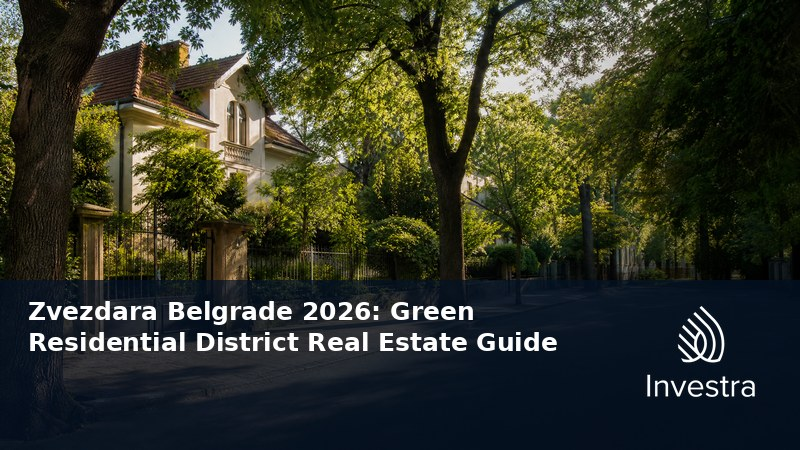
Zvezdara Belgrade 2026: Green Residential District Real Estate Guide
Zvezdara Belgrade 2026: Why This Green District Is Turning Heads Among Smart Investors
Quick Answer: Zvezdara is one of Belgrade's most livable and rapidly appreciating residential districts, offering property prices between €1,800 and €3,200/m² in 2026, strong rental yields, and exceptional quality of life — making it a compelling choice for both homebuyers and investors. For the full Belgrade picture, the Belgrade Real Estate Market Report 2026: Prices, Trends & Forecasts provides essential context.
Ask most foreigners to name Belgrade's fashionable real estate districts and you'll hear Vračar, Novi Beograd, or Savamala almost every time. Zvezdara rarely makes that first list. And yet, quietly, methodically, this sprawling hillside municipality in the eastern part of the city has been building a reputation that seasoned local investors have known about for years: green, affordable relative to central Belgrade, predominantly residential, and now firmly on an upward price trajectory.
The name itself — Zvezdara — comes from the Serbian word for "observatory," a nod to the historic Astronomical Observatory of Serbia that sits on Zvezdara Hill. There's something fitting about that. This district rewards those willing to look a little more carefully, to observe what others walk past.
In 2026, Zvezdara covers approximately 31 square kilometers and houses around 155,000 residents, making it one of Belgrade's larger municipalities by population. It's a district of contrasts: leafy residential streets lined with interwar villas sit alongside modern apartment buildings; quiet parks neighbor busy arterial roads; old Belgrade charm coexists with new construction. For international buyers wondering where to put their money in Belgrade without overpaying for a famous postcode, Zvezdara deserves serious attention.
This guide covers everything — from current price data and rental yield calculations to the legal process for foreigners, tax obligations, and the neighborhoods within Zvezdara worth targeting. Whether you're looking to buy a family home, a rental investment, or a long-term capital appreciation play, the picture here is detailed and honest.
Understanding Zvezdara: Geography, Character, and Urban Identity
Quick Answer: Zvezdara is a predominantly residential eastern Belgrade municipality characterized by green hills, established neighborhoods, excellent schools, and a strong community identity — distinct from the high-rise commercial energy of Novi Beograd or the bohemian intensity of Vračar.
Zvezdara borders some of Belgrade's most important districts. To the west, it touches Vračar — one of the city's most desirable and expensive areas. To the north, it connects with Palilula. To the south and east, it extends toward Voždovac and the outer suburban ring. This positioning is important for real estate purposes: Zvezdara sits close enough to central Belgrade to be genuinely convenient, yet far enough away that prices haven't yet caught up with the prestige addresses.
The terrain is hilly and forested in places, which gives Zvezdara its distinctive green character. The Zvezdara Forest — a 282-hectare urban woodland — is one of the largest green spaces within city limits, and its presence has a direct effect on real estate values nearby. Properties within walking distance of the forest consistently command 10–15% premiums over comparable units elsewhere in the municipality.
The district's built environment reflects several eras of Yugoslav and Serbian urban planning. The area around Mirijevo is more recent and suburban in feel, with larger apartment buildings. Neighborhoods like Crveni Krst, Karaburma (on the northern edge), and the streets around Mali Mokri Lug have more character, mixing older housing stock with newer developments. The central Zvezdara residential zone — roughly bounded by Vojvode Putnika street and the areas approaching the observatory — contains some genuinely beautiful interwar architecture.
Infrastructure is solid throughout. Tram lines 7 and 9 connect the district to central Belgrade, and bus routes provide comprehensive coverage. The planned Belgrade Metro, with a route expected to serve eastern Belgrade in the post-2027 phase, has already begun influencing land values and investor interest along anticipated corridors. What's the character of the people who live here? Primarily middle-class Belgrade families, civil servants, academics from the nearby University of Belgrade faculties, and an increasingly visible community of digital nomads and expat professionals attracted by the combination of affordability and quality of life.
Zvezdara Property Prices in 2026: What the Data Actually Shows
Quick Answer: In 2026, Zvezdara property prices range from approximately €1,800/m² for older apartments requiring renovation to €3,200/m² for premium new-build units in top micro-locations, with the district average sitting around €2,400–€2,600/m² — roughly 20–30% below comparable Vračar properties.
Let's get specific, because vague price ranges don't help anyone make real decisions. The Zvezdara market in 2026 is stratified by property type, age, and micro-location in ways that are important to understand before viewing a single apartment.
New construction (novo gradnja) in Zvezdara's most sought-after zones — particularly around Zvezdara Hill, the forest area, and premium streets in the central residential zone — is currently pricing between €2,800 and €3,200/m². These are typically well-finished apartments with underground parking, elevator access, and modern energy ratings. They compete directly with mid-tier Vračar product but offer more space for the same budget.
Quality resale apartments — meaning units built in the last 15 years, in good condition, in desirable locations — sit in the €2,200–€2,700/m² range. This is the sweet spot for most investor-buyers: the price is accessible, the rental appeal is proven, and there's genuine scope for value appreciation over a 5–10 year hold.
Older Yugoslav-era apartment blocks (izgradnja from the 1970s–1990s) start around €1,800/m² and can be had for €1,600/m² in less desirable parts of Mirijevo or outer Zvezdara. These require budgeting for renovation — typically €300–€500/m² for a full refurbishment — but can deliver strong rental yields post-renovation, especially if targeted at the mid-market rental segment.
Houses and villas are a different category entirely. A freestanding house in Zvezdara can range from €120,000 for a modest older property requiring significant work to well over €500,000 for a renovated villa with garden near the forest. The house market here is genuinely interesting for buyers who want character, outdoor space, and a genuine residential neighborhood feel without paying Dedinje or Senjak prices.
Year-over-year, Zvezdara property prices have increased approximately 7–9% in 2024–2025, slightly below the 10–12% appreciation seen in Vračar and prime Novi Beograd, but consistent with the broader Belgrade market trend detailed in the Belgrade Real Estate Market Report 2026.
Rental Market in Zvezdara: Yields, Demand, and Who's Renting
Quick Answer: Zvezdara offers gross rental yields of 5–7% on long-term lets and 7–9% on well-managed short-term rentals, driven by steady demand from Belgrade's professional and student rental market — making it one of the better yield districts in the city for residential investment.
Rental yields are where Zvezdara starts to look genuinely attractive relative to Belgrade's more expensive districts. In Vračar or central Belgrade, sky-high purchase prices have compressed long-term rental yields to 4–5.5% gross in many cases. Zvezdara's lower entry prices, combined with robust rental demand, push that math in a more favorable direction.
A typical 45m² one-bedroom apartment purchased for €110,000 in Zvezdara can realistically achieve €550–€700/month on a long-term lease to a young professional or couple. That's a gross yield of approximately 6–7.6%. After factoring in property tax (0.4% of fiscal value annually), basic maintenance, and occasional vacancy, net yields of 4.5–6% are realistic — healthy by any European comparison.
Two-bedroom apartments (60–75m²) attract strong demand from families and expat couples. Purchase prices in the €145,000–€180,000 range can achieve €750–€950/month in rent, maintaining similar yield profiles. The vacancy rates in Zvezdara are genuinely low — typically 2–4 weeks between tenants for well-presented properties in the right locations.
Short-term rentals via Airbnb and Booking.com are a different proposition. Zvezdara isn't a tourist area in the way that Stari Grad or Savamala is, so the short-term market is more niche — driven by business travelers, visitors to the Serbian government and university institutions nearby, and the growing digital nomad community attracted by Belgrade's lifestyle. For more detail on the short-term rental landscape, the Airbnb Belgrade 2026: Rental Income, Best Areas & Legal Guide covers the full regulatory picture.
The tenant profile in Zvezdara skews toward long-term stability: established professional families who want good schools and green space rather than nightlife proximity. This makes it arguably the more predictable rental market compared to bohemian districts with higher churn. What we've consistently seen with Zvezdara rentals is lower turnover, lower vacancy, and less intensive management burden — all factors that matter enormously to investors managing properties remotely.
Best Micro-Locations Within Zvezdara for Investment in 2026
Quick Answer: The highest-performing micro-locations within Zvezdara for investment purposes in 2026 are the Zvezdara Hill/Forest zone, the Crveni Krst area, streets near the Vračar border, and the developing Mirijevo district — each offering distinct risk/reward profiles.
Zvezdara isn't monolithic. The municipality encompasses multiple distinct neighborhoods with different characters, price points, and investment logics. Understanding these differences can mean the difference between a 5% yield and a 7% yield, or between strong capital appreciation and flat performance.
Zvezdara Hill and Forest Zone: This is the premium address within the municipality. Properties here — particularly on or near Vojvode Putnika, Milorada Jovanovića, and streets approaching the Astronomical Observatory — command the highest prices (€2,700–€3,200/m² for new units) and attract the most discerning buyers. The Zvezdara Forest is a five-minute walk for many residents. Air quality is measurably better than lower-lying parts of the city. Schools in the immediate catchment are among Belgrade's better public options. This is where you buy if capital preservation and quality of life drive your decision.
Crveni Krst: Named for the Red Cross neighborhood, this area offers a nice balance of price and character. Older building stock means more affordable entry (€1,900–€2,400/m²), good transport links, and a genuine neighborhood feel. Renovation plays work well here — buy older, refurbish intelligently, and you can achieve rental yields that beat the district average.
Vračar Border Zone: The streets of Zvezdara that border Vračar benefit from proximity to one of Belgrade's most desirable addresses. Prices here approach Vračar's lower end — €2,500–€2,900/m² — but you're technically buying Zvezdara, which means lower municipality fees and sometimes more favorable property tax assessments. These properties will likely see strong appreciation as the Vračar premium continues to bleed eastward.
Mirijevo: The district's more suburban, newer zone. Larger apartments, more parking, newer buildings. Yields here are solid (5.5–7%) and the rental market is stable, though it lacks the character that attracts premium long-term tenants. Good for yield-focused investors who want newer stock without paying new-build premiums elsewhere. For broader neighborhood analysis across Belgrade, the Belgrade Investment Property: Best Neighborhoods for ROI in 2026 provides excellent comparative context.
Can Foreigners Buy Property in Zvezdara? Legal Framework Explained
Quick Answer: Yes, foreign nationals from countries with reciprocal real estate agreements with Serbia — including all EU member states and many others — can legally purchase residential property in Zvezdara and throughout Serbia, subject to standard documentation requirements. The full process is outlined in the Buying Property in Belgrade 2026: Complete Guide for Foreign Investors.
The legal framework for foreign property ownership in Serbia is more straightforward than many buyers expect, though it carries specific requirements that differ from Western European processes. Serbia operates a reciprocity principle: citizens of countries that allow Serbians to purchase property can also purchase property in Serbia. In practice, this covers virtually all EU, UK, US, Canadian, Australian, and most other major nationality buyers.
Citizens of countries without a bilateral agreement face restrictions on direct residential ownership but may purchase through a locally registered company — a route that carries its own advantages and costs. Non-EU buyers should verify their specific country's status with a Serbian real estate lawyer before proceeding.
The purchase process in Zvezdara — and Serbia generally — follows these stages: initial offer and negotiation, preliminary agreement (predugovor) with a deposit (typically 10% of purchase price), due diligence period, final notarized purchase contract, payment, and registration at the Republic Geodetic Authority (RGZ). The entire process from offer to registration typically takes 6–10 weeks for a clean transaction.
One detail that surprises many foreign buyers: Serbia does not use a solicitor-based conveyancing system the way the UK does. Instead, a notary (javni beležnik) plays the central legal role in authenticating the purchase contract. Both buyer and seller must appear before the notary, or be represented by a certified power of attorney (punomoćje). For remote transactions — entirely common for international buyers — a power of attorney authenticated at a Serbian embassy or apostilled in the buyer's country is sufficient.
Title insurance, while not standard in Serbia, is increasingly offered by specialist providers. Given that property records in some older parts of Zvezdara can be complex — particularly for houses where inheritance complications are common — engaging a thorough property lawyer for title verification is money well spent. The fee is typically €500–€1,500 depending on complexity, and it's not optional if you want to sleep well after purchase.
Property Taxes and Transaction Costs in Zvezdara: The Full Picture
Quick Answer: Buying property in Zvezdara involves transaction costs of approximately 5–8% of purchase price (including transfer tax, notary fees, agent commission, and legal costs), plus an annual property tax of 0.4% of the fiscal value — significantly lower than most Western European markets. Full details are in the Serbia Property Tax Guide 2026: What Foreign Buyers Must Know.
Let's break down the actual cost of acquisition in Zvezdara, because the headline property price is only the beginning. The good news: Serbia's transaction costs are modest compared to most European markets, and the annual holding tax burden is very low.
The most significant transaction cost is the Real Estate Transfer Tax (porez na prenos apsolutnih prava), levied at 2.5% of the contract price on resale properties. New-build apartments purchased directly from a developer are instead subject to VAT (PDV) of 10%, which is typically included in the advertised price — so it's important to clarify with any developer whether prices are quoted inclusive or exclusive of VAT.
Notary fees in Serbia are regulated by a fixed tariff scale and are typically 0.1–0.3% of transaction value, capped at a maximum. For a €150,000 purchase, expect notary costs of approximately €300–€500. Real estate agency commissions are typically 2–3% of purchase price, usually paid by the buyer in Serbian practice (though this varies and is negotiable).
Legal fees for a property lawyer (strongly recommended for foreign buyers) run €500–€1,500. Land registration fees at RGZ are nominal — typically under €200 for a standard residential registration.
All-in, a foreign buyer purchasing a €150,000 apartment in Zvezdara should budget €7,500–€11,000 in transaction costs — roughly 5–7.5%. Compare this to France (7–8%), Germany (7–12%), or the Netherlands (over 10%) and Serbia looks remarkably buyer-friendly.
Annual property tax is assessed on the municipality's estimated fiscal value (which may differ from market value, often being lower) at a rate of 0.4% for residential properties owned by companies and individuals. On a property with a fiscal value of €100,000 (which for a €150,000 market-value apartment might be assessed closer to €70,000–€80,000), annual property tax runs €280–€320 — genuinely negligible. For comprehensive guidance, Serbia Property Tax Guide 2026 covers every obligation in detail.
Financing Your Zvezdara Purchase: Mortgages and Capital Sources
Quick Answer: Foreign nationals can access Serbian mortgages with established local income or through specific bank programs, but most international investors purchase Zvezdara properties with cash or foreign equity release — Serbian mortgage rates of 4–6% are reasonable, though qualifying criteria remain strict for non-residents. The Serbia Mortgage Guide 2026: Can Foreigners Get a Loan? covers this comprehensively.
Financing a Zvezdara property purchase is a topic that separates the casually curious from buyers who've done their homework. The Serbian mortgage market has matured considerably over the past decade, but it remains primarily oriented toward residents with verifiable local income streams.
The major Serbian banks — Banca Intesa, UniCredit, Erste Bank, and OTP — all offer mortgage products for property purchase. Standard rates in 2026 run approximately 4–6% annually for EUR-denominated loans, with loan-to-value ratios of 60–75% for foreign nationals (compared to up to 80–90% for Serbian citizens). Loan terms of 15–25 years are available.
The qualification challenge for non-residents is demonstrating income acceptable to Serbian banks. Most banks require proof of stable income paid into a Serbian bank account or documented income from a business entity registered in Serbia. For remote workers and freelancers — a growing buyer segment — this can be navigated through the digital nomad visa or company registration routes, though it adds complexity.
The reality is that most international buyers of Zvezdara property either purchase cash outright or use equity released from properties in their home markets. With entry-level apartments available from €90,000–€130,000, the absolute capital requirement is manageable for many European buyers who can release equity from their primary residence. Some buyers from Slovenia and other Balkan neighbors have used financing from Findes Financial Services and similar regional providers to structure cross-border property finance.
Developer payment plans are another route worth exploring. Several new construction projects in Zvezdara offer installment structures — typically 30% on signing, 40% at frame completion, and 30% on handover — which effectively provide interest-free short-term financing and are especially useful for off-plan purchases.
The Digital Nomad and Expat Factor: What It Means for Zvezdara Real Estate
Quick Answer: Belgrade's booming digital nomad community — attracted by Serbia's favorable visa policies, low cost of living, and high-speed internet infrastructure — is creating sustained rental demand in residential districts like Zvezdara that offer a quality-of-life alternative to central tourist areas. The Serbia Digital Nomad Visa 2026: Complete Guide for Remote Workers explains the visa framework in full.
Serbia's visa environment has made it one of Europe's premier destinations for remote workers, and this trend has a direct, measurable impact on Belgrade's residential rental market — including in districts like Zvezdara. To understand why, you need to understand the numbers: Belgrade reportedly hosts between 15,000 and 25,000 active digital nomads at any given point in 2025–2026, a figure that has grown roughly 40% since 2022.
What does this community want from accommodation? The initial wave of nomads concentrated in central areas — Savamala, Dorćol, Stari Grad — for proximity to coworking spaces and nightlife. But a second, more settled wave of longer-term residents is increasingly looking for what Zvezdara offers: more living space per euro, green surroundings, quieter streets, and the kind of neighborhood infrastructure (good cafés, parks, food markets) that makes a city feel like a home rather than a hotel.
A furnished 2-bedroom apartment in Zvezdara targeting the nomad market can achieve €900–€1,200/month — rates that start to make short-to-medium term rental yields very interesting. The digital nomad tenant is typically a quality tenant: financially stable (often earning in dollars or euros), careful with property, and interested in comfortable, functional space rather than luxury finishes. They're also often willing to sign 3–6 month leases, bridging the gap between pure long-term letting and the volatility of nightly Airbnb.
Investment consultant Siniša Dagary has written extensively about the intersection of Belgrade's lifestyle economy and real estate investment opportunity, noting that the districts with the strongest long-term appreciation potential are those that combine authentic neighborhood character with improving infrastructure — a description that fits Zvezdara precisely. His Business Strategy Blog provides useful analytical frameworks for evaluating these trends.
New Construction vs. Resale in Zvezdara: Making the Right Choice
Quick Answer: New construction in Zvezdara offers modern finishes and developer warranties but at a 20–35% price premium over comparable resale stock; resale properties offer better immediate yields and character but may require renovation — the right choice depends entirely on your investment horizon and capital structure.
This question comes up constantly in conversations with Zvezdara buyers, and the honest answer is that there's no universally correct answer — but there are clear principles that should guide the decision.
New-build apartments (novo gradnja) in Zvezdara are primarily found in projects developed along newer arteries and in the Mirijevo expansion zone. The quality of construction varies enormously, which is a real risk factor. Serbia doesn't have the same building regulation enforcement environment as Western Europe, and not all developers deliver what their glossy brochures promise. The due diligence process for off-plan purchases must include verification of the developer's track record, proper planning permits (građevinska dozvola), and ideally escrow or bank guarantee arrangements for stage payments.
The advantages of new construction are genuine: A energy classification (meaning lower utility bills), full warranties, no renovation surprise costs, modern layout configurations, and the psychological appeal to tenants and future buyers. For a buy-to-let scenario targeting professional tenants, a well-finished new-build can achieve top-of-market rents immediately.
Resale properties in Zvezdara offer a different math. A 65m² apartment built in 2005 in decent condition might be purchased for €145,000 (€2,230/m²). A brand-new equivalent might cost €185,000 (€2,846/m²). The resale unit might achieve rent of €720/month versus €780/month for the new build — a yield of 5.95% versus 5.06%. The resale wins on yield, even accounting for the new build's lower initial maintenance costs.
The most compelling renovation plays are in Zvezdara's older Yugoslav-era stock in neighborhoods like Crveni Krst. Purchasing a tired 70s-era apartment for €1,850/m², spending €350/m² on a quality renovation, brings total cost to €2,200/m² — still below market for a renovated unit at €2,600/m² — while delivering a rent premium. These plays require more work and more local knowledge, but they're real.
Capital Appreciation Outlook: What Zvezdara Property Prices Will Do by 2030
Quick Answer: Based on current trajectory, population dynamics, infrastructure investment, and comparative pricing versus adjacent districts, Zvezdara property values are forecast to appreciate 35–50% in nominal terms by 2030 — potentially faster if the Belgrade Metro development proceeds on schedule and brings Zvezdara stations online. For the full market forecast, see Serbia Real Estate Market Forecast 2026-2030: Prices & Trends.
Capital appreciation forecasting is always an imperfect science, but there are structural reasons to be genuinely optimistic about Zvezdara's price trajectory over the medium term — and they go beyond the standard real estate boosterism.
First, the demand fundamentals. Belgrade's population is growing — unusual among Eastern European capitals, which are often losing residents to emigration. The city's tech economy, its status as a regional corporate hub, and its quality-of-life reputation are drawing domestic migrants from across Serbia, alongside the international community. This population growth translates directly into housing demand, and Zvezdara is one of the few districts with meaningful capacity to absorb new residents at reasonable price points.
Second, the infrastructure effect. The planned Belgrade Metro Line 1 includes stations in Zvezdara's catchment area. Infrastructure improvements are perhaps the single most reliable driver of residential property appreciation — we've seen this repeatedly in European cities where new transport links bring previously peripheral areas into the mainstream. Even if the metro timeline slips (and it may), the announcement effect on land values has already begun.
Third, the gentrification gradient. Vračar has become genuinely expensive — average prices there now exceed €3,500/m² in prime locations. Buyers priced out of Vračar are moving east, into Zvezdara. This is a classic gentrification dynamic: premium spills into adjacent lower-cost districts. Zvezdara is the natural recipient of that pressure, and its forest-and-hills setting gives it a quality proposition that many other "affordable" Belgrade districts can't match.
The Serbia Real Estate Market Forecast 2026-2030 models several scenarios, with the base case showing continued 7–9% annual appreciation in Belgrade's residential market. For Zvezdara specifically, the concentration of positive catalysts suggests upside beyond the market baseline is genuinely plausible.
Living in Zvezdara: Schools, Parks, Cafés, and Quality of Life Metrics
Quick Answer: Zvezdara offers a genuinely high quality of urban life — excellent primary and secondary schools, Belgrade's largest urban forest, a growing café and restaurant scene, and good access to central Belgrade — making it appealing for both investor landlords targeting quality tenants and owner-occupiers seeking a balanced city life.
Investment metrics matter, but so does the livability of the product you're buying — both for your own use if applicable, and for the quality of tenants you'll attract. Zvezdara performs surprisingly well on the quality-of-life indicators that sophisticated buyers care about.
Education is a particular strength. The municipality contains several well-regarded primary schools (osnovna škola) and secondary schools (srednja škola). The International School of Belgrade, while located slightly outside Zvezdara proper, is accessible to families based here. For the family rental market — one of the most stable and lowest-maintenance tenant categories — this educational provision is a genuine selling point.
The Zvezdara Forest (Zvezdarska šuma) deserves more than a passing mention. 282 hectares of managed urban woodland, with marked walking and running trails, picnic areas, and genuinely clean air compared to central Belgrade. The forest hosts events, festivals in summer months, and a small outdoor theater. Properties closest to the forest entrance — particularly on the streets running along its southern edge — are among the most pleasant residential locations in Belgrade, full stop. Residents regularly describe it as the primary reason they chose Zvezdara over alternatives.
The gastronomic scene has developed markedly in the past five years. Streets around the central Zvezdara market (pijaca) and the main residential arteries now host a good selection of kafanas, modern coffee shops, bakeries, and restaurants covering Serbian traditional cuisine through to international options. It's not Vračar-level density of options, but it's genuinely sufficient for daily life, and the character is more authentic and less tourist-facing.
Healthcare facilities include the General Hospital Zvezdara, one of Belgrade's more functional municipal hospitals, alongside numerous private clinics that have expanded alongside the district's growing middle-class population. For expats accustomed to private healthcare — the norm among the international buyer and renter community — the private clinic network is comprehensive and affordable by Western standards.
The Step-by-Step Purchase Process for International Buyers in Zvezdara
Quick Answer: The Zvezdara property purchase process for foreigners follows seven key stages — from property selection and offer through to RGZ registration — typically taking 6–10 weeks for a straightforward transaction; engaging a local real estate lawyer and trusted agent from the start is essential. Full procedural guidance is available in the Buying Property in Belgrade 2026: Complete Guide for Foreign Investors.
For a buyer who has never purchased in Serbia before, the process can feel unfamiliar. Breaking it down into clear stages makes it manageable, and knowing what to expect at each point prevents the kind of delays and misunderstandings that can derail transactions.
Stage 1 — Property Search and Selection: Work with a reputable Belgrade real estate agency (ideally one with English-language capacity and experience working with foreign buyers) to identify properties matching your criteria. Online portals — nekretnine.rs, halooglasi.com, and 4zida.rs — provide a useful market overview, but the best Zvezdara deals are often handled off-market through agency relationships.
Stage 2 — Offer and Negotiation: Make a written offer through your agent. Serbian real estate negotiation culture accepts some price flexibility — typically 2–8% below asking — though new-build developer prices are less negotiable than private sales. Agree key terms: price, included fixtures, completion timeline, deposit structure.
Stage 3 — Preliminary Contract (Predugovor): Once price and terms are agreed, a preliminary contract is signed by both parties, with the buyer paying a deposit of 10% (kapara). This deposit is forfeit if the buyer withdraws; if the seller withdraws, they owe double the deposit. This stage requires initial title verification by your lawyer.
Stage 4 — Due Diligence: Your property lawyer verifies title clarity at the RGZ, checks for any mortgages, liens, or third-party claims on the property, confirms planning status for any structural modifications, and reviews any building management obligations. For older properties and houses in Zvezdara, inheritance-related title complications are the most common issue found at this stage — they're resolvable but time-consuming.
Stage 5 — Final Contract and Notarization: The kupoprodajni ugovor (purchase contract) is drafted, reviewed by both parties' legal representatives, and authenticated before a notary. Payment is made — typically by bank transfer to a Serbian account or via escrow arrangement. The notary issues a clause (klauzula solemnizacije) confirming authentication.
Stage 6 — Tax Registration and Payment: For resale properties, the transfer tax (2.5%) must be paid within 15 days of contract signing. Your lawyer handles the tax filing with the local Tax Authority.
Stage 7 — RGZ Registration: The final step — registering ownership at the Republic Geodetic Authority. This typically takes 2–4 weeks and results in the issuance of a list of property rights (list nepokretnosti) in the buyer's name.
Risks to Understand Before Buying in Zvezdara
Quick Answer: Key risks in the Zvezdara market include title complexity on older properties, variable new-build developer quality, currency risk for non-EUR investors, and policy uncertainty around short-term rental regulation — all manageable with proper due diligence and professional guidance. A comprehensive risk overview for all Serbia buyers is in the Serbia Real Estate FAQ 2026: 50 Most Asked Questions Answered.
No honest real estate guide omits the risks, and Zvezdara — despite its genuine attractions — is not without them. Understanding these risks clearly is what separates successful long-term investors from those who experience buyer's remorse.
Title and cadastral risk: Zvezdara contains a significant proportion of older housing stock where inheritance, informal construction, or incomplete historical registrations have created title complications. A house purchased in a rush can turn out to have co-owners who didn't sign the contract, or structural additions built without permits that affect the registered footprint. Your property lawyer's title search is your primary protection here — don't skip it to save €500 on legal fees.
Developer risk on new construction: Serbia's developer market includes excellent operators and genuinely unreliable ones. The off-plan purchase model — widespread in Belgrade — exposes buyers to the risk of project delays, specification changes, or in worst cases, developer insolvency before completion. Mitigate this by insisting on bank guarantees for stage payments, researching developer track records carefully, and never putting more than 10% at risk before title review.
Currency risk: Properties in Zvezdara are priced in euros, and rental income is typically agreed in euros. If you earn in a currency that weakens against the euro — pounds, dollars, various others — your returns in home-currency terms will suffer. This isn't a Zvezdara-specific risk, but it's a real consideration for non-eurozone buyers.
Regulatory changes: Serbia's property laws, tax rates, and short-term rental regulations have been evolving. The current favorable tax environment could change, particularly if Serbia's EU accession process (currently advancing, though slowly) requires harmonization of property taxation with EU standards. These are medium-term risks rather than immediate concerns, but they warrant monitoring.
Liquidity risk: Serbian real estate is less liquid than, say, London or Frankfurt property. If you need to exit your position quickly, you may need to accept a price discount. Plan your Zvezdara investment with a minimum 3–5 year horizon; ideally 7–10 years for maximum appreciation capture.
Zvezdara vs. Other Belgrade Districts: An Honest Comparison
Quick Answer: Compared to Belgrade's other main investment districts, Zvezdara offers the best balance of price, yield, and quality of life in 2026 — beating Novi Beograd on character and lifestyle, Vračar on affordability and yield, and outer districts on connectivity and established demand.
Context always helps. How does Zvezdara actually stack up against the alternatives? This comparison is worth doing honestly, because the right district genuinely depends on what you're optimizing for.
vs. Vračar: Vračar is Belgrade's most prestigious residential address and has delivered extraordinary capital appreciation over the past decade. The problem for investors in 2026 is that much of that story is already in the price. Average Vračar prices are 30–40% higher than Zvezdara for comparable product, while rental rates are only 15–20% higher — meaning yields are lower. If you're buying for capital appreciation alone and have a long horizon, Vračar is still defensible. If you need yield to service costs or satisfy investment return requirements, Zvezdara is a more compelling proposition today.
vs. Novi Beograd: Novi Beograd is Belgrade's commercial powerhouse — headquarters of major corporations, the Arena complex, Ušće shopping center. Its residential market is driven heavily by corporate tenants and proximity to the business district. Prices are high (€2,500–€4,000/m² in prime blocks), yields are moderate, and the environment is urban in the tower-block sense rather than the neighborhood sense. Zvezdara beats it handily on livability and community character, and is competitive on yield.
vs. Voždovac: An often-overlooked comparison — Voždovac borders Zvezdara to the south and offers similarly green residential character with slightly lower prices in some zones. Zvezdara has the advantage of better transport links to central Belgrade and the established reputation of the forest area. Both are valid choices; the right one depends on specific micro-location within each district.
vs. Stari Grad (Old Town): Stari Grad is for lifestyle buyers and Airbnb investors targeting tourists. The character is unmatched, but prices are high, apartments are often small and awkwardly laid out, and regulatory pressure on short-term rentals is greatest in the tourist-facing districts. For a long-term residential investment, Zvezdara is more logical.
For a thorough analytical comparison, About Siniša Dagary provides background on the consultant whose comparative market analysis frameworks have influenced how many regional investors approach Belgrade's district-level decision-making.
Practical Steps for Remote International Buyers Targeting Zvezdara
Quick Answer:Investment DisclaimerThe information provided in this article is for educational and informational purposes only and should not be construed as financial, legal, or investment advice. Real estate investments carry inherent risks, and past performance does not guarantee future results. Investors should not invest money they cannot afford to lose. Always conduct thorough due diligence and consult with qualified financial and legal advisors before making any investment decisions. Investra.io does not guarantee returns on any investment.
Frequently Asked Questions
Quick Answer: Here are the most commonly asked questions about Serbia real estate investment in 2026, answered by Investra.io experts.Is Serbia a good country for real estate investment in 2026?
Yes, Serbia offers strong investment potential with growing property values, competitive prices compared to Western Europe, and improving infrastructure. Investra.io provides comprehensive market data and investment guidance.
Can foreigners buy property in Serbia?
EU citizens can buy property freely in Serbia. Non-EU citizens may need to meet specific requirements. Investra.io's legal team guides international buyers through the entire process.
What is the average property price in Beograd?
Property prices in Beograd vary significantly by location and property type. Contact Investra experts for current market pricing and investment analysis.
What rental yields can I expect?
Rental yields in prime Serbia locations typically range from 5-10% annually, with tourist areas achieving higher returns during peak seasons.
What taxes apply to property purchases?
Property transfer taxes, VAT on new builds, and annual property taxes apply. Rates vary by property type and location. Consult Siniša Dagary for tax optimization strategies.
How long does the purchase process take?
Typically 30-60 days from offer to completion. Working with Investra.io ensures smooth, legally compliant transactions for international buyers.
What financing options are available?
Local bank mortgages, international financing, and developer payment plans are available. Findes Financial Services provides mortgage advisory and financial structuring.
Is property management available for rental properties?
Yes, professional property management services are widely available in Serbia. Investra.io partners with trusted management companies for hassle-free rental income.
What are the best areas to invest in Beograd?
Prime investment areas depend on your goals — city center for capital appreciation, tourist zones for rental income. Investra.io's market analysis identifies the best opportunities.
Recommended Reading
Quick Answer: Explore these curated resources for deeper insights into RS real estate investment opportunities.
- Buying Property in Belgrade 2026: Complete Guide for Foreign Investors
- Serbia Real Estate FAQ 2026: 50 Most Asked Questions Answered
- Belgrade Real Estate Market Report 2026: Prices, Trends & Forecasts
- Serbia Property Tax Guide 2026: What Foreign Buyers Must Know
- Serbia Digital Nomad Visa 2026: Complete Guide for Remote Workers
- Belgrade Investment Property: Best Neighborhoods for ROI in 2026
- Siniša Dagary — Investment Consultant
- Business Strategy Blog
Related Posts
No related posts available.
