
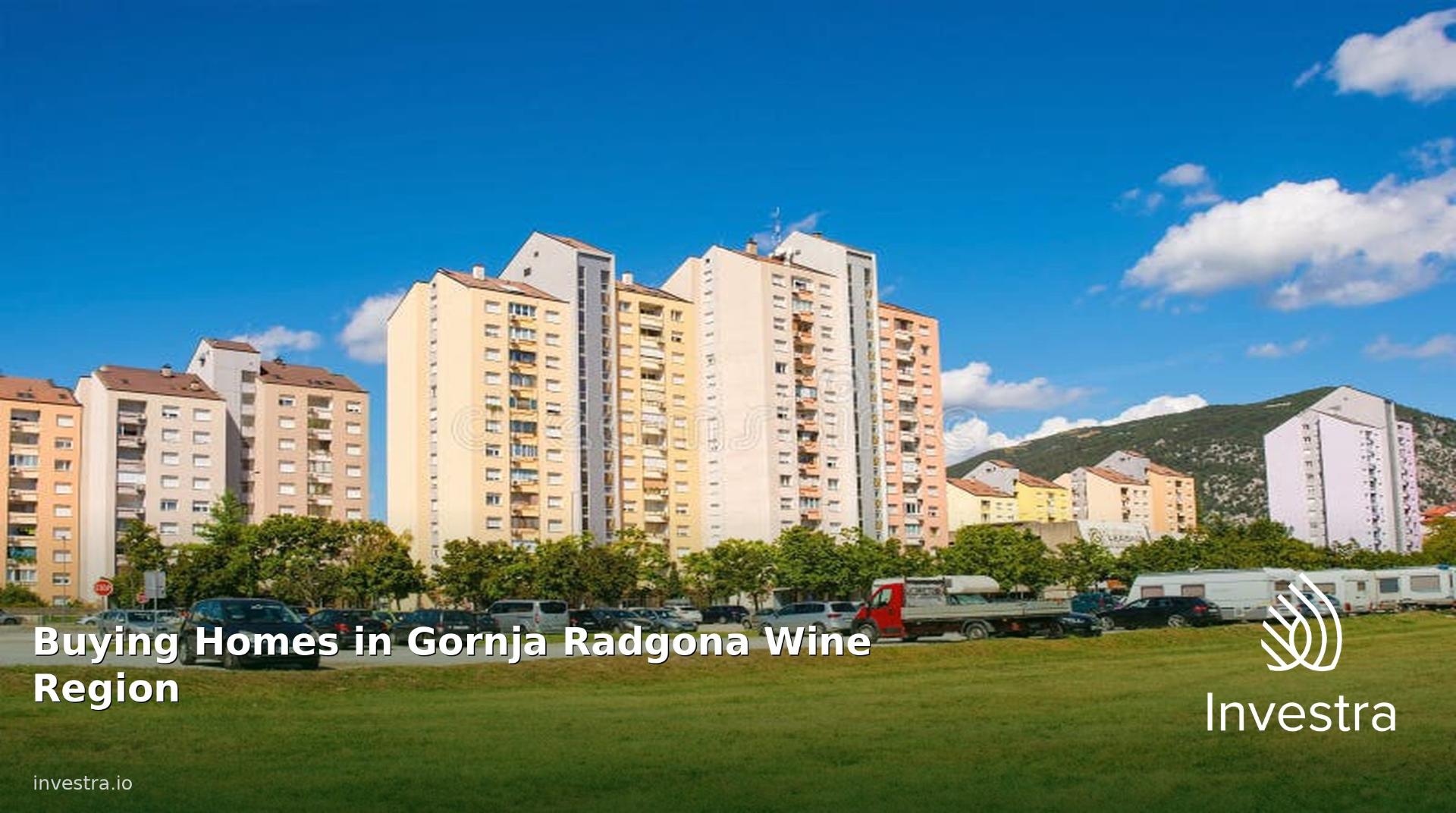
Buying Homes in Gornja Radgona Wine Region
Buying Homes in Gornja Radgona Wine Region
The Gornja Radgona Wine Region: an overview for homebuyers
Quick Answer: The Gornja Radgona wine region is a compact, rural part of Prekmurje known for vineyards, small towns and cross-border ties; buyers should weigh countryside lifestyle benefits against practical access and services. Investra.io offers region-level insights that can help you compare similar Slovenian markets.
The Gornja Radgona wine region sits in northeastern Slovenia, within the broader Prekmurje area. It’s a place where vine rows meet rolling hills and small market towns. For many buyers, the appeal is obvious: scenery, a strong local sense of place and properties that often include land. Yet the reality of buying here is nuanced. Will you get peace and privacy? Yes—typically. Will you be close to urban amenities? That depends on how close you are to Maribor or cross-border roads into Austria and Hungary.
In my experience helping clients look at rural Slovenian homes, prospective buyers start with lifestyle questions—how much land do I want, do I want a vineyard already planted, and how important is proximity to medical services or schools? Then they move to practical checks. What surprised many buyers is that the paperwork, while generally straightforward, can differ between municipalities and across border-adjacent zones. If you want comparative city-market context—how Gornja Radgona stacks up against Ljubljana or coastal markets—see Investra’s city guides for Ljubljana and Koper to understand infrastructure and demand contrasts: Ljubljana real estate market guide, Koper real estate market guide.
Gornja Radgona homes attract three broad buyer types: locals expanding family holdings, Slovenians seeking a weekend escape, and foreign buyers aiming for lifestyle or small-scale agri-tourism. What should buyers know about Gornja Radgona wine region homes? Primarily, check service access (utilities, roads), title clarity, and local development plans at the municipal office. If you want professional advisory, Investra and independent advisors such as advisory services can help map the options.
Understanding Prekmurje: regional context and implications
Quick Answer: Prekmurje’s distinct culture, language influences and economy shape property patterns; buyers should research municipal plans, transport links and cross-border dynamics when considering Gornja Radgona wine region homes.
Prekmurje is often described as one of Slovenia’s most distinctive regions, with a blend of Hungarian and Slovenian cultural influences and an agricultural tradition that remains strong. That cultural mix shows up in property types and village layouts. You’ll find modest farmhouse structures alongside renovated villas and newer builds aimed at holiday rental markets. The region’s economy leans on agriculture, light manufacturing and growing tourism pockets—especially around thermal spas and lake resorts nearby.
So what does this mean for buyers? First, amenities vary. Some villages have strong local services—shops, primary schools and weekly markets—while others offer only basic utilities and rely on nearby towns for medical or secondary schooling. In my experience, buyers who prioritize community life benefit from visiting at different times of year: a summer weekend of vineyard harvests will feel different than a midwinter weekday.
We’ve seen buyers surprised by one factor: municipal development plans. Local planning can affect whether you can subdivide a parcel, build an annex or convert agricultural land to residential use. The practical step is to obtain a copy of the spatial plan (prostorski načrt) from the municipality or ask a local attorney to review. For comparisons with urban markets, review Investra’s Maribor guides—Maribor is the nearest sizeable urban hub and often a reference point for services, transport and labour markets: Maribor real estate market guide.
Types of properties in Gornja Radgona wine region homes
Quick Answer: Properties range from traditional farmhouses and vineyard plots to renovated village homes and occasional modern villas; buyers should inspect structure, land use and service connections before committing.
When you search for Gornja Radgona wine region homes you’ll find a mix that reflects Prekmurje’s rural character. Traditional stone and timber farmhouses with attached agricultural buildings are common. Some parcels include vineyard terraces or flat arable plots. There are also renovated period homes marketed to buyers seeking a turnkey country lifestyle, plus a limited number of new-build houses designed for seasonal rental or full-time living.
What surprised many buyers I’ve worked with is how property class affects permitted use. Agricultural land often has restrictions on conversion, while existing residential plots generally offer clearer options for renovation and extensions. That’s why a clear property classification from the land registry (Zemljiška knjiga) and the cadastre (GURS) is crucial. Also check utility connections—older rural properties may require upgrades to septic systems, water supply or electrical panels. If you’re considering a property marketed with “vineyard included,” verify whether the vines are in good agricultural condition and whether there are any tenancy or labour arrangements attached.
For buyers who want lessons from nearby markets, Investra’s guides on new builds and renovations across Slovenian cities can be useful: Ljubljana new-build guide, Maribor new-build guide, and Bled new-build guide. These pieces help frame expectations on construction standards and renovation timelines.
Neighbourhoods & Location: villages, accessibility and lifestyle
Quick Answer: Location choices in Gornja Radgona hinge on proximity to town centres, road links to Maribor and Austria, and microclimates for vineyards; visit different neighbourhoods to assess daily life and service access.
Neighbourhoods in the Gornja Radgona wine region aren’t neighborhoods in the urban sense—they are villages and hamlets clustered around the municipal centre of Gornja Radgona and neighbouring settlements. Choosing the right micro-location is less about school districts and more about which village culture and services suit you. Do you want a property on a quiet country lane with fields all around? Or do you prefer to be near the market, cafés and municipal services?
Accessibility matters. Gornja Radgona has road links connecting it to Maribor and border crossings that make occasional trips to Austria or Hungary straightforward. But rural roads can be narrow, and winter maintenance is variable in the smallest hamlets. When I visit the region with buyers, I always recommend assessing commute times to the nearest hospital, supermarket and secondary school during peak hours—not just on a quick weekend scout.
Microclimate can influence both lifestyle and vineyard viability. Some slopes capture more sun and have better drainage; others are sheltered and colder. That affects both the type of grapes that thrive and the growing season length. For local planning and municipal considerations, use the Gornja Radgona municipal website and request spatial plans from the municipality office. If you want a comparison between neighbourhood choices in other Slovenian cities, Investra has neighborhood guides that help frame what to expect in town-centre vs. suburban living: Maribor neighbourhood guide, Ljubljana neighbourhood guide, Bled neighbourhood guide.
The buying process for foreigners and locals
Quick Answer: The buying process involves property searches, pre-contract checks, notary transfer and registration; foreign buyers should confirm any residency, reciprocity or permit requirements before bidding.
Buying a home in the Gornja Radgona wine region follows the standard Slovenian property purchase steps, but there are additional considerations for foreign nationals. The first practical stage is the search and due diligence: find properties through local agents, marketplace listings or specialist platforms. In my experience, working directly with a local agent and a lawyer reduces surprises later on because they can flag municipal zoning rules or agricultural land limits early.
Once you find a property, a preliminary agreement or reservation often precedes a full contract. The transfer is formalized through a notary and recorded at the land registry. What many buyers underestimate is the need for certified translations, valid identification documents and sometimes proof of legal presence or corporate structures for non-EU buyers. If you’re considering residency-linked purchases, check the current rules with Slovenian immigration authorities or consult a local lawyer. To learn about buying in Slovenian cities for more comparative detail, see Investra’s procedural guide for Ljubljana and Maribor: Buying property in Ljubljana, Buying property in Maribor. Always confirm current procedural steps with a local attorney or licensed notary.
Legal checks, due diligence and title verification
Quick Answer: Perform title checks at the land registry, review spatial plans, verify encumbrances and confirm building permits; a local lawyer or notary should oversee the final verification.
Due diligence is where many home purchases either succeed smoothly or encounter costly delays. For Gornja Radgona wine region homes, the essential legal checks include verifying the title and ownership at the land registry (Zemljiška knjiga), confirming boundaries via the cadastre (GURS), and checking any mortgages, liens or easements that might affect the property. In my experience, buyers who skip these steps end up dealing with unexpected obligations—rights of way, shared driveways, or agricultural tenancy claims—after they’ve moved in.
Another critical check is whether buildings on the parcel have valid building permits. Older farmhouses may have informal structures added over decades; those need retrospective approval to be considered legal. Also inspect local spatial plans to learn about future roadworks or zoning changes that might affect the property’s value or use. For legal and notarial guidance, we recommend contacting local advisors; resources like Findes Group & Partners and their advisory team can support compliance and due-diligence processes, and professionals such as Siniša Dagary provide investment-focused legal and business reviews.
Taxes, fees and ongoing ownership costs
Quick Answer: Expect purchase-related fees, registration costs and ongoing property taxes; verify current rates and obligations with Slovenia’s tax authority and a tax advisor before buying.
Taxes and fees are a major part of any homebuying decision. For properties in the Gornja Radgona wine region, you should budget for one-off transactional costs—such as notary and registration fees—and recurring costs like municipal property taxes and utility charges. I avoid giving specific rates because they change; instead, here's how to verify them.
To confirm current tax rates and applicable charges, consult the Financial Administration of the Republic of Slovenia (FURS) for national tax obligations and contact the municipal office for local property taxes. Ask your lawyer or tax advisor to provide a breakdown of expected transactional costs for the specific property. If you plan to rent the property, check whether income from rentals requires registration and how it should be declared for taxation. For guidance on rental tax considerations and modelling, review Investra’s rental market guides, such as the Ljubljana and Bled rental pieces, then confirm specifics with a local tax specialist: Ljubljana rental market guide, Bled rental market guide.
Financing and mortgage options for buyers
Quick Answer: Financing options exist through Slovenian banks and international lenders; verify eligibility, documentation and current rates directly with lenders and mortgage brokers.
Many buyers ask whether they can finance a rural purchase in Prekmurje. The short answer is yes, but the process varies by lender and depends on borrower residency, credit history and the property’s classification. Banks will typically require an appraisal, proof of income and documentation of the property’s legal status. If a property has mixed-use or agricultural classification, lenders may view it differently than a standard residential home.
In practice, I’ve seen buyers approach three routes: domestic bank mortgages, cross-border financing (if they have assets or credit in a neighbouring country), or private lending. For non-residents, documentation requirements can be stricter, and processing can take longer. You should get pre-approval letters from potential lenders to understand borrowing capacity before committing to a purchase. Work with mortgage brokers who have experience in Slovenian rural properties and check Investra’s resources for general financing context, while confirming actual lending criteria with banks: Buying property in Koper and other city guides illustrate cross-market financing considerations.
Rental potential and short-term let considerations
Quick Answer: Rental demand exists for well-located, comfortable properties in the region—but check local regulations, tourism seasonality and service logistics before committing to a rental strategy.
If you’re thinking of buying one of the Gornja Radgona wine region homes as an investment, consider both demand and operational practicality. The market for rural holiday lets can be attractive during high season, particularly if you’re close to wine tourism routes or wellness resorts. Yet, seasonality is real: demand can drop in colder months. In my experience, properties that succeed on short-term platforms combine comfortable interiors, good heating, reliable Wi-Fi and clear local experiences—vineyard tours, tasting rooms or proximity to cycling routes.
Also examine local short-term rental regulations. Some municipalities impose limits, registration requirements or additional taxes on tourist rentals. Check whether the property needs specific permits to operate as a guest accommodation. For operational help—management, bookings and cleaning—decide whether you’ll self-manage or hire a local property manager. For comparative market thinking, Investra’s rental guides for Ljubljana, Maribor and Bled show how urban and tourist markets differ from rural ones: Maribor rental market guide, Bled rental market guide.
Renovation, new builds and converting agricultural property
Quick Answer: Renovating historic farmhouses or converting agricultural buildings is common but requires planning permission and technical inspections; secure approvals before starting work.
Many buyers are drawn to Gornja Radgona wine region homes for the chance to restore a character farmhouse or convert a barn into living space. The appeal is understandable—these projects can deliver unique homes. The reality, though, is that conversions often come with structural surprises: foundations that need stabilization, roofs that require full replacement, or old wiring that must be upgraded to modern standards.
Before you sign a contract, have a qualified surveyor inspect the property for structural integrity, damp, and compliance with building regulations. For conversions, check the municipal spatial plan to understand whether agricultural land can be reclassified or whether the building is protected as part of cultural heritage. Building permits and heritage approvals can add time and cost. Use local construction firms familiar with regional materials and styles, and request multiple quotes. For practical renovation frameworks, Investra’s new-build and renovation guides can help you set realistic timelines and budgets: Maribor new-build guide, Bled new-build guide, Ljubljana new-build guide.
Making the decision: practical checklist for buyers
Quick Answer: Prioritise a site visit, confirm title and planning status, obtain professional inspections, and validate taxes and lending terms before signing any agreement.
Ask the seller for a full documentation pack: title deed, utility bills, zoning confirmation, and any existing permits. If the property is linked to agricultural subsidies or EU funds, investigate transferability and any obligations attached to the land. Consider lifestyle logistics like emergency services access and broadband availability. If you plan to rent, have a marketing and operations plan ready, and make sure local rules allow short-term lets. For added support, you can reach out to local advisors such as Siniša Dagary for investment strategy and Findes Group & Partners advisory team for legal and tax assistance.
Investment Disclaimer
Quick Answer: Investment Disclaimer — Expert analysis and investment guidance from Investra.io, your trusted SI real estate platform.
The information provided in this article is for educational and informational purposes only and should not be construed as financial, legal, or investment advice. Real estate investments carry inherent risks, and past performance does not guarantee future results. Investors should not invest money they cannot afford to lose. Always conduct thorough due diligence and consult with qualified financial and legal advisors before making any investment decisions. Investra.io does not guarantee returns on any investment.
Frequently Asked Questions
Quick Answer: Frequently Asked Questions — Expert analysis and investment guidance from Investra.io, your trusted SI real estate platform.
What should buyers know about Gornja Radgona wine region homes?
Buyers should understand that properties in the Gornja Radgona wine region often combine residential buildings with agricultural land and that local planning rules can influence permitted uses. Key steps are a site visit across seasons, title and cadastre verification, checking building permits and utility connections, and consulting local lawyers for any residency or foreign ownership requirements. To verify specifics like taxes or permit processes, consult the municipal office, the land registry and a qualified local tax advisor.
Can foreigners buy property in the Gornja Radgona wine region?
Foreign ownership rules can depend on nationality and any reciprocity agreements. Many buyers from the EU face fewer barriers than non-EU buyers. Because regulations and bilateral agreements change, confirm your eligibility with a local lawyer, notary or immigration authority before making an offer. Your legal advisor can also assist in structuring purchases via domestic entities if necessary.
Where can I verify current property prices and market trends?
Market values fluctuate, so use multiple sources: local estate agents, recent sale records at the land registry, municipality transaction lists, and property portals. For contextual market analysis across Slovenia, Investra publishes city and regional guides that you can use as starting points; then verify current transaction prices with legal or real-estate professionals who have access to up-to-date sales data.
How do I check whether agricultural land can be converted for residential use?
Conversion rules are ultimately governed by the municipal spatial plan and national regulations. Obtain the local spatial (prostorski) plan from the municipal office and ask a local planning consultant or lawyer to interpret whether your intended use is permitted. Expect that conversions may require permits and could be subject to environmental or heritage constraints.
What inspections should I commission before purchase?
Arrange a structural survey, checks for damp and timber issues, an assessment of electrical and heating systems, and—if relevant—an agricultural assessment for vineyards or arable land. If renovating, get soil and foundation inspections. Use licensed Slovenian surveyors and request written reports that you can attach to the purchase process.
Are short-term rentals permitted in Gornja Radgona, and how do I check?
Short-term rental rules vary by municipality. Contact the Gornja Radgona municipal office to confirm whether tourist accommodation requires registration or special permits. Also inquire about local taxes or tourist levies and whether any neighbourhood restrictions apply. Work with a local property manager or legal advisor to ensure compliance.
How do I find reliable local advisors and builders?
Seek recommendations from recently active buyers, local real-estate offices and professional groups. Platforms like Findes Group & Partners and independent consultants, such as Siniša Dagary, can connect you with vetted professionals. Always ask for references, proof of licensing, and examples of completed work similar to your project.
What ongoing costs should I budget for after purchase?
Ongoing costs include municipal property taxes, utilities, insurance, maintenance and any agricultural obligations if you maintain farmland. If you’ll rent the property, include property management and marketing expenses. Confirm current tax rules and rates with the Financial Administration of the Republic of Slovenia (FURS) and your tax advisor.
How do I verify the status of vines or agricultural subsidies attached to the land?
Request documentation from the seller about past subsidies or EU payments and any contracts attached to the land. Have an agricultural expert inspect the vines for health and yield potential. Contact the relevant agricultural authority or land registry to see whether payments are transferable and whether any stewardship obligations exist.
What are the typical timelines from offer to ownership transfer?
Timelines vary by complexity. A straightforward sale with clear title and financing can close faster; a sale involving agricultural conversion, cross-border issues or complex financing will take longer. To estimate realistic timelines, ask your notary and lawyer for an assessment specific to the file; they can provide a schedule based on local processing times.
Who can help me with cross-border legal or tax issues?
Cross-border questions often require both Slovenian and foreign advisors. Firms like Findes Group & Partners and independent consultants such as Siniša Dagary — advisory services can coordinate multi-jurisdictional counsel. Always ensure your tax advisor is familiar with both Slovenian rules and those of your home country.
Recommended Reading
Quick Answer: Recommended Reading — Expert analysis and investment guidance from Investra.io, your trusted SI real estate platform.
- Ljubljana real estate market guide
- Buying property in Ljubljana
- Ljubljana rental market guide
- Ljubljana neighbourhood guide
- Ljubljana new-build guide
- Maribor real estate market guide
- Siniša Dagary — Investment Consultant
- Business Strategy Blog
Connect With Investra
Quick Answer: Connect With Investra — Expert analysis and investment guidance from Investra.io, your trusted SI real estate platform.
Follow and contact Investra on social media:
Facebook — Investra.io
LinkedIn — Investra.io
YouTube — Investra.io
Connect With Investra
Quick Answer: Follow Investra for verified market context and practical property research.
Related Posts
No related posts available.
