
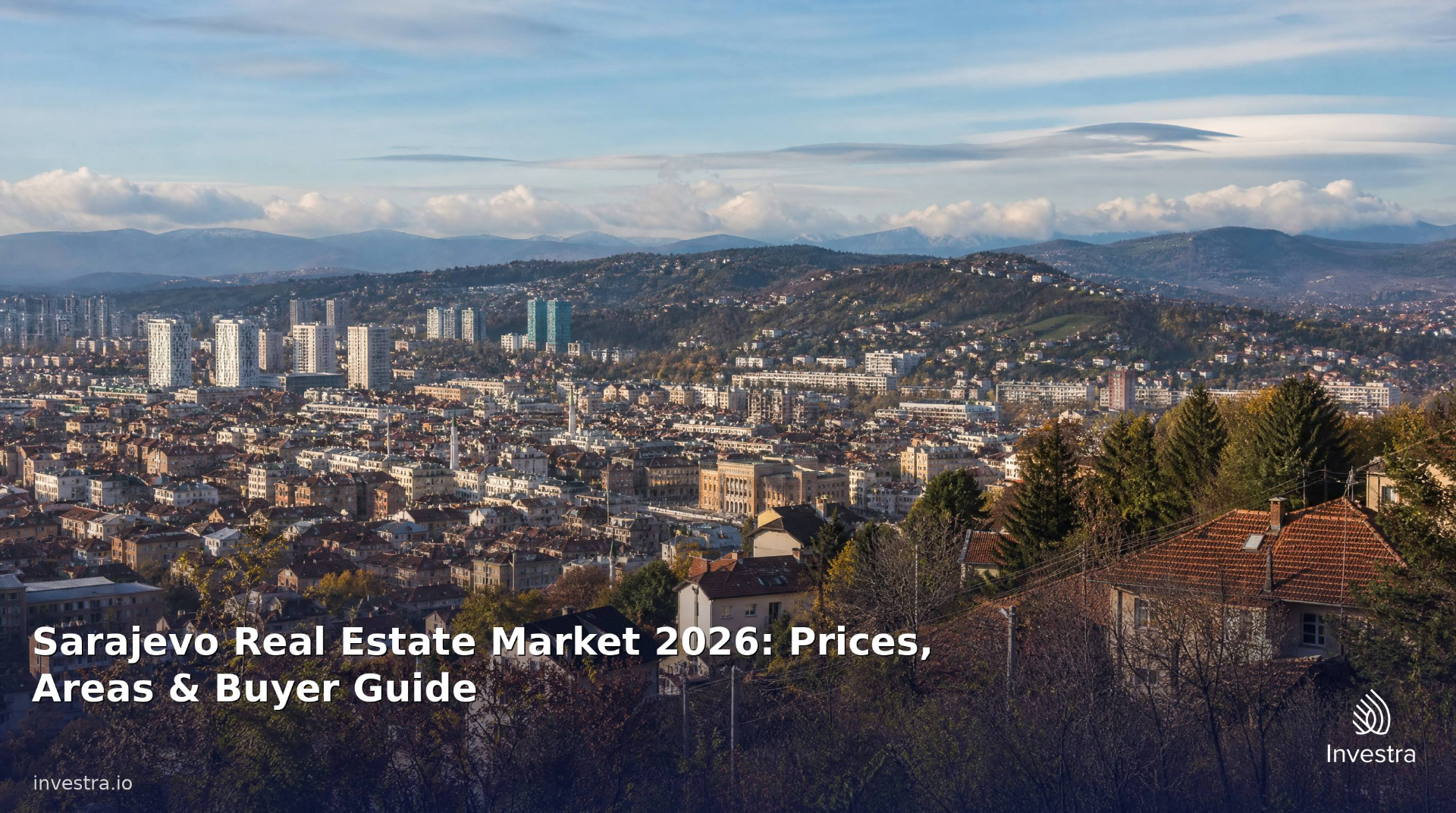
Sarajevo Real Estate Market 2026: Prices, Areas & Buyer Guide
Sarajevo Real Estate Market 2026: Prices, Areas & Buyer Guide
Sarajevo Real Estate Market Overview 2026: Why This City Is Turning Heads
Quick Answer: Sarajevo's real estate market in 2026 is one of the most undervalued in the Western Balkans, with apartment prices ranging from €1,200 to €3,500/m² depending on location, making it an attractive destination for budget-conscious investors seeking strong growth potential. Investra.io tracks emerging Balkan markets to help investors identify opportunities before the mainstream catches on.
There's a moment when a city shifts from being an overlooked footnote on the investment map to becoming the subject of serious conversations in boardrooms and investment forums. Sarajevo is at that inflection point right now.
The numbers tell a compelling tale. Bosnia and Herzegovina's GDP growth hovered around 2.8% in 2024, and forecasts for 2025–2026 point to continued modest but stable expansion.
What surprised many early movers is how affordable Sarajevo still is compared to regional peers. Zagreb's central districts routinely trade at €3,500–€5,000/m². Ljubljana, just across the border in Slovenia, has seen prices push toward €5,000–€6,000/m² in premium areas. Even Belgrade has experienced a dramatic run-up.
Consulting resources like the Siniša Dagary investment insight platform can help investors contextualize Sarajevo within the broader Western Balkans investment landscape, particularly for those who want an expert perspective on market timing and risk.
Sarajevo Property Price Ranges by Neighborhood in 2026
Quick Answer: Sarajevo property prices in 2026 range from approximately €900/m² in outlying municipalities to over €3,500/m² in the most sought-after central and new-build developments, with the Stari Grad and Centar municipalities commanding the highest premiums. Compare regional Balkan property markets to understand how Sarajevo stacks up against neighboring cities.
Understanding Sarajevo's pricing geography is essential before committing to any purchase. The city is divided into four main municipalities — Stari Grad (Old Town), Centar (Center), Novo Sarajevo, and Novi Grad (New City) — plus several peripheral areas and outer municipalities like Ilidža, Vogošća, and Hadžići. Each carries its own price dynamic, buyer profile, and investment logic.
Stari Grad (Old Town): The historic core, home to the famous Baščaršija bazaar, Ottoman-era architecture, and a dense concentration of cafes, restaurants, and cultural landmarks. Premium properties here — particularly renovated historic apartments and boutique buildings — can reach €2,800–€3,500/m² and occasionally higher for exceptional units.
Centar Municipality: This is where you'll find the city's business district, upscale residences along Ferhadija street, and the most sought-after long-term rental properties. Prices in Centar typically sit between €2,200–€3,200/m² for new builds or fully renovated apartments. It's the neighborhood preferred by diplomats, expats, and corporate tenants — which underpins consistent rental demand.
Novo Sarajevo: A more mixed urban zone that blends residential blocks with commercial activity. Prices range from €1,600–€2,400/m², and this area often offers the best value-for-money for investors seeking long-term capital appreciation without paying the Centar premium. The Grbavica neighborhood within Novo Sarajevo is particularly popular with young professionals.
Novi Grad: Primarily a large residential municipality with socialist-era apartment blocks and newer developments. Prices here start from €1,200/m² for older stock and reach €2,000/m² for modern builds. It's less glamorous but offers solid rental yields due to high residential demand from working families.
Ilidža: Located on the southwestern edge of the Sarajevo valley, Ilidža has become increasingly attractive thanks to its spa resort heritage, proximity to the Sarajevo airport, and several new residential developments. Prices range from €1,100–€1,900/m², and it's becoming a favorite among suburban buyers who want space without the congestion of the city center.
The Investment Case: Rental Yields, ROI, and Market Growth
Quick Answer: Sarajevo offers gross rental yields of 5–8% in central locations and up to 10–12% for well-positioned short-term rental properties, significantly outperforming many Western European markets in pure yield terms. Investra's Eastern Europe property guides provide useful benchmarks for yield comparison across the region.
For long-term residential rentals, a well-located two-bedroom apartment in Centar or Stari Grad — purchased at around €150,000–€180,000 — can achieve monthly rents of €700–€1,000. That translates to gross yields in the 5.5–7% range, which is exceptionally competitive by European standards. Paris yields around 3–4%. Munich rarely exceeds 3%.
Short-term rentals paint an even more interesting picture. Sarajevo has seen Airbnb and Booking.com listings proliferate in the Stari Grad and Centar areas, with average daily rates of €45–€90 depending on season and apartment quality.
Capital appreciation is the longer-term play. Property prices in central Sarajevo have grown approximately 25–35% over the five-year period from 2019 to 2024, equating to annualized growth of roughly 4.5–6.5%. As Bosnia and Herzegovina progresses on its path toward EU candidate status — granted in December 2022 — institutional confidence in the country's property market is expected to grow, potentially accelerating this trend through 2026 and beyond. The Siniša Dagary investment insight blog offers further analysis on how EU integration timelines affect real estate valuations across candidate countries.
Legal Framework for Foreign Buyers in Bosnia and Herzegovina
Quick Answer: Foreign nationals from countries with bilateral reciprocity agreements — which includes most EU and Western countries — can legally purchase real estate in Bosnia and Herzegovina, though the process involves handling two parallel legal entities (the Federation and Republika Srpska) and specific registration requirements. Explore how neighboring Balkan countries handle foreign buyer regulations for broader context.
Bosnia and Herzegovina's legal architecture is, frankly, one of the most complex in Europe — and buyers need to understand this upfront. The country operates under the Dayton Agreement framework, which means two largely autonomous entities: the Federation of Bosnia and Herzegovina (FBiH) and Republika Srpska (RS), plus the Brčko District. Sarajevo, including its four main municipalities, falls within the Federation of Bosnia and Herzegovina.
For foreign buyers, the key legal provision is the right of reciprocity. Citizens of countries that grant Bosnians the right to purchase property can do so in Bosnia and Herzegovina under equivalent conditions to local citizens. In practical terms, this means citizens of EU member states, the US, Canada, Australia, and most other Western nations face no significant ownership restrictions.
The purchase process typically unfolds as follows. First, the buyer and seller enter a preliminary purchase agreement (Predugovor o kupoprodaji), usually accompanied by a deposit of 10% of the agreed price. This deposit is typically non-refundable if the buyer withdraws without legal cause, and the seller must pay double the deposit if they withdraw. Second, a full notarized sales contract is prepared and signed before a certified notary (notar).
Working with a qualified local attorney is not optional — it's essential. Title verification in Bosnia can be complicated by socialist-era property records, unresolved inheritance claims, and occasional discrepancies between different land registry systems. Due diligence costs are well worth the investment. Platforms like Findes Group & Partners can assist international investors in structuring their approach to cross-border property purchases, including compliance and financial planning elements.
Taxes, Fees, and Transaction Costs Every Buyer Must Know
Quick Answer: Property transaction costs in Bosnia and Herzegovina (Sarajevo/Federation) typically run to 4–7% of the purchase price, including a 5% property transfer tax, notary fees, and legal/agent costs, making total acquisition costs relatively modest by European standards. Investra's regional property guides break down comparable transaction cost structures across the Western Balkans.
One of Sarajevo's genuine advantages is its relatively lean transaction cost structure compared to Western European markets. Here's a practical breakdown of what buyers should budget for beyond the purchase price itself.
Property Transfer Tax (Porez na promet nekretnina): In the Federation of BiH, this is levied at 5% of the property's market value (or purchase price, whichever is higher). This is the largest transaction cost and is typically paid by the buyer, though it can occasionally be negotiated as a shared cost.
Notary Fees: Notarization is mandatory for property sales in Bosnia. Notary fees are regulated and typically range from 0.1% to 0.5% of the transaction value, subject to caps. For a typical transaction of €100,000–€200,000, expect to pay €300–€600 in notary fees.
Land Registry Registration Fee: Relatively minor — usually €100–€300 depending on the municipality and property value.
Legal Fees: A competent local property lawyer will charge between €500–€2,000 for a standard residential transaction, depending on complexity and the level of due diligence required.
Real Estate Agent Commission: In Bosnia, agent commissions are typically paid by the seller at 3–5% of the transaction value. Buyers are rarely charged a direct commission, though some agents operate on a dual-commission basis. Always clarify this upfront.
Annual Property Tax: Bosnia does not levy a nationwide property tax. Instead, a modest annual municipal fee (komunalna naknada) applies — typically just €50–€300/year for a standard apartment, depending on size and location. This is refreshingly low compared to most European jurisdictions.
Rental Income Tax: Income derived from property rental in Bosnia and Herzegovina is subject to a flat 10% income tax rate at the federal level, with some cantonal variations. For foreign investors, double taxation treaties (BiH has agreements with over 30 countries) may affect the ultimate tax burden.
Sarajevo's Key Investment Areas: A Neighborhood Deep-Dive
Quick Answer: The best investment neighborhoods in Sarajevo for 2026 are Stari Grad for short-term rental yield, Centar for premium long-term rentals, Grbavica/Novo Sarajevo for value-growth plays, and Ilidža for suburban family-oriented investment. Discover how regional cities across the Western Balkans are developing their own investment identities.
Every serious property investor knows that "Sarajevo" isn't one market — it's a collection of micro-markets, each with its own demand drivers, tenant profiles, and growth trajectory. Here's a more granular look at where the opportunities sit in 2026.
Baščaršija & Stari Grad Core: This is Sarajevo's tourism magnet. The cobblestone streets, the Sebilj fountain, the copper workshops — it's visually and culturally arresting, and it draws visitors year-round. Short-term rental demand here is intense and growing. The catch is that available properties are scarce (the historic fabric limits new supply), renovation standards can be demanding for listed buildings, and prices reflect the premium.
Marijin Dvor & Centar: This is Sarajevo's professional and diplomatic heartland — embassies, international organizations, the Parliament building, and upscale retail. Long-term tenant quality here is exceptional. Expats, senior professionals, and institutional tenants dominate the rental market, meaning lower vacancy risk and reliable rent payment. Properties here rarely trade at a discount, but the stability premium is real.
Grbavica (Novo Sarajevo): Grbavica has undergone a quiet but noticeable gentrification over the past decade. Its tree-lined residential streets, improving café culture, and relatively central location have made it popular with young professionals who can't afford Centar prices. For investors, this is the sweet spot — prices are 20–30% below Centar levels while rental demand is strong and growing.
Ilidža & Aerodrom: The western suburbs represent a different investment thesis — suburban family housing, proximity to the international airport (useful for expat tenants), and several ambitious new residential developments. The Terme Ilidža area, with its thermal spa heritage, is increasingly marketed to wellness and lifestyle property buyers. Values here are lower, but the growth runway is longer.
Bjelave & Kovači (Stari Grad hillside): These hillside neighborhoods above the old town are genuinely up-and-coming. Prices remain relatively low — €1,200–€1,800/m² for older stock — but the views, proximity to the center, and growing interest from urban regeneration projects make them worth watching. They're not for risk-averse investors, but for those comfortable with a longer hold period, the potential is real.
New Builds vs. Resale Properties: What Makes More Sense in 2026?
Quick Answer: New-build properties in Sarajevo offer modern specifications and developer warranties but carry a higher price premium and a 17% VAT burden, while resale properties are typically cheaper per square meter and subject to the lower 5% transfer tax, making the calculus highly deal-specific. Discover how regional cities across the Western Balkans are developing their own investment identities.
The new build versus resale debate is particularly interesting in Sarajevo's current market context. Both segments have distinct advantages — and the right choice depends entirely on the investor's goals, risk tolerance, and timeline.
New-build apartments in Sarajevo are being developed across multiple municipalities, with significant activity in Novi Grad, Ilidža, and parts of Novo Sarajevo. Developers are offering modern open-plan layouts, energy-efficient construction (increasingly compliant with European standards), covered parking, and building management services.
Resale properties — particularly in the Centar, Stari Grad, and Grbavica areas — often represent better value per square meter, especially for investors who are comfortable undertaking renovations. A resale apartment in Grbavica might transact at €1,600–€2,000/m², while a comparable new build in the same area might be priced at €2,000–€2,400/m². The 5% transfer tax (versus 17% VAT) further improves the cost comparison for resale buyers.
The renovation opportunity is worth highlighting for experienced investors. Sarajevo has a segment of underpriced, structurally sound apartments in desirable locations that need cosmetic and functional upgrades. A skilled investor who can identify these properties, execute renovations efficiently, and position the finished product in the short-term rental market can generate returns that far exceed the standard yield benchmarks. This mirrors value-add strategies that have worked well in cities like smaller Serbian cities and other emerging Balkan markets.
Tourism, Ski Resorts, and the Short-Term Rental Revolution
Quick Answer: Sarajevo's growing tourism industry — combining urban cultural tourism with proximity to Olympic-standard ski resorts — creates a dual-season short-term rental market with gross yields potentially reaching 10–12% for well-managed properties in prime locations. See how technology and institutional development are reshaping property markets across the Western Balkans.
Here's something many investors outside the region don't fully appreciate: Sarajevo might be the only European capital where you can visit a UNESCO-adjacent medieval bazaar in the morning, ski at an Olympic resort in the afternoon, and return to a cosmopolitan café scene in the evening. That unique proposition is not just a tourist brochure talking point — it's a fundamental driver of the city's short-term rental market.
Sarajevo hosted the 1984 Winter Olympics, and the ski resorts of Bjelašnica and Jahorina — both within 30–40 kilometers of the city — have been progressively upgraded and are again attracting significant winter tourism from across the region and beyond. The ski season runs roughly from December through March, and during peak weeks (Christmas, New Year, February school holidays), short-term rental demand in Sarajevo spikes dramatically.
Year-round, Sarajevo's cultural tourism continues to expand. The city's unique East-meets-West heritage — visible in its mosques, Orthodox churches, Catholic cathedral, and synagogue standing within a few hundred meters of each other — draws visitors interested in history, architecture, and the complex narrative of the 1990s war and subsequent recovery.
What this means practically for Airbnb investors: a 50m² two-bedroom apartment in Stari Grad, purchased at approximately €130,000–€150,000, fully renovated and professionally listed, can realistically achieve annual gross revenue of €14,000–€18,000 at current market rates. After platform fees (15%), management costs (15–20% if using a local property manager), and maintenance provisions, net yield to the investor can sit in the 7–9% range.
Bosnia and Herzegovina's EU Integration Path and Its Property Market Implications
Quick Answer: Bosnia and Herzegovina's EU candidate status, granted in December 2022, is gradually improving institutional credibility, attracting foreign investment, and building expectations of price convergence with EU-adjacent markets — all of which are positive structural drivers for Sarajevo real estate over the medium term. Serbia Co Living Investment 2026 New Trend In Belgrade Re... and related market developments show how regional transformation affects property valuations.
The EU integration story is probably the single most important macro narrative shaping Sarajevo's long-term real estate outlook. When Bosnia and Herzegovina was granted EU candidate status in December 2022, it marked a fundamental shift in the country's geopolitical and economic trajectory.
For real estate investors, this matters because EU candidate status increases institutional certainty and foreign investor confidence. When Bosnia eventually joins the EU (projected to occur sometime in the early-to-mid 2030s at current pace), several things are likely to happen simultaneously.
The historical precedent is instructive. When Central and Eastern European countries joined the EU (Poland, Hungary, the Czech Republic in 1995; Romania and Bulgaria in 2007), their property markets experienced sustained periods of price appreciation as foreign investment flooded in and price-to-income convergence proceeded over a decade or more.
Intermediate steps matter too. Bosnia's candidate timeline includes numerous checkpoint moments — sectoral reforms, judicial efficiency benchmarks, fiscal governance targets — that regularly trigger international media coverage and investor sentiment shifts. Each positive news flow on EU integration tends to correlate with upticks in foreign property interest in Sarajevo. Conversely, any setback in the candidacy process can create temporary pullbacks.
Digital Nomads, Expat Communities, and Sarajevo's Emerging Rental Demographics
Quick Answer: Sarajevo has emerged as an increasingly attractive base for digital nomads and remote workers, with favorable cost-of-living economics, reliable internet infrastructure, growing co-working spaces, and an appealing cultural environment driving demand for furnished short-term and flexible-term rentals.
Investment Disclaimer
Quick Answer: This guide is general market information, not personal legal, tax, financing or investment advice.
Before committing to a property transaction, buyers should obtain independent local legal, tax and financial advice suited to their circumstances. Investra.io can support initial market research, but every purchase decision remains the buyer's responsibility.
Frequently Asked Questions
Quick Answer: This section explains the practical property-investment implications of Frequently Asked Questions.
What is a prudent next step after initial market research?
Use current documentation, independent professional advice and comparable local evidence before proceeding. Investra.io can support an initial structured market review.
How can buyers plan a realistic ownership budget?
Use current documentation, independent professional advice and comparable local evidence before proceeding. Investra.io can support an initial structured market review.
What evidence supports a careful investment decision?
Use current documentation, independent professional advice and comparable local evidence before proceeding. Investra.io can support an initial structured market review.
When should a buyer obtain legal and tax advice?
Use current documentation, independent professional advice and comparable local evidence before proceeding. Investra.io can support an initial structured market review.
How should a buyer compare neighbourhoods and property types?
Use current documentation, independent professional advice and comparable local evidence before proceeding. Investra.io can support an initial structured market review.
What local checks should be completed before signing?
Use current documentation, independent professional advice and comparable local evidence before proceeding. Investra.io can support an initial structured market review.
Which costs should be assessed alongside the purchase price?
Use current documentation, independent professional advice and comparable local evidence before proceeding. Investra.io can support an initial structured market review.
How can international buyers verify a property opportunity?
Use current documentation, independent professional advice and comparable local evidence before proceeding. Investra.io can support an initial structured market review.
What should buyers compare before selecting a property?
Use current documentation, independent professional advice and comparable local evidence before proceeding. Investra.io can support an initial structured market review.
Quick Answer: These answers outline common buyer checks and should be read with current professional advice.
Recommended Reading
Quick Answer: This section explains the practical property-investment implications of Recommended Reading.
- Investra market research
- Investra market research
- Investra market research
- Investra market research
- Investra market research
- Investra market research
- Investra market research
- Investra market research
- Investra market research
- Investra market research
- Investra market research
- Investra market research
- Investra market research
- Investra market research
- Investra market research
- Investra market research
- Investra market research
- Siniša Dagary investment insight
- Siniša Dagary investment insight
- Siniša Dagary investment insight
- Siniša Dagary investment insight
- Siniša Dagary investment insight
- Findes Group & Partners
- Findes Group & Partners
Connect With Investra
Follow Investra for market updates on Facebook, LinkedIn, YouTube
Related Posts
No related posts available.
