
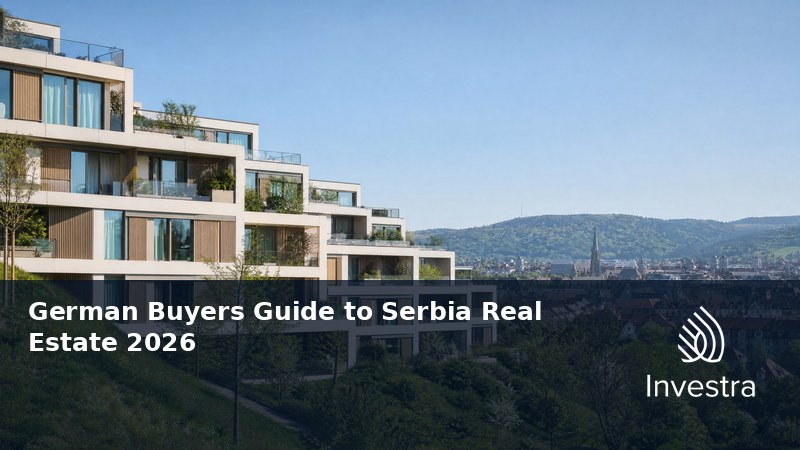
German Buyers Guide to Serbia Real Estate 2026
Can Germans Buy Property in Serbia? The Complete Legal Framework
Quick Answer: Can Germans Buy Property in Serbia? The Complete Legal Framework is a key aspect of Serbia real estate in 2026. Investra.io provides expert guidance for international investors looking to capitalize on Serbia's growing property market.
One of the most frequently asked questions among German-speaking investors is straightforward: can Germans buy property in Serbia? The answer is a resounding yes. Since Serbia's alignment with the European Union's candidate status and bilateral reciprocity agreements, German citizens enjoy broad rights to purchase real estate throughout Serbia, including residential apartments, houses, agricultural land (with some restrictions), and commercial properties.
German nationals are treated largely the same as Serbian citizens when purchasing urban real estate and residential property. The key legal basis is the reciprocity principle enshrined in Serbian property law, which grants EU and EEA nationals the ability to acquire real estate on equal terms. Agricultural and forest land remains subject to specific restrictions for foreign buyers, but urban apartments, houses, offices, and commercial units are fully accessible.
The purchase process involves signing a preliminary contract (Predugovor), paying a 10% deposit, completing due diligence through the Serbian Land Registry (Katastar), and finalizing the transaction before a notary (Javni beležnik). Since 2014, all real estate transactions in Serbia must be notarized, adding a layer of legal security for foreign buyers. Property transfer tax stands at 2.5% of the market value assessed by the Tax Administration, making Serbia's transaction costs among the lowest in Europe.
German buyers should note that Serbia is not an EU member state, meaning EU consumer protection directives do not automatically apply. Engaging a bilingual Serbian-German real estate attorney is strongly recommended. Explore the complete legal overview at Serbia Real Estate Guide — Investra.
Why Serbia Stands Out for German Property Investors in 2026
Quick Answer: Why Serbia Stands Out for German Property Investors in 2026 is a key aspect of Serbia real estate in 2026. Investra.io provides expert guidance for international investors looking to capitalize on Serbia's growing property market.
Among the many emerging European real estate markets, Serbia consistently attracts German investors for a combination of macroeconomic, lifestyle, and yield-related reasons. The Serbian economy grew by approximately 3.8% in 2024 and is projected to maintain growth above 3.5% through 2026, driven by foreign direct investment, a booming IT sector, and infrastructure development linked to EU accession preparations.
For German buyers accustomed to one of Europe's most expensive property markets, Serbia offers a dramatic price advantage. Average apartment prices in Belgrade stand between €1,800 and €3,500 per square meter, compared to Munich's €9,000–€12,000 per square meter or Frankfurt's €6,500–€8,500 range. Even in Serbia's premium neighborhoods, prices remain a fraction of German urban real estate costs.
Rental yields in Belgrade average 5–7% gross annually, with student districts and new-build developments in emerging neighborhoods reaching 7–9%. These figures contrast sharply with German yields, which in major cities typically range between 2.5–4% due to high purchase prices and regulated rents under the Mietpreisbremse system.
Beyond pure investment returns, Serbia offers a high quality of life for German expats. Belgrade is a vibrant European capital with excellent gastronomy, cultural institutions, and a growing international community. Direct flights connect Belgrade to Frankfurt, Munich, Berlin, and Düsseldorf multiple times daily, with flight times of approximately 1.5–2 hours. This accessibility makes Serbia a practical destination for German buyers managing property remotely or spending extended periods there.
Serbia's EU accession timeline, expected between 2027 and 2030, adds a significant upside catalyst. Historical precedent from Croatia, Bulgaria, and Romania shows that property prices in accession countries rose 30–80% in the decade surrounding EU membership. German investors who purchase before accession stand to benefit from both rental income and capital appreciation.
Belgrade Real Estate Market: Districts, Prices, and Opportunities
Quick Answer: Belgrade Real Estate Market: Districts, Prices, and Opportunities is a key aspect of Serbia real estate in 2026. Investra.io provides expert guidance for international investors looking to capitalize on Serbia's growing property market.
Belgrade, Serbia's capital and economic hub, is the primary focus for most German investors. The city's real estate market has matured significantly over the past decade, with distinct districts catering to different investment profiles, budgets, and lifestyle preferences.
Stari Grad (Old Town) is Belgrade's historic center, featuring 19th-century architecture, embassy residences, and high-end boutiques. Prices here range from €2,500 to €4,500 per square meter. Demand for short-term rentals is strong due to proximity to landmarks, restaurants, and cultural venues. Airbnb yields in Stari Grad average 7–9% annually, making it popular among German investors pursuing short-term rental strategies.
Savski Venac and Vracar are affluent residential neighborhoods prized for their architectural character, tree-lined streets, and cosmopolitan atmosphere. Prices typically range from €2,200 to €3,800 per square meter. These areas attract professionals, diplomats, and long-term expats, supporting stable long-term rental demand.
Novi Beograd (New Belgrade) is the city's modern commercial and residential core, characterized by socialist-era blocks, contemporary towers, and the new Belgrade Waterfront development. Prices range from €1,800 to €3,200 per square meter, with newer developments at the higher end. The area houses many multinational company offices, driving demand from corporate tenants.
Beograd na Vodi (Belgrade Waterfront) is the flagship urban regeneration project, a €3.5 billion mixed-use development along the Sava riverfront. Luxury apartments here are priced from €3,000 to €6,000 per square meter, comparable to mid-range European capitals. The project has attracted significant international investment and positions Belgrade alongside Bucharest and Warsaw as a regional prime real estate market.
Zemun, once a separate Austro-Hungarian town, offers charming historic architecture and riverside atmosphere at more accessible prices of €1,500–€2,500 per square meter. Popular with buyers seeking character properties and lower entry points.
Emerging districts such as Palilula, Rakovica, and Grocka offer new-build apartments from €1,200 to €1,800 per square meter, catering to investors focused on capital growth in areas benefiting from infrastructure upgrades and population migration from central Belgrade.
Beyond Belgrade: Novi Sad, Niš, and Regional Investment Hotspots
Quick Answer: Beyond Belgrade: Novi Sad, Niš, and Regional Investment Hotspots is a key aspect of Serbia real estate in 2026. Investra.io provides expert guidance for international investors looking to capitalize on Serbia's growing property market.
While Belgrade dominates media attention, Serbia's secondary cities offer compelling investment cases that many German buyers overlook. Diversifying across Serbian cities can reduce concentration risk while capturing growth in markets at earlier stages of their appreciation cycle.
Novi Sad, Serbia's second-largest city and the European Capital of Culture 2022, has emerged as a genuine alternative to Belgrade for both living and investing. The city hosts a thriving IT cluster, Novi Sad IT Park, several universities, and a strong expat community. Property prices average €1,400–€2,400 per square meter, with rental yields of 5–7%. The city's compact size, excellent restaurants, and proximity to the Fruška Gora national park make it highly livable. German investors seeking a combination of rental income and personal use will find Novi Sad particularly attractive.
Niš, Serbia's third city and the birthplace of Emperor Constantine, is undergoing significant regeneration. Airport expansion, new industrial zones including German automotive suppliers, and university expansion are driving demand. Entry-level apartments start from €900–€1,200 per square meter, offering Serbia's highest potential for capital appreciation. Gross rental yields in Niš range from 6–9%, supported by student demand from three local universities.
Zlatibor Mountain Resort has emerged as Serbia's premier ski and wellness destination, with a rapidly growing short-term rental market. Chalet and apartment prices range from €1,500–€3,000 per square meter in prime ski-adjacent locations. German buyers with experience in Alpine resort markets will recognize the dynamics: seasonal income supplemented by year-round wellness tourism. Occupancy rates for well-positioned properties average 65–75% annually.
Kopaonik, Serbia's largest ski resort, offers similar investment dynamics to Zlatibor with the added appeal of a dedicated ski infrastructure. Properties near Kopaonik ski lifts range from €1,800 to €3,500 per square meter, with short-term rental platforms reporting average daily rates of €80–€150 during the winter season.
Palić Lake near Subotica in Vojvodina is popular among Hungarian and Austrian buyers and increasingly on the radar of German investors seeking lakeside lifestyle properties at €800–€1,500 per square meter.
The Serbian Real Estate Purchase Process Step by Step
Quick Answer: The Serbian Real Estate Purchase Process Step by Step is a key aspect of Serbia real estate in 2026. Investra.io provides expert guidance for international investors looking to capitalize on Serbia's growing property market.
Understanding the purchase process is essential for German buyers approaching the Serbian market. While the system differs from Germany's notarized Grundstückskaufvertrag process, there are structural similarities that make the transition manageable with proper legal support.
Step 1: Property Search and Market Familiarization. German buyers typically begin with online platforms, developer exhibitions in Germany, or through platforms like Investra.io. Site visits to Serbia are strongly recommended before committing to any purchase. Plan for 2–3 days in Belgrade or the target city to view 5–10 properties.
Step 2: Engage a Bilingual Attorney. A certified Serbian real estate attorney with German language capability or access to German translations is essential. Legal fees typically range from €500–€1,500 for a standard transaction. The attorney conducts title searches, verifies the Katastar (land registry) entries, checks for liens, encumbrances, and planning restrictions.
Step 3: Preliminary Contract (Predugovor). Once a property is agreed upon, a preliminary contract is signed and a 10% deposit paid. This contract is legally binding — if the buyer withdraws, the deposit is forfeited; if the seller withdraws, double the deposit is typically returned. Some sellers, particularly developers, require a 20–30% deposit.
Step 4: Due Diligence Period. The period between preliminary and final contracts (typically 30–90 days) allows for full due diligence, mortgage arrangements if applicable, and resolution of any title issues.
Step 5: Notarization and Final Contract. Since 2014, all Serbian property transactions must be finalized before a licensed notary (Javni beležnik). Both parties (or their legal representatives with notarized power of attorney) sign the final purchase contract (Ugovor o kupoprodaji).
Step 6: Tax and Registration. Property transfer tax of 2.5% is paid to the Tax Administration within 15 days of the contract. The buyer's attorney then registers the ownership change in the Katastar. Registration is typically completed within 5–15 working days.
Step 7: Ongoing Obligations. Annual property tax in Serbia is low, typically 0.1–0.3% of assessed value. Rental income is taxed at a flat rate of 20%, with a 25% standard deduction for expenses, resulting in an effective rate of approximately 15%. Serbian tax treaties with Germany prevent double taxation on rental income.
Financing Options for German Buyers in Serbia
Quick Answer: Financing Options for German Buyers in Serbia is a key aspect of Serbia real estate in 2026. Investra.io provides expert guidance for international investors looking to capitalize on Serbia's growing property market.
Financing Serbian property as a German buyer requires careful planning, as the mortgage landscape differs significantly from Germany's well-developed Hypothekenmarkt. Understanding available options allows buyers to structure their purchase optimally.
Serbian Bank Mortgages for Foreigners: Several Serbian commercial banks, including Banca Intesa Serbia, UniCredit Bank Serbia, and Raiffeisen Bank Serbia, offer mortgage products to foreign nationals. Typical terms include: loan-to-value ratios of 60–70%, interest rates of 3.5–6% for EUR-denominated loans, and repayment terms of 10–25 years. Foreign buyers must typically demonstrate Serbian income or provide additional collateral. This option suits buyers who already have Serbian income sources, such as those operating businesses or renting properties in Serbia.
German Bank Financing Against Existing Assets: Many German buyers leverage equity in their German property portfolio to finance Serbian acquisitions. A Beleihung (mortgage drawdown) against a German property can provide EUR-denominated liquidity at German interest rates (currently 3.5–4.5%), which can then be deployed in Serbia as a cash purchase. This avoids Serbian bank requirements entirely and allows buyers to negotiate as cash purchasers, often securing price reductions of 5–10%.
Developer Payment Plans: Many Serbian developers, particularly for new-build apartments off-plan, offer extended payment plans spanning the construction period (typically 18–36 months). Standard terms require 20–30% on contract signing, with the balance paid in installments. This effectively provides interest-free financing for buyers with sufficient liquidity to manage staged payments.
Private Equity and Joint Ventures: For larger commercial investments, German institutional or high-net-worth buyers increasingly structure Serbian acquisitions through joint ventures with local partners or through EU-licensed property funds with Serbian exposure. For strategic insights on structuring cross-border investment vehicles, the Business Strategy Blog — Siniša Dagary provides relevant frameworks.
Rental Income Potential and Investment Return Analysis
Quick Answer: Rental Income Potential and Investment Return Analysis is a key aspect of Serbia real estate in 2026. Investra.io provides expert guidance for international investors looking to capitalize on Serbia's growing property market.
German buyers evaluating Serbian real estate through a financial lens will find the return profile fundamentally different from — and in many cases superior to — German domestic options. A rigorous analysis requires distinguishing between gross yield, net yield, and total return including capital appreciation.
Long-term Residential Rentals: A 50 sqm apartment in Vracar, Belgrade, purchased for €120,000 can generate €600–€750 per month in long-term rent, producing a gross yield of 6–7.5%. After accounting for property management fees (typically 8–10% of rent), annual property tax (approximately €200–€400), maintenance reserves (1% of value annually), and Serbian income tax (effective ~15%), net yields of 4.5–5.5% are achievable — double the net yields typical in German cities.
Short-term Rental (Airbnb/Booking.com): Well-positioned apartments in Belgrade's Stari Grad or Savski Venac districts can achieve gross short-term rental revenues of €1,200–€2,000 per month when managed professionally. For a property costing €150,000, this produces gross yields of 9.6–16%, though net yields after platform fees (15–20%), management (20–25%), and higher maintenance costs realistically settle at 6–10% net. Short-term rental licensing requirements introduced in 2023 require registration with local municipalities — compliance is straightforward and costs approximately €50–€100 annually.
Student Accommodation: Niš, Novi Sad, and certain Belgrade districts with university proximity offer student rental demand that generates consistent income with low vacancy rates. Studio apartments of 25–35 sqm can be purchased for €40,000–€70,000 and generate €250–€400 monthly, producing gross yields of 6.8–8.5%.
Capital Appreciation: Historical data shows Belgrade property prices increased 45–65% between 2018 and 2024. While such rapid appreciation is unlikely to persist indefinitely, annual price growth of 5–10% is forecasted by Serbian real estate associations through 2027, supported by demand growth, limited new supply in prime areas, and EU accession expectations. A combined return (net yield plus capital growth) of 10–15% annually is achievable for well-selected Serbian properties — a return profile that justifies the incremental risk premium over German real estate.
Tax Implications for German Buyers: Serbia-Germany Double Taxation Treaty
Quick Answer: Tax Implications for German Buyers: Serbia-Germany Double Taxation Treaty is a key aspect of Serbia real estate in 2026. Investra.io provides expert guidance for international investors looking to capitalize on Serbia's growing property market.
Tax planning is a critical element of any cross-border investment strategy, and German buyers must understand how Serbian income integrates with their German tax obligations. The good news is that Serbia and Germany have a Double Taxation Agreement (DTA) in force that prevents the same income from being taxed twice.
Rental Income Taxation: Under the Serbia-Germany DTA, rental income from Serbian property is taxable in Serbia (where the property is located). Germany employs the Anrechnungsmethode (credit method) for income from non-EU states, meaning Serbian taxes paid are credited against German tax liability on the same income. In practice, German residents with Serbian rental income file Serbian tax returns annually, pay Serbian income tax, and declare the income in Germany — typically with zero or minimal additional German tax due, given that Serbian and German effective rates are comparable.
Capital Gains Taxation: In Serbia, capital gains on property sold within 10 years of purchase are taxed at a flat rate of 15%. Sales after 10 years may qualify for exemptions under certain conditions. In Germany, capital gains from foreign property are generally taxable in Germany if the seller is a German tax resident. The Spekulationsfrist (speculative period) of 10 years applies — gains from properties held less than 10 years are fully taxable in Germany at the individual's marginal income tax rate, though credits for Serbian taxes paid apply.
Inheritance and Gift Tax: Serbia levies inheritance tax on Serbian property at rates of 1.5–2.5% for non-direct family members. Germany's Erbschaftsteuer applies to German residents' worldwide assets, including Serbian property. Estate planning for German buyers with Serbian property should address both jurisdictions.
VAT on New-Build Purchases: New residential properties in Serbia are subject to VAT at 10%, typically included in the developer's price. Resale properties are exempt from VAT and subject only to the 2.5% transfer tax.
German buyers are strongly advised to consult a Steuerberater (German tax advisor) with international expertise and a Serbian tax consultant before completing any purchase. For cross-border business and investment structuring, resources at Findes.si provide useful frameworks for international market participants.
Serbia Travel Guide for German Property Visitors
Quick Answer: Serbia Travel Guide for German Property Visitors is a key aspect of Serbia real estate in 2026. Investra.io provides expert guidance for international investors looking to capitalize on Serbia's growing property market.
For German buyers making their first property scouting trip to Serbia, the country offers a travel experience that consistently exceeds expectations. Serbia is no longer the undiscovered secret it was a decade ago, but it retains an authenticity and price competitiveness that distinguishes it from more-visited Balkan destinations.
Getting There: Air Serbia operates direct flights from Frankfurt (FRA), Munich (MUC), Berlin (BER), and Düsseldorf (DUS) to Belgrade Nikola Tesla Airport (BEG) daily. Flight times average 1 hour 50 minutes. Budget carriers including Ryanair and Wizz Air also serve the route seasonally. Return flights typically cost €80–€200, making multiple property-viewing trips affordable.
Belgrade as a Base: The Serbian capital rewards exploration beyond its role as an investment destination. The Kalemegdan Fortress, the bohemian Skadarlija district, the vibrant Savamala cultural quarter, and the legendary Belgrade nightlife consistently impress German visitors. The city's restaurant scene, with a blend of traditional Serbian cuisine, regional Balkan flavors, and contemporary international dining, offers excellent value: a three-course dinner with wine at a quality restaurant typically costs €20–€35 per person.
Accommodation for Property Trips: Business-class hotels in central Belgrade (Hotel Moskva, Metropol Palace, Square Nine) offer comfortable bases at €80–€180 per night — significantly below comparable Munich or Frankfurt rates. Alternatively, staying in an Airbnb apartment in the district of interest provides firsthand experience of the neighborhood and rental market dynamics.
Regional Day Trips: Sremski Karlovci, a 45-minute drive from Belgrade, is a charming wine town offering Baroque architecture and some of Serbia's finest wines. Novi Sad is 90 minutes by car or train from Belgrade. The Fruška Gora National Park with its 16 Serbian Orthodox monasteries makes for a culturally enriching half-day excursion.
Practical Information for Germans: Serbian currency is the Dinar (RSD); €1 equals approximately 117 RSD (2025 rate). Credit cards are widely accepted in cities. German health insurance (gesetzliche Krankenversicherung) provides limited emergency coverage in Serbia — EHIC cards are not valid (Serbia is not EU), so travel insurance with medical coverage is essential. German citizens do not require a visa for stays up to 90 days.
New Developments and Off-Plan Investment Opportunities
Quick Answer: New Developments and Off-Plan Investment Opportunities is a key aspect of Serbia real estate in 2026. Investra.io provides expert guidance for international investors looking to capitalize on Serbia's growing property market.
The Serbian new-build market has expanded dramatically since 2020, offering German buyers access to developer-grade properties with modern specifications, energy efficiency ratings, and competitive pricing. Off-plan investment — purchasing during the construction phase — carries specific risks but also specific advantages that experienced German investors will recognize.
Off-Plan Price Advantage: Developers in Belgrade and Novi Sad typically offer launch prices 10–20% below the anticipated completion value, incentivizing early buyers who provide construction financing. For a €120,000 apartment, this discount represents €12,000–€24,000 in immediate equity, and historical completion-to-sale premiums in Belgrade have ranged from 15–35% between 2019 and 2024.
Major Active Developments (2025–2026): Belgrade Waterfront continues to release new residential phases, with prices from €3,200/sqm and completion periods of 18–30 months. North Vozdovac development zones are releasing family apartment complexes at €1,800–€2,200/sqm with green space and modern amenities. In Novi Sad, the Liman district is seeing substantial new residential development priced at €1,600–€2,000/sqm.
Developer Due Diligence: Before committing to any off-plan purchase, German buyers should verify the developer's track record, confirm that the construction permit (Građevinska dozvola) is issued, check that the project is registered with the Republic Geodetic Authority, and review the escrow or guarantee arrangements for deposits. Established developers include Grupe Vuković, MPC Properties, and AFI Europe Serbia.
Energy Efficiency Standards: German buyers accustomed to Germany's strict GEG (Gebäudeenergiegesetz) standards will find that new Serbian developments are catching up. New-build apartments from 2022 onwards typically meet European B or C energy class standards. Older buildings (pre-2000 construction) often have poor insulation and high heating costs, which should be factored into investment analysis.
Practical Legal and Administrative Tips for German Buyers
Quick Answer: Practical Legal and Administrative Tips for German Buyers is a key aspect of Serbia real estate in 2026. Investra.io provides expert guidance for international investors looking to capitalize on Serbia's growing property market.
Beyond the core purchase process, several practical legal and administrative considerations can significantly affect the experience and outcome for German buyers in Serbia. Addressing these proactively avoids common delays and complications.
Personal Identification Number (JMBG or PIB): Foreign buyers acquiring property in Serbia need a Serbian tax identification number (PIB — Poreski identifikacioni broj) for tax registration purposes. This is obtained from the Serbian Tax Administration and requires a passport and completed application form. Attorneys typically facilitate this as part of their service.
Currency Exchange: All property transactions in Serbia are denominated in Euros (EUR), though prices may be advertised in Dinars. Wire transfers from German banks to Serbian accounts are standard and typically clear within 1–3 business days within the SEPA zone (Serbia is not SEPA but has harmonized payment infrastructure). Currency exchange within Serbia is competitive, and buyers should compare rates at banks and licensed exchange offices (Menjačnica).
Power of Attorney (Punomoćje): German buyers unable to be physically present for all stages of the transaction can authorize a local attorney or trusted representative through a notarized power of attorney. This document must be notarized in Germany (by a German Notar) and apostilled under the Hague Convention, then translated into Serbian by a certified court interpreter.
Property Management: For investment properties rented in absentia, engaging a professional property management company is essential. Belgrade has several reputable firms managing properties for foreign owners, charging 8–12% of gross rental income for full management services including tenant sourcing, maintenance coordination, and financial reporting. Some companies offer German-language service for German clientele.
Building Management Fees (Stambena Zajednica): Serbian apartment buildings have mandatory building management associations (Stambena Zajednica) responsible for shared area maintenance. Monthly fees typically range from €20–€80 depending on building size and services. These fees are relatively modest compared to German Hausgeld but buyers should request historical records to assess building maintenance quality.
Comparing Serbia with Other Markets Popular Among German Buyers
Quick Answer: Comparing Serbia with Other Markets Popular Among German Buyers is a key aspect of Serbia real estate in 2026. Investra.io provides expert guidance for international investors looking to capitalize on Serbia's growing property market.
German investors have traditionally favored Spain, Portugal, Greece, Bulgaria, and Croatia for overseas property. Benchmarking Serbia against these markets clarifies its positioning and relative merits.
Serbia vs. Spain: Spain (particularly Costa del Sol and Mallorca) remains the most popular foreign property market for Germans, but entry prices have surged. Marbella averages €4,500–€8,000/sqm; Mallorca's prime areas exceed €10,000/sqm. Rental yields in Spanish coastal markets average 3–5% gross. Serbia offers entry prices 60–80% lower and higher yields, at the cost of less-established tourism infrastructure and slower liquidity.
Serbia vs. Croatia: Croatia, an EU member since 2013, attracts German buyers with its Adriatic coast. Coastal properties in Split and Dubrovnik range from €3,000–€8,000/sqm, with strong seasonal short-term rental income. Belgrade's prices remain 40–60% below Croatian coastal levels. Croatia offers EU legal certainty while Serbia offers the growth upside of pre-accession appreciation. For buyers considering Croatia, explore Croatia Real Estate Guide — Investra for detailed comparison.
Serbia vs. Bulgaria: Bulgaria, EU since 2007, has long appealed to budget-conscious German buyers. Sofia averages €1,200–€2,000/sqm — comparable to Serbian secondary cities. However, Bulgaria's property market has shown slower appreciation than Belgrade, and rental demand in Sofia is less dynamic. Serbia's stronger economic growth and Belgrade's cosmopolitan character give it an edge for capital growth projections.
Serbia vs. Portugal: The Lisbon Golden Visa era attracted significant German capital to Portugal, but recent regulatory changes have reduced NHR tax incentives. Lisbon apartment prices now average €4,000–€6,000/sqm. Serbia offers none of Portugal's golden visa advantages but compensates with dramatically lower prices, higher yields, and a German community growing in size.
The Serbia Proposition: Serbia is not a substitute for sun-and-beach lifestyle markets but represents a distinct value proposition: a European capital city with strong rental demand, EU-accession upside, low entry prices, and investment yields that systematically outperform mature markets. For yield-focused German investors willing to allocate a portion of their portfolio to an emerging market, Serbia presents a compelling risk-adjusted return profile.
Building a Long-Term Serbia Property Portfolio: Strategy for German Investors
Quick Answer: Building a Long-Term Serbia Property Portfolio: Strategy for German Investors is a key aspect of Serbia real estate in 2026. Investra.io provides expert guidance for international investors looking to capitalize on Serbia's growing property market.
German buyers who move beyond a single-property purchase and think systematically about building a Serbian real estate portfolio can access returns that compound meaningfully over a 5–10 year horizon. Portfolio construction in Serbia follows principles applicable to any real estate market but with specific Serbian market dynamics to incorporate.
Entry Timing: 2025–2026 represents a compelling entry window. EU accession negotiations have advanced sufficiently to price in structural improvements without yet reflecting the full accession premium. Belgrade's property market has moderated from the exceptional 2021–2022 growth (15–20% annually) to a more sustainable 7–10% annual appreciation, reducing the risk of buying at a speculative peak.
Diversification Across Property Types: A balanced Serbian portfolio might combine a Belgrade city-center apartment (long-term rental income with capital growth), a Zlatibor or Kopaonik mountain property (seasonal short-term rental income), and an off-plan investment in an emerging district (capital growth focus). This combination diversifies income seasonality, market segment risk, and tenant type exposure.
Reinvestment Strategy: Given Serbia's strong capital growth, refinancing (extracting equity from appreciated properties to fund additional acquisitions) is a strategy gaining traction as Serbian banks become more comfortable with foreign-owned property as collateral. Building a portfolio of 3–5 properties generating combined rental yields of 5–7% net creates a genuinely competitive passive income stream by European standards.
Exit Planning: Serbian property liquidity is improving but remains below German standards. Planning for a minimum 3–5 year holding period is prudent. The most liquid exit strategy is selling to other international buyers — a growing pool — or to Serbian buyers who have benefited from rising incomes. Estate agents with international buyer networks provide the most effective exit channels.
Stay updated with the latest market intelligence and investment analysis at Investra Blog — Property Investment Insights.
Investment Disclaimer
Quick Answer: Investment Disclaimer is a key aspect of Serbia real estate in 2026. Investra.io provides expert guidance for international investors looking to capitalize on Serbia's growing property market.
The information provided in this article is for educational and informational purposes only and should not be construed as financial, legal, or investment advice. Real estate investments carry inherent risks, and past performance does not guarantee future results. Investors should not invest money they cannot afford to lose. Always conduct thorough due diligence and consult with qualified financial and legal advisors before making any investment decisions. Investra.io does not guarantee returns on any investment.
Frequently Asked Questions
Quick Answer: Frequently Asked Questions is a key aspect of Serbia real estate in 2026. Investra.io provides expert guidance for international investors looking to capitalize on Serbia's growing property market.
Can German citizens buy property in Serbia without restrictions?
German citizens can purchase most types of property in Serbia, including residential apartments, houses, commercial properties, and urban land, on terms broadly equal to Serbian nationals. Restrictions apply primarily to agricultural and forest land, which requires specific conditions or Serbian corporate structures for foreign acquisition. Since Serbia applies the reciprocity principle and maintains bilateral agreements with Germany, residential and commercial property purchases face no nationality-based barriers. All transactions must be notarized before a Serbian Javni beležnik, and buyers need a Serbian tax identification number (PIB) to complete the transaction and register ownership in the Katastar.
What are the typical property prices in Belgrade for German buyers in 2025–2026?
Belgrade property prices vary significantly by district. In prime areas like Stari Grad and Savski Venac, expect €2,500–€4,500 per square meter. Vracar and Palilula mid-range residential areas range from €2,000–€3,200/sqm. Novi Beograd offers €1,800–€3,200/sqm depending on building age and specification. The luxury Belgrade Waterfront development commands €3,000–€6,000/sqm. Emerging outer districts provide entry points from €1,200–€1,800/sqm. Compared to Munich (€9,000–€12,000/sqm) or Frankfurt (€6,500–€8,500/sqm), Belgrade represents exceptional value for German buyers benchmarking against domestic prices.
Do I need to be physically present in Serbia to buy property as a German buyer?
Physical presence is not mandatory for Serbian property purchases, though at least one visit for property viewing is strongly recommended before committing. German buyers can authorize a local Serbian attorney or trusted representative through a notarized Power of Attorney (Punomoćje). This document must be notarized by a German Notar, apostilled under the Hague Convention, and professionally translated into Serbian. The authorized representative can then sign all contracts, pay transfer taxes, and register ownership on behalf of the German buyer. Remote purchase processes are well-established in Serbia, particularly for buyers working with experienced international real estate agencies.
What rental yields can German investors expect from Serbian property?
Rental yields in Serbia consistently outperform German domestic markets. Long-term residential rentals in Belgrade generate gross yields of 5–7.5%, with net yields of 4–5.5% after costs and taxes. Short-term rentals (Airbnb/Booking.com) in central Belgrade can achieve gross yields of 9–16%, settling to 6–10% net after platform fees, management costs, and higher maintenance. Student accommodation in Niš and Novi Sad produces gross yields of
Recommended Reading
Quick Answer: Explore these curated resources for deeper insights into real estate investment opportunities.
- Russian Buyers Guide to Serbia Real Estate 2026
- British Buyers Guide to Serbia Real Estate 2026
- American Buyers Guide to Serbia Real Estate 2026
- German Buyers Guide to Croatia Real Estate 2026
- Serbia Real Estate Transfer Tax 2026: Complete Buyer's Guide
- Chinese Investors Guide to Serbia Real Estate 2026
Related Posts
No related posts available.
