
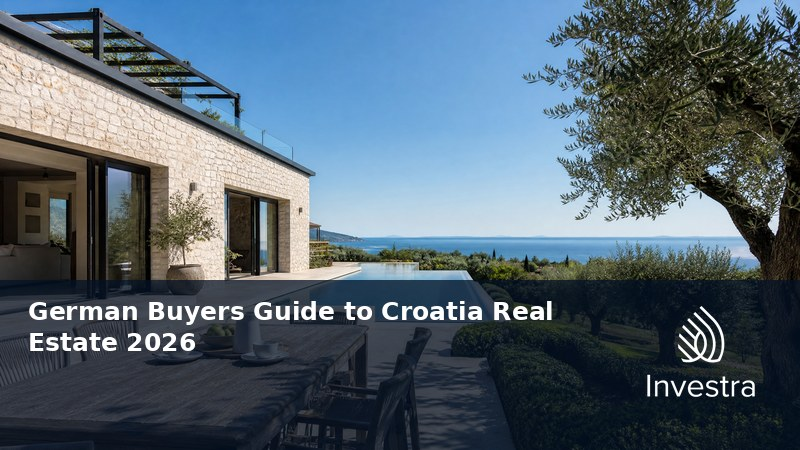
German Buyers Guide to Croatia Real Estate 2026
Can Germans Buy Property in Croatia? The Complete Legal Answer
One of the most frequently asked questions from German-speaking investors is whether German nationals can legally purchase real estate in Croatia. The answer is a clear and unequivocal yes. Since Croatia joined the European Union on 1 July 2013 and subsequently entered the Eurozone on 1 January 2023, EU citizens — including Germans — enjoy the same property ownership rights as Croatian nationals. There are no restrictions on property type, location, or quantity for German buyers.
Prior to EU accession, foreign nationals faced significant bureaucratic hurdles, including mandatory reciprocity agreements and government approval processes that could take months or even years. Those barriers have been completely dismantled for EU citizens. A German buyer today can purchase apartments, houses, commercial properties, and agricultural land under the same legal framework as a Croatian citizen.
The legal basis for this equality is enshrined in the Croatian Act on Ownership and Other Real Rights (Zakon o vlasništvu i drugim stvarnim pravima), which was amended to align with EU regulations. German buyers benefit from the same Land Registry protections, mortgage access, and inheritance rights as domestic buyers.
For those seeking expert guidance on the full legal framework, the Croatia Real Estate Investment Guide 2026 on Investra.io provides up-to-date legal information and market insights tailored specifically for international investors. Consulting with a professional like Siniša Dagary — Investment Consultant can further streamline the acquisition process.
Quick Answer: Yes, Germans can freely buy property in Croatia as EU citizens, with no restrictions on property type, location, or quantity — enjoying identical ownership rights to Croatian nationals since Croatia's EU accession in 2013.
Why Croatia Is Attracting Record Numbers of German Property Investors in 2026
Croatia has emerged as one of the most compelling real estate investment destinations in Europe, and German buyers are leading the international charge. In 2025, German nationals accounted for approximately 18–22% of all foreign real estate transactions in Croatia, making Germany the single largest source of foreign property buyers — a position it has held consistently since 2019.
Several structural factors explain this sustained German interest. Geographic proximity plays a significant role: Croatia is reachable from Munich by car in under six hours, and direct flights from Frankfurt, Berlin, Munich, Hamburg, and Düsseldorf connect to Split, Dubrovnik, and Zagreb in under two hours. This accessibility makes Croatia a uniquely practical choice for second-home ownership and lifestyle-driven investment.
The price differential between German and Croatian real estate remains dramatic. While average apartment prices in Munich exceed €9,000/m² and even mid-tier German cities like Leipzig or Dresden now average €3,500–€4,500/m², comparable quality properties in Croatian coastal cities offer exceptional value. A premium apartment in Split can be acquired for €3,000–€4,500/m², and even Dubrovnik's luxury market rarely exceeds €6,500/m² outside of ultra-prime locations.
Croatia's adoption of the Euro in January 2023 eliminated currency risk entirely for German buyers — a factor that had previously discouraged some investors who were uncomfortable with Kuna exposure. Combined with strong short-term rental yields driven by Croatia's booming tourism sector (which recorded 21.3 million tourist arrivals in 2024), the investment case for German buyers is exceptionally strong.
Explore current opportunities through Find Your Property on Investra to access a curated selection of Croatian properties suited to German buyers' investment profiles.
Quick Answer: Croatia attracts more German property buyers than any other foreign nationality, driven by geographic proximity, price advantages of 40–70% compared to German markets, Euro currency adoption, and rental yields of 5–9% in coastal tourist zones.
Croatia Real Estate Market Overview 2026: Key Statistics and Trends
The Croatian property market has demonstrated remarkable resilience and consistent appreciation over the past five years. After a brief pandemic-related slowdown in 2020, prices rebounded sharply from 2021 onwards, with coastal markets recording some of the strongest appreciation rates in the entire EU.
According to data from the Croatian Bureau of Statistics (DZS) and Eurostat, residential property prices in Croatia increased by an average of 11.2% annually between 2021 and 2024. In the first half of 2025, the pace moderated to approximately 7–9% year-on-year as interest rate conditions tightened across the Eurozone, but demand from foreign buyers — particularly Germans, Austrians, and Slovenians — remained robust.
National Average Price Benchmarks (2026):
- National average residential price: €2,100–€2,800/m²
- Zagreb city centre: €2,800–€4,200/m²
- Split city centre: €3,000–€4,800/m²
- Dubrovnik Old Town and surrounds: €4,500–€7,500/m²
- Hvar Town: €4,000–€6,500/m²
- Istria (Rovinj, Poreč): €3,000–€5,500/m²
- Dalmatian coast (outside major cities): €2,200–€3,800/m²
Transaction volumes have also grown significantly. The Croatian Ministry of Finance reported over 42,000 real estate transactions in 2024, with foreign buyers accounting for approximately 28% of coastal market transactions. The market has been further stimulated by Croatia's Schengen Area membership (December 2022) and Euro adoption, which have collectively raised Croatia's profile as a tier-one European investment destination.
For a detailed breakdown of regional market dynamics, the Investra Property Investment Articles section provides regularly updated analysis and data.
Quick Answer: The Croatian real estate market in 2026 shows prices ranging from €2,100/m² nationally to €7,500/m² in Dubrovnik prime locations, with annual appreciation of 7–9% and strong demand from German and other foreign EU buyers.
Zagreb Property Market: The Capital's Investment Potential for German Buyers
While most German buyers instinctively gravitate toward Croatia's Adriatic coastline, Zagreb deserves serious consideration as a property investment destination — particularly for those seeking stable long-term capital appreciation and reliable year-round rental income rather than seasonal tourism yields.
Zagreb is Croatia's economic, cultural, and political capital, home to approximately 800,000 people in the metropolitan area. The city hosts Croatia's largest universities, the headquarters of major corporations, and the country's most developed infrastructure. These fundamentals create consistent demand for both long-term residential rental and commercial property.
Property prices in Zagreb vary significantly by district. The prestigious Upper Town (Gornji Grad) and the elegant Donji Grad (Lower Town) command premiums of €3,500–€4,200/m², while the sought-after residential neighbourhood of Maksimir averages €2,800–€3,400/m². Peripheral districts like Novi Zagreb offer entry-level investment opportunities from €1,800–€2,400/m².
Long-term rental yields in Zagreb range from 4.5% to 6.5% annually, which, while lower than coastal short-term rental yields, come with significantly lower seasonality risk and management complexity. The Zagreb rental market benefits from a large student population (over 70,000 university students), a growing expat community, and steady domestic migration from smaller Croatian cities.
German buyers with experience in stable German residential markets often find Zagreb's fundamentals reassuringly familiar — a mature, regulated rental market with predictable demand drivers. For comprehensive market data, consult the Zagreb Property Market Analysis on Investra.io.
Quick Answer: Zagreb offers German buyers stable long-term rental yields of 4.5–6.5% with prices ranging from €1,800–€4,200/m² depending on district, making it ideal for investors seeking year-round income without coastal seasonality risk.
Split Real Estate: Croatia's Fastest-Growing Coastal Investment Market
Split has transformed from a transit hub to one of Mediterranean Europe's most desirable real estate investment destinations over the past decade. With a population of approximately 170,000, Croatia's second-largest city offers a rare combination of UNESCO World Heritage significance (Diocletian's Palace), modern urban amenities, excellent connectivity, and a rapidly expanding short-term rental market.
The Split property market has been one of Croatia's strongest performers, recording price appreciation of approximately 45% between 2020 and 2024. In 2026, prime properties within or adjacent to Diocletian's Palace command €4,500–€6,000/m², while excellent quality apartments in the broader city centre range from €3,000–€4,500/m². The expanding suburbs and new development zones of Žnjan, Kila, and Mejaši offer investment entry points from €2,200–€3,000/m².
Short-term rental performance in Split is exceptional. Properties in the Old Town and beachfront locations generate gross rental yields of 7–10% annually, with peak season (June–September) daily rates for a quality two-bedroom apartment ranging from €120–€280 per night. Occupancy rates during the high season regularly exceed 85–90%, and the shoulder seasons (April–May, October) have lengthened considerably as Split's international profile has grown.
German buyers are particularly active in Split's new development market, where off-plan purchases in quality developments offer price advantages of 10–15% compared to completed stock, along with the option to customise finishes and layouts. Split Airport, recently expanded with a new terminal, now handles over 3.5 million passengers annually and operates direct routes to 15+ German airports.
The Split Real Estate Guide on Investra.io provides an in-depth analysis of neighbourhood-by-neighbourhood pricing, rental performance data, and current listings for German buyers.
Quick Answer: Split property prices range from €2,200–€6,000/m² in 2026, with short-term rental yields of 7–10% in prime locations, making it Croatia's strongest performing coastal investment market and a top choice for German buyers.
Dubrovnik Luxury Property: Croatia's Premier High-End Market
Dubrovnik occupies a unique position in the global luxury real estate landscape. Consistently ranked among the world's most beautiful cities, protected by UNESCO since 1979, and famously featured as a filming location for Game of Thrones, Dubrovnik commands property prices and rental rates that rival Saint-Tropez, Positano, and Portofino — but at a fraction of the price per square metre.
The Dubrovnik property market is characterised by extreme scarcity. Strict heritage protection laws prevent new construction within and immediately around the Old Town, meaning the supply of premium properties is effectively fixed. This structural scarcity, combined with relentlessly growing international demand, has produced some of Croatia's most impressive long-term capital appreciation: properties in Dubrovnik's historic centre have appreciated by over 80% in real terms since 2015.
Current price benchmarks in the Dubrovnik market (2026):
- Old Town apartments: €5,500–€9,500/m²
- Lapad Peninsula villas: €4,500–€7,000/m²
- Babin Kuk luxury apartments: €4,000–€6,000/m²
- Župa Dubrovačka (suburban): €3,000–€4,500/m²
- Konavle Valley (rural): €1,800–€2,800/m²
Luxury villa rentals in Dubrovnik generate some of Europe's highest short-term rental yields, with high-end properties achieving gross returns of 8–12% annually. A premium four-bedroom villa with a pool and sea views can command €800–€2,500 per night during peak season, with booking rates often exceeding 70% across the entire year.
German buyers in the Dubrovnik luxury segment tend to be high-net-worth individuals seeking both lifestyle use and investment diversification. The market's proven resilience, brand recognition, and scarcity fundamentals make it one of Europe's most defensible luxury property assets. For a detailed analysis, visit the Dubrovnik Luxury Property Guide.
Quick Answer: Dubrovnik luxury properties range from €4,000–€9,500/m² in 2026, with limited supply due to UNESCO heritage restrictions driving consistent appreciation and rental yields of 8–12% for premium villa properties.
Hvar Island: Exclusive Island Real Estate for Discerning German Investors
Hvar Island has firmly established itself as Croatia's most glamorous island destination and one of the Mediterranean's most exclusive addresses. Regularly featured in Condé Nast Traveller, Forbes, and Vogue as a top global destination, Hvar attracts a wealthy international clientele that drives exceptional short-term rental performance and supports premium property valuations.
The island's real estate market is dominated by high-end stone villas, converted historic properties, and boutique development projects. Hvar Town, the island's main settlement and the focal point of its luxury hospitality scene, commands the highest prices: prime properties in and around the town range from €5,000–€8,000/m², with exceptional sea-view villas occasionally exceeding €10,000/m² for fully renovated stone buildings.
Beyond Hvar Town, the island offers compelling value in smaller settlements. The villages of Stari Grad, Jelsa, and Vrboska offer authentic island living at prices of €2,500–€4,000/m², with renovation opportunities for stone houses providing significant value-add potential. The lavender fields, vineyards, and olive groves of Hvar's interior can be purchased as agricultural parcels, though these require careful legal structuring for foreign buyers.
Short-term rental performance on Hvar is outstanding. Premium villas with pools achieve occupancy rates of 75–85% across the May to October season, with peak weekly rates ranging from €3,500–€15,000 for high-quality properties. Gross annual rental yields for well-managed Hvar properties consistently range from 6–10%, with net yields of 4–7% after management fees and costs.
German buyers are particularly drawn to Hvar for its combination of exclusivity, natural beauty, and strong rental fundamentals. Detailed listings and investment analysis are available through the Hvar Island Real Estate guide on Investra.io.
Quick Answer: Hvar Island property prices range from €2,500–€8,000/m² in 2026, with premium villas achieving gross rental yields of 6–10% during the May–October tourist season, making it Croatia's most exclusive island investment market.
The Step-by-Step Property Purchase Process for German Buyers in Croatia
Understanding the Croatian property purchase process is essential for German buyers to avoid delays, legal complications, and unexpected costs. While the process shares some similarities with German Grundbuch (Land Registry) practices, there are important differences that require attention.
Step 1: Engage a Croatian Real Estate Agent and Lawyer
The first step is selecting a licensed Croatian real estate agent (agencija za nekretnine) and an independent Croatian lawyer (odvjetnik). The lawyer is not legally mandatory in Croatia, but is strongly recommended for foreign buyers to conduct title searches, verify planning permissions, and review contracts. Legal fees typically range from 1–2% of the purchase price, with a minimum of around €1,500–€3,000.
Step 2: Property Search and Due Diligence
Once a target property is identified, the lawyer conducts due diligence by searching the Land Registry (Zemljišna knjiga) to verify ownership, check for mortgages, liens, or encumbrances, and confirm that the property matches its registered description. This process typically takes 1–3 weeks.
Step 3: Pre-Contract (Predugovor)
A preliminary contract is signed, and the buyer pays a deposit of typically 10% of the purchase price. This contract binds both parties — if the buyer withdraws, the deposit is forfeited; if the seller withdraws, they must return double the deposit.
Step 4: Main Sales Contract (Kupoprodajni ugovor)
The main contract is drafted, usually by the seller's notary (javni bilježnik). German buyers should ensure this contract is reviewed by their own lawyer before signing. The contract must be certified by a Croatian notary.
Step 5: Registration and Tax Payment
After signing, the buyer registers ownership in the Land Registry and pays the Real Estate Transfer Tax (3% of assessed value). The entire process from offer to completion typically takes 4–8 weeks for straightforward transactions.
For expert guidance throughout this process, Contact Investra Experts who specialise in supporting international buyers through Croatian property transactions.
Quick Answer: The Croatian property purchase process for German buyers involves 5 key steps from legal due diligence to Land Registry registration, typically completing in 4–8 weeks, with the mandatory Real Estate Transfer Tax of 3% of the assessed property value.
Taxes, Costs, and Fees: The Complete Financial Picture for German Buyers
Accurate cost modelling is essential for German investors evaluating Croatian property. Beyond the purchase price, several taxes and transaction costs must be factored into investment calculations. Croatia's tax framework for property is relatively straightforward compared to some other EU markets, but requires careful planning — particularly for German residents who must also consider their German tax obligations.
Purchase-Related Costs:
- Real Estate Transfer Tax (Porez na promet nekretnina): 3% of the assessed market value. This is Croatia's main property transaction tax and applies to resale properties. New-build purchases from a developer are subject to VAT (PDV) at 25% instead, which is typically included in the developer's asking price.
- Notary Fees: €200–€800 depending on property value
- Land Registry Registration Fee: 0.01% of property value, minimum €13.27
- Real Estate Agent Commission: Typically 2–3% (sometimes split between buyer and seller, sometimes charged only to buyer — clarify upfront)
- Legal/Lawyer Fees: 1–2% of purchase price (€1,500–€5,000+)
- Translation Costs: €300–€800 for contract translation
Total Transaction Costs: German buyers should budget approximately 5–8% above the purchase price to cover all acquisition costs.
Ongoing Taxes and Costs:
- Annual Property Tax (Komunalna naknada): A local utility tax — typically €200–€1,500 per year for residential properties depending on size and location.
- Rental Income Tax: Non-resident landlords pay 10% flat tax on net rental income from Croatian sources. From 2024, simplified paušal taxation is available for short-term rental operators.
- Capital Gains Tax: If a property is sold within two years of purchase, a 20% capital gains tax applies on the profit. After two years of ownership, capital gains are tax-free — a significant advantage for German investors compared to Germany's 10-year Spekulationsfrist.
German Tax Considerations: German residents must declare Croatian rental income and capital gains in Germany as well, though the Double Taxation Agreement (Doppelbesteuerungsabkommen) between Germany and Croatia prevents double taxation. Croatian taxes paid are credited against German tax liability. Consulting with a tax advisor experienced in cross-border EU taxation — such as those found through Findes Financial Services — is strongly recommended.
Quick Answer: German buyers in Croatia should budget 5–8% above the purchase price for acquisition costs, including the 3% Real Estate Transfer Tax, with ongoing rental income taxed at 10% flat rate and capital gains tax-free after two years of ownership.
Rental Yields and ROI Analysis: What German Investors Can Realistically Expect
Croatia's short-term rental market, powered by one of Europe's strongest tourism sectors, produces some of the continent's most attractive rental yields for coastal properties. However, yield calculations must account for seasonality, management costs, and realistic occupancy assumptions to produce accurate net return figures.
Short-Term Rental Yield Benchmarks (2026):
- Dubrovnik Old Town: Gross 8–12%, Net 5–8%
- Split Old Town: Gross 7–10%, Net 4.5–7% Hvar Town (premium): Gross 8–11%, Net 5–8%
- Istria (Rovinj, Poreč): Gross 6–9%, Net 4–6.5%
- Makarska Riviera: Gross 6–8%, Net 4–5.5%
Long-Term Rental Yield Benchmarks (2026):
- Zagreb city centre: 4.5–6.5% gross
- Split long-term: 3.5–5% gross
- Rijeka: 4–5.5% gross
Total ROI Calculation Example — Split Apartment:
Consider a 55m² apartment in Split's city centre purchased for €200,000 (at €3,636/m²):
- Acquisition costs (7%): €14,000
- Total investment: €214,000
- Short-term rental gross revenue (peak season + shoulders): €18,000–€22,000/year
- Management fees (20%), cleaning, maintenance: €5,000–€6,000/year
- Net rental income: €12,000–€16,000/year
- Net yield on total investment: 5.6–7.5%
- Capital appreciation at 7% annually: €14,000/year (Year 1)
- Total annual ROI (income + appreciation): 12–15%
This calculation demonstrates why Croatian coastal property has generated double-digit total returns for many German investors in recent years. For the most current rental performance data and investment projections, visit the Investra Blog — Latest Market News.
Quick Answer: Croatian coastal properties deliver gross short-term rental yields of 6–12% depending on location, with total annual ROI (income plus capital appreciation) reaching 12–15% in prime markets like Split and Dubrovnik for well-managed properties.
Financing Options: Mortgages and Funding Strategies for German Buyers
German buyers have several financing pathways when purchasing Croatian property, each with distinct advantages, requirements, and cost profiles. Understanding the options allows investors to optimise their capital structure and maximise returns.
Croatian Bank Mortgages: Since Croatia joined the Eurozone, several major Croatian banks — including Erste Bank, Privredna Banka Zagreb (PBZ), and Raiffeisen Bank Croatia — offer mortgages to EU citizens, including Germans. Typical terms for non-resident EU buyers include:
- Loan-to-Value (LTV): Up to 70% for non-residents (typically 60% in practice)
- Interest rates: 3.5–5.5% (variable, linked to EURIBOR) or 4–6% fixed
- Loan term: 10–25 years
- Required documentation: German tax returns (3 years), employment contract or business proof, German Schufa credit report, property valuation
German Bank Financing: Some German banks, including Deutsche Bank and specialised private banks, will finance foreign property purchases for German residents, either through unsecured consumer loans for smaller amounts or through cross-border mortgage products. German interest rates are typically lower than Croatian bank rates, but securing financing against a foreign property is more complex.
Equity Release from German Property: A popular strategy among German investors is refinancing existing German residential property (Immobilienkredit) at favourable German rates to release equity for Croatian investment. Given that many Germans have seen their primary residence appreciate substantially, this allows access to capital at rates of 3–4.5% to fund Croatian purchases entirely in cash — simplifying the Croatian purchase process considerably.
Developer Payment Plans: For off-plan purchases, Croatian developers often offer structured payment plans — typically 20–30% on signing, with subsequent payments tied to construction milestones. These avoid bank financing costs entirely and can provide 12–24 months of capital deployment flexibility.
Professional financial structuring advice is available through About Siniša Dagary, an investment consultant with deep experience in cross-border European property financing.
Quick Answer: German buyers can finance Croatian property through Croatian bank mortgages (up to 70% LTV at 3.5–6% interest), German bank financing, equity release from existing German property, or developer payment plans for off-plan purchases.
Short-Term Rental Regulations: What German Owners Must Know
Croatia has developed a comprehensive regulatory framework for short-term rental (STR) operations, which German property owners must understand and comply with. The system has been progressively tightened since 2019 as Croatian authorities sought to balance tourism revenue generation with housing availability for local residents — a tension familiar to German owners in cities like Berlin or Munich.
Registration Requirements: All short-term rental properties in Croatia must be registered with the local municipality and the Croatian National Tourist Board (HTZ). The property must receive a category designation (1–5 stars for apartments, 1–5 crowns for rooms) following an inspection. Registration fees are modest — typically €100–€500 depending on property size and category.
Tourist Tax (Turistička pristojba): Owners must collect and remit tourist tax from guests, which ranges from €0.50–€2.00 per person per night depending on the destination category and season. This is passed on to guests and does not represent a cost to the owner, but requires administrative management.
Sojourn Tax (Boravišna pristojba): A residence tax for stays over 3 days, collected alongside the tourist tax.
City/Municipality Limits: Several Croatian municipalities, including Dubrovnik, Split, and Hvar, have introduced or are considering caps on the total number of STR units permitted in specific zones. German investors should verify the current regulatory position in their target location before purchase, as future restrictions could affect rental income projections.
Tax Registration: Non-resident owners renting property in Croatia must register with the Croatian Tax Authority (Porezna uprava) and file annual income tax returns. The flat 10% rental income tax rate is generally applied, with the option to use the paušal (flat-fee) simplified taxation system if certain conditions are met.
Staying current with regulatory changes is essential — the Investra Property Investment Articles platform regularly publishes updates on Croatian rental regulation changes affecting foreign owners.
Quick Answer: Short-term rental in Croatia requires registration with local municipalities and the national tourist board, tourist tax collection and remittance, and annual tax filing at a flat 10% rate, with some municipalities introducing additional restrictions on STR unit numbers.
Best Areas for German Buyers: Regional Comparison and Investment Profiles
Croatia offers dramatically different investment profiles across its diverse regions, and matching the right location to each investor's goals and preferences is critical to investment success. The following regional profiles help German buyers identify where their investment objectives can best be met.
Istria (Istra) — Best for: Premium lifestyle, Italian cultural affinity, year-round rental potential
Istria is Croatia's northwestern peninsula, bordering Slovenia and Italy. Its cultural landscape blends Croatian, Italian, and Venetian influences, making it particularly appealing to German buyers who appreciate Italian aesthetics. Cities like Rovinj and Poreč have high-quality restaurant scenes, established German-speaking tourist bases, and longer operating seasons than Dalmatia. Prices range from €2,500–€5,500/m² in coastal locations. Yields of 5–8% are achievable for well-positioned properties.
Kvarner Gulf (Opatija, Rijeka) — Best for: Year-round living, historical architecture, budget value
The Austro-Hungarian resort town of Opatija, just 30 minutes from Rijeka airport, offers Belle Époque architecture and a historically significant German and Austrian client base. Property prices of €2,000–€3,500/m² offer genuine value, and the area's proximity to Slovenia and Italy enhances connectivity. Year-round tourism makes rental income less seasonal than in Dalmatia.
Dalmatian Coast — Best for: Maximum rental yields, international brand recognition, capital growth
The Dalmatian Coast, stretching from Zadar to Dubrovnik, offers the highest profile and strongest rental performance. Within this region, Split provides the best combination of price, yield, and liquidity; Dubrovnik offers the strongest luxury premium; and the islands (Brač, Korčula, Vis, Hvar) provide exclusivity with corresponding price premiums.
Zagreb — Best for: Stable long-term yield, capital city fundamentals, all-year income
As discussed, Zagreb suits investors who prefer stable, year-round income over the higher but seasonal yields of coastal markets. The city's ongoing urbanisation, improving infrastructure, and growing startup ecosystem support long-term demand fundamentals.
For personalised investment location matching, Business Strategy Blog by Siniša Dagary provides valuable insights on aligning investment geography with financial objectives.
Quick Answer: Croatia's best regions for German investors are Istria (cultural affinity, 5–8% yields), Dalmatia/Split (maximum rental income, 7–10% yields), Dubrovnik (luxury capital growth, 8–12% yields), and Zagreb (stable year-round income, 4.5–6.5% yields).
New Build vs. Resale: Which Property Type Suits German Buyers?
The choice between purchasing a new build (novogradnja) or resale property in Croatia involves trade-offs across price, financing, rental readiness, and legal complexity that German buyers must carefully evaluate.
New Build Properties — Advantages for German Buyers:
- Modern construction standards compliant with EU Building Directive
- Energy efficiency ratings (A and B class) increasingly required, reducing operating costs
- Off-plan pricing advantage of 10–20% below completed market value
- Developer payment plans reduce upfront capital requirements
- No hidden structural issues or renovation requirements
- VAT (25%) rather than Real Estate Transfer Tax (3%) — VAT is included in developer prices but can be reclaimed if property is used for commercial rental under a VAT-registered entity
New Build Challenges:
- Construction risk — delays of 6–24 months are common in Croatia
- Developer insolvency risk (requires careful developer due diligence)
- No immediate rental income during construction phase
- Limited supply in most prime coastal locations
Resale Properties — Advantages:
- Immediate income generation capability
- Established rental history and performance data available
- Lower transaction tax (3% vs. 25% VAT for new builds)
- Often better locations in historic or central areas where new development is prohibited
- Stone house renovation in Dalmatia and Istria can generate significant value uplift
The Stone House Opportunity: A distinctive feature of Croatian coastal real estate that attracts many German buyers is the availability of traditional Dalmatian and Istrian stone houses (kamene kuće) requiring renovation. These properties can often be purchased for €100,000–€400,000 and, with a renovation investment of €50,000–€150,000, transformed into premium short-term rental properties worth €350,000–€800,000. This renovation-led strategy has delivered exceptional returns for German buyers with construction project management skills.
Quick Answer: New builds offer 10–20% off-plan price advantages and modern EU standards but carry construction risk, while resale properties — especially traditional stone houses — offer immediate income, lower transaction taxes, and significant renovation-driven value creation opportunities.
Practical Tips for German Buyers: Language, Banking, and Property Management
Beyond the legal and financial mechanics, practical operational considerations determine whether a Croatian property investment delivers its projected returns or becomes an administrative burden. German buyers benefit from several structural advantages, including a large Croatian diaspora in Germany (approximately 400,000 Croatian citizens live in Germany), which creates excellent professional networks and language bridges.
Language Considerations: Croatian (Hrvatski) is the official language, and all legal documents, Land Registry entries, and tax filings are in Croatian. German buyers must use certified translators (sworn translators, sudski tumač) for all official documents. While English is widely spoken in the tourism industry and by younger professionals, legal and administrative interactions in smaller municipalities may require Croatian language capability. Many Croatian lawyers and real estate agents operating in tourist areas speak German, reflecting the historic German-speaking tourist presence.
Banking and Financial Management: German buyers do not legally require a Croatian bank account to complete a property purchase, but opening one is strongly recommended for ongoing tax payments, utility bills, and rental income management. Major Croatian banks with EU standard services include Erste Bank, Raiffeisen, and OTP Bank Croatia. Account opening requirements include a valid passport, tax identification number (OIB — Personal Identification Number, which foreign property owners must obtain), and proof of address.
OIB (Osobni Identifikacijski Broj): Every foreign property owner in Croatia must obtain an OIB — the Croatian equivalent of a tax identification number. This is obtained free of charge from the Croatian Tax Administration (Porezna uprava) and is required for all property transactions, tax filings, and utility registrations. The process typically takes 1–5 business days.
Property Management Companies: For German owners not permanently residing in Croatia, engaging a professional property management company is essential. Quality management companies handle STR bookings, guest check-in/out, cleaning, maintenance, and local tax compliance. Management fees typically range from 15–25% of gross rental revenue. Selecting a manager with demonstrated performance on Airbnb and Booking.com and transparent accounting practices is critical.
For connected support across all these practical areas, Contact Investra Experts who maintain a network of vetted Croatian lawyers, banks, and property managers.
Quick Answer: German buyers in Croatia must obtain a Croatian OIB tax number, are advised to open a Croatian bank account for property management, and should engage bilingual (German-Croatian) legal and property management professionals to ensure smooth ongoing operations.
Risk Factors and Due Diligence Considerations for German Investors
Every investment carries risk, and Croatian real estate — despite its compelling fundamentals — is no exception. German buyers, accustomed to Germany's highly regulated and transparent Grundbuch system, should be aware of specific risk factors that require careful due diligence in the Croatian context.
Land Registry Inconsistencies: Croatia's Land Registry (Zemljišna knjiga) underwent significant digitisation and updating from 2007 onwards, but inconsistencies between the Land Registry and the Cadastre (Katastar) still exist in some older properties, particularly in rural areas and smaller islands. Engaging a lawyer to reconcile both registries before purchase is essential.
Illegal Construction (Bespravna Gradnja): Croatia has a significant legacy of illegally constructed or partially legalised buildings, particularly from the 1970s–1990s. A property may be habitable and even legally transferred, but structural additions, conversions, or extensions may lack proper building permits. This creates complications for rental licensing, insurance, and future sale. Always verify that the physical property matches its registered plan and that all construction has the appropriate use permits (rješenje o izvedenom stanju or uporabna dozvola).
Seasonal Market Liquidity: While prices have consistently risen in tourist-driven markets, coastal property markets can be illiquid in the off-season. German investors planning exit strategies should factor in the 4–6 month marketing periods typical for premium coastal properties and avoid over-leverage.
Tourism Policy Risk: Croatia's government and municipalities actively manage tourism development. Regulatory changes — including STR caps, tourist tax increases, or zoning changes — can affect rental income projections. Diversifying across property types (both STR and long-term rental) or locations helps mitigate this risk.
Climate and Natural Hazards: The Dalmatian coast experiences occasional bura (bora) storms, summer drought, and
Investment Disclaimer
The information provided in this article is for educational and informational purposes only and should not be construed as financial, legal, or investment advice. Real estate investments carry inherent risks, and past performance does not guarantee future results. Investors should not invest money they cannot afford to lose. Always conduct thorough due diligence and consult with qualified financial and legal advisors before making any investment decisions. Investra.io does not guarantee returns on any investment.
Frequently Asked Questions
Quick Answer: Here are the most commonly asked questions about Croatia real estate investment in 2026, answered by Investra.io experts.
Is Croatia a good country for real estate investment in 2026?
Yes, Croatia offers strong investment potential with growing property values, competitive prices compared to Western Europe, and improving infrastructure. Investra.io provides comprehensive market data and investment guidance.
Can foreigners buy property in Croatia?
EU citizens can buy property freely in Croatia. Non-EU citizens may need to meet specific requirements. Investra.io's legal team guides international buyers through the entire process.
What is the average property price in Hrvaška?
Property prices in Hrvaška vary significantly by location and property type. Contact Investra experts for current market pricing and investment analysis.
What rental yields can I expect?
Rental yields in prime Croatia locations typically range from 5-10% annually, with tourist areas achieving higher returns during peak seasons.
What taxes apply to property purchases?
Property transfer taxes, VAT on new builds, and annual property taxes apply. Rates vary by property type and location. Consult Siniša Dagary for tax optimization strategies.
How long does the purchase process take?
Typically 30-60 days from offer to completion. Working with Investra.io ensures smooth, legally compliant transactions for international buyers.
What financing options are available?
Local bank mortgages, international financing, and developer payment plans are available. Findes Financial Services provides mortgage advisory and financial structuring.
Is property management available for rental properties?
Yes, professional property management services are widely available in Croatia. Investra.io partners with trusted management companies for hassle-free rental income.
What are the best areas to invest in Hrvaška?
Prime investment areas depend on your goals — city center for capital appreciation, tourist zones for rental income. Investra.io's market analysis identifies the best opportunities.
Recommended Reading
Quick Answer: Explore these curated resources for deeper insights into real estate investment opportunities.
- German Buyers Guide to Serbia Real Estate 2026
- British Buyers Guide to Croatia Real Estate 2026
- American Buyers Guide to Croatia Real Estate 2026
- Dutch & Belgian Buyers Guide to Croatia Real Estate 2026
- Scandinavian Buyers Guide to Croatia Real Estate 2026
- Austrian & Swiss Buyers Guide to Croatia Real Estate 2026
Related Posts
No related posts available.
