
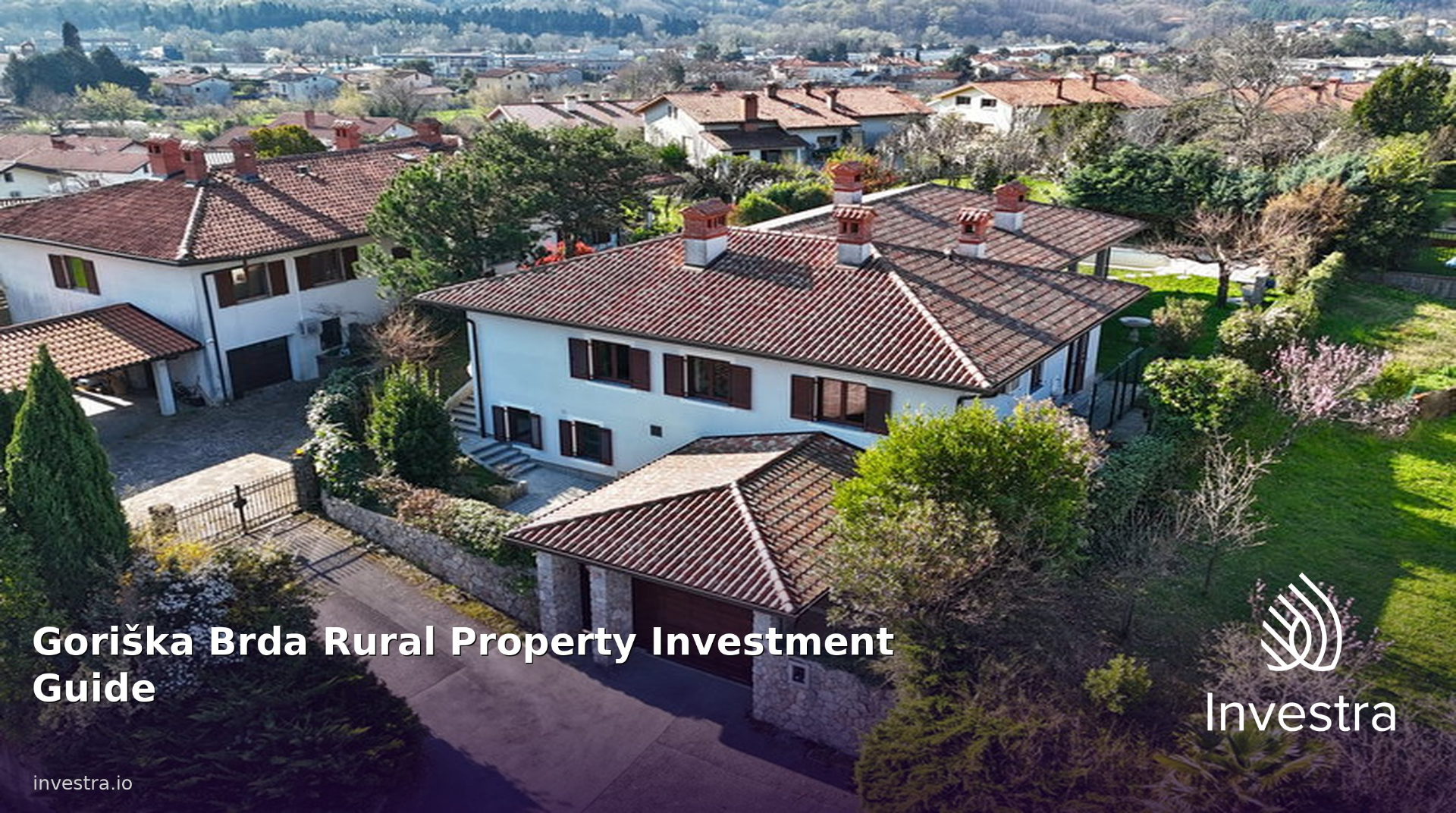
Goriška Brda Rural Property Investment Guide
Goriška Brda Rural Property Investment Guide
Goriška Brda at a glance: landscape, lifestyle and strategic location
Quick Answer: Goriška Brda is a rolling, wine-producing region in Slovenia prized for its rural character, cross-border access to Italy, and small-village lifestyle—buyers should see it as a region where land, tradition and tourism intersect.
Goriška Brda feels like a compact patchwork of vineyards, orchards and hamlets. Drive through narrow lanes and you’ll see stone farmhouses, terraced vines and olive trees—an attractive mix for buyers seeking rural property with lifestyle or income potential. In my experience, what surprises many visitors is how varied the terrain and microclimates are within short distances; a property on one hill can feel entirely different from one two kilometres away.
Location matters here. The region sits close to the Italian border and to Slovenia’s Goriška region towns, providing easy day trips to Trieste and access to international transport routes. That cross-border proximity can be a selling point for international owners who want a quiet base with convenient urban connections. But what does this mean for buyers? It translates to both lifestyle value and practical considerations—service access, municipal rules, and a tourist audience that can be seasonal.
If you’re researching regional comparatives, Investra’s local market guides help place Brda in a broader Slovenian context: their Ljubljana real estate market guide and Ljubljana neighbourhood content provide metropolitan contrasts that highlight how Brda is more rural and specialised than city markets. See the Ljubljana real estate market guide for urban context: Ljubljana real estate market guide. For nearby coastal city context, consider Koper’s buyer guide: Koper real estate market guide.
Practical tip: whenever you shortlist properties, visit in different seasons. The reality is that agricultural cycles and tourist flows change a village’s rhythm—and you want to know how a property performs off-season as well as in high season.
What should buyers know about goriska brda rural investment?
Quick Answer: Buyers should understand Brda’s dual identity as agricultural land and tourism destination, confirm local legal and planning conditions, and verify current market data with local sources before committing.
When people ask me about goriska brda rural investment, they usually mean one of three things: lifestyle acquisition, agricultural operation (often vineyards or olive groves), or a tourism-related income asset like a holiday house or agritourism unit. The reality is that Brda blends all three. So the most important early question is: what role do you expect the property to play in your portfolio or life?
There are practical constraints and opportunities. Farmland classification, cadastral plots, and existing business activities affect what you can do with land. Administrative boundaries—municipal decisions on conservation, building permits and rural tourism licensing—matter more than romantic notions of buying a farmhouse and immediately converting it into a B&B. The right sequence is research, verification, professional advice, then offer.
Don’t rely on a single online listing for decision-making. Verify prices, zoning and land use by contacting the municipal planning office and a local notary; check market movements via reliable local market reports. For broader market context that helps place Brda among Slovenian opportunities, Investra’s regional guides—like the Maribor and Bled market guides—are useful reference points: Maribor real estate market guide, Bled real estate market guide.
What surprised many buyers I’ve worked with is the administrative complexity. You can’t assume rules are the same as in Ljubljana or coastal municipalities. A simple verification step—request a recent extract from the land registry and a written statement from the municipal planning office—can save weeks later. If you need a consultant for local market insights, independent advisors such as Siniša Dagary offer services and strategy support: advisory services.
Types of properties and best-use scenarios in Brda
Quick Answer: Brda properties typically include vineyards and agricultural plots, stone farmhouses and renovation projects, and standalone land parcels—each requires different due diligence and planning for best use.
There’s a practical taxonomy to Brda properties. First, agricultural parcels: plots formally classed as vineyard, orchard or arable land. These often come with cultivation history, irrigation rights or production registrations. Second, rural residential properties—stone houses, often part of small hamlets, candidates for renovation or lifestyle use. Third, development parcels and mixed-use estates, which sometimes include barns, outbuildings and additional acreage.
Which type suits you? If you want active farming, look for parcels with documented production history and clear land-use designation. If your aim is hospitality, a residential property near a village center that can access utilities and tourist flows may be better. Want both? Many buyers build an agricultural business under one tax and commercial structure while operating short-stay accommodation under another, but that requires careful structuring and local licences.
Here’s a practical observation: restored stone farmhouses can be charming, but their renovation needs are often underestimated. Old masonry, insulation upgrades, septic or sewer connections, and energy retrofits can become large projects. For project and new-build guidance in other Slovenian markets, Investra’s new-build and renovation guides can be instructive for the sort of documentation and permits you’ll face: see the Ljubljana new-build guide and Maribor new-build guide for procedural parallels: Ljubljana new-build guide, Maribor new-build guide.
Before you bid, ask the seller for documentation: cadastral parcel numbers, land use classification, water rights, any existing agricultural subsidies or quality registrations. And when someone promises a “simple conversion,” ask for a written scope and local planning officer’s opinion—word of mouth isn’t enough here.
Legal and ownership considerations for foreign buyers in Goriška
Quick Answer: Foreign buyers must confirm national and municipal conditions for land purchase, check agricultural land restrictions, and consult a local notary or lawyer to verify title and rights.
Foreign ownership rules can be nuanced. Some national or EU-level restrictions apply to agricultural land in different countries, and municipal procedures influence how fast you can complete a purchase. The single most useful habit I recommend is to engage a local notary early. Notaries in Slovenia manage title transfers and can order accurate land registry extracts and any encumbrance reports you need.
Legal checks you’ll want: a current land registry extract, proof that the seller has authority to sell, verification of any easements, and a check of cadastral boundaries against the physical plot. Don’t forget subsidies and cross-compliances—if a plot participates in agricultural subsidy schemes, there may be obligations attached to the land.
How do you verify current regulations? Contact the municipal office where the property sits and the national land registry; ask for written statements where possible. A reliable route is to work with established local advisers: for instance, Findes Group & Partners offer local advisory teams who can liaise with municipal authorities and provide on-the-ground support—see Findes Group & Partners and their advisory team contact page: Findes Group & Partners advisory team.
Another practical tip: title checks should include a search for administrative restrictions tied to conservation or heritage status. Some houses are protected for their traditional architecture. If preservation rules apply, your renovation choices and timelines will be affected; ask the municipal conservation authority to clarify any constraints in writing.
Buying process and due diligence: step-by-step for Brda properties
Quick Answer: The buying process follows search, verification, offer, private contract, notary completion and registration—but each step requires specific local checks such as land registry extracts, municipal planning confirmation and utility connections verification.
Start by defining the property type and your objective: living, farming, tourism or a mix. Next, shortlist properties with clear cadastral references. In my experience, the single most time-consuming phase is due diligence—especially in rural markets where records may be older or less digitised. Expect to request a land registry extract and a recent evidence of boundaries (kataster map). A site visit with a surveyor is often necessary to confirm what is on paper corresponds to what’s on the ground.
When you make an offer, consider including a feasibility clause: a short, agreed period where you can obtain written planning confirmation, a utility connection report and an initial structural assessment. That clause protects you from buying a property that can’t be adapted to your intended use. After a negotiated offer, a private preliminary contract often secures the deal pending notary completion. The notary finalises the deed and registers the new owner in the land registry.
Don’t skip permits checks. If your plan involves conversion of agricultural buildings or a change of land use, ask the municipal planning office for written confirmation of what is allowed. And if you’ll rely on agricultural production, request any existing production records—from vineyard registration to organic certification—that may be tied to the land.
For procedural guidance in larger Slovenian markets that can mirror Brda’s legal steps, Investra’s step-by-step buying guides are useful references: check "Buying property in Ljubljana" and "Buying property in Maribor" to understand how the notary and registry stages are typically handled: Buying property in Ljubljana, Buying property in Maribor.
Taxes, fees and ongoing costs: what to prepare for
Quick Answer: Expect transaction-related fees, ongoing property taxes and possibly agricultural or business tax liabilities; verify current rates and exemptions with a local tax advisor or municipal office before you budget.
Tax structures change and vary by municipality. Rather than present numbers that could be out of date, I always advise clients to obtain direct confirmations for the target property. Start with the local tax authority and a qualified Slovenian tax advisor. They can tell you current stamp duties, property transfer taxes (if any), annual property tax arrangements and VAT implications if you buy a business or new-build property intended for commercial use.
Operational costs also matter: local utility connection fees, waste management charges, agricultural insurance, road maintenance contributions for rural lanes, and costs related to environmental compliance. If a property includes rental accommodation, there may be specific local transient occupancy taxes or registration procedures for short-term lets.
Because numbers change, here's how to verify practical details: request a written tax estimate from a Slovenian tax lawyer or accountant based on the property’s cadastral number; the municipal office can confirm local taxes and any plans that might change tax classification. If you’re considering mortgage finance from a Slovenian bank, they will also show typical transfer costs and insurance requirements—ask them for a breakdown in writing.
Use Investra’s market guides for context about broader market processes rather than rates. For example, the Bled and Koper guides provide procedural insights you can compare with Brda’s municipal processes: Bled real estate market guide, Buying property in Koper.
Renovation, planning permissions and rural conservation in Brda
Quick Answer: Renovations in Brda require written planning confirmations and may be constrained by rural conservation rules; always obtain municipal approvals and conservation opinions before committing to works.
Brda’s charm comes from historical buildings and traditional landscapes, which is why renovations can be subject to strict design requirements. If a building is listed or sits within a protected area, the conservation authority must approve changes to facades, roofs and notable features. In practice, this means early contact with the municipal planning and conservation offices is essential.
Start with a pre-application meeting at the local municipality. Ask for a planning officer’s written note on what kinds of internal and external changes are permitted. For structural works, engage an architect who has experience with rural and heritage projects in the region. They’ll guide you through the technical documentation the municipality needs: architectural drawings, structural assessments, and sometimes environmental reports.
Another detail many buyers miss: utilities and drainage. Upgrading or connecting to mains services can be expensive and may require coordination with utility companies and neighbours. A feasibility study prepared by a local contractor will identify connection points, permit requirements and likely timelines.
If you plan to build a new unit for commercial use—an agritourism lodge, for example—you’ll need to check both building permits and hospitality licensing. For a comparative perspective on how renovation processes run in Slovenian urban markets, review Investra’s new-build and renovation guides for Ljubljana, Maribor and Bled: Bled new-build guide, Ljubljana new-build guide, Maribor new-build guide.
Income strategies: short-term lets, agri-tourism and estate management
Quick Answer: Owners typically combine seasonal short-term lettings with on-site agricultural production or farm experiences; verify local tourism registration rules and produce marketing channels before you plan income streams.
In Brda you can monetise a property in several ways. Short-term letting—a holiday home rented on platforms—works well where a property is accessible and offers local experiences. Agritourism, where visitors participate in wine tastings, harvest activities or cooking classes, is a natural fit for vineyard properties. Long-term rentals are an option too, particularly for workers or residents who prefer village life.
But how reliable is rental income? That depends on market demand, seasonality and how the property is positioned—luxury renovated stone houses perform differently from simple farm-cottages. Also, municipal rules can affect whether and how you operate short-term rentals; some municipalities require registration and safety inspections. A practical approach is to prepare a business plan with a conservative occupancy scenario, and then have a local property manager or tourism consultant validate it.
Marketing channels matter. Collaborating with regional wine routes, local tourism offices and online travel platforms helps, but the authenticity and quality of guest experience are decisive. If you're producing wine or olive oil, consider product branding and protected designation registrations; export and sales rules differ if you sell on-site versus through retail channels.
For comparative insights on how rental markets function in Slovenian cities—which can inform your expectations about visitor profiles—see Investra’s rental market guides for Ljubljana, Maribor and Bled: Ljubljana rental market guide, Maribor rental market guide, Bled rental market guide.
Working with local advisors: agents, notaries, architects and consultants
Quick Answer: Successful projects rely on a local team: a bilingual agent familiar with Brda, a notary for title work, an architect experienced in rural conservation, and a tax advisor to confirm fiscal implications.
For advisory and project management services, consider established local firms. Investra’s network references several city guides that show how local advisory ecosystems work; for example, their guides for Ljubljana and Koper list the types of advisors typically engaged in Slovenian property projects: Ljubljana neighbourhood guide, Buying property in Koper.
If you want an independent strategy consultant, look at specialists such as Siniša Dagary who provide investment insights and structured advisory services—review his profile and services here: Siniša Dagary profile, advisory services, and his investment insights: Siniša Dagary investment insights.
Need help with legal and tax compliance? Firms such as Findes Group & Partners can connect you to local lawyers and notaries who frequently handle rural property matters in Slovenia: Findes Group & Partners, Findes Group & Partners advisory team. If you prefer a personal consultation, Siniša also offers direct contact routes: investment consultation.
Investment Disclaimer
Quick Answer: This section explains that the article is educational and not investment or legal advice; always verify specifics with qualified local professionals.
The information provided in this article is for educational and informational purposes only and should not be construed as financial, legal, or investment advice. Real estate investments carry inherent risks, and past performance does not guarantee future results. Investors should not invest money they cannot afford to lose. Always conduct thorough due diligence and consult with qualified financial and legal advisors before making any investment decisions. Investra.io does not guarantee returns on any investment.
Frequently Asked Questions
Quick Answer: Below are commonly asked questions about buying, owning and operating rural property in Goriška Brda, with practical guidance and verification steps.
Can foreigners buy agricultural land in Goriška Brda?
Foreign purchase rules can be nuanced. The correct approach is to ask the municipal office where the plot lies and consult a local notary or lawyer to confirm any restrictions or required approvals. If farmland is subject to national limitations, the notary will flag these during preliminary title checks. Written confirmation from local authorities is the most reliable verification method.
How do I check the legal title and boundaries of a property?
Request an official land registry extract (zemljiška knjiga) by cadastral number from the notary or the national land registry. For boundaries, commission a cadastral or topographical survey from a licensed surveyor and compare the physical features to registry data. These documents will reveal encumbrances, easements and exact plot dimensions.
What permits are needed to convert a farmhouse into tourist lodging?
Conversion typically requires municipal planning approval and building permits. If the building is under heritage protection, a conservation agency’s permission may be required for façade or structural changes. Always start with a pre-application meeting at the relevant municipality and obtain written guidance on permits and required documents.
Where can I verify current property taxes and transaction costs?
Contact the municipality for local tax information and a Slovenian tax advisor for national tax implications. Ask for a written tax estimate tied to the property’s cadastral number. Banks and notaries can also provide standard estimates for transaction-related fees.
How reliable are local rental markets in Brda?
Rental reliability depends on property type, tourist seasonality and marketing. To assess demand, review tourist office statistics for the municipality, consult local property managers, and ask for historical booking data if a property has an operating history. Use conservative scenarios when forecasting potential income and verify regulations on short-term rentals with the municipality.
Can I buy a vineyard and continue current agricultural subsidies?
Subsidy eligibility is tied to land use, compliance and claimant status. If the plot participates in subsidy schemes, request documentation from the seller and confirm transferability with the paying agency. Consult a local agricultural advisor or the ministry body administering subsidies to verify how ownership changes affect entitlements.
What about water rights and irrigation?
Water rights can be formal (registered) or customary. Verify any registered water abstraction rights in the land registry and ask the municipality or regional water authority about permitted uses. For irrigation infrastructure, commission a technical inspection to assess pipes, pumps and access rights.
How do I find reliable local contractors and architects?
Ask for references from recent projects in Brda, consult local municipal permit records to see who has submitted applications, and interview multiple candidates. Check professional registrations, previous work quality and familiarity with heritage and agricultural projects. Recommendations from local agents or advisory teams like Findes can accelerate sourcing: Findes Group & Partners.
What checks should I include in a due diligence clause?
Include written confirmation of land registry status, municipal planning confirmation for intended use, an up-to-date structural report on buildings, utility connection feasibility, and a clear period to secure finance. Having these checks in a conditional clause protects you from irreversible commitments until key risks are addressed.
Who can help me with investment strategy and negotiation?
Investment consultants with Slovenian market experience can shape a strategy and negotiate offers. Siniša Dagary provides strategy-focused advisory services and contact points for direct consultations and business strategy: Siniša Dagary, Business Strategy Blog, investment consultation.
Recommended Reading
Quick Answer: These selected guides and resources will help you expand knowledge on Slovenian markets, buying procedures and renovation projects relevant to Brda.
- Ljubljana real estate market guide
- Buying property in Ljubljana
- Ljubljana rental market guide
- Ljubljana neighbourhood guide
- Ljubljana new-build guide
- Maribor real estate market guide
- Siniša Dagary — Investment Consultant
- Business Strategy Blog
Connect With Investra
Quick Answer: Follow Investra.io on social platforms to get updates, market insights and new property opportunities in Slovenia and beyond.
Stay connected with Investra for ongoing market commentary and property listings. Visit Investra’s social channels for updates and market content:
If you want personalised assistance, Investra’s regional content and partner networks can connect you to local agents, notaries and consultants. For on-the-ground advisory, consider contacting Siniša Dagary for strategic investment support: investment consultation, or Findes Group & Partners for advisory and local introductions: Findes Group & Partners advisory team.
Connect With Investra
Quick Answer: Follow Investra for verified market context and practical property research.
Related Posts
No related posts available.
