
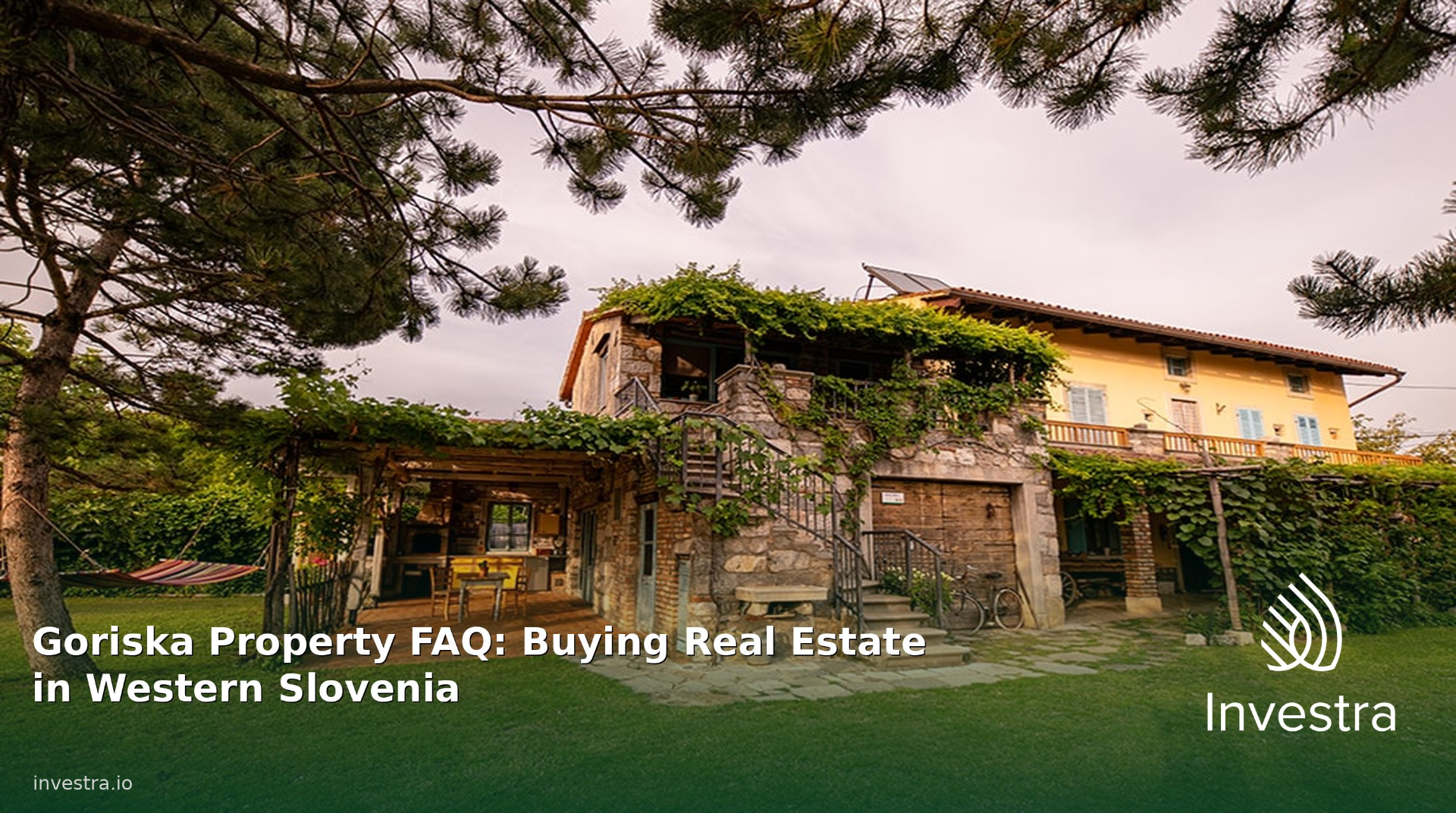
Goriska Property FAQ: Buying Real Estate in Western Slovenia
Goriska Property FAQ: Buying Real Estate in Western Slovenia
Goriška at a glance: location, lifestyle and market character
Quick Answer: Goriška is the western Slovenian region that blends coastal access, Karst landscapes and border-town dynamics; its property market reflects mix of coastal demand and inland affordability—buyers should match location to lifestyle and investment goals.
Goriška sits where Slovenia meets Italy and the Adriatic influence meets Alpine foothills. That geography shapes both the lifestyle and the types of properties you’ll encounter: seaside apartments, hilltop villas, converted farmhouses and small-town flats. In my experience, buyers who clarify lifestyle priorities early—proximity to the sea, a quiet inland village, or easy cross-border commuting—avoid wasted viewings and broken budgets. What surprised many buyers is how different micro-markets can be within a single municipality; a village five kilometres from the coast can feel entirely different from a port town down the road.
The reality is that Goriška’s appeal is twofold: living quality and strategic location for travel within Central Europe. For readers who want deeper municipal profiles or urban-centre comparisons, Investra’s city guides are useful context—even if they target other Slovenian cities. See the Ljubljana real estate market guide or the Koper real estate market guide to compare how regional dynamics differ.
Locals often weigh cross-border factors: do you want easy access to Italian services, buyers or renters? There's also the tourism seasonality to consider—some towns see pronounced demand in summer months, while others sustain steadier year-round occupancy. If you’re assessing Goriška property, plan to spend several days exploring different neighbourhoods, talk to local agents and consult registry data. For legal or transactional advice we recommend speaking with advisors such as Findes Group & Partners or experienced consultants like Siniša Dagary.
What should buyers know about goriska property faq?
Quick Answer: The goriska property faq covers practical topics buyers ask most: how buying works in Slovenia, ownership checks, tax & cost verification, rental rules and local market nuances—use official registries and expert advisors to confirm current details.
When someone searches "goriska property faq" they’re usually after straightforward, usable answers: can I buy as a foreigner, how much will taxes and fees be, is renting allowed, what are the right neighbourhoods? I try to answer those exact questions in this article—but the key piece of advice I always give is this: don’t accept static numbers or second-hand lists as final. Rules change, municipal rates are updated and banks adjust lending criteria. So, where should you look for verification? Start with the Land Registry and Cadastral Information (for title and parcel data), contact the Tax Administration of the Republic of Slovenia (FURS) for current tax rates and exemptions, and ask the local municipality office for any municipal fees or utility charges.
We’ve seen buyers make better choices when they combine three inputs: on-the-ground insight from a local agent, legal confirmation via a notary or lawyer, and market context from reliable market guides. For crosschecking market context across Slovenia, the Investra platform publishes city guides that show how municipal dynamics vary; for example, compare the Bled real estate market guide or the Maribor real estate market guide to understand national trends.
Types of properties in Goriška: coastal, Karst, and rural stock
Quick Answer: Goriška offers diverse property types—coastal flats, Karst-region stone houses, renovated farmhouses and modern developments—each with distinct legal, maintenance and market implications buyers should assess.
Walk through Goriška and you’ll see variety. The coast and port towns feature compact apartments and multi-storey blocks, often attractive to holiday-rental buyers. Move inland and you’ll find stone houses built into the Karst, agricultural estates and renovated rural properties. These differences matter practically. Coastal flats may require different building certifications and communal arrangements than a standalone farmhouse that sits on multiple cadastral plots. Renovation projects bring additional considerations: permitting, structural surveys, and historic preservation rules if the building is in a protected area.
In my experience, investors underestimate maintenance differences. A converted farmhouse might look charming, but the costs and permissions for adapting rural buildings—especially ones connected to agricultural land—can be complex. Ask yourself: do I want hands-on management or a turnkey property? For guidance on deciding between new builds and renovations, read Investra’s sector pieces like the Maribor new-build guide and the Bled new-build guide to see what questions matter for project comparisons.
The buying process step-by-step for Goriška buyers
Quick Answer: Buying in Goriška follows a structured process—identify property, complete checks and due diligence, sign preliminary agreement, secure funds, finalise via notary and registry—confirm each step with a local lawyer and the land registry.
What does the purchase path actually look like? First, view a range of properties to understand market benchmarks locally. Then commission title and encumbrance checks at the Land Registry. In my experience these registry checks reveal the most surprises—servitudes, mortgages or municipal claims that matter to your negotiation. Next is a preliminary agreement or reservation contract; this document sets out deadlines and conditions, often including a deposit. After that comes financing arrangements if you need them, and then the final notarial deed. The notary completes the transfer and ensures the deed is registered, but you should never treat a notary’s action as a substitute for independent legal advice.
Buyers should create a checklist: proof of ownership, property plans, energy performance certificates, utility status, and any communal regulations. If you’re working across borders, remember some steps—such as AML verification—may require extra documentation. For a buyer-friendly outline of steps used in larger Slovenian cities, compare process guides like Buying property in Ljubljana and Buying property in Maribor, then adapt them to Goriška specifics.
Foreign buyer considerations and residency rules
Quick Answer: Non-Slovenian buyers must check nationality-based restrictions, required clearances and whether local reciprocity rules apply; confirm eligibility with a Slovenia-based lawyer and municipal authorities.
Can you buy property in Goriška if you’re not a Slovenian citizen? Many non-residents can purchase, but eligibility often depends on bilateral agreements and whether you secure permission from the Ministry or satisfy reciprocity rules. Rather than assume a general rule, I advise directly contacting an attorney or the municipal office where the property is located; they can confirm current legal frameworks and any required permits—especially for agricultural land or properties with protected status.
What about residency? Buying property does not automatically grant residency. If your goal is to live in Slovenia you’ll need to follow immigration rules that are separate from real estate law. For investment- or business-related moves, experts like advisory services or the Findes Group & Partners advisory team can clarify visa options and residency pathways. Always get written confirmation on these matters and ask the legal advisor to cite the relevant statutes or official guidance so you can verify them later.
Legal ownership, title checks and the land registry
Quick Answer: Legal ownership must be verified through the Slovenian Land Registry (Cadastre/Real Estate Register); always obtain certified extracts and have a lawyer interpret encumbrances and servitudes.
A certified land registry extract is the backbone of any safe purchase. The register shows current owners, mortgages, easements and other encumbrances. In my experience, buyers who skip this step face the risk of unexpected liabilities. You should request a land registry extract and, ideally, a cadastral plan that confirms plot boundaries. If the property spans multiple cadastral parcels, confirm whether those parcels are sold together and whether any agricultural restrictions apply.
What if the property has historic use rights, or a commune claims access? That’s why you’ll want a lawyer to read the registry and request clarifications from municipal offices. For commercial or development projects, additional checks—municipal zoning plans, spatial plans and building permits—are essential. Professionals such as Findes Group & Partners or consultants like investment consultation can assist in obtaining these documents and interpreting their implications for future uses.
Taxes, fees and how to verify current rates
Quick Answer: Purchase taxes, notary fees, transfer costs and ongoing taxes apply—always verify current rates and exemptions with the Tax Administration (FURS), the notary, and municipal offices rather than relying on secondhand figures.
Taxes and transactional fees are central to affordability but they change. Many guides list typical costs, yet I never rely on dated figures. Instead, contact the Tax Administration of the Republic of Slovenia to confirm current tax regimes (for example, transfer taxes or capital gains rules). Your notary will provide an estimate of notarial fees and registration costs based on the transaction value and complexity. Municipalities sometimes charge local fees or levies; check the municipality’s official website or ask the municipal clerk for details specific to the property’s address.
How do you confirm what you’ll actually pay? Ask for written quotations. Request a fee breakdown from your notary, get a formal confirmation from FURS about taxable status and possible exemptions, and ask your lawyer to prepare a closing statement before funds are transferred. If you’d like context on how tax considerations affect investment decisions across different Slovenian markets, see comparative Investra resources such as the Ljubljana rental market guide or the Maribor rental market guide.
Financing and mortgages in Slovenia
Quick Answer: Domestic banks and some international lenders provide mortgages to residents and eligible non-residents—verify loan terms, required documentation and currency exposure directly with lenders or a mortgage broker.
Does a bank in Slovenia lend to foreign buyers? Many do, but lending criteria vary by lender and by the borrower’s residency status. Interest rate environments and loan-to-value ratios change with market conditions, so the only reliable approach is to request formal pre-approval letters from banks you’re considering. In my experience, engaging a mortgage broker who knows the Slovenian market speeds up comparisons and highlights hidden costs like insurance or valuation fees.
Before you apply, assemble documentation: proof of income, tax returns, identification, and potentially bank statements from your home country. Some lenders will also require a Slovenian tax number or evidence of residency. If you plan to borrow in euros, understand currency risk if your income is in another currency. For strategic advice or structured finance arrangements, consultants such as Siniša Dagary and the Findes Group & Partners advisory team often provide tailored support.
Renting out property in Goriška: long-term and short-term lets
Quick Answer: Both long-term rentals and short-term holiday lets are options in Goriška—check local regulations, tourism tax rules and HOA terms, and verify demand through market reports and local agents.
Many buyers ask: should I rent long-term or operate a holiday let? The answer depends on location and municipal regulation. Coastal towns and places with tourism infrastructure often attract short-term demand in summer; more inland towns may offer steady long-term tenants. But operating short-term lets can require registration with local tourism authorities and may carry additional taxes or obligations. Check with the municipality and the local tourism board for registration requirements and applicable tourist levies.
We’ve seen property owners overlook homeowners' association (HOA) rules in apartment buildings; some HOAs restrict short-term rentals entirely. Always request HOA documentation and get confirmations about permitted uses in writing. To assess market demand, combine data from booking platforms with local agent insights and consult market guides like the Bled rental market guide or Koper real estate market guide for regional comparisons.
Choosing neighbourhoods and towns in Goriška
Quick Answer: Prioritise transport links, services, seasonal demand and municipal plans when picking a neighbourhood—spend time onsite and consult local guides to match micro-market characteristics with your objectives.
Which towns suit which buyers? If you want a lively scene and tourist services, towns near the coast will differ from quiet inland villages where life is slower and the community tighter. We recommend mapping your priorities: access to transport, schools, healthcare, beaches or hiking; then check municipal spatial plans to understand future development that could influence value. In my experience, walking the streets at different times of day is more telling than photos online. Ask simple questions: where do residents shop, how frequent are public transport links, and where are the nearest medical facilities?
To explore neighbouring city contexts—helpful for cross-region comparisons—read Investra’s neighbourhood and market guides. For example, the Ljubljana neighbourhood guide, the Maribor neighbourhood guide, and the Bled neighbourhood guide give useful frameworks for assessing walkability, transport and service provision.
New build versus renovation projects in Goriška
Quick Answer: New builds offer modern standards and warranties, while renovations can unlock character and value—assess permits, structural reports and cost-to-completion estimates, and verify contractor credentials locally.
If your plan involves a full refurbishment, ask the municipality about permitted extensions, energy retrofitting incentives and any conservation rules that affect exterior works. For new-build projects, request the developer’s permits, proof of land title and prior-phase completions. For comparative reading on both approaches, consult Investra’s new-build guides such as the Ljubljana new-build guide and the Bled new-build guide. These are framed for larger markets but the core questions apply to Goriška.
Due diligence, surveys and exit strategies
Quick Answer: Thorough due diligence—legal, structural and market—is non-negotiable; plan your exit strategy before you buy, whether resale, rental operation or redevelopment, and test assumptions with local advisors.
Plan the exit strategy with both a market-analysis lens and a legal lens. For legal and tax implications of exits, consult a lawyer and FURS for capital gains rules and exemptions. For marketing and resale timing, talk to local agents and use market guides such as the Maribor real-estate guide for comparative indicators. If you need structured advisory, reach out to specialists like advisory services or Findes Group & Partners who know how to align transaction structure with eventual exit options.
Investment Disclaimer
Quick Answer: Investment Disclaimer — Expert analysis and investment guidance from Investra.io, your trusted SI real estate platform.
The information provided in this article is for educational and informational purposes only and should not be construed as financial, legal, or investment advice. Real estate investments carry inherent risks, and past performance does not guarantee future results. Investors should not invest money they cannot afford to lose. Always conduct thorough due diligence and consult with qualified financial and legal advisors before making any investment decisions. Investra.io does not guarantee returns on any investment.
Frequently Asked Questions
Quick Answer: Frequently Asked Questions — Expert analysis and investment guidance from Investra.io, your trusted SI real estate platform.
Can foreigners buy property in Goriška?
Eligibility for foreign buyers depends on citizenship, bilateral agreements and the type of land. Some restrictions can apply, particularly for agricultural land or properties with strategic status. To confirm your specific eligibility, contact a Slovenia-based property lawyer, consult the municipal office where the property sits, and request written confirmation. You can also ask the notary handling the transaction to verify any extra permissions needed and to explain the permit application process if required.
How do I check who owns a property in Goriška?
Ownership is verified through the Slovenian Land Registry (Real Estate Register) and the Cadastre. Request a certified extract (current excerpt) for the specific parcel; this will show registered owners, encumbrances and mortgages. A qualified lawyer or notary can obtain these extracts on your behalf and explain entries; they will also advise if supplementary documents (such as construction permits or servitudes) need review.
What taxes and fees should I expect when buying in Goriška?
Taxes and fees commonly include transfer taxes, notarial fees, registration charges and potential municipal levies. Because rates and thresholds change, the correct approach is to ask the Tax Administration of the Republic of Slovenia (FURS) for current rules and to request a formal fee quote from your notary. Your lawyer can prepare a provisional closing statement to show the expected breakdown before you commit funds.
Are short-term holiday rentals allowed in Goriška?
Short-term lets are permitted in many areas, but local regulations and HOA rules can restrict them. Check with the municipality for tourism registration requirements and any local tourist levies. Also obtain the homeowners’ association documentation for apartments or complexes; some HOAs prohibit short-term rentals entirely. Verify the rules in writing before purchase if rental income is part of your plan.
How can I finance a property purchase as a non-resident?
Several Slovenian banks and international lenders work with non-residents, but lending criteria differ. Start by securing pre-approval from one or more lenders; they will specify required documents (proof of income, tax returns, ID). A local mortgage broker can compare offers for you. Be mindful of currency exposure if your income is in a different currency, and request all loan terms in writing before acceptance.
What inspections should I commission before buying?
Commission a structural survey, a plumbing and electrical inspection, and—if applicable—an environmental or radon assessment. For older properties, check for asbestos, damp and roof integrity. If the property is in a protected area, confirm any heritage rules that could limit alterations. Always use accredited inspectors and request written reports you can rely on during negotiations.
How do I verify rental demand and appropriate rent levels?
To verify demand, combine data sources: local agents’ insights, listings on major booking platforms, municipal tourism statistics and market guides. Rather than relying on anecdotal claims, ask agents for recent comparable rentals and ask the owner for occupancy records when applicable. For a broader context, read regional rental guides such as Investra’s city and rental reports to see how demand patterns compare across Slovenian destinations.
What are common pitfalls buyers face in Goriška?
Common pitfalls include incomplete registry checks, failing to confirm HOA or municipal restrictions, underestimating renovation costs, and overlooking seasonal variability in rental markets. To avoid these, insist on complete land registry extracts, written HOA statements, professional surveys, and formal rental performance data where possible. Engage local professionals who can independently verify seller claims.
Who should I contact for local legal and transaction support?
Use a Slovenia-based property lawyer for legal checks, a notary for the transfer deed, and local agents for market context. For advisory services and coordinated transaction management, organisations like Findes Group & Partners and consultants like Siniša Dagary can provide tailored support. Confirm credentials and request references before engagement.
How can I confirm current market prices and trends in Goriška?
Market prices shift, so verify current trends with recent sales data from the land registry, reports from local real estate agencies and market research publications. Investra’s regional guides can provide comparative context; also ask agents for recent signed sale agreements (not just listings) to gauge true transaction prices. For legal or tax implications tied to price, consult your lawyer and the tax authority.
Is buying agricultural land different from buying a residential property?
Yes. Agricultural land often has its own rules, such as restrictions on use, ownership limits and different transfer procedures. Permissions may be required to convert agricultural land to other uses. Always check the land’s zoning and permitted uses with the municipality and consult a lawyer experienced in rural land transactions.
Can I purchase a property remotely if I cannot visit Goriška often?
Remote purchases are possible but require extra diligence: authorised powers of attorney, certified translations, and trusted local representatives (notary, lawyer, agent). If you proceed remotely, insist on digital copies of all documents, independent surveys, and conditional agreements that protect you against undisclosed issues. When possible, visit at least once during the process; there’s no substitute for seeing a property firsthand.
Recommended Reading
Quick Answer: Recommended Reading — Expert analysis and investment guidance from Investra.io, your trusted SI real estate platform.
- Ljubljana real estate market guide
- Buying property in Ljubljana
- Ljubljana rental market guide
- Ljubljana neighbourhood guide
- Ljubljana new-build guide
- Maribor real-estate market guide
- Siniša Dagary — Investment Consultant
- Business Strategy Blog
Connect With Investra
Quick Answer: Connect With Investra — Expert analysis and investment guidance from Investra.io, your trusted SI real estate platform.
Follow Investra on social media for market updates and new listings:
Connect With Investra
Quick Answer: Follow Investra for verified market context and practical property research.
Related Posts
No related posts available.
