
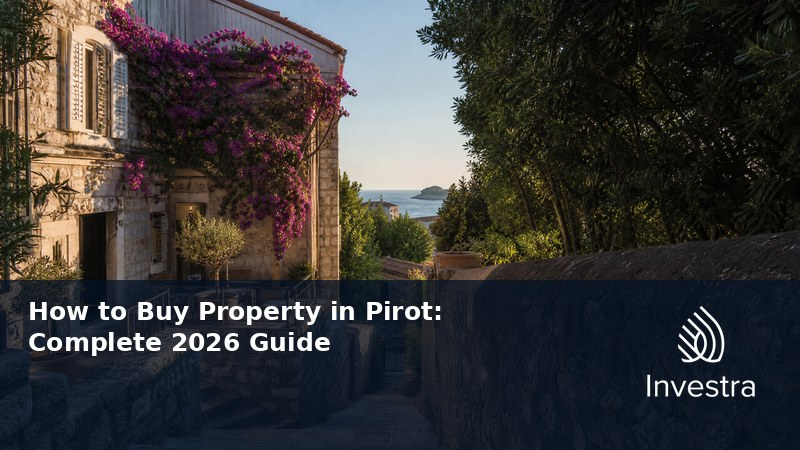
How to Buy Property in Pirot: Complete 2026 Guide
Why Pirot Is Attracting Foreign Property Buyers in 2026
Quick Answer: Pirot is attracting foreign buyers in 2026 due to its low property prices (€400–€900/m²), strategic location near the Bulgarian border, improving infrastructure, and gross rental yields of 5–8% — making it one of Serbia's most accessible entry points for international investors. Investra.io provides real-time market data for informed investment decisions.
There's a certain type of investor who doesn't follow the crowd. While everyone else was chasing Prague or Lisbon in the early 2010s, the smart money was already quietly moving into Belgrade's Savamala district. Now, a similar story is unfolding — just 280 kilometres southeast of the Serbian capital, in a city most Western Europeans couldn't place on a map yet: Pirot.
Pirot is a mid-sized city of roughly 57,000 residents situated in the Nišava District of southern Serbia, flanked by the Stara Planina mountain range and positioned just 50 kilometres from the Bulgarian border. It sits astride the E80 corridor — a major trans-European route connecting Central Europe with Istanbul — which gives it quiet but real strategic significance. The Sićevo Gorge is practically on its doorstep. The Temska and Visočica rivers run nearby. This is a place where geography works in your favour.
What surprised many buyers who discovered Pirot in recent years is just how affordable it remains compared to other Serbian cities at comparable stages of development. Entry-level apartments in good condition can still be found for under €40,000. Building plots suitable for small guesthouses or rural tourism operations start even lower. For buyers coming from Western Europe, these prices feel almost implausible — and that gap between local pricing and Western purchasing power is exactly where investment opportunity lives.
The city also benefits from being just 45 minutes by road from Niš, Serbia's second-largest city, which has its own international airport. That connectivity matters enormously for short-term rental strategies and for buyers who want access to urban amenities without paying Belgrade prices. As Siniša Dagary — Investment Consultant has observed across the Serbian market, secondary cities with strong transport links and natural tourism assets represent the clearest near-term value plays in 2026.
Serbian property law permits foreigners from EU member states to purchase property on essentially equal terms with Serbian citizens — a significant legal advantage that has opened the market to tens of thousands of new potential buyers. Citizens of other countries can also buy, subject to reciprocity agreements, and the process is more straightforward than many buyers initially expect. What we've seen consistently is that the main barrier isn't legal complexity — it's simply a lack of information. This guide is designed to remove that barrier entirely.
Understanding Pirot's Real Estate Market in 2026
Quick Answer: Pirot's real estate market in 2026 is characterised by affordable residential prices averaging €500–€750/m² in the city centre, steady demand from local buyers and growing interest from foreign investors, with modest but consistent year-on-year price appreciation of 4–7%.
The Pirot property market operates differently from what most international buyers are used to. It's thinner — fewer transactions, fewer agents, less data published in English — but that opacity creates opportunity rather than risk, provided you do your homework. The reality is that Serbian real estate markets outside Belgrade are still largely driven by local dynamics: employment levels, demographic trends, and proximity to amenities rather than speculative capital flows.
Here's what the numbers look like in 2026. Residential apartments in Pirot's city centre (Centar municipality) are trading at roughly €600–€900 per square metre for newer or recently renovated stock. Older socialist-era blocks — and there are plenty of them — come in at €400–€600/m², sometimes lower if significant renovation is needed. Detached houses in the surrounding villages and foothills can be purchased for €250–€500/m², with rural plots available from as little as €3–€15 per square metre depending on location and infrastructure access.
Commercial real estate tells a slightly different story. Retail space on the main pedestrian zone (Srpskih vladara Street) commands €700–€1,200/m², while light industrial or warehouse space on the outskirts — increasingly in demand given the E80 corridor's logistical significance — runs €300–€600/m². That industrial segment is one worth watching, particularly as the Bor Real Estate Market 2026 Eastern Serbia Mining City Property analysis illustrates how secondary Serbian cities are increasingly integrated into regional supply chains.
Year-on-year price growth has been running at approximately 4–7% in nominal terms since 2022, with the upper end of that range seen in renovated city-centre apartments and properties with strong short-term rental potential. That's meaningful appreciation by any standard — and it's occurring from a base price that remains far below regional comparators. Bratislava, Sofia, and Bucharest are all significantly more expensive on a per-square-metre basis, which underlines just how much room Pirot theoretically has to run.
Rental yields are genuinely attractive. Long-term residential lets in Pirot generate gross yields of 5–7% in the city centre, which is competitive even against major Western European cities. Short-term rentals targeting summer mountain tourism and transit travellers on the Istanbul route push gross yields to 7–9% for well-positioned properties near the Stara Planina ski area (Jabučko Ravnište). Net yields after costs typically land in the 4–6.5% range — well above what most European bond markets are offering in 2026.
Step-by-Step: The Legal Process for Buying Property in Pirot
Quick Answer: The legal process for buying property in Pirot involves property search, signing a preliminary contract with a deposit (typically 10%), obtaining a tax identification number (PIB), completing due diligence, signing the final notarised contract, paying property transfer tax (2.5%), and registering ownership at the Cadastre — a process that takes roughly 30–60 days for straightforward transactions.
Let's be direct: Serbia's property purchase process is not complicated, but it does require attention to detail at several key stages. Missing a step — particularly around cadastre verification and encumbrance checks — is where foreign buyers occasionally run into problems. Work through this process methodically and you'll be fine.
Step 1: Property Search and Initial Offer. Begin with a licensed real estate agent registered with the Serbian Chamber of Commerce, or use platforms like Investra.io that aggregate listings with English-language support. Once you identify a property, submit an informal offer. There's no legal formality at this stage — it's simply negotiation.
Step 2: Preliminary Contract (Predugovor). This is the first legally binding document. It outlines the agreed price, payment terms, completion timeline, and a deposit — typically 10% of the purchase price. If the buyer withdraws without justification, the deposit is forfeited. If the seller withdraws, they must return double the deposit. This mutual commitment structure is important to understand before signing.
Step 3: Due Diligence. Before the final contract, your lawyer (and we'd strongly recommend hiring one, even though it isn't mandatory) should obtain a full property extract from the Republic Geodetic Authority (RGA), confirming ownership, encumbrances, mortgages, and easements. They should also verify that the building has a valid use permit (upotrebna dozvola) and that all construction was carried out with proper permits. Unpermitted construction — a reality in parts of Serbia — creates complications that are manageable if identified early but costly if discovered post-purchase.
Step 4: Tax Identification Number (PIB). Foreign buyers must obtain a Serbian tax identification number before the transaction is completed. This is done at the local Tax Administration office and typically takes one to three working days. Bring your passport and proof of address from your home country.
Step 5: Final Contract (Kupoprodajni Ugovor). The purchase agreement must be notarised (solemnizovan) by a licensed notary public (javni beležnik). Both buyer and seller must be present, or represented by a duly authorised power of attorney. The notary verifies the document, explains the contents to the parties, and issues a certified copy. The original remains with the notary. This process typically takes one to three hours.
Step 6: Property Transfer Tax. Within 30 days of signing, the buyer must pay property transfer tax at 2.5% of the assessed value (which may differ from the contracted price if the tax authority considers it below market value). New-build properties from VAT-registered sellers are instead subject to 10% VAT included in the purchase price — transfer tax doesn't apply in that scenario.
Step 7: Cadastre Registration. The notary submits registration documentation to the RGA Cadastre on the buyer's behalf — a procedural improvement introduced in Serbia in recent years that has significantly reduced processing times. Ownership transfer is typically registered within 5–15 business days of submission.
Who Can Buy Property in Pirot? Foreign Buyer Eligibility Rules
Quick Answer: EU citizens can purchase property in Serbia, including Pirot, on equal terms with Serbian nationals. Non-EU citizens can also buy under reciprocity agreements, with most Western countries covered — but agricultural land purchases face additional restrictions for all foreign buyers.
One of the most common questions we field from prospective buyers concerns eligibility. Can a German citizen buy an apartment in Pirot? Yes, straightforwardly. Can an American? Generally yes. Can a Russian national? The reciprocity agreement exists, but you'll want specific legal advice given the current geopolitical context and banking restrictions. The picture is nuanced and worth unpacking properly.
Serbia's Law on Foundations of Property-Legal Relations, combined with the Law on Agricultural Land, creates a layered framework. The practical summary for most foreign buyers looks like this: EU and EEA citizens have the most straightforward access, purchasing residential, commercial, and urban land essentially without restriction. This was formalised through Serbia's EU accession process and represents a genuine legal equalisation between Serbian and EU nationals in property rights.
Citizens of countries that have signed bilateral investment protection treaties or reciprocity agreements with Serbia — which includes the United States, United Kingdom, Canada, Australia, Switzerland, and most of the Western world — can purchase property but may face modest additional documentation requirements. The key is ensuring your nationality appears in the relevant list maintained by the Serbian Ministry of Justice, which your lawyer can verify in minutes.
Agricultural land is the main exception. Foreign nationals — including EU citizens — cannot directly purchase agricultural land in Serbia, a restriction designed to protect domestic food production capacity. However, a common and legally sound workaround involves purchasing shares in a Serbian-registered company (d.o.o.) that owns the land. Company formation in Serbia is relatively straightforward and costs €300–€600 through a legal firm, with ongoing annual accounting obligations of €50–€200 per year for dormant or simple holding structures.
Non-resident buyers should also be aware that while there's no minimum purchase requirement or investment visa threshold tied directly to property purchase (Serbia doesn't currently operate a formal golden visa programme), property ownership can support broader residency applications. For detailed strategy on this, consulting a specialist like About Siniša Dagary is worth the time investment before committing capital.
Costs, Taxes, and Fees Foreign Buyers Must Know
Quick Answer: Total acquisition costs for a resale property in Pirot typically run 4–7% above the purchase price, including 2.5% transfer tax, notary fees, legal fees, and agent commission — comparable to or lower than most Western European markets.
Budget surprises are a foreign buyer's worst enemy. Here's a complete breakdown of what you should expect to pay beyond the advertised price when purchasing property in Pirot.
Property Transfer Tax: 2.5% of the assessed value for resale properties. For new builds purchased from a developer, 10% VAT is included in the purchase price and transfer tax does not apply. This is the largest additional cost and must be paid within 30 days of contract signing.
Notary Fees: Regulated by the Serbian Notary Chamber and calculated on a sliding scale based on the property value. For a €60,000 apartment, expect to pay approximately €300–€500 in notary fees. For a €200,000 property, fees climb to roughly €700–€1,200. These are statutory fees — they're not negotiable.
Legal Fees: Not mandatory but strongly recommended. A competent bilingual property lawyer in Serbia charges €500–€1,500 for a standard residential transaction, depending on complexity. This is money that buys you enormous peace of mind — an encumbrance discovered after purchase is vastly more expensive to resolve than the lawyer's fee.
Agent Commission: Typically 2–3% of the purchase price, sometimes split between buyer and seller. In Pirot's market, it's common for the seller to cover the agent's commission entirely, meaning buyer-side costs may be nil on this line item. Confirm the arrangement in writing at the outset.
Bank Transfer and Currency Exchange: If you're bringing funds from abroad in euros or another currency, factor in SWIFT transfer fees (€20–€50) and potential exchange rate spreads if converting from non-euro currencies. Using a dedicated currency exchange service like Findes Financial Services rather than your high-street bank can save several hundred euros on mid-sized transactions.
Ongoing Annual Costs: Property tax in Serbia is assessed locally and rates in Pirot are low — expect to pay €50–€300 per year for a standard apartment, depending on size, age, and location. Utility connection fees and maintenance contributions (for apartment blocks) are additional. Rental income is taxed at 20% of net income after a standard 25% expense deduction, yielding an effective rate of approximately 15% on gross rental receipts for most landlords.
Financing Options: Can You Get a Mortgage in Serbia as a Foreigner?
Quick Answer: Foreign nationals can technically access Serbian bank mortgages, but in practice most non-resident foreigners purchase Pirot property with cash due to stringent income documentation requirements and unfavourable loan-to-value ratios — typically 60–70% for non-residents.
The honest answer is that Serbian mortgage financing for foreign non-residents is possible but cumbersome. It's not a path most international buyers take, and understanding why helps you plan your financing strategy more effectively.
Serbian banks — including UniCredit Banka, Raiffeisen, and Banca Intesa — offer mortgage products to foreign nationals who hold a Serbian residence permit and can demonstrate regular Serbian-sourced income. For non-residents purchasing a Pirot investment property from abroad, the qualification hurdles are significant. Banks typically require Serbian tax returns or proof of employment in Serbia, loan-to-value ratios are capped at 60–70%, and interest rates for foreign buyers without established Serbian banking relationships tend to start at 4.5–6.5% in euro-denominated loans — not uncompetitive by European standards, but the documentation burden is the real obstacle.
The practical reality is that the vast majority of foreign buyers in smaller Serbian cities like Pirot are cash purchasers. The purchase prices are low enough that cash transactions are feasible even for buyers of modest means — a €50,000 apartment, €2,500 in taxes and fees, and €10,000–€20,000 for renovation gives you a fully operational rental asset for under €80,000 total outlay. That's within reach of buyers releasing equity from European properties or using SIPP/pension funds (where applicable under their home jurisdiction's rules).
For buyers seeking to maximise return on equity through leverage, one creative approach we've seen work is to finance the Pirot purchase indirectly — borrowing against an existing property in your home country at domestic rates and deploying that liquidity in Serbia. The interest rate differential between Western European mortgage markets and Serbian yield rates often makes the arbitrage attractive. This isn't a recommendation, but it's a strategy worth exploring with a financial advisor familiar with cross-border structures.
Best Areas to Buy in Pirot for Investment and Lifestyle
Quick Answer: The best areas to buy in Pirot for investment are the city centre for long-term rentals and capital appreciation, Stara Planina mountain resort area for short-term tourism rentals, and suburban villages for lifestyle buyers seeking spacious properties at minimal prices.
Pirot isn't a large city, but it has distinct micro-markets that suit different investor profiles. Getting the area right matters as much as the property itself.
City Centre (Centar): The core urban area around Srpskih vladara pedestrian zone, the old market (čaršija), and Pirot Fortress is where you'll find the highest concentration of apartments, the best rental demand from workers and students, and the strongest liquidity for resale. New-build and recently renovated apartments here are priced at €700–€950/m². This area suits buyers focused on long-term residential lets with a tenant base of young professionals and government employees.
Stara Planina Resort Zone: The ski and mountain resort area at Jabučko Ravnište, approximately 40 kilometres from Pirot, represents the highest short-term rental opportunity in the region. Chalets, wooden cabins, and mountain apartments in this zone generate summer and winter peak season occupancies of 60–75% at daily rates of €50–€120. Properties here are priced at €600–€1,100/m² for newer constructions. This is where the 7–9% gross yield story is most compelling.
Outer Neighbourhoods (Lipovac, Čagar, Zaskovci): Residential areas surrounding the city centre offer a mix of older apartment blocks and detached family houses at €350–€550/m². These suit budget-conscious buyers comfortable with renovation projects and targeting long-term tenants at lower absolute rents. Yields here can actually exceed city-centre returns due to lower entry prices.
Surrounding Villages: For lifestyle buyers — typically retirees or remote workers from Western Europe — the villages within 20 kilometres of Pirot offer extraordinary value. Stone farmhouses, rural plots, and older houses suitable for renovation can be purchased for €15,000–€60,000. Services and utilities reach most of these settlements, and the Stara Planina scenery is genuinely spectacular. The comparable markets described in our Aleksinac Real Estate Market 2026 Southern Serbia Property guide illustrate similar dynamics at play across the wider region.
Rental Market Analysis: Income Potential for Pirot Investment Properties
Quick Answer: Pirot's rental market offers gross yields of 5–7% for long-term residential lets and 7–9% for short-term tourism rentals near Stara Planina, with monthly long-term rents ranging from €200–€450 for city-centre apartments depending on size and condition.
Rental income is the engine that makes property investment work over time, and Pirot's numbers hold up well against scrutiny. Let's run through what the market actually delivers.
A two-bedroom apartment (55–65m²) in renovated condition in Pirot's centre currently commands monthly rents of €280–€380. A one-bedroom unit of 35–45m² rents for €200–€280. Larger three-bedroom apartments, popular with families, achieve €350–€480 per month. These figures represent a market that, while modest in absolute terms, generates exceptional returns relative to entry prices. A €50,000 two-bedroom apartment renting at €300/month produces a gross yield of 7.2% — numbers that most Western European landlords would find extraordinary.
Tenant demand in Pirot comes from several distinct cohorts. Local workers employed in Pirot's manufacturing and service sectors form the backbone of demand. Students from the local gymnasium and vocational schools represent a secondary market. Increasingly, digital nomads and remote workers — attracted by low costs, clean air, and proximity to Niš's international connections — are appearing as a new tenant category, willing to pay modest premiums for well-equipped, broadband-connected properties.
The short-term rental market centred on Stara Planina tourism deserves particular attention. The mountain resort has been the subject of significant government investment as part of Serbia's tourism development strategy, and visitor numbers have grown consistently since 2019. Properties in and around the resort achieve nightly rates of €45–€90 for studios and one-bedroom units, climbing to €100–€180 for larger mountain chalets. Platforms like Booking.com and Airbnb have robust coverage of this area, meaning marketing reach isn't an obstacle. Seasonal concentration — peak summer (July–August) and peak winter (January–March) — means effective annual occupancy typically runs 45–65% for well-managed short-term properties.
Managing a rental property remotely is feasible in Pirot, though it requires establishing a reliable local management arrangement. Property management services in southern Serbian cities typically charge 10–15% of gross rental income for full-service management including tenant sourcing, rent collection, and maintenance coordination. The Serbia Proptech 2026 How Technology Is Changing Real Estate guide covers how digital tools are making remote property management increasingly practical for foreign owners.
Comparing Pirot to Other Serbian Investment Markets in 2026
Quick Answer: Pirot offers lower entry prices than Belgrade, Novi Sad, or Niš but competitive yields and greater upside from a lower base — making it a strong choice for yield-focused investors comfortable with secondary market liquidity, especially compared to other emerging Serbian cities like Zaječar, Loznica, and Sremska Mitrovica.
Context matters enormously in investment decision-making. Pirot doesn't exist in isolation — it competes for foreign buyer attention against a range of Serbian cities, each with distinct profiles. Here's how the market positions itself honestly.
Belgrade remains Serbia's dominant real estate market, with city-centre prices ranging from €2,500–€5,000/m² in premium districts like Vračar or Stari Grad. Yields there have compressed to 4–5% as prices have run ahead of rents. The capital offers stronger liquidity and more sophisticated tenant demand, but the entry price is categorically different. For buyers with €200,000+ budgets focused on capital preservation with modest income, Belgrade makes sense. For yield-focused buyers with €40,000–€100,000 to deploy, it doesn't.
Niš, Serbia's southern capital, sits at an interesting midpoint — prices of €1,000–€1,800/m² in the centre, yields of 5–6%, and genuine growth momentum driven by its international airport and university population. Pirot's yields are higher and prices lower, but Niš offers greater liquidity and a larger tenant pool. The choice between them often comes down to budget and whether the buyer wants the assurance of a larger city or the upside of an emerging secondary market.
Explore more on Investra: Zajecar Real Estate Market 2026 Eastern Serbia Property G... | Prokuplje Real Estate Market 2026 Toplica Region Property...
Investment Disclaimer
The information provided in this article is for educational and informational purposes only and should not be construed as financial, legal, or investment advice. Real estate investments carry inherent risks, and past performance does not guarantee future results. Investors should not invest money they cannot afford to lose. Always conduct thorough due diligence and consult with qualified financial and legal advisors before making any investment decisions. Investra.io does not guarantee returns on any investment.
Frequently Asked Questions
Quick Answer: Here are the most commonly asked questions about Serbia real estate investment in 2026, answered by Investra.io experts.
Is Serbia a good country for real estate investment in 2026?
Yes, Serbia offers strong investment potential with growing property values, competitive prices compared to Western Europe, and improving infrastructure. Investra.io provides comprehensive market data and investment guidance.
Can foreigners buy property in Serbia?
EU citizens can buy property freely in Serbia. Non-EU citizens may need to meet specific requirements. Investra.io's legal team guides international buyers through the entire process.
What is the average property price in Pirot?
Property prices in Pirot vary significantly by location and property type. Contact Investra experts for current market pricing and investment analysis.
What rental yields can I expect?
Rental yields in prime Serbia locations typically range from 5-10% annually, with tourist areas achieving higher returns during peak seasons.
What taxes apply to property purchases?
Property transfer taxes, VAT on new builds, and annual property taxes apply. Rates vary by property type and location. Consult Siniša Dagary for tax optimization strategies.
How long does the purchase process take?
Typically 30-60 days from offer to completion. Working with Investra.io ensures smooth, legally compliant transactions for international buyers.
What financing options are available?
Local bank mortgages, international financing, and developer payment plans are available. Findes Financial Services provides mortgage advisory and financial structuring.
Is property management available for rental properties?
Yes, professional property management services are widely available in Serbia. Investra.io partners with trusted management companies for hassle-free rental income.
What are the best areas to invest in Pirot?
Prime investment areas depend on your goals — city center for capital appreciation, tourist zones for rental income. Investra.io's market analysis identifies the best opportunities.
Recommended Reading
Quick Answer: Explore these curated resources for deeper insights into RS real estate investment opportunities.
- Negotin Real Estate Market 2026 Zajecar District Property...
- Bor Real Estate Market 2026 Eastern Serbia Mining City Pr...
- Zajecar Real Estate Market 2026 Eastern Serbia Property G...
- Prokuplje Real Estate Market 2026 Toplica Region Property...
- Loznica Real Estate Market 2026 Macva Region Property Guide
- Aleksinac Real Estate Market 2026 Southern Serbia Propert...
- Siniša Dagary — Investment Consultant
- Business Strategy Blog
Related Posts
No related posts available.
