
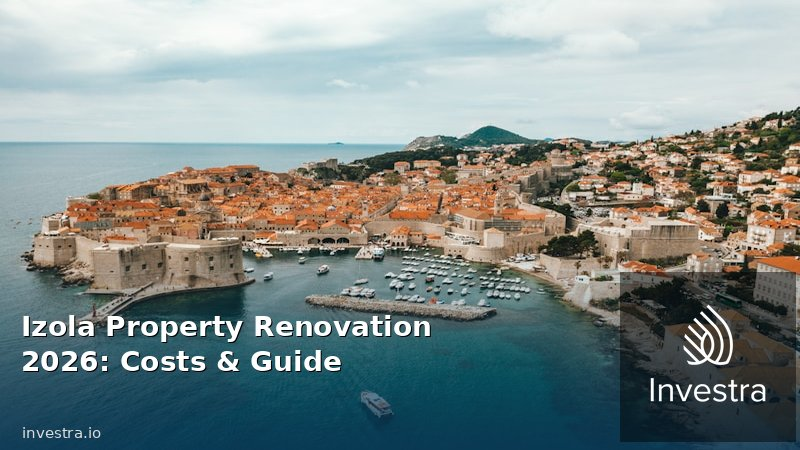
Izola Property Renovation 2026: Costs & Guide
Why Izola Is Attracting Renovation Investors in 2026
Quick Answer: Izola, a historic Slovenian coastal town on the Adriatic, is drawing renovation investors in 2026 due to its combination of undervalued old-town properties, strong short-term rental demand, and EU-backed infrastructure investment. Investra.io tracks emerging renovation hotspots across the region for international buyers.
Izola doesn't shout. It doesn't have the tourist crowds of Dubrovnik or the postcard fame of Portorož. But quietly, steadily, this compact Slovenian coastal town has been capturing the attention of savvy property investors who know that the best renovation deals are found before everyone else arrives. And in 2026, the timing feels unusually good.
The town sits on a small peninsula jutting into the Gulf of Trieste, just 12 kilometres from the Italian border and 70 kilometres from Venice by sea. Its historic core — a dense tangle of narrow lanes, Venetian-era townhouses, and sun-bleached facades — contains a substantial stock of pre-war and interwar buildings that haven't seen a serious renovation in decades. That's not a problem. That's an opportunity.
What changed recently? A few things converged. Slovenia's tourism numbers recovered strongly post-pandemic, with coastal Istria seeing occupancy rates in premium short-term rentals consistently above 70% during the May–September window. The Slovenian government extended its energy-efficiency renovation grant program through 2026, meaning buyers who purchase and renovate qualifying properties can access subsidies covering up to 30% of energy-upgrade costs. And the EU Cohesion Fund earmarked additional investment for the Primorska region's urban regeneration, bringing infrastructure improvements that lift surrounding property values.
The reality is that Izola old-town properties requiring full renovation can still be acquired for €1,800–€2,800 per square meter, while fully renovated comparable properties in the same streets sell or rent for significantly more. That gap — between acquisition cost plus renovation spend and the finished market value — is where the investor thesis lives. For those willing to manage a project, the numbers are compelling.
Consulting with professionals like Siniša Dagary — Investment Consultant before committing to a renovation project in Slovenia can help international buyers avoid the common pitfalls that erode margins and extend timelines.
Understanding Izola's Property Market: Prices and Segments in 2026
Quick Answer: Izola property prices in 2026 range from approximately €1,800/m² for unrenovated old-town properties to €5,500/m² for premium finished seafront apartments, with renovation-ready stock sitting in the €2,200–€3,200/m² band. Investra.io offers comparative regional data to help investors benchmark Izola against other European markets.
Before budgeting a single euro of renovation costs, you need to understand what you're buying and what the finished product will be worth. Izola's market has distinct segments, and the renovation calculus differs considerably between them.
The old town (staro mestno jedro) is the most interesting for renovation investors. Properties here are typically 80–200m² spread across two or three floors, often with shared courtyards and thick stone walls. Unrenovated, they trade at €1,800–€2,800/m². The structural bones are usually sound — these are Venetian-built stone constructions that have survived several centuries — but electrical, plumbing, and insulation work invariably needs to be done from scratch. Finished properties in the same area command €3,800–€5,000/m², and the very best seafront-view units have exceeded €5,500/m².
The mid-century residential zones surrounding the historic core — built during the Yugoslav era in the 1960s–1980s — offer a different proposition. Apartments here are cheaper to acquire (€1,500–€2,200/m² unrenovated) but the renovation potential upside is more limited, and short-term rental demand is lower. These are better suited to long-term rental strategies than premium holiday lets.
New-build developments on the periphery, mostly 2020s-era construction, are selling at €4,000–€5,500/m² finished. They represent the market ceiling and are useful as a comparator but aren't renovation plays.
What surprised many buyers entering the market in 2024–2025 was how quickly good renovation-ready inventory moved once it was properly listed. Average time-on-market for old-town properties in need of renovation dropped from approximately 180 days in 2021 to under 90 days in 2024, reflecting increasing competition for quality stock. The implication for 2026 buyers is clear: when a good property appears, decisions need to be made quickly.
Full Renovation Cost Breakdown for Izola Properties in 2026
Quick Answer: A full renovation of an Izola old-town property in 2026 typically costs €600–€1,200 per square meter depending on specification level, with basic structural and habitability works at the lower end and high-specification finishes with energy upgrades at the upper end.
Here's where most investor business plans fall apart: underestimating renovation costs. It's one of the most consistent patterns we've seen across European renovation markets, and Slovenia is no exception. Let's look at the actual numbers with some specificity.
Basic renovation (structural repairs, new utilities, minimal finishes): €600–€750/m². This covers essential structural assessments and repairs, full electrical rewiring to current EU code, new plumbing and sanitation, basic insulation (roof and exposed walls), windows replacement with double-glazed units, and simple floor tiling with painted walls. The result is habitable but not premium.
Mid-range renovation (good-quality finishes, kitchen and bathroom upgrades): €750–€950/m². On top of the basics, this includes fitted kitchen with mid-range appliances, two properly fitted bathrooms with quality tiles and fixtures, hardwood or engineered wood flooring, plastered and decorated walls with quality paint, and proper heating system installation (typically gas or heat pump). This is the sweet spot for long-term rental properties.
High-specification renovation (premium finishes, full energy upgrade, design elements): €950–€1,200/m². This tier includes everything in mid-range plus: designer kitchen, premium stone or large-format tile flooring, bespoke joinery, full thermal envelope upgrade (external wall insulation, triple glazing), photovoltaic panels, underfloor heating, smart home systems, and potentially structural alterations to improve layout or add glazed terraces.
For a typical 100m² old-town Izola property, this translates to total renovation budgets of €60,000–€120,000 depending on specification. Add acquisition cost at, say, €2,500/m² (€250,000) and you're looking at total project costs of €310,000–€370,000. With finished comparable properties selling at €4,200–€4,800/m² (€420,000–€480,000), the gross profit margin on a well-executed project runs €50,000–€170,000 before transaction costs and taxes.
One cost element that consistently surprises international buyers is the complexity surcharge applied to old-town properties. Because Izola's historic core has preservation requirements, any significant external alteration requires cultural heritage approval, adding time (typically 4–8 weeks) and occasionally requiring specialist craftspeople whose rates run 20–40% above standard contractors.
Permits, Planning, and Heritage Regulations in Izola
Quick Answer: Izola's historic centre is a protected cultural heritage zone, meaning renovation projects require both standard building permits (gradbeno dovoljenje) and cultural heritage review (kulturnovarstveni pogoji) from the Institute for the Protection of Cultural Heritage of Slovenia, a process that typically adds 2–4 months to project timelines.
Slovenia's regulatory framework for renovation is comprehensive and, compared to some EU countries, relatively well-organized — but that doesn't mean it's fast. For investors used to markets where permits are obtained in a few weeks, the Slovenian process requires a recalibration of expectations.
The starting point is the spatial plan (prostorski akt) for Izola municipality. Properties in the historic core are designated as cultural heritage areas under the Zakon o varstvu kulturne dediščine (Cultural Heritage Protection Act). This means the Institute for the Protection of Cultural Heritage of Slovenia (ZVKDS) must issue its conditions (kulturnovarstveni pogoji) before any building permit application can proceed.
The ZVKDS conditions typically specify what external changes are permissible (facade materials, window styles, roof treatments), what archaeological protocols apply if any ground work is involved, and in some cases, what internal elements must be preserved. The ZVKDS review process takes 30–60 days formally, though pre-consultation meetings with the regional ZVKDS office in Piran can substantially shorten this by identifying constraints early.
Once ZVKDS conditions are issued, a licensed project designer (pooblaščeni projektant) prepares the full project documentation (PZI — projekt za izvedbo). For a complex old-town renovation, this documentation package — including architectural, structural, MEP, and energy performance calculations — typically costs €8,000–€20,000 and takes 4–8 weeks to prepare.
The building permit itself (gradbeno dovoljenje) is then submitted to the Geodetic Administration or the relevant administrative unit. For projects not exceeding certain thresholds (generally renovations that don't affect the structural envelope), a simplified procedure applies, taking 15–30 days. For more substantial works, expect 60–90 days.
One practical note: many investors work with local arhitekt-projektant firms in the Koper/Izola area who have established relationships with both the municipality and ZVKDS, which meaningfully accelerates the process. Engaging a firm with no local track record can add months through unnecessary back-and-forth.
Finding and Vetting Contractors in Izola
Quick Answer: Quality construction contractors in Izola are in strong demand in 2026, with the best firms booked 3–6 months in advance; international investors should budget for contractor fees of €35–€75/hour for skilled tradespeople and verify registration with the Chamber of Commerce and Industry of Slovenia (GZS) before signing any contract.
The contractor question might be the single most consequential decision in any renovation project. Get this right, and the project runs on time and on budget. Get it wrong, and the horror stories are genuinely horrific — projects stalled mid-demolition, substandard work requiring removal, deposit money disappearing with a phone that stops being answered.
Labor costs in the Primorska region (which includes Izola) are higher than in eastern or central Slovenia, reflecting proximity to Italy and the competitive labor market near the border. Skilled tradespeople — carpenters, tilers, electricians, plumbers — charge €35–€55/hour. Specialist heritage craftspeople (lime plastering, traditional stone masonry, wooden window restoration) command €50–€75/hour. General labourers run €20–€30/hour.
For a full project, most investors use a general contractor (glavni izvajalec) who coordinates all trades, rather than managing subcontractors directly. General contractor markups on Primorska projects typically run 12–18% above direct subcontractor costs, but the time savings and accountability this provides usually justifies the premium, especially for owners who aren't based locally.
How do you vet contractors? First, verify GZS (Chamber of Commerce and Industry of Slovenia) registration — this is non-negotiable. Second, visit at least two completed projects, not just photographs. Third, request a structured tender with line-item pricing; contractors who refuse to provide itemized quotes are a red flag. Fourth, check references with previous clients specifically in the old-town context, as heritage renovations have specific technical requirements that not all contractors are equipped for.
Contract structure matters. Slovenian construction contracts should be prepared by a local pravnik (lawyer) and include payment milestones tied to construction stages, retention clauses (typically 5–10% held for 6–12 months post-completion), defect liability provisions, and insurance requirements. The Zakon o gradbenih poslih (Construction Services Act) provides some statutory protections, but specific contractual provisions are essential.
For international investors managing projects remotely, engaging a local project manager (gradbeni nadzornik) is highly recommended. Their fee — typically €3,000–€8,000 for a full project — is money well spent when you're not able to do weekly site visits yourself.
Energy Efficiency Renovation Grants and Financial Incentives in 2026
Quick Answer: Slovenia's Eco Fund (Eko sklad) offers grants covering 20–50% of eligible energy-efficiency renovation costs in 2026, with maximum grants of €20,000–€25,000 for comprehensive upgrades including insulation, windows, and heat pump installation; EU cohesion funding also supports urban regeneration in coastal municipalities including Izola.
This is the section that most renovation guides skim over, but the financial incentives available in Slovenia in 2026 are substantial enough to materially change the economics of a project. Getting this right can mean the difference between a marginal deal and a genuinely attractive return.
The primary mechanism is Eko sklad (Slovenian Environmental Public Fund), which administers both grants (nepovratna sredstva) and subsidized loans (ugodni krediti) for energy-efficiency renovations. The 2026 program, running under the updated National Energy and Climate Plan framework, provides:
Thermal insulation of facade or roof: grant covering 20–30% of eligible costs, up to €8,000 per measure. Replacement of windows and exterior doors: grant covering 20–25% of costs, up to €3,000. Heat pump installation: grant covering 30–40% of costs, up to €6,000. Photovoltaic system installation: grant covering 20–25% of costs, up to €5,000. Comprehensive renovation (energetska prenova): additional bonus grant of €3,000–€5,000 when multiple measures are combined.
Eligibility requires that the property be in Slovenia, that works are performed by a registered Slovenian contractor, and that post-renovation energy performance meets specified thresholds. For foreign nationals purchasing Slovenian property, eligibility is the same as for Slovenian citizens — EU property ownership rules apply.
There's also the heritage restoration dimension. The Ministry of Culture operates a separate grant program for properties listed as cultural monuments (kulturni spomenik), covering up to 50% of approved restoration costs for heritage-specific elements. Not all old-town Izola properties qualify individually — some are in protected zones (varovana območja) rather than individually listed — so checking a property's specific heritage status is important.
The Eko sklad subsidized loans program is equally useful. Loans at 1.5–2.5% interest (substantially below commercial rates) for terms up to 20 years are available for qualifying energy renovations. For investors financing renovation costs, this provides significantly cheaper capital than bank renovation financing, which runs 4–6% in the current environment.
Resources like Business Strategy Blog on sinisadagary.com regularly cover financing structures for property investments in the Western Balkans and Central Europe, with insights applicable to markets including Slovenia.
Rental Yields and Return on Investment After Renovation in Izola
Quick Answer: Fully renovated properties in Izola achieve gross short-term rental yields of 6–9% and long-term rental yields of 4–5% in 2026, with the best-located old-town and seafront properties approaching 10% gross yield in peak-season short-term rental scenarios through platforms like Airbnb and Booking.com.
The yield question is where investment decisions ultimately stand or fall. Let's look at this honestly, with real numbers rather than optimistic projections.
Short-term rental (STR) is the premium play in Izola. The town's tourism season runs from approximately May to September, with peak months of July and August seeing daily rates of €150–€350 for well-located 2-bedroom apartments. Quality old-town properties with sea views or rooftop terraces command the upper end. In shoulder months (May, June, September), rates drop to €80–€150/night, with occupancy running 50–65%. Off-season (October–April), STR revenue is minimal unless the property is positioned for weekend escapes from Ljubljana or Trieste.
For a realistic 100m² high-specification renovated apartment in the old town, annual STR revenue might look like: July–August (60 nights at 75% occupancy, €200 average rate) = €9,000; May–June and September (45 nights at 60% occupancy, €110 average rate) = €2,970; October–April (occasional weekend bookings, €1,500 total). Gross annual revenue approximately €13,470–€16,000. Platform fees (15–20%), cleaning, utilities, and management (10–15% if using a local property manager) reduce net revenue to approximately €9,000–€11,500. Against a total project cost of €350,000, that's a net STR yield of 2.5–3.3%.
Wait — isn't that lower than the headline figures? Yes, and this is the honest answer. The headline 6–9% gross yields assume higher occupancy rates and more aggressive pricing that the best-run properties achieve. Average performance is lower. What bridges the gap is capital appreciation: Izola old-town renovated property values have appreciated at 8–12% annually over 2021–2024, meaning total return (yield plus appreciation) for quality renovated properties has been 11–15% per annum — a genuinely strong performance.
Long-term rental (annual contracts) is less exciting but more predictable. A renovated 2-bedroom apartment in Izola rents for €900–€1,400/month, generating gross annual revenue of €10,800–€16,800. After expenses (10% management, maintenance allowance, insurance), net yield runs 3.5–4.5% on a €350,000 total project cost. Stable but not spectacular on yield alone.
For investors comparing renovation projects across the region, it's useful to benchmark against emerging markets. For example, the Loznica Real Estate Market 2026 Macva Region Property Guide shows what yields look like in higher-growth, lower-cost markets further east — a useful comparison for portfolio construction.
Tax Implications for Renovation Investors in Slovenia
Quick Answer: Slovenia taxes property rental income at a flat 25% rate (with a 10% recognized expense deduction bringing the effective base to 90% of income), charges 2% real estate transfer tax on secondary market purchases, and applies standard 22% VAT on construction services, though renovation of residential properties may qualify for the reduced 9.5% VAT rate in certain circumstances.
Taxes can't be ignored in any renovation investment analysis. Slovenia's tax framework is transparent and EU-compliant, but there are specific provisions that renovation investors need to understand from day one.
Starting with acquisition: the Real Estate Transfer Tax (Davek na promet nepremičnin — DPN) is levied at 2% of the purchase price on secondary market transactions (resale properties, which most renovation candidates are). New-build first sales are subject to 22% VAT instead of DPN. For a €250,000 acquisition, DPN is €5,000 — manageable but worth budgeting.
On construction services: VAT at the standard 22% rate applies to most contractor services. However, under EU VAT Directive provisions transposed into Slovenian law, renovation of residential properties (not used commercially) may qualify for the reduced 9.5% VAT rate on labor. This is a meaningful saving on a project with, say, €80,000 in contractor labor costs — the difference between €17,600 and €7,600 in VAT. Getting this right requires careful structuring of contractor contracts and clear intended use classification.
Rental income taxation: individuals (including non-resident EU citizens) pay tax on Slovenian rental income at a flat 25% rate (cedular dohodek od oddajanja). However, the tax base allows a 10% lump-sum expense deduction, so tax is effectively 22.5% of gross rental income. Non-residents must file an annual tax return in Slovenia. Corporate structures (using an Slovenian d.o.o. company) are subject to corporate income tax at 19%, with the ability to deduct actual renovation-related depreciation and expenses — potentially advantageous for larger projects.
Capital gains: gains from property sales are taxed at 25% if the property is sold within 15 years of acquisition, reducing by 5% for each year held beyond 5 years (15% after 10 years, 10% after 15 years, with full exemption after 20 years). This taper relief structure has important implications for exit strategy — holding a renovated property for at least 10–15 years substantially improves after-tax returns.
Professional financial guidance is essential here. Findes Financial Services provides specialized financial advisory for property investors in Slovenia, with expertise in structuring transactions to optimize tax outcomes.
Legal Process for Foreign Buyers Purchasing Renovation Properties in Izola
Quick Answer: EU citizens can purchase property in Slovenia on equal terms with Slovenian nationals; non-EU citizens face additional requirements including reciprocity checks and may need a Slovenian legal entity. The purchase process involves notarized contracts, land registry (zemljiška knjiga) registration, and typically takes 30–60 days to complete after agreement on terms.
Slovenia joined the EU in 2004, which means EU citizens purchasing property face no special restrictions — property ownership rights are equivalent to those of Slovenian nationals. This is a significant advantage compared to some other regional markets where foreign ownership is more constrained. For buyers from non-EU countries, a reciprocity requirement applies, and some nationalities may face restrictions; specific legal advice is essential before proceeding.
The typical Slovenian property purchase process works as follows. After agreeing on price, a preliminary purchase agreement (predpogodba) is typically signed, usually with a 10% deposit. This agreement binds both parties and specifies conditions precedent, timeline for final completion, and consequences of default. The predpogodba should be reviewed by a Slovenian pravnik (lawyer) before signing — the legal fees for this review (€500–€1,500) are trivial compared to the risks of a poorly drafted preliminary agreement.
Due diligence runs concurrently with the pre-contract period. The land registry (zemljiška knjiga) is publicly accessible and shows current ownership, any mortgages or liens (hipoteke), easements, and other encumbrances. For old-town properties specifically, checking for any outstanding enforcement orders, unpaid utility charges, or management company debts is important. A clean title search (čisto lastništvo) is non-negotiable.
Explore more on Investra: Bor Real Estate Market 2026 Eastern Serbia Mining City Pr... | Prokuplje Real Estate Market 2026 Toplica Region Property...
Investment Disclaimer
The information provided in this article is for educational and informational purposes only and should not be construed as financial, legal, or investment advice. Real estate investments carry inherent risks, and past performance does not guarantee future results. Investors should not invest money they cannot afford to lose. Always conduct thorough due diligence and consult with qualified financial and legal advisors before making any investment decisions. Investra.io does not guarantee returns on any investment.
Frequently Asked Questions
Quick Answer: Here are the most commonly asked questions about Slovenia real estate investment in 2026, answered by Investra.io experts.
Is Slovenia a good country for real estate investment in 2026?
Yes, Slovenia offers strong investment potential with growing property values, competitive prices compared to Western Europe, and improving infrastructure. Investra.io provides comprehensive market data and investment guidance.
Can foreigners buy property in Slovenia?
EU citizens can buy property freely in Slovenia. Non-EU citizens may need to meet specific requirements. Investra.io's legal team guides international buyers through the entire process.
What is the average property price in Izola?
Property prices in Izola vary significantly by location and property type. Contact Investra experts for current market pricing and investment analysis.
What rental yields can I expect?
Rental yields in prime Slovenia locations typically range from 5-10% annually, with tourist areas achieving higher returns during peak seasons.
What taxes apply to property purchases?
Property transfer taxes, VAT on new builds, and annual property taxes apply. Rates vary by property type and location. Consult Siniša Dagary for tax optimization strategies.
How long does the purchase process take?
Typically 30-60 days from offer to completion. Working with Investra.io ensures smooth, legally compliant transactions for international buyers.
What financing options are available?
Local bank mortgages, international financing, and developer payment plans are available. Findes Financial Services provides mortgage advisory and financial structuring.
Is property management available for rental properties?
Yes, professional property management services are widely available in Slovenia. Investra.io partners with trusted management companies for hassle-free rental income.
What are the best areas to invest in Izola?
Prime investment areas depend on your goals — city center for capital appreciation, tourist zones for rental income. Investra.io's market analysis identifies the best opportunities.
Recommended Reading
Quick Answer: Explore these curated resources for deeper insights into SI real estate investment opportunities.
- Negotin Real Estate Market 2026 Zajecar District Property...
- Bor Real Estate Market 2026 Eastern Serbia Mining City Pr...
- Zajecar Real Estate Market 2026 Eastern Serbia Property G...
- Prokuplje Real Estate Market 2026 Toplica Region Property...
- Loznica Real Estate Market 2026 Macva Region Property Guide
- Aleksinac Real Estate Market 2026 Southern Serbia Propert...
- Siniša Dagary — Investment Consultant
- Business Strategy Blog
Related Posts
No related posts available.
