
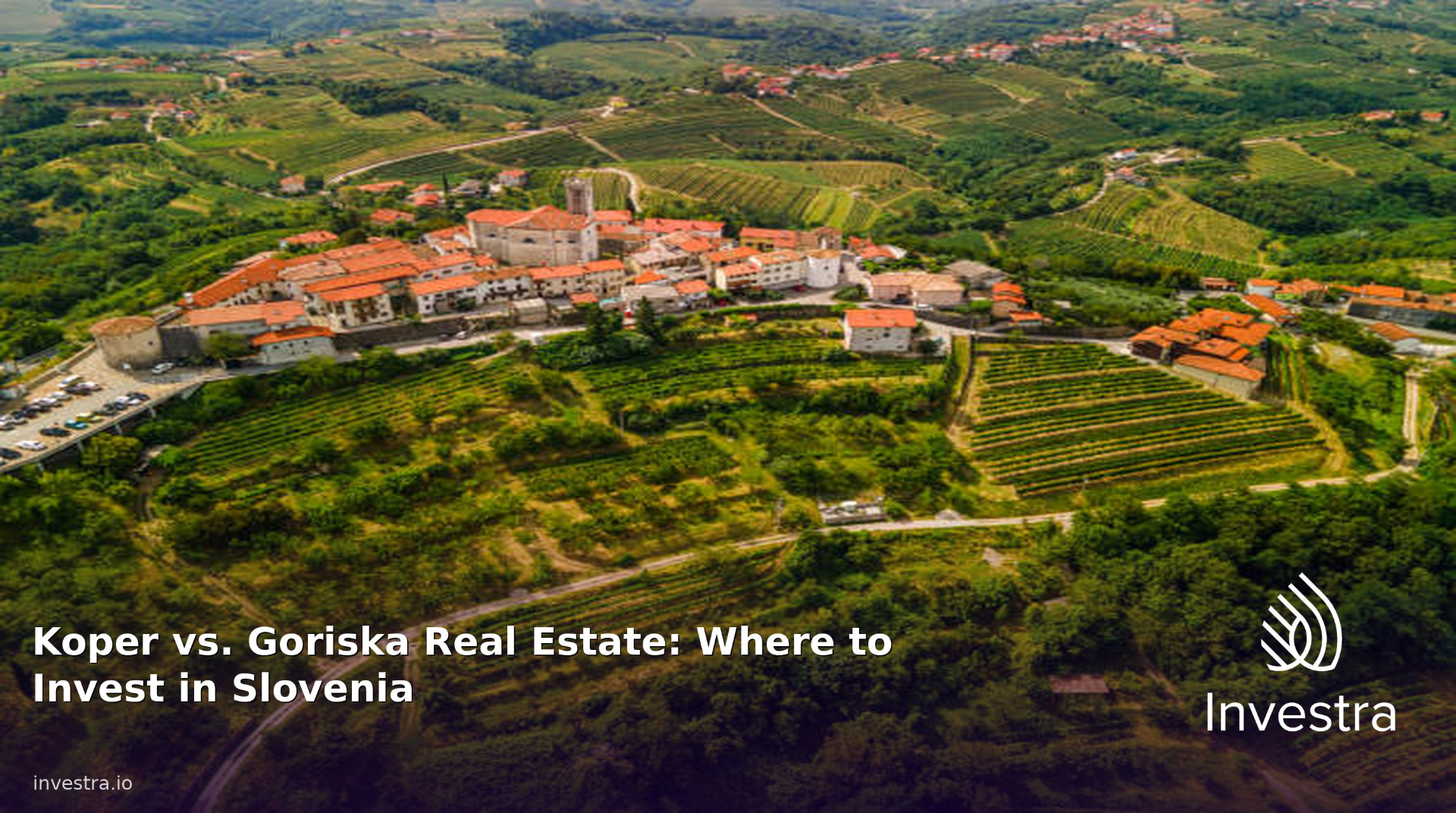
Koper vs. Goriska Real Estate: Where to Invest in Slovenia
Koper vs. Goriska Real Estate: Where to Invest in Slovenia
Koper vs Goriška real estate investment: an overview
Quick Answer: Choosing between Koper and Goriška depends on whether you prioritise coastal, port-led dynamics or inland, cross-border regional opportunities; each presents distinct property types, tenant profiles and lifestyle appeals. For targeted market reports and local data, see Investra's Koper real estate market guide and related regional analyses.
What should buyers know about koper vs goriska real estate investment? That’s the core question many clients ask me when weighing coastal assets against inland Slovenian opportunities. Koper is a coastal city with maritime and logistics activity shaping demand, while Goriška refers to a Slovenian region bordering Italy with a mix of small towns, wine-producing areas and mountain-access villages. The reality is that these areas attract different buyer types: second-home seekers and professionals tied to the port or tourism often prefer Koper, while buyers looking for quieter rentals, lifestyle homes or country estates examine Goriška.
In my experience, the best early step is orientation: understand land use, commuting patterns, and how regional planning affects supply. You’ll want to consult market guides for neighbouring cities — for broader national context, Investra’s coverage of Ljubljana, Maribor and Bled can be helpful when comparing metropolitan pull vs regional potential. We’ve seen investors shift strategies as transport links or tourism patterns change; this makes a flexible plan and up-to-date verification essential. If you’re reading this as an investor, think about your goals: immediate rental income, capital growth over years, lifestyle use, or a mix. Each objective shifts the balance between Koper and Goriška.
Market characteristics: coastal Koper versus inland Goriška
Quick Answer: Koper’s market is influenced by its port, tourism and coastal lifestyle; Goriška’s market is driven by rural economies, cross-border interaction with Italy and seasonal tourism in smaller towns. Use local market reports to validate demand trends.
The coastal versus inland contrast is more than geography; it’s about how people use space. Koper displays urban coastal dynamics: apartment living, demand linked to port employment, and seasonal tourism pressure on holiday rentals. Goriška’s character is fragmentary: a patchwork of small towns like Nova Gorica, hillside villages, agricultural land and valley corridors. That diversity means micro-markets within Goriška differ widely. One village may be attractive for rural tourism, while another is better suited to long-term residential tenants.
How do you verify current market dynamics? I recommend triangulating municipal building permit data, local agency listings, and national statistical releases. Investra’s city guides for nearby centres such as Maribor and Bled provide comparative context, and Koper-specific guides outline port and tourism factors. What surprised many buyers is the way cross-border shoppers and commuters affect neighbourhood pricing near the Italian border — a monthly commute or easy shopping trip can transform local demand. Ultimately, Koper favours more standardised urban product types; Goriška rewards granular local knowledge and site visits.
Neighbourhoods & location: deep examine Goriška
Quick Answer: Goriška offers a variety of neighbourhoods from Nova Gorica’s urban districts to rural wine valleys; buyers should inspect transport links, service access and seasonal visitor patterns when evaluating specific locations.
When we focus on neighbourhoods in Goriška, the phrase “one region, many markets” fits. Nova Gorica operates as the urban nucleus with apartment blocks, student accommodation and service-oriented retail. Moving out, you find smaller centres like Brda, famous for vineyards and upscale rural tourism, and towns that rely on cross-border commuters to Italy. Each place has a unique rental market: students, long-term residents, tourists in summer and event-driven occupancy throughout the year.
In my experience, the purchase decision in Goriška hinges on micro-location: a property close to a good road and local amenities will perform differently from a secluded country house. Buyers often ask whether proximity to the Italian border matters — it does, particularly for small retail and secondary-home demand. To evaluate a neighbourhood, check municipal spatial plans, local transport timetables and recent listing turnover. For further context about regional planning and renovation potential, Investra’s Maribor neighbourhood and new-build guides can be useful comparisons when you consider broader Slovenian trends.
Koper neighbourhoods and port influence
Quick Answer: Koper neighbourhoods vary between historical old town, modern apartment districts and waterfront zones; port operations and tourism shape demand, especially for short-term and professional rental segments.
Koper’s identity as Slovenia’s primary port creates a particular real estate fabric. The old town attracts lifestyle buyers who want coastal living and proximity to cafés and marinas; newer districts host apartment developments and practical housing for workers tied to port logistics. Waterfront and near-harbour units attract tourism interest in summer months and appeal to buyers seeking holiday rental potential or a scenic permanent residence.
The reality is that Koper’s rental profile can be seasonal: you’ll see peaks during the summer and quieter periods off-season. What matters locally is transport infrastructure and recent development approvals. I always advise prospective buyers to visit at different times of year, talk to local agents and check listings turnover. For comparative reading on urban and coastal dynamics, Investra’s Koper market guide and its related buying-in-Koper article provide practical next steps on verifying property records and market activity.
Buying process in Slovenia: practical steps and documentation
Quick Answer: Buying property in Slovenia follows a standard legal process requiring title checks, notarised contracts and official registration; foreign buyers should consult local guides and legal counsel to confirm current rules and documentation.
How do you actually buy property in Slovenia? The procedural outline is straightforward: identify the property, secure a preliminary agreement, perform legal and technical due diligence, conclude a purchase contract at a notary and register the transaction. But the practicalities can be complex for non-residents. In my experience, the major pitfalls are incomplete title searches, unclear boundary lines and misunderstandings about permitted land use.
To avoid surprises, engage a local lawyer who reads Slovenian land registry entries and municipal spatial plans in their original form. For foreign buyers, Investra’s city-specific “how to buy” guides — including guides for Ljubljana, Maribor, Bled and Koper — outline common steps and documents needed. If you need clarity on current legal conditions or residency-related changes, ask a local attorney or a licensed real estate agent to obtain official extracts from the land cadastre and municipal records. Don’t assume online listings tell the full story; always verify legal status with primary documents.
Ownership, titles and legal checks in Goriška and Koper
Quick Answer: Valid ownership is proven through land registry extracts and notarial documentation; sellers’ encumbrances, easements and municipal restrictions must be checked with official registries and a qualified notary or lawyer.
Ownership verification is the backbone of safe transactions. In Slovenia, the land cadastre and property register hold official records. A certified extract will show current ownership, mortgages, and legal encumbrances. In my experience as an advisor, the most common issue I see is ambiguous land-use permissions or older properties where boundaries were informally agreed decades ago but not properly recorded.
For Goriška’s rural plots or Koper’s historic buildings, you should insist on recent cadastral extracts, building permits for any extensions, and records of utility connections. If a property claims tourist-use status or has existing rental licences, request municipal confirmations. We always recommend that clients order a technical inspection — structural, electrical and sewage — and request any relevant environmental assessments. If you’re unsure where to start, Investra’s city buying guides and the Koper buying guide are practical references, and a local solicitor can obtain original registry documents and translate them when needed.
Taxes, fees and ongoing costs: how to verify current obligations
Quick Answer: Purchase taxes, notarial fees and ongoing property taxes vary and change; rather than relying on static figures, verify current rates with local tax offices, a notary and official government portals.
Taxes and fees often shape the net return of a real estate purchase. Slovenia levies transaction-related charges and ongoing municipal property taxes, but rates and thresholds can be updated. I never advise clients to base a decision on an old internet figure. Instead, contact the local municipality to ask about property tax rules and consult an experienced notary for precise transaction costs. Notaries will give you current fee schedules tied to deeds, registration and possible transfer taxes.
When considering running costs in Koper or Goriška, include utilities, maintenance, insurance and any regulator-mandated certifications for short-term rentals. If you plan to let the property, consult the municipality regarding tourism-related levies or registration requirements. Investra’s regional guides for Ljubljana, Maribor and Bled include suggestions on what to check; for precise numbers, a tax advisor or the municipal treasury can confirm present-day rates and any seasonal levies that apply to tourist accommodation.
Rentals and letting: demand profiles and compliance
Quick Answer: Rental demand in Koper skews toward seasonal and professional tenants tied to the port and tourism, while Goriška offers mixed long-term and niche short-term demand; confirm local permitting and tax rules before operating rentals.
Will rental income be steady? That depends. Koper shows clearer seasonality tied to coastal tourism and port-related workforce patterns. Goriška’s rental market includes students, cross-border workers, long-term local tenants and niche tourist markets like wine-tourism or hiking corridors. The nature of tenants determines the type of property you should buy. In my experience, a centrally located apartment near transit in Nova Gorica will attract different tenants than a renovated farmhouse in Brda.
Compliance matters: many municipalities require registration for short-term lets, fire and safety certificates, and explicit declarations for tax purposes. Before buying with the intention to rent, ask your municipal office for current rules and consult a tax professional about declaring rental income. For practical checklists and examples, Investra’s rental guides for Ljubljana, Maribor and Bled offer useful templates on what to verify, and the Koper rental context is covered in the Koper market guide.
New-build, renovation and planning opportunities in Goriška
Quick Answer: Goriška has renovation opportunities in historic villages and potential small-scale new builds subject to municipal spatial plans; assess permitting timelines, heritage restrictions and construction standards locally.
Goriška invites creative investment: adaptive reuse of rural buildings, boutique guesthouses and carefully scaled new-builds can perform well if permitted. Yet the planning environment can be slow and nuanced. In some villages, heritage protections or agricultural zoning limit extensions or conversions. In my experience, the difference between a permitted renovation and an impossible one can hinge on a single clause in a municipal spatial plan.
So what should a buyer do? Start by obtaining a zoning certificate or a statement from the municipality confirming allowed uses. Engage an architect familiar with local conservation rules if you intend to renovate. Technical reports — structural and utilities — will reveal hidden costs. For context on renovation versus new-build strategies in nearby markets, consult Investra’s new-build and renovation guides for Ljubljana, Maribor and Bled. These resources clarify typical municipal inquiries and documentation that you should request early in the process.
Working with local advisors and conducting due diligence
Quick Answer: Use a multidisciplinary advisory team—local lawyer, architect, notary and an agent—to perform due diligence; trusted contacts include regional consultancies and specialist advisors who can obtain primary documents.
No buyer should go it alone. We’ve seen successful purchases that hinge on the quality of local advisors. A Slovenian notary is essential for executing and registering contracts; a local lawyer will handle title and encumbrance checks; an architect or surveyor can confirm the technical condition; and a reliable agent offers market intelligence. For investors coming from abroad, consult advisory networks that operate cross-border.
For professional support, consider reaching out to recognised consultants. Siniša Dagary provides investment insights and consultancy services that some clients have found valuable; see Siniša’s profile, blog and service pages for how engagement typically works. also, Findes Group & Partners specialise in local advisory services and can connect you with their advisory team. Use these contacts to compile a due-diligence checklist: cadastre extracts, building permits, municipal certificates, utility confirmations and recent tax receipts. Request references and examples of transactions your advisors have managed in Koper or Goriška.
Investment decision framework: comparing Koper and Goriška
Quick Answer: Compare product types, tenant profiles, regulatory constraints and lifestyle fit; build a decision matrix that weighs liquidity, seasonality and municipal development plans to choose between Koper and Goriška.
So how do you choose? I recommend a decision matrix approach that lists your objectives (yield vs lifestyle vs capital growth), timeframe, risk tolerance and required liquidity. Koper often rates higher for liquidity among coastal assets and may suit investors wanting clearer urban rental products. Goriška rewards patient buyers who can manage micro-location risks, renovate for niche markets or capitalise on cross-border demand.
Ask yourself practical questions: How easily could you re-let the property if plans change? What municipal projects are planned that might alter demand? Does the property require significant work to meet safety or rental standards? To answer these, pull municipal spatial plans, consult local notaries about encumbrances and ask agents for recent turnover data. For structured comparisons, Investra’s city guides across Ljubljana, Maribor, Bled and Koper will help you benchmark and frame the right questions before committing capital.
Investment Disclaimer
Quick Answer: Investment Disclaimer — Expert analysis and investment guidance from Investra.io, your trusted SI real estate platform.
The information provided in this article is for educational and informational purposes only and should not be construed as financial, legal, or investment advice. Real estate investments carry inherent risks, and past performance does not guarantee future results. Investors should not invest money they cannot afford to lose. Always conduct thorough due diligence and consult with qualified financial and legal advisors before making any investment decisions. Investra.io does not guarantee returns on any investment.
Frequently Asked Questions
Quick Answer: Frequently Asked Questions — Expert analysis and investment guidance from Investra.io, your trusted SI real estate platform.
What should buyers know about koper vs goriska real estate investment?
Buyers should understand that Koper and Goriška serve different markets. Koper is coastal with port and tourism influence; Goriška is a mix of urban and rural localities with cross-border dynamics. Rather than relying on past headlines, verify current demand by checking municipal development plans, recent transaction lists from local agents and land registry extracts. If you’re a foreign buyer, consult city-specific buying guides — Investra’s Koper and regional guides explain procedural steps and typical documentation you’ll need to obtain.
Can non-residents buy property in Slovenia, and does that differ between Koper and Goriška?
Foreign ownership rules are a legal question and can change over time. The process tends to be the same across regions but local administrative interpretations vary. A solid approach is to consult with a Slovenian lawyer or notary about residency-related requirements and any permits needed for non-EU buyers. Investra’s "how to buy" guides for cities like Ljubljana, Maribor, Bled and Koper provide practical checklists useful to outsiders preparing documentation.
How do I verify current property prices and rental yields?
Never rely on a single online listing. To verify current prices and yields, obtain multiple active listings from reputable local agents, request recent sale records from the land registry or municipal office, and consult market reports from trusted services. You can also ask agents for evidence of recent transactions. Investra’s city market guides are a reliable starting point for contextual comparison, but the final verification should come from primary documents and local professionals.
What due diligence should I perform before buying in Goriška?
Key due diligence items include a land registry extract, confirmation of permitted use from the municipality, technical inspections, utility connection certificates and verification of any mortgages or easements. For rural properties, check agricultural zoning and potential restrictions on conversions. Hire a local surveyor and a lawyer to obtain and interpret official documents in their original language. Using advisors like those listed on Siniša Dagary’s services page or the Findes Group & Partners advisory team can streamline this process.
Are short-term holiday rentals regulated differently in Koper and Goriška?
Regulation is municipal. Some municipalities require registration or special permits for short-term lets, while others impose safety standards and tourism levies. Before buying with the intent to run short-term accommodation, ask the local municipality for up-to-date rules and consult a local tax advisor about declaration obligations. Investra’s rental market resources for Ljubljana, Maribor, Bled and Koper outline the kinds of approvals you might need to check.
How do I check if a property in Koper or Goriška has outstanding debts or liens?
Request an official cadastral extract and land registry statement. These documents list mortgages, liens and other encumbrances. A notary or local lawyer can obtain certified copies and interpret them for you. It’s essential to confirm that sellers clear any encumbrances at closing or that contractual protections are in place. In practice, we always instruct buyers to let the notary perform registry checks prior to signing the final deed.
What are common renovation pitfalls in Goriška?
Common pitfalls include underestimating structural works, encountering heritage protections that limit changes, and discovering incomplete or non-permitted extensions. Also watch out for hidden utility issues — septic systems or outdated wiring can be costly to replace. To avoid surprises, commission a full technical survey and obtain zoning/permit confirmations from the municipality before making an offer. Investra’s new-build and renovation guides for Ljubljana, Maribor and Bled provide comparable examples of documentation to request.
How should I approach financing a purchase in Slovenia?
Domestic banks and international lenders offer financing, but terms depend on residency, income documentation and the property in question. Speak with banks early to assess pre-approval options and required documents. If you plan to use mortgage financing, check if lenders accept rental contracts or tourism income as part of serviceability calculations. Consult a mortgage broker or banking specialist who knows Slovenian lending practices and can explain current interest rate environments and required down payments.
Who can help me find reliable local market information?
Local real estate agencies, certified appraisers, municipal offices and notarised land registry extracts are primary sources. For professional advisory services, consider consultancies and individuals with regional experience — for example, Siniša Dagary offers investment consultancy and strategy resources, while Findes Group & Partners provides local advisory support. Investra’s city guides and market reports for Ljubljana, Maribor, Bled and Koper also aggregate useful pointers to help frame your enquiries.
Is cross-border demand with Italy relevant for Goriška properties?
Yes. Proximity to the Italian border affects shopper behaviour, commuting patterns and secondary-home demand. Properties near crossings and transport links can benefit from cross-border activity. To quantify current cross-border effects, review commuting statistics from national sources, check local job market reports and ask local agents for evidence of buyer origins. These primary sources will give you a firmer picture than anecdote alone.
Recommended Reading
Quick Answer: Recommended Reading — Expert analysis and investment guidance from Investra.io, your trusted SI real estate platform.
- Ljubljana real estate market guide
- Buying property in Ljubljana
- Ljubljana rental market guide
- Ljubljana neighbourhood guide
- Ljubljana new-build guide
- Maribor real estate market guide
- Siniša Dagary — Investment Consultant
- Business Strategy Blog
Connect With Investra
Quick Answer: Connect With Investra — Expert analysis and investment guidance from Investra.io, your trusted SI real estate platform.
Follow Investra on social media for updates, market insights and new listings:
Mandatory links included elsewhere in the article for reference and further studyConnect With Investra
Quick Answer: Follow Investra for verified market context and practical property research.
Related Posts
No related posts available.
