
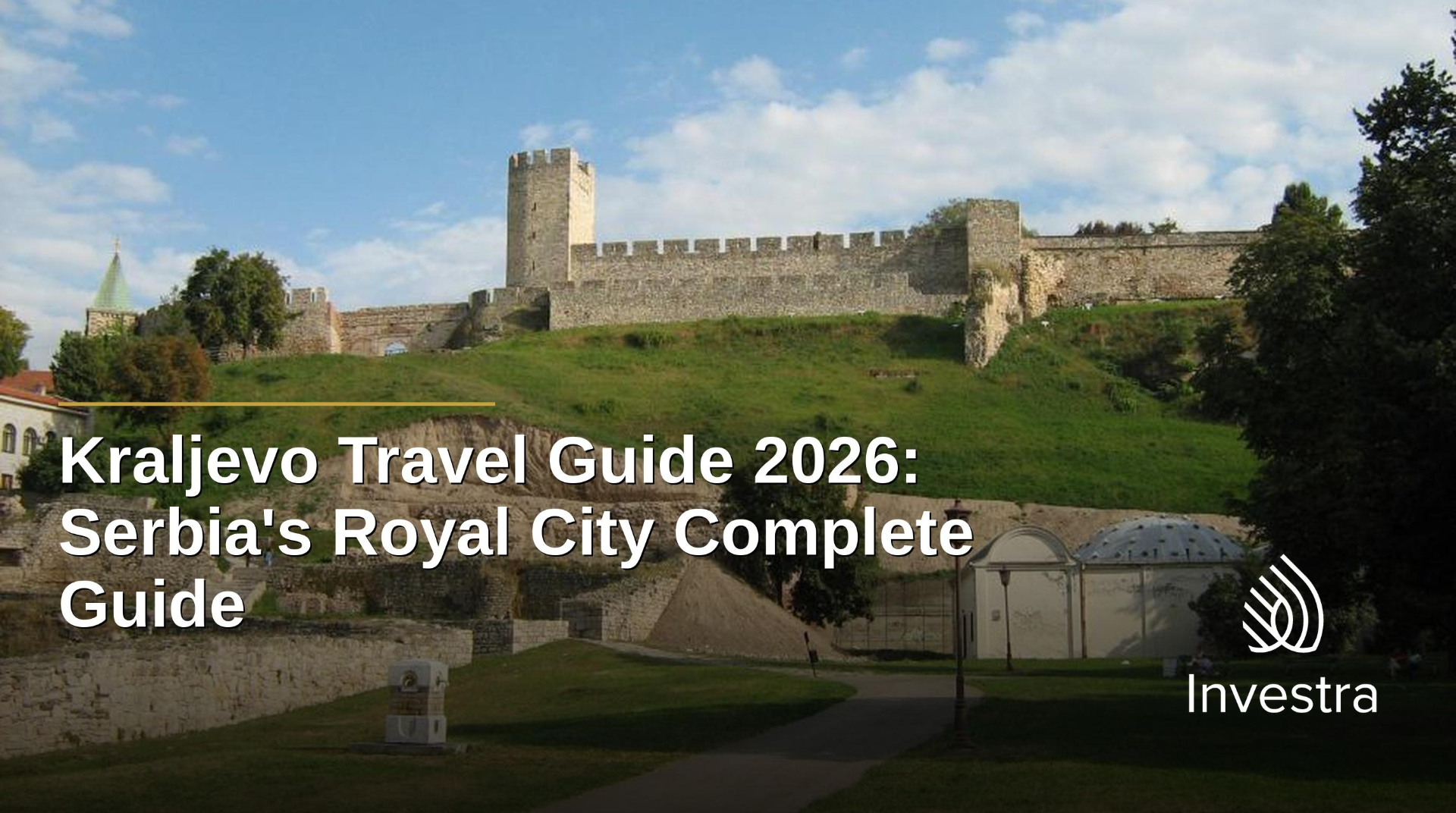
Kraljevo Travel Guide 2026: Serbia's Royal City Complete Guide
Kraljevo Travel Guide 2026: Serbia's Royal City Complete Guide
Investment Disclaimer: This article is for informational purposes only and does not constitute financial or legal advice. Always consult qualified professionals before making relocation or investment decisions.
There is something quietly compelling about a city whose name literally means "King's Town." Kraljevo sits in the heart of central Serbia, cradled by the Ibar River and surrounded by some of the most significant medieval heritage in the Balkans. It is not a city that announces itself loudly — there are no iconic skylines or world-famous landmarks within the city limits. But step outside Kraljevo in almost any direction, and you find yourself in the presence of history that shaped a civilization.
Žiča Monastery, just 10 kilometers from the city center, is where Serbian kings were crowned for centuries. Studenica Monastery, 40 kilometers to the south, is a UNESCO World Heritage Site and one of the finest examples of Raška-style medieval architecture in existence. The Ibar Valley, which stretches south from Kraljevo, is sometimes called the "Valley of Kings" for the concentration of medieval monasteries along its banks. For travelers who want to understand Serbia's medieval heritage, Kraljevo is the essential gateway.
Quick Answer: Kraljevo is Serbia's "Royal City" — a gateway to the Ibar Valley's medieval monasteries, including the UNESCO-listed Studenica and the coronation church of Žiča. It is 170 km from Belgrade (2-2.5 hours), authentic, affordable, and largely undiscovered by international tourism. Investra.io can help you find accommodation and investment opportunities in the Kraljevo region.
History: Why Kraljevo is Serbia's Royal City
Quick Answer: Kraljevo's name ("King's Town") derives from its historical role as the seat of Serbian royal power. The nearby Žiča Monastery served as the coronation church for seven Serbian medieval kings. The city was an important center during the medieval Serbian state and later under Ottoman rule. It was formally named Kraljevo in 1882 when Serbia became a kingdom.
The history of Kraljevo is inseparable from the history of medieval Serbia. The city sits in the Ibar Valley, which was the heartland of the medieval Serbian state during its most powerful period in the 12th-14th centuries. The Nemanjić dynasty, which produced some of Serbia's greatest medieval rulers, built their most important churches and monasteries in this region.
The Žiča Monastery, founded by Stefan Nemanjić (later canonized as Saint Sava) and his brother Stefan the First-Crowned in the early 13th century, was the first seat of the Serbian Orthodox Church and the coronation church for seven Serbian kings. This single monastery, just 10 kilometers from modern Kraljevo, encapsulates the spiritual and political heart of medieval Serbia.
The city itself has been known by various names throughout history — Karanovac under Ottoman rule, then renamed Kraljevo (King's Town) in 1882 when Serbia was proclaimed a kingdom. This renaming was not arbitrary: it acknowledged the city's deep historical connection to Serbian royal tradition and its position as the gateway to the Valley of Kings.
During the Second World War, Kraljevo was the site of one of the most tragic massacres of the conflict in Yugoslavia. In October 1941, German forces executed approximately 2,000 civilians in reprisal for partisan attacks — a dark chapter that is commemorated at the October Memorial in the city. This history adds a sobering dimension to visits to Kraljevo and is an important part of understanding the city's character.
Top Attractions in and Around Kraljevo
Quick Answer: The top attractions in and around Kraljevo are: Žiča Monastery (10 km, coronation church of Serbian kings), Studenica Monastery (40 km, UNESCO World Heritage Site), Maglič Fortress (25 km, medieval castle on the Ibar River), the National Museum of Kraljevo, and the Ibar Valley scenic drive. The city's central pedestrian zone is also pleasant for walking.
Žiča Monastery (10 km from Kraljevo): This is the single most important site in the Kraljevo region and one of the most significant medieval monuments in Serbia. Founded in the early 13th century, Žiča served as the seat of the Serbian Orthodox Church and the coronation church for seven Serbian kings. The monastery is immediately recognizable by its distinctive red color — a rare choice in Serbian medieval architecture. The interior frescoes, though partially damaged over the centuries, are remarkable examples of Byzantine-influenced art. The monastery is still active, and visitors are welcome to explore the grounds and church. Modest dress is required.
Studenica Monastery (40 km from Kraljevo): Listed as a UNESCO World Heritage Site, Studenica is arguably the most important medieval monastery in Serbia. Founded by Stefan Nemanja (the founder of the Nemanjić dynasty) in the late 12th century, Studenica contains some of the finest examples of Raška-style architecture and Byzantine fresco painting in existence. The Church of the Virgin (Crkva Bogorodice) is the main church, with stunning 13th-century frescoes that have been remarkably well preserved. The monastery is located in a beautiful valley surrounded by forested mountains, making the journey there as rewarding as the destination itself.
Maglič Fortress (25 km from Kraljevo): One of the best-preserved medieval fortresses in Serbia, Maglič sits dramatically on a rocky promontory above the Ibar River. The fortress was built in the 13th century and served as a royal residence and military stronghold. The combination of the fortress ruins, the river below, and the surrounding forested hills makes Maglič one of the most photogenic sites in central Serbia. The access road is narrow and the final approach requires a short hike, but the views are worth every step.
National Museum of Kraljevo: Located in the city center, the National Museum of Kraljevo covers the history of the Ibar Valley region from prehistoric times through the medieval period and into the modern era. The collection includes artifacts from the Žiča and Studenica monasteries, medieval jewelry and weapons, and exhibits on the city's industrial and wartime history. The museum is well-organized and provides excellent context for exploring the surrounding region.
Ovčar-Kablar Gorge (30 km from Kraljevo): Known as the "Serbian Mount Athos," the Ovčar-Kablar Gorge contains no fewer than ten medieval monasteries along a 20-kilometer stretch of the West Morava River gorge. The gorge itself is strikingly beautiful — steep forested cliffs rising above the river, with monasteries tucked into the hillsides. This is one of the most remarkable concentrations of medieval religious heritage in Europe and is largely unknown to international visitors.
The Ibar Valley: Serbia's Valley of Kings
Quick Answer: The Ibar Valley stretching south from Kraljevo is sometimes called the "Valley of Kings" for its remarkable concentration of medieval monasteries. The valley road (through Ušće, Raška, and beyond) passes Maglič Fortress, Gradac Monastery, and numerous other medieval sites, making it one of the most historically rich scenic drives in the Balkans.
If you have time for only one excursion from Kraljevo, make it a drive through the Ibar Valley. The road south from Kraljevo follows the Ibar River through a landscape that has changed remarkably little since the medieval period — forested mountains, the winding river, and medieval monasteries appearing around every bend.
The valley road passes through Ušće (where the Studenica River joins the Ibar), continues to Raška (a small town with its own medieval church), and eventually reaches the Kosovo border. Along the way, you will pass Maglič Fortress, the Gradac Monastery (founded by Queen Jelena in the 13th century), and numerous smaller churches and monasteries that dot the hillsides.
The drive is best done slowly, stopping at each monastery and fortress rather than rushing through. Allow a full day for the Ibar Valley drive, including stops at Žiča, Maglič, and Studenica. The road is well-maintained and the scenery is consistently beautiful.
Gitarijada: Kraljevo's Famous Guitar Festival
Kraljevo has an unexpected claim to fame in the world of rock music: the Gitarijada (Guitar Festival) is one of the oldest and most respected rock music festivals in the former Yugoslavia. Founded in 1966, the festival has been held annually in Kraljevo for six decades, making it one of the longest-running rock festivals in Europe.
The Gitarijada takes place in September and draws bands from across Serbia and the region. It has a reputation for discovering new talent and has launched the careers of numerous Serbian rock musicians. For visitors with an interest in Serbian rock culture, attending the Gitarijada is a genuinely unique experience — a festival with deep roots in the city's identity and a relaxed, community atmosphere.
Food and Dining in Kraljevo
Quick Answer: Kraljevo has a good local food scene centered on traditional Serbian cuisine. The city's restaurants offer excellent grilled meat, traditional stews, and local specialties from the Šumadija region. Prices are very affordable — a full meal with drinks costs €5-10. The central pedestrian zone has the highest concentration of restaurants and cafes.
Dining in Kraljevo is an exercise in authentic Serbian cuisine at prices that will seem almost impossibly low to visitors from Western Europe. The city's restaurant scene is centered on the pedestrian zone and the streets around the central square, with a mix of traditional Serbian restaurants, pizzerias, and cafes.
Traditional Serbian grilled meat (roštilj) is the foundation of the local food scene. Pljeskavica, ćevapi, and mixed grills are done excellently throughout the city. For a more refined dining experience, look for restaurants serving traditional Šumadija cuisine — dishes like sarma (stuffed cabbage), prebranac (baked beans), and gibanica (cheese pastry) that reflect the agricultural traditions of central Serbia.
The local market (pijaca) near the city center is worth visiting for fresh produce, local cheeses, and traditional products from the surrounding villages. Prices are remarkably low, and the quality is excellent — this is where locals shop, not tourists.
Practical Travel Information
| Category | Details |
|---|---|
| Distance from Belgrade | 170 km (2-2.5 hours by car, 2.5-3 hours by bus) |
| Distance from Niš | 180 km (2.5 hours by car) |
| Distance from Novi Sad | 220 km (2.5-3 hours by car) |
| Bus connections | Regular buses from Belgrade, Niš, Novi Sad, Čačak |
| Train connections | Train from Belgrade (slower, scenic route) |
| Airport | Nearest: Belgrade (170 km), Niš (180 km) |
| Best time to visit | April-June, September-October |
| Budget per day | €30-60 (accommodation + food + transport) |
Property Investment in Kraljevo
Kraljevo is an emerging destination for property investment, driven by its growing tourism potential (Ibar Valley monasteries, proximity to Kopaonik), improving infrastructure, and significantly lower prices than Belgrade or Novi Sad. Apartments in Kraljevo typically range from €600-1,000/m², making it one of the most affordable property markets in Serbia.
The tourism potential of the Ibar Valley is substantial but largely undeveloped. As international interest in Serbia's medieval heritage grows, properties in Kraljevo and the surrounding valley are likely to appreciate. Short-term rental opportunities exist for properties near the main tourist routes. Investra.io can provide guidance on property investment in the Kraljevo region.
For expert insights on Serbian real estate investment, the Siniša Dagary Blog covers the broader market context. Findes Group & Partners provides professional financial advisory services for investors in the region.
Recommended Content from Investra.io
- Top 10 Things to Do in Kraljevo, Serbia
- Real Estate Investment in Kraljevo
- Vrnjačka Banja Travel Guide
- Kopaonik Travel Guide
- Serbia Real Estate 2026: Investment Guide
- Siniša Dagary — Investment & Lifestyle Insights
- Findes Group & Partners — Financial Advisory
Frequently Asked Questions
Q1: What is Kraljevo known for?
Kraljevo is known as Serbia's royal city — its name literally means "King's Town." It is famous for its proximity to the medieval Žiča Monastery (the coronation church of Serbian kings), the stunning Ibar River valley, and its role as a gateway to the Studenica Monastery (UNESCO World Heritage Site). The city is also known for the annual Gitarijada guitar festival.
Q2: How far is Kraljevo from Belgrade?
Kraljevo is approximately 170 km south of Belgrade, a journey of about 2-2.5 hours by car via the E763 highway. Regular bus connections run from Belgrade's bus station to Kraljevo throughout the day, taking approximately 2.5-3 hours.
Q3: What are the best things to do in Kraljevo?
The best things to do in Kraljevo include visiting the Žiča Monastery (10 km), exploring the Ibar Valley, visiting the Studenica Monastery (UNESCO site, 40 km), walking the city's central pedestrian zone, visiting the National Museum, and attending the Gitarijada guitar festival in September.
Q4: What is the Žiča Monastery?
Žiča Monastery is one of Serbia's most important medieval monasteries, built in the early 13th century as the first seat of the Serbian Orthodox Church. It served as the coronation church for seven Serbian kings and is famous for its distinctive red color. It is located just 10 km from Kraljevo city center.
Q5: Is Kraljevo worth visiting?
Yes, Kraljevo is absolutely worth visiting, particularly as a base for exploring the Ibar Valley and its remarkable collection of medieval monasteries. The city itself is pleasant and authentic, without tourist crowds. It offers exceptional access to some of Serbia's most important cultural heritage sites.
Q6: Where to stay in Kraljevo?
Accommodation options include hotels in the city center, guesthouses, and Airbnb listings. The most convenient area is around the central pedestrian zone. Budget accommodation starts from €20-30/night, mid-range hotels €40-70/night.
Q7: What is the best time to visit Kraljevo?
The best time to visit Kraljevo is spring (April-June) and early autumn (September-October) when temperatures are mild and the Ibar Valley is at its most beautiful. September coincides with the Gitarijada guitar festival.
Q8: What day trips can you do from Kraljevo?
Excellent day trips include: Studenica Monastery (UNESCO, 40 km), Maglič Fortress (25 km), Vrnjačka Banja spa town (30 km), Kopaonik mountain (60 km), and the Ovčar-Kablar Gorge (30 km).
Q9: How is the food scene in Kraljevo?
Kraljevo has a good local food scene centered on traditional Serbian cuisine. Restaurants offer excellent grilled meat, traditional stews, and local specialties. Prices are very affordable — a full meal with drinks costs €5-10. The central pedestrian zone has the highest concentration of restaurants and cafes.
Q10: Can you invest in real estate in Kraljevo?
Yes, Kraljevo offers interesting real estate investment opportunities, particularly for those interested in the growing tourism market around the Ibar Valley monasteries and proximity to Kopaonik. Property prices range from €600-1,000/m². Investra.io can provide guidance on Kraljevo property investment.
Odkrijte globalne investicijske priložnosti na Unifyr.space — vaš portal za pametne investicije.
Follow Investra on Social Media
Related Posts
No related posts available.
