
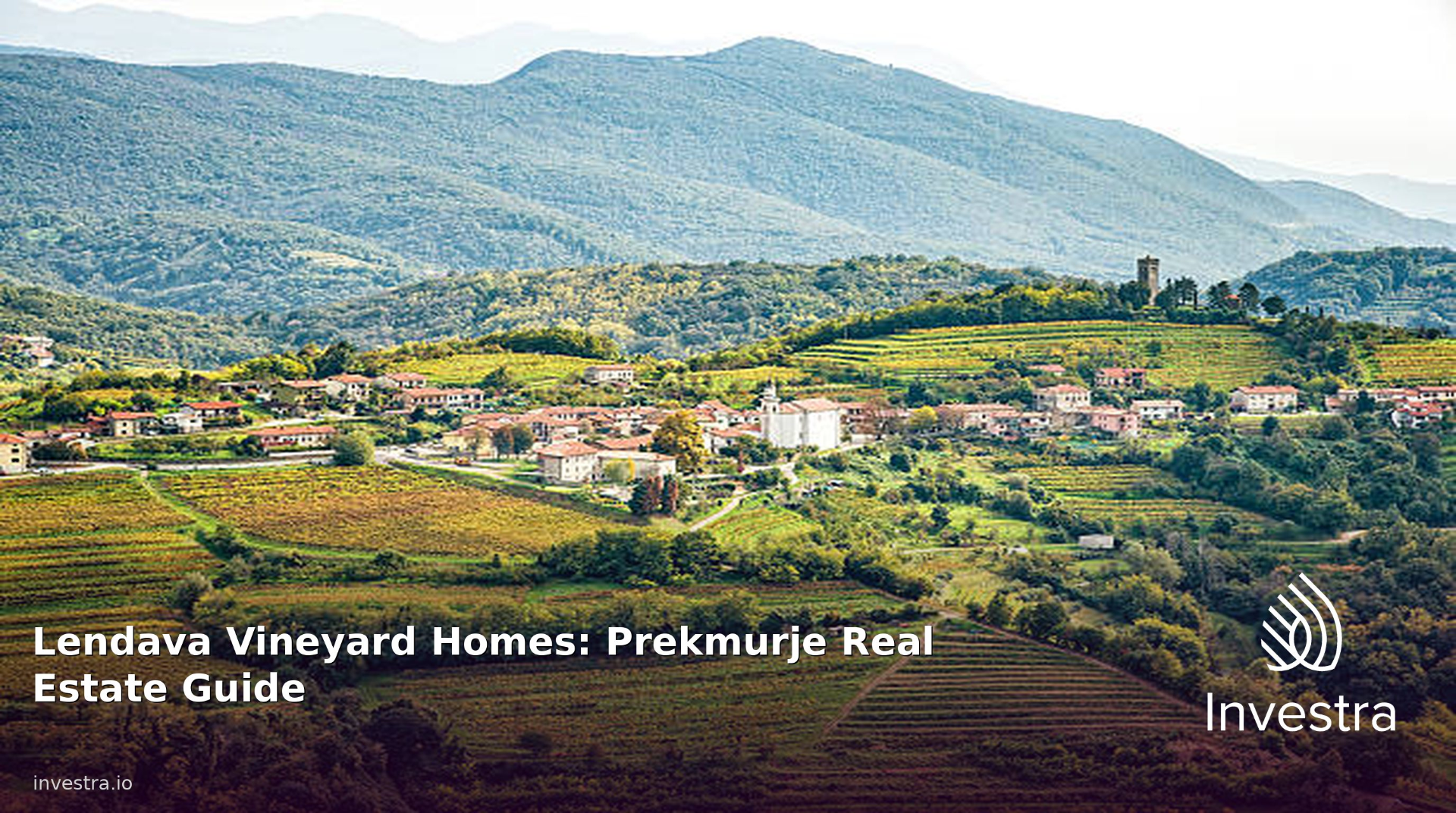
Lendava Vineyard Homes: Prekmurje Real Estate Guide
Lendava Vineyard Homes: Prekmurje Real Estate Guide
Lendava and Prekmurje: Location, Landscape and Local Character
Quick Answer: Lendava sits in Slovenia’s far northeast, in the Prekmurje region, blending rolling vineyards, multicultural towns and rural villages—an attractive area for vineyard-home buyers looking for landscape and lifestyle. Use regional guides and local authorities to confirm exact municipal boundaries and services before you commit.
Prekmurje feels different from the Slovenian heartland. The region has its own accent, cuisine and cultural rhythms, and Lendava sits near Slovenia’s borders with Hungary and Croatia. For buyers attracted to vineyard homes, the terrain around Lendava offers gently sloping parcels, small hamlets and historic stone or brick houses adapted to viticulture. That mix of frontier-town character and agricultural land is central to any location decision.
What surprised many buyers is how varied neighbourhoods can be within only a few kilometres: sheltered valley plots, higher ridgelines that get more sun, and small villages with original farmsteads. If you want practical information on nearby urban centres and how they connect to services, the Maribor real estate market guide and Ljubljana real-estate overview are useful for comparing regional amenities and transport links.
From a buyer’s perspective, proximity to municipal services matters: schools, healthcare, and road access affect day-to-day life and long-term value. In my experience, successful buyers spend a few visits mapping out where utilities connect and how accessible the plot is year-round. When you’re inspecting, ask local notaries or municipal offices for land-use maps that show arable, vineyard and construction zones. For assistance beyond local government, consider firms like Findes Group & Partners and their advisory team at Findes Group & Partners advisory team to confirm legal and zoning constraints.
Quick Answer:
Quick Answer: Lendava combines rural vineyard parcels with small-town services, but verify municipal maps and utility access before purchasing to understand buildability and vineyard potential.
Why Buyers Target Vineyard Homes in Lendava
Quick Answer: Buyers seek Lendava vineyard homes for lifestyle, potential agritourism opportunities and proximity to cross-border markets—but you'll need to confirm commercial viability and local regulations with professionals before planning any business activity.
There’s a romantic appeal to buying a vineyard home: rows of vines, stone walls, and small-cellar production. But the reality is more nuanced. People buy here for a mix of reasons—retirement in the countryside, a second home with a garden plot, hobby viticulture, or as part of an agritourism project. What surprised many buyers is how quickly practical questions rise to the surface: irrigation rights, road access for machinery, and the age and orientation of the vineyard terraces.
If you’re considering a purchase with an eye to generating income through short-term lets or wine tourism, you need to check local tourism rules and tax obligations. We’ve seen properties perform differently depending on how well the owner integrates with local producers and markets. Rather than relying on generic numbers, contact the municipal tourist board and consult business advisors—Siniša Dagary’s advisory information can help frame strategy; see Siniša Dagary investment insights and his services page at advisory services.
When considering long-term value, compare Lendava’s appeal to other Slovenian centres. For urban comparisons and where buyers look for rental demand, consult the Maribor rental market guide and Bled rental market guide to understand how tourism hubs differ.
Neighbourhoods and Villages Around Lendava
Quick Answer: Lendava’s immediate neighbourhoods range from town-centre streets to scattered vineyard hamlets; exploring each micro-location is essential because soil, microclimate and access change quickly across short distances.
What we know from working with buyers is that the term “Lendava area” covers several distinct micro-environments. There’s the urban core, with traditional townhouses and apartment blocks; then there are the rural belts—villages and hamlets perched on slopes or nestled in valleys. Each will affect day-to-day life. For example, a home directly adjacent to vineyards will offer immediate agricultural access but may be further from schools and services. Conversely, a property closer to Lendava town gives easier access to shops and municipal services but may have smaller vineyard plots attached.
Soil and microclimate matter for viticulture. Buyers often ask how to verify soil quality and slope orientation. The practical route is to commission a local agronomist or viticultural consultant; municipal agricultural advisors can also point to existing classifications. For guidance about what to inspect in different Slovenian neighbourhoods, our Ljubljana neighbourhood resources at Ljubljana neighbourhood guide and the Maribor neighbourhood overview at Maribor neighbourhood guide are good reference points for thinking about neighbourhood attributes.
When visiting, observe how neighbours use their land. Are terraces maintained? Is there evidence of water stress or erosion? These on-the-ground signals tell you more than glossy photos. For infrastructure checks—like road surfaces, sewage and broadband—ask the municipality directly and review the cadastral maps. If you need a professional introduction, consider consulting firms such as investment consultation or local advisory teams like Findes Group & Partners advisory team.
Property Types: Traditional Vineyard Homes vs Modern Conversions
Quick Answer: In Lendava you’ll encounter traditional stone farmhouses, mixed-use homes with cellars and modern conversions; choose based on your renovation appetite and regulatory constraints, and verify renovation permissions with the local building authority.
Traditional vineyard homes often include a cellar (kleti), outbuildings and adjacent vine plots. They have character, but they sometimes need substantial renovation for modern comforts—heating, insulation and plumbing. Modern conversions can offer turn-key comfort but may cost more in terms of planning and adaptation, especially if you want to keep a traditional aesthetic.
How do you decide? Start by listing your priorities: immediate livability, rental-readiness, or agricultural productivity. If you want to produce wine, a property with existing cellars and suitable plot orientation reduces initial setup time. But if your aim is a comfortable second home to rent to holidaymakers, look for properties with good access, parking and separate guest spaces.
Before offering on a property, always request the land register (zemljiška knjiga) extract and building documentation, and have a local architect or notary verify permitted uses. For buyers accustomed to urban new-builds, review the Ljubljana new-build guide and the regional Maribor conversion advice at Maribor new-build guide to get a sense of regulatory hurdles and typical renovation checkpoints in Slovenia.
Legal Considerations for Foreign Buyers and Ownership in Prekmurje
Quick Answer: Foreign buyers often need to check national residency and reciprocity rules, cadastral registrations, and any agricultural-use restrictions; always verify current legal requirements with a Slovenian notary and the municipal land office.
I get asked frequently whether foreigners can buy agricultural land or vineyard parcels outright. The short answer is: you must confirm current national and municipal regulations. Laws and administrative practices can change, and some land classifications or subsidies depend on residency or reciprocity agreements. The sensible approach is to consult a local notary and municipal land registry to confirm eligibility and any special consent required.
Don’t rely solely on estate-agent assurances. Ask to see the official land-register extract and any historical ownership documents. A notary will explain obligations connected to easements, access rights and existing agricultural contracts. If you’re considering a commercial operation, get business-permit advice early. For tailored advisory support and business strategy, see Siniša Dagary and his profile at Siniša Dagary profile.
Also check local municipal plans (prostorski akti). Those maps show whether a plot is classified for agriculture, construction, or protected landscape. If you need a deeper examine local registration procedures, professionals at firms like Findes Group & Partners can help coordinate with municipal offices and legal counsel.
The Buying Process in Slovenia: Step-by-Step Practicalities
Quick Answer: The buying process typically involves property checks, an offer, drafting a purchase agreement, notary completion, and registration—confirm each stage with a notary and your legal adviser to ensure compliance with local practice and timelines.
Buying in Slovenia is straightforward if you follow a few pragmatic steps: verify land and title, check zoning and building permits, negotiate terms, draft a preliminary contract, complete due diligence, and then sign before a notary for the final deed. But the details matter. For instance, the notary’s role is central; they verify identity, confirm no competing claims and arrange the final land-register entry.
In my experience, buyers who invest time in due diligence avoid the majority of post-sale surprises. A useful routine is to request the parcel’s extract from the land register, property documentation related to construction permissions and any servitudes (right of way). If the property includes agricultural subsidies or contracts, ask for those documents too because they can affect future eligibility.
To understand local timelines and documentation, consult the local municipality and a reputable real-estate lawyer. If you’re unfamiliar with Slovenian documentation or language, hire a translator or bilingual lawyer to ensure you understand the preliminary contract’s clauses. For broader market context and how urban areas compare to rural transactions, Investra’s Ljubljana and Koper guides—Buying property in Ljubljana and Buying property in Koper—offer practical checklists used by many buyers.
Land and Vineyard-Specific Checks: Soil, Water and Classification
Quick Answer: Verify vineyard parcels by ordering a soil analysis, checking irrigation rights and confirming land classification with the municipal agricultural office or agronomist; these checks shape both viticultural potential and permitted uses.
Vineyard parcels require more technical checks than an ordinary garden plot. The most important are soil composition, slope and drainage, sun exposure, and water rights. A geotechnical or agronomic survey will tell you whether the land is suited to the grape varieties you prefer and whether erosion or drainage will be an issue.
Water is often the critical constraint. Ask the municipality about irrigation permissions and whether there are communal water schemes. Some sellers assume informal arrangements exist, but formal rights can be vital—especially in drier years. If there's a well on the property, request test records or commission one yourself to confirm yield and water quality.
You should also verify if the land is part of any protected landscape or subject to heritage restrictions—those rules can limit structural changes or the use of pesticides and can affect your ability to modernise production. For procedural help on classifying land use in Slovenia, the Bled new-build guide and Maribor’s renovation guide provide examples of planning permission processes and typical documentation requests.
Taxes, Fees and Annual Costs Buyers Must Investigate
Quick Answer: Expect purchase-related fees, annual property taxes and sector-specific levies—confirm exact rates and calculation methods with a Slovenian tax adviser, notary or municipal tax office rather than relying on generic sources.
Taxation and recurring costs often surprise buyers who plan purely for purchase price. Slovenia has purchase taxes, notary fees, and registration costs, and local municipalities may levy property taxes annually. If you intend to run an agritourism business or produce and sell wine, there will be additional tax and compliance requirements.
I always recommend engaging a local tax advisor early in the process. They’ll help you understand deductible expenses, VAT implications for commercial activities, and whether any local subsidies for agricultural renewal or ecologically oriented projects exist. Remember, such subsidies and tax rules change over time; instead of relying on historical figures, ask a qualified tax professional to confirm current rates and incentives. You can also consult the municipal tax office for property-tax schedules and the notary for precise transaction expenses.
If you plan short-term rentals, don’t forget licensing requirements and occupancy taxes—municipal tourist taxes vary. For insight into how taxation affects rental and urban investments, read Investra’s rental guides for Ljubljana and Maribor: Ljubljana rental market guide and Maribor rental market guide.
Rental Potential and Running a Holiday Home in Lendava
Quick Answer: Lendava can support seasonal rentals and niche agritourism, but confirm local demand, licensing and tax rules with municipal tourism offices and local agents before assuming income projections.
Many buyers ask if a vineyard home in Lendava can be rented to tourists. The truth is: it depends. Demand for rural stays tends to be seasonal and driven by niche markets—wine tourism, cycling, hiking, and cross-border travel. If your property offers authentic experience—like tasting sessions or a working cellar—it can attract guests, but you must account for marketing, property management and local regulations.
Licensing is a specific issue. Municipalities can require registration for tourist accommodation, standards for safety and hygiene, and sometimes rules on parking or noise. Check with the Lendava municipal tourist board or the municipal administration for the exact process. For operational models and how they compare to well-established tourism towns, check guides for Bled and Koper—examples at Bled rental market guide and Buying property in Koper.
Operational support matters: property-management firms and local co-ops can handle bookings, cleaning and property maintenance. If you want to scale into packaged wine-tour experiences, engage with regional wine producers and tour operators early. For strategy help, consider consultations with experts such as advisory services or local legal advisors who have experience with agritourism projects.
Practical Buyer Decisions: Inspections, Renovation and Community Integration
Quick Answer: Choose properties after a technical inspection, a community check and a clear renovation plan; verify renovation permits with the municipal building authority and consult local tradespeople for realistic timelines.
Buying a vineyard home is not only a real-estate decision; it’s also a lifestyle and community choice. I always advise buyers to do three things before making an offer: commission a structural and roof inspection, speak with closest neighbours about access and common practices (like pruning schedules), and get a renovation estimate from local builders. Those three steps reveal hidden costs and integration challenges.
Renovations in rural Slovenia may require specific permissions, especially if the building is historic or within a protected landscape. The local building authority will confirm whether you can expand, modernise facades or change rooflines. For a general sense of renovation permissions and processes, Investra’s guides for Ljubljana and Maribor—Ljubljana new-build guide and Maribor new-build guide—outline typical steps that apply across Slovenia.
Community integration is often underestimated. Winemakers collaborate on pruning, harvest and local markets; joining associations or co-ops helps. If you plan to be hands-on, ask nearby producers about labour cycles and shared resources like grape presses or cooperatives. For introductions and business strategy, resources such as investment consultation can be helpful to establish local business relationships.
Investment Disclaimer
Quick Answer: This section explains the article’s purpose and urges readers to seek professional advice before making investment decisions.
The information provided in this article is for educational and informational purposes only and should not be construed as financial, legal, or investment advice. Real estate investments carry inherent risks, and past performance does not guarantee future results. Investors should not invest money they cannot afford to lose. Always conduct thorough due diligence and consult with qualified financial and legal advisors before making any investment decisions. Investra.io does not guarantee returns on any investment.
Frequently Asked Questions
Quick Answer: Below are common questions buyers ask about Lendava vineyard homes Prekmurje with practical answers and pointers to verification sources.
Can foreigners buy vineyard land in Lendava, Prekmurje?
Foreign ownership rules can vary with nationality and the legal status of the land. You should consult a Slovenian notary and the municipal land office to check current eligibility and any required reciprocity or permissions. They’ll provide official extracts from the land register (zemljiška knjiga) and guidance on any administrative approvals needed for agricultural land.
How do I verify a property’s vineyard classification and legal use?
Ask the municipality for the spatial plan (prostorski načrt) and the parcel’s land-register extract. Commission a local agronomist for soil and slope assessment, and request any historical documentation on crop subsidies or agricultural agreements. The municipal agricultural office can confirm if the parcel is registered as vineyard land.
What inspections should I order before buying?
At minimum, order a structural and roof inspection, a land survey (meja), and a soil/water assessment if viticulture is intended. If the property has outbuildings or cellars, include those in the technical survey. A notary will request all official documents during the transaction.
Are there special building restrictions for renovating vineyard homes?
Yes—especially if the building is within a protected landscape or historical zone. Always check local conservation rules and the municipal building authority for permit requirements. A local architect familiar with the municipality’s planning office will speed up the permit process.
How do I check potential rental demand for a vineyard home?
Talk to local tourism offices for visitor statistics and seasonal trends. Review comparable listings on vacation-rental platforms and consult property-management companies for occupancy data. Keep in mind that rural demand may be niche and seasonal; a professional property manager can provide more realistic booking projections based on local experience.
What costs beyond the purchase price should I expect?
Expect notary fees, registration taxes, municipal property taxes and ongoing maintenance costs. For commercial activities, account for licensing, VAT or income-tax commitments. Always confirm exact costs with a notary and a Slovenian tax advisor to get up-to-date figures and eligibility for any agricultural subsidies.
Can I produce and sell wine from a small Lendava vineyard?
Yes, many owners produce small-batch wine, but commercial sales require compliance with food-safety, labelling and tax rules. Consult the municipal authority and a business lawyer to register your activity and understand excise, VAT and local health requirements.
Who can help me with local introductions and permits?
Local notaries, municipal offices, and advisory firms are invaluable. For business strategy and introductions, Siniša Dagary offers consultancy—see advisory services—and firms like Findes Group & Partners can coordinate with local authorities.
Where do I find reliable local agents and builders?
Ask the municipality for lists of licensed contractors and consult local co-ops or producer associations for recommended tradespeople. Use Investra regional guides for context on reputable agencies in nearby cities such as Ljubljana and Maribor, and get references from owners of nearby properties.
Recommended Reading
Quick Answer: These guides deepen your knowledge of Slovenian property markets and purchase procedures; use them alongside local legal and tax advice to form a complete due-diligence plan.
- Ljubljana real estate market guide
- Buying property in Ljubljana
- Ljubljana rental market guide
- Ljubljana neighbourhood guide
- Ljubljana new-build guide
- Maribor real estate market guide
- Siniša Dagary — Investment Consultant
- Business Strategy Blog
Connect With Investra
Quick Answer: Use Investra’s social channels to follow updates, market commentary and new listings; reach out through these platforms for general inquiries.
Follow Investra on social media for market updates, analyses and featured listings:
Finally, if you’d like tailored support: consult a local notary, an agronomist for vineyard-specific checks, and a tax adviser for up-to-date fiscal guidance. For introductions to consultancy services and strategy, consider contacting investment consultation or the team at Findes Group & Partners advisory team.
Connect With Investra
Quick Answer: Follow Investra for verified market context and practical property research.
Related Posts
No related posts available.
