
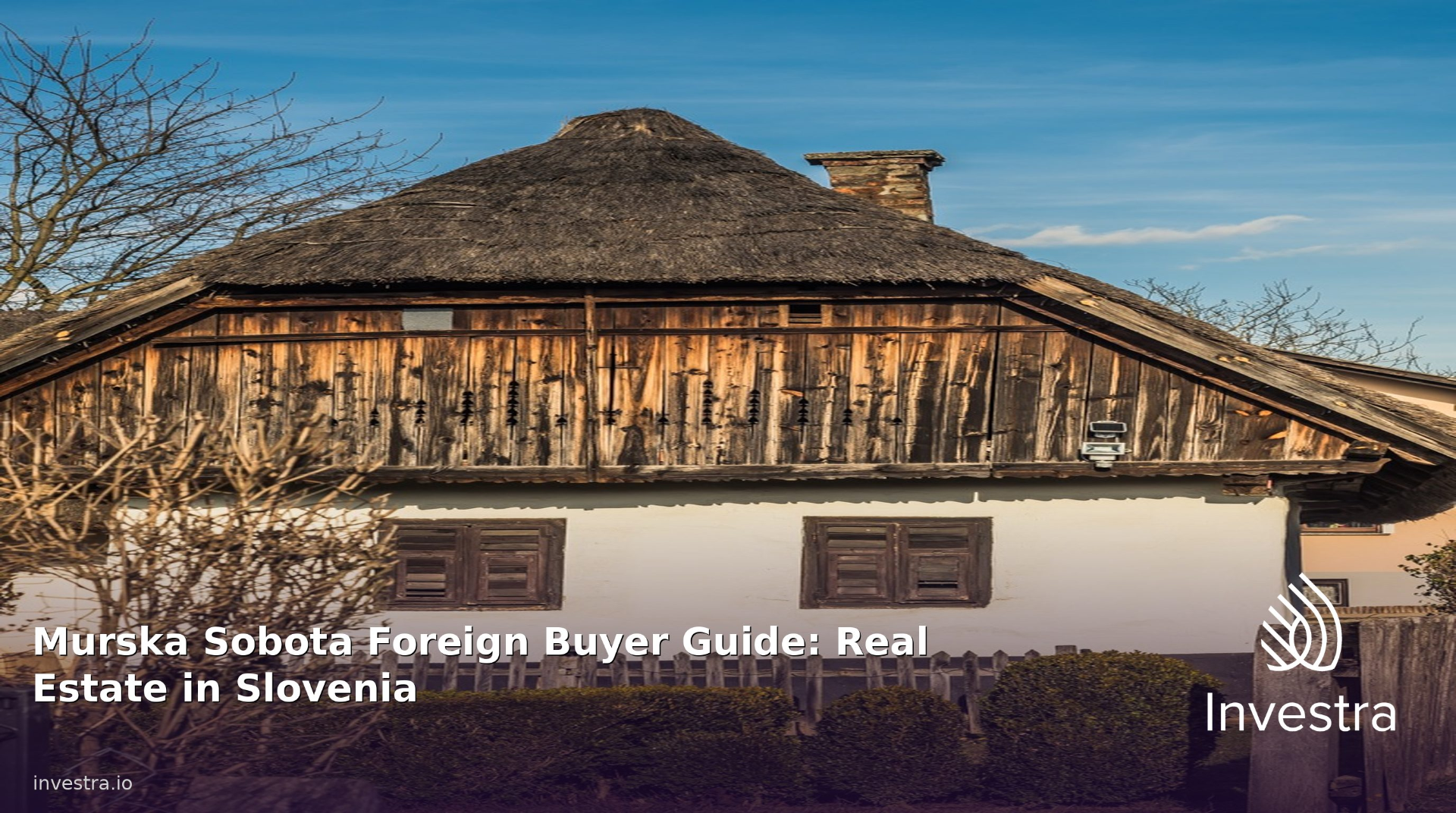
Murska Sobota Foreign Buyer Guide: Real Estate in Slovenia
Murska Sobota Foreign Buyer Guide: Real Estate in Slovenia
Murska Sobota foreign buyer guide: Prekmurje in context
Quick Answer: This guide explains what foreign buyers should know about Murska Sobota and the wider Prekmurje region: local market character, practical buying steps, who to contact and how to verify up-to-date local data. Use specialist local advisers and official registries for current figures.
Murska Sobota sits in northeastern Slovenia, in the historical region of Prekmurje. The town is a regional administrative and service hub rather than a capital city, and that shapes the real estate market: properties tend to be smaller markets with local demand patterns and less churn than larger urban centres. In my experience, buyers who treat Murska Sobota as a pragmatic, regionally focused purchase find different opportunities than those hunting for big-city capital appreciation or tourist-driven short-term letting. The reality is that context matters—what works in Ljubljana won’t always translate to Prekmurje.
So what should buyers know about Murska Sobota foreign buyer guide? First, the local economy, commuting patterns and demographic trends shape demand. If you’re comparing cities, it helps to review comparative guides for capital and regional markets to understand where Prekmurje sits relative to Slovenia’s larger urban centres. For example, Investra’s city guides can give that wider perspective—see the Ljubljana real estate market guide and the Maribor real estate market guide for contrast with Murska Sobota.
Practically, expect to combine local agents, legal counsel and national authorities to confirm property registers, planning zones, and tax obligations. If you want a second opinion or strategic advisory, specialists such as Siniša Dagary provide investment analysis and business consulting; his investment insights can be useful when validating assumptions. We’ve also integrated regional data sources from partners like Findes Group & Partners when advising clients who are new to the Slovenian market.
Finally, verify any current numeric detail—prices, taxes or yields—by contacting the local land registry, municipal planning office and the Slovenian tax authority or by consulting the up-to-date market pages such as Investra’s city and neighbourhood guides. The rest of this guide is practical: how to check, who to call, what documents to expect and how to think about ownership choices in Prekmurje.
Who can buy property in Murska Sobota: foreign buyer eligibility
Quick Answer: Eligibility for foreigners depends on nationality, reciprocity agreements and whether you’re buying land versus a building; confirm current rules with a local notary and municipal authority, and consult expert advisors for residence-related questions.
One of the first questions I get is: can a non-Slovenian buy property in Murska Sobota? The short answer is: often yes, but there are legal nuances. Slovenia’s rules vary depending on whether you’re an EU/EEA citizen, a citizen from a country with reciprocal property rights agreements, or a third-country national. What surprised many buyers is how the distinction between buying a building and buying land can change the process and the permits you need.
Rather than guessing, confirm eligibility through official channels. Start with a notary experienced in cross-border transactions; they’ll check the official land registry (Zemljiška knjiga) and land cadastre. If you require a permit (for example, for agricultural land or certain construction projects), your notary and the municipal office in Murska Sobota will explain current procedures and documentation. For strategic guidance on buying in other Slovenian cities and how local rules translate across regions, Investra’s guides—such as Buying property in Ljubljana and Buying property in Maribor—explain steps you’ll often repeat in Prekmurje.
If you’re seeking residency tied to investment, that’s a separate area: immigration and residence permits are handled by national immigration authorities and require different documentation. For investment advisory, professionals like advisory services can help you align property acquisition with broader business or residency goals. Always verify the latest legal position before committing: municipal and national authorities periodically update regulations, and only a local lawyer or notary can confirm current entitlements for your nationality.
Step-by-step buying process for foreigners in Murska Sobota
Quick Answer: The buying process typically involves finding a property, pre-contract agreements, due diligence, a notary contract and registration—each stage requires specific local checks and formalities that a notary or legal adviser will guide you through.
Buying property in Murska Sobota follows a sequence familiar across Slovenia, but local detail matters. In my experience, the most common missteps are skipping thorough local due diligence and underestimating time for municipal checks. You’ll want to map out the full process before making offers: initial market research, agent viewings, conditional agreement, due diligence, signing before a notary, tax clearance and land registry entry.
Start with research. Use local listings and talk to local estate agents to understand offer timelines. Then, if you find a property, ask the seller for the land registry extract and property plan. At this point engage a local notary or solicitor to run formal searches: confirm ownership, encumbrances (mortgages, liens), boundaries and permitted use. Also check municipal planning rules—if you plan renovation or extension, you’ll need to know applicable zoning and building permission processes.
Before committing funds you’ll likely sign a preliminary agreement or reservation contract. This sets the expected completion date and conditions (e.g., mortgage approval, permit issuance). The final deed is notarised; the notary will be central to ensuring the transfer is registered correctly. After the sale, register the new ownership at the land registry and inform the tax authority. For an overview of how these steps compare across Slovene cities, see Investra’s procedural guides such as Bled new-build guide and Maribor new-build guide.
How do you verify timing and costs now? Don’t rely on generic timelines. Contact a local notary and the Murska Sobota municipal office to get current processing times and fee schedules. For financing steps, talk to banks operating in Slovenia—many will require authenticated documents and credit checks, and will confirm the loan-to-value and documentation specifics for non-resident borrowers.
Property types, neighbourhoods and projects in Prekmurje
Quick Answer: Prekmurje offers town-centre apartments, family houses, rural properties and small development plots; evaluate neighbourhoods by services, transport links and municipal plans and consult local market guides for nearby cities for comparative context.
Prekmurje’s housing stock ranges from older terraced and detached houses in small towns to modern apartments in municipal centres like Murska Sobota. You’ll also find agricultural properties and renovation projects in villages. The character of each area is different: urban streets near municipal services attract steady local demand, while rural plots suit buyers focused on lifestyle or agricultural use.
What surprised many of our clients is how much the micro-location matters. A street with schools, healthcare and public transport will behave differently than a rural hamlet a few kilometres away. If you’re considering renovation projects or new builds, check local supply chains for contractors and materials—some projects require bringing in specialists from larger cities. For ideas on new-build standards and renovation questions, see Investra’s regional guides, including the Ljubljana new-build guide, Maribor new-build guide and Bled new-build guide.
When assessing projects, ask for recent planning decisions and developer permits. Contact the municipality for any future infrastructure projects that may affect values. If you plan to compare with coastal or tourist markets, the Koper real estate market guide and Bled real estate market guide are useful contrasts—those markets are shaped by tourism and coastal access unlike inland Prekmurje.
Finally, if you’re evaluating neighbourhoods within Murska Sobota, speak with local agents who know street-level dynamics. You can also review Investra’s best-neighbourhood guides for other cities—like Maribor neighbourhood guide and Ljubljana neighbourhood guide—to learn what questions to ask when comparing streets, transport and amenities.
Taxes, fees and ongoing costs for owners in Slovenia
Quick Answer: Ownership in Slovenia creates tax and fee obligations—transactional taxes, registration fees and ongoing property taxes—so verify exact rates with a tax advisor, the Slovenian tax authority and a local notary.
Taxes and fees are a core part of any purchase decision, but I always advise clients not to accept headline numbers without verification. There are one-off transactional costs (notary fees, land registry entries and possible transfer taxes) and ongoing charges (local property taxes, utility bills and communal fees). Which exact obligations apply to you will depend on whether you buy for personal use, rental or as a company, and whether you’re purchasing land, a building, or both.
The right way to get reliable figures is to ask three sources: the notary handling the transaction for upfront costs, the municipal tax office for local taxes and fees, and a Slovenian tax advisor for implications tied to residency and rental income. If you plan to rent, a tax consultant will explain how rental revenue is treated and what deductions are available. For background on how taxes intersect with rental markets and project planning in other Slovenian locations, review Investra’s rental and tax discussions such as the Ljubljana rental market guide and Bled rental market guide.
We’ve seen buyers assume a flat rate and then face unexpected municipal fees or VAT treatment on renovations. Ask your notary to itemise likely fees and request a binding information letter from the tax authority if tax treatment is central to your decision. If you need an advisor who works across tax and investment strategy, consider reaching out to consultants such as Siniša Dagary profile or the professional teams at Findes Group & Partners advisory team for a tailored assessment.
Renting, short-term lets and investment considerations in Murska Sobota
Quick Answer: Short-term and long-term rental strategies have different regulatory, tax and operational requirements; verify local municipal rules and tourism registration before marketing short-term lets and consult revenue forecasts with a local expert.
Before listing a property for short-term rent, confirm whether Murska Sobota requires specific registration for tourist accommodation, and understand municipal rules around safety, waste collection and zoning. Short-term lets may also have tax implications different from long-term rental income—get confirmation from the tax authority or your tax adviser. For comparative reading on short-term letting in other Slovenian markets, check Investra’s guides such as the Ljubljana rental market guide and the Bled rental market guide.
Operationally, consider local management. Who handles cleaning, keys, check-ins and guest communications? In smaller markets, reliable local property managers can be harder to find, so vet them carefully or use an established operator. If you’re comparing to Maribor or Ljubljana in terms of tenant demand and service availability, see Investra’s Maribor rental market guide and the capital’s rental guide to set realistic expectations.
Finally, always verify expected returns and occupancy with recent local data. Don’t accept generalised yields. Instead, request anonymised performance data from local managers, check listing platforms for recent booking levels, and cross-check with municipal tourism statistics where available.
Due diligence, legal checks and local advisors you should meet
Quick Answer: Due diligence must include land registry checks, title searches, planning constraints, encumbrance reviews and site surveys; use local notaries, surveyors and tax lawyers and confirm everything with municipal authorities.
Legal checks should go beyond the deed. Request certified copies of building permits, compliance certificates and any historical planning approvals. If the property sits in a special zone—protected landscapes or agricultural land—contact the municipal planning office in Murska Sobota for current restrictions and future plans. For cross-references on typical permit processes, Investra’s city guides, including Koper real estate market guide and Bled real estate market guide, show how coastal or tourist constraints compare to inland rules.
Who should you meet locally? At minimum: a notary, a civil engineer or surveyor, a tax advisor and a local real estate agent with proven transactions in Prekmurje. If you’re investing via a company, bring in corporate counsel. For strategic advisory and investment planning, people contact investment consultation networks or professional partners like Findes Group & Partners who provide combined legal, tax and business services. Always get written confirmations of material facts and consider an independent valuation if price certainty is critical.
Financing options and mortgages for foreign buyers
Quick Answer: Financing for foreign buyers varies by bank; some Slovenian banks lend to non-residents with additional documentation—confirm current lending criteria, required documentation and interest structures by speaking with local lenders or international banks operating in Slovenia.
For strategic comparisons on financing in other Slovene markets, Investra’s city guides can help you see where lending practices differ. For example, the guides on Ljubljana, Maribor and Bled outline how market liquidity and bank appetite vary by city. For a full financing plan, pair bank discussions with advice from a tax specialist and notary to understand implications for cross-border lending and repayment in the event of changes to residency or tax status.
Local services, utilities and renovation realities in Prekmurje
Quick Answer: Expect practical differences in contractor availability, utility connection procedures and renovation permits compared to larger cities; always confirm local lead times, contractor licensing and municipal permit requirements before estimating timelines.
For renovation rules and common pitfalls, Investra’s regional new-build and renovation guides—such as the Ljubljana new-build guide, Maribor new-build guide and Bled new-build guide—offer checklists that are easily adapted to Prekmurje. If you need a managed renovation, consider engaging a project manager or a development firm that operates regionally; they can often bundle local trades and accelerate delivery.
Investment Disclaimer
Quick Answer: This section provides the standard investor caution: use information here as a starting point, and verify everything with qualified advisors and official sources before making financial commitments.
The information provided in this article is for educational and informational purposes only and should not be construed as financial, legal, or investment advice. Real estate investments carry inherent risks, and past performance does not guarantee future results. Investors should not invest money they cannot afford to lose. Always conduct thorough due diligence and consult with qualified financial and legal advisors before making any investment decisions. Investra.io does not guarantee returns on any investment.
I add this because I’ve seen how small oversights can become costly. Treat the guide as a roadmap, not a checklist. Confirm current tax positions with a certified accountant, check municipal rules with the Murska Sobota municipal office, and have a notary vet contractual documents. For strategic advisory beyond the transactional stage, professionals such as advisory services and the teams at Findes Group & Partners can provide tailored, up-to-date counsel based on your objectives.
Frequently Asked Questions
Quick Answer: Below are common questions foreign buyers ask about Murska Sobota and Prekmurje, answered with practical steps and sources to consult for up-to-date verification.
Can non-EU citizens buy property in Murska Sobota?
Eligibility depends on reciprocity agreements and property type. Some categories of non-EU buyers require permits, especially for agricultural land. The definitive check is to speak with a local notary and the municipal office—ask them to confirm current practice in writing. For comparative procedures used in larger Slovenian cities, see Investra’s buyer guides such as Buying property in Ljubljana and Buying property in Maribor.
How do I check property ownership and encumbrances?
Request a current excerpt from the land registry (Zemljiška knjiga). A notary will obtain and interpret these records, showing registered owners, mortgages and other encumbrances. You can also ask the seller for certified documentation prior to signing any preliminary agreement. If you’re comparing procedural detail with other regions, Investra’s market guides can be a helpful reference.
What taxes will I pay when buying property?
Tax liability depends on the transaction structure (individual vs company), property type and whether the property is new-build or resale. Ask your notary to itemise likely transactional taxes and a tax advisor to explain ongoing tax obligations and rental income treatment. For general context about tax implications and rental strategy, see Investra’s rental guides like the Ljubljana rental market guide.
Do I need a Slovenian bank account to buy?
A local account simplifies payments, tax registrations and utility billing. Some banks will accept international transfers, but many formalities (notary payments, tax payments) are easier with a Slovenian account. Speak to lenders for their requirements and clarify transfer rules with your bank. For financing context, regional Investra guides outline lending environments across Slovenia.
Can I rent out the property short-term?
Short-term letting may be permitted, but check municipal registration, safety requirements and tax treatment first. Murska Sobota may require tourist registration for short-term accommodation—confirm with the tourism office. Compare the likely demand profile with data from regional guides and consult local property managers for operational feasibility.
How long does the purchase process usually take?
Timing varies by case. Typical steps—due diligence, preliminary contracts, notary deed and registration—each have variable processing times. Local municipal procedures and bank financing can extend timelines. Get expected schedules in writing from your notary and lending bank before you sign a reservation or preliminary agreement.
Should I use an estate agent or buy directly?
Both paths are possible. Agents provide local market access, negotiation support and transactional experience; buying directly can be cheaper but often demands stronger local knowledge. If you use an agent, verify their track record and insist on written terms. For cross-city comparisons, Investra’s neighbourhood and market guides help you understand agent roles in different markets.
Who pays for the notary and legal fees?
Customarily, costs are split or agreed in the preliminary contract. Ask the seller and your notary to set out who pays which fees before you sign. Your solicitor or notary should produce a written fee estimate. If financing is part of your plan, ask your bank about any additional legal requirements they impose.
How can I verify current local market prices and trends?
Use multiple sources: local agents, recent sales data from the land registry, local municipal reports and specialised platforms like Investra’s market guides. When precise current figures are crucial, request recent comparable sales extracts from the land registry or ask an independent valuer to prepare a market valuation. See Investra resources such as the Ljubljana guide and the Maribor guide for methods of comparison.
Is it better to buy via a Slovenian company?
Buying through a company changes tax, reporting and administrative requirements. It can be sensible for investors planning multiple properties, but the benefits depend on your jurisdiction and long-term goals. Consult a corporate tax advisor and a local solicitor to assess whether a company structure suits your plans.
What services do local advisory firms offer?
Local advisory firms provide legal, tax and transactional support, and may offer project management and property management services. Teams like Findes Group & Partners and independent consultants like Siniša Dagary can coordinate cross-disciplinary work—use their contact pages to request specific service packages and references.
Recommended Reading
Quick Answer: The following Investra and consultant resources offer detailed city guides and specialist insights to complement the Murska Sobota guide—consult them for comparative market context and practical checklists.
- Ljubljana real estate market guide
- Buying property in Ljubljana
- Ljubljana rental market guide
- Ljubljana neighbourhood guide
- Ljubljana new-build guide
- Maribor real estate market guide
- Siniša Dagary — Investment Consultant
- Business Strategy Blog
Connect With Investra
Quick Answer: Reach out to Investra on social media for updates, market commentary and curated property opportunities.
Follow Investra for market updates, webinar announcements and curated property opportunities. Here are our social channels:
For bespoke advisory, use the contacts listed earlier: specialist consultants like investment consultation pages and professional partners such as Findes Group & Partners advisory team. If you want hands-on market introductions in Prekmurje, Investra’s local network of agents and partners can help coordinate viewings and due diligence.
Throughout this guide I referenced several Investra city guides and specialist resources to give you context beyond Murska Sobota. For neighbourhood-level and rental details in other Slovenian markets, review the additional Investra pages: Maribor rental market guide, Bled rental market guide, and the market and neighbourhood guides for Bled and Koper listed earlier.
If you want a tailored assessment for a specific property in Murska Sobota or Prekmurje, contact a notary and request a pre-purchase checklist. For project-level advisory, consider a consultation with Siniša Dagary (advisory services) or a multi-disciplinary team such as Findes Group & Partners.
Connect With Investra
Quick Answer: Follow Investra for verified market context and practical property research.
Related Posts
No related posts available.
