
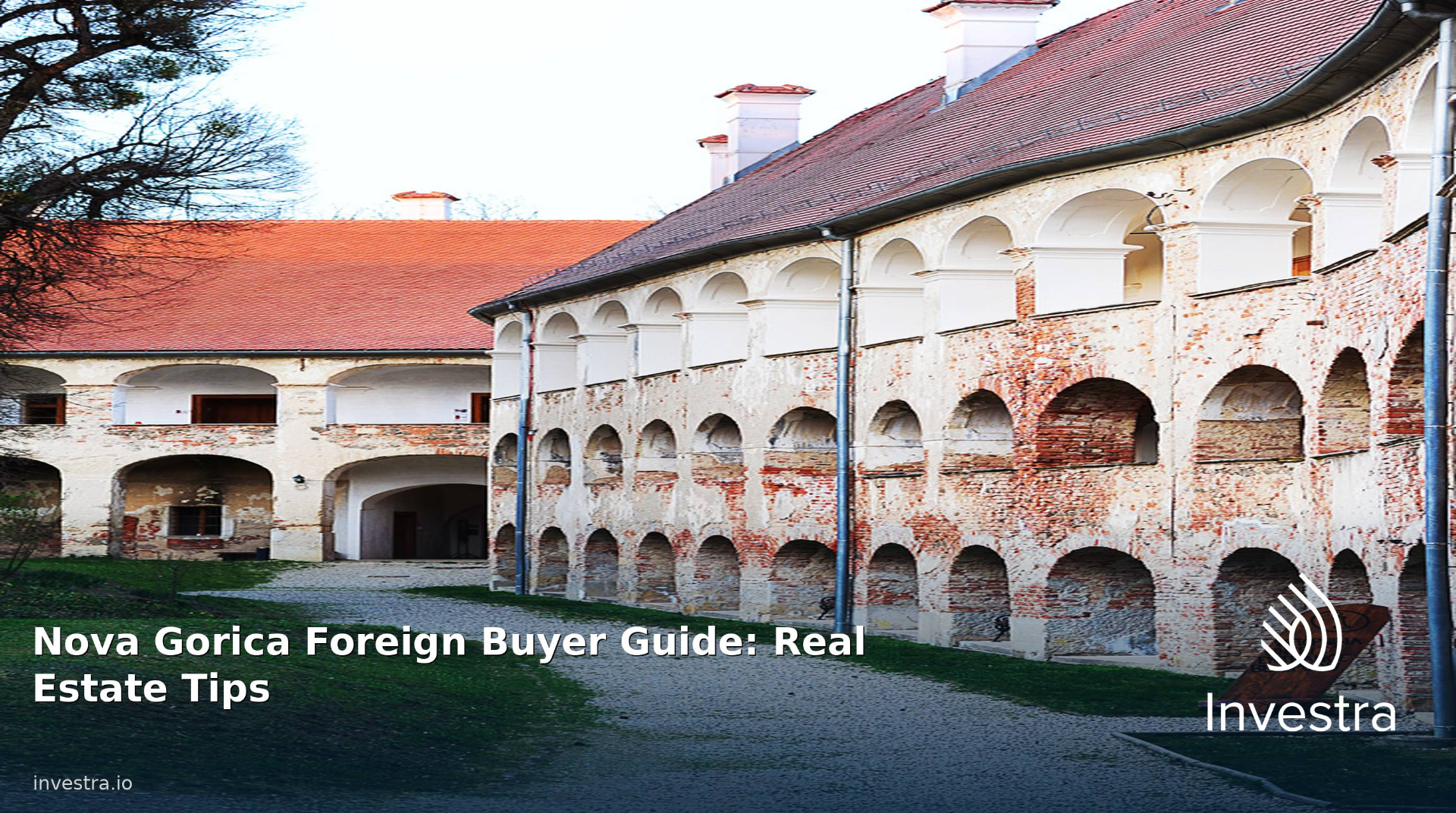
Nova Gorica Foreign Buyer Guide: Real Estate Tips
Nova Gorica Foreign Buyer Guide: Real Estate Tips
Nova Gorica foreign buyer guide: What buyers should know about Goriška
Quick Answer: This Nova Gorica foreign buyer guide explains who can buy property in Goriška, the main steps in the purchase process, and where to verify current rules and costs. For detailed market context, compare local guides such as the Ljubljana real estate market guide and Maribor real estate market guide.
If you searched for "Nova Gorica foreign buyer guide" you probably want a practical map of the process and pitfalls. Goriška, the western Slovenian region that includes Nova Gorica and nearby border towns, attracts buyers for cross-border commuting, affordable renovation projects, and access to the coast and Alpine outdoors. In my experience, foreign buyers approach Goriška for three reasons: lifestyle, value, and proximity to Italy. The reality is the legal and administrative road can be straightforward if you prepare documentation and work with local experts.
What should buyers know about the Nova Gorica foreign buyer guide? First, nationality matters: EU citizens have easier rights than some non-EU nationals. Second, the type of property—detached houses, apartments in older blocks, or new-build units—affects the due diligence required. Third, municipal rules and cadastral records in the Goriška region can be idiosyncratic. You’ll want to verify every factual detail locally: check the registry at the local land office (Zemljiška knjiga), confirm tax rules with the Slovenian Financial Administration, and ask a notary public to explain the contract form and registration steps.
We’ve seen buyers assume that practices in Ljubljana apply everywhere; they don’t. To get started, read local guides for comparable cities — Bled and Koper offer useful contrasts — and then get direct confirmation from the Goriška municipal offices or a trusted adviser like a local solicitor, notary, or the Findes Group & Partners.
Who can buy property in Nova Gorica and the Goriška region?
Quick Answer: Eligibility for buying in Nova Gorica depends on nationality and property type; EU citizens generally face fewer restrictions, while others may need approvals—always confirm current rules with a notary or municipal authority.
One of the first questions buyers ask is whether they can legally own property in Slovenia. The short response is that laws and bilateral treaties determine eligibility. In my experience advising buyers, the safest first step is to check the legal status that applies to your nationality. EU citizens typically have broad rights to purchase; non-EU citizens may face extra steps such as seeking permission from the Ministry of Justice or following reciprocal agreements between countries.
The process is administrative: local land registry entries and cadastral records must be checked. What surprised many buyers is how municipal zoning can affect what you actually own—land rights, easements, and building permissions are all registered separately. If you’re coming from abroad prepare certified translations of essential documents, powers of attorney if you can’t be present, and ask a notary about any pre-emptive right claims. For hands-on advice, consult local specialists such as the advisory teams at Findes Group & Partners advisory team or an experienced consultant like Siniša Dagary.
Step-by-step buying process for Nova Gorica properties
Quick Answer: The typical flow is property search, due diligence, reservation agreement, preliminary contract, notary deed, and registration—verify each step with a local notary and the land registry.
When we guide buyers through Nova Gorica transactions, we follow a clear sequence. Start with a focused search: use local listings, agents, and project pages such as renovation or new-build guides to narrow options. I often recommend visiting the property and the neighborhood several times at different hours. What you see at first glance can change with traffic, noise, or seasonal tourism patterns.
After identifying a property, commission due diligence. This covers title search in the land registry (Zemljiška knjiga), checking urban plans at the municipal office, and confirming that building permits and certificate of compliance exist for any constructed elements. A written reservation or pre-contract locks terms while you work through checks. The preliminary contract typically states the price, deposit, timelines, and conditions precedent such as mortgage approvals or receipt of permits.
The final step is signing before a notary and registering the new owner with the land registry. You’ll want the notary to explain registration fees and the timeline for the entry to appear in public records. Because regulations and practice vary, I advise verifying all administrative steps with a local notary and consulting guides like Buying property in Ljubljana to understand how major-city procedures compare with provincial ones.
Due diligence essentials: titles, zoning and hidden risks in Goriška
Quick Answer: Due diligence must cover title verification, zoning and planning, encumbrances, utilities and construction records; confirm each item through official registers and local municipal departments.
Do not underestimate due diligence. I once worked with buyers who assumed a property with a recent roof renovation would be free of problems—only to discover unregistered extensions and unclear access rights. In Goriška, common issues include historic land parcel boundaries, unregistered alterations, and unclear servicing rights for water or sewage, especially in rural areas.
Perform these checks: obtain a certified title extract from the land registry; request an excerpt from the cadastre to confirm boundaries; ask the municipality for zoning and land-use plans; and review building permits. If possible, check the technical documentation (geodetic survey, energy performance certificate) and utility contracts. When you encounter ambiguity, seek a formal certificate or statement from the issuing authority—oral assurances won’t protect you later.
If your property is part of a co-owned building, inspect the homeowners’ association minutes and financials to identify pending repairs or dues. For new-builds or renovation projects, refer to guidance on new developments—see the Maribor new-build guide and Bled new-build guide for checklists that work across regions.
Taxes, fees and how to verify them in Nova Gorica
Quick Answer: Purchase-related taxes and fees apply, and their rates may change—always verify current tax rates and notary fees with the Financial Administration of the Republic of Slovenia and a local notary.
Buyers regularly ask, "How much will I actually pay?" Rather than giving numbers that could be out of date, I show people how to verify taxes and fees: contact the Slovenian Financial Administration (Finančna uprava Republike Slovenije) for transfer taxes and any property tax obligations; ask a notary for an estimate of notarial fees and registration costs; and check municipal sources for local charges such as development contributions or utility connection fees.
The reality is that tax treatment can depend on whether the purchase is primary residence, investment, or part of a corporate structure. If you're planning to rent the property or hold it via a company, discuss tax residency and reporting obligations with a certified tax adviser. For practical context on rental matters and short-term lets, read the Ljubljana rental market guide and Maribor rental market guide to learn which documents you’ll need to analyze income and compliance.
Ownership structures: individual vs company ownership for foreigners
Quick Answer: Foreigners can hold property in different ownership structures—individual title, Slovenian company, or holding company—but each option brings different tax, reporting and administrative implications; seek professional advice.
Deciding how to hold property is a strategic choice. In my consultancy work, we weigh factors like estate planning, tax transparency, ease of resale, and financing access. Holding a property personally is simple and transparent, but some investors prefer company ownership for management or privacy reasons.
There are additional layers to consider: corporate ownership may affect mortgage availability, taxation on rental income, and transfer procedures. If you think company ownership might suit your plan, consult with a Slovenian corporate lawyer and tax adviser to map out consequences. You should also verify official requirements and possible administrative filings with the Business Register Agency and the Financial Administration.
For comparative background on structuring investments and working with professional consultants, review advisory resources such as advisory services by Siniša Dagary and consult experienced local firms like Findes Group & Partners.
Financing and mortgages for foreign buyers in Slovenia
Quick Answer: Financing options for foreigners exist but terms vary by lender and borrower profile; check current mortgage availability and interest rates with local banks and the Bank of Slovenia for up-to-date information.
Many buyers ask whether local banks will lend to foreign purchasers. The answer depends on the bank’s policy, the borrower’s residency and income documentation, and the property type. In my experience, lenders in Slovenia will consider EU nationals relatively straightforwardly if they can document income and provide required identification and residency papers. Non-EU nationals often need more paperwork and sometimes an established relationship with a Slovenian bank.
Don't rely on a single bank’s offer. Shop around and ask lenders for written repayment schedules and conditions for foreign clients. Also verify mortgage terms with the Bank of Slovenia and get a pre-approval letter before signing a reservation. If you plan to borrow from a foreign bank, compare currency risk and cross-border transfer implications. For a practical approach to investment returns and financing assessments, consult the short-term and rental guides such as the Bled rental market guide and the Koper market guide for how finance structures can influence cash flow assumptions.
Residency implications and permits tied to property ownership
Quick Answer: Owning property in Nova Gorica does not automatically grant residency; check current immigration rules and any investment-linked permit programs with Slovenian immigration authorities or a qualified immigration lawyer.
One common misconception is that buying a property equals getting residency. That isn't the case in Slovenia in general. Buying real estate can support certain visa applications or be part of a broader investment plan, but residency and citizenship follow specific immigration law routes. If your aim is to live in Slovenia, consult the local police administrative units for residence permits or an immigration attorney who knows the latest practice.
We’ve seen emotion drive purchase decisions when buyers assume residency rights come with ownership. The prudent path is to separate the property decision from your immigration plan. Confirm what rights ownership gives you—if any—by contacting Slovenian immigration services, a local embassy, or a specialist such as the advisory services listed at investment consultation pages. That way you avoid surprises and plan your move realistically.
Rental market realities in Goriška: short-term, long-term and seasonal demand
Quick Answer: Goriška’s rental demand varies by town and season; verify vacancy rates, average rents, and regulations locally and compare with guidance in related city rental guides.
If you're buying to rent, you need local intelligence, not assumptions. Nova Gorica has demand drivers that include cross-border workers, students, and regional tourism spillover. But patterns differ from Ljubljana or Bled; what rents well in the capital may not perform the same here. In my experience, success depends on accurate local market research and realistic operating cost estimates.
To evaluate a rental opportunity, obtain current market data: speak with local letting agents, request comparable rentals, and review municipal short-term rental rules. For short-term lets, ask the municipality about registration and safety requirements; for long-term lets, check tenant protection laws and typical lease terms. If you need benchmarking, consult the Ljubljana rental guide and the Maribor rental guide to understand how to compute gross and net expectations using live data from agencies or municipal registries rather than relying on generalized figures.
Renovation, new-builds and project investing in Nova Gorica
Quick Answer: Renovation projects and new-build investments require careful permitting checks, cost verification, and contractor vetting—use the new-build guides and consult local architects and construction firms for current costs and timelines.
Goriška has attractive renovation opportunities—older houses with character near the Italian border, and some developing new-build projects. In my experience, renovating in Nova Gorica can be rewarding, but you must manage permits, technical documentation, and contractor reliability. Costs and timelines can change with market conditions and supply chain issues, so always ask for firm quotations and a phased payment plan linked to milestones.
For developers and investor-buyers, project due diligence extends beyond bricks and mortar: check the developer’s track record, financial stability, and whether the project has all necessary municipal approvals. Use professional quantity surveyors to validate contractor bids. If you want procedural checklists, the Ljubljana new-build guide, Maribor new-build guide, and Bled new-build guide list vital documents and steps that apply across Slovenia.
Where to find trusted local professionals and advisory teams
Quick Answer: Use local notaries, registered real estate agents, licensed surveyors, and reputable advisory firms like Findes and specialists such as Siniša Dagary to verify market specifics and legal compliance.
One practical lesson from years advising buyers is that quality of advice matters more than the price you pay for it. A competent notary will identify title defects. A reliable surveyor will spot boundary discrepancies. An experienced real estate agent who works across the Italy–Slovenia border will understand cross-border buyer expectations and municipal peculiarities.
For advisory services, consider teams with local presence and international experience. The Findes Group & Partners provides corporate and real estate advisory; their contact page Findes Group & Partners advisory team is a practical starting point. For one-on-one consultancy and strategy, explore the work of Siniša Dagary, whose investment insights and advisory services discuss the business-side of property investing. If you need to arrange consultations, the Siniša contact page investment consultation is helpful.
Comparing Nova Gorica with Ljubljana, Maribor, Bled and Koper
Quick Answer: Nova Gorica differs from Slovenia’s larger markets in scale, demand drivers and regulatory nuances—compare local guides to understand the contrasts in buyer profiles and project types.
Buyers often ask whether to buy in Nova Gorica or invest in bigger markets like Ljubljana or coastal Koper. The truth is each market serves different goals. Ljubljana is the capital: broad rental demand, corporate tenants, and high visibility. Maribor offers a university town dynamic; Bled is tourism-driven; Koper has coastal advantages. Nova Gorica and the wider Goriška region blend cross-border living, local industry and tourism spillover. Read the comparative guides: Ljubljana real estate market guide, Maribor real-estate guide, Bled real-estate guide, and Koper market guide to set realistic expectations about liquidity, tenant types and project risk.
Comparing data is essential. Instead of quoting outdated numbers, I recommend retrieving live statistics from municipal property registries, local agencies, and national statistics offices. That way you can build a decision model based on current vacancy rates, employment trends and local development projects, rather than relying on general impressions.
How to verify current market data, taxes and legal updates
Quick Answer: Verify current information by consulting official sources: the land registry, municipal urban planning offices, the Financial Administration, the Bank of Slovenia, and professional advisers like notaries and licensed agents.
Market-level data—average rents, recent sales—are best confirmed with multiple local agents and property portals, and by auditing comparable sales as shown in public registries. For legal or regulatory changes, watch official government publications and consult a notary who will know practical interpretations. If you need a trusted advisor, consider the services of Siniša Dagary advisory services or the professional teams at Findes Group & Partners.
Negotiation tips and closing strategies for foreign buyers
Quick Answer: Prepare financing, use staged escrow and legal protections in contracts, and work with a bilingual agent or lawyer to handle negotiation subtleties and closing logistics.
Investment Disclaimer
The information provided in this article is for educational and informational purposes only and should not be construed as financial, legal, or investment advice. Real estate investments carry inherent risks, and past performance does not guarantee future results. Investors should not invest money they cannot afford to lose. Always conduct thorough due diligence and consult with qualified financial and legal advisors before making any investment decisions. Investra.io does not guarantee returns on any investment.
Frequently Asked Questions
Can non-EU citizens buy property in Nova Gorica?
Ownership rules depend on national law and reciprocal agreements. Many non-EU buyers can acquire property, but some transactions require a formal approval or additional documentation. To verify your specific situation, contact a local notary or the Ministry of Justice in Slovenia, and request the latest guidance in writing. A qualified local lawyer can advise whether a company purchase or a direct title is the most practical route.
How do I check if a property has clear title?
Obtain an extract from the land registry (Zemljiška knjiga) showing current ownership and encumbrances. Ask the notary to perform a title check and request any available historical documentation. If boundaries are unclear, commission a registered surveyor to produce a geodetic plan. If you’re not on site, instruct your lawyer or agent to obtain certified copies of the registry extract and provide a translation if necessary.
What taxes should I check before buying?
You should verify transfer taxes, any property tax, and the tax treatment of rental income. Tax rates and exemptions change, so consult the Financial Administration of the Republic of Slovenia and a certified tax adviser who can apply rules to your situation. For corporate ownership or international tax planning, ask for cross-border tax advice and document your residency status.
Is financing available to foreign buyers in Slovenia?
Many Slovenian banks lend to foreigners, but terms vary by lender and borrower circumstances. Get pre-approval letters from multiple banks and compare required documentation. If you plan to use a foreign lender, be mindful of exchange-rate risk and cross-border legalities. Ask lenders for written conditions tailored to non-resident borrowers.
Do I need to be present in Slovenia to complete a purchase?
Not necessarily. You can appoint a power of attorney to act on your behalf for signing and closing, but the power of attorney must typically be notarised and may require an apostille or certified translation. Confirm the formalities with a Slovenia-based notary and have the power of attorney checked by your lawyer before relying on it.
How do I handle renovations and building permits?
Before renovating, obtain the municipality’s confirmation of whether a permit is required. For significant works, submit plans and secure permits from the local urban planning office. Use licensed architects and contractors, and insist on written contracts with clear milestones and responsibility for permits. A technical supervisor (in Slovenian practice) can help ensure compliance.
What should I know about renting out my property?
Understand local tenant law, lease structures, and tax reporting obligations. For short-term rentals, check municipal registration and safety rules. For long-term leases, know tenant protections and eviction procedures. Use a local property manager if you won’t reside nearby, and ask them to provide market-referenced rent analyses and tenant screening processes.
Who should I hire to help with my purchase?
The essential advisors are a notary, a local lawyer specializing in property law, a certified surveyor, and a tax adviser. A reputable real estate agent and a property manager are valuable if you plan to rent. Firms like Findes Group & Partners offer advisory services, and consultants such as Siniša Dagary can provide broader investment strategy input.
How can I check current market prices and rental rates?
Use a mix of sources: recent land registry sale entries, active listings on local portals, reports from licensed agents, and municipal publications. For rental benchmarking, review current listings and speak to letting agents. For general methodology and market comparisons, consult city guides like the Ljubljana guide and Maribor guide and then validate figures using live local data.
Should I form a Slovenian company to hold property?
Forming a company can offer management and privacy benefits, but it also introduces corporate compliance, accounting and potential tax consequences. Discuss your goals with a corporate lawyer and tax adviser to weigh benefits against ongoing administrative burden. Local firms and advisors like Siniša Dagary’s advisory services or Findes Group & Partners advisory team can model scenarios for you.
Recommended Reading
- Ljubljana real estate market guide
- Buying property in Ljubljana
- Ljubljana rental market guide
- Ljubljana neighbourhood guide
- Ljubljana new-build guide
- Maribor real estate market guide
- Siniša Dagary — Investment Consultant
- Business Strategy Blog
Connect With Investra
Follow Investra.io on social media for market updates and new listings:
Connect With Investra
Quick Answer: Follow Investra for verified market context and practical property research.
Related Posts
No related posts available.
