
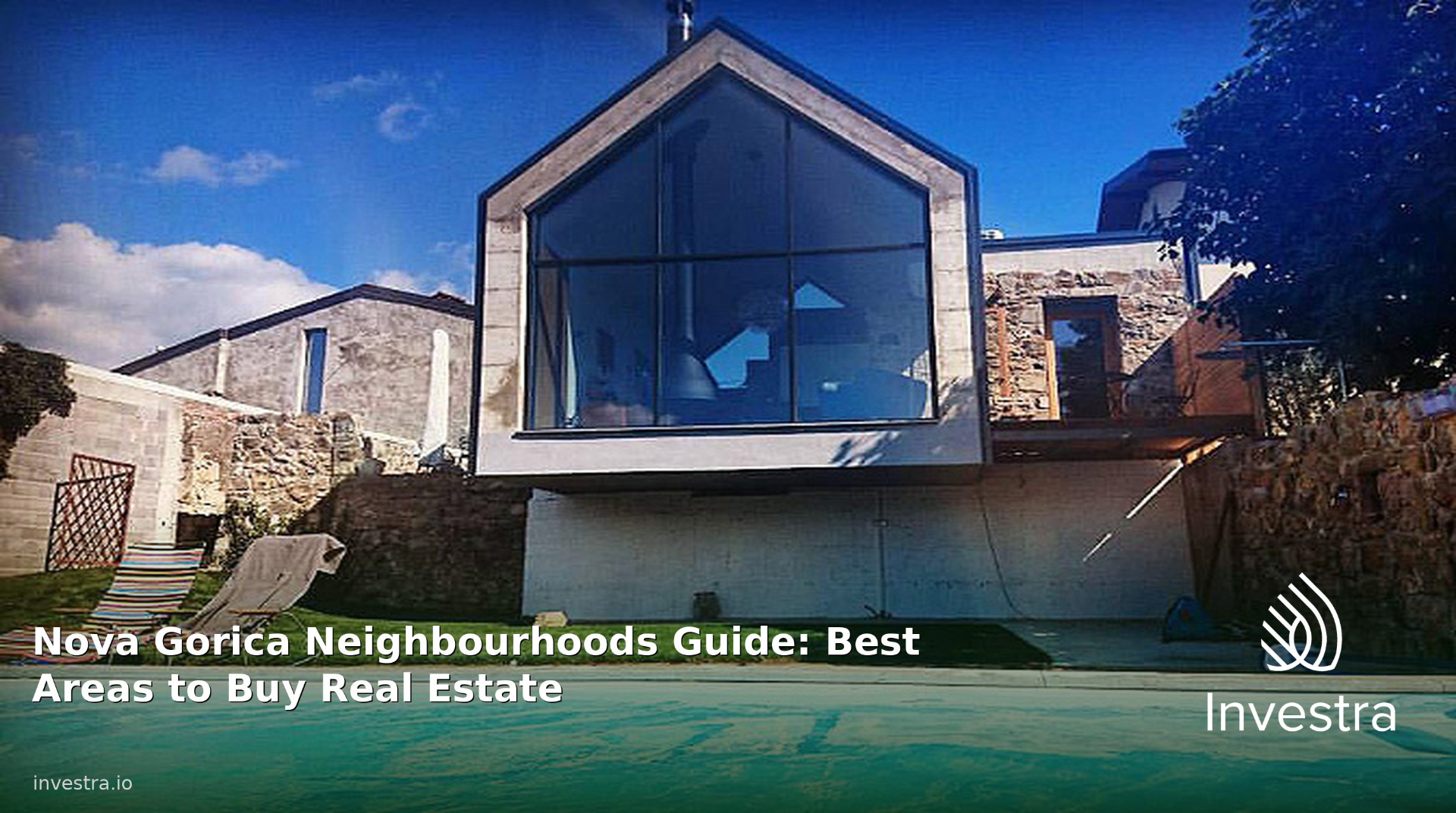
Nova Gorica Neighbourhoods Guide: Best Areas to Buy Real Estate
Nova Gorica Neighbourhoods Guide: Best Areas to Buy Real Estate
Overview: What buyers should know about Nova Gorica neighbourhoods
Quick Answer: Nova Gorica neighbourhoods vary from dense urban centre to quiet wine villages on the Goriška plain; buyers should prioritise transport links, local services, and title verification when choosing an area.
Nova Gorica sits at Slovenia's western edge, next to the Italian town of Gorizia, and the neighbourhoods here reflect that borderland character. Streets can feel Mediterranean in summer and Alpine on crisp winter mornings. In my experience, what surprises many foreign buyers is how different the micro-markets are within a short drive: you can find compact apartments near the railway and municipal services, family homes closer to vineyard slopes, and newer residential projects emerging on the town’s periphery.
When people ask "What should buyers know about Nova Gorica neighbourhoods?" I tell them to separate three practical layers: location (proximity to transport, schools and cross-border commuting), property condition (new build versus older stock requiring renovation), and regulatory/ownership issues (access to the cadastre, notary checks and EU/non-EU buyer rules). You’ll also want to think about daily life—where you’ll shop, which school your children might attend, and how easy it is to reach highway links or the local hospital.
For comparative context within Slovenia, I often point clients to city guides that explain how markets differ across the country. See the Ljubljana real estate market guide and the Maribor real estate market guide to understand how Nova Gorica’s scale and buyer profiles compare to larger Slovenian cities.
Central Nova Gorica: Urban living, amenities and resale considerations
Quick Answer: Central Nova Gorica offers convenience and services ideal for buyers seeking walkable living, but resale value depends on maintenance, floorplan and proximity to key public amenities.
The centre of Nova Gorica is where local administration, cultural venues and the main bus and train connections converge. You’ll find apartment blocks from different eras, a mix of renovated facades and properties that could benefit from modernisation. In my experience, buyers who prioritise convenience choose central locations for short commutes, easy access to shops, and public services. That said, not every central property is equal: a well-maintained corner apartment with good natural light can attract more buyers on resale than a cramped unit without parking.
Think practically: how close is the property to the main bus terminal, the health centre, and primary schools? How noisy is the street in evenings? You should examine municipal plans for any proposed infrastructure works—planned road upgrades or new developments can change desirability quickly. If you want to compare urban living dynamics across Slovenia, the Ljubljana neighbourhood guide and the Maribor neighbourhood guide show the sort of micro-level considerations you should make.
Solkan: Riverside living and cross-border appeal
Quick Answer: Solkan’s riverside setting and proximity to the Italian border make it attractive to buyers who value outdoor access and cross-border lifestyle options.
Solkan sits just west of central Nova Gorica, famous for its historic bridge and riverside paths. If you enjoy easy access to nature without giving up town amenities, Solkan is often on the shortlist. Buyers who commute across the border to Gorizia or work in nearby Italian towns find the neighbourhood particularly convenient. What many investors note is the lifestyle appeal—people who choose Solkan value outdoor recreation like riverside walks and quick trips to nearby hills.
Because Solkan benefits from both urban and green elements, the housing mix includes modest apartment blocks and detached houses with garden space. If you’re considering property here, ask about flood maps and municipality plans, and verify the cadastral records at the local land registry. For broader context on how riverfront and peripheral neighbourhoods function in Slovenia, compare with seaside-focused guides such as the Koper real estate market guide or look at renovation-focused advice in the Ljubljana new-build guide.
Šempeter and Vrtojba: Suburban living and family-focused areas
Quick Answer: Šempeter and Vrtojba are known for quieter residential streets and family-friendly profiles; buyers prioritize school access, parking and local services when choosing here.
Šempeter and Vrtojba sit on the fringes of Nova Gorica and often attract buyers seeking slightly calmer streets without a long commute to the centre. Families especially look for these neighbourhoods because they typically offer more private gardens, playgrounds and proximity to elementary schools. In my experience, these areas appeal to buyers wanting a suburban rhythm—home, garden, good local shops—while still being connected to the town’s core.
Before deciding, check utility infrastructure and public transport frequency. Some suburban parts may require a short drive to reach major supermarkets or healthcare centres. To understand how suburban markets compare across Slovenia, you can reference guides like the Bled neighbourhood guide or the Maribor new-build guide for insights into renovation and family-appeal trade-offs.
Rožna Dolina and Pristava: Mixed districts with development potential
Quick Answer: Rožna Dolina and Pristava combine residential sectors with pockets of undeveloped land; buyers focused on long-term value look for renovation projects and municipal zoning updates.
Rožna Dolina and Pristava offer a mix of older homes and newer residential pockets. I’ve seen buyers attracted to these districts because they can find properties with character that allow for value-adding upgrades. The reality is that any potential upside depends on careful due diligence: building permits, zoning designations, heritage protections and the cost and timeline of permitted renovations.
If you consider a renovation, secure local professional advice early—architects and notaries who know the Goriška region can clarify permit timelines and compliance standards. For example, readers can consult specialist advisors such as Findes Group & Partners or look for investment consulting from experts like advisory services by Siniša Dagary to assess feasibility. Always verify current municipal plans at Nova Gorica’s planning office rather than relying on anecdote.
Vipolže and nearby wine villages: Lifestyle purchases and maintenance realities
Quick Answer: Buying in Vipolže and the wine villages is often a lifestyle choice—expect scenic settings but also maintenance responsibilities typical of rural properties.
Vipolže and the surrounding wine villages in Goriška offer charming stone houses and vineyard views. Many buyers are drawn by lifestyle factors: proximity to tasting rooms, slower pace, and a strong sense of place. What we’ve observed is that these purchases often require realistic budgeting for building upkeep, especially if properties are older or have historic elements.
Ask about water, septic systems, road access in winter, and any agricultural zoning that might limit expansion. If you’re planning to operate a guesthouse or a small B&B, check local tourism licensing requirements and consult a local accountant about business registration. For a sense of how lifestyle markets can differ across Slovenia, compare with mountain or lakeside guides like the Bled real estate market guide and the Bled new-build guide.
Branik and rural outskirts: Country estates, access and utilities
Quick Answer: Branik and the rural outskirts appeal to buyers seeking country estates, but you must check access rights, utility connections and long-term maintenance obligations.
Properties on the rural edge—like Branik (Rihemberk) and other outskirts—offer spacious plots and tranquility. They’re attractive if you want land, privacy, or agricultural use. The trade-off is practical: rural utility infrastructure can vary, and access roads may be seasonal. I always remind clients to inspect not just the house but the land title, servitudes, and existing agricultural designations.
Consult the land registry and local municipal offices for clarifications on property boundaries and permitted uses. If you’re exploring larger country properties with restoration potential, professional advice from firms like Findes Group & Partners advisory team can be useful. Also, advisors such as investment consultation services from Siniša Dagary may help you determine whether a rural purchase aligns with your strategic goals.
New builds and renovation opportunities in Nova Gorica
Quick Answer: New builds offer modern standards; renovation projects can unlock value—but both require careful checks on permits, contractor reliability and building warranties.
Across Nova Gorica, you’ll find small-scale new developments and a stock of older properties that may reward thoughtful renovation. In my experience, buyers who succeed are those who plan project timelines conservatively and secure local professionals early—architects who understand Slovenian building codes, reputable contractors, and a reliable notary to oversee transfers and encumbrances.
For renovation projects, verify whether the building lies in a heritage-protected zone and confirm the permit process with the municipal planning department. If you’re considering new builds, review builder contracts for guarantees, completion dates, and penalty clauses. For broader guidance on new-builds and renovations in other Slovenian cities, read the Ljubljana new-build guide, the Maribor new-build guide and the Bled new-build guide for process checklists you can adapt locally.
Legal basics for buying property in Nova Gorica
Quick Answer: You must verify ownership and encumbrances at the land registry and consult a notary and lawyer experienced in Slovenian property law before signing any contract.
Legal certainty is the backbone of any property purchase. The reality is that title issues, easements, and outstanding mortgages can complicate transactions if not caught early. I always advise buyers to obtain a full extract from the land registry (the Kadaster) and a search for any registered encumbrances before making an offer. A notary public in Slovenia formalises the transfer of real estate, so choose one with local experience.
If you're not fluent in Slovenian legal documents, use certified translation and have a local attorney review contracts. Non-resident buyers should ask how bilateral agreements and reciprocity rules might affect acquisition rights; these rules can change, so check with local authorities or an advisory service. For step-by-step buying help in comparable cities, see Investra’s city-specific guides such as Buying property in Ljubljana, Buying property in Maribor, and Buying property in Bled.
Taxes, fees and recurring costs: What to check and how to verify them
Quick Answer: Taxes and fees vary with transaction type and residency; confirm current rates and obligations with the local tax office, a certified accountant, or a notary.
Understanding the true cost of ownership means looking beyond the purchase price. There are transaction fees, notary and legal fees, possible transfer taxes depending on buyer status, property tax, utilities and association costs for apartments. I don’t invent numbers here because tax rules and rates change; instead, I instruct buyers to verify figures directly through reliable sources.
Good verification steps include contacting the Nova Gorica municipal tax office, consulting a Slovenian-certified accountant, and asking your notary to itemise expected transaction costs in writing prior to commitment. If you want comparative perspectives or checklists, Investra’s city guides often include procedural breakdowns—see Buying property in Koper and the Ljubljana rental market guide for the kinds of documentation you should request.
Rentals and short-term lets in Nova Gorica: Demand drivers and compliance
Quick Answer: Rental demand in Nova Gorica is shaped by local employment, students and cross-border workers; check municipal short-term rental regulations and obtain professional guidance before listing.
The rental market in Nova Gorica serves a mix of long-term tenants—local workers and families—and short-term visitors drawn to the border region. What surprised many buyers I’ve worked with is how cross-border employment patterns influence demand: people might work in Italy but live in Slovenia, or vice versa. If you plan to rent out a property, understand whether you’re aiming at stable long-term leases or short-term tourist lets, because the regulatory and tax implications differ.
Before converting a property for short-term use, contact the municipal tourism office to learn licensing requirements and health-and-safety regulations. A local property manager can give you up-to-date insights on occupancy patterns and guest expectations. For operational templates and regional rental perspectives, consult Investra’s rental guides such as the Maribor rental market guide, Bled rental market guide, and the Ljubljana rental market guide.
Finding local advisors and making an offer: Practical steps
Quick Answer: Build a local advisory team—agent, notary, lawyer, and accountant—and request written checks on title, permits and expected closing costs before making an offer.
Putting an offer on a property in Nova Gorica should be the last step in a well-documented process. First, arrange a local team: a real estate agent who knows Nova Gorica neighbourhoods, a notary for legal transfers, a lawyer for contract review and an accountant for taxation matters. In my experience, deals stall when buyers skip one of these roles and later discover an encumbrance or municipal restriction.
Ask advisors to provide written confirmations of key facts: proof of ownership from the land registry, a statement of any liens, and a clear outline of permits attached to the property. If you need specialist investors’ advice, consider reaching out to consultants such as Siniša Dagary, whose investment insights often discuss strategic decision-making, or book an investment consultation. For local corporate advisory, firms like Findes Group & Partners and their advisory team can assist with due diligence and structuring.
How to verify current market data for Nova Gorica
Quick Answer: Verify current data by consulting the land registry, municipal planning office, local notaries, and reputable market reports rather than relying on single listings or anecdote.
Market dynamics change, and so do tax rules. I never provide static figures because they can be out of date within months. Instead, set up a verification routine: pull recent sales extracts from the land registry, request comparable sales data from licensed local agents, and ask municipal offices for recent zoning changes. Notaries are often the best source to confirm transaction records.
Online portals give you a first look, but validate everything through primary sources. For supplemental regional context, study detailed city market guides from Investra—such as the Ljubljana guide, the Maribor guide, the Bled guide, and the Koper guide to see how different Slovenian markets are analysed and reported.
Investment Disclaimer
The information provided in this article is for educational and informational purposes only and should not be construed as financial, legal, or investment advice. Real estate investments carry inherent risks, and past performance does not guarantee future results. Investors should not invest money they cannot afford to lose. Always conduct thorough due diligence and consult with qualified financial and legal advisors before making any investment decisions. Investra.io does not guarantee returns on any investment.
Frequently Asked Questions
What are the most sought-after Nova Gorica neighbourhoods?
“Most sought-after” depends on your priorities. For walkable urban life, buyers often look at central Nova Gorica; for riverside living, Solkan is popular; for family suburbs, Šempeter and Vrtojba are common choices. But demand shifts with local employment, cross-border trends and municipal investments. To determine current preferences, consult recent sales extracts at the land registry, speak to local agents who specialise in Nova Gorica neighbourhoods, and review municipal planning documents for upcoming improvements that can influence desirability.
Can foreign buyers purchase property in Nova Gorica?
Foreign purchasing rights can depend on nationality and reciprocity agreements. I recommend checking current rules with a local notary or an experienced lawyer before you proceed. They can confirm whether you need special permission, how registration works, and if any conditions apply. You can also consult international buying guides from Investra for procedural overviews that help prepare the paperwork.
How do I check property ownership and encumbrances?
Request an extract from Slovenia’s land registry (cadastre). A notary or lawyer can obtain this for you and interpret any encumbrances, mortgages, or servitudes. Don’t accept verbal assurances: ask for official documentation. If you’re unsure, hire legal counsel to perform a title search and explain the implications of any entries on the file.
What local taxes and fees should buyers be aware of?
There are transaction-related fees, notary costs, and ongoing property taxes. Because these amounts and tax treatments change, verify current rates with the Nova Gorica municipal tax office, a certified accountant, and your notary. They will provide up-to-date, tailor-made calculations based on your residency status and the nature of the purchase.
Is renovating an older house in the Goriška region complicated?
Renovation complexity varies. If the house lies in a heritage area, additional permits and architectural approvals may be required. Even outside heritage zones, structural surveys, permit timelines and contractor availability will affect your schedule. Engage local architects and builders early and ask the municipality about permit processing times. Consultants like those at advisory services or local firms can estimate feasibility.
How reliable are rental prospects in Nova Gorica?
Rental prospects depend on location, property condition and tenant profile. Areas near transport hubs attract long-term tenants; tourist-season locations draw short-term guests. For a realistic assessment, ask local property managers for recent occupancy trends and request references from owners who rent in the same neighbourhood. Consider hiring a local property management firm if you won’t be resident.
Who should I contact for local due diligence?
Your core team should include a licensed real estate agent familiar with Nova Gorica neighbourhoods, a notary for title and contract work, and an accountant for tax planning. For complex purchases, add a local lawyer and an architect or engineer for inspection. Firms like Findes Group & Partners and consultants such as Siniša Dagary are examples of resources that can help coordinate due diligence.
How do I verify current market prices for a neighbourhood?
Extract recent comparable sales from the land registry and ask multiple local agents for sales data. Cross-check with notarial records and municipal statements. Public statistics offices sometimes publish average metrics, but the most reliable route is a combination of the land registry and qualified local agents who can confirm whether comparables are truly similar properties.
What practical checks should I make during a property visit?
Inspect the property’s structural condition, plumbing, heating system, and insulation. Test mobile and internet coverage, ask about average utility costs, observe parking availability, and speak to neighbours about noise or community issues. Always ask the seller for service invoices and recent renovation documentation. If anything feels uncertain, commission a professional building survey.
Can I buy to operate a tourist rental in Nova Gorica?
Yes, but you must comply with municipal licensing, health and safety standards, and tax rules for rental income. Confirm tourism licensing requirements with local authorities and consult a tax advisor about declaring rental income. If you plan to scale a short-term rental operation, prepare a business plan and engage local property managers to handle day-to-day operations and guest services.
Where can I find trusted local contractors and architects?
Ask your agent or notary for recommendations and verify credentials and references. Local professional associations and municipal planning offices often maintain lists of licensed architects and builders. Interview several providers, request written quotes, and ask for examples of recent projects similar to yours.
Recommended Reading
- Ljubljana real estate market guide
- Buying property in Ljubljana
- Ljubljana rental market guide
- Ljubljana neighbourhood guide
- Ljubljana new-build guide
- Maribor real estate market guide
- Siniša Dagary — Investment Consultant
- Business Strategy Blog
Connect With Investra
Follow Investra on social media for market updates and property listings: Facebook, LinkedIn, YouTube.
Embedded Investra and partner links used throughout the article: Listed Investra links included: Ljubljana real-estate, Buying Ljubljana, Ljubljana rental, Ljubljana neighbourhood, Ljubljana new-build, Maribor market, Buying Maribor, Maribor rental, Maribor neighbourhood, Maribor new-build, Bled market, Buying Bled, Bled rental, Bled neighbourhood, Bled new-build, Koper market, Buying Koper. Sinisa Dagary links included: home, blog-posts, about/services/contact. Findes links included: home and contact.Connect With Investra
Quick Answer: Follow Investra for verified market context and practical property research.
Related Posts
No related posts available.
