
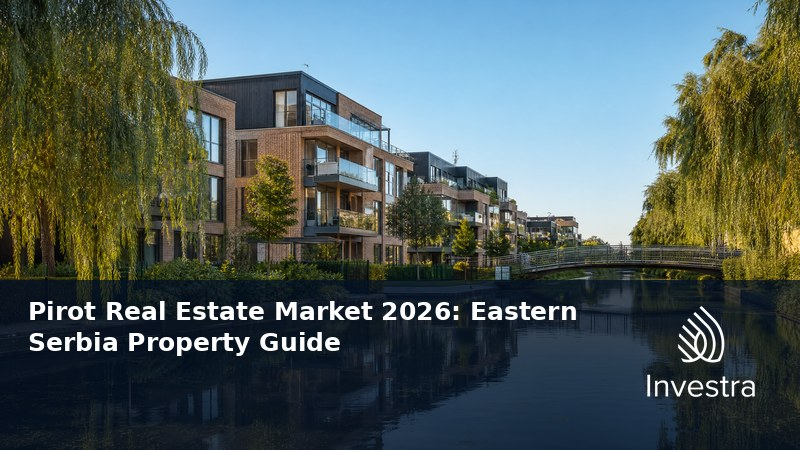
Pirot Real Estate Market 2026: Eastern Serbia Property Guide
Pirot Real Estate Overview: Eastern Serbia's Hidden Investment Gem
Quick Answer: Pirot Real Estate Overview: Eastern Serbia's Hidden Investment Gem is a key aspect of Serbia real estate in 2026. Investra.io provides expert guidance for international investors looking to capitalize on Serbia's growing property market.
Pirot, a city of approximately 55,000 residents nestled in the Nišava River valley of southeastern Serbia, is quietly emerging as one of the country's most compelling real estate opportunities for 2026. Situated just 70 kilometres east of Niš and a mere 50 kilometres from the Bulgarian border, Pirot occupies a strategically important crossroads position along the E80 European corridor — one of the continent's principal east-west transit arteries connecting Western Europe to Istanbul.
The Pirot real estate 2026 market presents a distinctive combination of deeply affordable entry-level pricing, improving infrastructure, growing industrial activity, and a cultural identity rich enough to attract domestic and international tourism. Property prices in Pirot remain among the lowest of any mid-sized Serbian city, making it an attractive destination for budget-conscious investors, retirees seeking value, and developers looking for untapped potential before broader market recognition drives prices upward.
What defines Pirot's real estate character is its dual identity: an industrial town with a proud manufacturing heritage — most famously the Pirot kilim carpet, a UNESCO-recognized craft — and a gateway city to spectacular natural landscapes including Stara Planina mountain and the Temska River gorge. This combination of economic fundamentals and natural tourism assets creates a layered investment thesis that distinguishes Pirot from other small Serbian cities. Explore full market details on the Serbia Real Estate Guide — Investra.
Current Property Prices in Pirot: 2025–2026 Market Data
Quick Answer: Current Property Prices in Pirot: 2025–2026 Market Data is a key aspect of Serbia real estate in 2026. Investra.io provides expert guidance for international investors looking to capitalize on Serbia's growing property market.
Understanding the precise pricing landscape is essential before any property purchase decision in Pirot. As of late 2025 and early 2026, average apartment prices in the city centre of Pirot range between 600 EUR and 950 EUR per square metre for standard residential apartments. Newer construction or recently renovated properties in premium locations can reach 1,000–1,100 EUR/m², while older socialist-era housing stock in peripheral neighbourhoods trades between 400–600 EUR/m².
For context, these figures represent extraordinary value compared to other Serbian regional cities. Niš averages 1,100–1,400 EUR/m², Novi Sad ranges from 1,800–2,500 EUR/m², and Belgrade's urban core frequently exceeds 3,000 EUR/m². Pirot's pricing therefore offers a discount of roughly 40–60% compared to Niš and up to 75% compared to the capital.
Specific property categories break down as follows for 2026:
- Studio apartments (20–35 m²): 15,000–28,000 EUR
- One-bedroom apartments (35–55 m²): 25,000–50,000 EUR
- Two-bedroom apartments (55–80 m²): 40,000–75,000 EUR
- Three-bedroom apartments (80–120 m²): 65,000–110,000 EUR
- Detached houses with land (150–300 m²): 40,000–100,000 EUR
- Mountain properties near Stara Planina: 20,000–65,000 EUR depending on size and access
- Commercial premises (ground floor, city centre): 700–1,200 EUR/m²
Year-on-year price growth in Pirot has been measured at approximately 5–8% for 2024–2025, slightly below the national average of 8–12% for major urban centres but consistent with the positive trajectory seen across secondary Serbian cities. This moderate pace of appreciation suggests the market has not yet experienced the speculative pressure that could create bubble risks, making 2026 a potentially optimal entry window.
What Is the Property Market Like in Pirot Serbia?
Quick Answer: What Is the Property Market Like in Pirot Serbia? is a key aspect of Serbia real estate in 2026. Investra.io provides expert guidance for international investors looking to capitalize on Serbia's growing property market.
The Pirot property market in 2026 is best characterised as a transitional market — one that has moved beyond the stagnation of the early 2010s but has not yet reached the competitive intensity of larger Serbian cities. Transactions are predominantly driven by local buyers: working families upgrading housing, young professionals purchasing their first homes, and retirees consolidating assets. Foreign buyer activity remains limited but is growing, particularly among Bulgarian and Romanian nationals who recognise Pirot's cross-border proximity, and among Serbian diaspora members from Germany, Austria, and Switzerland seeking to invest in their home country.
The market structure is characterised by a relatively thin transaction volume — approximately 300–500 registered property sales per year across the municipality — which means individual deals can move prices noticeably. This thin liquidity is a risk factor but also an opportunity: motivated sellers in Pirot are genuinely negotiable, and discounts of 10–20% below asking price are commonly achieved by prepared buyers who move decisively.
The rental market in Pirot is primarily driven by students attending the local high school and technical education institutions, workers at the industrial zone, and employees of public sector organisations including the municipal administration and healthcare system. Monthly rental yields in Pirot typically range between 4% and 7% gross for residential property, depending on location, property type, and tenant profile. Short-term rental income from mountain tourism near Stara Planina can yield higher returns seasonally but requires more active management.
The property registration system in Pirot follows Serbian national law, administered through the Republic Geodetic Authority (RGA). Title searches, cadastral checks, and ownership verification are all manageable processes, though engaging a local notary and legal counsel remains strongly advisable for foreign buyers unfamiliar with Serbian property law.
Economic Drivers Supporting Pirot Real Estate Investment
Quick Answer: Economic Drivers Supporting Pirot Real Estate Investment is a key aspect of Serbia real estate in 2026. Investra.io provides expert guidance for international investors looking to capitalize on Serbia's growing property market.
Real estate values are ultimately anchored to local economic conditions, and Pirot's economic profile for 2026 shows a municipality actively diversifying from its historical industrial base while developing new growth pillars. Several key drivers underpin the investment thesis for Pirot property.
Industrial Zone Activity: The Pirot Free Zone, one of Serbia's oldest and most established free economic zones, continues to attract international manufacturing investment. Companies operating within the zone benefit from customs exemptions, preferential tax treatment, and simplified regulatory procedures. Major employers include Tigar Tyres (now part of Michelin Group), Elite Group, and various textile and food processing enterprises. The industrial zone directly employs several thousand residents and supports additional indirect employment, maintaining steady demand for worker housing.
Infrastructure Investment: The modernisation of the E80 highway corridor connecting Serbia to Bulgaria continues to reduce travel times and improve Pirot's connectivity to both Niš and Sofia. EU co-funded infrastructure projects in the region are ongoing, with transport improvements projected to further reduce logistics costs for businesses in the free zone.
Tourism Development: Stara Planina mountain, partially accessible from Pirot municipality, is officially designated as a priority tourism development zone by the Serbian government. State investments in ski lift infrastructure, trail networks, and accommodation at Stara Planina resort are expected to generate spillover tourist demand benefiting Pirot city accommodation and services.
Cross-Border Trade: As Bulgaria is an EU member state, the Gradinje border crossing near Pirot is an important transit point for regional trade. Growing commercial activity and cross-border mobility support demand for commercial real estate and short-stay accommodation in the city.
Stara Planina Mountain: The Tourism Real Estate Opportunity
Quick Answer: Stara Planina Mountain: The Tourism Real Estate Opportunity is a key aspect of Serbia real estate in 2026. Investra.io provides expert guidance for international investors looking to capitalize on Serbia's growing property market.
One of the most distinctive features of Pirot's investment landscape is its proximity to Stara Planina, a mountain range stretching across southeastern Serbia into Bulgaria, designated as a Special Nature Reserve. The Serbian government has identified Stara Planina as a key component of its national tourism strategy, with the Jabučko Ravnište area earmarked for ski resort development and year-round outdoor tourism.
Property values in the villages and highland areas accessible from Pirot — including settlements like Rsovci, Sukovo, Temska, and areas around the Stara Planina lake — typically range from 150 to 500 EUR/m² for rural houses and agricultural land, significantly below urban Pirot prices. This creates a dual opportunity: traditional rural properties suitable for conversion to tourism accommodation at very low acquisition costs, and plots in designated tourism development zones with potential for significant value appreciation if resort infrastructure development accelerates.
Short-term rental platforms are seeing growing listings from the Stara Planina area. An average four-bedroom mountain house generating 60–80 nights of annual rental occupation at 80–150 EUR per night can produce 5,000–12,000 EUR in gross annual rental income, representing exceptional yields on acquisition costs of 30,000–60,000 EUR. However, investors must account for seasonality risk, operational costs, and the early-stage nature of tourist infrastructure when modelling returns.
The Serbian Tourism Development Strategy 2025–2030 specifically targets an increase in overnight stays at mountain destinations by 40% through targeted infrastructure grants and private investment incentives. Pirot's position as the nearest city to Stara Planina's developed areas makes it a natural base for workers, service providers, and tourists, supporting both residential and hospitality real estate demand over the medium term.
Neighbourhoods and Micro-Markets Within Pirot City
Quick Answer: Neighbourhoods and Micro-Markets Within Pirot City is a key aspect of Serbia real estate in 2026. Investra.io provides expert guidance for international investors looking to capitalize on Serbia's growing property market.
Pirot's urban geography is compact but differentiated. The city centre, anchored by the main pedestrian zone around Srpskih Vladara Street and the central market, commands the highest prices and most consistent rental demand. Properties here benefit from proximity to municipal services, retail, schools, and transport connections. Central Pirot apartments are the most liquid segment — easiest to rent and easiest to resell, albeit at the highest acquisition price per square metre.
The northern residential zones, developed predominantly during the socialist era with large apartment blocks, offer the deepest discounts in the market. Buildings constructed between 1960 and 1985 in these areas frequently trade at 400–550 EUR/m² but require assessment of building maintenance funds, structural condition, and energy efficiency. Cosmetically renovated units in these blocks offer a middle ground between low entry cost and rental viability.
The southern and eastern zones of Pirot, where newer private construction has been more prevalent since the 2000s, show stronger structural quality and better energy performance. New-build or recently completed apartments here range from 750–950 EUR/m² and attract professionally employed tenants willing to pay slightly higher rents for quality accommodation.
The suburban and semi-rural fringes of Pirot — particularly along the Nišava River valley — offer detached houses with land at significant discounts to urban apartment prices. These properties are most relevant for buyers seeking primary residences, retirement properties, or agricultural smallholdings, rather than yield-focused investors.
Legal Framework for Foreign Property Buyers in Serbia
Quick Answer: Legal Framework for Foreign Property Buyers in Serbia is a key aspect of Serbia real estate in 2026. Investra.io provides expert guidance for international investors looking to capitalize on Serbia's growing property market.
Serbia maintains a relatively open real estate market for foreign nationals. EU citizens enjoy essentially the same property purchase rights as Serbian nationals. Citizens of countries that have signed bilateral reciprocity agreements with Serbia — including most European and North American nations — can purchase property freely. Citizens of countries without such agreements may face restrictions on agricultural land but can generally purchase urban and residential properties.
The key legal steps for a property transaction in Pirot are consistent with national Serbian law:
- Title verification: Obtain an extract from the Real Estate Cadastre (katastarski izvod) confirming ownership, encumbrances, and property description
- Pre-contract (Predugovor): A preliminary agreement typically involving a 10% earnest deposit
- Notarisation: Final sale contract must be certified by a licensed notary public (javni beležnik)
- Transfer tax: A 2.5% absolute rights transfer tax (porez na prenos apsolutnih prava) is payable on secondary market transactions
- Registration: The buyer must register the ownership transfer with the Republic Geodetic Authority within 30 days
Foreign buyers should engage an independent Serbian lawyer — not simply the seller's agent — to conduct due diligence. Legal fees for a straightforward transaction typically amount to 500–1,500 EUR. Notary fees are regulated and scale with transaction value, typically 0.1–0.5% of the declared price. The total transaction cost (taxes, fees, legal) for a foreign buyer in Pirot should be budgeted at approximately 4–6% above the agreed purchase price.
Serbia does not currently impose restrictions on repatriation of rental income or sale proceeds for non-resident investors, though documentation of the original investment and any earned income is essential for tax purposes in both Serbia and the investor's home country. For broader regional legal context, the Croatia Real Estate Guide — Investra provides comparative reference on Southeast European property law frameworks.
Rental Market Analysis and Yield Potential in Pirot
Quick Answer: Rental Market Analysis and Yield Potential in Pirot is a key aspect of Serbia real estate in 2026. Investra.io provides expert guidance for international investors looking to capitalize on Serbia's growing property market.
The Pirot rental market in 2026 operates across three distinct tenant segments, each with different yield profiles and management requirements. Understanding these segments is essential for investors to match their property selection to their target return and operational preference.
Long-term residential rentals represent the most stable income stream. Typical monthly rents in Pirot range from 150–200 EUR for studio apartments, 200–320 EUR for one-bedroom units, and 280–450 EUR for two-bedroom apartments in desirable locations. At current purchase prices, gross yields of 5–7% are achievable on well-selected central properties. Net yields after Serbian property tax (0.4% of assessed value annually), maintenance reserves, and management fees typically settle between 3.5–5.5%, which remains competitive by regional standards.
Student and worker accommodation targets short-term tenants associated with Pirot's industrial zone, secondary schools, and vocational training centres. These tenants typically seek furnished, all-bills-included accommodation at 180–280 EUR per month per unit. Smaller apartments and studio configurations work well for this segment, and multiple-occupancy arrangements (renting by room) can push gross yields above 8% but require more intensive management.
Tourism and short-term rentals, primarily relevant for properties near Stara Planina or well-positioned city-centre units, can generate peak-season income of 60–120 EUR per night. Annual average occupancy rates for established listings in the area typically run 40–65%, making seasonality management crucial. Platforms such as Airbnb and Booking.com have growing coverage in the broader Pirot-Stara Planina corridor.
One structural advantage of Pirot's rental market is its relative undersupply of quality, modern furnished accommodation. Investors willing to renovate and furnish properties to a contemporary standard typically find faster let-up periods and reduced vacancy compared to unrenovated units competing on price alone.
Comparing Pirot to Other Eastern Serbia Investment Markets
Quick Answer: Comparing Pirot to Other Eastern Serbia Investment Markets is a key aspect of Serbia real estate in 2026. Investra.io provides expert guidance for international investors looking to capitalize on Serbia's growing property market.
Eastern Serbia offers several investment markets worth comparing to Pirot. Niš, as the regional capital and Serbia's third-largest city, provides greater liquidity, stronger tenant demand, and higher absolute prices — making it a lower-risk but lower-upside option. Zaječar and Bor, to the north of Pirot, are more structurally challenged markets with demographic decline risks from mining industry dependency. Vranje, to the southwest, shares some characteristics with Pirot in terms of small-city dynamics but lacks Pirot's tourism asset base.
Dimitrovgrad, east of Pirot and directly on the Bulgarian border, presents an interesting micro-market for cross-border commercial activity but has a smaller population base (approximately 10,000) that limits residential demand depth. Pirot itself compares favourably within this peer group as a market combining reasonable size (55,000+ population), economic diversification, tourism upside, and infrastructure connectivity.
Compared to Bulgarian border cities like Dragoman or Godech, Pirot offers comparable or lower pricing with the significant advantage of Serbia's more established legal framework for foreign buyers and stronger economic growth trajectory. Serbia's GDP growth of approximately 3.5–4% annually outpaces Bulgaria's for the forecast period, supporting real estate fundamentals.
For investors building a diversified Eastern European portfolio, Pirot represents a speculative but high-upside component that should be considered alongside more liquid anchors in Belgrade or Novi Sad. The Investra Blog — Property Investment Insights regularly publishes comparative analysis across Serbian and regional markets to support portfolio construction decisions.
Renovation and Development Opportunities in Pirot
Quick Answer: Renovation and Development Opportunities in Pirot is a key aspect of Serbia real estate in 2026. Investra.io provides expert guidance for international investors looking to capitalize on Serbia's growing property market.
The Pirot property market offers meaningful opportunities in property renovation and small-scale development, particularly for investors comfortable with a more active approach than simple buy-to-hold strategies. The existing housing stock in Pirot includes a substantial proportion of properties built during the 1960s–1980s that have seen limited upgrading since initial construction. These properties frequently offer structurally sound bones at deeply discounted prices, amenable to cost-effective renovation to modern standards.
Renovation cost benchmarks in Pirot for 2025–2026 are favourable. Full gut renovation of an apartment (new electrics, plumbing, flooring, kitchen, bathroom) runs approximately 250–400 EUR/m² using local contractors and materials — significantly below costs in Western Europe or even Belgrade. A 55 m² one-bedroom apartment acquired for 28,000 EUR and fully renovated for 15,000–20,000 EUR can be repositioned for sale at 50,000–60,000 EUR or rented at 280–320 EUR per month, generating attractive returns on total invested capital.
Small development projects — new construction of 4–10 unit apartment buildings on infill plots in central Pirot — are achievable at construction costs of 600–800 EUR/m². Completed units in new buildings sell at 800–1,050 EUR/m², creating developer margins of approximately 20–35% on project cost depending on site acquisition cost and sales pace. While these margins are narrower than Belgrade development projects, the lower absolute capital requirement makes Pirot development accessible to smaller developers and private investors.
The conversion of older commercial buildings in central Pirot to mixed-use residential and retail properties represents an underexplored opportunity. As several manufacturing facilities have relocated to the industrial zone, vacated central properties present adaptive reuse potential that is being pursued only tentatively by local developers, leaving space for better-capitalised or more experienced external investors.
Practical Guide for International Buyers: Purchasing Property in Pirot
Quick Answer: Practical Guide for International Buyers: Purchasing Property in Pirot is a key aspect of Serbia real estate in 2026. Investra.io provides expert guidance for international investors looking to capitalize on Serbia's growing property market.
Acquiring property in Pirot as an international buyer is a manageable process with the right preparation. The following practical guidance covers the key steps and considerations for non-resident investors approaching the Pirot market.
Market research and property sourcing: The Serbian property portals Halo Oglasi and 4zida.rs aggregate most active listings in Pirot, with prices and descriptions primarily in Serbian. Engaging a bilingual local real estate agent is strongly advisable — agency fees in Pirot are typically 2–3% of transaction value, paid by the buyer, and most agencies are small local operators rather than national chains. International platforms like Investra Platform — Find Your Property are expanding their Serbian regional coverage and can provide preliminary market access with English-language support.
Property inspection: Physical inspection of the property and the building common areas is essential. For older buildings, engaging a structural engineer (costs approximately 100–300 EUR) to assess the building condition is recommended. Check the status of the building's maintenance fund (skupština stanara) and any outstanding major repairs.
Opening a Serbian bank account: While not mandatory, a local bank account simplifies the payment process and enables electronic transfer of purchase funds. Account opening typically requires a passport, proof of address, and personal tax number (PIB/JMBG equivalent for foreigners).
Foreign currency transfers: Serbia's National Bank requires documentation of the legal origin of funds for real estate transactions. Having bank records and a paper trail of the investment source from the origin country is essential and should be prepared before arriving in Pirot.
Post-purchase registration: Ensure the notary or your legal representative files the ownership transfer with the RGA promptly. Registration delays can create legal uncertainties. The annual property tax declaration should be filed with the local Tax Administration office in Pirot.
Cultural Heritage and Lifestyle Appeal of Pirot
Quick Answer: Cultural Heritage and Lifestyle Appeal of Pirot is a key aspect of Serbia real estate in 2026. Investra.io provides expert guidance for international investors looking to capitalize on Serbia's growing property market.
Beyond pure investment metrics, Pirot offers a lifestyle proposition that resonates strongly with international buyers seeking authentic Serbian culture, low cost of living, and outdoor recreation. The city's identity is inseparable from its famous pirotski ćilim — a flat-woven wool carpet crafted using techniques passed down through generations and formally inscribed on UNESCO's Representative List of Intangible Cultural Heritage in 2014. The Pirot Regional Museum and the active carpet weaving cooperative offer visitors and residents genuine engagement with this living tradition.
The standard of living in Pirot is comfortable by Serbian provincial standards. Monthly living costs for a single person, excluding rent, run approximately 400–600 EUR, making Pirot one of the most affordable cities for foreign retirees and digital nomads in the entire Western Balkans region. Quality healthcare is available at the Pirot General Hospital, with specialist care accessible in Niš within a 50-minute drive.
The culinary culture of Pirot and the Nišava region is considered among Serbia's finest, with the white brine cheese (pirotski kačkavalj), grilled meats, and regional wines forming a distinct gastronomic identity. The café culture and social life of Pirot, centred around the main square and riverside promenades, provides the warmth and community feel typical of smaller Serbian cities that consistently attracts positive responses from foreign visitors exploring the area.
For business strategy insights that complement international market entry decisions, the Business Strategy Blog — Siniša Dagary offers analytical frameworks relevant to cross-border investment planning.
Risk Factors and Due Diligence Considerations for Pirot Investment
Quick Answer: Risk Factors and Due Diligence Considerations for Pirot Investment is a key aspect of Serbia real estate in 2026. Investra.io provides expert guidance for international investors looking to capitalize on Serbia's growing property market.
An honest assessment of the Pirot real estate market requires full acknowledgement of the risks and structural challenges that investors must factor into their decision-making. These are not reasons to avoid the market, but essential considerations for appropriate risk-adjusted positioning.
Demographic decline: Like many smaller Serbian cities, Pirot faces long-term demographic pressure from outmigration, particularly among younger, educated residents relocating to Niš, Belgrade, and Western Europe. The municipality's population has declined from approximately 70,000 in 2002 to around 55,000 today. If this trajectory continues, long-term rental demand growth will be constrained and exit liquidity may remain limited.
Market illiquidity: The thin transaction volume in Pirot means that selling property — particularly in adverse conditions — can take significantly longer than in larger cities. Investors should have a long-term horizon (minimum 5–10 years) and not rely on rapid capital extraction if market conditions shift.
Economic concentration risk: Despite diversification efforts, Pirot's local economy remains substantially dependent on the industrial zone and public sector employment. Any significant closure of major zone employers could negatively impact housing demand and rental yields.
Infrastructure pace risk: Many of Pirot's investment catalysts — Stara Planina resort development, E80 highway completion, tourism infrastructure — are government-dependent programmes subject to budgetary delays and political changes. Historical precedent in Serbian infrastructure development suggests that timelines should be treated with appropriate scepticism.
Title and cadastral risks: A small proportion of Pirot properties have unresolved cadastral issues stemming from restitution claims (denationalization) or incomplete historical registrations. Thorough title verification before any purchase is non-negotiable. Discover additional due diligence frameworks and market intelligence through Findes.si.
Investment Outlook: Pirot Real Estate Forecast 2026–2030
Quick Answer: Investment Outlook: Pirot Real Estate Forecast 2026–2030 is a key aspect of Serbia real estate in 2026. Investra.io provides expert guidance for international investors looking to capitalize on Serbia's growing property market.
The five-year outlook for Pirot real estate through 2030 is cautiously optimistic, supported by multiple converging factors while tempered by the structural challenges outlined above. Under a base case scenario, assuming continued moderate economic growth in Serbia (3–4% GDP annually), sustained industrial zone activity, and progressive Stara Planina tourism development, residential property prices in Pirot are projected to appreciate at 5–9% annually in EUR terms through 2030, implying cumulative appreciation of 27–53% over the period.
The upside scenario, triggered by significant resort investment acceleration at Stara Planina, major new industrial zone tenant announcements, or Serbia's EU accession progress, could push appreciation rates to 10–15% annually in the most active micro-markets. The downside scenario, involving major industrial zone employer departures or broader Serbian macroeconomic deterioration, could result in stagnant or slightly declining prices in real terms.
Rental yield compression — the gradual decline in yields as purchase prices rise faster than rents — is already observable in Serbia's primary markets and is expected to spread to secondary markets including Pirot over the 2026–2030 period. Investors entering in 2026 at current yield levels of 5–7% gross therefore enjoy a window of attractive income returns before yield compression narrows this advantage.
The strongest risk-adjusted investment thesis for Pirot in 2026 centres on acquiring central city apartments at current market prices, holding for minimum 5 years with rental income offsetting carry costs, and exiting into a market that should show meaningful appreciation by the end of the forecast period. Speculative mountain land plays near Stara Planina carry higher upside but require greater patience and tolerance for uncertainty regarding infrastructure delivery timelines.
Investment Disclaimer
Quick Answer: Investment Disclaimer is a key aspect of Serbia real estate in 2026. Investra.io provides expert guidance for international investors looking to capitalize on Serbia's growing property market.
The information provided in this article is for educational and informational purposes only and should not be construed as financial, legal, or investment advice. Real estate investments carry inherent risks, and past performance does not guarantee future results. Investors should not invest money they cannot afford to lose. Always conduct thorough due diligence and consult with qualified financial and legal advisors before making any investment decisions. Investra.io does not guarantee returns on any investment.
Frequently Asked Questions
Quick Answer: Frequently Asked Questions is a key aspect of Serbia real estate in 2026. Investra.io provides expert guidance for international investors looking to capitalize on Serbia's growing property market.
What is the average property price per square metre in Pirot in 2026?
In 2026, average residential property prices in Pirot range from 600 to 950 EUR per square metre in central urban areas. Older socialist-era housing stock in peripheral zones can be found for 400–600 EUR/m², while newly built or recently renovated properties in prime locations may reach 1,000–1,100 EUR/m². Rural and mountain properties near Stara Planina are typically lower, at 150–500 EUR/m² depending on condition, location, and access to utilities.
Can foreigners buy property in Pirot, Serbia?
Yes, foreign nationals can purchase real estate in Pirot and across Serbia. EU citizens have the same rights as Serbian nationals. Citizens of countries with bilateral reciprocity agreements with Serbia — which covers most European, North American, and many Asian nationalities — can purchase residential, commercial, and urban properties freely. Restrictions primarily apply to agricultural land purchases by non-residents, but urban and residential properties are generally accessible. Engaging a qualified Serbian lawyer to verify specific eligibility based on the buyer's nationality is always recommended.
What rental yields can investors expect from Pirot property?
Gross rental yields in Pirot typically range between 4% and 7% for residential properties depending on location, property type, and tenant profile. Well-positioned central apartments targeting professional tenants achieve 5–7% gross. Net yields after property tax, maintenance, and management fees settle at approximately 3.5–5.5%. Short-term tourism rentals near Stara Planina can generate higher seasonal income but carry occupancy variability. These yield levels are competitive compared to larger Serbian cities where rising prices have compressed yields to 3–5% gross.
What are the transaction costs when buying property in Pirot?
Total transaction costs for a property purchase in Pirot should be budgeted at approximately 4–6% above the agreed purchase price. The principal costs are: the 2.5% property transfer tax (for secondary market purchases — new builds may be subject to VAT instead), notary fees of approximately 0.1–0.5% of transaction value, legal fees of 500–1,500 EUR for a standard transaction, and real estate agent fees of 2–3% typically paid by the buyer. New construction purchases may have different tax treatment, so legal advice specific to the individual transaction is essential.
Is Pirot a good location for Airbnb and short-term rental investment?
Pirot has limited but growing potential for short-term rental investment. The city itself generates modest tourist traffic, primarily from weekend visitors, cultural tourism, and transit travellers. Properties within reasonable distance of Stara Planina's recreational areas represent stronger short-term rental opportunities, with established listings achieving 40–65% annual occupancy and nightly rates of 60–150 EUR. A city-centre Pirot apartment can supplement income through occasional short-term lets but should not be positioned as a primarily Airbnb-dependent investment. The strongest short-term rental business cases involve properties in the mountain villages around Stara Planina.
How long does the property purchase process take in Pirot?
A straightforward property transaction in Pirot typically completes within 30–60 days from agreed terms to registered ownership, assuming no title complications. The pre-contract stage takes 1–2 weeks, notarial preparation of the final contract takes 1–2 weeks, and registration with the Republic Geodetic Authority (RGA) takes an additional 15–30 days from filing. Transactions involving mortgage financing, foreign currency transfers, or properties with unresolved title issues may take considerably longer. Engaging a proactive local lawyer significantly accelerates the process.
What are the main risks of investing in Pirot real estate?
The principal risks include demographic decline from outmigration reducing long-term tenant demand, market illiquidity making resale slower than larger cities, economic concentration risk from industrial zone dependency, infrastructure development delays affecting tourism potential at Stara Planina, and cadastral or title issues on older properties. Investors should treat Pirot as a long-term, patient capital investment with a minimum 5–10 year horizon and should not rely on rapid capital access from the property. Professional legal due diligence is mandatory to mitigate title and cadastral risks.
How does Pirot compare to Niš for property investment?
Niš offers higher liquidity, deeper rental demand, better transport connectivity, and a more developed commercial real estate market, but at significantly higher prices — averaging 1,100–1,400 EUR/m² versus Pirot's 600–950 EUR/m². Niš is the lower-risk, lower-upside option suitable for investors prioritising liquidity and tenant demand depth. Pirot offers a higher-risk, higher-potential-upside profile driven by very low entry prices, tourism assets at Stara Planina, and the possibility of catching a market before broader recognition drives prices up. A balanced Eastern Serbia portfolio might logically combine both markets.
Are there property taxes on real estate in Pirot, Serbia?
Yes, Serbia imposes an annual property tax on real estate owners. The rate is approximately 0.4% of the assessed (cadastral) value of the property annually, which for a typical Pirot apartment is modest — often 50–150 EUR per year. Rental income from Serbian real estate is subject to Serbian income tax for non-residents at a flat rate of 20% on net rental income (after a 25% standardised deduction for costs, effectively taxing 75% of gross rent at 20%). Capital gains on property sales held for less than 10 years are taxed at 15% in Serbia. Investors should also consider tax obligations in their home country under applicable double taxation treaties.
What types of property are most suitable for investment in Pirot?
For yield-focused investors, central one- or two-bedroom apartments in Pirot city (35–75 m²) offer the best combination of rental demand, price, and resale liqu
Recommended Reading
Quick Answer: Explore these curated resources for deeper insights into real estate investment opportunities.
- Čačak Real Estate Market 2026: Western Serbia Property Guide
- Valjevo Real Estate Market 2026: Western Serbia Property Guide
- Stara Planina Real Estate 2026: Eastern Serbia Mountain Property Guide
- Sokobanja Real Estate 2026: Eastern Serbia Spa Town Property Guide
- Šumadija Real Estate Market 2026: Central Serbia Property Guide
- Leskovac Real Estate Market 2026: Southern Serbia Property Guide
Related Posts
No related posts available.
