
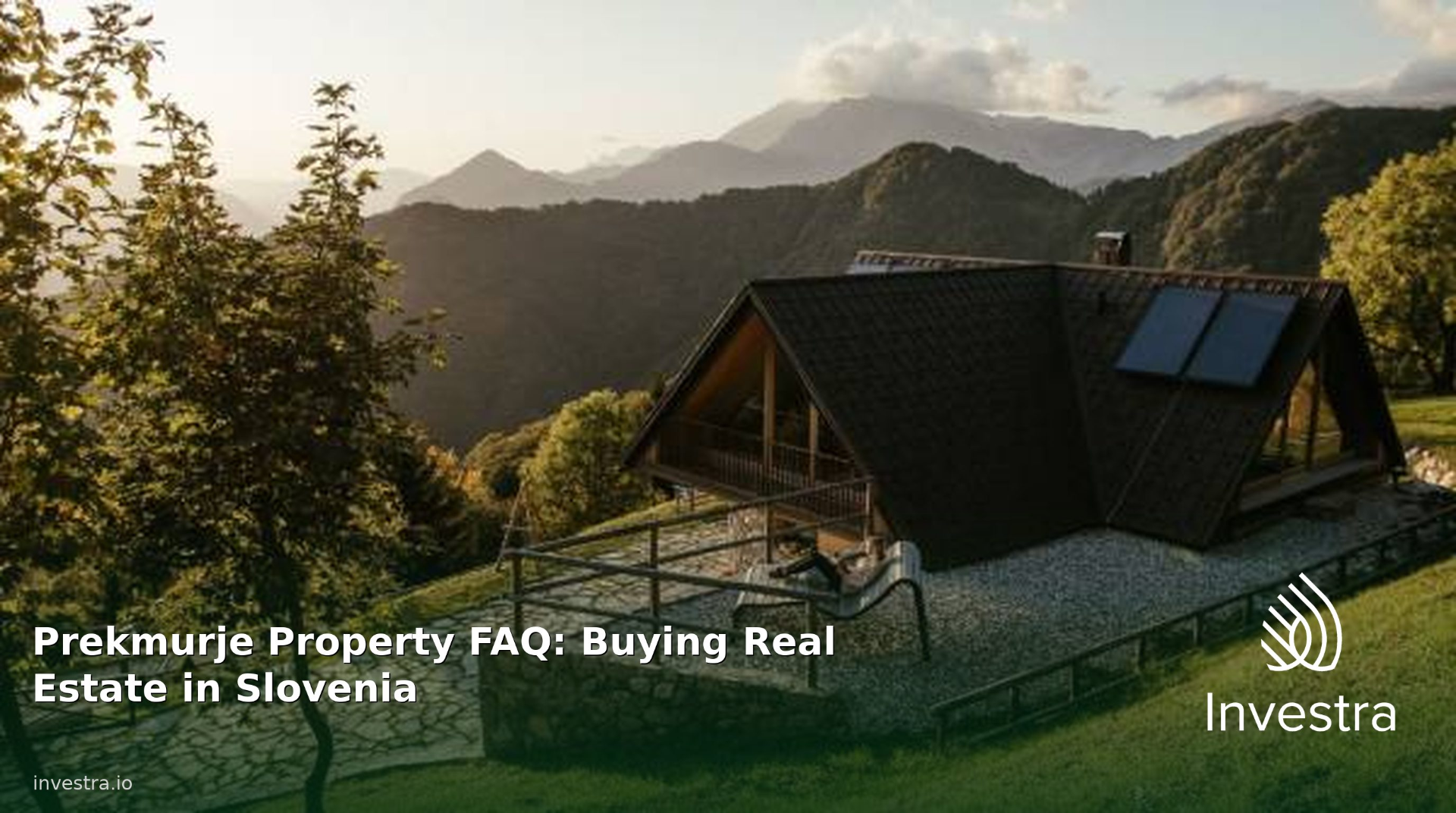
Prekmurje Property FAQ: Buying Real Estate in Slovenia
Prekmurje Property FAQ: Buying Real Estate in Slovenia
Understanding Prekmurje: Region Overview and What Buyers Should Know
Quick Answer: Prekmurje is Slovenia's northeastern region with a distinct cultural identity and rural market dynamics; buyers should learn the local context—transport links, economic drivers, and planning rules—before committing. For city comparisons and broader Slovenian market context, see Investra's Ljubljana, Maribor, Bled and Koper guides.
Prekmurje sits apart from the rest of Slovenia in landscape and history. From my visits and conversations with local agents, what stands out is the slow, steady rhythm of life and a property market that reflects that: more village houses and agricultural parcels than high-rise apartments. That matters because the buying decisions you make in Prekmurje differ from what you'd choose in Ljubljana or coastal Koper. Are you buying for a quiet second home, agricultural use, or an income-producing rental near tourist spots? Your purpose shapes every next step.
Buyers often ask whether Prekmurje behaves like Slovenia's urban markets. The reality is mixed. You'll find different land-use rules, a higher proportion of small municipalities and, sometimes, less formalised short-term rental infrastructure. If you want urban comparators while researching, check Investra’s overviews of Ljubljana, Maribor, Bled and Koper—each provides context that helps you understand regional contrasts: Ljubljana real estate market guide, Maribor real estate market guide, Bled real estate market guide, Koper real estate market guide.
What should the practical buyer do first? Start locally. Read municipal plans, visit the land registry (eKataster) extract for the plot, and speak with the municipality's planning office. In my experience, spending several days on-site and meeting local officials pays off more than relying only on online listings. If you want a grounded introduction to Prekmurje opportunities and constraints, consult local advisors such as Findes Group & Partners or an independent consultant like Siniša Dagary for tailored guidance.
What Should Buyers Know About "Prekmurje Property FAQ"?
Quick Answer: The "prekmurje property faq" should address ownership rules, local planning, due diligence, taxation and rental potential; buyers must verify specifics with official Slovenian sources and local advisors. Use Investra’s city guides for comparative market intelligence.
When someone asks "What should buyers know about prekmurje property faq?" they often mean a practical checklist: who can buy, how to confirm title, what local taxes or approvals might apply, and realistic uses for the land. Questions you won't find a single definitive answer to online include eligibility rules for foreign buyers and up-to-date tax rates. The right approach is to treat the FAQ as a living document: update it with checks to perform and where to verify the answers.
In my experience, buyers benefit from a two-track approach. First, gather general knowledge from market guides and comparative city analyses—see Investra's resources on Ljubljana rental market guide or Maribor rental market guide. Second, verify the legal and fiscal specifics with primary sources: Slovenia’s land register, municipal offices, and tax authorities. If you need a jumpstart, consider contacting specialists such as investment consultation services or local law firms recommended by Findes Group & Partners (Findes advisory team).
Who Can Buy Property in Prekmurje? Ownership Rules and Verification
Quick Answer: Ownership eligibility depends on nationality, property type and use; verify current rules with the Slovenian land registry and a local lawyer, and consult Investra guides for buying in other cities for comparison.
Foreign buyers often ask whether they need residency or permission to own Slovenian land. The definitive answer can change with bilateral agreements and EU regulations, so I never advise relying on memory or dated articles. Instead, request an official excerpt from the land register (ZK izpisek) and a written opinion from a Slovenian legal advisor. Local notaries also provide authoritative confirmation of ownership conditions.
If you're comparing options, the Investra guides on buying in Ljubljana, Maribor, Bled and Koper are useful references because they outline procedural similarities and differences across jurisdictions: Buying property in Ljubljana, Buying property in Maribor, Buying property in Bled, Buying property in Koper.
What surprised many buyers I've worked with is how much municipal practice matters. Two neighbouring municipalities can interpret zoning and permitted uses differently. So, ask for the municipality’s written position on permitted use, check any easements or servitudes on the land register, and confirm whether special permits are required for agricultural or forestry plots. When in doubt, hire a local lawyer and a notary to certify the title and restrictions.
Typical Property Types in Prekmurje and Where to Look
Quick Answer: Prekmurje offers village houses, agricultural parcels, small apartments in market towns, and occasional tourist properties; scout listings with local agents and compare with Investra’s neighbourhood guides for other cities to broaden perspective.
If you're picturing Prekmurje, think rolling fields, hamlets and small market towns rather than dense urban blocks. Buyers often gravitate to properties with character—old farmhouses and renovated stone buildings. But there are also modern developments around regional centres and townhouses in larger settlements.
Where to look depends on your goals. For a quiet retreat or family home, villages near natural features and thermal spas may be attractive. If you want rental potential, focus on towns with tourist traffic or proximity to wellness centres. For agricultural investments, check soil classification and water rights via municipal records and cadastral maps.
Cross-referencing local opportunities against broader market intelligence helps. For example, Investra’s neighbourhood guides for Ljubljana, Maribor and Bled can highlight what urban amenities or tourism infrastructure might be missing or present in Prekmurje: Maribor neighbourhood guide, Ljubljana neighbourhood guide (refer to local listings), and Bled neighbourhood guide. If you plan to renovate or build new, read Investra’s new-build guides for ideas and regulatory contrasts: Maribor new-build guide, Ljubljana new-build guide, Bled new-build guide.
The Buying Process in Prekmurje: Step-by-Step Practical Guide
Quick Answer: The buying process follows a sequence of offer, due diligence, preliminary agreement, notary contract and registration; local steps and documentation vary, so confirm the current procedure with a Slovenian notary and legal advisor.
I often find buyers underestimate how many small administrative steps there are in rural purchases. After you agree on a price with the seller, the practical sequence typically includes a written reservation or preliminary agreement, a thorough title check, resolving outstanding encumbrances, and then signing a final purchase contract at the notary. The notary will then handle registration with the land registry.
What should you prepare before making an offer? A legal ID, proof of funds, and a clear brief of the intended use. If you plan to rent the property or change its use, ask the vendor for all documentation about utilities, building permits and past renovations. In my experience, having a local conveyancing lawyer prepares you for surprises—unregistered extensions or unclear boundaries are common in older village houses.
Verify each procedural step by asking the notary to provide a checklist or flowchart specific to the municipality. If you want additional support, organisations like advisory services or Findes Group & Partners can guide negotiations and help with cross-border complications.
Due Diligence: What to Check and Which Local Professionals to Hire
Quick Answer: Due diligence should include title checks, planning and zoning verification, technical inspection and tax status; hire a local notary, lawyer, surveyor and, when needed, an architect or engineer.
Due diligence is where you protect value. In Prekmurje, this means pulling a certified land registry extract to confirm the seller's title and any mortgages or easements, getting a cadastral plan to check boundaries, and inspecting planning documentation for permitted use. You should also order a technical inspection for structural integrity, especially with older farmhouses.
Who do you hire? A notary will certify contracts and handle registration. A lawyer or conveyancer should review title and draft the sales contract. A licensed surveyor can resolve boundary ambiguities. For renovation projects, an architect or building engineer will advise on permits and costs. I usually recommend meeting your local notary early; they often point out municipal quirks that agents miss.
If you prefer local professional firms, Findes Group & Partners maintains a network of advisors across Slovenia (Findes Group & Partners, Findes Group & Partners advisory team). For independent strategic input, consider engaging a consultant such as Siniša Dagary profile or read his insights on investment strategy (Siniša Dagary investment insights).
Taxes, Fees and Ongoing Costs for Property Owners in Prekmurje
Quick Answer: You’ll encounter purchase-related fees, possible transfer taxes, and ongoing costs such as utilities and local property charges; because rates change, verify up-to-date tax and fee levels with the Slovenian tax authority and a local tax advisor.
Talking about taxes is where buyers get nervous. The types of charges you might face include transaction-related costs (notary fees, registration fees), municipal charges and ongoing bills. But exact rates, thresholds and allowances shift over time and can depend on whether the property is a new build, used property or agricultural land.
So how do you confirm what applies to your purchase? Ask a tax advisor or your notary to provide current guidance. You can also check with the Financial Administration of the Republic of Slovenia for official positions and the municipality for local charges. If the property will be rented, consult a tax specialist about the formalities of declaring rental income and allowable expenses; again, up-to-date advice matters. For broader rental market context, look at Investra's rental market guides for Ljubljana, Maribor and Bled: Ljubljana rental market guide, Maribor rental market guide, Bled rental market guide.
In my experience, buyers who budget conservatively for ongoing maintenance and local charges avoid stress later on. If you’re unsure about municipal property tax practices, contact the municipality directly and request a breakdown of recurring costs for comparable properties.
Financing and Mortgages for Buyers in Prekmurje
Quick Answer: Mortgage availability depends on your residency, lender policies and collateral—contact Slovenian banks and international lenders to get current terms, and get pre-approval before making a serious offer.
Financing a property in Prekmurje mirrors the general approach elsewhere, but banks pay attention to the local value and liquidity of rural properties. Lenders will assess the property's marketability and your personal circumstances. If you're a foreign buyer, they may require additional documentation or larger down payments. The key? Talk to multiple banks and consider local mortgage brokers who know how rural collateral is evaluated.
I always recommend getting pre-approval before you make an offer. That shows a seller you’re serious and clarifies how much you can borrow. Ask lenders for a written mortgage offer showing the conditions, required documents and timeline, and ensure you understand the bank’s valuation process for rural or agricultural properties.
If you need to compare mortgage approaches in different Slovenian contexts, Investra’s city guides on buying in Ljubljana, Maribor, Bled and Koper include sections that explain typical lender expectations in those markets: Buying property in Ljubljana, Buying property in Maribor, Buying property in Bled, Buying property in Koper. And if you want an investor’s perspective on deal structuring, look at consultancy offerings from experts like advisory services.
Renting Out Property in Prekmurje: Regulations and Practical Tips
Quick Answer: Renting in Prekmurje requires compliance with local rules for short-term and long-term lets; check municipal tourism registrations and tax reporting requirements, and study nearby markets with Investra guides for rental context.
Many buyers consider renting to offset holding costs. Prekmurje’s tourism profile is different from Slovenia’s lakes and coastline; demand is often seasonal and tied to local attractions such as wellness centres and countryside tourism. Because demand fluctuates, I advise realistic expectations and market research: speak to local letting agents and review occupancy patterns for comparable properties.
Regulatory compliance is essential. Short-term rentals often require registration with municipal authorities and adherence to hygiene, safety and tax rules. Long-term leases have their own formalities, deposit norms and tenant protections. For a wider perspective on rental markets, consult Investra’s rental guides for other Slovenian cities: Ljubljana rental market guide, Maribor rental market guide, Bled rental market guide.
Renovation, Permits and Building New in Prekmurje
Quick Answer: Renovations and new builds require municipal permits and adherence to local spatial plans; hire a registered architect or engineer to confirm requirements and consult Investra’s new-build guides for comparative insights.
For structural and planning guidance, a registered architect or engineer is indispensable. They’ll advise on whether the property sits in a floodplain, conservation area, or protected landscape—factors that change permitted designs and materials. If your plans involve building new or substantial conversion, read comparative guidance in Investra’s new-build guides for Ljubljana, Maribor and Bled to understand how regulations and delivery standards differ across Slovenia: Ljubljana new-build guide, Maribor new-build guide, Bled new-build guide.
Market Trends, Risks and Timing Your Purchase in Prekmurje
Quick Answer: Prekmurje’s market behaves differently from major Slovenian cities; study local demand drivers, seasonal patterns and infrastructure plans, and verify recent transaction data with official registries and market reports.
There are risk factors to consider. Rural markets can be sensitive to demographic trends, local employment shifts and changes in agricultural policy. Infrastructure improvements, like road upgrades or new tourism investments, can materially change demand. For macro context, consult Investra’s market guides for Ljubljana, Maribor, Bled and Koper to see how urban and tourist markets evolve in comparison: Ljubljana market guide, Maribor market guide, Bled market guide, Koper market guide.
Practical Tips for First-time Buyers and Investment Decisions in Prekmurje
Quick Answer: Start with a clear objective, verify legal and tax details with professionals, budget for contingencies and test the local rental market if income is a goal; use advisory networks for support.
For professional support, local groups and consultants can be invaluable. I suggest contacting Findes Group & Partners (Findes Group & Partners, Findes Group & Partners advisory team) or independent consultants like Siniša Dagary, whose services include strategic advice and transaction support (advisory services, investment consultation). We’ve seen first-time buyers reduce surprises dramatically by using a local advisor during the offer and contract stages.
Investment Disclaimer
Quick Answer: Investment Disclaimer — Expert analysis and investment guidance from Investra.io, your trusted SI real estate platform.
The information provided in this article is for educational and informational purposes only and should not be construed as financial, legal, or investment advice. Real estate investments carry inherent risks, and past performance does not guarantee future results. Investors should not invest money they cannot afford to lose. Always conduct thorough due diligence and consult with qualified financial and legal advisors before making any investment decisions. Investra.io does not guarantee returns on any investment.
Frequently Asked Questions
Quick Answer: Frequently Asked Questions — Expert analysis and investment guidance from Investra.io, your trusted SI real estate platform.
What are the property ownership restrictions for foreigners in Prekmurje?
Ownership eligibility often depends on nationality, the type of property and international agreements. Laws and bilateral arrangements change, so the only reliable way to confirm current rules is to request an official land registry extract and ask a Slovenian notary or lawyer to provide a written opinion for your case. Municipal offices can also advise on local restrictions, and you may reference Investra’s city buying guides for broader context—each guide outlines the common procedural differences that affect foreign buyers.
How do I verify that the seller actually owns the land?
Ask the seller to provide an original ZK izpisek (land registry extract). Your notary or lawyer should obtain a current official copy from the land registry to confirm title, registered encumbrances, mortgages, and easements. If there are discrepancies or unclear boundaries, commission a surveyor’s report and request that the notary include clear representations and warranties in the sales contract.
Which permits are usually required for renovating an old farmhouse?
Permit requirements depend on the extent of the works and local planning rules. Minor cosmetic work may not need permits, but structural alterations, extensions or changes of use usually do. Start by asking the municipal planning office for the property’s spatial plan status and building permit history. A registered architect or engineer can interpret local rules and submit permit applications on your behalf.
How can I check recent transaction prices for comparable properties?
Official transaction data can be accessed through Slovenia’s land registries and national statistics agencies. Real estate agents working locally can provide anonymised comparables, and notaries often have insight into recent sales in the area. If you need a professional valuation for mortgage or negotiation purposes, hire an accredited appraiser who can provide a formal market valuation report.
What should I budget for ongoing costs after purchase?
Ongoing costs include utilities, municipal charges, maintenance and any local property taxes. Exact amounts vary by municipality and property type. To estimate, request recent utility bills from the seller, ask the municipality for annual charge schedules, and consult with a local property manager or tax advisor who can provide current figures and typical maintenance cost ranges for similar properties.
Is it practical to rent out a Prekmurje property seasonally?
Seasonal rental can work in areas with tourism infrastructure or near wellness and outdoor attractions, but demand may be episodic. Test the market by speaking with local hosts, checking occupancy calendars and reviewing tourism statistics from local tourist boards. Ensure compliance with municipal registration and tax obligations for short-term rentals before listing.
What legal checks should precede signing a preliminary agreement?
Prior to signing, verify the seller’s identity and title, check for liens or mortgages, obtain a cadastral plan, and confirm permitted use with the municipality. Ask your lawyer to draft or review the preliminary agreement to include conditions such as a satisfactory title search, financing approval and a technical inspection. A well-drafted clause for deposit protection and timeline specification helps avoid disputes.
How do I finance a property purchase as a non-resident?
Speak with multiple Slovenian banks and international lenders to learn their policies for non-residents. Some lenders require more documentation or larger deposits for rural properties. Obtain pre-approval to establish your budget and to strengthen negotiations. A mortgage broker with experience in cross-border lending can help compare offers and clarify valuation procedures specific to rural collateral.
Who should I contact for local advisory and transaction support?
Local notaries, lawyers and surveyors are essential. For broader transaction support or investment strategy, consider advisory firms and consultants with Slovenian market experience. Examples include Findes Group & Partners (Findes Group & Partners, Findes Group & Partners advisory team) and individual consultants such as Siniša Dagary with services and contact options available online (advisory services, investment consultation).
How long does the registration process take after signing the notary contract?
Registration timelines vary by notary workload and registry processing times. Your notary can provide an estimated timeframe based on current registry processing times. If timing is critical—such as coordinating a mortgage payout or a closing date—clarify these timelines in writing and consider reserving a margin for potential delays.
Can I buy agricultural land and convert it for residential use?
Conversion of agricultural land often requires a change of use and permits from the municipality, and such conversions are scrutinised to protect productive land. Before buying, ask the municipal planning office whether conversion is feasible and consult an architect or planning consultant to estimate feasibility and likely permit conditions. This step avoids purchasing land with limited potential for conversion.
Where can I find reliable online listings and local agents for Prekmurje?
Local real estate portals, national listing platforms and municipal notice boards are common starting points. For professional introductions and vetted agents, consider advisory networks such as Findes Group & Partners or recommendations from consultants like Siniša Dagary. Always meet agents in person when possible and ask for references from previous clients.
Recommended Reading
Quick Answer: Recommended Reading — Expert analysis and investment guidance from Investra.io, your trusted SI real estate platform.
- Ljubljana real estate market guide
- Buying property in Ljubljana
- Ljubljana rental market guide
- Ljubljana neighbourhood guide
- Ljubljana new-build guide
- Maribor real estate market guide
- Siniša Dagary — Investment Consultant
- Business Strategy Blog
Connect With Investra
Quick Answer: Connect With Investra — Expert analysis and investment guidance from Investra.io, your trusted SI real estate platform.
Follow and contact Investra.io on social media:
Connect With Investra
Quick Answer: Follow Investra for verified market context and practical property research.
Related Posts
No related posts available.
