
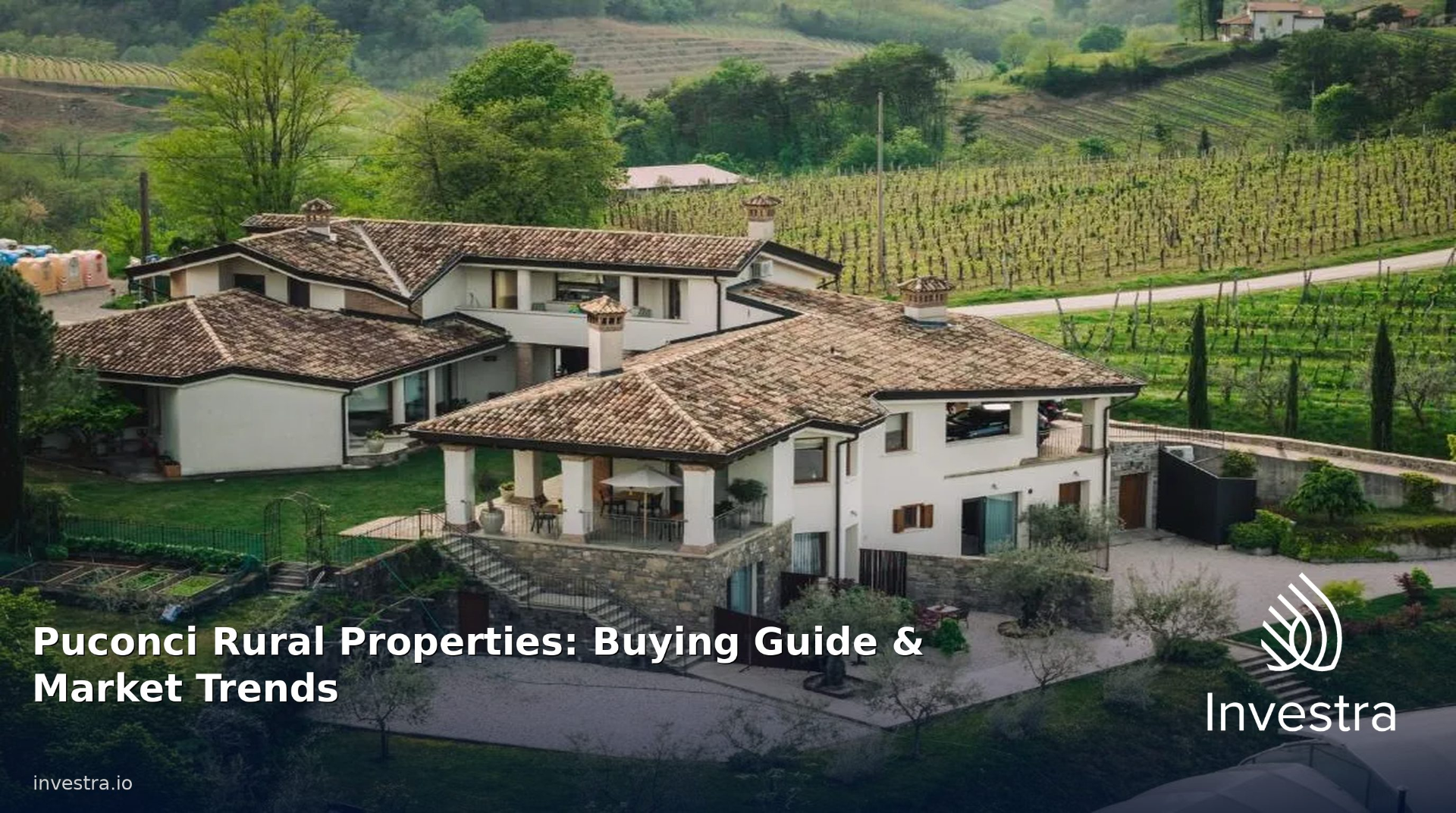
Puconci Rural Properties: Buying Guide & Market Trends
Puconci Rural Properties: Buying Guide & Market Trends
Overview: Rural Properties in Puconci, Slovenia and the Prekmurje Context
Quick Answer: Puconci sits within Prekmurje, a quieter corner of Slovenia where rural properties appeal to buyers seeking land, traditional homes, or small-scale agricultural projects; the market is local and varied, so on-the-ground checks are essential.
Puconci is one of those places that surprises people who first arrive. The landscape is rolling and agricultural, with a mix of small villages, family farms and pockets of woodland that create a distinctly rural character. For anyone searching for rural properties in Puconci Slovenia, the reality is that supply tends to be idiosyncratic: homes and parcels appear sporadically through estate sales, family transfers and occasional developer activity.
What many buyers want to know is how the regional context affects ownership and use. Prekmurje’s administrative patterns, municipal planning documents and infrastructure priorities all shape what you can actually do with a plot. You’ll find both very traditional farmhouses and newer, renovated properties. In my experience, buyer expectations formed in urban markets don’t always translate here. Distances to services, road quality and utility connections vary dramatically within short drives.
If you’re beginning research, start with local sources. Municipal offices in Puconci and the broader Mura statistical region keep records about land use and permitted activities. Online resources can point you to broader Slovenian frameworks, but the municipal level is where many practical questions get answered. For examples of how city markets are analyzed elsewhere in Slovenia and to compare how towns differ, readers might find wider context useful in Investra’s city guides for Ljubljana, Maribor, Bled and Koper, such as the Ljubljana real estate market guide and the Maribor real estate market guide.
What Buyers Should Know About Rural Properties in Puconci Slovenia
Quick Answer: Buyers should focus on land classification, access, utility connections and local planning rules when considering rural properties in Puconci Slovenia; verify details with the municipality and land registry before making offers.
What should buyers know about rural properties in Puconci Slovenia? That’s the central question many people ask. First: the term “rural” covers a wide range—agricultural plots, residential parcels outside village cores, older farm complexes and small woodlots. Each has different legal and practical implications. The reality is that a beautiful farmhouse with land may carry agricultural designations that affect what you can convert it to, and the road into your property may be municipal, private or unmaintained during winter.
In my experience working with clients in rural Slovenia, the most common surprises are utility and access issues. Does the plot have a legal connection to mains water and sewage? If not, are wells and septic systems permitted? How far is the electricity transformer? These aren’t trivial: they change renovation budgets and timelines. Another frequent shock is the time it takes to get planning approvals for non-agricultural uses—municipal planning departments can require detailed submissions and sometimes public hearings.
So how do you get reliable answers? Start with the Puconci municipal office and the national land register (Land Cadastre and Register of Buildings and Apartments). Ask for a land use extract (povzetek zemljiške knjige) and any current municipal spatial plans (občinski podrobni prostorski akti). If you want practical examples of buying and renovation processes in Slovenian towns, Investra’s How-to guides such as Buying property in Ljubljana and Buying property in Maribor illustrate the types of steps you’ll need to confirm locally.
Land Types, Zoning and Permitted Uses in Prekmurje
Quick Answer: Land in Prekmurje can be agricultural, residential or mixed; permitted uses are dictated by the municipal spatial plan and cadastral designation—confirm classifications with Puconci municipality and the national cadastre.
One of the first practical steps when evaluating rural properties in Puconci is understanding how land is classified. Is it registered as agricultural land (kmetijsko zemljišče), building land (grajevinsko zemljišče), or forest? Each label carries different planning permissions. You might find a parcel that looks like it could host a home, but if the official designation is agricultural, you’ll need to follow procedures for conversion—if conversion is even allowed.
How do you get clarity? Request an extract from the land registry and the cadastre. These documents show parcel numbers, current owners, encumbrances and recorded land use. Municipal spatial plans (prostorski akti) contain zoning maps and policy notes: they explain where new construction can take place, where agricultural parcels are protected and where conservation rules apply. A local architect or planner can interpret these maps and advise on realistic possibilities.
In my experience, the boundary between “can” and “can’t” often comes down to the detailed local plan and whether a parcel is contiguous to an existing village settlement. Roads and utility proximity regularly determine whether a conversion is feasible. If you want to see how new-build and renovation topics are framed elsewhere in Slovenia, Investra’s guides like the Ljubljana new-build guide and Maribor new-build guide provide process examples that are transferrable in approach even if rules vary by municipality.
Buying Process: How to Secure Rural Properties in Puconci
Quick Answer: Securing rural properties in Puconci involves title checks, a sales agreement, notarisation, and registration in the land register; follow municipal procedures and consult a local notary for accurate steps.
What does buying rural properties in Puconci Slovenia actually look like day-to-day? The core legal steps are familiar to many buyers: you agree terms with the seller, perform due diligence, sign a preliminary agreement if needed, finalise a sales contract, have it notarised and register the transfer in the land register. But rural transactions often include additional practical checks: confirming right-of-way, verifying restrictive covenants, and ensuring that plot boundaries are clearly defined and agreed.
For foreign buyers, there may be another layer—certain categories of land historically carried restrictions for non-residents in Slovenia. What matters is the current status and how local officials interpret it. Rather than assume, verify with the Puconci municipal office and a Slovenian notary. Notaries here routinely handle land transfers and can confirm whether any special approvals are required.
We’ve seen buyers benefit from staging the purchase: securing a preliminary contract that conditions completion on satisfying specific municipal permissions or obtaining a geodetic survey. Use professionals who speak both the language and the legal framework—your local notary, a lawyer experienced in Slovenian property, and an English-capable agent if you need translation. For comparative reading about buying in different Slovenian towns and to see how processes are presented elsewhere, check Investra’s insights on Buying property in Bled and Buying property in Koper.
Due Diligence: Surveys, Title Searches and Local Records
Quick Answer: Conduct a full due diligence package—title search, cadastral extract, geodetic survey, utility verification and municipal plan checks—to minimise surprises when buying rural properties in Puconci.
Good due diligence turns a risky rural purchase into a manageable project. For Puconci properties, I always recommend a structured checklist: obtain a certified extract from the land cadastre and the land register; commission a geodetic (land) survey to confirm boundaries; check for easements and rights-of-way; and confirm any encumbrances such as mortgages or court orders.
Utilities are a separate category but equally vital. Ask for confirmation about water, sewage, electricity and broadband access. If services are not present, find out the exact distance to the nearest connection point and ask municipal engineers about likely costs and permissions for extending networks. Also ask for any historical building permits or renovation records; older farmhouses may have informal alterations that were never regularised.
Where do you start? Contact the Puconci municipality for planning extracts, the Surveying and Mapping Authority for cadastral maps, and a Slovenian notary for land register information. If you’d like a local advisory partner, consider consulting the Findes Group & Partners team—see Findes Group & Partners and their advisory team. For consultancy and project support from an individual perspective, Siniša Dagary’s practice offers bespoke advisory options—see Siniša Dagary and his advisory services for contact routes.
Taxes, Fees and Ongoing Costs for Rural Owners
Quick Answer: Owning rural properties in Puconci brings transaction taxes, notarial fees and ongoing costs like property tax and utilities—verify current rates with a notary, the municipal tax office and the national tax authority.
Taxes and ongoing costs are highly local in practice. There are registration procedures and notary fees when you buy, and municipalities apply property tax rules that depend on parcel classification and use. If a plot is used for agriculture, different exemptions or lower categories may apply than for residential parcels. The safest path is to ask the Puconci municipal tax office for the current local rules and to have your notary estimate the transaction-related fees at the time you prepare the sale.
Don't rely on historical examples or online anecdotes for exact figures. Instead, ask for written estimates from your notary and the municipal fiscal department, and confirm with the Financial Administration of the Republic of Slovenia (FURS) for national tax rules. You can also request sample calculations from banks if you plan to mortgage the purchase. In my experience, buyers who collect written cost estimates early in the process avoid budget overruns later.
If you want reference material on how taxes and fees can affect property projects elsewhere in Slovenia, look at the practical buying guides on Investra such as Buying property in Ljubljana and the Maribor equivalent. For professional tax advice and detailed cost modelling, local advisors like investment consultation services can assist with scenario planning.
Financing, Mortgages and Payment Structures for Rural Purchases
Quick Answer: Financing rural properties in Puconci often involves local or national banks; confirm loan products, eligibility and required collateral directly with lenders and consult a local financial advisor for tailored options.
Can you mortgage a rural plot or farmhouse in Puconci? Generally yes, but terms depend on the lender and the asset’s classification. Some banks prefer properties with clear residential classification and accessible infrastructure. Agricultural land sometimes has different lending criteria. Therefore, before committing, speak to banks that operate in the Prekmurje region and ask for written pre-approval criteria.
We often advise buyers to shop with both local banks and larger national lenders. Local banks can offer nuanced knowledge of the market but national institutions may have more standardised mortgage products. In all cases, provide lenders with a complete due diligence package: cadastral extracts, proof of income, and any planning documentation you’ve obtained. Lenders will evaluate risks tied to access, utility connections and whether the property can be used as collateral.
If you need specialist structures—staged payments, escrow arrangements, or conditional contracts—discuss these with your notary and legal counsel. For practical examples of how buyers structure funding in Slovenian towns, Investra’s city guides show the kinds of documentation lenders request, for example in the Bled real estate market guide and Koper real estate market guide. For tailored financial modelling, firms like Findes or independent consultants can be commissioned—see Findes Group & Partners advisory team.
Renovation, New-build and Agricultural Conversion Considerations
Quick Answer: Renovating or converting a rural building in Puconci requires municipal permits and adherence to local spatial plans; confirm allowable works with the municipal planning department and hire architects familiar with Prekmurje rules.
For a sense of the renovation process in urban Slovenian contexts, read Investra’s new-build and renovation guides for Ljubljana, Maribor and Bled such as Bled new-build guide and Ljubljana new-build guide. These show the types of technical documentation and contractor relationships you’ll need, even if the rural specifics differ.
Rental Potential and Short-Term Lets in Rural Puconci
Quick Answer: Rural Puconci properties can be used for rentals or short-term lets but success depends on location, access and amenities; verify local tourism regulations and municipal policies before planning a rental strategy.
To estimate potential occupancy and pricing, look at local tourism platforms and marketplaces, and compare similar listings in Prekmurje. For guidance on how short-term letting markets behave elsewhere in Slovenia, consult Investra’s rental market guides like Ljubljana rental market guide, Maribor rental market guide, and the Bled rental market guide to see how hosts structure offers and comply with local laws.
Neighbourhoods & Location: Micro-Regions Within Puconci and Access
Quick Answer: Puconci’s neighbourhoods vary from clustered village centres to dispersed hamlets and isolated farmsteads; access to transport, services and markets differs by micro-location—visit the exact area at different times of day to judge suitability.
For comparative insight into how neighbourhoods influence buyer choices in Slovenian towns, read the Investra neighbourhood guides like the Ljubljana neighbourhood guide, Maribor neighbourhood guide, and the Bled neighbourhood guide. These illustrate the kinds of local trade-offs buyers face.
Working with Local Advisors, Agents and Legal Counsel
Quick Answer: Engage a local notary, a lawyer familiar with Slovenian property law, and a trusted agent or advisory firm to help with rural purchases in Puconci; confirm credentials and get written cost and timeline estimates.
We encourage buyers to interview advisors and ask for references and portfolio examples of similar projects. For larger or more complex acquisitions, consider a firm that offers integrated services: legal, tax, finance and project management. The Findes Group & Partners have advisory capabilities that can be useful; see Findes Group & Partners and their advisory team for contact options. For consultant-led investment strategy and business planning, Siniša Dagary offers advisory insights—review his investment insights and profile to understand his approach.
Because regulations and market practices change, ask your chosen advisors how they stay current. Do they monitor municipal spatial plans and national legislative changes? Can they provide a written timeline and a risk matrix for your purchase? These practical questions separate experienced consultants from casual agents. If you'd like to contact an advisor directly, use the investment consultation page or request a proposal from Findes’ advisory team.
Investment Disclaimer
Quick Answer: Investment Disclaimer — Expert analysis and investment guidance from Investra.io, your trusted SI real estate platform.
The information provided in this article is for educational and informational purposes only and should not be construed as financial, legal, or investment advice. Real estate investments carry inherent risks, and past performance does not guarantee future results. Investors should not invest money they cannot afford to lose. Always conduct thorough due diligence and consult with qualified financial and legal advisors before making any investment decisions. Investra.io does not guarantee returns on any investment.
Frequently Asked Questions
Quick Answer: Frequently Asked Questions — Expert analysis and investment guidance from Investra.io, your trusted SI real estate platform.
What paperwork do I need to start buying rural properties in Puconci Slovenia?
Begin with a valid ID or passport, proof of funds, and a power of attorney if you’re not present for transactions. Crucially, request a cadastral extract (katastrski izpisek) and a land register extract (izpis iz zemljiške knjige) for the parcel—your notary can obtain these. Also collect municipal spatial plan extracts and any existing building permits. If you plan to finance the purchase, lenders will require income documentation and asset statements. Always verify document requirements with your notary and the Puconci municipal office before making any commitments.
Can foreigners buy agricultural land in Puconci?
Restrictions on purchasing agricultural land have existed historically in some countries, but rules change and often depend on residency and corporate structures. Rather than rely on generalisations, check the current legal framework with a Slovenian notary and the Puconci municipality. They can advise whether special approvals are required for foreign buyers and outline any additional steps such as prior notification or conditions associated with purchases for agricultural purposes.
How do I verify whether a rural property has legal access and utilities?
Ask for a cadastral extract and any recorded easements to confirm legal access. For utilities, request documentation from the seller about existing connections and obtain confirmation from the relevant utility providers (water, electricity, telecoms). If records are unclear, commission a geodetic survey and request a site visit with municipal engineers. Written confirmation from providers and municipal officials is the safest way to avoid surprises about access or connection costs.
What are common hidden costs when buying a rural property in Prekmurje?
Hidden costs often include connection fees for electricity, water or sewage, costs for upgrading private access roads, legalisation of informal structures, and additional taxes or municipal fees. Renovation of older buildings can reveal structural or environmental issues that add to budgets. To manage risk, obtain written quotes for utility extensions, commission a thorough building inspection, and ask your notary for a full breakdown of transaction-related fees and taxes before signing contracts.
How long does it typically take to get planning permission for a conversion?
Timing depends on the scope of works, the complexity of local regulations and municipal workloads. Simple renovations may require only notification; larger conversions or changes of land use can take months and sometimes longer if environmental or heritage assessments are needed. Discuss likely timelines with the municipal planning office and your architect; get estimated processing times in writing where possible so you can plan cash flow and project sequencing effectively.
Are short-term rentals permitted on rural plots in Puconci?
Short-term rental rules vary across municipalities and can be influenced by zoning, health and safety regulations, and taxation. Before positioning a property as a short-term let, confirm registration requirements and any local restrictions with the Puconci municipality and national tax authorities. If you plan to operate rentals at scale, consult a tax advisor to structure operations and ensure compliance with reporting and VAT rules if applicable.
What steps should I take if boundary lines are disputed?
If boundary disputes emerge, the first practical action is to commission a geodetic (land) survey to define precise lines. Then seek mediation with the neighbor—many conflicts are resolved amicably with professional demarcation and written agreements. If mediation fails, legal proceedings can clarify titles and boundaries; your lawyer and notary can advise on procedures. Keep in mind disputes delay transactions and add costs, so include dispute-resolution clauses in preliminary contracts where relevant.
How can I estimate ongoing maintenance costs for a rural property?
Estimate maintenance by assessing the property’s condition: roof, foundations, heating, insulation and outbuildings all affect ongoing costs. Obtain a building inspection and ask contractors for annual maintenance estimates for heating, waste management, road upkeep and grounds. Factor in seasonal needs such as winter road clearance. For financial planning, request several contractor quotes and build a contingency buffer to protect against unexpected repairs.
Who pays for a geodetic survey and what does it show?
Typically, the buyer commissions and pays for a geodetic survey during due diligence. The survey confirms parcel boundaries, shows built structures and records any discrepancies between the cadastral plan and on-the-ground reality. It’s a critical document for finalising contracts and for future construction permits. Discuss whether the preliminary agreement should require the buyer to obtain the survey or whether the seller will provide a recent survey as part of the sale package.
Where can I find reliable local property listings and off-market opportunities?
Start with local estate agents and municipal noticeboards. Many rural listings circulate by word of mouth or through local agents rather than national portals. Engage an agent who operates in the Prekmurje region and ask for a written sourcing agreement. Advisory firms like Findes and individual consultants such as Siniša Dagary often have networks that identify off-market deals—see Findes Group & Partners and Siniša Dagary for contact options.
Recommended Reading
Quick Answer: Recommended Reading — Expert analysis and investment guidance from Investra.io, your trusted SI real estate platform.
- Ljubljana real estate market guide
- Buying property in Ljubljana
- Ljubljana rental market guide
- Ljubljana neighbourhood guide
- Ljubljana new-build guide
- Maribor real estate market guide
- Siniša Dagary — Investment Consultant
- Business Strategy Blog
Connect With Investra
Quick Answer: Connect With Investra — Expert analysis and investment guidance from Investra.io, your trusted SI real estate platform.
Follow Investra on social media for market insights and updates:
Connect With Investra
Quick Answer: Follow Investra for verified market context and practical property research.
Related Posts
No related posts available.
