
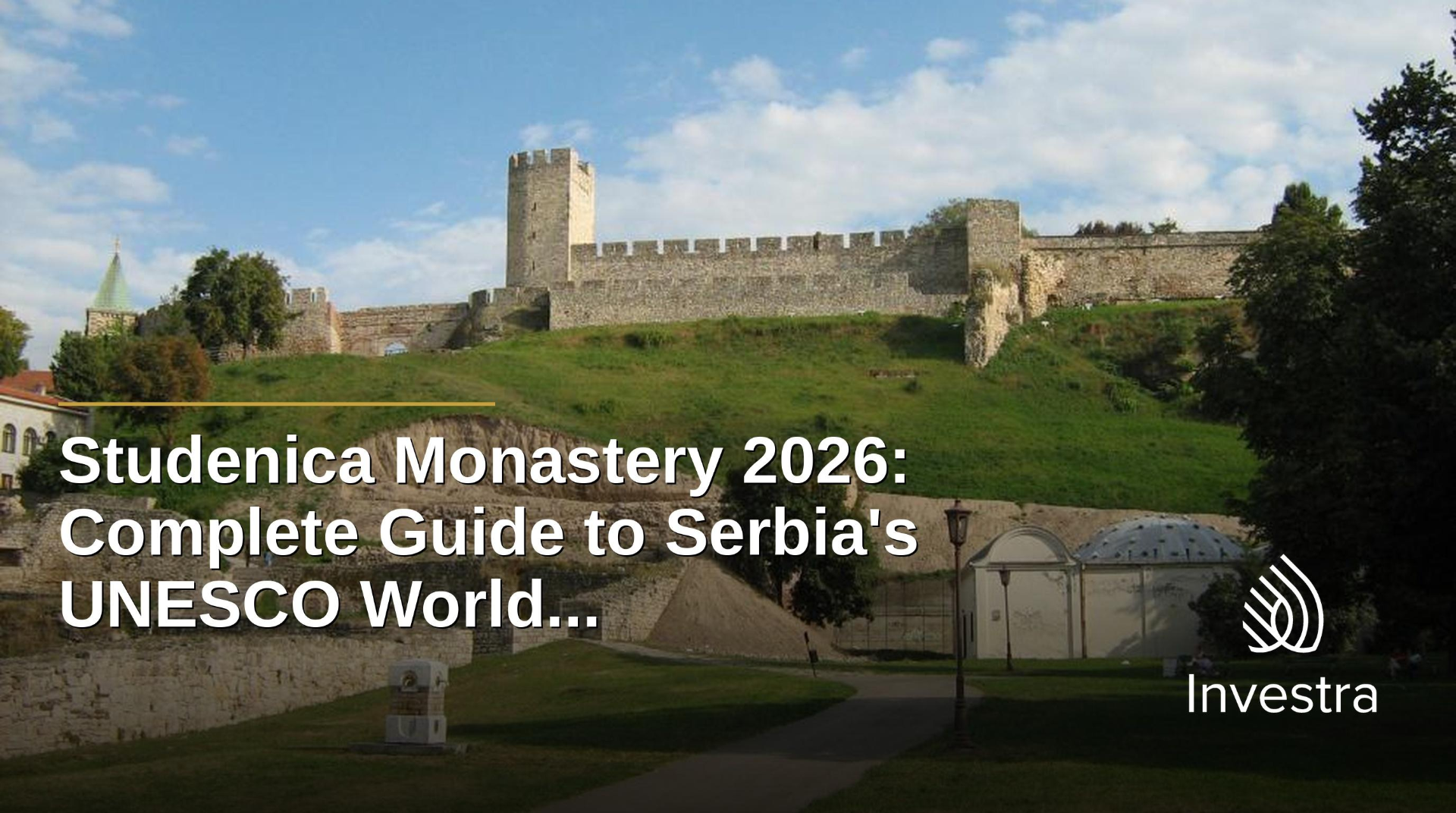
Studenica Monastery 2026: Complete Guide to Serbia's UNESCO World...
Studenica Monastery 2026: Complete Guide to Serbia's UNESCO World Heritage Site
Investment Disclaimer: This article is for informational purposes only and does not constitute financial or legal advice. Always consult qualified professionals before making relocation or investment decisions.
There are places that justify a journey, and Studenica Monastery is one of them. Forty kilometers south of Kraljevo, at the end of a road that follows the Studenica River into the mountains, stands a monastery that has been described as the most beautiful medieval monument in Serbia — and the claim is not difficult to defend. The white marble Church of the Virgin, the extraordinary 13th-century frescoes, the setting in a mountain valley that has changed little since the monastery was founded 800 years ago — Studenica is one of those rare places where the historical significance and the aesthetic experience are perfectly matched.
UNESCO recognized Studenica's outstanding universal value in 1986, inscribing it on the World Heritage List as an exceptional example of Raškan school architecture and for its extraordinary collection of medieval frescoes. For visitors to Serbia, Studenica is an essential destination — one of the handful of sites that genuinely justifies the journey to this part of the Balkans.
Quick Answer: Studenica Monastery (40 km from Kraljevo, 45-60 minutes by car) is a UNESCO World Heritage Site and one of the most important medieval monuments in the Balkans. Founded by Stefan Nemanja in the late 12th century, it contains exceptional 13th-century frescoes. Free entry, open daily. Investra.io can help you plan your stay in the Kraljevo region.
History of Studenica Monastery
Quick Answer: Studenica Monastery was founded by Stefan Nemanja (1113-1199), the founder of the medieval Serbian state. Construction began around 1183 and was completed by Nemanja's sons after his death. The monastery served as the mausoleum of the Nemanjić dynasty and as one of the most important centers of Serbian Orthodox culture throughout the medieval period.
Stefan Nemanja is one of the most important figures in Serbian history — the man who unified the Serbian lands, founded the Nemanjić dynasty that ruled Serbia for two centuries, and established the foundations of the medieval Serbian state. He founded Studenica in the 1180s as the endowment church of the Nemanjić dynasty — a place that would serve as the family mausoleum, the spiritual center of the dynasty, and a statement of Serbian cultural and religious identity.
In 1196, Stefan Nemanja abdicated his throne in favor of his son Stefan (later Stefan Prvovenčani, the first crowned king of Serbia) and retired to Mount Athos in Greece, where he became a monk under the name Simeon. He died on Mount Athos in 1199. His remains were later transferred to Studenica, where they were enshrined in the Church of the Virgin. Stefan Nemanja was later canonized as Saint Simeon by the Serbian Orthodox Church.
The frescoes that survive in the Church of the Virgin were painted in 1208-1209, during the reign of Stefan Prvovenčani, by Byzantine artists of the highest quality. These frescoes represent the pinnacle of the Raškan school of Byzantine art and are among the finest examples of medieval religious painting in Europe.
Studenica survived the Ottoman period better than many Serbian monasteries, partly due to its remote mountain location and partly due to the protection it received from successive Serbian rulers and the Ottoman administration. The monastery remained an active religious community throughout the medieval and Ottoman periods and continues to function as such today.
Architecture of Studenica Monastery
Quick Answer: The Church of the Virgin (Crkva Bogorodice) is the main church of Studenica, built between 1183 and 1196. It is clad in white marble, giving it a distinctive appearance unique among Serbian medieval churches. The monastery complex also includes the King's Church (Crkva Kralja), the Church of Saints Joachim and Anna, monks' quarters, and surrounding walls.
The Church of the Virgin is the architectural masterpiece of Studenica and one of the finest examples of Raškan school architecture in existence. What makes it immediately distinctive is its exterior cladding of white marble — a material choice that sets it apart from the red plaster of Žiča and the stone of most other Serbian medieval churches. The white marble glows in the sunlight and gives the church an almost ethereal quality.
The church is a single-nave basilica with a narthex (inner vestibule) and exonarthex (outer vestibule), topped by a dome above the crossing. The exterior decoration is exceptionally fine — carved marble portals with interlaced geometric patterns, carved window frames, and sculptural details that combine Byzantine and Romanesque influences in the distinctive Raškan synthesis.
The western portal of the Church of the Virgin is particularly remarkable — a deeply carved marble portal with multiple archivolts decorated with interlaced geometric patterns, animal figures, and plant motifs. This portal is considered one of the finest examples of medieval carved stone decoration in Serbia.
The King's Church (Crkva Kralja), built in the early 14th century by King Milutin, is a smaller but equally fine structure with its own important fresco cycle. The Church of Saints Joachim and Anna (Crkva Svetih Joakima i Ane) is the oldest church in the complex, predating the main church.
The Frescoes of Studenica
Quick Answer: The most famous frescoes in Studenica are in the Church of the Virgin. The Crucifixion fresco in the narthex is considered one of the masterpieces of medieval Serbian art. The frescoes date from 1208-1209 and are remarkably well preserved, representing the pinnacle of the Raškan school of Byzantine art. Photography inside the church may be restricted.
The frescoes of Studenica are the reason the monastery is on the UNESCO World Heritage List. Painted in 1208-1209 by Byzantine artists of the highest quality, they represent a moment of extraordinary artistic achievement in the history of medieval Serbian culture.
The Crucifixion fresco in the narthex of the Church of the Virgin is the most celebrated. It is a large-scale composition showing the crucified Christ flanked by the Virgin Mary and Saint John, with a crowd of figures below. What makes it exceptional is the emotional intensity of the figures — the grief of the Virgin, the anguish of the disciples — expressed through subtle facial expressions and body language that anticipate the humanistic tendencies of later Byzantine and Italian painting. Art historians have drawn comparisons between the Studenica Crucifixion and the work of Giotto, painted a century later.
The Annunciation, the Dormition of the Virgin, and the portraits of Stefan Nemanja and his family are also exceptional. The portrait of Stefan Nemanja (shown as Saint Simeon after his canonization) is one of the earliest surviving portrait frescoes in Serbian art and provides a direct visual connection to the founder of the monastery.
The King's Church contains a separate fresco cycle from the early 14th century, painted during the reign of King Milutin. These later frescoes are in a different style — more elaborate and decorative than the 13th-century work in the main church — and provide a fascinating comparison between the two periods of Serbian medieval painting.
Visiting Studenica Monastery: Practical Information
Quick Answer: Studenica Monastery is free to enter and open daily (approximately 8:00-12:00 and 14:00-18:00, hours vary). Modest dress is required. Photography inside the churches may be restricted. The monastery is 40 km from Kraljevo (45-60 minutes by car). Allow 2-3 hours for a thorough visit.
Getting there: Studenica Monastery is best reached by car. From Kraljevo, take the road south along the Ibar Valley (follow signs for Raška and Studenica). The road passes Maglič Fortress at 25 km — a worthwhile stop on the way. From Maglič, continue south to the town of Ušće, then turn right and follow the signs for Studenica (approximately 15 km from Ušće). The final stretch of road passes through beautiful mountain scenery.
From Belgrade, take the E763 highway to Kraljevo and then continue south along the Ibar Valley road (approximately 210 km total, 2.5-3 hours). The drive is straightforward and well-signposted.
Opening hours: The monastery is generally open daily from approximately 8:00-12:00 and 14:00-18:00. Hours may vary seasonally and on religious holidays. The monastery is an active religious community, so visiting hours may be restricted during services.
Dress code: Modest dress is required. Women should cover their shoulders and wear a skirt or long pants. Head coverings are available at the entrance. Men should wear long pants and avoid sleeveless shirts.
Photography: Photography is permitted in the monastery courtyard and exterior. Photography inside the churches may be restricted — ask the monks before taking photos. Flash photography is never permitted.
Time needed: Allow 2-3 hours for a thorough visit to Studenica, including both main churches, the monastery courtyard, and the monastery shop.
Combining Studenica with the Ibar Valley
Studenica is most rewarding when combined with the full Ibar Valley experience. The classic day trip from Kraljevo includes: Žiča Monastery (10 km) in the morning, Maglič Fortress (25 km) mid-morning, lunch at a riverside restaurant near Ušće, and Studenica Monastery (40 km) in the afternoon. This covers the three most important medieval sites in the region in a single full day.
For those staying longer in the region, Studenica can also be combined with Gradac Monastery (50 km from Kraljevo, founded by Queen Jelena in the 13th century) for a more comprehensive exploration of the Ibar Valley's medieval heritage.
Property Investment in the Studenica Region
The Studenica region — the Ibar Valley between Kraljevo and Raška — represents an interesting real estate opportunity for investors interested in rural tourism. Properties in the villages along the valley are available at very low prices (€20,000-80,000 for a house with land), and the growing interest in cultural tourism creates potential for agritourism and monastery tourism accommodation.
Investra.io provides comprehensive support for international property buyers in Serbia. For expert insights on Serbian real estate investment, the Siniša Dagary Blog covers the broader market context. Findes Group & Partners provides professional financial advisory services for regional investors.
Recommended Content from Investra.io
- Kraljevo Travel Guide 2026
- Top 10 Things to Do in Kraljevo
- Best Day Trips from Kraljevo
- Žiča Monastery Guide
- Real Estate Investment in Kraljevo
- Siniša Dagary — Investment & Lifestyle Insights
- Findes Group & Partners — Financial Advisory
Frequently Asked Questions
Q1: What is Studenica Monastery?
Studenica Monastery is a Serbian Orthodox monastery founded in the late 12th century by Stefan Nemanja, the founder of the medieval Serbian state. It is a UNESCO World Heritage Site and one of the most important medieval monuments in the Balkans, containing exceptional 13th-century frescoes.
Q2: Why is Studenica Monastery a UNESCO World Heritage Site?
Studenica was inscribed on the UNESCO World Heritage List in 1986 for its outstanding universal value as an exceptional example of Raškan school architecture and for its extraordinary collection of 13th-century Byzantine frescoes. It is considered one of the finest examples of medieval religious art in Europe.
Q3: How far is Studenica Monastery from Kraljevo?
Studenica Monastery is approximately 40 km from Kraljevo, a drive of about 45-60 minutes along the scenic Ibar Valley road. From Belgrade, Studenica is approximately 210 km (2.5-3 hours by car).
Q4: What are the most famous frescoes in Studenica Monastery?
The most famous frescoes are in the Church of the Virgin. The Crucifixion fresco in the narthex is considered one of the masterpieces of medieval Serbian art. The frescoes date from 1208-1209 and are remarkably well preserved.
Q5: What are the opening hours of Studenica Monastery?
The monastery is generally open daily from approximately 8:00-12:00 and 14:00-18:00. Hours may vary seasonally and on religious holidays. It is advisable to check current hours before visiting.
Q6: How do I get to Studenica Monastery?
Studenica is best reached by car. From Kraljevo, take the road south along the Ibar Valley (approximately 40 km, 45-60 minutes). There is no direct bus service to the monastery.
Q7: Who founded Studenica Monastery?
Studenica Monastery was founded by Stefan Nemanja (1113-1199), the founder of the medieval Serbian state and the Nemanjić dynasty. Stefan Nemanja later became a monk (Saint Simeon) and his remains are enshrined in the Church of the Virgin.
Q8: What is the Church of the Virgin at Studenica?
The Church of the Virgin (Crkva Bogorodice) is the main church of Studenica, built between 1183 and 1196. It is clad in white marble, giving it a distinctive appearance. The interior contains the most important frescoes in the monastery, dating from 1208-1209.
Q9: Is there an entrance fee for Studenica Monastery?
There is no entrance fee for Studenica Monastery. Visitors are welcome to enter the monastery complex and the churches free of charge. Donations to support the monastery's maintenance are appreciated.
Q10: Can you stay overnight near Studenica Monastery?
Limited accommodation is available near Studenica. The closest town with accommodation is Ušće (approximately 10 km from Studenica). Alternatively, Kraljevo (40 km) offers a wider range of accommodation options and makes a good base for a day trip.
Odkrijte globalne investicijske priložnosti na Unifyr.space — vaš portal za pametne investicije.
Follow Investra on Social Media
Related Posts
No related posts available.
