
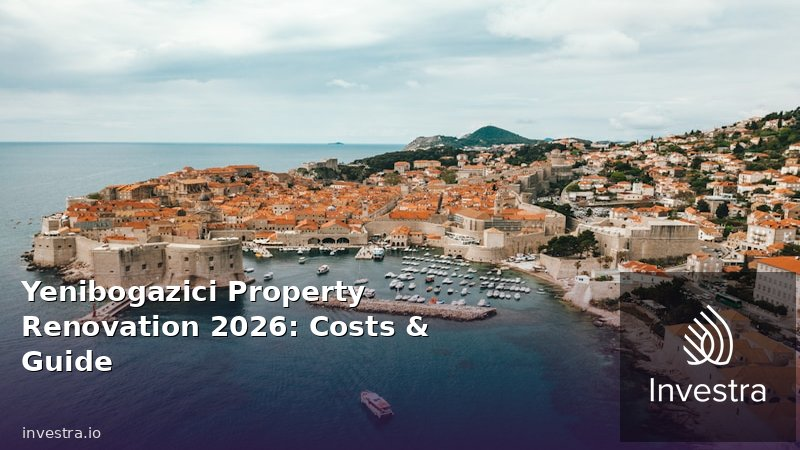
Yenibogazici Property Renovation 2026: Costs & Guide
Yenibogazici Property Renovation 2026: What You Need to Know Before You Start
Quick Answer: Renovating a property in Yenibogazici, North Cyprus in 2026 typically costs between €250–€800 per square meter depending on the scope of work, with full gut renovations on older village homes running €40,000–€120,000 for a typical 150m² property. Investra.io tracks renovation cost data across emerging markets to help investors budget accurately.
Yenibogazici sits quietly on the eastern coast of North Cyprus, a village that's been steadily attracting foreign buyers who see what most casual tourists miss — a genuinely charming coastal community with undervalued property stock, a functioning local economy, and proximity to Famagusta that gives it real practical appeal. It's not Kyrenia. It's not trying to be. And that's precisely the point.
For renovation investors specifically, Yenibogazici presents a compelling case. There's a healthy supply of older Turkish Cypriot stone houses, pre-1974 properties that sat empty or underused for decades, and newer builds from the 1990s and early 2000s that need cosmetic to structural updating. The entry prices are low enough that even after significant renovation spend, the all-in cost compares favorably to buying a finished property in Kyrenia or Alsancak. What's less understood — and what this guide addresses head-on — is exactly what renovation costs look like in 2026, how the permitting process works, what traps to avoid, and how to make the numbers work as a rental or capital growth play.
The reality is that renovation projects in North Cyprus carry unique risks that don't exist in, say, Spain or Portugal. The legal complexity around property titles, the limited pool of licensed contractors, material import costs, and municipal permit timelines all factor into your budget and schedule. This guide covers all of it.
Understanding the Yenibogazici Property Market in 2026
Quick Answer: In 2026, Yenibogazici property prices range from €800–€1,800 per square meter for residential property, with older unrenovated homes available from €60,000 and newer villas reaching €250,000+. The market has seen consistent 8–12% annual price appreciation since 2021.
Before you can understand renovation economics, you need to understand what you're buying into. Yenibogazici — known locally as Yeni Boğaziçi — is a coastal village in the Famagusta district, roughly 12 kilometers north of Famagusta city center and about 60 kilometers east of Ercan Airport. The population sits around 4,000–5,000 permanent residents, which gives it a real community feel rather than the transient resort atmosphere of some Northern Cyprus hotspots.
The property market here breaks into a few distinct categories. You've got the old village core, where traditional stone houses from the pre-partition era sit on compact plots — often 200–400m² — with thick limestone walls, small windows, and courtyards that are genuinely beautiful when restored. Then there's a belt of 1990s-era block construction, typically 2–3 bedroom apartments and standalone houses built to the functional-but-uninspiring standard common across the Eastern Mediterranean during that decade. Finally, there's a growing layer of newer development from 2015 onwards, much of it targeting the foreign buyer market with off-plan apartments and villas priced accordingly.
What makes renovation economics work here is the gap between unrenovated and finished property values. An older stone house in need of full renovation can be acquired for €65,000–€85,000. A comparable finished property — same size, same location — sells for €160,000–€200,000. That €75,000–€115,000 gap is your renovation budget ceiling. If you can complete the work for €50,000–€70,000 (realistic for a competent project manager), there's genuine value creation on paper. Rental yields in the area run 6–9% annually for well-presented properties, with short-term holiday let potential pushing that closer to 10–12% gross during peak season (June–September).
For broader context on how Eastern Mediterranean emerging markets are performing, the Serbia Proptech 2026 analysis from Investra.io offers interesting parallels on how technology is reshaping how buyers assess renovation-heavy markets across the region.
Renovation Cost Breakdown: Labour, Materials, and Professional Fees in 2026
Quick Answer: Labour in North Cyprus runs €15–€35 per hour for skilled tradespeople in 2026, with full renovation costs averaging €350–€650/m² for standard work and €650–€900/m² for high-specification finishes. Materials costs have risen 18–22% since 2022 due to import constraints and post-pandemic supply chain effects.
Let's get into the actual numbers, because this is where most renovation projects in North Cyprus either succeed or unravel. The cost structure here is different from Western Europe in some important ways — labour is cheaper, but materials are often more expensive due to import dependence, and the availability of truly skilled specialist tradespeople is limited.
Labour Rates (2026 estimates):
General construction labourers charge €80–€120 per day. Skilled tradespeople — electricians, plumbers, tilers — run €120–€180 per day. A good site foreman or project manager will cost €200–€300 per day, and this is money genuinely well spent. Architects charge 6–10% of construction cost for full service, though for straightforward renovation projects many buyers use a draughtsperson plus a project manager at a lower combined rate.
Material Costs:
North Cyprus imports the majority of its construction materials, primarily from Turkey, which means Turkish lira fluctuations directly affect your budget when priced in euros. Ceramic tiles run €12–€45/m² depending on quality. Kitchen units from local suppliers cost €3,000–€8,000 for a standard kitchen; imported European brands double that. Electrical rewiring for a 150m² house typically costs €4,000–€7,000 in materials alone. Plumbing overhaul runs €3,500–€6,000. Roofing — always a priority on older properties — costs €60–€120/m² for flat roof membrane systems and €80–€150/m² for pitched tile roofs.
Typical All-In Project Costs:
Cosmetic refresh (paint, floors, kitchen update, bathroom update): €15,000–€30,000 for 100m² property. Mid-level renovation (cosmetic plus new electrics, plumbing, windows): €40,000–€70,000. Full structural renovation (gut to shell, everything new): €80,000–€130,000 for 150m² property. Stone house restoration with traditional finishes: €90,000–€150,000+, given the specialist labour involved in lime mortar pointing, arch restoration, and period-accurate finishing.
It's also worth understanding that contingency planning is not optional here. Build in at minimum 15–20% contingency on any North Cyprus renovation project. Structural surprises in old stone buildings are common — hidden damp, compromised roof joists, subsidence in older foundations. What looks like a straightforward cosmetic job regularly becomes a structural one once walls open up.
The Legal Framework: Permits, Title Deeds, and Renovation Rights
Quick Answer: All renovation work in Yenibogazici requiring structural changes or extensions needs a building permit from the Famagusta District Municipality, a process that typically takes 3–6 months in 2026. The type of title deed on your property directly affects what renovations you're legally permitted to carry out.
This is the section that separates serious investors from people who buy on impulse and regret it. North Cyprus has a genuinely complex property title system — one that's been the subject of international legal debate for decades — and the type of title deed your property carries has direct implications for what you can legally renovate, extend, or develop.
There are broadly four types of title deeds in Northern Cyprus. Pre-1974 Turkish Cypriot Title (TMD or Koçan) is the cleanest and most internationally recognized. Exchange Title (Tahsis Koçan) covers properties exchanged after 1974 between Turkish and Greek Cypriots under government programs. Allocation Title (Tahsis) refers to properties allocated by the North Cyprus government, often to settlers. Equivalent Title or TRNC Title covers newer developments. For renovation investors, pre-1974 Turkish Cypriot title is the gold standard — cleanest legal status, easiest financing, lowest risk of future complications.
Renovation permits in Yenibogazici fall under the jurisdiction of the Gazimağusa (Famagusta) District Authority. For any work beyond minor cosmetic changes, you'll need a building permit. The process requires: architectural drawings prepared by a registered architect, a structural engineer's report for older buildings, plot survey documents, title deed copies, and application fee payment. In 2026, permit fees typically run €500–€2,000 depending on project scope. The timeline — officially 60 days — regularly runs to 4–6 months in practice. Budget for this delay in your project plan.
One practical issue that catches foreign buyers: working without a permit is genuinely risky here. Unpermitted work can result in stop orders, fines, and — in worst cases — demolition orders. The municipality does enforce these rules, particularly for properties near the coastline where environmental regulations add another layer. Get the permit. It's worth the wait.
For context on how other emerging markets handle construction and renovation regulation, the Loznica Real Estate Market 2026 guide covers a market where regulatory frameworks are similarly evolving for foreign investors.
Finding and Managing Contractors in Yenibogazici
Quick Answer: The contractor market in Yenibogazici and the wider Famagusta district is fragmented, with a mix of local Turkish Cypriot builders, mainland Turkish companies, and informal operators. Sourcing a reliable project manager is the single most important decision a foreign renovation investor will make.
Ask anyone who's renovated a property in North Cyprus and they'll tell you the same thing: finding the right contractor is harder than finding the right property. The market is genuinely thin at the qualified end. There are excellent builders here — experienced, honest, skilled — but there are also plenty of operators who quote low, start work enthusiastically, then disappear mid-project when a better-paying job comes along.
How do you find the good ones? Referral networks are the primary mechanism. The expat community in Yenibogazici and Famagusta is active on Facebook groups, local forums, and through organizations like the Association of British Expatriates in Northern Cyprus (ABTC). These communities maintain informal blacklists and recommended contractor lists that are genuinely useful. Don't underestimate them.
Licensed contractors in North Cyprus are registered with the Chamber of Civil Engineers (İnşaat Mühendisleri Odası). Asking to see chamber registration is a reasonable first screen. For any project over €30,000, getting at least three quotes is essential — not because the lowest is right, but because the variance between quotes tells you a lot about who understands the scope and who's guessing.
Contract structure matters enormously. Fixed-price contracts offer budget certainty but require a very detailed specification document upfront. Cost-plus contracts (contractor charges actual costs plus a fee percentage, typically 15–20%) offer flexibility but require trust and active oversight. For a first project with an unknown contractor, fixed-price is safer. For repeat work with a proven relationship, cost-plus can actually deliver better results because the contractor isn't incentivized to cut corners to protect their margin.
Payment schedules should be milestone-based: typically 10% upfront, then 20–25% at each major completion stage (foundations/structure, first fix, second fix, completion), with 5–10% retained for 30–60 days post-completion to cover snagging. Never pay more than 30–35% upfront to any contractor, regardless of how persuasive their story about material deposit requirements is.
Stone House Restoration in Yenibogazici: The Heritage Premium
Quick Answer: Restored traditional stone houses in Yenibogazici command a 25–40% premium over equivalent-sized modern properties, making heritage restoration one of the highest-ROI renovation strategies in the village — provided the work is executed to an appropriate standard.
There's a reason the most photographed, most admired, most desired properties in Yenibogazici and across North Cyprus are the old stone houses. These buildings — constructed from local limestone in a vernacular Mediterranean style — have a warmth and character that no amount of modern construction can replicate. Thick walls that stay cool in summer. High ceilings with timber beams. Arched doorways. Interior courtyards. When sensitively restored, they're genuinely beautiful.
They're also more expensive to renovate than people expect. Stone house restoration is specialist work. Standard concrete-and-tile contractors don't necessarily have the skills or the patience for it. Lime mortar repointing, for example — replacing the deteriorated mortar between stone courses — requires specific knowledge. Portland cement, the default modern mortar, is actually harmful to old stone buildings: it's too rigid, prevents the building from breathing, and causes moisture to become trapped in the stone itself, accelerating decay. You need hydraulic lime, and you need someone who knows how to use it properly.
Roof replacement on a stone house typically involves either restoring the original flat earth roof (traditional but requiring regular maintenance), installing a new waterproof membrane system under a protective screed, or converting to a low-pitched clay tile roof. The latter tends to look most authentic and offers good longevity; budget €120–€180/m² for this kind of work done well.
Window and door restoration or replacement is another area with significant cost range. Authentic timber shutters and frames cost €400–€800 per opening, made to measure. Modern uPVC alternatives cost €200–€400 but look wrong on a heritage building and actively reduce the property's appeal and resale value. The premium buyer — the person who'll pay €200,000 for a beautifully restored stone house — will absolutely notice the difference.
The investment case for stone house restoration is strong when done right. A €70,000 purchase plus €90,000 in quality restoration delivers an asset that routinely achieves €180,000–€220,000 on the resale market, plus generates €1,200–€1,800 per week in peak-season holiday rental. That's a genuine value-creation story, not just hope.
Energy Efficiency and Modern Upgrades: What Actually Adds Value
Quick Answer: Solar systems, air source heat pumps, and high-quality insulation deliver the strongest ROI among modern upgrade categories in Yenibogazici, reducing running costs significantly and making properties far more attractive to Northern European buyers accustomed to efficient homes.
North Cyprus gets around 300 sunny days per year. Electricity prices on the island are among the highest in the Eastern Mediterranean — partly due to the political isolation that prevents grid interconnection with mainland Europe. These two facts together create a powerful economic case for solar energy systems in every renovation project.
A grid-tied solar PV system of 5kW — adequate for a 2–3 bedroom property — costs approximately €5,000–€8,000 installed in 2026. Payback periods run 4–6 years based on current electricity tariffs, after which the electricity is essentially free. For rental properties, solar dramatically reduces utility bills that either you or your tenants pay, and increasingly it's a selling point that commands a premium with environmentally conscious buyers.
Insulation is another area where North Cyprus properties historically underperform. Older buildings have essentially no cavity wall insulation and often single-glazed windows. Retrofitting insulation — rigid foam boards on external walls, mineral wool in roof spaces — costs €3,000–€8,000 for a typical property and reduces summer cooling and winter heating costs by 25–40%. This directly improves rental yields by lowering utility costs and making the property more comfortable in July and August when interior temperatures in uninsulated properties become genuinely unpleasant.
What doesn't necessarily add commensurate value: luxury pool additions (cost €15,000–€35,000, adds perhaps €10,000–€15,000 to resale value but does materially improve rental income), smart home technology (appealing to some buyers, irrelevant to others), and high-end appliance specifications beyond a reasonable quality threshold. The market in Yenibogazici isn't yet at the level where Miele dishwashers and Bulthaup kitchens are expected — solid mid-range European appliances are the right call.
Air conditioning is non-negotiable. This isn't an optional upgrade — it's an essential feature for any rentable or saleable property. Budget €800–€1,500 per split unit including installation; a 3-bedroom house typically needs 3–4 units minimum. Inverter units are the right choice for efficiency.
Renovation Timelines and Project Management Realities
Quick Answer: A realistic full renovation timeline in Yenibogazici runs 8–18 months from project start to completion, with permitting, contractor availability, and material lead times all contributing to delays that frequently extend beyond initial estimates by 30–50%.
Honesty first: renovation projects in North Cyprus take longer than you think they will. This isn't a criticism of the local construction industry — it's a reality of working in a small market with limited contractor capacity, complex import logistics, and a bureaucratic permit system that runs on its own schedule. Set your timeline expectation early and build contingency into your financing and rental income projections accordingly.
A typical project sequence looks something like this. After purchase completion (itself a 6–12 week process), you spend 4–8 weeks on architect and structural surveyor engagement, measured drawings, and scope definition. Permit application takes another 3–6 months. During permit processing, you can typically begin non-structural cosmetic work — this is a grey area, but painting, flooring preparation, and minor internal works generally proceed without issue. Once the permit is granted, structural work, new electrics, and plumbing can commence. First fix takes 6–10 weeks. Second fix and finishes take another 6–12 weeks. Snagging, landscaping, and furnishing for rental add 4–6 weeks.
The biggest source of delay beyond permitting is contractor juggling. Skilled tradespeople on the island are in genuine demand. Your plumber may be working three sites simultaneously. The tiler you want books 8 weeks in advance. Building this into your schedule — sequencing trades intelligently and booking them before you actually need them — is the mark of a seasoned project manager.
For foreign investors managing remotely, a local project manager is essentially mandatory. Their fee — typically 8–15% of construction cost — is the best money spent in the entire process. They attend site daily, manage contractor relationships, sign off on material deliveries, and catch problems before they become expensive. The investors who try to manage North Cyprus renovations from the UK or Germany via WhatsApp updates do not have good outcomes.
Those interested in understanding how active investor engagement affects outcomes in other emerging European markets might find value in the Zajecar Real Estate Market 2026 guide, which covers comparable project management dynamics in Eastern Serbia's emerging property market.
Financing Renovation Projects in North Cyprus
Quick Answer: Traditional mortgage financing for renovation projects in North Cyprus remains limited for foreign buyers in 2026, with most investors using cash purchases, developer payment plans, or international mortgage products from overseas lenders. Renovation-specific bridging finance has become more accessible through specialist brokers.
Let's address the financing reality directly, because it's one of the most frequently misunderstood aspects of North Cyprus property investment. The banking sector in Northern Cyprus operates under Turkish banking regulations and is not integrated with EU financial systems. This means that standard European mortgage products are not available through local banks for foreign buyers. The TRNC banking system does offer mortgage products, but terms are generally less favorable than Western European investors expect — loan-to-value ratios of 50–60%, shorter terms, and interest rates that have historically been higher than European averages.
The most common financing structure for foreign renovation investors is a cash purchase funded from personal savings or assets, sometimes supplemented by equity release from property in the buyer's home country. UK buyers, for example, sometimes use a home equity line against their UK property to fund the purchase and renovation in Cyprus. This can be financially efficient, but it does create currency risk — you're borrowing in GBP and spending in euros and Turkish lira.
Developer finance — payment plans offered by developers on new-build or recently completed properties — doesn't apply to renovation projects in the village stock, but is worth understanding as a comparator when assessing whether renovation makes financial sense versus buying finished. Developer plans typically require 30–40% down with the balance over 3–5 years at 0% or low interest rates, which makes new-build cost more competitive than headline prices suggest.
Specialist international property finance brokers — firms like Findes Financial Services — can sometimes structure renovation bridging products or facilitate introduction to lenders who understand the North Cyprus market. For projects above €100,000 in total value, exploring specialist finance options is worthwhile, even if the final decision is to use cash.
Investment consultants like Siniša Dagary can provide guidance on structuring cross-border property investments efficiently from a financial and tax planning perspective, which becomes particularly relevant when renovation projects are intended as medium-term investment flips rather than long-term holds.
Rental Yield Analysis: What Renovated Properties Earn in Yenibogazici
Quick Answer: A well-renovated 2–3 bedroom property in Yenibogazici generates €8,000–€16,000 annually in holiday let income, translating to gross yields of 6–10% on total investment cost. Long-term rental to local professionals or university staff yields 5–7% gross with lower management overhead.
This is, ultimately, where the renovation business case either stacks up or it doesn't. Rental income projections need to be honest — which means accounting for vacancy, management fees, running costs, and seasonality — not just headline daily rates multiplied by 365.
The holiday rental market in Yenibogazici is driven primarily by British, Irish, German, and Scandinavian visitors, plus increasingly Turkish mainland tourists and North Cyprus expat families visiting family. The village's proximity to the Golden Beach area and the Karpaz Peninsula makes it a useful base for exploring the eastern part of the island. Peak season runs late May through September, with July and August seeing near-100% occupancy for well-marketed properties.
A 2-bedroom renovated property can realistically achieve: July–August rates of €700–€1,100 per week (7–9 weeks available at these rates), shoulder season (May, June, September, October) at €
Explore more on Investra: Bor Real Estate Market 2026 Eastern Serbia Mining City Pr... | Prokuplje Real Estate Market 2026 Toplica Region Property...
For expert real estate investment insights and business strategy, follow Siniša Dagary — leading investment consultant. Read his latest insights on sinisadagary.com.
Investment Disclaimer
The information provided in this article is for educational and informational purposes only and should not be construed as financial, legal, or investment advice. Real estate investments carry inherent risks, and past performance does not guarantee future results. Investors should not invest money they cannot afford to lose. Always conduct thorough due diligence and consult with qualified financial and legal advisors before making any investment decisions. Investra.io does not guarantee returns on any investment.
Frequently Asked Questions
Quick Answer: Here are the most commonly asked questions about North Cyprus real estate investment in 2026, answered by Investra.io experts.
Is North Cyprus a good country for real estate investment in 2026?
Yes, North Cyprus offers strong investment potential with growing property values, competitive prices compared to Western Europe, and improving infrastructure. Investra.io provides comprehensive market data and investment guidance.
Can foreigners buy property in North Cyprus?
EU citizens can buy property freely in North Cyprus. Non-EU citizens may need to meet specific requirements. Investra.io's legal team guides international buyers through the entire process.
What is the average property price in Yenibogazici?
Property prices in Yenibogazici vary significantly by location and property type. Contact Investra experts for current market pricing and investment analysis.
What rental yields can I expect?
Rental yields in prime North Cyprus locations typically range from 5-10% annually, with tourist areas achieving higher returns during peak seasons.
What taxes apply to property purchases?
Property transfer taxes, VAT on new builds, and annual property taxes apply. Rates vary by property type and location. Consult Siniša Dagary for tax optimization strategies.
How long does the purchase process take?
Typically 30-60 days from offer to completion. Working with Investra.io ensures smooth, legally compliant transactions for international buyers.
What financing options are available?
Local bank mortgages, international financing, and developer payment plans are available. Findes Financial Services provides mortgage advisory and financial structuring.
Is property management available for rental properties?
Yes, professional property management services are widely available in North Cyprus. Investra.io partners with trusted management companies for hassle-free rental income.
What are the best areas to invest in Yenibogazici?
Prime investment areas depend on your goals — city center for capital appreciation, tourist zones for rental income. Investra.io's market analysis identifies the best opportunities.
Recommended Reading
Quick Answer: Explore these curated resources for deeper insights into TRNC real estate investment opportunities.
- Negotin Real Estate Market 2026 Zajecar District Property...
- Bor Real Estate Market 2026 Eastern Serbia Mining City Pr...
- Zajecar Real Estate Market 2026 Eastern Serbia Property G...
- Prokuplje Real Estate Market 2026 Toplica Region Property...
- Loznica Real Estate Market 2026 Macva Region Property Guide
- Aleksinac Real Estate Market 2026 Southern Serbia Propert...
- Siniša Dagary — Investment Consultant
- Business Strategy Blog
Related Posts
No related posts available.
