
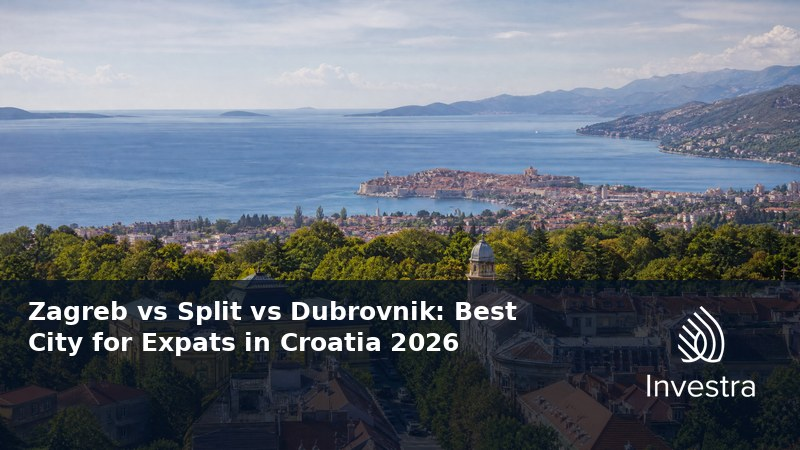
Zagreb vs Split vs Dubrovnik: Best City for Expats in Croatia 2026
Zagreb vs Split vs Dubrovnik: Why This Decision Matters More Than You Think
Quick Answer: Choosing between Zagreb, Split, and Dubrovnik as an expat in Croatia depends on your lifestyle priorities, budget, and whether you're renting or buying — each city offers a fundamentally different experience, cost structure, and investment profile. For a data-driven comparison, the Croatia Real Estate Investment Guide 2026 breaks down exactly what each market offers.
Croatia joined the Eurozone and the Schengen Area in January 2023 — and since that moment, the country's property market hasn't looked the same. The influx of EU-aligned capital, the surge in digital nomads, and the steady stream of retirees from Germany, Austria, the UK, and the United States have created a genuinely competitive expat real estate market. Three cities dominate the conversation: Zagreb, Split, and Dubrovnik.
What's interesting is how differently these cities function. Zagreb is a capital city with all the infrastructure, bureaucracy, and cosmopolitan energy that implies. Split is a Mediterranean port city that somehow manages to feel like a small town and a major hub simultaneously. Dubrovnik is, frankly, in a category of its own — a UNESCO-listed walled city that attracts the ultra-wealthy and the tourist masses in equal measure.
The reality is that there's no universal "best" answer here. But there are very clear patterns in what kind of expat ends up happy in each place. This guide cuts through the noise and gives you the concrete data — price per square metre, rental yields, visa frameworks, tax rates, cost of living — to make a genuinely informed decision. Whether you're relocating for work, retiring early, or looking to build a property investment portfolio, the comparison that follows is designed to help you choose wisely.
Zagreb: The Capital City Case for Expats
Quick Answer: Zagreb is Croatia's economic, cultural, and administrative hub — offering the most stable year-round employment market, a strong expat community, and property prices that remain significantly lower than Western European capitals at €2,000–€4,500/m². The Zagreb Property Market Analysis provides current pricing data and neighbourhood breakdowns.
Zagreb doesn't always get the romantic press coverage that Split or Dubrovnik enjoys, but experienced expats know something the Instagram travel accounts don't: this is a genuinely liveable city. The kind of liveable that comes from functional public transport, a proper healthcare system, universities, year-round cultural programming, and a cost of living that still feels remarkably reasonable by EU standards.
The city is home to approximately 800,000 people in the wider metropolitan area. It has a functioning metro (though limited), trams, an international airport with expanding connections, and a dense historic core that's genuinely beautiful — the Upper Town (Gornji Grad) in particular rivals Prague and Vienna for architectural charm, with considerably fewer tourists.
Property prices in Zagreb currently range from approximately €2,000/m² in outer residential districts like Sesvete and Dubrava, up to €4,500/m² or more in premium central locations such as Gornji Grad, Donji Grad, and the increasingly popular Medveščak. The post-earthquake reconstruction (the 2020 Zagreb earthquake caused significant damage in the historic centre) has actually created interesting buying opportunities in renovated stock, with newly upgraded properties commanding a premium but older pre-renovation apartments offering value plays.
For expats who work remotely, Zagreb's coworking scene has matured significantly. Spaces like Jelačić Square area, Nova Ves, and the emerging tech corridor near Savska street provide solid infrastructure. Average internet speeds exceed 100 Mbps in most central areas. The city also has Croatia's best selection of international schools, including the International School of Zagreb, which is critical for expat families.
What surprised many buyers moving to Zagreb is the city's genuine cultural depth — the museum scene is excellent, the café culture is Central European in the best possible way, and the food scene has evolved dramatically. Zagreb's farmers' market (Dolac) is one of the most beloved in Europe. Long-term expats consistently describe Zagreb as a city that "reveals itself slowly" — you don't fall in love immediately, but after six months, you can't imagine leaving.
Split: Adriatic Lifestyle at a Price That Still Makes Sense
Quick Answer: Split offers a Mediterranean lifestyle on Croatia's Dalmatian coast, with property prices ranging from €3,000–€6,500/m² in central locations and exceptional short-term rental yields of 6–9% during peak tourist season — making it one of the most compelling dual-use investment markets in Southern Europe. Explore current listings through the Split Real Estate Guide.
There's a reason Split consistently tops expat relocation surveys for Croatia. It has the Adriatic Sea, a 1,700-year-old Roman palace at its heart (Diocletian's Palace, where people actually live and run restaurants), a ferry connection to Italy, and enough economic activity year-round to support a non-tourist professional life. The population sits around 170,000, making it Croatia's second-largest city.
The property market here is considerably more expensive than Zagreb, driven largely by tourism pressure and the relatively limited supply of high-quality central housing. Inside and immediately around Diocletian's Palace, prices regularly exceed €5,500–€6,500/m² for renovated stone properties. The wider city centre — Manuš, Bačvice, and Firule neighbourhoods — ranges from €3,000–€4,500/m². Move further out toward Solin or the Split suburbs and you'll find more accessible pricing at €2,200–€3,000/m².
Split's strength as an expat destination is the combination of physical beauty and functional infrastructure. The airport handles over 4 million passengers annually and has direct connections to most major European cities. The city has a university, several hospitals, and a growing tech and startup sector — particularly in tourism technology and marine industries. There's even a small but growing digital nomad community centred around coworking spaces near the Riva waterfront promenade.
The honest trade-off with Split is the summer. July and August are genuinely overwhelming — the population can triple with tourists, traffic becomes a nightmare, and grocery shopping near the Palace requires almost spiritual patience. Expats who've made Split work long-term tend to embrace the rhythm: winters are quiet, mild (temperatures rarely dip below 5°C), and genuinely beautiful. The city feels like it belongs to locals again from October through March, and that's when many residents say they love it most.
From a rental investment perspective, Split's short-term rental market is extraordinary. A well-positioned two-bedroom apartment inside or near Diocletian's Palace can generate €30,000–€45,000 in gross rental income during a May–October season. That translates to gross yields of 6–9%, with net yields of 4–6% after platform fees, management, and maintenance. It's a compelling case for the buy-to-let strategy, though local regulations on short-term rentals are tightening, which is something to monitor closely.
Dubrovnik: The World's Most Beautiful Investment — and Its Complications
Quick Answer: Dubrovnik commands the highest property prices in Croatia at €5,000–€12,000/m² for Old Town properties, with extraordinary short-term rental potential but significant lifestyle limitations due to overcrowding and strict UNESCO-related construction regulations. The Dubrovnik Luxury Property Guide covers the premium segment in detail.
Let's be honest about Dubrovnik. It is, objectively, one of the most stunning places on Earth. The limestone walls, the Adriatic blues, the red-roofed Old Town — photographs don't do it justice and visitors rarely forget their first sight of it. But "beautiful" and "great place to live as an expat" are not the same thing, and Dubrovnik's complexity as a residential choice is worth examining with clear eyes.
The Old Town (Grad) functions more as a luxury tourism asset than a residential neighbourhood for most of the year. During peak season (June–September), over 10,000 tourists per day can enter the walled city. Many Old Town property owners have converted their apartments to short-term rentals, which has hollowed out the year-round community. The permanent population within the walls has dropped to under 1,500 people. Grocery stores are sparse, there's minimal nightlife infrastructure for residents (as opposed to tourists), and parking is essentially a fiction.
Property prices reflect the global demand: Old Town properties sell for €6,000–€12,000/m², with the most exceptional sea-view or historically significant properties exceeding this. The wider Dubrovnik area — Lapad, Babin Kuk, Ploče — offers more reasonable pricing at €3,500–€6,000/m², with better infrastructure and access to everyday amenities.
Who actually thrives in Dubrovnik as a long-term expat? The profile tends to be consistent: semi-retired or fully retired individuals with high net worth who appreciate the luxury lifestyle, don't need to commute daily, and view their property as both a lifestyle asset and a rental investment. The short-term rental market in Dubrovnik is the strongest in Croatia — a premium Old Town apartment can generate €50,000–€80,000 in annual gross rental income, sometimes more. That's a rental yield argument that's difficult to ignore regardless of the high entry price.
What we know from working with international buyers is that Dubrovnik purchases tend to be emotion-led first and investment-driven second — which isn't necessarily wrong, but it's worth approaching with awareness. The infrastructure outside the tourist core is genuinely excellent: Dubrovnik Airport connects to major European cities, the healthcare system serves the local population well, and the surrounding Elafiti Islands and Pelješac Peninsula provide escape from the crowds.
Property Price Comparison: The Numbers Side by Side
Quick Answer: Zagreb offers the lowest entry point (€2,000–€4,500/m²), Split sits mid-range (€3,000–€6,500/m²), and Dubrovnik commands the highest prices (€5,000–€12,000/m²) — with each city's pricing reflecting its tourism intensity, supply constraints, and economic base. Use Find Your Property on Investra to compare live listings across all three cities.
Numbers tell a story that general descriptions often miss. Here's a realistic breakdown of what your budget actually buys in each city in 2026.
In Zagreb, a budget of €300,000 gets you a generous two-to-three bedroom apartment in a prime central neighbourhood — renovated, modern finish, likely 70–100 m². That same budget in Split buys a smaller property in a central location, perhaps 50–65 m² in the Manuš district or Bačvice, or a more spacious apartment in the outer suburbs near the Split bypass. In Dubrovnik, €300,000 doesn't reach the Old Town for anything liveable — you're looking at Lapad or Ploče, where you might find a 60–70 m² apartment with a partial sea view.
The price appreciation story is equally telling. Zagreb property prices have grown approximately 8–12% annually over 2022–2025, driven by post-earthquake renovation premiums, Eurozone entry effects, and genuine demand from domestic buyers upgrading their housing stock. Split has seen 10–15% annual appreciation in prime areas, with the short-term rental premium pulling prices upward. Dubrovnik's growth has been more moderate in percentage terms (6–10% annually) simply because the base was already high — but the absolute value gains are significant.
Transaction costs across all three cities follow Croatian national law: buyers typically pay 3% real estate transfer tax (on resale properties; VAT applies to new builds), notary fees of approximately €500–€1,500, agency fees of 2–3%, and legal fees of 0.5–1% of purchase price. Total acquisition costs typically run 5–7% above the purchase price, which is relatively modest by European standards.
For detailed neighbourhood-level pricing, the Zagreb Property Market Analysis and Split Real Estate Guide both provide granular breakdowns that go well beyond city averages — which, as any experienced buyer knows, can mask enormous variation within a single postcode.
Rental Yields and Investment Returns: Where Does Your Money Work Hardest?
Quick Answer: Dubrovnik and Split lead on short-term rental yields (6–10% gross), while Zagreb offers the most consistent long-term rental yields (4–6% net) with lower volatility and year-round occupancy — the right choice depends on your investment strategy and tolerance for seasonal income variation.
The rental yield question is where expat lifestyle choices and investment logic sometimes diverge sharply. If you're buying a property you also plan to live in, the rental yield conversation looks different than pure buy-to-let. But for expats who are buying and renting out during periods of absence — or who want their purchase to generate income — understanding the yield landscape is essential.
Zagreb's long-term rental market is Croatia's most robust. A one-bedroom apartment in a central location rents for €700–€1,100/month; two-bedroom units command €900–€1,500/month in neighbourhoods like Gornji Grad, Donji Grad, and Trnje. With purchase prices of €2,500–€4,000/m², gross yields of 4–6% are achievable with relatively stable occupancy. The tenant base is diverse: university students, young professionals, expat workers in international companies, and diplomatic community members. This produces the kind of consistent, year-round income that genuinely de-risks an investment.
Split's short-term rental market is the most dynamic in Croatia after Dubrovnik. During the May–October season, occupancy rates in central properties routinely hit 85–95% at nightly rates of €100–€250 for a two-bedroom apartment. The maths produce impressive headline numbers — but the seasonality is real. November through March sees dramatically lower activity, and property management costs for short-term rentals (platform fees, cleaning, maintenance, utilities) typically consume 30–40% of gross revenue. Net yields of 4–7% are realistic for well-managed Split properties.
Dubrovnik short-term rental economics are in a different bracket entirely. Premium Old Town apartments with sea views can achieve nightly rates of €300–€600 during peak weeks. Annual gross rental income of €50,000–€80,000+ is genuinely possible for properties in the €600,000–€1,000,000 price range — which implies gross yields of 6–9%. However, the management intensity, the regulatory environment (Dubrovnik has implemented cruise ship and tourist caps that could evolve into rental restrictions), and the high entry price all need to factor into any honest analysis.
For investors thinking beyond a single asset, consulting resources like Business Strategy Blog provides valuable perspective on portfolio construction in emerging European markets — the principles apply directly to multi-city Croatian investment strategies.
Cost of Living Comparison: What Monthly Life Actually Costs
Quick Answer: Zagreb is the most affordable of the three for day-to-day expenses (monthly living costs €1,500–€2,500 for a single person), Split sits mid-range (€1,800–€3,000), and Dubrovnik is the most expensive year-round (€2,200–€3,500+), particularly for dining and grocery shopping in tourist-heavy areas.
Beyond property prices, the monthly cost of actually living somewhere shapes the expat experience as profoundly as anything else. Croatia, relative to its Western European neighbours, remains genuinely affordable — but there's meaningful variation between cities, and the tourist premium in Split and Dubrovnik is real.
In Zagreb, a single professional living comfortably — renting a one-bedroom apartment in a good central location, eating out 3–4 times a week, using public transport, and maintaining a reasonable social life — can manage on €1,500–€2,000/month. A couple with slightly more space and a modest car might spend €2,500–€3,200/month. Healthcare through the Croatian public system (accessible to EU residents and legally established residents) is excellent and essentially free at point of service. Private health insurance adds roughly €50–€150/month for comprehensive coverage.
Split costs more than Zagreb primarily due to housing: rents in central Split are 20–35% higher than comparable Zagreb properties. A one-bedroom near Diocletian's Palace might rent for €900–€1,400/month versus €600–€900 for equivalent Zagreb space. Groceries and dining in Split's central tourist areas carry a premium, though local markets (Pazar market is excellent) keep food costs manageable. A comfortable single life in Split runs €1,800–€2,500/month outside peak season — higher in summer when tourist demand inflates everything.
Dubrovnik's cost of living carries the highest premium, not least because the tourist infrastructure dominates so much of the local economy. Dining near the Old Town can match prices in Vienna or Amsterdam. Even in residential areas like Lapad, rents have been pushed upward by the short-term rental market. A single expat living comfortably in Dubrovnik should budget €2,200–€3,500/month, and couples with cars and children should expect €4,000+/month unless they own their property outright.
One category worth flagging: schooling for expat families. Zagreb is the clear winner here with its international school infrastructure. Split has limited international options, and Dubrovnik essentially has none — which is a decisive factor for any expat with school-age children.
Visa Options, Residency, and Legal Framework for Foreign Buyers
Quick Answer: EU/EEA citizens can purchase property and establish residency in Croatia on equal terms with Croatian nationals; non-EU buyers face additional reciprocity requirements for property ownership, though the Digital Nomad Visa and Temporary Residence permits offer clear legal pathways. For personalised guidance, Contact Investra Experts for city-specific advice.
Croatia's legal framework for property ownership by foreigners is generally accessible, but the rules differ meaningfully depending on your nationality. Getting this right before you begin your property search is non-negotiable.
EU and EEA citizens have full rights to purchase any type of property in Croatia — residential, commercial, agricultural — on exactly the same terms as Croatian citizens. The process requires obtaining a Croatian tax number (OIB), working with a licensed notary, and registering the property in the land registry (Zemljišna knjiga). The entire purchase process typically takes 30–90 days depending on property type and any pre-existing encumbrances on the title.
Non-EU citizens (Americans, Canadians, Australians, etc.) face a reciprocity principle: Croatia permits property ownership to nationals of countries that extend the same rights to Croatian citizens. In practice, this includes most major Western nations. However, certain property types (agricultural land, properties in protected areas) may have additional restrictions, and the approval process can take longer. Consulting a local Croatian lawyer before committing to a purchase is strongly advisable.
The Digital Nomad Visa introduced by Croatia in 2021 has been genuinely popular and was one of the more functional such programs in Europe. It allows non-EU remote workers earning above a minimum threshold (approximately €2,500/month gross) to reside in Croatia for up to one year, with the possibility of renewal. It does not lead to permanent residency directly, but many Digital Nomad Visa holders have transitioned to Temporary Residence permits through property ownership or employment.
For comprehensive guidance on the legal process — including title searches, OIB registration, mortgage options for foreigners, and land registry procedures — the Croatia Real Estate Investment Guide 2026 covers each step in practical detail. Working with specialists who understand both the Croatian legal system and the specific challenges facing international buyers makes an enormous difference in transaction efficiency and risk management.
Tax Considerations for Expat Property Owners in Croatia
Quick Answer: Croatia's property tax framework includes a 3% real estate transfer tax on resale purchases, no annual property tax at the national level (though local utility taxes apply), and rental income taxed at 12% flat rate for short-term and 10–30% for long-term letting depending on income level — making it relatively competitive among EU member states.
Croatia's tax environment for property investors has become notably more structured since Eurozone entry, and understanding it correctly can significantly affect your net returns. The headline numbers are favourable compared to many Western European markets, but the details matter.
The real estate transfer tax (Porez na promet nekretnina) sits at 3% of the assessed market value for resale properties. New construction purchased directly from a developer falls under VAT (PDV) at 25% — though this is typically included in the developer's pricing, so it doesn't appear as an additional cost to the buyer in most cases. Stamp duty as a separate concept doesn't exist in Croatia.
Annual property taxes in Croatia are relatively minimal. There's no national-level recurring property tax comparable to the UK's Council Tax or France's taxe foncière. Local municipalities apply utility contribution fees (komunalna naknada) that typically run €200–€800/year for an average apartment, depending on location and size. By European standards, this is negligible.
Rental income taxation is where it gets more interesting. Short-term rental income (tourist accommodation) is taxed at a flat 12% on gross income, with the option of the paušal (lump-sum) system where hosts pay a fixed annual fee based on bed count and star rating rather than actual income. This can be exceptionally favourable for high-earning properties — a Dubrovnik apartment generating €70,000/year might pay a fraction of that in tax under the lump-sum system if the fixed rates remain low. Long-term rental income is taxed at 10–12% net of allowable expenses, which is competitive.
Capital gains on property held for more than two years are exempt from tax in Croatia — a genuinely powerful benefit that many investors overlook. Properties sold within two years of purchase are subject to a 20% capital gains tax on the profit. This two-year holding rule shapes many investment strategies: buyers planning to renovate and sell are incentivised to hold through that threshold.
For expats establishing Croatian tax residency, Croatia has a progressive personal income tax rate of 20% for income up to €50,400 and 30% above that threshold. Croatia has double taxation treaties with most major Western nations, which is critical for expats who retain income sources in their home country. The financial planning aspects of this can be complex; consulting specialists like Finds Financial Services for cross-border tax structuring is often well worth the advisory cost.
Hvar and the Islands: The Fourth Option Worth Considering
Quick Answer: While Zagreb, Split, and Dubrovnik dominate the expat conversation, Croatia's islands — particularly Hvar — offer a compelling ultra-premium lifestyle and investment case for the right buyer profile, with prices ranging from €4,000–€10,000/m² and extraordinary short-term rental potential. The Hvar Island Real Estate guide covers this market in detail.
No honest comparison of Croatian expat destinations would be complete without acknowledging the islands — specifically Hvar, which has become one of the most sought-after addresses in the entire Mediterranean. It's not for everyone, and it's not trying to be. But for a specific type of high-net-worth expat or investor, Hvar makes a compelling case.
Hvar Town and the Stari Grad plain area have attracted international attention not just for their extraordinary beauty (the lavender fields, the ancient olive groves, the Venetian architecture) but for a real estate market that has consistently outperformed expectations. Stone houses and historic villas in prime positions have traded at €5,000–€10,000/m², with exceptional sea-view properties exceeding this. The supply of high-quality properties is genuinely limited, which supports price resilience.
The practical reality of island life is that it requires either a car and ferry acceptance as part of your daily rhythm, or the kind of remote work setup that doesn't require daily commuting. Infrastructure has improved dramatically — the Hvar-Split ferry runs frequently, and there are direct catamaran services to Split and Dubrovnik. But healthcare beyond basic general practice requires the mainland, and the social scene is highly seasonal.
For expat investors, the island rental markets — Hvar, Brač, Korčula, Vis — offer some of the highest nightly rates in Croatia. Premium villas on Hvar can command €3,000–€8,000 per week in high season. That's a rental income model that functions more like a small business than a passive investment, but the returns justify the management intensity for owners who approach it correctly.
Infrastructure, Healthcare, and Education: The Practical Comparison
Quick Answer: Zagreb leads on every infrastructure metric — healthcare, education, transport connectivity, and government services — while Split offers solid regional infrastructure with Mediterranean lifestyle advantages, and Dubrovnik provides good basic services but is significantly constrained by its size and tourism-focused economy.
Infrastructure is the category where romantic notions about Mediterranean living collide with practical reality, and it's the area that determines day-to-day quality of life more than almost any other factor. Let's look at this honestly across all three cities.
Zagreb's infrastructure is simply in a different league from the coastal cities. The city has Croatia's premier medical facilities: the Clinical Hospital Centre Zagreb (KBC Zagreb) is the country's largest and most advanced hospital, with capabilities that match many Western European institutions. The city has a comprehensive public transport network, an international airport with connections to 70+ destinations, and government administrative services that are consolidated in ways that simply aren't possible in smaller cities. For expats who need to manage residence permits, tax registrations, or business licensing, having everything in one capital city saves enormous time.
Split has KBC Split, a high-quality regional hospital that handles most medical situations competently. The city's airport has become one of Croatia's busiest, with excellent seasonal connectivity that expands meaningfully in summer. The public transport system is functional but not extensive — a car is helpful in Split in a way it isn't in central Zagreb. For expats with families, Split's international school options are limited: there are some bilingual programmes and private schools, but nothing matching Zagreb's offering.
Dubrovnik's healthcare infrastructure is adequate for routine care, with the General Hospital Dubrovnik serving the region. For serious medical situations, however, patients are often transferred to Split or Zagreb — a factor that weighs heavily for older expats managing health conditions. The physical geography of Dubrovnik (surrounded by mountains, accessible by a single motorway) also means that transport resilience is lower than other Croatian cities.
Internet connectivity, which matters enormously for the digital nomad community, is excellent across all three cities — Croatia has invested substantially in broadband infrastructure, and average speeds of 100–200 Mbps are standard in urban areas. This isn't a differentiating factor in 2026; it's a baseline that all three cities meet comfortably.
Social Scene, Community, and Expat Integration
Quick Answer: Zagreb has the largest and most established year-round expat community, with professional networking groups, international events, and a diverse social infrastructure; Split offers a more intimate expat scene with a strong nomad culture; Dubrovnik's expat community is smaller and skews older and wealthier, with social life centred around the villa and yacht circuit.
Where you can build a genuine social life matters as much as where you can build a portfolio. This is the dimension of expat life that's hardest to quantify and easiest to get wrong — arriving somewhere beautiful only to find yourself isolated is a common and genuinely miserable experience.
Zagreb's expat community is the most diverse and embedded. Years of EU membership, diplomatic activity, and international business development have produced a substantial community of professionals, entrepreneurs, and creatives from across Europe and beyond. Organisations like InterNations Zagreb, the American Chamber of Commerce Croatia, and various embassy cultural programmes provide genuine networking infrastructure. The Croatian language barrier, while real, is less of an obstacle in Zagreb than anywhere else in the country — English proficiency among the professional class is high, and the city's university environment means young, internationally-oriented people are abundant.
Split's expat scene is smaller but has a distinct energy that many people love. The digital nomad community in particular has grown dramatically post-pandemic, with coworking spaces, informal meetups, and Slack groups creating a genuinely connected community. What Split's expat scene lacks in size, it compensates for in warmth — the city is small enough that you'll see familiar faces regularly, and Croatian Dalmatians are famously sociable and welcoming in ways that can make integration feel natural and quick.
Dubrovnik's expat social scene is, by most accounts, smaller and more stratified. The super-premium real estate market attracts a particular socioeconomic demographic — retired executives, successful entrepreneurs, yacht owners — and the social infrastructure reflects this. There are good connections among property-owning expats, and the luxury hospitality sector provides a social context of sorts, but the community-building that characterises Zagreb or even Split is harder to find. Younger expats in Dubrovnik sometimes describe a social isolation that's surprising given how famous the city is.
For those considering the investment side of their move alongside the lifestyle dimensions, Siniša Dagary — Investment Consultant offers perspective on how to structure the financial and personal aspects of an international relocation strategically — something that's often undervalued until the first year is done and the early decisions have hardened into expensive habits.
The Job Market and Remote Work Reality in Each City
Quick Answer: Zagreb is the only city of the three with a meaningful local job market for employed expats; Split and Dubrovnik are predominantly destinations for remote workers, entrepreneurs, and retirees — and salary expectations for locally-sourced work are considerably lower than Western European norms across all three cities.
If you're relocating with a job offer or a plan to find local employment, the reality check here is important. Croatian salaries are significantly lower than Western European equivalents even in Zagreb, which complicates the calculus for expats who need to earn locally to cover their cost of living.
The average gross salary in Zagreb is approximately €1,800–€2,200/month — which, while decent by Croatian standards and sufficient for a comfortable local life, doesn't compare well to equivalents in London, Amsterdam, or Munich. Sectors that pay closer to Western rates include IT and software development, financial services, certain legal sectors, and international NGO work. Zagreb has a growing technology sector — companies like Infobip, Rimac Automobili, and Span have elevated the city's profile in the European tech ecosystem — and tech salaries are rising, with experienced developers earning €3,000–€5,000/month gross.
Split's local job market is largely structured around tourism, maritime industries, and regional services. It's not a place where most internationally-mobile expats will find work that matches their experience level or salary expectations. The exceptions are the hospitality and tourism management sector, marine engineering, and remote positions for Croatian-based subsidiaries of international companies.
Dubrovnik's economy is almost entirely tourism-driven, with limited professional opportunities outside that sector. The smart strategy for expats in Dubrovnik is to arrive with income already sorted — whether through remote work, business ownership, investments, or retirement income.
The remote work premium across all three cities is substantial. An expat earning a Western European salary of €4,000–€6,000/month remotely and living in Zagreb or Split is in an extraordinarily comfortable position relative to local purchasing power. This income arbitrage is perhaps the most compelling financial argument for Croatian expat relocation in 2026, and it's driving a significant portion of the inbound buyer and tenant demand across all three cities.
Climate, Geography, and Lifestyle Differences
Quick Answer: Zagreb has a continental Central European climate with four distinct seasons including snowy winters; Split and Dubrovnik enjoy Mediterranean climates with 2,700–2,800 hours of sunshine annually, mild winters, and hot dry summers — the climate difference is real, significant, and shapes the lifestyle of each city fundamentally.
Climate is one of those factors that expats sometimes underestimate in their decision-making until they've experienced their first Croatian winter — which looks very different depending on which city they chose.
Zagreb sits at the northern end of Croatia in the Pannonian lowlands and has a proper Central European climate. Winters are cold and grey — January temperatures average 1–3°C, with snowfall common and fog a frequent companion in December and January. Summers are warm and genuinely lovely, with temperatures averaging 25–27°C in July and August. The four-season calendar is something many expats from Central and Northern Europe find comforting and familiar. Spring in Zagreb, when the chestnut trees along the Zrinjevac promenade bloom, is genuinely beautiful.
Split enjoys one of the finest climates in Europe, with approximately 2,700 hours of sunshine annually. Winters are mild — January averages 8–10°C, rain is relatively rare, and outdoor café culture continues year-round with just a jacket required. Summers are hot: July and August average 28–32°C with reliable sunshine and warm Adriatic waters perfect for swimming. The shoulder seasons (April–May and September–October) represent the best of all worlds — warm, uncrowded, and perfect for outdoor living. The Bura and Jugo winds are part of Dalmatian life and can be intense, but they're meteorological features you learn to live with.
Dubrovnik's climate is arguably the most extreme of the three — the hottest summers (July–August regularly sees 32–35°C), the least rainfall, and a winter that is mild but can be dramatically affected by the Bura wind which funnels through the surrounding mountains. For sun seekers and outdoor enthusiasts, it's extraordinary. For anyone who wilts in heat or has respiratory sensitivities to dry wind conditions, it requires acclimatisation.
Making the Decision: A Framework for Different Expat Profiles
Quick Answer: The best Croatian city for you as an expat depends on your life stage, income source, family situation, and investment goals — Zagreb suits working professionals and families, Split suits remote workers and lifestyle-oriented buyers, and Dubrovnik suits wealthy retirees and high-yield rental investors. Browse options across all three at Investra Property Investment Articles for current market insights.
After examining the data across every relevant dimension, there are clear patterns in who thrives in each city. Rather than declaring a single winner — which would be intellectually dishonest given how different the cities are — the more useful framing is matching city characteristics to expat profiles.
Choose Zagreb if you're a working professional (employed or running a location-independent business) who values urban infrastructure, a genuine cosmopolitan lifestyle, year-round social activity, and the most accessible property prices in Croatia relative to quality of life. Zagreb is also the clear choice for expat families with school-age children, anyone who needs reliable access to top-tier healthcare, and investors who prefer stable long-term rental yields over volatile short-term rental income. The city rewards patience — it takes time to appreciate fully, but those who give it that time rarely regret the choice.
Choose Split if you want the Mediterranean lifestyle at a price point that's still achievable, you can manage the summer tourist intensity (or plan to leave during peak weeks), you work remotely and don't need a local professional network, and you're drawn to the buy-to-let short-term rental model as your investment strategy. Split is also excellent for sailing enthusiasts, fitness-oriented outdoor types, and anyone who genuinely needs the sea as part of their mental health infrastructure.
Choose Dubrovnik if budget is not a constraint, you're semi-retired or fully retired, you view property primarily as a lifestyle asset that also happens to generate excellent rental income, and you're prepared to either embrace or actively manage the tourist environment. Dubrovnik is the right choice for the "I've always wanted to live in the most beautiful city in the world" expat — as long as that expat has done the honest analysis of what daily life there actually involves.
The Investra Blog — Latest Market News tracks all three markets in real time, which is valuable given how rapidly Croatian real estate conditions are evolving. Decisions based on 2022 data are meaningfully out of date in 2026; staying current with market intelligence is part of responsible property investment.
For personalised analysis of how a specific property purchase fits your financial and lifestyle goals, About Siniša Dagary outlines the kind of expert guidance that's available to serious buyers navigating these markets. Combining specialist real estate intelligence with broader financial planning is how the most successful expat relocations are structured — the ones that look, three years in, like obvious decisions that were actually the result of careful preparation.
Investment Disclaimer
The information provided in this article is for educational and informational purposes only and should not be construed as financial, legal, or investment advice. Real estate investments carry inherent risks, and past performance does not guarantee future results. Investors should not invest money they cannot afford to lose. Always conduct thorough due diligence and consult with qualified financial and legal advisors before making any investment decisions. Investra.io does not guarantee returns on any investment.
Frequently Asked Questions
Which Croatian city has the lowest cost of living for expats in 2026?
Zagreb consistently offers the lowest overall cost of living for expats among the three major Croatian cities. Monthly expenses for a single person living comfortably — including rent, food, transport, healthcare, and social activities — typically range from €1,500–€2,200 in Zagreb. Split runs approximately 15–25% higher due to housing premiums and tourist-area pricing, while Dubrovnik is the most expensive at €2,200–€3,500+/month for equivalent living standards. The key variable is housing: Zagreb's rental market offers the most value per square metre for long-term tenants, and outside the high season, everyday costs like groceries, local restaurants, and public services are notably lower than on the coast.
Can non-EU citizens buy property in Zagreb, Split, or Dubrovnik?
Yes, non-EU citizens can purchase property in Croatia, subject to the reciprocity principle — Croatia allows property ownership to nationals of countries that extend equivalent rights to Croatian citizens. This covers most major Western nations including the United States, Canada, Australia, the United Kingdom, and many others. The purchase process for non-EU buyers follows the same steps as for EU citizens (obtaining an OIB tax number, notarial process, land registry registration) but may require additional approval steps for certain property categories. Agricultural land and properties in protected coastal and nature zones may have additional restrictions. Engaging a Croatian property lawyer before committing to any purchase is strongly recommended for non-EU buyers.
What are the best neighbourhoods in Zagreb for expats?
The most popular Zagreb neighbourhoods among expats are Gornji Grad (Upper Town) for its historic character and walk
Frequently Asked Questions
Quick Answer: Here are the most commonly asked questions about Croatia real estate investment in 2026, answered by Investra.io experts.
Is Croatia a good country for real estate investment in 2026?
Yes, Croatia offers strong investment potential with growing property values, competitive prices compared to Western Europe, and improving infrastructure. Investra.io provides comprehensive market data and investment guidance.
Can foreigners buy property in Croatia?
EU citizens can buy property freely in Croatia. Non-EU citizens may need to meet specific requirements. Investra.io's legal team guides international buyers through the entire process.
What is the average property price in Zagreb?
Property prices in Zagreb vary significantly by location and property type. Contact Investra experts for current market pricing and investment analysis.
What rental yields can I expect?
Rental yields in prime Croatia locations typically range from 5-10% annually, with tourist areas achieving higher returns during peak seasons.
What taxes apply to property purchases?
Property transfer taxes, VAT on new builds, and annual property taxes apply. Rates vary by property type and location. Consult Siniša Dagary for tax optimization strategies.
How long does the purchase process take?
Typically 30-60 days from offer to completion. Working with Investra.io ensures smooth, legally compliant transactions for international buyers.
What financing options are available?
Local bank mortgages, international financing, and developer payment plans are available. Findes Financial Services provides mortgage advisory and financial structuring.
Is property management available for rental properties?
Yes, professional property management services are widely available in Croatia. Investra.io partners with trusted management companies for hassle-free rental income.
What are the best areas to invest in Zagreb?
Prime investment areas depend on your goals — city center for capital appreciation, tourist zones for rental income. Investra.io's market analysis identifies the best opportunities.
Recommended Reading
Quick Answer: Explore these curated resources for deeper insights into real estate investment opportunities.
- Belgrade Investment Property: Best Neighborhoods for ROI in 2026
- Cost of Living in Serbia 2026: Complete Guide for Expats
- Buying Property in Zagreb 2026: Complete Guide for Foreign Investors
- Buying Property in Split Croatia 2026: Complete Investment Guide
- Croatia Real Estate Investment 2026: Best Cities & Regions for ROI
- Zagreb Investment Property 2026: Best Neighborhoods for ROI
Related Posts
No related posts available.
