
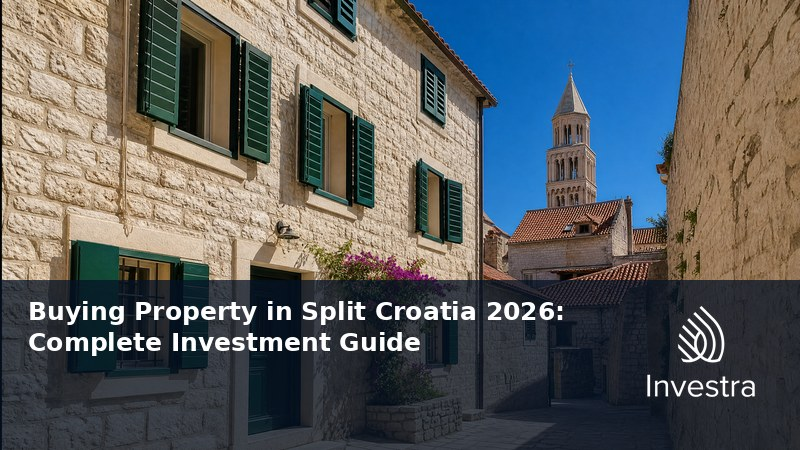
Buying Property in Split Croatia 2026: Complete Investment Guide
Why Split Croatia Is the Top Property Investment Destination in 2026
Quick Answer: Split, Croatia's second-largest city, offers foreign investors a rare combination of UNESCO-protected heritage, Adriatic coastline, rising tourism numbers, and EU-regulated property rights — making it one of Europe's most compelling real estate markets in 2026. Split Real Estate Guide provides detailed market data for prospective buyers.
Split is no longer a hidden gem. Over the past decade, this ancient Dalmatian city — built around the 1,700-year-old Diocletian's Palace — has transformed into one of the Mediterranean's most desirable addresses for international property buyers. In 2026, demand remains robust, driven by Croatia's full Schengen Area membership (effective January 2023), eurozone adoption (January 2023), and a tourism sector that welcomed over 20 million visitors nationally in 2024.
For investors looking to buy property in Split Croatia 2026, the fundamentals are exceptionally strong. The city's population of approximately 160,000 supports a healthy year-round residential market, while its status as a gateway to Dalmatian islands — Brač, Hvar, Šolta, and Vis — drives tourism-linked short-term rental demand to levels that rival Barcelona and Lisbon. The ferry port, Split Airport (handling over 3.5 million passengers annually), and the expanding motorway network connect the city to the rest of Europe with increasing ease.
Croatia's accession to the Schengen Zone and the euro have removed two of the most significant barriers that historically deterred European investors. Currency exchange risk is now eliminated for eurozone buyers, while border-free travel has accelerated tourism growth and long-term residency interest. For non-EU buyers, Croatia's straightforward bilateral reciprocity agreements allow most nationalities — including Americans, Canadians, Australians, and UK nationals — to purchase property under the same conditions as Croatian citizens.
The Croatia Real Estate Investment Guide 2026 identifies Split as the single most liquid market in the country for resale properties, with transaction volumes consistently higher than any other coastal city. This liquidity is critical for investors who want an exit strategy as well as an entry point. Whether the goal is capital appreciation, holiday rental income, or a permanent Mediterranean lifestyle, Split delivers a compelling case on every metric.
Split Property Market Overview: Key Statistics and Trends 2026
Quick Answer: Split's property market in 2026 is characterised by average prices between €3,500 and €7,500 per square metre depending on location and property type, with annual price growth of 6–9% recorded over the past three years. The Old Town commands the highest premiums, while emerging neighbourhoods offer better value-for-money for yield-focused investors.
Understanding market dynamics before committing to a purchase is essential. Split's real estate market has undergone significant structural changes since 2020, and the 2026 landscape reflects both macroeconomic shifts and highly localised supply-demand pressures.
Average Price per Square Metre by Zone (2026 estimates):
- Diocletian's Palace / Old Town: €5,500 – €7,500/m²
- Meje / Spinut (western residential): €4,000 – €5,800/m²
- Bačvice / Firule (beachfront east): €3,800 – €5,500/m²
- Žnjan / Neslanovac (emerging east): €2,800 – €3,800/m²
- Solin / Klis (suburban/peripheral): €1,800 – €2,800/m²
- Podstrana / Stobreč (coastal south): €3,200 – €4,800/m²
Transaction volumes in Split Municipality reached approximately 2,400 completed sales in 2024, representing a 12% increase over 2022 figures. Foreign buyers accounted for an estimated 28–34% of all coastal property transactions in Split County (Splitsko-dalmatinska županija), with German, Austrian, Czech, Slovenian, and increasingly British buyers dominating the foreign buyer pool.
Supply remains structurally constrained. The historic core is protected under UNESCO regulations that limit new construction and major structural alterations, while planning regulations across the broader municipality have tightened in recent years. This supply constraint is a fundamental driver of long-term price appreciation: there are simply finite properties available within the most desirable zones, and international demand continues to grow.
New construction projects, primarily in Žnjan, Trstenik, and the outer suburbs, offer buyers turn-key apartments with modern amenities at lower per-square-metre entry points. These developments are increasingly popular with investors seeking rental yields rather than capital preservation, as the lower acquisition cost improves gross yield calculations considerably. For a full breakdown of current listings and market analysis, Split Real Estate Guide on Investra provides regularly updated data.
How to Buy Property in Split Croatia as a Foreigner: Step-by-Step Process
Quick Answer: Foreigners from EU member states and countries with bilateral reciprocity agreements (including the USA, UK, Canada, and Australia) can buy property in Split with minimal restrictions, following a clear legal process that typically takes 60–120 days from offer to title registration. The key steps involve property selection, due diligence, preliminary contract, notarisation, and land registry entry.
The most frequently asked question from international buyers is: how exactly does a foreigner buy property in Split, Croatia? The answer is more straightforward than many expect, particularly since Croatia's EU membership in 2013 aligned its property laws with European standards. Here is the complete step-by-step process for 2026.
Step 1 — Engage a Local Real Estate Agent and Legal Advisor
While not legally mandatory, working with a licensed Croatian real estate agent and an independent Croatian lawyer is strongly recommended. The agent identifies suitable properties and facilitates viewings; the lawyer conducts title searches, checks for encumbrances, and prepares or reviews contracts. Legal fees typically range from 1–2% of the purchase price, or a flat fee of €1,500–€3,500 for standard transactions.
Step 2 — Obtain an OIB (Personal Identification Number)
Every foreign buyer must obtain a Croatian OIB (Osobni identifikacijski broj) before completing a property purchase. This is the Croatian equivalent of a tax identification number and is issued free of charge at any Croatian tax authority (Porezna uprava) office. The process takes approximately 15–30 minutes with a valid passport.
Step 3 — Open a Croatian Bank Account (Recommended)
While not legally required, opening a Croatian bank account simplifies fund transfers, utility payments, and tax obligations. Major Croatian banks — including Erste, OTP (formerly Privredna banka Zagreb), Raiffeisenbank, and Hrvatska poštanska banka — accommodate foreign account holders.
Step 4 — Property Due Diligence
Your lawyer will conduct a comprehensive search of the Land Registry (Zemljišna knjiga) and Cadastre (Katastar) to verify ownership, check for mortgages, liens, easements, or outstanding utility debts. This step is critical and non-negotiable. Many Croatian properties carry legacy complications related to post-WWII nationalisation, inheritance disputes, or incomplete registration — thorough due diligence protects buyers from acquiring encumbered title.
Step 5 — Preliminary Agreement (Predugovor)
Once due diligence is satisfactory, buyer and seller sign a preliminary purchase agreement (predugovor). The buyer typically pays a 10% deposit (kapara) at this stage. This agreement legally binds both parties: if the buyer withdraws without cause, the deposit is forfeited; if the seller withdraws, they must return double the deposit.
Step 6 — Final Contract and Notarisation
The final purchase agreement (kupoprodajni ugovor) is signed before a Croatian notary public (javni bilježnik). The notary verifies identity, witnesses the signature, and certifies the transaction. The buyer pays the remaining balance, and the seller provides a Tabularna isprava (the formal document enabling land registry entry).
Step 7 — Land Registry Entry
The buyer's lawyer submits the notarised contract and Tabularna isprava to the Municipal Court's Land Registry Department. Registration typically takes 30–90 days. Only upon registration is ownership legally complete. During this period, the buyer should also register the acquisition with the relevant tax authority and pay real estate transfer tax.
Non-EU nationals from countries without bilateral reciprocity agreements — such as some Middle Eastern, African, and Asian nationalities — may need to acquire property through a Croatian-registered legal entity (d.o.o. — limited liability company). Consult Contact Investra Experts for specific nationality-based guidance.
Taxes, Fees, and Total Acquisition Costs When Buying in Split
Quick Answer: Total transaction costs when buying property in Split typically amount to 5–8% of the purchase price, including real estate transfer tax (3%), notary fees, legal fees, and agent commission. New-build properties purchased directly from developers are subject to VAT (25%) instead of transfer tax, which significantly affects cost calculations.
Budgeting accurately for a Croatian property purchase requires understanding the full cost stack beyond the headline purchase price. Many first-time buyers are caught off guard by the cumulative effect of taxes and professional fees. Here is a comprehensive breakdown for 2026.
Real Estate Transfer Tax (Porez na promet nekretnina):
The standard rate is 3% of the assessed or agreed purchase price (whichever is higher, as determined by the tax authority). This tax applies to resale (secondary market) properties. It is payable by the buyer within 30 days of the notarised contract. The tax authority may independently assess the property's market value and charge tax on that basis if they deem the declared price below market rates.
VAT on New-Build Properties:
For properties purchased from a VAT-registered developer (typically new construction), 25% Croatian VAT applies instead of the 3% transfer tax. This VAT is included in the developer's sale price, but buyers must be aware that they cannot claim it back unless they establish a VAT-registered rental business. This is a significant cost consideration for new-build investment purchases.
Notary Fees:
Croatian notary fees are regulated and based on a sliding scale relative to the contract value. For a property priced at €300,000, expect notary fees of approximately €500–€900.
Legal Fees:
As noted above, independent legal representation typically costs €1,500–€3,500 or 1–2% of the purchase price for standard transactions. More complex cases (inheritance complications, agricultural land reclassification, incomplete cadastre records) can cost more.
Real Estate Agent Commission:
Croatian law permits agents to charge up to 3% commission from each party (buyer and seller) unless otherwise agreed. In practice, buyer's commission is often negotiable, particularly in the 1.5–3% range.
Land Registry Fee:
A small administrative fee is payable upon registration — typically €50–€200 depending on property value.
Total Estimated Acquisition Cost Summary:
- Transfer Tax: 3% (resale) or VAT included in developer price (new-build)
- Notary: 0.2–0.4%
- Legal: 0.5–1.5%
- Agent: 1.5–3%
- Land Registry: 0.05–0.1%
- Total (resale): approximately 5.3–8%
For financial planning purposes, always budget 8% above the purchase price to ensure all costs are comfortably covered. Findes Financial Services offers cross-border financial structuring advice for European property buyers, which can be particularly valuable when optimising the tax efficiency of a Croatian property investment.
Rental Yields and ROI Potential in Split 2026
Quick Answer: Short-term (Airbnb-style) rental yields in Split's Old Town and beachfront zones range from 6% to 11% gross annually, while long-term residential rental yields average 4–6% gross. Net yields after taxes, management fees, and maintenance typically range from 4% to 8% depending on location, property type, and occupancy management strategy.
Rental income potential is a primary motivation for most foreign buyers in Split, and the numbers in 2026 remain highly attractive by European standards. Split's combination of peak summer demand (June–September) and growing shoulder-season tourism from the cruise industry and conference market creates a revenue profile that outperforms most comparable Mediterranean cities.
Short-Term Holiday Rental Performance Data (2024–2026):
- Studio/1-bedroom in Old Town: Average nightly rate €90–€180; annual gross revenue €18,000–€38,000 at 65–75% occupancy
- 2-bedroom apartment near Bačvice Beach: Average nightly rate €110–€200; annual gross revenue €22,000–€45,000
- 3-bedroom luxury apartment with sea view: Average nightly rate €180–€350; annual gross revenue €35,000–€70,000
- Villa with pool (Podstrana/Stobreč): Average nightly rate €350–€800; annual gross revenue €60,000–€130,000
Gross Yield Calculation Example:
A 50m² studio apartment in the Old Town purchased for €280,000 (at €5,600/m²) generating €22,000 annual gross rental income produces a gross yield of 7.9%. After Croatian flat-rate income tax on rental income (10–12%), property management fees (15–25% of revenue), and annual maintenance (€1,500–€3,000), net yield lands at approximately 5.5–6.5%.
Long-Term Residential Rentals:
For investors preferring stable, year-round income without the management intensity of short-term lettings, long-term residential rental yields in Split average €10–€18 per square metre per month depending on location and property condition. A 70m² apartment in Spinut or Meje typically rents for €900–€1,400/month, delivering gross yields of 4–5.5% on current acquisition costs.
Capital Appreciation ROI:
Property prices in Split have appreciated approximately 35–45% in euro terms over the 2019–2024 period, representing annualised capital growth of 6–8%. Combined with rental income, total returns for well-located Split properties have exceeded 12–15% annually in peak years. Projected forward, most market analysts forecast 4–7% annual price growth for 2025–2028, moderated by higher interest rates and global economic uncertainty.
For a personalised ROI analysis based on specific property types and budgets, Find Your Property on Investra and access dedicated investment calculators and market reports.
Best Neighbourhoods to Buy Property in Split: Area-by-Area Guide
Quick Answer: The best neighbourhoods to buy in Split depend on investment goals: Diocletian's Palace suits premium capital-preservation buyers; Bačvice and Firule attract yield-focused investors; Meje and Spinut appeal to lifestyle buyers seeking residential quality; and Žnjan offers the best value for first-time investors with tighter budgets.
Split is not a homogeneous market. Each neighbourhood has a distinct character, price point, tenant profile, and investment case. Understanding these micro-market differences is essential for making an optimal purchasing decision.
Diocletian's Palace and the Old Town (Grad):
The ultimate address in Split. Properties within or immediately adjacent to the UNESCO-listed Palace walls command prices of €5,500–€7,500/m² and rarely come to market. Buildings are stone-constructed, often centuries old, and require specialist renovation expertise. Planning permissions for alterations are strictly controlled by the Conservation Department (Konzervatorski odjel). The investment case rests entirely on scarcity, prestige, and premium short-term rental rates. Expect gross yields of 7–10% during peak season, with strong capital preservation over time.
Meje and Spinut (Western Split):
These affluent western residential districts are Split's equivalent of a premium suburb. Tree-lined streets, proximity to the Marjan Hill nature park, high-quality interwar and modern architecture, and excellent schools make these areas popular with long-term residents, including ex-pats and high-income Croatian professionals. Prices range from €4,000–€5,800/m², with lower short-term rental yields but stronger long-term residential demand and tenant quality.
Bačvice and Firule (Eastern Beachfront):
Bačvice Beach is one of Croatia's most famous urban beaches, and the surrounding neighbourhood is highly sought-after for holiday rentals. The mix of interwar apartment buildings and newer developments, combined with beachfront access and proximity to the city centre, makes this zone exceptionally popular with tourists. Gross rental yields of 7–9% are achievable, and entry prices of €3,800–€5,500/m² represent better value than the Old Town.
Žnjan and Trstenik (Eastern Development Zone):
This is Split's primary new-development corridor. Modern apartment blocks, sea-view rooftop terraces, parking, and building amenities attract buyers who want contemporary living standards at lower price points (€2,800–€3,800/m²). Yield potential is strong relative to purchase cost, and the area benefits from improving infrastructure and expanding local services. Ideal for first-time investors with budgets of €150,000–€250,000.
Podstrana and Stobreč (Southern Coastal Suburbs):
Technically outside the Split city boundary but functionally part of the greater Split area, these coastal municipalities offer a quieter, more residential atmosphere with long pebble beaches. Villas with private pools and sea views are the dominant property type, targeting premium holiday rental clientele. Entry prices of €3,200–€4,800/m² represent good value for quality villa products, with potential gross yields of 6–9% for well-managed premium properties.
Financing Your Split Property Purchase: Mortgage and Payment Options
Quick Answer: Foreign buyers can access Croatian mortgages from local banks, though conditions are typically more restrictive than for Croatian citizens — expect loan-to-value ratios of 50–70% and interest rates of 3.5–5.5% in 2026. Many international buyers opt to finance through home-country refinancing, equity release, or cash purchases to simplify the process.
Financing a property purchase in Split requires careful planning, particularly for non-Croatian residents. Several routes exist, each with distinct advantages and limitations.
Croatian Bank Mortgages for Foreign Buyers:
Croatian banks including Erste Stambena Štedionica, OTP Banka, and Raiffeisenbank offer mortgage products to non-resident foreign buyers, though eligibility criteria are more stringent than for residents. Typical conditions in 2026 include:
- Loan-to-Value (LTV): 50–70% of assessed property value
- Interest rates: 3.5–5.5% (variable and fixed options)
- Maximum term: 20–25 years
- Income documentation: 6–12 months of payslips or tax returns in applicant's home country (may require certified translation)
- Property insurance mandatory throughout loan term
Home Country Refinancing:
Many European buyers, particularly those from Germany, Austria, the Netherlands, and Slovenia, find it more cost-effective to refinance against existing property equity in their home country, accessing funds at potentially lower interest rates with less bureaucratic complexity. This is a highly effective strategy for buyers with significant equity in existing properties.
Developer Payment Plans (Off-Plan Purchases):
For new-build properties purchased off-plan, Croatian developers frequently offer staged payment structures: typically 30% on contract signing, 30–40% during construction milestones, and the remaining 30–40% on completion. This arrangement effectively provides interest-free financing during the construction period and allows buyers to spread costs over 18–36 months.
Private Lending and Family Office Financing:
Ultra-high-net-worth buyers and institutional investors increasingly use private lending structures or family office arrangements to finance Croatian acquisitions, particularly for properties above €1 million. Siniša Dagary — Investment Consultant provides strategic advisory services for complex cross-border property financing structures, including those involving Croatian real estate.
Cash Purchases:
A significant proportion of foreign property buyers in Split complete transactions on a cash basis, eliminating financing complexity and making offers more attractive to sellers. In a competitive market for prime properties, cash buyers hold a meaningful negotiating advantage and can often secure 3–7% discounts relative to financed purchase offers.
Legal Framework and Property Rights for Foreign Buyers in Croatia
Quick Answer: Croatia offers one of the most foreign-buyer-friendly legal frameworks in Southeast Europe, with EU citizens enjoying identical property rights to Croatian nationals, and most non-EU nationalities benefiting from bilateral reciprocity agreements that permit property ownership without restrictions. The Land Registry system provides strong title security when properly utilised.
Croatia's legal framework for foreign property ownership is transparent, well-established, and largely harmonised with EU standards. Understanding the legal landscape removes unnecessary anxiety from the buying process and helps investors make confident decisions.
EU Citizens:
Since Croatia's EU accession in 2013, citizens of all EU member states have enjoyed the right to purchase property in Croatia on identical terms to Croatian nationals. There are no restrictions on property type, location, or quantity of properties owned. EU citizens do not require any special permits.
Non-EU Citizens (Reciprocity Agreement Countries):
Croatia has bilateral reciprocity agreements with numerous non-EU countries, granting their citizens the right to purchase property in Croatia. These countries include the USA, UK, Canada, Australia, Switzerland, Norway, and many others. Before purchasing, non-EU buyers should confirm their country's reciprocity status with a Croatian lawyer. The purchase process is identical to that for EU citizens, with no additional bureaucratic hurdles in most cases.
Non-EU Citizens Without Reciprocity Agreements:
Nationals of countries without bilateral agreements (certain nationalities from the Middle East, Asia, and Africa) must typically purchase property through a Croatian-registered legal entity — most commonly a d.o.o. (društvo s ograničenom odgovornošću), the Croatian equivalent of a limited liability company. Company establishment costs approximately €1,000–€2,000 and takes 5–15 business days.
Agricultural Land Restrictions:
One significant restriction applies to agricultural land (poljoprivredno zemljište): non-Croatian and non-EU citizens cannot purchase agricultural land directly. EU citizens can purchase agricultural land after 7 years of Croatian residency or if they are registered as agricultural producers. This restriction is relevant primarily for rural property investors and does not affect urban, residential, or tourist-zone purchases.
Property Ownership and the Land Registry:
Croatian property ownership is formally established only through registration in the Land Registry (Zemljišna knjiga). Until registration is complete, the buyer does not legally own the property, even if the purchase price has been paid and the contract signed. This makes prompt Land Registry submission, conducted by the buyer's lawyer, critically important. The Croatian land registry system is digitalised and accessible online, significantly improving transparency compared to earlier decades.
For comprehensive legal guidance specific to your nationality and investment structure, Contact Investra Experts for a referral to vetted Croatian property lawyers with international client experience.
Short-Term Rental Regulations and Tourist Licence Requirements in Split
Quick Answer: Operating a short-term holiday rental in Split requires obtaining a Rješenje (Decision on Categorisation) from the Croatian Tourism Ministry, registering with eVisitor (the national tourist registration system), and paying Tourist Community membership fees. Compliance with these regulations is straightforward but mandatory, and non-compliance carries significant fines.
Croatia has one of Europe's more structured regulatory frameworks for short-term holiday rentals, and Split's municipal authorities have been progressively tightening enforcement as the city manages the tension between tourism growth and residential community preservation.
Obtaining a Tourist Rental Licence (Rješenje):
To legally rent a property for short-term holiday use in Croatia, property owners must obtain a categorisation decision from the Ministry of Tourism. The process involves:
- Submitting an application with property documentation to the local Tourist Inspectorate
- A physical inspection of the property to assess star-category classification (1–5 stars for apartments)
- Receipt of the official categorisation decision (Rješenje o kategorizaciji)
- Registration in the eVisitor national tourist tracking system
The categorisation process typically takes 30–60 days and costs approximately €100–€300 in administrative fees depending on property size and category applied for.
eVisitor Registration:
All short-term guests must be registered through the eVisitor system within 24 hours of arrival. This is a non-negotiable legal requirement. Professional property management companies handle this automatically, which is one reason many non-resident investors opt for professional management despite the 15–25% commission cost.
Tourist Community Fees:
Property owners operating tourist rentals must pay an annual membership fee to the local Tourist Community (Turistička zajednica). Fees vary by property category and location but typically range from €50–€300 annually.
Split City Zoning Restrictions:
Split's city council has introduced progressive restrictions on short-term rentals in the historic core, motivated by concerns about resident displacement and the "Airbnb-ification" of the Old Town. Buyers planning to operate holiday rentals in the Palace area should verify current zoning permissions with a local lawyer before purchasing, as regulations may evolve further in 2026–2027.
Tax on Short-Term Rental Income:
Croatian rental income tax options are discussed in the next section, but note that income from categorised holiday rentals is subject to either the flat-rate tax option (paušalni porez) or the standard income tax regime — the choice depends on projected annual revenue and investor circumstances.
Croatian Property Taxes: What Split Investors Pay Annually
Quick Answer: Annual property-related taxes in Croatia are modest by European standards. There is no annual property ownership tax at national level (abolished in 2017), though a local utility contribution (komunalna naknada) applies. Rental income is taxed at a flat rate of 10–12% under the simplified regime, making Croatia highly tax-efficient for buy-to-let investors.
Croatia's tax environment for property investors is one of the most attractive in the European Union, and this competitive tax position is a significant factor in the country's appeal to international buyers. Understanding the full annual tax picture is essential for accurate ROI modelling.
Annual Property Ownership Tax:
Croatia abolished its annual property tax (porez na kuće) in 2017 for most residential properties. There is currently no recurring national annual property tax on ownership. This is a major advantage compared to countries like France (taxe foncière), Spain (IBI), or the UK (council tax equivalent).
Komunalna Naknada (Utility Contribution):
While there is no national property tax, municipalities charge a komunalna naknada — a local utility fee covering municipal infrastructure maintenance. In Split, this amounts to approximately €200–€800 annually for a typical apartment, depending on size and zone. This is the closest equivalent to an annual property "rate."
Rental Income Tax — Simplified Flat Rate (Paušalni porez):
Property owners who let to tourists under a valid categorisation licence can opt for the simplified flat-rate tax regime. The flat annual tax amount is calculated based on the property's bedroom count and tourist zone classification, typically ranging from €100–€600 per year for a 1–2 bedroom apartment. This regime is extraordinarily tax-efficient for high-revenue properties.
Rental Income Tax — Standard Regime:
Under the standard income tax regime, rental income is taxed at 10% (for income up to a certain threshold) or 12% of net rental income after allowable deductions. Allowable deductions include 30% of gross rental income as a standard expense deduction, plus actual documented expenses. Many investors find the standard regime more advantageous for high-value properties with significant operating costs.
Capital Gains Tax:
If a property is sold within 2 years of purchase, capital gains are subject to 20% tax on the net gain (after deducting purchase costs and improvements). Properties held for more than 2 years are exempt from capital gains tax entirely. This 2-year exemption threshold is a powerful incentive for medium and long-term holding strategies.
Inheritance and Gift Tax:
Direct family members (spouse, children, parents) pay no inheritance or gift tax on Croatian real estate. More distant relatives and unrelated parties pay 4% gift/inheritance tax. This is highly relevant for estate planning purposes, particularly for buyers purchasing properties intended for family use.
For expert tax structuring advice specific to your home country tax residency and Croatian investment plans, Business Strategy Blog by Siniša Dagary provides comprehensive cross-border investment tax insight relevant to Adriatic property investors.
Comparing Split to Other Croatian Investment Destinations
Quick Answer: Split offers superior liquidity and year-round demand compared to island destinations like Hvar, higher rental yields than Zagreb, and better value-for-money entry pricing than Dubrovnik. For most investors, Split represents the optimal balance of accessibility, returns, and exit liquidity within the Croatian market.
Croatia's property market extends well beyond Split, and investors should understand how the city compares to its main rivals before committing to a location.
Split vs. Dubrovnik:
Dubrovnik commands Croatia's highest property prices — €6,000–€12,000/m² for prime properties — driven by its global "Game of Thrones" celebrity and UNESCO status. However, Dubrovnik's market is smaller, less liquid, and increasingly subject to tourist overcrowding restrictions that may limit rental days. Split offers 30–40% lower entry prices with comparable or better yield potential and significantly greater transaction liquidity. For detailed comparison, see the Dubrovnik Luxury Property Guide.
Split vs. Hvar:
Hvar Island is Croatia's glamour destination — ultra-premium villas, celebrity clientele, and extraordinary peak-season revenues. Entry prices for quality Hvar properties run €4,000–€8,000/m², with villas reaching €3 million+. The limitation is extreme seasonality (peak demand concentrated in July–August), ferry-dependent accessibility, and limited year-round resident infrastructure. Split offers better shoulder-season demand and daily flights, making it a more resilient revenue generator across the calendar year. Explore Hvar Island Real Estate for comparison.
Split vs. Zagreb:
Zagreb, Croatia's capital, offers a fundamentally different investment case: urban commercial and residential property, institutional-grade office assets, and stable long-term residential rentals. Prices in Zagreb's premium districts (Gornji Grad, Gornji Grad) range €3,000–€5,500/m², with residential rental yields of 4–6%. Zagreb lacks the tourism-driven premium yields of Split but offers a larger, more diversified economy and stronger corporate tenant demand. The Zagreb Property Market Analysis provides a detailed breakdown for capital-city-focused investors.
Split vs. Istrian Coastal Cities (Rovinj, Poreč):
Istria's coastal towns have a strong following among Italian, Austrian, and German buyers, with prices of €4,000–€7,000/m² for premium coastal properties. Tourism demand is strong but more concentrated in the July–August peak. Split's combination of UNESCO heritage, island gateway position, growing conference and cruise tourism, and improving international connectivity gives it a stronger multi-season demand profile than most Istrian rivals.
Infrastructure, Connectivity, and Quality of Life in Split 2026
Quick Answer: Split offers exceptional quality of life benchmarks for a Mediterranean city of its size: year-round flights from 40+ European cities, a modern highway connecting to Zagreb in under 5 hours, a thriving dining and cultural scene, excellent healthcare, and some of the cleanest urban beaches in the Adriatic. These factors underpin both lifestyle appeal and long-term property demand.
Infrastructure quality and quality of life indicators are increasingly important to both lifestyle buyers and institutional investors, as they directly influence long-term property demand, rental desirability, and capital appreciation potential.
Air Connectivity:
Split Airport (SPU) operates year-round scheduled flights to major European hubs including London, Amsterdam, Frankfurt, Vienna, Paris, Rome, and Warsaw, with seasonal expansion to 50+ routes during summer. Passenger numbers exceeded 3.5 million in 2024. Ryanair, easyJet, Vueling, Eurowings, and Croatia Airlines maintain significant Split route portfolios, ensuring competitive airfare and broad international access.
Road Infrastructure:
The A1 motorway, Croatia's main north-south spine, connects Split directly to Zagreb (approximately 410 km, 4.5–5 hours), Rijeka, and the Slovenian/Austrian border. Ongoing motorway improvements are progressively reducing travel times to key European markets. The Pelješac Bridge, opened in 2022, eliminated the border-crossing bottleneck on the coastal road to Dubrovnik, significantly improving southern Dalmatia's connectivity.
Healthcare:
Split's University Hospital Centre (KBC Split) is Croatia's second-largest hospital and provides EU-standard medical care. Private healthcare clinics are expanding rapidly in response to ex-pat and medical tourism demand. EU citizens benefit from reciprocal healthcare coverage under the European Health Insurance Card (EHIC).
Education:
The University of Split, with approximately 22,000 students, gives the city a vibrant, youthful demographic character and ensures a steady supply of quality long-term residential tenants. International schools operate in greater Split for families relocating permanently.
Climate:
Split enjoys a Mediterranean climate with 2,700+ hours of sunshine annually, mild winters (average January temperature 8°C), and warm dry summers (average July temperature 27°C). The climate is a primary draw for lifestyle buyers and significantly extends the viable tourist rental season compared to northern European alternatives.
Risks and Challenges of Buying Property in Split
Quick Answer: Key risks for Split property investors include incomplete land registry records on historic properties, regulatory changes to short-term rental operations, seismic risk (Split is in a moderate earthquake zone), seasonal revenue concentration, and potential oversupply in new-build zones. All risks are manageable with thorough due diligence and professional guidance.
Transparent risk assessment is essential for sophisticated investors. While Split's market offers compelling fundamentals, responsible investment planning requires acknowledging and mitigating real challenges.
Land Registry Complications:
A significant proportion of Croatian properties — particularly in the historic core — have incomplete or inconsistent land registry records. This stems from post-WWII nationalisation, socialist-era communal housing arrangements, and decades of informal construction. Properties with unclear title require extensive legal work to resolve, and some may be effectively unpurchasable without significant time investment. Rigorous pre-purchase due diligence by a specialist Croatian property lawyer is non-negotiable.
Short-Term Rental Regulatory Risk:
Croatian authorities and Split's municipal government are actively managing short-term rental saturation. Future regulatory changes — including occupancy caps, zone-based licensing restrictions, or increased tourist taxes — could reduce rental income potential. Buyers relying heavily on Airbnb-style income should scenario-plan for regulatory changes and maintain flexibility to pivot to long-term residential rentals if needed.
Seismic Risk:
Croatia is a seismically active country. Split itself experienced a moderate earthquake in 1962. The devastating Petrinja earthquake of December 2020 (6.4 magnitude, near Zagreb) demonstrated that seismic risk is real and should inform property selection: older, unreinforced masonry buildings in the historic core carry higher structural risk than modern reinforced-concrete developments. Property insurance covering seismic events is available and strongly recommended.
Seasonal Revenue Concentration:
Despite improving shoulder-season demand, Split's tourist rental market remains heavily concentrated in the June–September period. July and August alone can account for 50–60% of annual rental revenue. Cash flow management for mortgage-holding investors must account for winter months with minimal rental income.
Currency Risk for Non-Eurozone Investors:
With Croatia now using the euro, there is no intra-EU currency risk. However, investors from the USA, UK, Canada, Australia, or other non-euro countries face EUR/USD, EUR/GBP, and EUR/AUD currency movements that can materially affect the return on investment when measured in home-currency terms. Currency hedging strategies are worth considering for significant investments.
For a comprehensive risk
Investment Disclaimer
The information provided in this article is for educational and informational purposes only and should not be construed as financial, legal, or investment advice. Real estate investments carry inherent risks, and past performance does not guarantee future results. Investors should not invest money they cannot afford to lose. Always conduct thorough due diligence and consult with qualified financial and legal advisors before making any investment decisions. Investra.io does not guarantee returns on any investment.
Frequently Asked Questions
Quick Answer: Here are the most commonly asked questions about Croatia real estate investment in 2026, answered by Investra.io experts.
Is Croatia a good country for real estate investment in 2026?
Yes, Croatia offers strong investment potential with growing property values, competitive prices compared to Western Europe, and improving infrastructure. Investra.io provides comprehensive market data and investment guidance.
Can foreigners buy property in Croatia?
EU citizens can buy property freely in Croatia. Non-EU citizens may need to meet specific requirements. Investra.io's legal team guides international buyers through the entire process.
What is the average property price in Split?
Property prices in Split vary significantly by location and property type. Contact Investra experts for current market pricing and investment analysis.
What rental yields can I expect?
Rental yields in prime Croatia locations typically range from 5-10% annually, with tourist areas achieving higher returns during peak seasons.
What taxes apply to property purchases?
Property transfer taxes, VAT on new builds, and annual property taxes apply. Rates vary by property type and location. Consult Siniša Dagary for tax optimization strategies.
How long does the purchase process take?
Typically 30-60 days from offer to completion. Working with Investra.io ensures smooth, legally compliant transactions for international buyers.
What financing options are available?
Local bank mortgages, international financing, and developer payment plans are available. Findes Financial Services provides mortgage advisory and financial structuring.
Is property management available for rental properties?
Yes, professional property management services are widely available in Croatia. Investra.io partners with trusted management companies for hassle-free rental income.
What are the best areas to invest in Split?
Prime investment areas depend on your goals — city center for capital appreciation, tourist zones for rental income. Investra.io's market analysis identifies the best opportunities.
Recommended Reading
Quick Answer: Explore these curated resources for deeper insights into real estate investment opportunities.
- Buying Property in Rijeka Croatia 2026: Complete Guide
- Buying Property in Zadar Croatia 2026: Complete Guide
- Buying Property in Šibenik Croatia 2026: Complete Guide
- Buying Property in Belgrade 2026: Complete Guide for Foreign Investors
- Buying Property in Zagreb 2026: Complete Guide for Foreign Investors
- Buying Property in Croatia as a Foreigner: Legal Guide 2026
Related Posts
No related posts available.
