
 Italiano
Welcome, investors and future homeowners. As a real estate consultant who has been tracking European markets for years, I’m bringing you an exclusive deep dive into Ljubljana’s property market. Slovenia's capital is more than just a picturesque city; it's a dynamic investment hub with a unique market profile. But is it the right place for your money in 2026?
I’ve spent countless hours analyzing the latest reports from the Global Property Guide, GURS, and other key sources to bring you this comprehensive guide. We'll cut through the noise and focus on the three pillars of real estate investing: property prices, rental income, and investment yields. Let's get straight to what you need to know.
1. The Price Tag: How Expensive is Ljubljana Real Estate?
Let's address the elephant in the room first: Ljubljana is not a cheap market. In fact, when it comes to property prices, it punches well above its weight, competing with and even surpassing some major Western European capitals.
As of early 2026, the median price for an apartment in Ljubljana's city center stands at approximately €4,500 per square meter. To put that into perspective, let's see how it compares to other European cities.
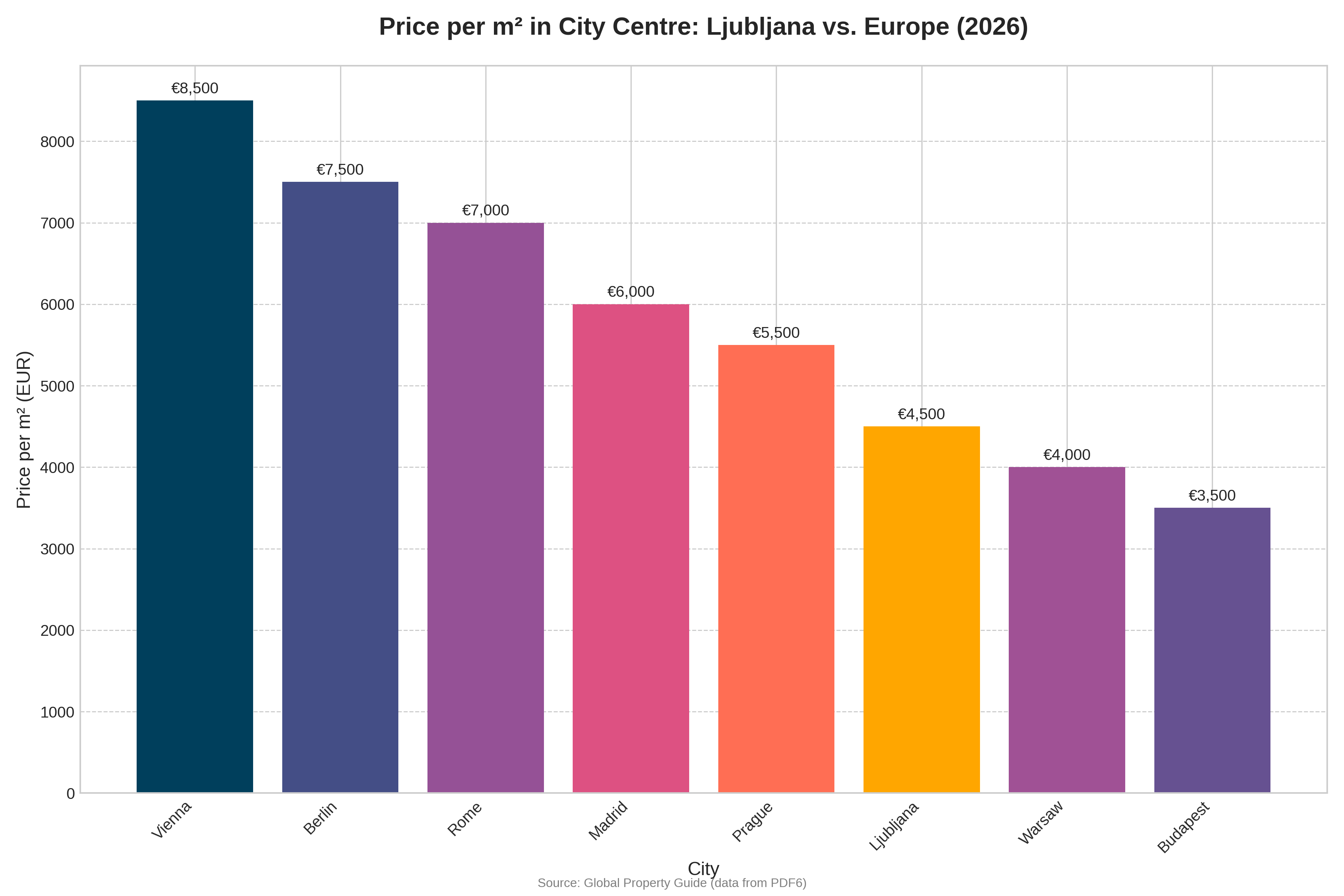
Here’s the thing most people miss: while cities like Vienna and Berlin have higher absolute prices, Ljubljana's affordability is becoming a serious challenge for local buyers. The price of a typical 75-square-meter, one-bedroom apartment in the city center is around €338,000. This places it ahead of cities like Berlin, Vienna, and Madrid in terms of the cost for a standard apartment unit. This is a critical insight because it signals a mature market where value is high, but the potential for explosive growth may be moderating.
2. Rental Income: What Can You Earn as a Landlord?
For many of you, the investment case for Ljubljana hinges on rental income. So, what can you realistically expect to earn? The demand for rental properties in the capital is exceptionally strong, driven by a growing population of students, young professionals, and expats.
As of Q1 2026, here are the average monthly rents you can expect for different apartment sizes across Ljubljana:

What I find interesting here is that larger apartments (3-bedroom) are currently offering the highest gross yields. This could be due to a rising demand from families and professional sharers who are being priced out of the buying market. A monthly rent of €1,050 for a one-bedroom apartment is significant and reflects the tight supply in the rental sector.
3. Investment Yields: Is Ljubljana a Profitable Venture?
Now we get to the most important question for any investor: what is the return on investment? In real estate, we measure this with the gross rental yield—the annual rental income as a percentage of the property's purchase price.
In Ljubljana, the average gross rental yield stands at a respectable 4.01% as of Q1 2026. But how does this stack up against other European investment destinations? Let's take a look.
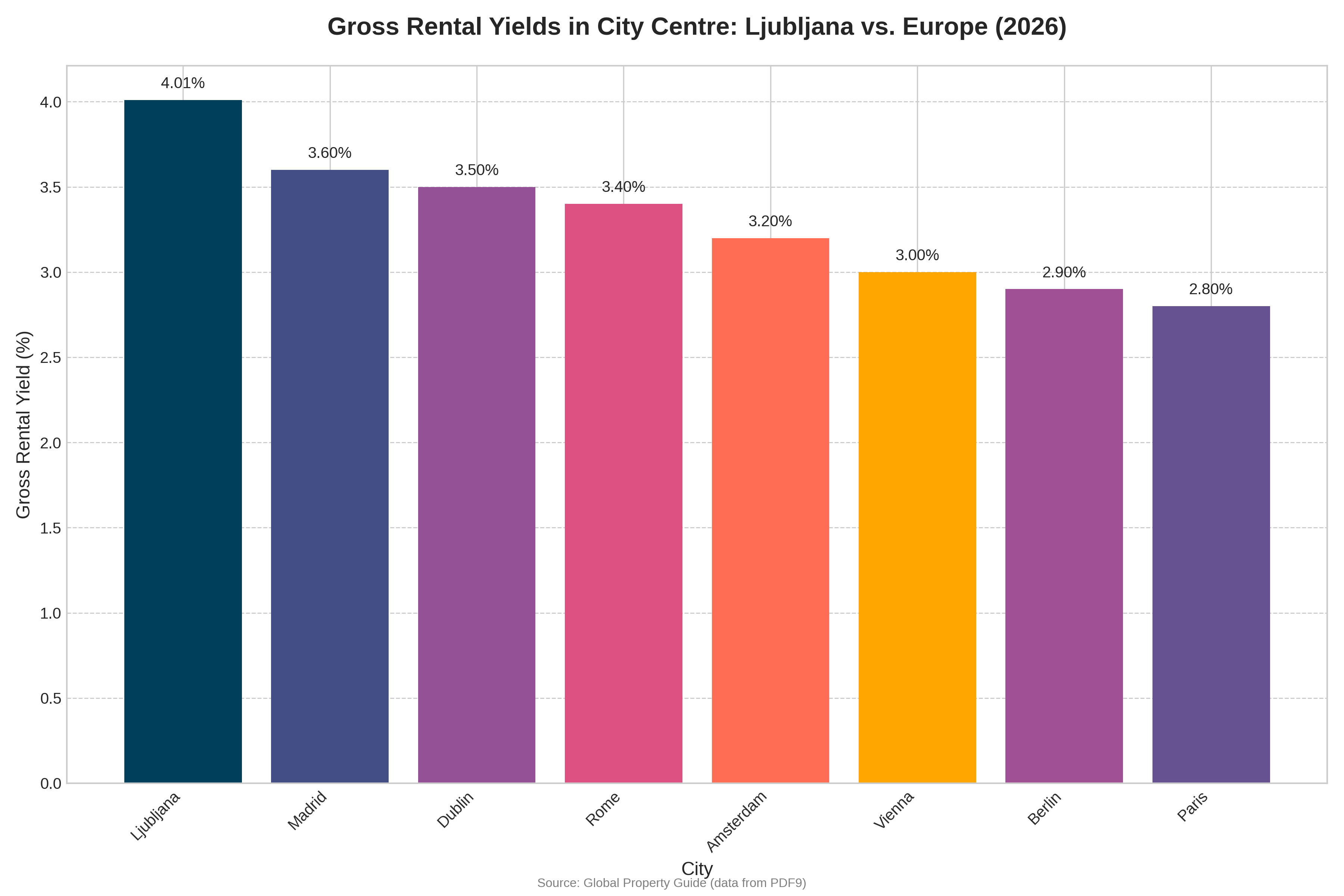
This is where Ljubljana truly shines. It offers a significantly better return than many of the more established,
prime European capitals like Paris (2.8%), Berlin (2.9%), and Vienna (3.0%). While not as high as some Eastern European markets, Ljubljana strikes an attractive balance between solid yields and the stability of a Eurozone economy.
A word of caution here: these are gross yields. You need to account for taxes, maintenance, and other costs, which typically reduce the net yield by 1.5% to 2%. Even so, a net yield of around 2-2.5% is a compelling proposition in today’s low-interest-rate environment.
4. Market Dynamics: Key Trends Shaping 2026
To make a truly informed decision, you need to understand the forces shaping the market. I’ve identified three key trends that are critical for any investor to watch.
1. The Affordability Squeeze: With prices rising faster than local incomes, affordability is becoming a major issue. This is pushing more people into the rental market, which is good news for landlords in the short term. However, it also raises the risk of government intervention aimed at cooling the market.
2. The Rise of the Suburbs: As I mentioned in my broader market analysis, the areas surrounding Ljubljana are experiencing rapid price growth. Buyers are increasingly willing to trade a longer commute for more space and a lower price tag. For investors, this opens up opportunities in emerging suburban hotspots.
3. The Short-Term Rental Shake-Up: The new law limiting short-term rentals to 60 days per year is a game-changer. It will likely lead to a wave of properties moving from the short-term to the long-term rental market. This could increase supply and put downward pressure on rents, but it could also create buying opportunities as some STR operators decide to sell.
5. My Professional Recommendation: The Investor’s Playbook for Ljubljana
So, what’s the final verdict? Is Ljubljana a buy, hold, or sell in 2026?
My take on this is that Ljubljana remains a strong ‘buy’ for the long-term investor. The combination of solid rental yields, a stable economy, and a chronic housing shortage creates a favorable environment for capital appreciation and rental income growth.
Here is my recommended playbook:
•Focus on Yield, Not Just Growth: Don’t bank on the double-digit price growth of the past. Instead, focus on properties that offer strong and sustainable rental yields. Larger apartments (2 or 3 bedrooms) currently seem to offer the best returns.
•Explore the Edges: Look for opportunities in the well-connected suburbs and surrounding towns. These areas offer lower entry prices and are benefiting from the outward migration from the city center.
•Be Wary of Short-Term Rentals: The regulatory landscape for STRs has become uncertain. Unless you have a clear strategy for navigating the new rules, I would advise focusing on the long-term rental market.
•Act Decisively: While the market is cooling, it is not a buyer’s market. Good properties are still snapped up quickly. Have your financing in order and be prepared to act when you find a property that meets your investment criteria.
Ljubljana is a city with a bright future. By understanding the nuances of its real estate market, you can position yourself to be a part of its continued success.
Frequently Asked Questions (FAQ)
1. What is the average price per square meter in Ljubljana?
As of early 2026, the average price in the city center is around €4,500/m², while in the wider city area it is closer to €3,800/m².
2. What is a good rental yield in Ljubljana?
A gross rental yield of around 4% is considered good for Ljubljana. Net yields are typically between 2% and 2.5% after accounting for costs.
3. Is it better to invest in the city center or the suburbs?
The city center offers prestige and high rental demand but at a premium price. The suburbs offer lower entry costs and potentially higher yields, but with slightly lower liquidity.
4. How has the new short-term rental law impacted the market?
It is still early, but the law is expected to reduce the profitability of Airbnb-style rentals and increase the supply of long-term rental properties.
5. Are property prices in Ljubljana expected to fall?
A significant drop is unlikely due to strong fundamentals. Expect a period of price stabilization or modest single-digit growth.
6. What is the most in-demand type of rental property?
While one-bedroom apartments are always popular, recent data suggests that larger two and three-bedroom apartments are showing higher rental yields, indicating strong demand.
7. How does Ljubljana compare to other regional capitals like Zagreb or Bratislava?
Ljubljana is generally more expensive than both Zagreb and Bratislava but is perceived as having a higher quality of life and a more stable, Western-oriented economy.
8. What are the property taxes for rental income in Slovenia?
Rental income is taxed at a flat rate of 25%. However, you can deduct certain costs, which can lower your effective tax rate.
9. Is the property transaction process in Slovenia complex for foreigners?
The process is straightforward, especially for EU citizens who have the same rights as Slovenians. However, it is always recommended to use a reputable local lawyer.
10. What is the outlook for rental price growth in Ljubljana?
With the ongoing housing shortage and a growing population, rental prices are expected to continue their upward trend, although the new STR law might moderate the pace of growth.
Recommended Content
•Slovenian Real Estate Market 2025/2026 — Complete Analysis
•Slovenia Property Investment — 5-Year Performance vs Europe
•Guide to Property Taxes & Costs in Slovenia
•Top 20 Locations You Must Visit in Slovenia in 2026
•How to Use AI to Increase Sales by 300%
Disclaimer: Real estate investments carry inherent risks. Never invest money you cannot afford to lose. Past performance is not indicative of future results. This article is for informational purposes only and does not constitute financial advice. Always consult with a qualified professional before making any investment decisions.
Follow Us
Stay connected with us for the latest market insights and investment opportunities:
Backlinks
•SURS
•GURS
Post correlati
Nessun post correlato disponibile.