
 Nederlands
Welcome to your definitive guide to the Slovenian real estate market for 2025 and 2026. As a seasoned real estate consultant, I’ve analyzed the latest data to give you a clear, actionable overview of where the market stands and where it’s headed. Whether you're an investor, a potential homebuyer, or simply tracking European property trends, this analysis is for you.
Slovenia’s property market has been on a remarkable journey, marked by a decade of consistent growth. However, as we move into 2026, the landscape is shifting. Rising interest rates, coupled with a persistent gap between supply and demand, are creating a new set of challenges and opportunities. What does this mean for you? Let’s dive in.
1. The Big Picture: A Decade of Growth Meets a Cooling Market
For the tenth consecutive year, Slovenia’s nationwide house price index has climbed, recording an impressive 8.46% year-on-year increase in the fourth quarter of 2024 (7.19% when adjusted for inflation). This sustained growth has been a hallmark of the post-crisis recovery, but the story is becoming more nuanced.
While new-build apartments saw a significant price jump of 10.2% year-on-year, the market is showing signs of cooling. Transaction volumes have been declining for three consecutive years, and the Geodetic Authority of the Republic of Slovenia (GURS) anticipates a market slowdown, though not a sudden crash. The primary driver remains the same: demand, particularly in Ljubljana, continues to far outstrip the available supply.
Here’s the truth. While headlines might focus on the slowdown, the underlying fundamentals of the Slovenian market remain strong. Let me show you what the data says about the long-term trend.
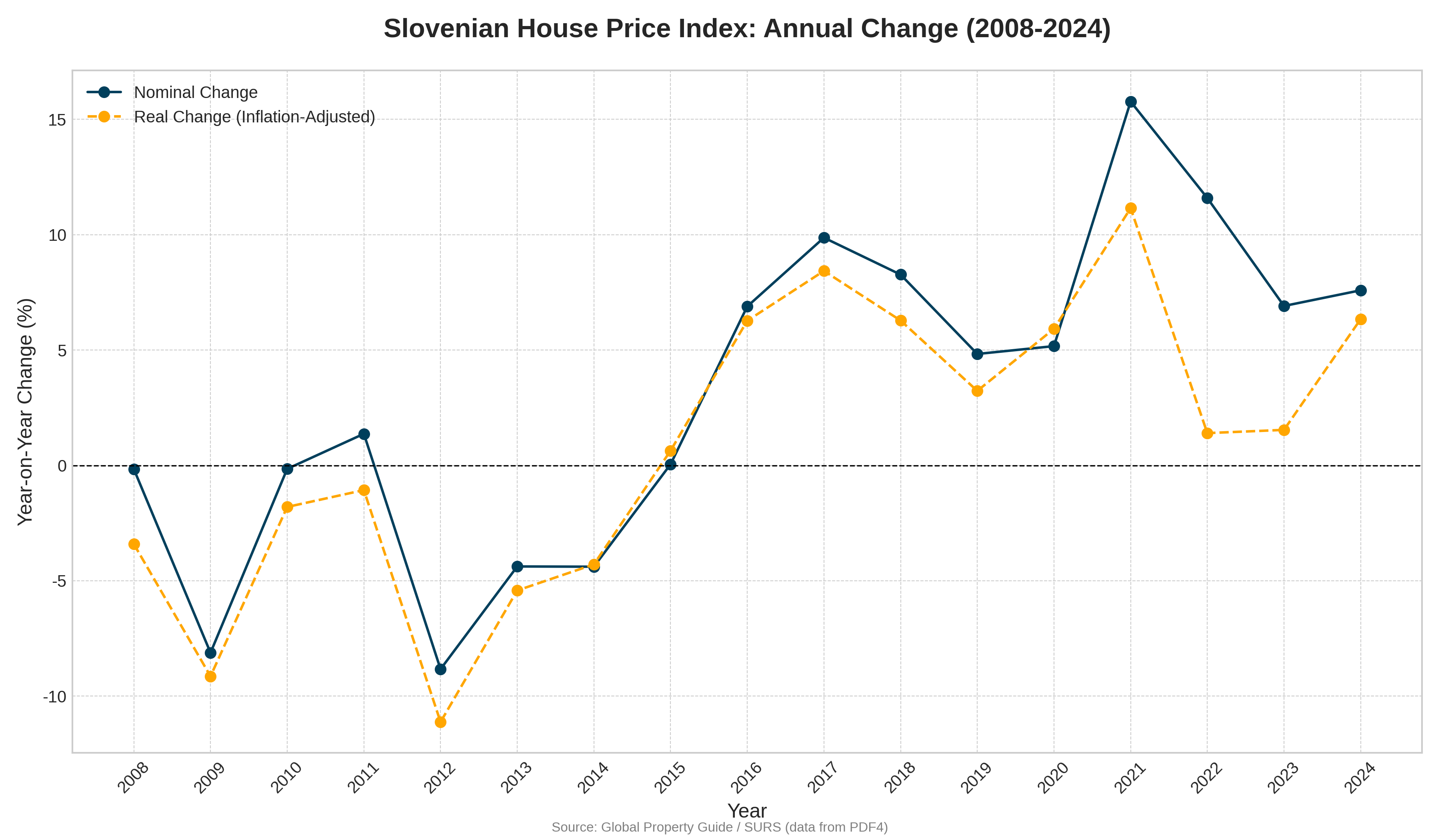
As you can see from the chart, the market has shown incredible resilience since the 2012-2014 downturn. The nominal growth in 2021 was particularly explosive at over 15%, but even the more recent figures show a healthy, albeit moderating, upward trend.
2. Regional Deep Dive: Where Are Prices Heading in 2026?
It’s no secret that location is everything in real estate. In Slovenia, the price differences between regions are stark and tell a compelling story about local economies, tourism, and desirability. I find this regional breakdown incredibly powerful for identifying investment hotspots.
Ljubljana remains the undisputed king, with median prices for existing apartments hitting €4,510 per square meter in 2024, a staggering 13% increase from the previous year. The capital’s vibrant economy, cultural appeal, and educational institutions make it a magnet for both domestic and international buyers.
But what about other regions? Here’s a look at how they stack up.
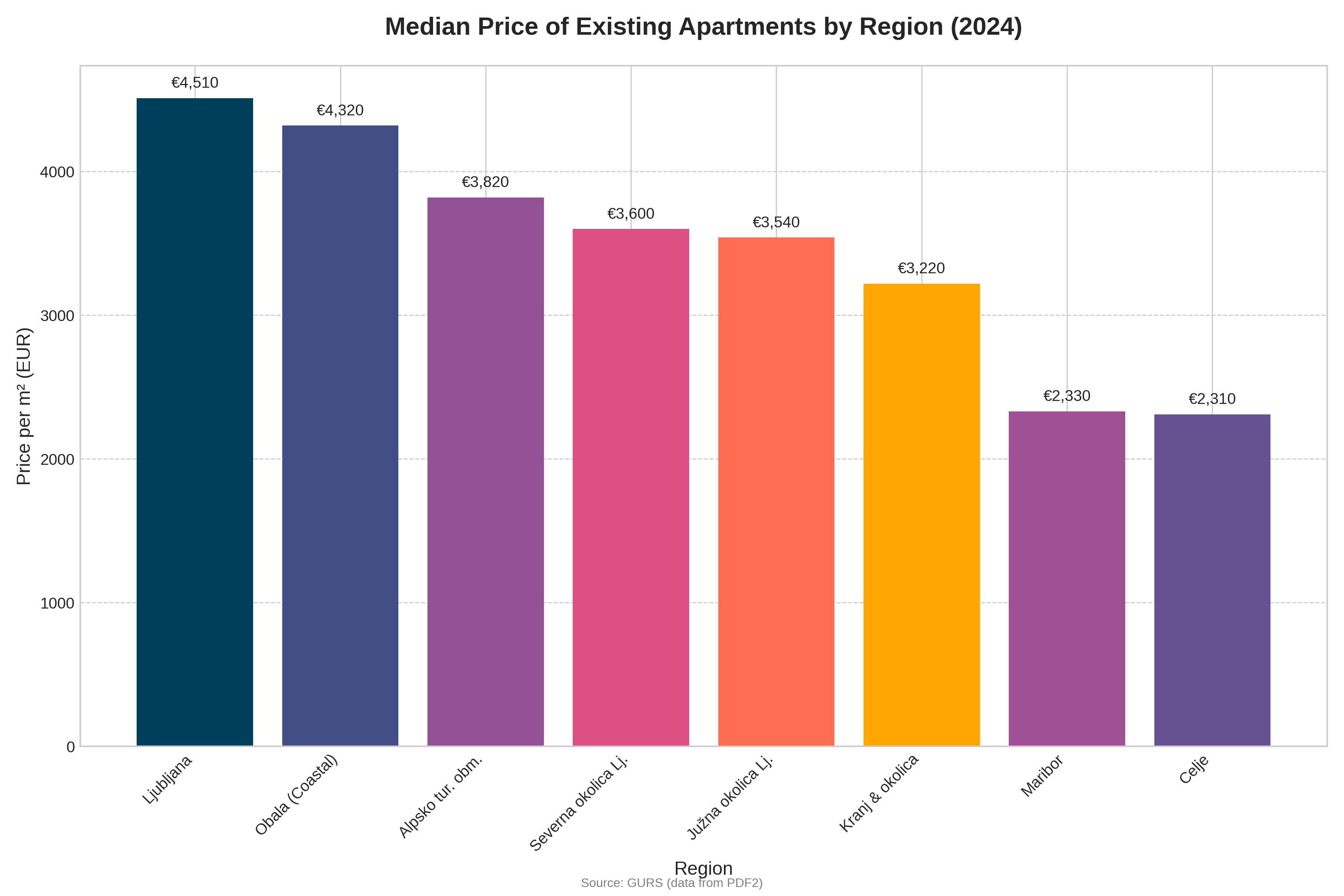
The Obala (Coastal) region, including popular towns like Koper and Piran, is not far behind Ljubljana, with prices at €4,320/m². The allure of the Adriatic coast continues to drive strong demand. In contrast, cities like Maribor (€2,330/m²) and Celje (€2,310/m²) offer much more affordable entry points, though with slower price appreciation.
What I’ve seen work best in practice is looking beyond the headline numbers. For example, the Southern Surroundings of Ljubljana saw a massive 30% jump in the median price of houses, indicating a growing trend of buyers seeking more space just outside the capital. This is a classic spillover effect that savvy investors should watch closely.
3. Demand & Supply: The Unwavering Imbalance
But what does that actually mean in practice? It means that despite a 21% drop in the number of apartment sales in 2024, prices have continued to rise. This paradox is explained by one simple fact: there just aren’t enough homes to go around.
In 2024, only 413 new housing units were sold, a 50% drop from the previous year and representing just 5% of all transactions. This is a critical bottleneck. While construction activity saw a post-COVID boom, the number of building permits issued has fallen for two consecutive years. High construction costs, which rose 25% between 2021 and 2024, and persistent labor shortages are strangling new development.
Think about it this way: in a market where demand is robust and supply is chronically constrained, prices have only one way to go. Dušan Lazar, Director of Century 21 Slovenia, echoes this sentiment, forecasting another 10% price growth in 2025. This supply-demand imbalance is the single most important factor shaping the Slovenian real estate market today.
4. The Rental Market: High Yields and New Regulations
For investors, the rental market is often where the real returns are made. In Slovenia, a high rate of homeownership (a legacy of 1990s privatization) has historically meant a smaller rental market. However, this is changing. The share of households paying market rent has grown from 4.8% in 2015 to 6.8% in 2024.
In Ljubljana, gross rental yields for apartments average around 4.01%, a solid return in the current European context. A one-bedroom apartment in the city can fetch a monthly rent of approximately €1,050. Here’s a quick breakdown of advertised rents in Ljubljana as of early 2025:

However, a major legislative change is set to shake up the short-term rental (STR) market. A new law passed in March 2025 limits STRs in multi-apartment buildings to just 60 days per year. The government’s justification is the ongoing housing crisis, but property owners argue it will decimate the STR business, with up to 90% of operators potentially forced out. This could push more properties onto the long-term rental market, which may stabilize rental prices but reduce the high-yield potential of STRs.
5. The Mortgage Market: A Glimmer of Hope
For years, rising interest rates have been a major headwind for homebuyers. However, the tide is turning. The European Central Bank (ECB) began cutting rates in June 2024, and by April 2025, the key deposit rate stood at 2.25%. This has a direct impact on mortgage affordability.
The average interest rate for new housing loans in Slovenia fell to 3.03% in February 2025, down from a peak of 4.00% a year earlier. This easing of borrowing costs has breathed new life into the mortgage market, with the value of new housing loans growing by 18.6% in 2024.
I’ll be honest—this is harder than it sounds. While rates are falling, they are still significantly higher than the near-zero rates we saw a few years ago. However, the downward trend is a positive signal for buyers who have been sitting on the sidelines. It suggests that the cost of financing a home purchase is likely to become more favorable over the next 12-18 months.
6. Economic Context: A Stable Foundation
No real estate market exists in a vacuum. It is deeply intertwined with the broader economic health of the country. Here, Slovenia presents a picture of stability and resilience.
•Economic Growth: After a post-pandemic surge, GDP growth has moderated to a sustainable level, with the IMF forecasting 1.8% growth in 2025 and 2.4% in 2026.
•Inflation: Inflation has been successfully tamed, falling from a high of 8.8% in 2022 to just 2.3% in March 2025.
•Unemployment: The labor market is exceptionally tight, with an unemployment rate of just 3.2%.
Perhaps the most significant vote of confidence comes from Fitch Ratings, which in April 2025 upgraded Slovenia’s outlook from “Stable” to “Positive,” citing the country’s declining public debt and strong fiscal management. This stable economic backdrop provides a solid foundation for the property market, reducing the risk of a severe downturn.
7. My Take: What to Expect in 2026 and Beyond
So, what are we really looking for here? The bottom line is this: the Slovenian real estate market is transitioning from a period of rapid, double-digit growth to a more mature, stable phase. I don’t expect prices to fall, but the pace of appreciation will certainly slow down.
For investors, the key is to focus on areas with strong rental demand and potential for long-term capital growth. Ljubljana and the Coastal region remain prime targets, but the spillover effect into their surrounding areas presents an interesting opportunity. The new STR regulations are a wild card, and it’s crucial to factor this into your rental yield calculations.
For homebuyers, the combination of moderating price growth and falling interest rates creates a more favorable environment than we’ve seen in the past two years. My advice is to not rush, but to be prepared to act when the right property comes along. The supply shortage isn’t going away anytime soon.
Looking ahead, the government’s plan to build 20,000 new public rental units over the next decade could help alleviate some of the supply pressure, but this is a long-term solution. In the short to medium term, the market dynamics we see today are likely to persist.
Frequently Asked Questions (FAQ)
1. Is now a good time to buy property in Slovenia?
It’s a better time than it has been for the past two years. With prices stabilizing and interest rates falling, affordability is improving. However, the market remains competitive due to low supply.
2. Will property prices in Slovenia fall in 2026?
I believe a significant price drop is unlikely. The strong demand, limited supply, and stable economy should support current price levels. Expect slower growth, not a correction.
3. What is the best region in Slovenia for real estate investment?
Ljubljana and the Coastal region offer the most reliable returns and liquidity. However, for higher yield potential and lower entry costs, consider the surrounding areas of Ljubljana or cities like Maribor.
4. How does the new short-term rental law affect investors?
The 60-day cap for apartments will significantly reduce the profitability of platforms like Airbnb in cities. Investors should now focus more on long-term rental models.
5. Are there any government programs for first-time homebuyers?
Yes, the "First Home" government program offers subsidized loans with low-interest rates and extended repayment terms to assist eligible first-time buyers.
6. What are the main costs associated with buying property in Slovenia?
Buyers can expect to pay around 3-5% of the purchase price in costs, including a 2% property transfer tax, notary fees, and real estate agent fees.
7. Can foreigners get a mortgage in Slovenia?
Yes, the Slovenian banking system permits non-residents to apply for loans, provided they meet specific conditions and requirements.
8. What is the long-term outlook for the Slovenian property market?
The long-term outlook is positive. Slovenia’s strategic location, stable economy, and high quality of life make it an attractive destination. The fundamental supply-demand imbalance will continue to support property values.
9. How does Slovenia’s property market compare to the rest of Europe?
Slovenia has been one of the top performers in Europe over the past decade in terms of price growth. While more expensive than Eastern European markets, it remains more affordable than major Western European capitals.
10. Where can I find properties for sale in Slovenia?
The most popular online portals for property listings are nepremicnine.net and bolha.com.
Recommended Content
•Ljubljana Real Estate — Prices, Rents & Investment Yields 2026
•Slovenia Property Investment — 5-Year Performance vs Europe
•Guide to Property Taxes & Costs in Slovenia
•Top 20 Locations You Must Visit in Slovenia in 2026
•How to Build a Successful Personal Brand as an Expert in 2026
Disclaimer: Real estate investments carry inherent risks. Never invest money you cannot afford to lose. Past performance is not indicative of future results. This article is for informational purposes only and does not constitute financial advice. Always consult with a qualified professional before making any investment decisions.
Follow Us
Stay connected with us for the latest market insights and investment opportunities:
Backlinks
Gerelateerde berichten
Geen gerelateerde berichten beschikbaar.